안녕하세요. 이름이 뭐예요? / 안녕하세요. 저는 민수예요. 캐나다에서 왔어요. / 아, 캐나다요? 만나서 반가워요. 직업이 뭐예요? / 저는 학생이에요. 지수 씨는요? / 저는 회사원이에요. 취미가 뭐예요? / 제 취미는 요리예요. / 와, 좋은 취미예요! 저는 영화를 좋아해요. / 저도 영화를 좋아해요! 지수 씨는 어느 나라에서 왔어요? / 저는 한국에서 왔어요. 서울에 살아요. / 만나서 반가워요, 지수 씨. 또 만나요!
What you'll learn
- Ask and give a name with 이름이 뭐예요? and 저는 ...예요.
- Say where you are from with ...에서 왔어요.
- Give a job and a hobby, and pass the turn back with 지수 씨는요?
- Swap the details on a prompt card so the lines become yours, not a memorised script.
Before you start: you need to read Hangul and know the endings 이에요 and 예요. Time: about 20 minutes. Level: A1.
What Is Korean Self Introduction Role Play?
A Korean self introduction role play is a practice conversation with fixed roles: one person asks the standard first-meeting questions and the other answers with their own details. A role play differs from a dialogue you only listen to, because you say the lines aloud and decide which details to put in them.
The script moves in a fixed order: name, country, job, hobby. That is the order most Korean small talk follows between strangers, such as classmates or colleagues on the first day. The phrases are taught one by one in introduce yourself in Korean. If you want to hear a similar exchange first, play the Korean introduction dialogue audio. When you are ready to put the same facts on paper, write about yourself in Korean.
This is the first role play on the speaking ladder, so the sentences are short and use only the polite -요 style. Before you try it, see why it is harder than it looks.
Why Is This Hard for English Speakers?
English introductions repeat "I" and use the present tense for origin, but Korean drops the subject, marks the topic with 는, and puts the verb last. Three habits cause most of the trouble.
| English habit | Korean pattern | Example |
|---|---|---|
| "Where are you from?" uses the present tense | Korean asks "Where did you come from?" in the past tense | 어느 나라에서 왔어요? (eoneu naraeseo wasseoyo) |
| "What is your name?" needs "your" | The listener is clear from context, so no word for "you" is said | 이름이 뭐예요? (ireumi mwoyeyo) |
| "And you?" uses "you" | A name plus 씨 is used instead of "you" | 지수 씨는요? (jisu ssineunyo) |
The first row surprises most learners. 왔어요 comes from 오다 (to come), and its polite past form is 왔어요, so the question literally asks which country you came from. The second row means that saying 당신 for "you" sounds cold or even rude. Finally, a final consonant changes the ending: 이에요 follows a consonant, as in 학생이에요, and 예요 follows a vowel, as in 민수예요.
Now see how the practice itself is organised.
How Does the Role Play Work?
You rehearse the same ten turns twice, once in each role, with a prompt card to change the details in round two.
- Listen once to the whole role play at normal speed and follow the English column in the dialogue below.
- Read Role B's lines aloud while you play Role A from the model answers. Use the audio clip for each turn to copy the rhythm.
- Cover the Role A lines and answer from your prompt card instead.
- Swap roles. Now read Role A's lines and ask Role B's questions yourself.
- Record round two on your phone and compare it with the audio.
- Score yourself with the rubric below.
You can do this alone by reading the other role's lines aloud, or with a partner. The usual slip is to read each answer in one flat tone, so pause briefly after each question mark and let the pitch rise on yes/no questions only.
Role a and Role B Prompt Cards
A prompt card holds the facts you must say, so you practise changing words instead of repeating one script. Round one uses the Minsu and Jisu details from the model answers. In round two, pick the second set.
| Role A, round one | Role A, round two | Role B (both rounds) | |
|---|---|---|---|
| Name | 민수 (minsu) | 안나 (anna) | 지수 (jisu) |
| Country | 캐나다 (kaenada) | 영국 (yeongguk) | 한국 (hanguk) |
| Job | 학생 (haksaeng) | 의사 (uisa) | 회사원 (hoesawon) |
| Hobby | 요리 (yori) | 독서 (dokseo) | 영화 (yeonghwa) |
| Must do | Ask one question back | Ask one question back | Ask name, job and hobby |
Other words you can swap in:
- Countries: 미국 (miguk), 호주 (hoju), 일본 (ilbon), 중국 (jungguk).
- Jobs: 선생님 (seonsaengnim, teacher), 회사원 (hoesawon, office worker), 의사 (uisa, doctor), 학생 (haksaeng, student).
- Hobbies: 운동 (undong, exercise), 음악 (eumak, music), 여행 (yeohaeng, travel), 요리 (yori, cooking).
Next come the full model answers.
Model Answers and Alternatives
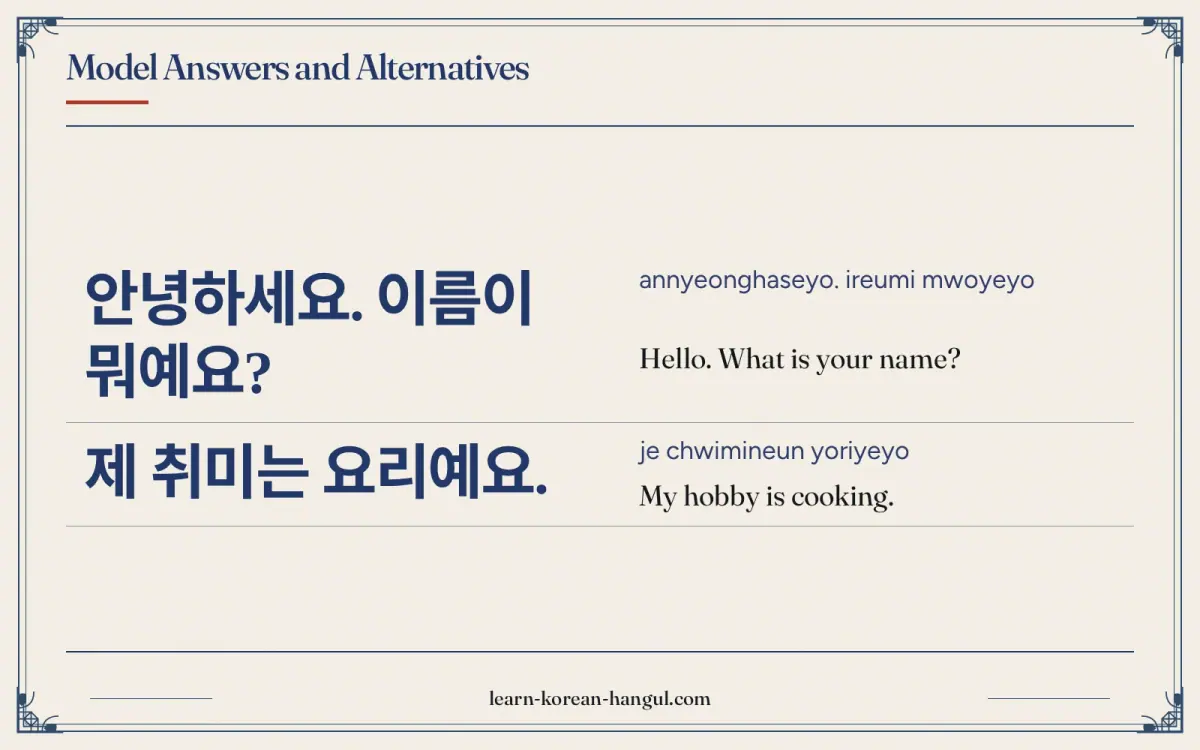
Here is the whole role play. Each line has its own clip, so shadow one turn at a time.
Meeting a New Classmate
Jisu (B)
안녕하세요. 이름이 뭐예요?
annyeonghaseyo. ireumi mwoyeyo
Hello. What is your name?
Minsu (A)
안녕하세요. 저는 민수예요. 캐나다에서 왔어요.
annyeonghaseyo. jeoneun minsuyeyo. kaenadaeseo wasseoyo
Hello. I am Minsu. I am from Canada.
Jisu (B)
아, 캐나다요? 만나서 반가워요. 직업이 뭐예요?
a, kaenadayo? mannaseo bangawoyo. jigeobi mwoyeyo
Oh, Canada? Nice to meet you. What is your job?
Minsu (A)
저는 학생이에요. 지수 씨는요?
jeoneun haksaengieyo. jisu ssineunyo
I am a student. And you, Jisu?
Jisu (B)
저는 회사원이에요. 취미가 뭐예요?
jeoneun hoesawonieyo. chwimiga mwoyeyo
I am an office worker. What is your hobby?
Minsu (A)
제 취미는 요리예요.
je chwimineun yoriyeyo
My hobby is cooking.
Jisu (B)
와, 좋은 취미예요! 저는 영화를 좋아해요.
wa, joeun chwimiyeyo! jeoneun yeonghwareul joahaeyo
Wow, that is a good hobby! I like films.
Minsu (A)
저도 영화를 좋아해요! 지수 씨는 어느 나라에서 왔어요?
jeodo yeonghwareul joahaeyo! jisu ssineun eoneu naraeseo wasseoyo
I like films too! Which country are you from, Jisu?
Jisu (B)
저는 한국에서 왔어요. 서울에 살아요.
jeoneun hangugeseo wasseoyo. seoure sarayo
I am from Korea. I live in Seoul.
Minsu (A)
만나서 반가워요, 지수 씨. 또 만나요!
mannaseo bangawoyo, jisu ssi. tto mannayo
Nice to meet you, Jisu. Let us meet again!
Each turn can be changed. The table gives one alternative for each part that you may swap.
| Turn | Model | Alternative |
|---|---|---|
| 2 (name and country) | 저는 민수예요. 캐나다에서 왔어요. | 저는 안나예요. 영국에서 왔어요. |
| 4 (job) | 저는 학생이에요. | 저는 의사예요. |
| 6 (hobby) | 제 취미는 요리예요. | 제 취미는 독서예요. |
| 8 (return question) | 지수 씨는 어느 나라에서 왔어요? | 지수 씨는 무슨 운동을 좋아해요? |
Notice that 의사예요 uses 예요 because 사 ends in a vowel, but 학생이에요 uses 이에요 because 생 ends in a consonant.
A formal upgrade. At a business meeting or a first visit to someone's home, replace turn 1 with a formal opening and the polite name question.
처음 뵙겠습니다 (cheoeum boepgetseumnida) means "How do you do?" and is used on a first meeting. 성함이 어떻게 되세요? (seonghami eotteoke doeseyo) is the honorific way to ask a name, where 성함 is the honorific word for a person's name. Use it when you want to be careful; 이름이 뭐예요? is fine for classmates and peers.
The Self-Check Rubric
Score yourself with the same four-part rubric as every speaking page: 0, 1 or 2 points per part, for a total out of 8.
| Part | What to check on this page | 0 | 1 | 2 |
|---|---|---|---|---|
| Sounds | [학쌩이에요] with a tense ㅅ, and the linked [지거비] | Often not understood | Understood with effort | Clear, with small slips |
| Flow | Ten turns without long pauses | Long pauses inside sentences | Pauses between sentences | Steady, natural pace |
| Form | 이에요 or 예요 after each noun, and 에서 왔어요 | Endings often missing | Mostly correct -요 forms | Correct throughout |
| Task | Name, country, job, hobby and one return question | Not completed | Completed with the script | Completed without the script |
A score of 6 or more in round two means you can move on. A score under 5 means repeating round one tomorrow. A score of exactly five means one more practice round before you move on. A self-score is a rough guide, so ask a teacher or partner to check your Sounds score now and then.
What to Do after the Role Play
Repeat the role play tomorrow with a different card, and change at least two details. Record round two once and compare it with the audio clips. Then take the next step on the ladder.
- Shadow the Role B lines until you can say them with the audio at the same time.
- Write your own card with your real name, country, job and hobby, and say it aloud in under 30 seconds.
- Move on to Korean hobbies conversation practice, which trains the return question you used in turns 4 and 8.
Which Sound Changes Are Hidden in the Role Play?
Four written forms sound different from their spelling. Listen to each one, then say it twice.
In 학생 [학쌩], the ㅅ after the final ㄱ becomes tense, a change that Revised Romanization does not write, so the romanization is simply haksaengieyo. In 직업이, the final ㅂ links to the vowel 이 and is said as [지거비], and Revised Romanization writes jigeobi. In 좋은, the ㅎ is silent before a vowel, so you hear [조은]. In 서울에 [서우레], the ㄹ moves to the next block. These patterns follow the standard pronunciation rules (표준 발음법) of the National Institute of Korean Language (국립국어원).
Worked Example: 이름이 뭐예요?
The first question shows how a Korean sentence is built from small parts.
이름이 뭐예요?
ireumi mwoyeyo
What is your name?
- Read the noun. 이름 is "name". No word for "your" is needed.
- Read the particle. 이 marks 이름 as the subject. After a consonant, the particle is 이, so you hear [이르미].
- Read the question word and ending. 뭐 means "what", and 예요 is the polite "is". This is a wh-question, so it does not end with a sharp rise; it falls or rise-falls.
Now the answer.
저는 민수예요.
jeoneun minsuyeyo
I am Minsu.
- Read the topic. 저 is the humble "I", and 는 marks it as the topic: "As for me".
- Pick the ending. 민수 ends in a vowel, so 예요 follows. A name that ends in a consonant, such as 영진, takes 이에요: 영진이에요.
The country comes next.
어느 나라에서 왔어요?
eoneu naraeseo wasseoyo
Which country are you from?
- Read 어느 나라. 어느 means "which" and 나라 means "country".
- Read 에서. The particle 에서 means "from".
- Read 왔어요. It is the polite past of 오다. The ㅆ is a tense sound, spelled ss in Revised Romanization.
Finally the hobby.
취미가 뭐예요?
chwimiga mwoyeyo
What is your hobby?
- Notice the particle. 취미 ends in a vowel, so the subject particle is 가, not 이.
The same four sentences work in almost every first meeting, so keep them ready.
What Mistakes Do Learners Make Here?
Learners often assume that Korean needs a word for "you", but Korean avoids it, because a name and 씨 or a title is more polite. Five slips are common.
- Saying 당신 or 너 for "you". Use the person's name plus 씨, as in 지수 씨, or leave the subject out.
- Matching the wrong ending. Say 학생이에요 and 민수예요, not 학생예요 or 민수이에요.
- Saying 저는 캐나다예요. It sounds like "I am Canada". Say 캐나다에서 왔어요 or 캐나다 사람이에요 (kaenada saramieyo, "I am Canadian").
- Dropping the return question. A bare list of facts feels like an interview. Always pass the turn with 지수 씨는요?, where the final 요 often sounds like [뇨] after ㄴ.
- Using 나 with strangers. 나 is plain and for friends or younger people. Use 저 until the other person tells you otherwise.
Test these in the practice set.
Practice and Answer Key
- Ask someone's name in the polite style.
- Say "I am from the United States" using 에서 왔어요.
- Say "I am a teacher" with the correct ending.
- Ask "And you, Jisu?" in the way that a role play uses.
- Choose the right ending: 안나 ( ) and 학생 ( ).
Answers
- 이름이 뭐예요?
- 저는 미국에서 왔어요.
- 저는 선생님이에요. (선생님 ends in a consonant, so 이에요.)
- 지수 씨는요?
- 안나예요 and 학생이에요.
Where to Go Next
Play the role play again tomorrow, hide the English column and change the card. When it feels easy, continue with Korean hobbies conversation practice, which builds a longer small talk from the hobby turn. All role plays are listed in Korean conversation practice, and spoken dialogues for listening are in Korean audio dialogues.
What this page does not cover. It does not cover business-card exchange, age questions or family introductions, and it teaches only the polite -요 style with one formal alternative.
Frequently Asked Questions
What is the formal way to ask a name?
Say 성함이 어떻게 되세요? (seonghami eotteoke doeseyo). 성함 is the honorific word for a name, and 되세요 is the honorific "become". Use it with elders, clients or at a first business meeting. With classmates and peers, 이름이 뭐예요? is the normal polite question and does not sound rude.
Should I say 저 or 나?
Say 저. It is the humble "I" used with strangers, teachers and anyone older. 나 is the plain "I" for close friends and younger people. In a first meeting you cannot know which fits, so 저는 is always the safe choice. Switch to 나 only after the other person invites casual speech.
How do I give my job in turn four?
Say 저는 and your job, then 이에요 after a consonant or 예요 after a vowel: 저는 학생이에요, 저는 의사예요. The other person asked 직업이 뭐예요? ("What is your job?"). If your job is not on the card, look up the noun in a dictionary and keep the same ending pattern.
How do I give my country?
Say the country, then 에서 왔어요: 저는 미국에서 왔어요 means "I am from the United States". The verb 왔어요 is the polite past of 오다 (to come), so Korean literally says "I came from". You can also say the country plus 사람이에요, such as 캐나다 사람이에요, "I am Canadian".
Return to Korean conversation practice for the other role plays.