What you will learn
- Order a drink with 한 잔 주세요, choose a size, and say here or to go.
- Understand the staff's polite questions, such as 주문하시겠어요? and 드시고 가세요?
- Finish with a payment turn and score yourself.
Before you start: you should read Hangul blocks and know the native numbers 한, 두, 세 and 네. Time: about 20 minutes. Level: A1. Audio plays only when you press a button.
어서 오세요. 주문하시겠어요? / 아이스 아메리카노 한 잔 주세요. / 사이즈는 어떻게 하시겠어요? / 큰 걸로 주세요. / 여기서 드시고 가세요, 아니면 포장하세요? / 여기서 먹고 갈게요. / 디저트도 하나 드릴까요? / 아니요, 괜찮아요. / 사천오백 원이에요. 카드로 하시겠어요, 현금으로 하시겠어요? / 카드로 할게요.
Key Facts
- 어서 오세요 is the standard welcome in a shop or cafe, and you do not need to repeat it.
- 주문하시겠어요? is the staff's honorific question "would you like to order?".
- 여기서 드시고 가세요? asks "will you have it here?", and 포장하세요? asks about take-away.
- 한 잔 uses the native number 한 with the counter 잔, as in 아이스 아메리카노 한 잔 주세요.
- You order and pay with plain polite forms: 주세요, 할게요 and 괜찮아요.
*Last updated: 2026-10-09. The Korean text, romanization and audio on this page are AI-assisted drafts.
What Is a Korean Coffee Order Role Play?
A Korean coffee order role play is a short scripted scene in which one person is the customer and the other is the cafe staff. You say your lines aloud, answer the staff in turn and finish the order. It trains the exact exchange you will meet at almost any Korean cafe: a welcome, an order, a size, here or to go, an offer of dessert and a payment.
The scene has ten turns, five for each role. The customer's lines are short and use only a few patterns, while the staff's lines are longer and polite. That is the real situation: you need to say little, but you need to understand more. The lesson is part of Korean conversation practice, and the printed menu side is covered in the Korean cafe menu lesson.
Why Is This Hard for English Speakers?
It is hard because the staff speak a style of Korean that learners rarely produce, and because the order itself uses a counter. In English, "Can I get one iced Americano?" has no special number word and no verb for the staff's respect. In Korean, the staff add the honorific -시- to their questions (주문하시겠어요?), and the customer counts cups with a native number and the counter 잔.
| English habit | Korean cafe reality | What to do |
|---|---|---|
| "I want an Americano" | 주세요 (please give me) is the usual order | Say the drink, the amount, then 주세요 |
| "One coffee" | 한 잔, with a native number and a counter | Learn 한 잔, 두 잔, 세 잔 |
| Answer yes to every question | Either-or questions need a choice | Pick one: 여기서 or 포장 |
| Expect "you" in every sentence | Korean drops the subject | Leave out 당신 and 저는 |
| Hear separate words | Words run together in fast speech | Listen for 주문하시겠어요 as one chunk |
The staff's honorific forms, such as 하시겠어요 and 드시고 가세요, are for you as the customer. You never use them about yourself. Next, how the exercise works.
How Does the Role Play Work?
Do the role play in four passes. Each pass takes about five minutes.
- Listen. Play the whole scene once at normal speed with the transcript hidden. Say in English what was ordered.
- Read and repeat. Open the transcript, play each turn and say it back, matching rhythm.
- Play the customer. Play the staff's turns from the audio and say the customer's turns yourself. Use the prompt card, not the script.
- Swap. Say the staff's turns and let the audio play the customer. This is the best way to learn the honorific questions.
Press the slow version for turns you find hard. A partner can replace the audio. If you work alone, pause the audio after each staff turn and answer aloud before you hear the customer.
Role a and Role B Prompt Cards
The prompt cards give the goal and the facts but not the words, so you can improvise.
| Role | Goal | Facts |
|---|---|---|
| Role A: customer | Order one drink, choose a size, say where you will drink it, and pay | Iced Americano, large, here, no dessert, card |
| Role B: staff | Welcome the customer and take the order | Offer sizes, ask here or to go, offer dessert, price 4,500 won, ask card or cash |
Once you can do the first card, try two variation cards.
| Variation | Role A (customer) | Role B (staff) |
|---|---|---|
| Card 2 | Hot latte, small, take-away, cash | Price 5,000 won |
| Card 3 | Two iced Americanos, large, here, card | Price 9,000 won |
For card 3, the amount is 두 잔, and the price is spoken 구천 원 (9,000 won). For card 2, the price is 오천 원 (5,000 won). The numbers for prices are Sino-Korean, as in Korean money numbers in the numbers section.
Model Answers and Alternatives
Here is the model dialogue. Press each line to hear it, and read along with the table.
Ordering a Drink at a Cafe Counter
Staff
어서 오세요. 주문하시겠어요?
eoseo oseyo. jumunhasigesseoyo
Welcome. Would you like to order?
Customer
아이스 아메리카노 한 잔 주세요.
aiseu amerikano han jan juseyo
One iced Americano, please.
Staff
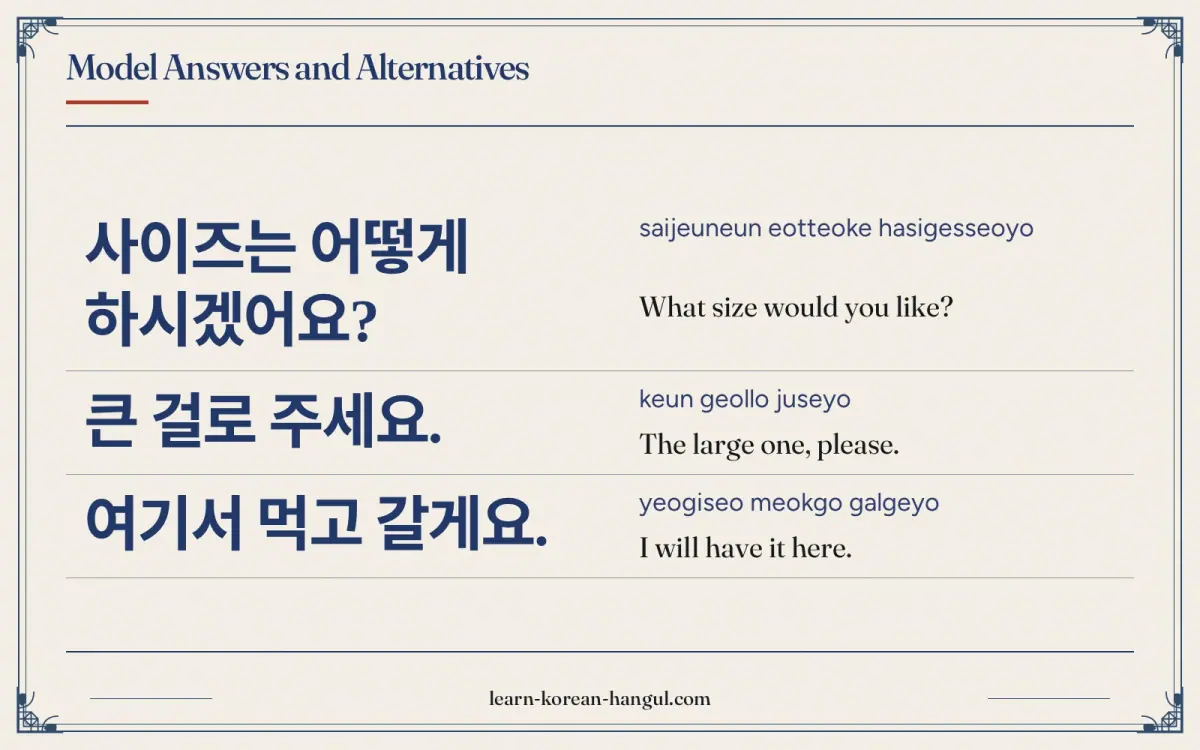
사이즈는 어떻게 하시겠어요?
saijeuneun eotteoke hasigesseoyo
What size would you like?
Customer
큰 걸로 주세요.
keun geollo juseyo
The large one, please.
Staff
여기서 드시고 가세요, 아니면 포장하세요?
yeogiseo deusigo gaseyo, animyeon pojanghaseyo
Will you have it here, or take it away?
Customer
여기서 먹고 갈게요.
yeogiseo meokgo galgeyo
I will have it here.
Staff
디저트도 하나 드릴까요?
dijeoteudo hana deurilkkayo
Would you like a dessert too?
Customer
아니요, 괜찮아요.
aniyo, gwaenchanayo
No, thank you.
Staff
사천오백 원이에요. 카드로 하시겠어요, 현금으로 하시겠어요?
sacheonobaek wonieyo. kadeuro hasigesseoyo, hyeongeumeuro hasigesseoyo
It is 4,500 won. Will you pay by card or cash?
Customer
카드로 할게요.
kadeuro halgeyo
I will pay by card.
| # | Speaker | Korean | Revised Romanization | English |
|---|---|---|---|---|
| 1 | Staff | 어서 오세요. 주문하시겠어요? | eoseo oseyo. jumunhasigesseoyo | Welcome. Would you like to order? |
| 2 | Customer | 아이스 아메리카노 한 잔 주세요. | aiseu amerikano han jan juseyo | One iced Americano, please. |
| 3 | Staff | 사이즈는 어떻게 하시겠어요? | saijeuneun eotteoke hasigesseoyo | What size would you like? |
| 4 | Customer | 큰 걸로 주세요. | keun geollo juseyo | The large one, please. |
| 5 | Staff | 여기서 드시고 가세요, 아니면 포장하세요? | yeogiseo deusigo gaseyo, animyeon pojanghaseyo | Will you have it here, or take it away? |
| 6 | Customer | 여기서 먹고 갈게요. | yeogiseo meokgo galgeyo | I will have it here. |
| 7 | Staff | 디저트도 하나 드릴까요? | dijeoteudo hana deurilkkayo | Would you like a dessert too? |
| 8 | Customer | 아니요, 괜찮아요. | aniyo, gwaenchanayo | No, thank you. |
| 9 | Staff | 사천오백 원이에요. 카드로 하시겠어요, 현금으로 하시겠어요? | sacheonobaek wonieyo. kadeuro hasigesseoyo, hyeongeumeuro hasigesseoyo | It is 4,500 won. Will you pay by card or cash? |
| 10 | Customer | 카드로 할게요. | kadeuro halgeyo | I will pay by card. |
어서 오세요. 주문하시겠어요? / 아이스 아메리카노 한 잔 주세요. / 사이즈는 어떻게 하시겠어요? / 큰 걸로 주세요. / 여기서 드시고 가세요, 아니면 포장하세요? / 여기서 먹고 갈게요. / 디저트도 하나 드릴까요? / 아니요, 괜찮아요. / 사천오백 원이에요. 카드로 하시겠어요, 현금으로 하시겠어요? / 카드로 할게요.
Four sound changes hide in the customer's and staff's lines. Press each one on its own.
| Written | Spoken | What happens |
|---|---|---|
| 주문하시겠어요 | [주문하시게써요] | ㅆ links to the vowel of 어요 |
| 먹고 갈게요 | [먹꼬 갈께요] | ㄱ after ㄱ is tense; ㄱ after -ㄹ is tense |
| 괜찮아요 | [괜차나요] | ㅎ is silent before a vowel |
| 카드로 할게요 | [카드로 할께요] | ㄱ after -ㄹ is tense |
| 사천오백 | [사처노백] | ㄴ links to 오 |
The Revised Romanization (RR) writes tense letters that are in the spelling (kk, ss), but it does not show tensing caused by a sound change. That is why 갈게요 is written galgeyo while it sounds like [갈께요].
Alternatives
Each key line has other ways to say it. The notes say when each fits.
| Line | Alternative | Meaning and note |
|---|---|---|
| 아이스 아메리카노 한 잔 주세요 | 따뜻한 라떼 한 잔 주세요 | one hot latte; 따뜻한 means warm |
| 아이스 아메리카노 한 잔 주세요 | 아이스 아메리카노 두 잔 주세요 | two cups; 두 before 잔 |
| 큰 걸로 주세요 | 작은 걸로 주세요 | the small one; 걸로 is short for 것으로 |
| 여기서 먹고 갈게요 | 포장해 주세요 | take-away; 포장 means wrapping |
| 아니요, 괜찮아요 | 네, 하나 주세요 | yes, one please, for the dessert |
| 카드로 할게요 | 현금으로 할게요 | I will pay in cash |
| (extra request) | 샷 추가해 주세요 | please add a shot |
The staff may also say 음료가 나오면 불러 드릴게요 ("I will call you when the drink is ready"). The -ㄹ게요 ending here is the staff's promise, and 음료 is spoken [음뇨]. Some cafes give you a pager instead, and the staff say 진동벨 드릴게요.
Cups are counted with 잔 and a native number: 한 잔, 두 잔, 세 잔, 네 잔. More counters are in the counters for food and drinks lesson. Now score yourself.
The Self-Check Rubric
Use the same four-part rubric as every speaking page: 0, 1 or 2 points per part, for a total out of 8. The same rubric is used on every role play in Korean conversation practice.
| Part | What to check on this page | 0 | 1 | 2 |
|---|---|---|---|---|
| Sounds | [먹꼬 갈께요] for 먹고 갈게요 and [괜차나요] for 괜찮아요 | Often not understood | Understood with effort | Clear, with small slips |
| Flow | Each customer turn follows the staff turn without a long gap | Long pauses inside sentences | Pauses between sentences | Steady, natural pace |
| Form | 한 잔 주세요 with a native number, and -ㄹ게요 for decisions | Endings or particles often missing | Mostly correct -요 forms | Correct throughout |
| Task | Drink, size, here or to go, and payment | Not completed | Completed with the script | Completed without the script |
Eight is a perfect score. Six or more on your second pass means you can move on, and a score below five means repeating the first pass. A score of exactly five means one more practice round before you move on. A self-score is a rough guide, so ask a partner to check the Sounds row now and then. If you freeze, use a repair phrase: 천천히 말해 주세요 (please speak slowly) or 다시 한번 말해 주세요 (please say it once more).
What to Do after the Role Play
Spend five minutes on review, because that is where most of the learning happens.
- Mark the misses. Write down each turn where you hesitated or looked at the script.
- Shadow the staff. Play the staff turns and say them at the same time, matching rhythm, until 주문하시겠어요 sounds like one chunk.
- Record. Record yourself as the customer and compare it with the model.
- Change one fact. Use variation card 2 or 3 and run the scene again with the script closed.
- Move on. When you score 6 or more on your second pass, go to Korean Restaurant Role Play.
If you want to hear the whole scene as a listening task, ordering at a cafe dialogue gives the dialogue with comprehension questions.
Worked Example: 어서 오세요. 주문하시겠어요?
The worked example takes the staff's first turn apart, because it holds the two forms that surprise learners most.
어서 오세요. 주문하시겠어요?
eoseo oseyo. jumunhasigesseoyo
Welcome. Would you like to order?
- Hear the welcome. 어서 오세요 means "welcome", literally "come in quickly". It is a greeting, not a question, and you do not have to answer it.
- Split the question. 주문하시겠어요 is 주문하다 (to order) + -시- (honorific) + -겠- (offer) + -어요 (polite). The -시- shows respect for you, the customer. Staff use it for you, and you never use it about yourself.
- Hear the sound. It is spoken [주문하시게써요]: the ㅆ of 겠 links to the vowel of 어요.
- Answer. Say the drink, the amount and 주세요: 아이스 아메리카노 한 잔 주세요.
아이스 아메리카노 한 잔 주세요.
aiseu amerikano han jan juseyo
One iced Americano, please.
- Check the pieces. 아이스 아메리카노 is the drink and has no particle, because Korean often drops 을/를 in speech. 한 잔 is one cup: the native number 한 and the counter 잔. 주세요 means "please give me".
- Say it with the right tune. The staff's question is a yes/no question and ends with a rise. Your order is a request and ends level or with a small fall.
You will know it worked when you can answer the staff's first turn without looking at the script. The same steps work for each staff turn. A few mistakes catch learners out.
What Mistakes Do Learners Make Here?
The most common mistakes are using the wrong number word, answering an either-or question with 네 and using the staff's honorific for yourself.
- Learners often assume 원해요 (I want) is the polite way to order. Actually 주세요 is the normal order, because 원해요 sounds stiff and translated when you order.
- Learners often count cups with Sino-Korean numbers. Actually 일 잔 and 이 잔 are wrong, so say 한 잔 and 두 잔, because 잔 takes a native number.
- Learners often answer 여기서 드시고 가세요, 아니면 포장하세요? with 네. Actually it is an either-or question, so choose one answer such as 여기서 먹고 갈게요, because 네 does not pick a side.
- Learners often use 주문하시겠어요 about themselves. Actually the honorific -시- is for the other person, so say 주문할게요 for yourself, because you do not honour your own action.
- Learners often treat 괜찮아요 as "yes". Actually after an offer it usually means "no thanks", so add 아니요 to be clear, because 괜찮아요 can be heard either way.
- Learners often assume 어서 오세요 needs an answer. Actually it is a greeting, so a nod or 안녕하세요 is enough, because the staff do not expect a full reply.
Test these in the practice set next.
Practice and Answer Key
Exercise 1: Say it in Korean.
- One iced Americano, please.
- Two lattes, please.
- I will take it away.
- I will pay in cash.
- No, thank you.
Exercise 2: Match the staff's question with an answer.
- 주문하시겠어요?
- 사이즈는 어떻게 하시겠어요?
- 여기서 드시고 가세요, 아니면 포장하세요?
- 카드로 하시겠어요, 현금으로 하시겠어요?
a. 포장해 주세요. b. 현금으로 할게요. c. 큰 걸로 주세요. d. 아이스 아메리카노 한 잔 주세요.
Exercise 3: Correct the mistake.
- 아이스 아메리카노 일 잔 주세요.
- 저는 주문하시겠어요.
- (Asked: 여기서 드시고 가세요, 아니면 포장하세요?) 네.
Answer key:
Exercise 1: (1) 아이스 아메리카노 한 잔 주세요. (2) 라떼 두 잔 주세요. (3) 포장해 주세요. (4) 현금으로 할게요. (5) 아니요, 괜찮아요.
Exercise 2: 1-d, 2-c, 3-a, 4-b.
Exercise 3: (1) 한 잔, because 잔 takes a native number. (2) 주문할게요, because -시- is not used about yourself. (3) Choose one: 여기서 먹고 갈게요 or 포장해 주세요.
For a speaking task, say the customer's five turns aloud without the script, then record yourself and compare with the audio.
Where to Go Next
This lesson covers one scripted cafe order, with a few alternatives and variations. It does not cover cafe loyalty cards, ordering by kiosk or app, customising a drink at length, or fast casual speech between friends. Real staff may speak faster, skip lines or ask in a different order, and the 4,500 won price is invented for practice. The audio is AI-generated pronunciation audio, so real speakers may sound different.
Next: Korean Restaurant Role Play, which adds allergy and spice requests. Before this lesson, Korean Hobbies Conversation Practice covers small talk. For more phrases, see Korean restaurant phrases, and for all the dialogues, see Korean audio dialogues.
Frequently Asked Questions
What does 드시고 가세요 mean? 드시고 가세요 literally means "eat and go" and is the staff's polite way of asking "will you have it here?". 드시다 is the honorific verb for eating or drinking, used for you, the customer. You answer with 여기서 먹고 갈게요 (I will have it here) or choose take-away with 포장해 주세요.
How do I answer "for here"? Say 여기서 먹고 갈게요 (I will have it here). The question is an either-or question, so do not answer with just 네. For take-away, say 포장해 주세요 (please wrap it) or 가져갈게요 (I will take it with me). Short answers such as 여기서요 (here) or 포장이요 (take-away) are also common.
What does 어서 오세요 mean? 어서 오세요 means "welcome", literally "come in quickly". Staff say it when you enter a shop, cafe or restaurant. You do not need to answer. A small nod is enough, or you can start your order with 안녕하세요. It is a greeting, not a question, so it falls at the end.
How does the customer pay at the end of the cafe role play? The customer answers the payment question with 카드로 할게요 (I will pay by card) or 현금으로 할게요 (I will pay in cash). The staff say the price first, as in 사천오백 원이에요. The ending -(으)ㄹ게요 means "I will do it", so it sounds natural for a decision you have just made.
How do I say two coffees? Use a native number before the counter 잔: 아이스 아메리카노 두 잔 주세요. The numbers are 한 잔 (1), 두 잔 (2), 세 잔 (3) and 네 잔 (4). Do not use the Sino-Korean 이 or 삼 here. The counter 잔 is for cups and glasses.