민수 씨, 이번 주말에 시간 있어요? / 네, 있어요. 왜요? / 같이 영화 볼까요? / 좋아요! 토요일 어때요? / 미안해요, 그날은 약속이 있어요. 일요일은 어때요? / 일요일은 괜찮아요. 몇 시에 만날까요? / 오후 두 시 어때요? 영화는 세 시 반이에요. / 좋아요. 어디서 만날까요? / 영화관 앞에서 만나요. / 네, 일요일 오후 두 시, 영화관 앞이죠? 그때 봐요!
What you'll learn
- Check availability with 이번 주말에 시간 있어요? and propose with -ㄹ까요.
- Decline politely with a reason, as in 그날은 약속이 있어요.
- Fix the time with 몇 시에 and the place with 어디서.
- Repeat the plan back with -죠? so that both people know it is agreed.
Before you start: you need to read Hangul, know the days of the week and have met the hour counter 시. Time: about 20 minutes. Level: A2.
What Is Korean Making Plans Conversation?
A Korean making plans conversation is a practice exchange in which two people agree on an activity, a day, a time and a place. The script has both a refusal and an acceptance, so you practise saying no gently and saying yes clearly. Ten turns are enough to cover every step of a real invitation.
The grammar behind the suggestion is in Korean let's grammar, and the clock words are in telling time in Korean. Plans are often made by message or by phone, so the next role play uses Korean phone phrases for the same job.
First, look at why plans are awkward for English speakers.
Why Is This Hard for English Speakers?
English invitations use "Do you want to...?" and a plain "no", but Korean prefers a suggestion with -ㄹ까요 and a reason in place of a bare refusal. Four habits cause trouble.
| English habit | Korean pattern | Example |
|---|---|---|
| "Do you want to see a film?" | "Shall we watch a film?" with -ㄹ까요 | 같이 영화 볼까요? (gachi yeonghwa bolkkayo) |
| "No, I can't" is direct | A reason softens the refusal | 그날은 약속이 있어요 (geunareun yaksogi isseoyo) |
| "Two o'clock" uses one number system | The hour uses native numbers, minutes use Sino-Korean | 두 시 (du si), 세 시 삼십 분 (se si samsip bun) |
| "Plan" and "promise" are different words | 약속 covers an appointment, a plan and a promise | 약속이 있어요 |
The second row matters most. A reason is not an excuse in Korean, it is the polite form of a refusal. You still say 미안해요, "I'm sorry", first. The fourth row is a false friend: 약속 translates as "promise", but 약속이 있어요 means "I have plans" or "I have an appointment", not that you promised something.
Now see how the practice works.
How Does the Role Play Work?
You say the ten turns twice, once accepting and once declining.
- Listen once to the whole conversation and note the day and the time that are agreed.
- Read Role B's lines aloud and answer as Role A from the model answers.
- Cover the Role A lines and answer from your prompt card.
- Swap roles and make the suggestions yourself.
- Run the decline path in round two, using the alternatives table.
- Score yourself with the rubric.
If you practise alone, read Role B's line, pause, and say Role A's reply. The usual slip is to accept the first suggestion without negotiating. The script includes a day change on purpose, so you practise the back-and-forth.
Role a and Role B Prompt Cards
The cards give each role a different schedule so that you must negotiate. In round two, Role A declines first.
| Role A, round one | Role A, round two | Role B | |
|---|---|---|---|
| Free days | 토요일, 일요일 | 목요일 (mogyoil) only | 일요일 (iryoil) |
| Activity | 영화 (yeonghwa, film) | 커피 (keopi, coffee) | Proposes 영화 |
| Time | 오후 두 시 | 저녁 일곱 시 (jeonyeok ilgop si) | 오후 두 시 |
| Place | 영화관 (yeonghwagwan) | 카페 (kape) | 영화관 앞 |
| Must do | Accept, ask the time and place | Decline with a reason, offer another day | Propose and confirm |
The days are 월요일 (woryoil), 화요일 (hwayoil), 수요일 (suyoil), 목요일 (mogyoil), 금요일 (geumyoil), 토요일 (toyoil) and 일요일 (iryoil). Three reasons that work for a refusal are 약속이 있어요 ("I have plans"), 일이 있어요 (iri isseoyo, "I have work to do") and 바빠요 (bappayo, "I'm busy").
Model Answers and Alternatives
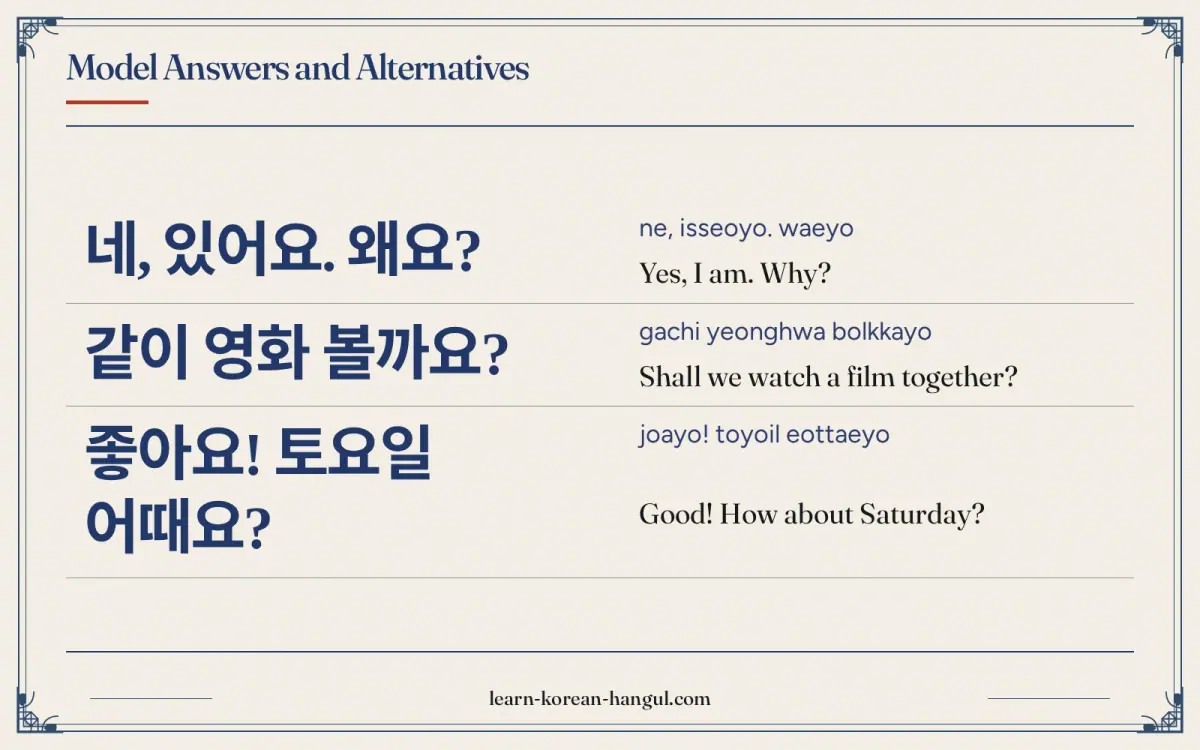
Here is the whole conversation. Each turn has its own clip, so shadow one at a time.
Making Plans for a Weekend Film
Jisu (B)
민수 씨, 이번 주말에 시간 있어요?
minsu ssi, ibeon jumare sigan isseoyo
Minsu, are you free this weekend?
Minsu (A)
네, 있어요. 왜요?
ne, isseoyo. waeyo
Yes, I am. Why?
Jisu (B)
같이 영화 볼까요?
gachi yeonghwa bolkkayo
Shall we watch a film together?
Minsu (A)
좋아요! 토요일 어때요?
joayo! toyoil eottaeyo
Good! How about Saturday?
Jisu (B)
미안해요, 그날은 약속이 있어요. 일요일은 어때요?
mianhaeyo, geunareun yaksogi isseoyo. iryoireun eottaeyo
Sorry, I have plans that day. How about Sunday?
Minsu (A)
일요일은 괜찮아요. 몇 시에 만날까요?
iryoireun gwaenchanayo. myeot sie mannalkkayo
Sunday is fine. What time shall we meet?
Jisu (B)
오후 두 시 어때요? 영화는 세 시 반이에요.
ohu du si eottaeyo. yeonghwaneun se si banieyo
How about 2 p.m.? The film is at 3:30.
Minsu (A)
좋아요. 어디서 만날까요?
joayo. eodiseo mannalkkayo
Good. Where shall we meet?
Jisu (B)
영화관 앞에서 만나요.
yeonghwagwan apeseo mannayo
Let us meet in front of the cinema.
Minsu (A)
네, 일요일 오후 두 시, 영화관 앞이죠? 그때 봐요!
ne, iryoil ohu du si, yeonghwagwan apijyo? geuttae bwayo
Yes, Sunday at 2 p.m. in front of the cinema, right? See you then!
For round two, use these alternatives. They show the decline path and a different activity.
| Turn | Model | Alternative |
|---|---|---|
| 2 | 네, 있어요. 왜요? | 왜요? |
| 3 (Role B) | 같이 영화 볼까요? | 같이 커피 마실까요? |
| 4 | 좋아요! 토요일 어때요? | 미안해요, 이번 주말에는 약속이 있어요. 목요일은 어때요? |
| 5 (Role B) | 미안해요, 그날은 약속이 있어요. 일요일은 어때요? | 좋아요. 목요일은 괜찮아요. |
| 6 | 일요일은 괜찮아요. 몇 시에 만날까요? | 몇 시에 만날까요? |
| 9 | 영화관 앞에서 만나요. | 카페 앞에서 만나요. |
In the decline path, Role A refuses first and offers Thursday, Role B accepts the new day in turn 5, and the plan continues from turn 6 as before. Notice that the refusal is followed at once by a counter-offer. A refusal with no alternative can sound cold, so always add 다음 주는 어때요? ("How about next week?") or a new day.
A note on -ㄹ까요. 볼까요 comes from 보다 plus -ㄹ까요, and 만날까요 comes from 만나다 plus -ㄹ까요. After a consonant the form is -을까요, as in 먹을까요. In turn 10, -죠 is the short form of -지요, and it asks the other person to confirm.
The Self-Check Rubric
Score yourself with the same four-part rubric as every speaking page: 0, 1 or 2 points per part, for a total out of 8.
| Part | What to check on this page | 0 | 1 | 2 |
|---|---|---|---|---|
| Sounds | [약쏘기] for 약속이 and [멷씨에] for 몇 시에 | Often not understood | Understood with effort | Clear, with small slips |
| Flow | The turns follow without long gaps | Long pauses inside sentences | Pauses between sentences | Steady, natural pace |
| Form | -ㄹ까요 for suggestions, 에 for time, 에서 for place of action | Endings or particles often missing | Mostly correct -요 forms | Correct throughout |
| Task | Day, time and place agreed and repeated back | Not completed | Completed with the script | Completed without the script |
Six or more in round two means you can move on. Under five means round one again tomorrow. A score of exactly five means one more practice round before you move on. A self-score is a rough guide, so ask a partner to check your Sounds row now and then.
What to Do after the Role Play
Make a real plan: send a friend, or write for yourself, one message with a day, a time and a place in Korean. Then run turns 5 to 10 from memory with a different activity. When the day and time come easily, try the phone call role play, which uses the same plan in a call. If place words such as 앞 and 옆 still feel slow, go back to the directions role play.
Which Sound Changes Are Hidden in the Role Play?
Four spellings sound different from what you read. Listen to each, then say it twice.
In 주말에 [주마레], the final ㄹ links to 에 (liaison, 연음). In 약속이 [약쏘기], the ㅅ after the final ㄱ is tense and the final ㄱ links to 이. Revised Romanization does not show this tensing, so it writes yaksogi. In 몇 시에 [멷씨에], the final ㅊ is said as ㄷ and the ㅅ is tense. Revised Romanization treats spaced words separately, so it writes myeot sie. In 앞이죠 [아피죠], the ㅍ links to the vowel 이, and Revised Romanization writes apijyo. These rules come from the standard pronunciation rules (표준 발음법) of the National Institute of Korean Language (국립국어원).
Worked Example: 이번 주말에 시간 있어요?
The opening question checks availability before the invitation.
이번 주말에 시간 있어요?
ibeon jumare sigan isseoyo
Are you free this weekend?
- Read 이번 주말. 이번 means "this time" and 주말 means "weekend".
- Add 에. The particle 에 marks the time.
- Read 시간 있어요. Literally "is there time". Here 시간 means free time, not a clock hour.
The invitation uses -ㄹ까요.
같이 영화 볼까요?
gachi yeonghwa bolkkayo
Shall we watch a film together?
- Read 같이. It means "together".
- Make the suggestion. 보다 becomes 볼 before -까요. The ending asks "Shall we?" and invites the other person to agree or suggest something else.
The refusal has two parts.
미안해요, 그날은 약속이 있어요.
mianhaeyo, geunareun yaksogi isseoyo
Sorry, I have plans that day.
- Apologise first. 미안해요 means "I'm sorry".
- Give a reason. 그날 is "that day", and 은 marks the contrast with the other days. 약속이 있어요 is "there is a plan".
Finally, the time.
몇 시에 만날까요?
myeot sie mannalkkayo
What time shall we meet?
- Read 몇 시에. 몇 means "what number", 시 is the hour and 에 marks the time. Because it has a question word, it does not end with a sharp rise; it falls or rise-falls.
- Add 만날까요. It is 만나다 plus -ㄹ까요, "shall we meet?".
What Mistakes Do Learners Make Here?
Learners often assume that a bare 아니요 is the polite way to decline, but Korean prefers an apology and a reason. Five slips are common.
- Saying 아니요, 안 돼요 with no reason. Say 미안해요, 그날은 약속이 있어요.
- Using a Sino-Korean number for the hour. Say 두 시, not 이 시.
- Using 에서 for time. Time takes 에, so 두 시에, not 두 시에서.
- Declining without a counter-offer. Add 일요일은 어때요?
- Forgetting to confirm. Repeat the day, time and place with -죠? at the end.
Test these in the practice set.
Practice and Answer Key
- Ask "Are you free this weekend?"
- Suggest "Shall we eat together?" with 먹다.
- Decline politely with a reason.
- Ask "What time shall we meet?"
- Choose the right particle: 영화관 앞( ) 만나요.
Answers
- 이번 주말에 시간 있어요?
- 같이 먹을까요?
- 미안해요, 그날은 약속이 있어요.
- 몇 시에 만날까요?
- 에서 (영화관 앞에서 만나요), because 에서 marks where the action happens.
Where to Go Next
Play the conversation again tomorrow, cover the English column and change the activity. When it feels easy, continue with Korean phone call role play, which uses the same plan on the phone. To go back a step, review the Korean directions role play. All role plays are in Korean conversation practice, and similar listening practice is in Korean audio dialogues.
What this page does not cover. It does not cover cancelling plans, group invitations or casual speech with close friends.
Frequently Asked Questions
What does -ㄹ까요 mean in a suggestion?
-ㄹ까요 means "shall we" when it follows a verb and the subject is "we". 같이 영화 볼까요? is "Shall we watch a film together?". After a consonant the form is -을까요, as in 먹을까요. It invites the other person to agree or to suggest something else, so it is softer than 봐요.
How do I decline politely?
Apologise, then give a reason, then offer another time: 미안해요, 그날은 약속이 있어요. 일요일은 어때요? A reason does not need to be detailed. 약속이 있어요 ("I have plans") is enough. Avoid a bare 아니요 or 안 돼요, which sounds abrupt in an invitation.
What does 약속 mean?
약속 means an appointment, a plan or a promise, depending on the sentence. 약속이 있어요 is "I have plans" or "I have an appointment". 약속해요 is "I promise". The context tells you which one, and the first meaning is the one you will use most when you make plans.
How do I confirm the time?
Repeat the day, the time and the place and end with -죠?, as in 일요일 오후 두 시, 영화관 앞이죠? The ending asks the other person to confirm. The hour uses native numbers, such as 두 시 or 세 시, and 반 means "half past". Add 오후 for the afternoon.