What you will learn
- Ask whether a place is near with 이 근처에 ...이/가 있어요?
- Ask for a repeat with 다시 한번 말씀해 주시겠어요? and say the directions back.
- Understand and give simple directions with 왼쪽으로, 오른쪽으로 and 앞에서.
Before you start: you should know 있어요, the polite request -세요 and the Sino-Korean numbers up to ten. Time: about 20 minutes. Level: A2. Audio plays only when you press a button.
실례합니다, 이 근처에 약국이 있어요? / 네, 있어요. 저 건물 앞에서 왼쪽으로 가세요. / 죄송하지만 다시 한번 말씀해 주시겠어요? / 저기 높은 건물 보이세요? 그 앞에서 왼쪽으로 가세요. / 저 건물 앞에서 왼쪽으로 가요? / 네, 맞아요. 그리고 횡단보도를 건너세요. / 여기서 얼마나 걸려요? / 걸어서 오 분쯤 걸려요. / 감사합니다. 약국이 오른쪽에 있어요? / 네, 편의점 옆에 있어요.
Key Facts
- 이 근처에 약국이 있어요? asks whether a pharmacy is near here.
- 건물 앞에서 왼쪽으로 가세요 gives a turn: 에서 marks where you turn and (으)로 marks the direction.
- 다시 한번 말씀해 주시겠어요? asks for a repeat and is the key survival phrase of this lesson.
- 말씀 is the honorific word for someone else's speech.
- Repeating the directions back, as in 저 건물 앞에서 왼쪽으로 가요?, lets the other person correct you.
*Last updated: 2026-10-09. The Korean text, romanization and audio on this page are AI-assisted drafts.
What Is a Korean Directions Role Play?
A Korean directions role play is a short scripted scene in which one person asks the way and the other gives directions. You say your lines aloud, listen for the landmarks and the turns, and check what you heard by saying it back. It trains the exchange you will use most when you are lost: an opening question, directions, a repeat request, a time and a final check.
The scene has ten turns, five for each role. The traveller's job is to ask, to ask again and to confirm. The local's job is to give directions in polite instruction form, such as 가세요 and 건너세요. The lesson is part of Korean conversation practice. If you want a longer list of travel sentences, the Korean directions phrases page has them, and the listening side is in the Korean directions dialogue audio lesson.
Why Is This Hard for English Speakers?
It is hard because the directions come fast, in a different word order, and because the learner has no way to recover when a word is missed. In English, you say "go left in front of that building" and the verb comes early. In Korean, the verb comes last, so the listener must hold the landmark and the direction in mind until the end: 저 건물 앞에서 왼쪽으로 가세요.
| English habit | Korean directions reality | What to do |
|---|---|---|
| Verb comes early: "Go left..." | Verb comes last: "...left go" | Listen for landmark, direction, then verb |
| One word for "at": "at the building" | 에서 for an action, 에 for a place | Say 건물 앞에서 왼쪽으로 |
| "Left" alone | 왼쪽 + (으)로 shows direction | Add (으)로 to the side word |
| Say "sorry?" and wait | Ask 다시 한번 말씀해 주시겠어요? | Learn the repair question first |
| Nod and walk away | Say the directions back | Repeat in a rising question |
The repair question is the most important line of this lesson. A learner who can ask for a repeat can handle any speed. Next, how the exercise works.
How Does the Role Play Work?
Do the role play in four passes. Each pass takes about five minutes.
- Listen. Play the whole scene once at normal speed. Draw the route on paper, using arrows and the words 건물, 횡단보도, 편의점 and 약국.
- Read and repeat. Open the transcript, play each turn and say it back. Pay attention to the particles 에서 and (으)로.
- Play the traveller. Play the local's turns from the audio and say the traveller's turns yourself. Use the prompt card, not the script.
- Swap. Say the local's turns and let the audio play the traveller. Giving directions teaches you the -세요 form.
Use the slow version for turns you find hard. A partner can replace the audio. If you work alone, pause after each local turn and answer aloud before you hear the traveller.
Role a and Role B Prompt Cards
The prompt cards give the goal and the facts but not the words, so you can improvise.
| Role | Goal | Facts |
|---|---|---|
| Role A: traveller | Find a pharmacy, ask for one repeat, say the directions back, ask how long, and check the side | Pharmacy, near here, no map |
| Role B: local | Give directions and confirm the traveller's repeat | Left at the tall building, cross the crosswalk, five minutes on foot, pharmacy on the right next to the convenience store |
A second card changes the place and the route.
| Variation | Role A (traveller) | Role B (local) |
|---|---|---|
| Card 2 | Find the subway station | Go straight on, turn right at the intersection, ten minutes on foot, the station is across the road |
For card 2, the station is 지하철역, and 지하철역이 is spoken [지하철려기]: a ㄴ sound is added before 역, and the ㄹ of 철 turns that ㄴ into ㄹ, which gives [지하철려기]. This is the same pattern as 서울역에 (Seoullyeoge). The time is 십 분 (ten minutes), because minutes use Sino-Korean numbers, as in Sino-Korean numbers.
Model Answers and Alternatives
Here is the model dialogue. Press each line to hear it, and read along with the table.
Asking the Way to a Pharmacy
Traveller
실례합니다, 이 근처에 약국이 있어요?
sillyehamnida, i geuncheoe yakgugi isseoyo
Excuse me, is there a pharmacy near here?
Local
네, 있어요. 저 건물 앞에서 왼쪽으로 가세요.
ne, isseoyo. jeo geonmul apeseo oenjjogeuro gaseyo
Yes, there is. Go left in front of that building.
Traveller
죄송하지만 다시 한번 말씀해 주시겠어요?
joesonghajiman dasi hanbeon malsseumhae jusigesseoyo
Sorry, could you say that once more?
Local
저기 높은 건물 보이세요? 그 앞에서 왼쪽으로 가세요.
jeogi nopeun geonmul boiseyo? geu apeseo oenjjogeuro gaseyo
Can you see the tall building over there? Go left in front of it.
Traveller
저 건물 앞에서 왼쪽으로 가요?
jeo geonmul apeseo oenjjogeuro gayo
Left in front of that building?
Local
네, 맞아요. 그리고 횡단보도를 건너세요.
ne, majayo. geurigo hoengdanbodoreul geonneoseyo
Yes, that is right. Then cross the crosswalk.
Traveller
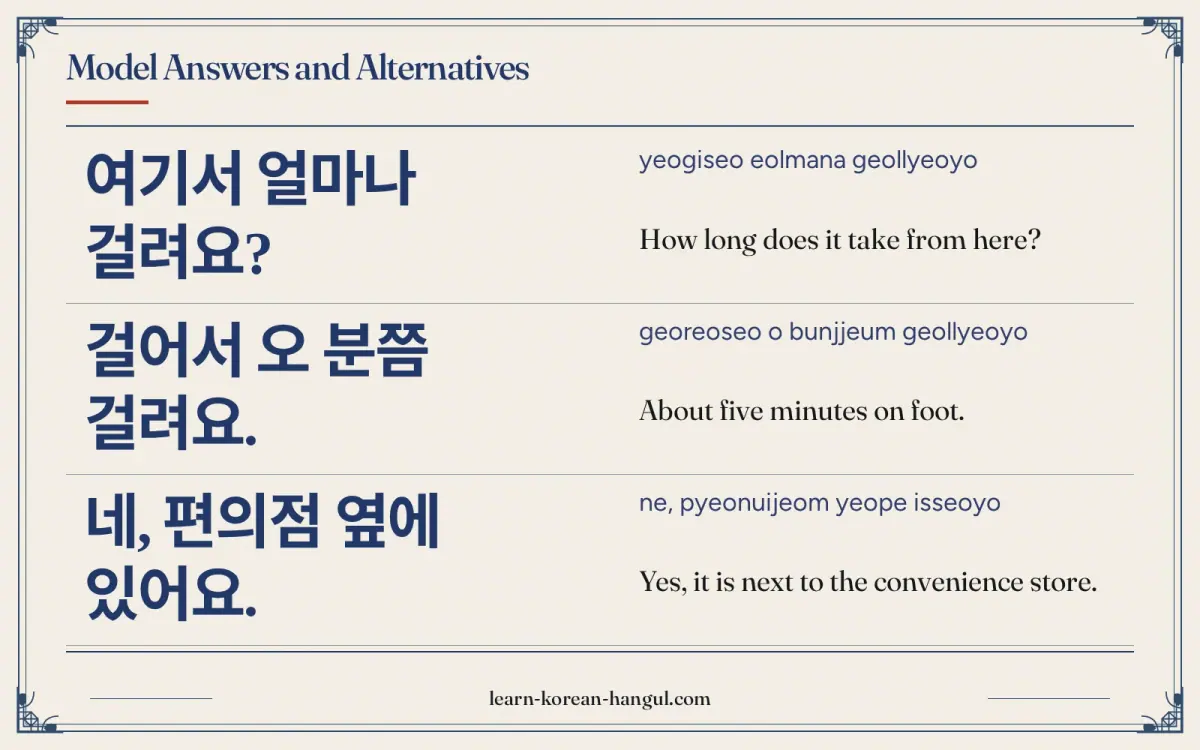
여기서 얼마나 걸려요?
yeogiseo eolmana geollyeoyo
How long does it take from here?
Local
걸어서 오 분쯤 걸려요.
georeoseo o bunjjeum geollyeoyo
About five minutes on foot.
Traveller
감사합니다. 약국이 오른쪽에 있어요?
gamsahamnida. yakgugi oreunjjoge isseoyo
Thank you. Is the pharmacy on the right?
Local
네, 편의점 옆에 있어요.
ne, pyeonuijeom yeope isseoyo
Yes, it is next to the convenience store.
| # | Speaker | Korean | Revised Romanization | English |
|---|---|---|---|---|
| 1 | Traveller | 실례합니다, 이 근처에 약국이 있어요? | sillyehamnida, i geuncheoe yakgugi isseoyo | Excuse me, is there a pharmacy near here? |
| 2 | Local | 네, 있어요. 저 건물 앞에서 왼쪽으로 가세요. | ne, isseoyo. jeo geonmul apeseo oenjjogeuro gaseyo | Yes, there is. Go left in front of that building. |
| 3 | Traveller | 죄송하지만 다시 한번 말씀해 주시겠어요? | joesonghajiman dasi hanbeon malsseumhae jusigesseoyo | Sorry, could you say that once more? |
| 4 | Local | 저기 높은 건물 보이세요? 그 앞에서 왼쪽으로 가세요. | jeogi nopeun geonmul boiseyo? geu apeseo oenjjogeuro gaseyo | Can you see the tall building over there? Go left in front of it. |
| 5 | Traveller | 저 건물 앞에서 왼쪽으로 가요? | jeo geonmul apeseo oenjjogeuro gayo | Left in front of that building? |
| 6 | Local | 네, 맞아요. 그리고 횡단보도를 건너세요. | ne, majayo. geurigo hoengdanbodoreul geonneoseyo | Yes, that is right. Then cross the crosswalk. |
| 7 | Traveller | 여기서 얼마나 걸려요? | yeogiseo eolmana geollyeoyo | How long does it take from here? |
| 8 | Local | 걸어서 오 분쯤 걸려요. | georeoseo o bunjjeum geollyeoyo | About five minutes on foot. |
| 9 | Traveller | 감사합니다. 약국이 오른쪽에 있어요? | gamsahamnida. yakgugi oreunjjoge isseoyo | Thank you. Is the pharmacy on the right? |
| 10 | Local | 네, 편의점 옆에 있어요. | ne, pyeonuijeom yeope isseoyo | Yes, it is next to the convenience store. |
실례합니다, 이 근처에 약국이 있어요? / 네, 있어요. 저 건물 앞에서 왼쪽으로 가세요. / 죄송하지만 다시 한번 말씀해 주시겠어요? / 저기 높은 건물 보이세요? 그 앞에서 왼쪽으로 가세요. / 저 건물 앞에서 왼쪽으로 가요? / 네, 맞아요. 그리고 횡단보도를 건너세요. / 여기서 얼마나 걸려요? / 걸어서 오 분쯤 걸려요. / 감사합니다. 약국이 오른쪽에 있어요? / 네, 편의점 옆에 있어요.
Four spoken forms are worth practising on their own.
| Written | Spoken | What happens |
|---|---|---|
| 약국이 있어요 | [약꾸기 이써요] | 약국 is [약꾹]; ㄱ links to 이; ㅆ links to 어 |
| 왼쪽으로 | [왼쪼그로] | ㄱ links to 으 |
| 건물 앞에서 | [건물 아페서] | ㅍ links to 에 |
| 걸어서 | [거러서] | ㄹ links to 어 |
The Revised Romanization (RR) writes the tense letters that appear in the spelling, such as the jj of oenjjok, but it does not show tensing caused by a sound change, so 약국 is written yakguk.
Repair Questions
The traveller's third turn is the key survival skill of the scene: 죄송하지만 다시 한번 말씀해 주시겠어요? ("Sorry, could you say that once more?"). Break it into pieces.
- 죄송하지만 means "sorry, but". It softens the request.
- 다시 한번 means "once more".
- 말씀해 comes from 말씀하다 (to speak), the honorific form for the listener's speech. 말씀 is the respectful word for someone else's words, while 말 is the plain word. Use 말씀 for the other person, and 말 for yourself.
- 주시겠어요? is 주다 (give) + -시- (honorific) + -겠- + -어요. It makes a request very polite.
Use the shorter 다시 한번 말해 주세요 with friends, and add 천천히 (slowly) if the speaker is too fast. Then say what you understood, as in turn 5, so the local can correct you. The second half of this skill, repeating back, is what makes the scene work.
Landmark and Direction Words
| Korean | Meaning | Note |
|---|---|---|
| 앞 / 뒤 / 옆 | front / back / side | 건물 앞에서, 은행 뒤에, 편의점 옆에 |
| 건너편 | across the road | 길 건너편에 있어요 |
| 왼쪽 / 오른쪽 | left / right | add (으)로 for direction |
| 직진하세요 | go straight | spoken [직찐하세요] |
| 쭉 가세요 | keep going straight | 쭉 means straight on |
| 사거리 | intersection | 사거리에서 오른쪽으로 가세요 |
| 횡단보도 | crosswalk | 횡단보도를 건너세요 |
| 왼쪽으로 도세요 | turn left | 돌다 drops its ㄹ before -세요 |
| 가까워요 / 멀어요 | it is near / it is far | answer to 멀어요? |
For more words of this kind, see directions and position words. Street and building signs that help on the way are in the Korean street signs lesson. Now score yourself.
The Self-Check Rubric
Use the same four-part rubric as every speaking page: 0, 1 or 2 points per part, for a total out of 8. The same rubric is used on every role play in Korean conversation practice.
| Part | What to check on this page | 0 | 1 | 2 |
|---|---|---|---|---|
| Sounds | [약꾸기 이써요] for 약국이 있어요 and [왼쪼그로] for 왼쪽으로 | Often not understood | Understood with effort | Clear, with small slips |
| Flow | The repair question 다시 한번 말씀해 주시겠어요? comes out in one breath | Long pauses inside sentences | Pauses between sentences | Steady, natural pace |
| Form | 에서 and (으)로 in the right places, and -세요 for instructions | Endings or particles often missing | Mostly correct -요 forms | Correct throughout |
| Task | Ask, ask for a repeat, say the directions back and check the side | Not completed | Completed with the script | Completed without the script |
Eight is a perfect score. Six or more on your second pass means you can move on, and a score below five means repeating the first pass. A score of exactly five means one more practice round before you move on. A self-score is a rough guide, so ask a partner to check the Sounds row now and then. If you freeze, use a repair phrase: 천천히 말해 주세요 (please speak slowly) or 다시 한번 말해 주세요 (please say it once more).
What to Do after the Role Play
Spend five minutes on review, because that is where most of the learning happens.
- Mark the misses. Write down each turn where you hesitated or looked at the script.
- Redraw the route. Close the script, play the local's turns and draw the route again. Compare it with the first drawing.
- Shadow the repair question. Say turn 3 until it comes out in one breath.
- Run card 2. Use the variation card with the script closed.
- Move on. When you score 6 or more on your second pass, go to Korean Making Plans Conversation.
Worked Example: 실례합니다, 이 근처에 약국이 있어요?
The worked example takes the traveller's first turn apart, because it is the line you will say most often.
실례합니다, 이 근처에 약국이 있어요?
sillyehamnida, i geuncheoe yakgugi isseoyo
Excuse me, is there a pharmacy near here?
- Get attention. 실례합니다 means "excuse me". It is spoken [실례함니다], because the ㅂ before ㄴ is said as ㅁ.
- Name the area. 이 근처에 means "near here": 이 (this) + 근처 (vicinity) + 에 (at).
- Name the place. 약국이 is the pharmacy with the subject marker 이. The marker shows that the pharmacy is the thing you are asking about.
- Ask. 있어요? means "is there one?". This is a yes/no question, so it ends with a rise.
- Hear the links. It is spoken [약꾸기 이써요].
- Listen for the answer. The reply gives a landmark and a direction.
The local's reply follows the pattern landmark + 에서 + direction + 으로 + 가세요.
저 건물 앞에서 왼쪽으로 가세요.
jeo geonmul apeseo oenjjogeuro gaseyo
Go left in front of that building.
- Split the instruction. 저 건물 (that building) + 앞에서 (in front of) + 왼쪽으로 (to the left) + 가세요 (please go).
- Say it back. Make it a question: 저 건물 앞에서 왼쪽으로 가요? The rise tells the local that you want to confirm.
You will know it worked when you can ask, understand and say back one set of directions. The same steps work for 지하철역 and 은행. A few mistakes catch learners out.
What Mistakes Do Learners Make Here?
The most common mistakes are mixing up left and right, using the wrong particle and skipping the repeat-back.
- Learners often assume 에 works for every "at". Actually 에서 marks where an action happens, so say 건물 앞에서 왼쪽으로 가세요, because turning is an action.
- Learners often say 왼쪽에 가세요 for "go left". Actually (으)로 shows direction, so say 왼쪽으로 가세요, because 에 marks a place.
- Learners often mix up 왼쪽 and 오른쪽. Actually they are easy to link with 왼손 and 오른손 (left and right hand), so point as you say them, because the hand gives the answer.
- Learners often use 말씀 for their own plain speech. Actually 말씀 raises the other person's words, so use 말 for yourself in everyday talk, because the honorific is for the listener (the humble 말씀드리다 is for speaking to a senior).
- Learners often nod without understanding. Actually it is better to say 다시 한번 말씀해 주시겠어요?, because a nod tells the local that you understood when you did not.
- Learners often use 가요 as a polite instruction. Actually the polite instruction is 가세요, because -세요 is the form for asking someone to do something.
Test these in the practice set next.
Practice and Answer Key
Exercise 1: Say it in Korean.
- Is there a pharmacy near here?
- Could you say that once more?
- Go left in front of the building.
- Cross the crosswalk.
- It takes about five minutes on foot.
Exercise 2: Listen for the route. Read this reply and answer the questions: 사거리에서 오른쪽으로 가세요. 은행 옆에 있어요.
- Where do you turn right?
- What is the place next to?
Exercise 3: Correct the mistake.
- 왼쪽에 가세요.
- 건물 앞에 왼쪽으로 가세요.
Answer key:
Exercise 1: (1) 이 근처에 약국이 있어요? (2) 다시 한번 말씀해 주시겠어요? (3) 건물 앞에서 왼쪽으로 가세요. (4) 횡단보도를 건너세요. (5) 걸어서 오 분쯤 걸려요.
Exercise 2: (1) At the intersection (사거리). (2) The bank (은행).
Exercise 3: (1) 왼쪽으로 가세요, because (으)로 shows direction. (2) 건물 앞에서 왼쪽으로 가세요, because 에서 marks the place of the action.
For a speaking task, say the traveller's five turns aloud without the script, then record yourself and compare with the audio.
Where to Go Next
This lesson covers one scripted conversation, with a few alternatives and one variation. It does not cover reading a map app, taking a taxi, or understanding long or fast directions with many turns, and the route is invented for practice. Real locals may point and use shorter phrases or different landmarks. The audio is AI-generated pronunciation audio, so real speakers may sound different.
Next: Korean Making Plans Conversation, which proposes and confirms a plan. Before this lesson, Korean Shopping Role Play covers prices and payment. For more phrases, see Korean directions phrases, and for all the dialogues, see Korean audio dialogues.
Frequently Asked Questions
How do I ask someone to repeat? Say 다시 한번 말씀해 주시겠어요? (could you say that once more?). For a casual request, 다시 한번 말해 주세요 also works. If the person speaks too fast, add 천천히 (slowly): 천천히 말씀해 주시겠어요? Then repeat what you understood, so they can correct you.
What does 말씀 mean? 말씀 is the honorific word for speech, the respectful form of 말. You use it for the other person's words, as in 다시 한번 말씀해 주시겠어요?, which raises the listener. For your own ordinary speech, use 말, as in 말해요. The related humble form 말씀드리다 is used when you speak to a senior.
How do I say "in front of"? Use 앞에 for a location, as in 건물 앞에 있어요 (it is in front of the building), and 앞에서 for an action there, as in 건물 앞에서 왼쪽으로 가세요 (turn left in front of the building). Related words are 뒤 (behind), 옆 (next to) and 건너편 (across the road).
How do I tell 오른쪽 from 왼쪽 when giving directions? Link them with the hand words 오른손 (right hand) and 왼손 (left hand), which share the same stems, and point as you speak. Both words end in 쪽 (side), which is spelled with the tense letter ㅉ, so the Revised Romanization writes oreunjjok and oenjjok. Add (으)로 for the direction, as in 왼쪽으로 가세요.
How do I ask how far something is? Ask 여기서 멀어요? (is it far from here?) or 얼마나 걸려요? (how long does it take?). The answer is often a time with 분: 걸어서 오 분쯤 걸려요 (about five minutes on foot). Use 가까워요 for close and 멀어요 for far.