네, 한빛 미용실입니다. / 여보세요? 예약하고 싶은데요. / 네, 언제가 좋으세요? / 내일 오후 세 시에 가능해요? / 잠깐만 기다려 주세요. 네, 가능해요. 성함이 어떻게 되세요? / 김민수예요. 김치의 김, 민속의 민, 수영의 수예요. / 죄송해요, 잘 안 들려요. 다시 한번 말씀해 주시겠어요? / 김민수예요. 김, 민, 수. / 아, 네. 김민수 씨, 내일 오후 세 시 맞으시죠? / 네, 맞아요. 감사합니다. 내일 봬요!
What you'll learn
- Open a call with 여보세요? and answer with 누구세요?
- State a wish politely with 예약하고 싶은데요.
- Say 잘 안 들려요 and 다시 한번 말씀해 주세요 when the line is bad.
- Spell a name aloud by syllables and confirm a time by repeating it.
Before you start: you need to read Hangul and know the hour words 한 시 to 열두 시. Time: about 20 minutes. Level: A2.
What Is Korean Phone Call Role Play?
A Korean phone call role play is a practice exchange in which you play a caller and a partner, or the audio, plays the person who answers. The script books a hair salon appointment, and it includes the hard parts of a real call: a hold, a poor line and a name that must be spelled.
The set phrases are in Korean phone phrases. To hear a call first, play the Korean phone call dialogue. When your speed is steady, Korean shadowing phone calls trains the same rhythm line by line.
First, see why calls are harder than face-to-face talk.
Why Is This Hard for English Speakers?
On the phone you cannot see lips or gestures, and Korean has pairs that sound alike. Four habits cause trouble.
| English habit | Korean pattern | Example |
|---|---|---|
| "Hello, who is this?" | 여보세요 opens, then 누구세요? asks who | 여보세요? 누구세요? (yeoboseyo, nuguseyo) |
| "I'd like to book" states a plain wish | 싶은데요 adds a trailing softener | 예약하고 싶은데요 (yeyakago sipeundeyo) |
| Spelling uses letters | Names are spelled with example words | 김치의 김 (gimchiui gim) |
| Numbers are heard clearly | 세 시 (3) and 네 시 (4) sound close | 세 시 맞으시죠? |
The third row exists because Korean has many words that sound the same, and one syllable such as 민 can be written with several different Chinese characters. So callers give a familiar word that contains the syllable. The fourth row is why the call ends with a repeat of the time: on a bad line, 세 and 네 are easy to confuse.
The ending -는데요 in 싶은데요 is a soft tail. It leaves the sentence open, so the other person fills in with a question. It is more natural than a flat 예약하고 싶어요 in a first call.
Now see how the practice works.
How Does the Role Play Work?
You say the caller's lines twice, with a new booking in round two.
- Listen once to the whole call and write down the day, the time and the name.
- Read Role B's lines aloud and answer as the caller from the model answers.
- Cover the caller's lines and answer from your prompt card.
- Swap roles so you also practise the hold and the repair line.
- Record round two and compare it with the audio.
- Score yourself with the rubric.
If you practise alone, put your phone on speaker, hold a pen, and say the caller's lines out loud. The usual slip is to speak too fast when you spell the name. Slow down and say each syllable on its own beat.
Role a and Role B Prompt Cards
The cards change the booking and the name, so you rehearse the pattern and not one script.
| Role A (caller), round one | Role A (caller), round two | Role B (receptionist) | |
|---|---|---|---|
| Place | 미용실 (miyongsil, hair salon) | 식당 (sikdang, restaurant) | Answers the call |
| When | 내일 오후 세 시 | 금요일 저녁 일곱 시 | Checks and holds |
| People | 한 명 (han myeong) | 네 명 (ne myeong) | Asks the name |
| Name | 김민수 | 박지수 | Mishears once |
| Must do | Spell, repair, confirm | Spell, repair, confirm | Repeats the time |
To spell a name, say the example word, 의 and the syllable:
| Syllable | Example phrase | Revised Romanization |
|---|---|---|
| 김 | 김치의 김 | gimchiui gim |
| 박 | 박수의 박 | baksuui bak |
| 최 | 최고의 최 | choegoui choe |
| 민 | 민속의 민 | minsogui min |
| 지 | 지도의 지 | jidoui ji |
| 수 | 수영의 수 | suyeongui su |
Model Answers and Alternatives
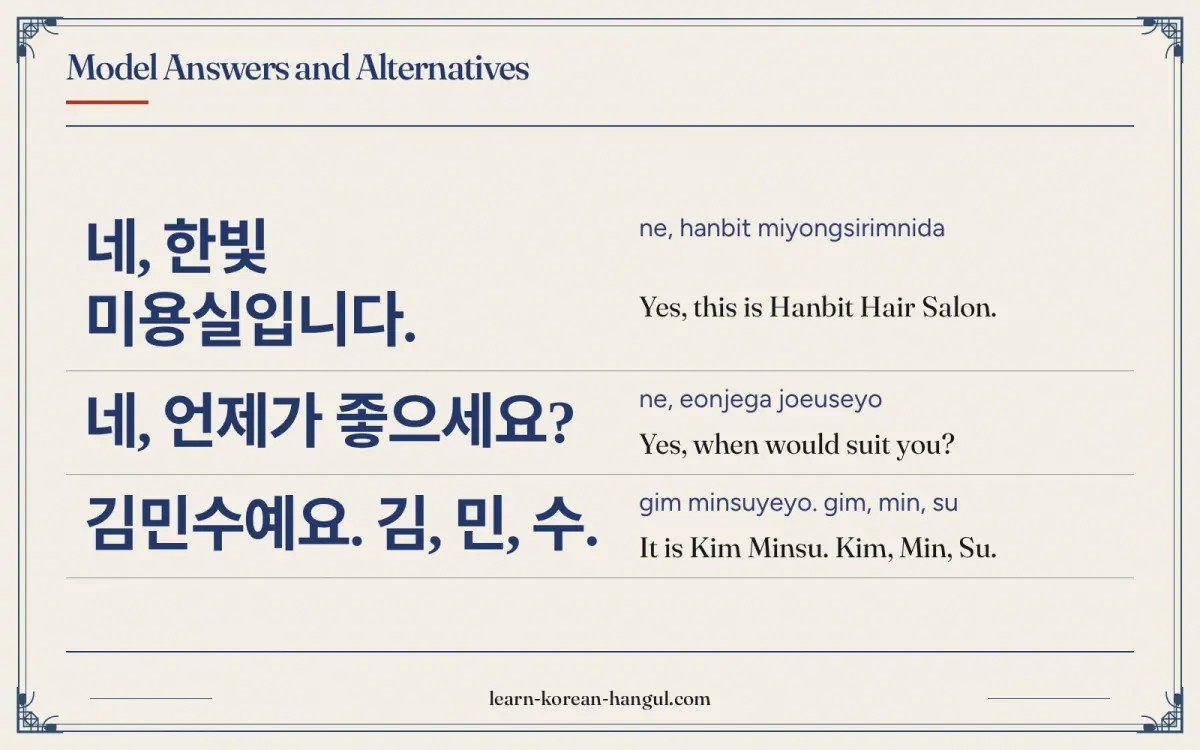
Here is the whole call. Each turn has its own clip, so shadow one at a time.
Booking a Hair Salon Appointment by Phone
Receptionist (B)
네, 한빛 미용실입니다.
ne, hanbit miyongsirimnida
Yes, this is Hanbit Hair Salon.
Caller (A)
여보세요? 예약하고 싶은데요.
yeoboseyo? yeyakago sipeundeyo
Hello? I would like to make a booking.
Receptionist (B)
네, 언제가 좋으세요?
ne, eonjega joeuseyo
Yes, when would suit you?
Caller (A)
내일 오후 세 시에 가능해요?
naeil ohu se sie ganeunghaeyo
Is tomorrow at 3 p.m. possible?
Receptionist (B)
잠깐만 기다려 주세요. 네, 가능해요. 성함이 어떻게 되세요?
jamkkanman gidaryeo juseyo. ne, ganeunghaeyo. seonghami eotteoke doeseyo
Please wait a moment. Yes, that is possible. What is your name?
Caller (A)
김민수예요. 김치의 김, 민속의 민, 수영의 수예요.
gim minsuyeyo. gimchiui gim, minsogui min, suyeongui suyeyo
It is Kim Minsu. Kim as in kimchi, Min as in folk, Su as in swimming.
Receptionist (B)
죄송해요, 잘 안 들려요. 다시 한번 말씀해 주시겠어요?
joesonghaeyo, jal an deullyeoyo. dasi hanbeon malsseumhae jusigesseoyo
Sorry, I cannot hear well. Could you say it once more?
Caller (A)
김민수예요. 김, 민, 수.
gim minsuyeyo. gim, min, su
It is Kim Minsu. Kim, Min, Su.
Receptionist (B)
아, 네. 김민수 씨, 내일 오후 세 시 맞으시죠?
a, ne. gim minsu ssi, naeil ohu se si majeusijyo
Ah, yes. Mr Kim Minsu, tomorrow at 3 p.m., is that right?
Caller (A)
네, 맞아요. 감사합니다. 내일 봬요!
ne, majayo. gamsahamnida. naeil bwaeyo
Yes, that is right. Thank you. See you tomorrow!
Swap parts of the caller's lines for these alternatives.
| Turn | Model | Alternative |
|---|---|---|
| 2 | 예약하고 싶은데요. | 금요일 저녁에 자리 예약하고 싶은데요. |
| 4 | 내일 오후 세 시에 가능해요? | 금요일 저녁 일곱 시에 네 명 가능해요? |
| 6 | 김민수예요. | 박지수예요. |
| 10 | 내일 봬요! | 금요일에 봬요! |
Two repair phrases help when the line is bad. 잘 안 들려요 (jal an deullyeoyo) means "I can't hear well", and 다시 한번 말씀해 주시겠어요? is the polite "Could you say it once more?". Use the shorter 다시 말해 주세요 with a friend.
The receptionist speaks in the formal -ㅂ니다 style in turn 1, 입니다, which is the usual way to answer for a business. The caller stays in the polite -요 style.
The Self-Check Rubric
Score yourself with the same four-part rubric as every speaking page: 0, 1 or 2 points per part, for a total out of 8.
| Part | What to check on this page | 0 | 1 | 2 |
|---|---|---|---|---|
| Sounds | [예야카고], [시픈데요] and each syllable of the name | Often not understood | Understood with effort | Clear, with small slips |
| Flow | The hold and the repair do not end the call | Long pauses inside sentences | Pauses between sentences | Steady, natural pace |
| Form | -고 싶은데요, polite -요 forms, 에 for the time | Endings or particles often missing | Mostly correct -요 forms | Correct throughout |
| Task | Booking, name, repair and the time confirmed | Not completed | Completed with the script | Completed without the script |
Six or more in round two means you can move on. Under five means round one again tomorrow. A score of exactly five means one more practice round before you move on. A self-score is a rough guide, so ask a partner to check your Sounds row now and then.
What to Do after the Role Play
Call a friend, or a partner on a video chat with the camera off, and book a made-up appointment. This removes the lip-reading and makes the practice honest. Then shadow the receptionist's lines until you can say them with the audio. When the call feels steady, continue with the doctor visit conversation, which moves from the phone to a face-to-face clinic visit. If the time words still slip, review the making plans conversation.
Which Sound Changes Are Hidden in the Role Play?
Four spellings sound different from what you read. Listen to each, then say it twice.
In 예약하고 [예야카고], the final ㄱ of 약 and the ㅎ of 하 merge into one aspirated ㅋ sound. In a predicate, Revised Romanization writes the merged sound, so it is yeyakago. In 싶은데요 [시픈데요], the final ㅍ of 싶 moves onto the vowel 으, so you hear a clear P sound before 은. In 미용실입니다 [미용시림니다], the ㄹ moves onto 이, and the ㅂ before ㄴ is said as ㅁ, so Revised Romanization writes miyongsirimnida. In 맞으시죠 [마즈시죠], the ㅈ of 맞 moves onto 으, and the vowel ㅡ is said with unrounded lips. These rules come from the standard pronunciation rules (표준 발음법) of the National Institute of Korean Language (국립국어원).
Worked Example: 여보세요? 누구세요?
The call opens with two short sentences.
여보세요? 누구세요?
yeoboseyo? nuguseyo
Hello? Who is this?
- Read 여보세요. It is the word for "hello" used only on the phone.
- Read 누구세요. 누구 means "who", and 세요 is the honorific polite ending. Together they ask "Who is it?" politely.
- Answer with your name. Say 저는 민수예요 or 민수예요 and the reason for the call.
The booking wish is next.
예약하고 싶은데요.
yeyakago sipeundeyo
I would like to make a booking.
- Read 예약하다. It means "to book", and -고 싶다 means "to want to".
- Add 은데요. The ending softens the wish and invites a reply.
Then the hold.
잠깐만 기다려 주세요.
jamkkanman gidaryeo juseyo
Please wait a moment.
- Read 잠깐만. 잠깐 is "a moment", and 만 means "only".
- Read 기다려 주세요. 기다리다 is "to wait", and -아/어 주세요 turns it into a polite request.
Finally the repair.
잘 안 들려요.
jal an deullyeoyo
I can't hear well.
- Read 잘 안. 잘 means "well" and 안 makes the verb negative.
- Read 들려요. It is the polite present of 들리다, "to be audible". It describes the sound reaching you, not the act of listening (듣다).
What Mistakes Do Learners Make Here?
Learners often assume that 여보세요 can be said face to face, but it belongs to the phone. Five slips are common.
- Saying 여보세요 to a shop assistant. Use 안녕하세요 in person.
- Saying 듣지 않아요 for "I can't hear". Say 잘 안 들려요, because 들리다 means the sound reaches you.
- Spelling with letter names. Use an example word: 김치의 김.
- Not repeating the time. On a bad line, 세 시 and 네 시 are easy to confuse, so repeat it.
- Hanging up when you do not understand. Ask 다시 한번 말씀해 주시겠어요? instead.
Test these in the practice set.
Practice and Answer Key
- Say "I would like to make a booking" politely.
- Say "I can't hear well."
- Ask someone to repeat politely.
- Spell the surname 박 with an example word.
- Ask the other person to wait a moment.
Answers
- 예약하고 싶은데요.
- 잘 안 들려요.
- 다시 한번 말씀해 주시겠어요?
- 박수의 박.
- 잠깐만 기다려 주세요.
Where to Go Next
Play the call again tomorrow, cover the English column and change the booking. When it feels easy, continue with Korean doctor visit conversation, which moves from the phone to a clinic visit and adds symptoms. To go back a step, review the Korean making plans conversation. All role plays are in Korean conversation practice, and similar listening practice is in Korean audio dialogues.
What this page does not cover. It does not cover leaving a voicemail, calling an emergency number or video calls.
Frequently Asked Questions
What do I say when the line is bad?
Say 잘 안 들려요 (jal an deullyeoyo), "I can't hear well", and then ask 다시 한번 말씀해 주시겠어요?, "Could you say it once more?". With a friend, 다시 말해 줘요 or 뭐라고요? is enough. Do not hang up: asking again is normal on the phone and is not rude.
How do I spell my name aloud?
Spell each syllable with a familiar word, 의 and the syllable. For 김민수 say 김치의 김, 민속의 민, 수영의 수. Korean has many words that sound the same, so an example word removes the doubt. Say each syllable on its own beat and pause between them.
What does 누구세요 mean?
누구세요 means "Who is it?" in a polite way. 누구 is "who", and 세요 is the honorific polite ending. It is what you say after 여보세요 when you do not know the caller. The caller replies with a name, such as 저는 민수예요, and then the reason for the call.
How do I confirm a time?
Repeat the day and the time, then end with -죠?: 내일 오후 세 시 맞으시죠? The ending asks the other person to confirm. Say the hour clearly, because 세 시 (3 o'clock) and 네 시 (4 o'clock) sound close on a poor line. Add 오후 for the afternoon.