What you will learn
- Fill ten sentence slots with your own details in the polite 해요 style.
- Choose between 이에요 and 예요 after your name, job and hobby.
- Say that you are studying Korean with -고 있어요.
- Check your text with a four-question checklist.
Before you start: you should know the polite -요 ending and the topic particle 은/는. Time: about 25 minutes.
Key Facts
- The template has ten slots, from name (slot 1) to goals (slot 10).
- 취미는 요리예요 uses 은/는 to make the hobby the topic, and 예요 because 요리 ends in a vowel.
- 한국어를 공부하고 있어요 uses -고 있어요, the progressive, for something you are doing at this stage of your life.
- Age uses native Korean numbers with 살: 스물다섯 살이에요.
- The phrase bank has nine jobs and eight hobbies, each with the right ending.
*Last updated: 2026-10-09. The Korean text, romanization and audio on this page are AI-assisted drafts.
How Do You Write about Yourself in Korean?
You write about yourself in Korean by giving basic facts in short polite sentences, one fact per sentence. A written Korean self-introduction is a short text in which you give basic facts about yourself in polite sentences. It differs from a spoken introduction because the reader can re-read it, so you can use a fixed order and complete sentences. Every line ends in the polite 요 style, which suits teachers, classmates and strangers online.
The ten slots follow the order people expect: who you are, where you are from, what you do, what you like and what you want. The explanation of the polite style is in Korean speech levels, and the spoken version of this text is in introduce yourself in Korean. The forms follow the Hangul Orthography (한글 맞춤법) of the National Institute of Korean Language (국립국어원), and the spoken forms in brackets follow its Standard Pronunciation Rules (표준 발음법). Next, see why English speakers need a template.
Why Is This Hard for English Speakers?
English speakers find a Korean self-introduction hard because every English habit about "I am" breaks. English uses the verb "to be" for name, job and hobby, with "I" in front. Korean uses 이다 for those facts, but the form changes with the last sound of the noun, and "I" is usually shown with a topic particle.
Three problems cause most errors:
- Copula form. The form is 예요 after a vowel (마리아예요) and 이에요 after a consonant (존이에요).
- Particles. "From Brazil" needs 에서, "live in Seoul" needs 에, and "like coffee" needs 를.
- Numbers. Age needs native numbers (스물다섯 살), not the Sino-Korean numbers you use for phone numbers.
The template fixes the pattern for each fact so you only change the nouns. The next section explains how the set works.
How Does the Writing Set Work?
The set works in four parts: a template of ten slots, a phrase bank, two model texts and a checklist. Fill the template with your own details first, then compare with the models. The table shows the ten slots with the A1 pattern for each.
| Slot | Fact | Sentence pattern | Example |
|---|---|---|---|
| 1 | Name | 저는 ○○예요/이에요. | 저는 마리아예요. |
| 2 | Country | 저는 ○○ 사람이에요. or ○○에서 왔어요. | 저는 브라질 사람이에요. |
| 3 | Age | ○○ 살이에요. | 스물다섯 살이에요. |
| 4 | City | 지금 ○○에 살아요. | 지금 서울에 살아요. |
| 5 | Job | 저는 ○○예요/이에요. | 저는 학생이에요. |
| 6 | Family | 가족은 ○ 명이에요. | 가족은 네 명이에요. |
| 7 | Hobby | 취미는 ○○예요/이에요. | 취미는 요리예요. |
| 8 | Likes | 저는 ○○을/를 좋아해요. | 저는 김치찌개를 좋아해요. |
| 9 | Korean study | 한국어를 공부하고 있어요. | 한국어를 공부하고 있어요. |
| 10 | Goal | ○○고 싶어요. | 한국에서 일하고 싶어요. |
Use slots 1, 2, 4, 5, 7 and 9 for a short A1 text, and all ten for A2. The phrase bank gives the nouns.
What Are the Tasks and Prompts?
Write your own text in this order. Each task builds on the one before it.
- Write slots 1 and 2. Give your name and country. Choose the ending by the last sound: 예요 after a vowel, 이에요 after a consonant.
- Write slots 4 and 5. Say where you live and what you do. Pick your job from the bank below.
- Write slots 6 and 7. Give your family size and a hobby. Use 취미는 for the hobby.
- Write slots 8 and 9. Say what you like and that you are studying Korean.
- Write slots 3 and 10. Add your age and one goal.
The phrase banks follow. Each job takes the copula that fits its last sound.
| Job | RR | Meaning | Sentence |
|---|---|---|---|
| 학생 | haksaeng | student | 학생이에요 |
| 대학생 | daehaksaeng | university student | 대학생이에요 |
| 회사원 | hoesawon | office worker | 회사원이에요 |
| 선생님 | seonsaengnim | teacher | 선생님이에요 |
| 의사 | uisa | doctor | 의사예요 |
| 간호사 | ganhosa | nurse | 간호사예요 |
| 요리사 | yorisa | cook, chef | 요리사예요 |
| 디자이너 | dijaineo | designer | 디자이너예요 |
| 개발자 | gaebalja | developer | 개발자예요 |
To say where you work, add the workplace: 회사에서 일해요 (I work at a company, hoesaeseo ilhaeyo). The hobbies follow, with 취미는 in front.
| Hobby | RR | Meaning | Sentence |
|---|---|---|---|
| 요리 | yori | cooking | 취미는 요리예요. |
| 독서 | dokseo | reading | 취미는 독서예요. |
| 운동 | undong | exercise | 취미는 운동이에요. |
| 여행 | yeohaeng | travel | 취미는 여행이에요. |
| 영화 감상 | yeonghwa gamsang | watching movies | 취미는 영화 감상이에요. |
| 음악 감상 | eumak gamsang | listening to music | 취미는 음악 감상이에요. |
| 그림 그리기 | geurim geurigi | drawing | 취미는 그림 그리기예요. |
| 사진 | sajin | photography | 취미는 사진이에요. |
The spoken form of 독서 is [독써], and 개발자 is [개발짜]. Neither the spelling nor Revised Romanization shows this tensing, because it comes from a sound change. The models show the finished texts.
Model Answers
The A1 model uses six slots, and the A2 model uses all ten. Both are in the polite style. The tables give the Revised Romanization (RR), a learning aid that follows the letters, and the spoken form in brackets where it differs from the spelling.
Model Text A1: Maria
| Slot | Korean | RR and spoken form |
|---|---|---|
| Greeting | 안녕하세요. | annyeonghaseyo. |
| 1 | 저는 마리아예요. | jeoneun mariayeyo. |
| 2 | 저는 브라질 사람이에요. | jeoneun beurajil saramieyo. [저는 브라질 사라미에요] |
| 4 | 지금 서울에 살아요. | jigeum seoure sarayo. [지금 서우레 사라요] |
| 5 | 저는 학생이에요. | jeoneun haksaengieyo. [저는 학쌩이에요] |
| 7 | 취미는 요리예요. | chwimineun yoriyeyo. |
| 9 | 한국어를 공부하고 있어요. | hangugeoreul gongbuhago isseoyo. [한구거를 공부하고 이써요] |
Translation: Hello. I am Maria. I am Brazilian. I live in Seoul now. I am a student. My hobby is cooking. I am studying Korean.
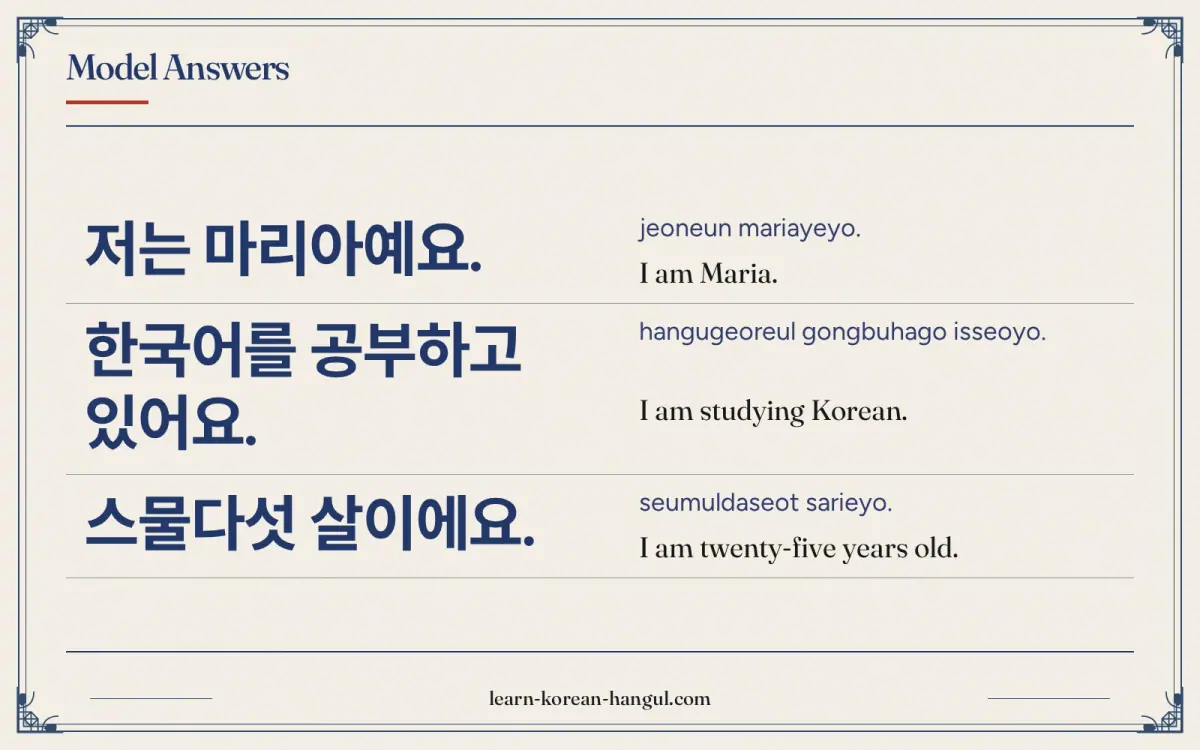
저는 마리아예요.
jeoneun mariayeyo.
I am Maria.
한국어를 공부하고 있어요.
hangugeoreul gongbuhago isseoyo.
I am studying Korean.
Model Text A2: Maria, Ten Sentences
| Slot | Korean | RR and spoken form |
|---|---|---|
| 1 | 저는 마리아예요. | jeoneun mariayeyo. |
| 2 | 저는 브라질에서 왔어요. | jeoneun beurajireseo wasseoyo. [저는 브라지레서 와써요] |
| 3 | 스물다섯 살이에요. | seumuldaseot sarieyo. [스물다섣싸리에요] |
| 4 | 지금 서울에서 살고 있어요. | jigeum seoureseo salgo isseoyo. [지금 서우레서 살고 이써요] |
| 5 | 저는 대학생이에요. | jeoneun daehaksaengieyo. [저는 대학쌩이에요] |
| 6 | 가족은 네 명이에요. | gajogeun ne myeongieyo. [가조근 네 명이에요] |
| 7 | 취미는 요리예요. | chwimineun yoriyeyo. |
| 8 | 저는 김치찌개를 좋아해요. | jeoneun gimchijjigaereul joahaeyo. [저는 김치찌개를 조아해요] |
| 9 | 한국어를 일 년 동안 공부하고 있어요. | hangugeoreul il nyeon dongan gongbuhago isseoyo. [한구거를 일련 동안 공부하고 이써요] |
| 10 | 앞으로 한국에서 일하고 싶어요. | apeuro hangugeseo ilhago sipeoyo. [아프로 한구게서 일하고 시퍼요] |
Translation: I am Maria. I come from Brazil. I am twenty-five. I am living in Seoul now. I am a university student. My family has four people. My hobby is cooking. I like kimchi stew. I have been studying Korean for one year. In the future I want to work in Korea.
스물다섯 살이에요.
seumuldaseot sarieyo.
I am twenty-five years old.
앞으로 한국에서 일하고 싶어요.
apeuro hangugeseo ilhago sipeoyo.
In the future I want to work in Korea.
In sentence 9, 일 년 is read with Sino-Korean numbers because 년 counts years. The A2 text adds the "how long" detail with 동안 (for a period of time). Next, check your own text.
How Do You Check Your Own Writing?
The self-check checklist for a self-introduction has four yes/no questions. Answer them for your own text.
- Does every sentence end in the polite -요 style? A sentence that ends in -다 or -입니다 changes the style halfway.
- Is the copula right? After a vowel the form is 예요, and after a consonant it is 이에요.
- Does each noun carry the right particle? Topic 은/는, place 에 or 에서, object 을/를, and each attached to its noun.
- Does it fit the slots? Do you have name, country, job and hobby at least, and one new fact per sentence?
Then use the shared checks for Korean spelling rules and Korean spacing rules. Next, learn what to do after comparing.
What Should You Do after Comparing?
After comparing, fix the errors the checklist finds, read the text aloud, and then reuse it. Reading aloud finds the endings that look right but sound wrong. Follow this routine.
- Mark. Underline each sentence that differs from the pattern in the slot table.
- Fix. Rewrite the underlined sentences from the table, not from memory.
- Read aloud. Say the text at a normal pace and check the spoken forms in brackets.
- Copy and keep. Save the corrected text. It is your reusable introduction for a class, a language-exchange profile or a first message.
- Say it. Practise it in Korean conversation practice.
Once the A1 text feels easy, add slots 3, 6, 8 and 10 to reach ten sentences. The worked example builds one sentence in detail.
Worked Example: 취미는 요리예요.
Building 취미는 요리예요 (My hobby is cooking) from the English sentence takes five steps.
- Choose the topic. The sentence is about the hobby, so the first noun is 취미.
- Add the topic particle. 취미 ends in a vowel, so the particle is 는: 취미는.
- Choose the hobby noun. "Cooking" is 요리.
- Choose the copula. 요리 ends in the vowel ㅣ, so the form is 예요, not 이에요: 요리예요.
- Check the pieces. Topic with 는, noun, polite ending, no space before 는.
You will know it worked when you can swap 요리 for 운동 and know that the ending becomes 이에요. The next section lists the errors to avoid.
What Mistakes Do Learners Make Here?
Learners repeat five mistakes in a self-introduction. Each has a cause you can fix.
- Mistake 1: 마리아이에요. Learners often use 이에요 for every name. Actually the form after a vowel is 예요: 마리아예요. After a consonant the form is 이에요, as in 존이에요.
- Mistake 2: 브라질을 왔어요. Learners often use the object marker with 오다. Actually "come from" needs 에서: 브라질에서 왔어요.
- Mistake 3: 이십오 살이에요. Learners often use Sino-Korean numbers for age. Actually 살 takes native numbers: 스물다섯 살이에요.
- Mistake 4: 서울을 살아요. Learners often mark the city as an object. Actually "live in" needs 에 or 에서: 서울에 살아요.
- Mistake 5: 나는 마리아예요. Learners often use 나 in a polite text. Actually 저 is the polite word for "I" in a text that ends in 요.
Expert tip: build every identity sentence with the same three questions: what is the topic, what does the noun end in, and which copula follows? Now test yourself.
Practice and Answer Key
Write your answers before you open the key.
- Choose 이에요 or 예요: (a) 존__ (b) 수지__ (c) 선생님__ (d) 의사__
- Fill the particle: 저는 캐나다__ 왔어요. (에서 / 를)
- Correct the sentence: 저는 서울을 살아요.
- Write in Korean: I am studying Korean.
Answer key
- (a) 존이에요 (b) 수지예요 (c) 선생님이에요 (d) 의사예요. 존 and 선생님 end in a consonant; 수지 and 의사 end in a vowel.
- 에서: 저는 캐나다에서 왔어요. (I come from Canada.) RR: jeoneun kaenadaeseo wasseoyo.
- 저는 서울에 살아요. (I live in Seoul.)
- 한국어를 공부하고 있어요. RR: hangugeoreul gongbuhago isseoyo. 한국어를 공부해요 is also correct and means "I study Korean" as a general fact.
Three or four correct means your template is ready to reuse. The last section shows where to go.
Where to Go Next
After you write about yourself in Korean, continue with Write a Paragraph in Korean, where you connect sentences with words like 그리고 and 그래서. For the particles in this template, see Korean topic and subject particles. Before this set, you can review Korean Sentence Writing Practice. More tasks are in Korean writing prompts.
This set covers a polite-style introduction of ten sentences. It does not cover the formal -ㅂ니다 style, honorifics or longer self-descriptions. For an interview or a formal speech, ask a teacher to check the register.
Frequently Asked Questions
Should I write 저 or 나? Write 저 in a self-introduction in the polite style, because 저 is the humble word for "I" that goes with the -요 ending. 나 is the plain word for friends and for the -다 style used in diaries. A teacher, a classmate you do not know well or a reader online should see 저는.
How do I give my job in a written introduction? Put the job noun before 이에요 or 예요, choosing by the last sound: 학생이에요, 의사예요. To name the workplace, add 에서 일해요, as in 회사에서 일해요 (I work at a company). If you have no job, say what you study or leave the job slot out.
How do I say I am studying Korean? Write 한국어를 공부하고 있어요, using -고 있어요 for an action in progress. This phrase fits a period of study that includes today. 한국어를 공부해요 also works and sounds like a general fact. Add a time detail with 동안, as in 일 년 동안 (for one year).
How long should it be? Write six sentences at A1 and ten at A2. The ten-slot template is the full length, and each sentence gives one new fact. Add more only when a new sentence tells the reader something new. Short, correct sentences read better than long uncertain ones, and you can always add slots later.