안녕하세요? 만나서 반갑습니다.
저는 매일 한국어를 공부해요.
Before you start
- Time: 15 to 20 minutes per session, with five sessions a week as the target.
- Difficulty: beginner (A1). You need to read Hangul and know the polite -요 ending.
- You need: one clip of 20 to 40 seconds with a written script, headphones, and a phone or computer to record yourself.
- Cost: free. All the clips on this page and in the practice sets have slow and normal audio.
Key facts
- Use short clips of 20 to 40 seconds so that you can repeat the same clip many times.
- The six steps are: listen, read, read along, shadow slowly, shadow at normal speed, record.
- Rhythm and pitch matter more than perfect words, so a sentence that sounds right beats one that is spelled right.
What Is Shadowing in Korean?
Shadowing is a speaking exercise in which you talk along with a recording, a fraction of a second after the speaker, so your voice trails the original like a shadow. In Korean it trains three things that books teach poorly: the even rhythm of the syllables, the pitch at the end of a sentence, and the sound changes that make spoken Korean differ from its spelling.
It is easy to confuse shadowing with listen-and-repeat, but they work differently.
| Feature | Shadowing | Listen-and-repeat |
|---|---|---|
| Timing | You speak while the recording plays | You wait until the recording stops |
| Pauses | None; the recording keeps running | A pause after each phrase |
| What it trains | Rhythm, pitch and speed | Accuracy of single phrases |
| Memory load | Low; you copy by ear | Higher; you hold the phrase in mind |
| Best for | Fluent-sounding delivery | First contact with a new sentence |
Language teachers and interpreters use shadowing, and research on it in second-language teaching exists, but results differ between studies and learners. The method trains how you sound, not how much you know. That makes it a partner to vocabulary and grammar study, not a replacement.
With the idea clear, the next section gives the whole method in one list.
How to Shadow Korean in Six Steps
The six steps take you from hearing a clip to recording a normal-speed run. Do them in order on a single clip.
- Listen. Play the clip twice without the script. Aim to catch the gist.
- Read. Read the script and note any sound change you hear.
- Read along. Read the script aloud with the audio.
- Shadow slowly. Speak half a second behind the slow clip with the script in view.
- Shadow at normal speed. Do the same at normal speed, then without the script.
- Record. Record yourself and compare it with the original.
The steps are grouped into three phases below, with the action, the method, a success check and a common mistake for each step.
Step 1 and 2: Listen and Read
The first two steps prepare your ear and your eye before you open your mouth. They take about five minutes in total.
Step 1: Listen to the clip twice (2 minutes).
- Action: play the whole clip two times with the script hidden.
- How: use headphones and listen for the rhythm, not for every word. Try to describe the situation in one English sentence, such as "two people meet".
- You'll know it worked when you can say who is speaking and what they want.
- Common mistake: reading the script first. If you read first, you stop hearing and start decoding.
Step 2: Read the script and mark the changes (3 minutes).
- Action: read the script silently and mark each place where speech differs from spelling.
- How: mark final consonants followed by a vowel, tense sounds and the pitch at the end of each sentence. In 반갑습니다, for example, the spoken form is [반갑씀니다]. Use the pronunciation audio to check your marks.
- You'll know it worked when you have at least one mark on every sentence that has a final consonant.
- Common mistake: marking every syllable. Mark only the changes, or the page becomes noise.
Once your ear and eye are ready, the next phase moves your voice in.
Step 3 and 4: Read along and Shadow Slowly
These two steps connect your voice to the recording. They take about six minutes.
Step 3: Read along (3 minutes).
- Action: read the script aloud while the audio plays at normal speed.
- How: follow the text with your finger. Do not try to be behind yet; match the voice as closely as you can.
- You'll know it worked when you can finish each sentence at the same time as the speaker, or one beat later.
- Common mistake: skipping ahead and reading faster than the voice. The goal is to match its rhythm, not to win.
Step 4: Shadow slowly (3 minutes).
- Action: play the slow clip and speak about half a second behind it.
- How: keep the script in view. In practice, half a second is a gap of about two to three syllables, which is a rule of thumb for teaching, not a measured standard. If you cannot keep up, lengthen the gap.
- You'll know it worked when you reach the end of the clip without stopping.
- Common mistake: pausing to fix an error. Keep going and fix it on the next run.
안녕하세요? 만나서 반갑습니다.
With your voice running behind the clip, the last phase raises the speed and checks the result.
Step 5 and 6: Shadow at Speed and Record
The final two steps test whether the rhythm holds at real speed. They take about eight minutes.
Step 5: Shadow at normal speed (4 minutes).
- Action: shadow the normal clip three times, once with the script, once with the script half hidden, and once with no script.
- How: if a sentence fails, shadow that sentence alone five times, then return to the whole clip.
- You'll know it worked when you can complete the clip with no script and no more than three stumbles. A stumble is a hesitation, a repeated syllable or a lost beat.
- Common mistake: raising the volume of your voice. If you cannot hear the model, your pitch drifts.
Step 6: Record and compare (4 minutes).
- Action: record one full run on your phone, then play the original and your recording one after the other.
- How: use the checklist in the next section, and write down one thing to fix.
- You'll know it worked when you can name one specific difference, such as "I dropped the final ㅂ".
- Common mistake: judging the recording as good or bad. Compare it, then pick one change.
The recording is only useful if you know what to listen for.
How Do I Check My Recording?
Check your recording against four points, and score each as matched or not matched. A fixed checklist stops you from judging by feeling.
| Point | What to listen for | Red flag | Fix |
|---|---|---|---|
| Rhythm | Even syllables, no stressed beats | A heavy hit on one syllable | Tap one finger per syllable |
| Final consonants | Closed stops, such as the ㅂ in 갑 | A vowel added after the consonant | Close your lips or throat without a release |
| Intonation | Gentle fall on statements, light rise on yes/no questions | A rise on every sentence | Mark the pitch on the script |
| Speed | The same finish time as the original | You finish well before or after | Return to the slow clip |
Pitch is explained in Korean intonation, and the habit of speaking text aloud is covered in read Korean aloud.
A fixed checklist leads naturally to the question of how far behind to stay.
How Far behind Should I Speak?
Speak about half a second behind the recording, or roughly two to three syllables. This gap is a teaching convention, not a research figure. It is long enough that you hear a syllable before you copy it, and short enough that you cannot translate in your head.
Adjust it for your level. If you lose the thread, widen the gap to one second and shorten it over a few sessions. If you are copying without thinking, narrow it. The gap should feel like running just behind a friend, not like a relay in which you wait for the baton.
How Do I Choose a Clip?
Choose a clip of 20 to 40 seconds with one or two speakers, clear audio and everyday topics. Short clips let you repeat the same material many times, which is where the gain comes from.
| Check | Good sign | Bad sign |
|---|---|---|
| Length | 20 to 40 seconds | Over one minute |
| Speakers | One or two | A crowd or overlapping talk |
| Audio | Clear, no music under the voice | Loud background music or noise |
| Speed | You can catch half of the words | You catch almost nothing |
| Script | A Korean script is available | No text at all |
The scripted sets on this site follow these rules. They have eight lines each and come with slow and normal audio, and you can start with Korean shadowing daily routine. For drama clips, see Shadow Korean with kdramas.
Worked Example: 안녕하세요? 만나서 반갑습니다.
Take the first sample clip through the six steps in outline.
안녕하세요? 만나서 반갑습니다.
annyeonghaseyo? mannaseo bangapseumnida
Hello. Nice to meet you.
- Listen. Two people greet. The first group lifts lightly, and the second falls.
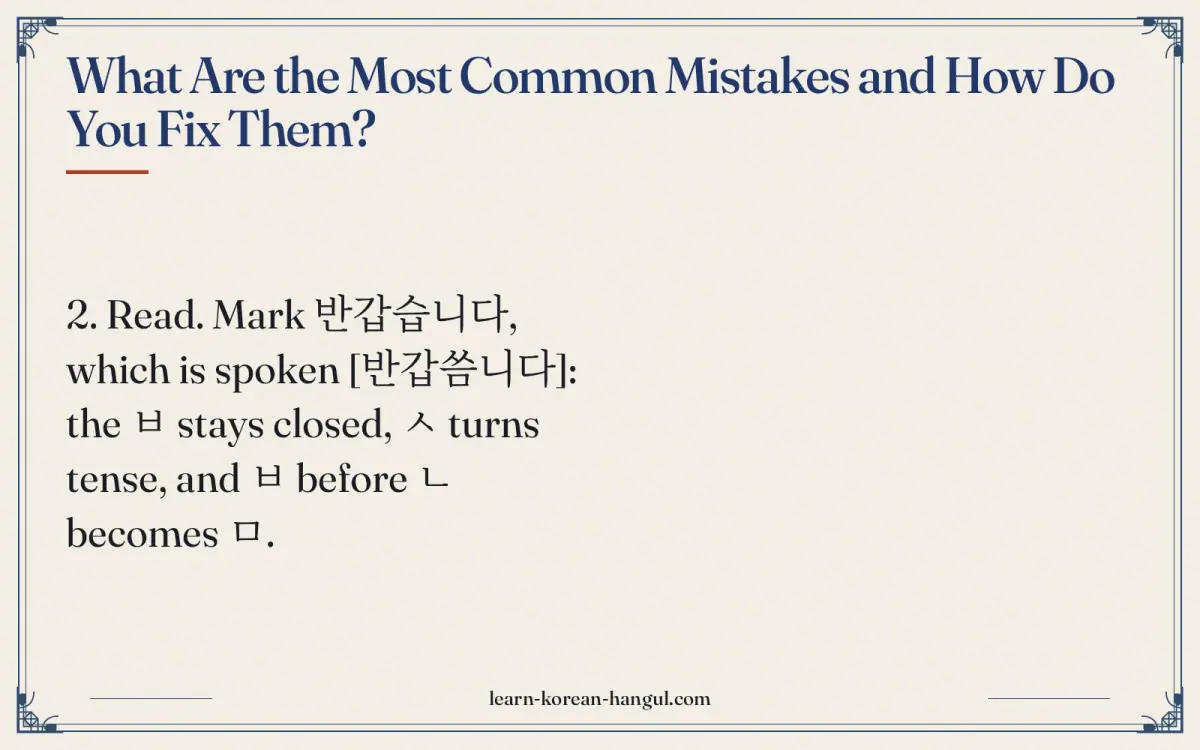
- Read. Mark 반갑습니다, which is spoken [반갑씀니다]: the ㅂ stays closed, ㅅ turns tense, and ㅂ before ㄴ becomes ㅁ.
- Read along. Read both phrases with the audio.
- Shadow slowly. Play the slow clip and say "man-na-seo" a beat behind "man-na-seo".
- Shadow at normal speed. Repeat three times, the last time without the script.
- Record. Check four points: lift on 안녕하세요, closed ㅂ, tense 씀, gentle fall on 다.
The second sample uses a different challenge: a linked sound.
저는 매일 한국어를 공부해요.
jeoneun maeil hangugeoreul gongbuhaeyo
I study Korean every day.
Here 한국어를 is linked as [한구거를]: the ㄱ of 국 moves to 어.
저는 매일 한국어를 공부해요.
The same six steps apply to every clip. Where learners go wrong is predictable, so the next section lists the failures.
What Are the Most Common Mistakes and How Do You Fix Them?
Learners often assume that shadowing is simply repeating, and five failures follow from that.
- Reading only. Silent shadowing trains reading. Fix: whisper if you must, but produce sound.
- Speaking too loud. A loud voice masks the model, so your pitch drifts toward your own habits. Fix: keep your voice just under the model's volume.
- Choosing clips that are too fast. If you cannot catch half of the words, the exercise becomes noise. Fix: use the slow rendering, or pick a shorter and clearer clip.
- Pausing after each phrase. This turns shadowing into listen-and-repeat. Fix: keep your voice running through the gaps and accept an error rather than stopping.
- Ignoring final consonants. Adding a vowel after a closed stop, as in "ban-ga-beu-seum-ni-da", adds extra beats and breaks the rhythm. Fix: close the lips or throat and do not release.
None of these requires special equipment. They do require honest checking, which a weekly routine builds in.
What Does a Weekly Shadowing Routine Look Like?
A good routine uses five short sessions across the week and repeats each clip about three times. Repetition on the same clip is the point, so do not hunt for new clips each day.
| Session | Time | Task |
|---|---|---|
| 1 | 15 minutes | New clip: steps 1 to 3 |
| 2 | 15 minutes | Same clip: steps 4 and 5 with the script |
| 3 | 20 minutes | Same clip: step 5 without the script, then step 6 |
| 4 | 15 minutes | New clip: steps 1 to 4 |
| 5 | 20 minutes | Second clip: steps 5 and 6, then compare with session 3 |
Keep one recording per week and listen to the first one again after a month. Progress shows as fewer stumbles on the same clip, not as a score. The method suits an A1 learner and stays useful at higher levels, where you can use longer clips.
When Should I Not Use Shadowing?
Do not use shadowing if you cannot yet read Hangul, because the script step needs it. Start with the Hangul lessons first. Shadowing also does not teach meaning. If you shadow a clip you do not understand, you will copy the sounds, but you will not learn what they mean, so always look up the translation.
Shadowing does not replace conversation, either. It trains delivery of sentences someone else built. To build your own, move to scripted role plays and questions, as laid out in Korean speaking practice. Pair it with listening work, such as how to improve Korean listening, because both depend on the same ear.
Where to Go Next
Start with one clip this week and complete all six steps. When the method feels natural, work through the scripted sets, beginning with Korean shadowing daily routine. All sets are listed in Korean shadowing. The audio on this site is generated by text-to-speech and checked by a Korean teacher before publication, so a real speaker may be faster. If you remember one thing about how to shadow Korean, remember this: keep your voice running, and fix one thing at a time.
Frequently Asked Questions
What is shadowing?
Shadowing is speaking aloud along with a recording, a fraction of a second after the speaker, without pausing. It differs from listen-and-repeat, where you wait for the recording to stop. In Korean it trains syllable rhythm, sentence-final pitch and the sound changes that make speech differ from spelling.
Is shadowing good for Korean?
It is good for pronunciation, rhythm, intonation and speed, because you copy real sentences at real tempo. It is weaker for vocabulary and grammar, which you must study separately. It also works only if you understand and can read the clip, so use it as a partner to your lessons, not a replacement.
How far behind should I speak?
Start about half a second behind, which is roughly two to three syllables. This is a teaching rule of thumb, not a research figure. If you lose the thread, widen the gap to about one second, then shorten it over several sessions. The aim is to hear each syllable just before you copy it.
Should I use a script?
Yes, at first. Use the script in steps 2 to 4 so you know every word and sound change. In step 5, hide it on the last run to test whether you are copying by ear. If you stumble badly without it, return to the script for one more run.