괜찮아요?
진짜요?
Before you start
- Time: 20 to 30 minutes for one scene, spread across two or three short sessions.
- Level: B1. You should be able to read Hangul and follow slow, simple Korean. If you are new to shadowing, learn the method first in how to shadow Korean.
- You need: a drama you can watch on an official service, a player with Korean subtitles and speed control, headphones and a recorder.
- Cost: a streaming subscription may be needed. This site hosts no drama clips.
Key facts
- Use slow playback at 0.75 speed first, then normal speed.
- Do not copy or share video. Watch on official sources and keep the clip for private study.
What Does It Mean to Shadow Korean with Kdramas?
Shadowing Korean with kdramas is the shadowing method applied to scenes from Korean television dramas. You pick a short scene, play it, and speak the actors' lines aloud a half-second behind them. The method itself is the same as in how to shadow Korean: your voice trails the recording without pausing, and you copy its rhythm, pitch and sound changes.
What changes is the material. A textbook clip is slow, clean and scripted for learners. A drama scene is acted for native viewers, so it comes with natural speed, reduced forms, emotion and slang. That makes it a good B1 exercise, after the scripted sets such as Korean shadowing phone calls, and a poor first exercise.
The reasons dramas are worth the extra effort come next.
Why Use Dramas for Shadowing?
Dramas are worth using because they show Korean as it is spoken: with contractions, varied pitch and feeling. Textbook audio rarely does this. Three features matter most.
- Natural reductions. Actors say 이건 for 이것은, 뭘 for 무엇을 and 근데 for 그런데. You hear the short forms that learners often miss.
- Pitch with feeling. The same sentence can be warm, annoyed or teasing, and the pitch moves accordingly. You can copy that range.
- Motivation. Many learners keep going longer with material they enjoy. This is a plausible effect and not a measured one, so test it on yourself.
Dramas also have costs. The speed is higher, background music can mask the voice, and the language is written for entertainment, not for your needs. Emotional scenes are the hardest to shadow, because shouting, whispering and crying change the pitch and speed and drop sentence endings.
| Feature | Textbook clip | Drama scene |
|---|---|---|
| Speed | Slow to moderate | Natural, often fast |
| Vocabulary | Chosen for learners | Whatever the story needs |
| Emotion | Neutral | Often strong |
| Slang | Rare | Common |
| Subtitles | Matching script | Depends on the service |
To get the benefits without the costs, the choice of scene matters most.
Which Kdrama Scenes Are Best for Shadowing?
The best scenes are short, calm and everyday. Choose a scene of 30 seconds or less with one or two speakers, clear audio and a normal setting such as a home, a café, a school or an office.
| Check | Good sign | Skip the scene if |
|---|---|---|
| Length | 20 to 30 seconds | It runs over a minute |
| Setting | Everyday: home, office, café, school | Historical, fantasy or war |
| Speakers | One or two | Several people talk over each other |
| Sound | Voice is clear | Music or noise covers the voice |
| Mood | Calm or lightly emotional | Shouting, crying or whispering |
| Subtitles | Korean subtitles are available | Only subtitles in another language |
Modern everyday dramas are clearer than historical dramas, because historical dramas (사극, sageuk) use older endings that people do not say today. For other places to find clips, see kdramas to learn Korean, and for listening-only practice, see Korean drama listening practice.
Once you have a scene, follow the steps below.
How to Shadow Korean with Kdramas, Step by Step
The process has six steps and takes two or three short sessions. Each step has a check.
- Pick and cut. Choose a scene of 30 seconds or less. Note the start and end times in your player.
- You'll know it worked when you can replay exactly that scene.
- Watch with Korean subtitles. Watch twice. Use English subtitles only for the first watch if you need the meaning.
- You'll know it worked when you can say in one sentence what happens.
- Mark the script. Copy the Korean lines into a note. Mark slang, casual endings and sound changes, and strike out any line you would not say.
- You'll know it worked when every kept line has a mark or a tick.
- Shadow at 0.75 speed. Slow the player to 0.75, then speak half a second behind the actors with the script in view.
- You'll know it worked when you finish without stopping.
- Shadow at normal speed. Move to 1.0 speed in two sets: with the script, then without it.
- You'll know it worked when you finish with three stumbles or fewer.
- Record and compare. Record one run and compare it with the scene.
- You'll know it worked when you can name one difference to fix.
| Speed | Use it when |
|---|---|
| 0.75 | First two or three runs, with the script |
| 0.9 | You can finish 0.75 smoothly, if your player has this step |
| 1.0 | You finish 0.9 or 0.75 with few stumbles |
Not every player offers speed control, so if yours does not, shadow in short loops of one or two lines instead. A common mistake is to jump to 1.0 speed at once, which turns the scene into noise.
What Are the Variations for Different Situations?
The six steps suit most learners, but three variations help in particular situations.
- Audio only. Hide the picture and shadow the sound. This removes the distraction of the actors' faces and works well on a commute, where a whisper is enough.
- One line at a time. Loop a single line five times, then add the next. This suits fast dialogue that you cannot follow in one piece.
- Split the roles. Shadow only speaker A on one run and only speaker B on the next. You hear how each person's rhythm differs, and you stop mixing the two voices.
You can also track progress without a score. Count the stumbles on the same scene each week, and keep the recording from the first week. A drop from many stumbles to a few, on the same 30 seconds, is the clearest sign that the method is working.
Worked Example: a 20-Second Everyday Scene
An original practice scene shows the process on a small scale. The four lines below are written for this guide, not taken from any drama, and they use the kind of everyday polite speech you often meet in modern scenes.
어디 가요? / 도서관에 가요. / 진짜요? 저도 가요. / 그럼 같이 가요.
| Line | Korean | Spoken form | Note |
|---|---|---|---|
| 1 | 어디 가요? | [어디 가요] | Wh-question: weight on 어디, then a fall |
| 2 | 도서관에 가요. | [도서과네 가요] | ㄴ links to 에 |
| 3 | 진짜요? 저도 가요. | [진짜요 저도 가요] | 진짜요 rises: surprise; 저도 means me too |
| 4 | 그럼 같이 가요. | [그럼 가치 가요] | 같이 is spoken [가치] |
Run the six steps on this scene. In step 3, you would tick every line, because all four use the polite -요 ending. In step 4, shadow at 0.75 speed.
어디 가요? / 도서관에 가요. / 진짜요? 저도 가요. / 그럼 같이 가요.
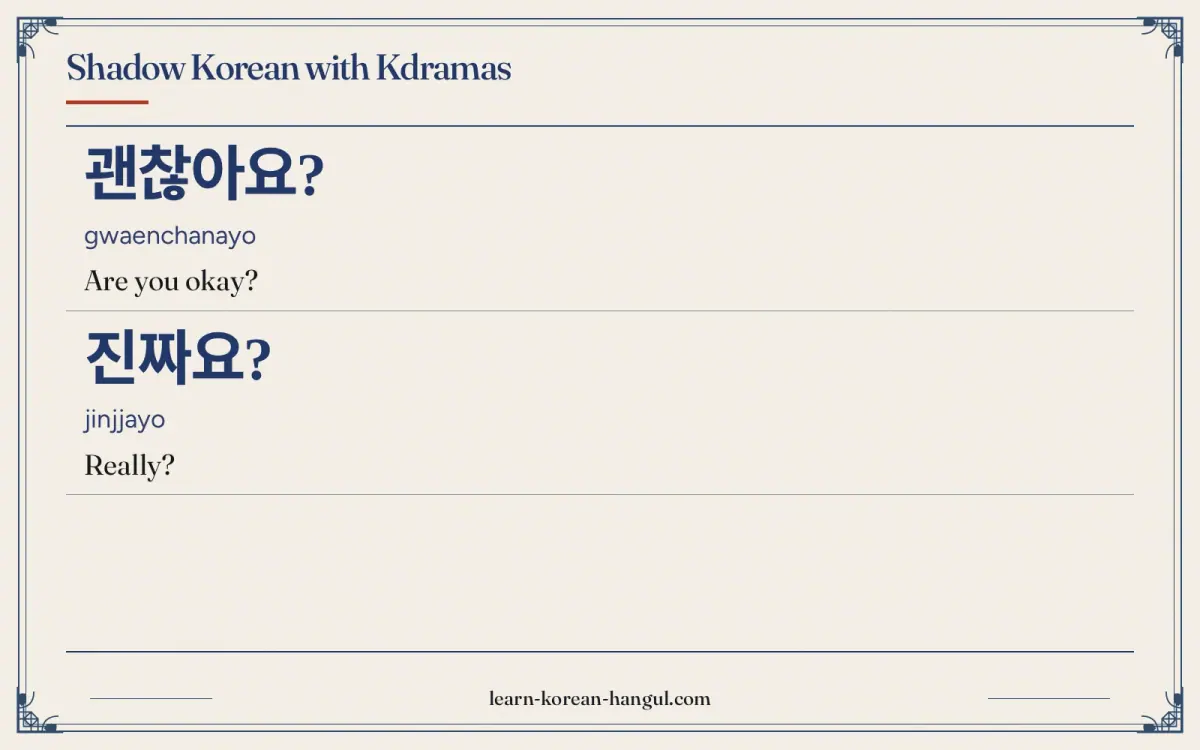
The two short sample lines at the top of the page show how emotion changes pitch. 괜찮아요? [괜차나요] is spoken gently as a check on someone, and 진짜요? [진짜요] is spoken with surprise, with a rise on the last syllable. Compare the slow versions with the normal ones.
괜찮아요?
gwaenchanayo
Are you okay?
진짜요?
jinjjayo
Really?
Both are safe to copy. The next risk is the language you should not copy.
Why Is Emotional Speech Harder to Shadow?
Emotional speech is harder to shadow because strong feeling changes the three things you are trying to copy: pitch, speed and sentence endings. Actors who are angry, tearful or whispering do not speak in the neat patterns of a practice set, so a learner who copies them is copying a performance and not a pattern.
| Emotion | What changes | Effect on shadowing |
|---|---|---|
| Anger | Higher pitch, faster speed, clipped endings | You lose the beat and drop final consonants |
| Crying | Broken rhythm, breath in the middle of words | There is no stable rhythm to follow |
| Whispering | No clear pitch, quiet voice | You cannot hear the pitch you want to copy |
| Joy or teasing | Wide pitch range, stretched vowels | Good practice, but exaggerated |
Begin with calm or lightly emotional scenes. Keep the strong ones for listening, and return to them when your normal-speed runs are steady.
How Do I Avoid Rude Slang When I Shadow Dramas?
Shadow only what you would say to a teacher or a new acquaintance, and treat everything else as listening practice. Drama characters speak to friends, family and rivals, and many of their lines are casual or harsh. Copying them out of context can sound rude.
| Type | Examples | Safe to copy? |
|---|---|---|
| Polite -요 or -ㅂ니다 style | 괜찮아요? 진짜요? | Yes |
| Casual style (반말) | 뭐 해? 어디 가? | Only with close friends your age or younger |
| Reaction slang | 대박 (daebak, "wow"), 헐 (heol, a surprised reaction) | Among friends, not with elders or in formal places |
| Address words | 야 (ya, "hey"), 너 (neo, "you") | Rude toward elders or strangers |
| Insults and swearing | Strong words in angry scenes | No |
| Historical endings | -하오, -이옵니다 | No, they are not used in everyday speech today |
The safe-to-copy rule has two parts. First, keep the speech level you would use yourself, which for most learners is the polite -요 style; the levels are explained in Korean speech levels. Second, when in doubt, shadow silently or skip the line. Many popular phrases from dramas appear in kdrama Korean phrases, where each phrase has a register note.
Language is only one side of the risk. The other is how you get the clips.
What Are the Copyright and Subtitle Limits?
Watch dramas on official services and do not copy, download or post clips. This site hosts no drama clips and gives only original practice lines. Copyright rules differ between countries, so treat a scene as something you watch on an official service and study privately, not something you share.
Subtitles help in two ways. Korean subtitles give you the script for step 3. Use them with care, though: subtitles are often shortened or edited, so the words on screen may differ slightly from what the actors say. If the audio and the subtitle disagree, trust your ears and note the difference.
With the clips and subtitles sorted, here are the failures to expect.
What Are the Most Common Mistakes and How Do You Fix Them?
Learners often assume that a drama scene is just a harder textbook clip. It also brings slang, emotion and speed, and five slips are common.
- Choosing a scene that is too long or too noisy. Fix: cut it to 30 seconds or less and pick one with a clear voice.
- Jumping to normal speed. Fix: start at 0.75 and move up only when you finish without stopping.
- Copying rude lines. Fix: mark and strike out any line you would not say to a teacher.
- Shadowing an emotional scene first. Fix: begin with calm dialogue, and keep shouting and crying scenes for later.
- Trusting the subtitle over your ears. Fix: check against the audio, and write the words you actually hear.
None of these needs special equipment, but each needs a small amount of discipline, and the habit grows with practice.
Where to Go Next
Choose one calm scene this week and run all six steps. If the speed is too much, return to the scripted sets, starting with Korean shadowing daily routine, where the audio is slow and clean. All the sets are listed in Korean shadowing. The audio on this site is generated by text-to-speech and checked by a Korean teacher before publication, so it is clearer than real television. Shadow Korean with kdramas once you can finish a scripted set without more than three stumbles, and keep each scene short.
What this guide does not cover. It does not teach the speech levels in full, rate specific dramas or give legal advice. It also does not promise a result: shadowing trains delivery, not vocabulary, and progress varies from learner to learner.
Frequently Asked Questions
Can I shadow Korean dramas?
Yes, from about B1 level. Pick a calm scene of 30 seconds or less, watch it with Korean subtitles, and shadow it at 0.75 speed before normal speed. Skip scenes with heavy emotion or music at first. If you are new to shadowing, learn the method on scripted clips before moving to television.
Which dramas are best for shadowing?
Modern dramas set in homes, schools, cafés or offices work best, because the speech is clear and everyday. Historical dramas use older endings, and thrillers use clipped, fast lines. Judge by the scene, not the title: look for calm dialogue, one or two speakers and a clear voice.
Is drama Korean too fast?
Often yes at first, because actors speak at natural speed with reductions such as 이건 and 뭘. Slow the player to 0.75, shorten the scene to one or two lines, and loop it. Move to normal speed only after you finish a slow run without stopping. If your player lacks speed control, use short loops.
Will I learn slang?
You will hear some, and you can learn to understand it. But copy only what suits the person you speak to. Slang such as 대박 and 헐 fits friends, not teachers or elders, and address words such as 야 are rude to strangers. Mark each slang line, then decide whether to use it or only recognise it.