일곱 시에 일어나요. / 먼저 세수를 해요. / 아침을 먹고 학교에 가요. / 열두 시에 점심을 먹어요. / 도서관에서 책을 읽어요. / 저녁에 한국어를 공부해요. / 밤에 일기를 써요. / 열두 시 전에 자요.
What you'll learn
- Shadow eight routine lines at normal speed with no more than three stumbles.
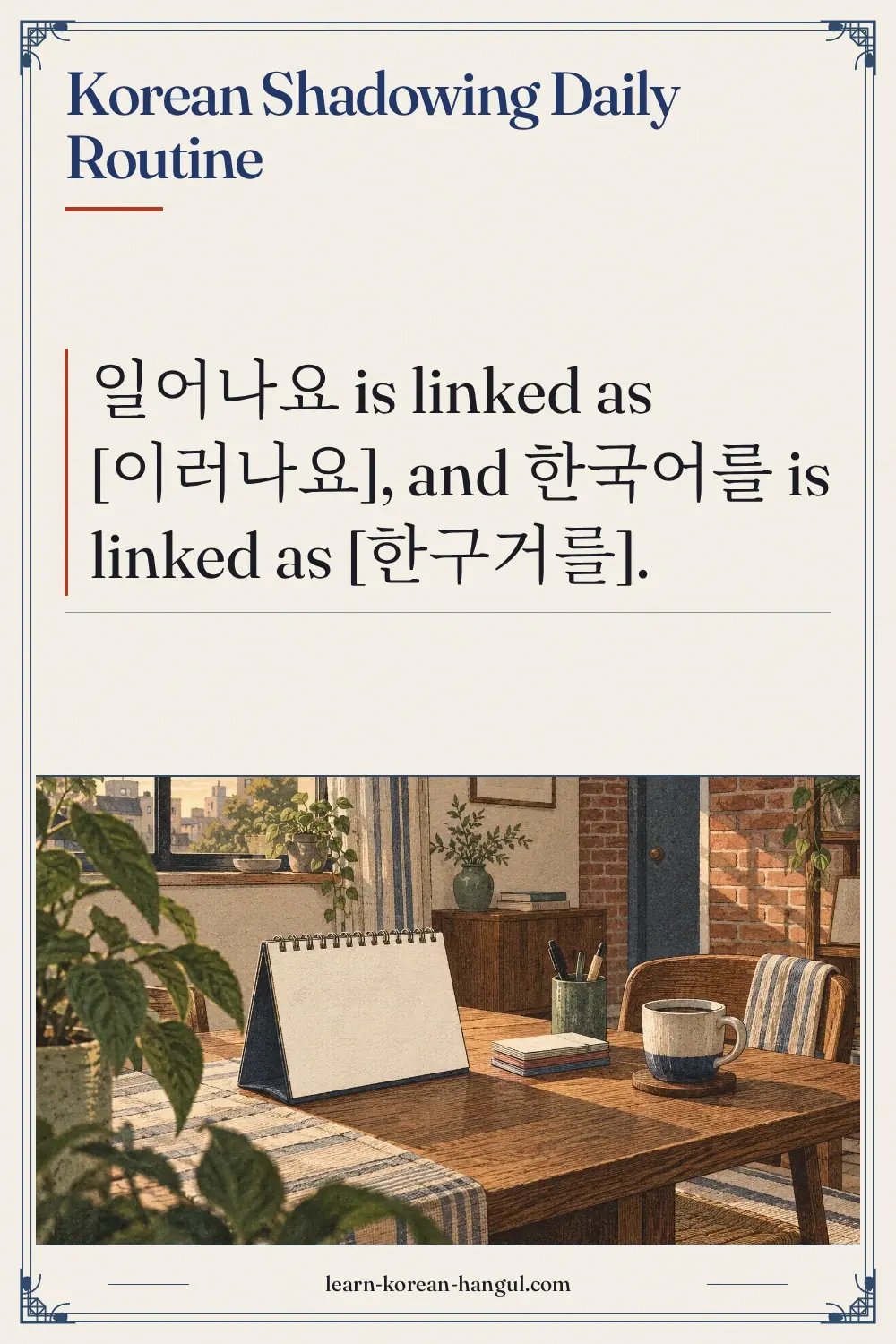
- Link a final consonant to the vowel that follows it in 일어나요 and 한국어를.
- Say 일곱 시 with a tense [씨] and 먹고 학교 with tense [꼬] and [꾜].
- Keep a gentle fall at the end of each polite statement instead of an English-style rise.
Before you start: you need to read Hangul and know the polite -요 ending. Level: A1. Time: about 20 minutes. If shadowing itself is new, read how to shadow Korean first. Audio plays only when you press a button.
Key facts
- The lines follow clock order from the morning to bedtime, so you can recall the next line from the time of day.
- A stumble means a hesitation, a repeated syllable or losing the beat. Three or fewer on the final run is the goal.
Why Is a Daily Routine Good Shadowing Material?
A daily routine is good shadowing material because it uses the most frequent verbs in the simplest polite pattern. Every line has the same shape: a time or place word, an object, and a verb ending in -요. Because the pattern repeats, your attention goes to sound and rhythm instead of grammar.
The set also fits memory. A day has a fixed order, so line 4 (lunch) reminds you of line 3 (breakfast and school). If you have already read the matching story, My Morning, the vocabulary is familiar and you can spend your effort on speed. The numbers in the lines follow the pattern taught in telling time in Korean: native numbers for the hour, as in 일곱 시 and 열두 시.
The next question is what makes these simple lines hard to copy by ear.
Why Is This Hard for English Speakers?
These lines are hard for English speakers because the written syllables do not match the spoken ones. English speakers also tend to stress one syllable per word, while Korean gives its syllables a more even length. Three habits cause most of the slips.
| What you see | What you hear | Why it surprises English speakers |
|---|---|---|
| 일어나요 | [이러나요] | The ㄹ of 일 moves to the next block, so the word sounds like "i-reo-na-yo" |
| 한국어를 | [한구거를] | The ㄱ of 국 moves to 어, so the sound is "han-gu-geo-reul" |
| 일곱 시에 | [일곱씨에] | After the unreleased ㅂ of 일곱, ㅅ becomes the tense [ㅆ] |
| 먹고 학교에 | [먹꼬 학꾜에] | After a final ㄱ, the next ㄱ turns tense |
The first two rows are linking (연음, yeoneum). A final consonant followed by a vowel moves across the block boundary, as set out in Articles 13 and 14 of the standard pronunciation rules (표준 발음법) of the National Institute of Korean Language (국립국어원). The last two rows are tensing, covered by Article 23. Read more in Korean liaison.
Revised Romanization writes what is spoken, so it shows linking (ireonayo) but not the tensing that comes from a neighbouring sound (meokgo, hakgyo). Brackets in this set show the spoken form.
With the traps named, here is how a session runs.
How Does the Korean Shadowing Daily Routine Set Work?
The set works in four passes, each with one job. Total time is about 20 minutes. The passes compress the six steps of how to shadow Korean into one session; for step 6, record your last pass and compare it with the audio.
- Listen and read (3 minutes). Play the normal-speed audio above once while you read the script below. Note the lines where the spoken form differs from the spelling.
- Shadow slowly (6 minutes). Use the slow player and speak a beat behind the voice, line by line, with the script in view.
- Shadow at normal speed (6 minutes). Use the normal clip. Keep going if you slip; do not stop and restart.
- Shadow without the script (5 minutes). Hide the text and shadow the whole set. Count your stumbles.
You will know it worked when you finish the last pass with three stumbles or fewer. A common mistake is pausing after each line, which turns shadowing into listen-and-repeat. Keep your voice running through the gaps.
일곱 시에 일어나요. / 먼저 세수를 해요. / 아침을 먹고 학교에 가요. / 열두 시에 점심을 먹어요. / 도서관에서 책을 읽어요. / 저녁에 한국어를 공부해요. / 밤에 일기를 써요. / 열두 시 전에 자요.
The marks in the script tables use a slash for a breath group and an arrow for pitch: ↘ is a gentle fall on a polite statement.
Script Lines 1 to 4
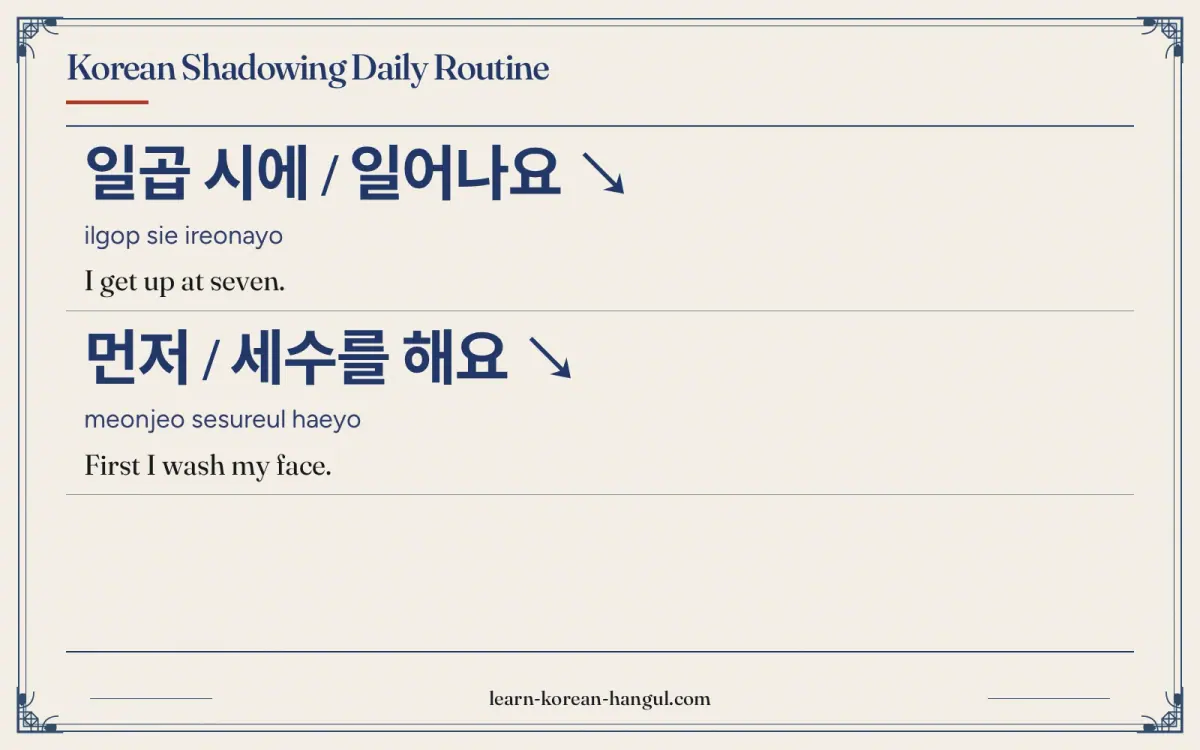
Lines 1 to 4 cover waking, washing, breakfast with school, and lunch. Each line has its own clip, so you can loop a single line.
일곱 시에 / 일어나요 ↘
ilgop sie ireonayo
I get up at seven.
먼저 / 세수를 해요 ↘
meonjeo sesureul haeyo
First I wash my face.
아침을 먹고 / 학교에 가요 ↘
achimeul meokgo hakgyoe gayo
I eat breakfast and go to school.
열두 시에 / 점심을 먹어요 ↘
yeoldu sie jeomsimeul meogeoyo
I eat lunch at twelve.
Lines 1 to 4 lead the day up to midday, so lines 5 to 8 cover the afternoon and night.
Script Lines 5 to 8
Lines 5 to 8 move through the library, an evening study session, a diary and bedtime. They contain the second liaison case, 한국어를.
도서관에서 / 책을 읽어요 ↘
doseogwaneseo chaegeul ilgeoyo
I read a book at the library.
저녁에 / 한국어를 공부해요 ↘
jeonyeoge hangugeoreul gongbuhaeyo
In the evening I study Korean.
밤에 / 일기를 써요 ↘
bame ilgireul sseoyo
At night I write in my diary.
열두 시 / 전에 자요 ↘
yeoldu si jeone jayo
I go to bed before twelve.
Before you check yourself, a small glossary keeps the time words straight.
| Word | Romanization | Meaning | Used in line |
|---|---|---|---|
| 아침 | achim | morning; breakfast | 3 |
| 점심 | jeomsim | midday; lunch | 4 |
| 저녁 | jeonyeok | evening; dinner | 6 |
| 밤 | bam | night | 7 |
| 먼저 | meonjeo | first, before others | 2 |
| 전에 | jeone | before | 8 |
What Is the Speed Ladder?
The speed ladder is a fixed order of speeds that you climb only when the lower step feels easy. Skipping steps leads to guessing, so the sounds never settle.
| Step | Speed | Script | Move up when |
|---|---|---|---|
| 1 | Slow (0.8x) | visible | you finish the set with five stumbles or fewer |
| 2 | Normal | visible | you finish with four stumbles or fewer |
| 3 | Normal | hidden | you finish with three stumbles or fewer |
The slow clip is a separate rendering, so it keeps its natural pitch. If step 1 feels fast, shadow lines 1 to 4 only, then add lines 5 to 8 the next day.
How Do I Check Myself?
Record the final run on your phone, listen once to your voice, then compare it with the model audio. Use this checklist and tick each item.
- Linking. Do you say [이러나요] and [한구거를], not "il-eo-na-yo" and "han-guk-eo-reul"?
- Tense sounds. Do you say [일곱씨에], [먹꼬] and [학꾜]?
- Pitch. Does every line end with a gentle fall?
- Beat. Do you keep the syllables roughly even, or do you hurry the short words?
- Stumbles. Count them. Three or fewer meets the goal.
Pick one item for tomorrow rather than fixing all five at once.
Worked Example: 일곱 시에 일어나요
Take line 1 apart in four moves.
일곱 시에 일어나요.
ilgop sie ireonayo
I get up at seven.
- Hear it. At normal speed you hear [일곱씨에 이러나요]. It sounds like one smooth stream with a small push on 씨.
- Split the written form. 일곱 (seven, native number) + 시 (o'clock) + 에 (at) + 일어나요 (gets up, polite).
- Match the sounds. ㅂ closes 곱 without releasing air, so ㅅ in 시 becomes tense. The ㄹ of 일 moves to 어.
- Shadow it. Speak a beat behind: "ilgop-ssi-e i-reo-na-yo", with a gentle fall on 요.
Slow it down, then speed it up, and the line stays the same shape. Now look at the sounds learners most often get wrong.
What Mistakes Do Learners Make Here?
Learners often assume that each written syllable is a separate beat. In fact, linked syllables run together, and four slips are common.
- Pronouncing 일어나요 as "il-eo-na-yo". The ㄹ belongs to the next block in speech: [이러나요]. Listen for "i-reo".
- Saying 한국어를 as "han-guk-eo-reul". The ㄱ moves: [한구거를]. Keep the same length for all four syllables.
- Rising on every line. English statements in a list often rise. A Korean polite statement falls gently at the end, so keep 요 low.
- Making 시 plain after 일곱. After the closed ㅂ of 일곱, 시 is tense: [일곱씨]. After 두 in 열두 시, 시 stays plain.
Fixing these slips takes one more pass, so the practice below tests them.
Practice and Answer Key
Answer from memory, then check the key.
- How do you say 일어나요 aloud?
- Which line has the most syllables, and how many?
- In 열두 시에 and 일곱 시에, which 시 is tense?
- Does 밤에 일기를 써요 end with a rise or a gentle fall?
Answers
- [이러나요]
- Line 6, 저녁에 한국어를 공부해요, with 11 syllables.
- 일곱 시에. The tense [씨] follows the stop sound of 일곱.
- A gentle fall, because it is a polite statement.
Where to Go Next
Repeat the set tomorrow without the script and see whether you still manage three stumbles or fewer. Once the daily routine feels easy, continue with Korean shadowing greetings, which adds a first-meeting exchange. Pitch patterns are explained in Korean intonation, and more scripts are in Korean shadowing.
What this set does not cover. It does not teach the numbers or the grammar of the endings in full, because those live in the number and grammar lessons. The audio is generated by text-to-speech and checked by a Korean teacher before publication, so a real speaker may sound faster or slower. Shadowing builds sound and rhythm, not vocabulary or free speech.
Come back to this Korean shadowing daily routine whenever the linked sounds start to feel stiff again.
Frequently Asked Questions
Why is 일어나요 said [이러나요]?
The final ㄹ of 일 moves to the empty ㅇ of 어, so the word is spoken as three smooth beats plus 요. Korean does this when a final consonant meets a vowel-initial ending or particle, as here. The spelling keeps the ㄹ with 일 for the meaning, while the sound moves it to the next block.
Where do I breathe in a longer line?
Breathe at the natural break after the time or place phrase, such as after 저녁에 or 도서관에서. This set keeps every line to 11 syllables or fewer, so one breath is enough. In longer lines, never breathe between a noun and its particle, for example 한국어 and 를.
Should the pitch rise at 일곱 시에?
No. A polite statement is mostly level and ends with a gentle fall. You may lift the pitch a little on the time word 일곱 to give it light prominence, but the line should settle down at 요. A strong rise would turn the line into a question.
How do I link 한국어를?
Say 한 (han), then move the ㄱ of 국 to the front of 어, giving 구 (gu) and 거 (geo). The blocks are han, gu, geo, reul, and the spoken form is [한구거를]. Slow the clip down and tap each syllable with your finger until the ㄱ feels like part of 거.