안녕하세요? / 안녕하세요. 저는 민수예요. / 저는 마리아예요. / 만나서 반갑습니다. / 저도 반갑습니다. / 오늘 만나서 좋았어요. / 저도요. 다음에 또 만나요. / 네, 안녕히 가세요.
What you'll learn
- Shadow a full eight-line first-meeting exchange in a natural rhythm.
- Say 반갑습니다 as [반갑씀니다], with a tense [씀] and a nasal [ㅁ].
- Swap in your own name with 예요 or 이에요.
- Tell the formal 반갑습니다 from the polite 만나요, and 가세요 from 계세요.
Before you start: you need to read Hangul and know that 안녕하세요 means hello. Level: A1. Time: about 20 minutes. New to shadowing? Start with how to shadow Korean. Audio plays only when you press a button.
Key facts
- 안녕하세요? carries a light rise in this set because it is a friendly opener, not because it is a real question.
- 반갑습니다 is said [반갑씀니다].
- 저는 마리아예요 has a slot for your own name.
- 다음에 또 만나요 closes the exchange, and 안녕히 가세요 is the parting word for the person who leaves.
What Are the First Lines of a Korean Meeting?
A Korean first meeting follows a fixed order: greet, give your name, say you are glad to meet, then part. The set copies that order, so you learn the phrases in the sequence you will use them. You can read the meanings in Korean greetings and the naming pattern in introduce yourself in Korean.
The two speakers here are 마리아 (Maria) and 민수 (Minsu). They use the polite -요 style, plus the formal 반갑습니다, which is the set phrase for meeting someone new. If you want to hear the same situation as a listening task first, try the Korean introduction dialogue.
Before you start the set, it helps to know why these short lines still trip learners up.
Why Is This Hard for English Speakers?
Greeting lines are hard to copy because English greetings and Korean greetings use pitch differently. In English, a friendly "Hello?" climbs, and speakers often lift the pitch on every line to sound warm. Korean polite statements mostly settle downward. The second problem is sound: written 습니다 is never pronounced the way it looks.
| What you see | What you hear | Why it surprises English speakers |
|---|---|---|
| 반갑습니다 | [반갑씀니다] | The ㅂ of 갑 keeps the lips closed, ㅅ turns tense, and the ㅂ of 습 becomes ㅁ before ㄴ |
| 좋았어요 | [조아써요] | The silent ㅎ drops, and the ㅆ moves to the next block |
| 다음에 | [다으메] | The ㅁ of 음 moves to 에 |
| 만나서 | [만나서] | Three even beats; English speakers add stress on the middle |
The first row combines two rules from the standard pronunciation rules (표준 발음법) of the National Institute of Korean Language (국립국어원): tensing after a final ㅂ (Article 23) and nasalization of ㅂ before ㄴ (Article 18). See Korean nasalization for the full set of cases. Revised Romanization shows the nasal as m (bangapseumnida) but does not show the tense ㅆ that comes from the neighbouring sound, so the brackets in this set show the spoken form.
Now that the sounds are named, here is the set procedure.
How Does the Korean Shadowing Greetings Set Work?
The set works in four passes, and you speak both roles. It takes about 20 minutes. The passes compress the six steps of how to shadow Korean into one session; for step 6, record your last pass and compare it with the audio.
- Listen once (3 minutes). Play the normal clip while you read the script. Decide which lines are the questions or openers.
- Shadow slowly (6 minutes). Use the slow player. Speak a beat behind each line, with the script in view.
- Shadow at normal speed (6 minutes). Keep your voice running through the gaps between speakers.
- Shadow without the script (5 minutes). Hide the text and shadow the full exchange. Count the stumbles.
You will know it worked when the whole exchange sounds like one conversation, not eight separate sentences. A common mistake is to shadow only your own role and skip the other one. Both roles contain sounds you need.
안녕하세요? / 안녕하세요. 저는 민수예요. / 저는 마리아예요. / 만나서 반갑습니다. / 저도 반갑습니다. / 오늘 만나서 좋았어요. / 저도요. 다음에 또 만나요. / 네, 안녕히 가세요.
In the script, ↗ marks a light rise and ↘ marks a gentle fall.
Script Lines 1 to 4
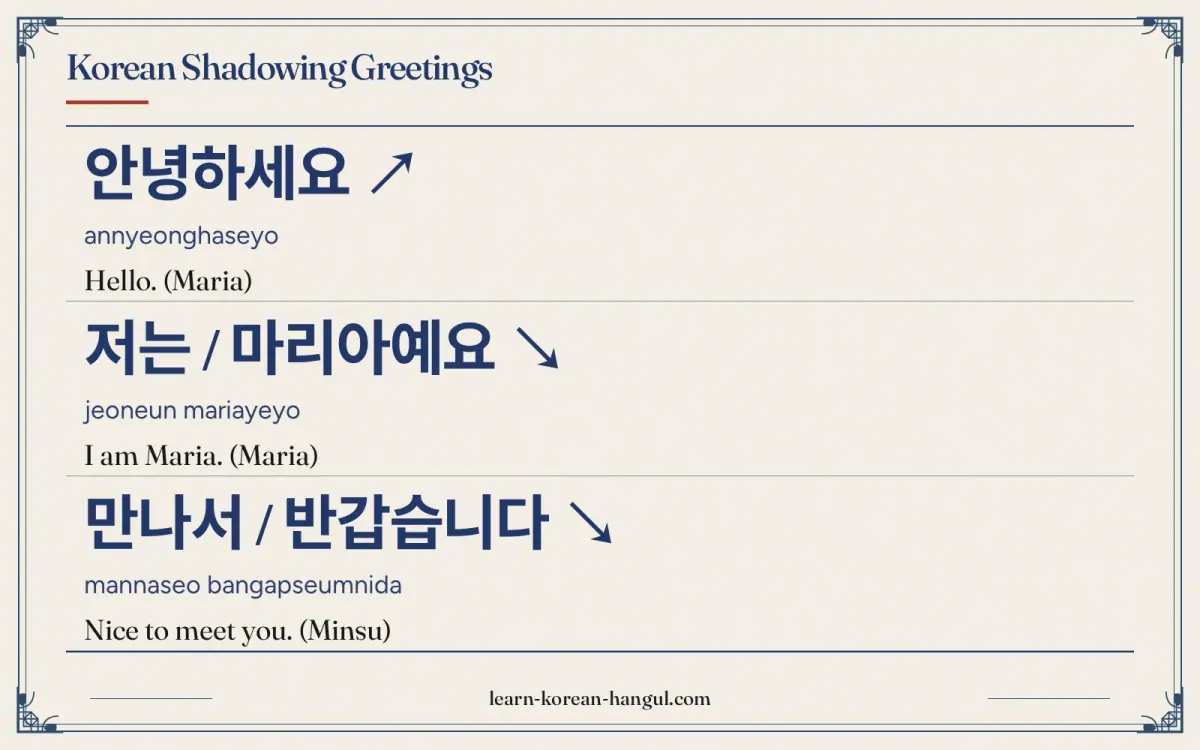
Lines 1 to 4 cover the opening, naming and the first expression of pleasure. Maria speaks lines 1 and 3, and Minsu speaks lines 2 and 4.
안녕하세요 ↗
annyeonghaseyo
Hello. (Maria)
안녕하세요. / 저는 민수예요 ↘
annyeonghaseyo. jeoneun minsuyeyo
Hello. I am Minsu. (Minsu)
저는 / 마리아예요 ↘
jeoneun mariayeyo
I am Maria. (Maria)
만나서 / 반갑습니다 ↘
mannaseo bangapseumnida
Nice to meet you. (Minsu)
Lines 1 to 4 introduce both people, so lines 5 to 8 can move toward the goodbye.
Script Lines 5 to 8
Lines 5 to 8 return the pleasantry, look back on the meeting and part. Maria speaks lines 5 and 7, and Minsu speaks lines 6 and 8.
저도 / 반갑습니다 ↘
jeodo bangapseumnida
Nice to meet you too. (Maria)
오늘 / 만나서 좋았어요 ↘
oneul mannaseo joasseoyo
I was glad to meet you today. (Minsu)
저도요. / 다음에 또 만나요 ↘
jeodoyo. daeume tto mannayo
Me too. Let us meet again. (Maria)
네, / 안녕히 가세요 ↘
ne, annyeonghi gaseyo
Yes, goodbye. (Minsu, to the person leaving)
Before checking yourself, compare the two ways of saying "glad to meet you" in the set.
| Phrase | Style | When it fits |
|---|---|---|
| 만나서 반갑습니다 | formal (-ㅂ니다) | first meetings, work, any time you want to sound careful |
| 만나서 반가워요 | polite (-요) | the same moment, a little softer and more relaxed |
| 다음에 또 만나요 | polite (-요) | parting after a pleasant meeting |
What Is the Speed Ladder?
The speed ladder is a fixed order of speeds that you climb only when the step below feels easy. In a greeting exchange the first climb is the hardest, because the lines are short and arrive quickly.
| Step | Speed | Script | Move up when |
|---|---|---|---|
| 1 | Slow (0.8x) | visible | you finish both roles without losing the beat |
| 2 | Normal | visible | the exchange sounds like one conversation |
| 3 | Normal | hidden | you finish with the natural rhythm and few stumbles |
A stumble is a hesitation, a repeated syllable or a lost beat. Aim for a smooth run, then re-record yourself after a few days to compare.
How Do I Check Myself?
Record both roles, then listen once and tick the checklist. Aim for the natural rhythm, not for a perfect accent.
- Opening pitch. Does 안녕하세요? lift lightly, and do the other lines fall?
- Tense and nasal. Do you say [반갑씀니다] with closed lips on ㅂ?
- Your name. Does 예요 or 이에요 follow your name smoothly?
- Linking. Do you say [다으메] and [조아써요] without a break?
- Beat. Do the lines of the two speakers join without a silent gap?
Pick one point to fix before the next session.
Worked Example: 안녕하세요? 만나서 반갑습니다
Take the two phrases that open every meeting and separate them.
안녕하세요? 만나서 반갑습니다.
annyeonghaseyo? mannaseo bangapseumnida
Hello. Nice to meet you.
- Hear it. You hear [안녕하세요 만나서 반갑씀니다]. The first group lifts lightly and the second falls.
- Split the written form. 안녕하세요 (hello) + 만나- (meet) + -아서 (so, because) + 반갑- (glad) + -습니다 (formal ending).
- Match the sounds. The final ㅂ of 갑 stays closed, ㅅ becomes tense, and the ㅂ turns nasal before ㄴ, which gives [씀니다].
- Shadow it. Speak a beat behind: "man-na-seo ban-gap-ssum-ni-da", falling on 다.
The polite alternative follows the same path but without the nasal and tense sounds.
In the polite version the ㅂ of 반갑- changes to 우, giving 반가워요, because 반갑다 is a ㅂ-irregular adjective. Next, look at the slips that learners make most often.
What Mistakes Do Learners Make Here?
Learners often assume that a greeting must rise at the end. In Korean only some openers do, and four slips are common.
- Raising the pitch on every line. Only 안녕하세요? gets the light lift. Lines 2 to 8 fall gently at the end.
- Pronouncing 반갑습니다 as "ban-gap-seum-ni-da". The spoken form is [반갑씀니다]. Close your lips on ㅂ, then say a tense 씀.
- Putting 이에요 after a name that ends in a vowel. After a vowel, say 예요: 마리아예요. After a consonant, say 이에요: 존이에요 (John).
- Saying 가세요 when you are the one leaving. 안녕히 가세요 goes to the person who leaves. When you leave, say 안녕히 계세요 to the person who stays.
Checking all four takes one short quiz, so the practice below tests them.
Practice and Answer Key
Answer from memory, then check the key.
- How is 반갑습니다 pronounced?
- Your name is 에밀리 (Emily). Which ending follows it: 예요 or 이에요?
- Which line closes the exchange with "let us meet again"?
- You are leaving and the other person is staying. Which goodbye do you say?
Answers
- [반갑씀니다]
- 예요, because 리 ends in a vowel: 에밀리예요.
- Line 7, 다음에 또 만나요.
- 안녕히 계세요, because you say it to the person who stays.
Where to Go Next
Shadow the set again tomorrow with the script hidden. When the exchange feels natural, continue with Korean shadowing ordering food, which moves from meeting a person to ordering a meal. If you want to go back a step, Korean shadowing daily routine has the shorter lines. Pitch is explained in Korean intonation, and more scripts are in Korean shadowing.
What this set does not cover. It does not teach the full greeting range, such as morning, evening or festival greetings, which have their own phrase pages. The audio is generated by text-to-speech and checked by a Korean teacher before publication, so real speakers vary in speed. Shadowing builds rhythm and sound, not new vocabulary.
Return to this Korean shadowing greetings set whenever the first minute of a meeting feels shaky.
Frequently Asked Questions
Why is 반갑습니다 said [반갑씀니다]?
Two rules act together. After the closed ㅂ of 갑, the ㅅ of 습 becomes the tense [ㅆ]. Then the final ㅂ of 습 turns into [ㅁ] because a nasal ㄴ follows it. The spelling stays 반갑습니다, but the sound is [반갑씀니다], and Revised Romanization writes it bangapseumnida.
Does 안녕하세요 rise at the end?
It can, lightly. A friendly 안녕하세요? with a small upward lift sounds warm and welcoming, as in line 1 of this set. A flat or gently falling 안녕하세요 is also normal. What you should avoid is copying the strong English rise, which makes the greeting sound like a real question.
Where does my name go?
Put your name before 예요 or 이에요 in the pattern 저는 ___예요. After a name that ends in a vowel, use 예요, as in 저는 사라예요. After a name that ends in a consonant, use 이에요, as in 저는 존이에요. Keep the same gentle fall at the end.
Is 다음에 또 만나요 formal?
No. It is in the polite -요 style, so it is friendly and suits a new acquaintance, a classmate or a colleague. A formal version would use the -ㅂ니다 ending. In the set, only 반갑습니다 is formal, because it is the fixed phrase for first meetings. Use 다음에 또 만나요 when you hope to meet again.