How Do You Play Korean Wordle?

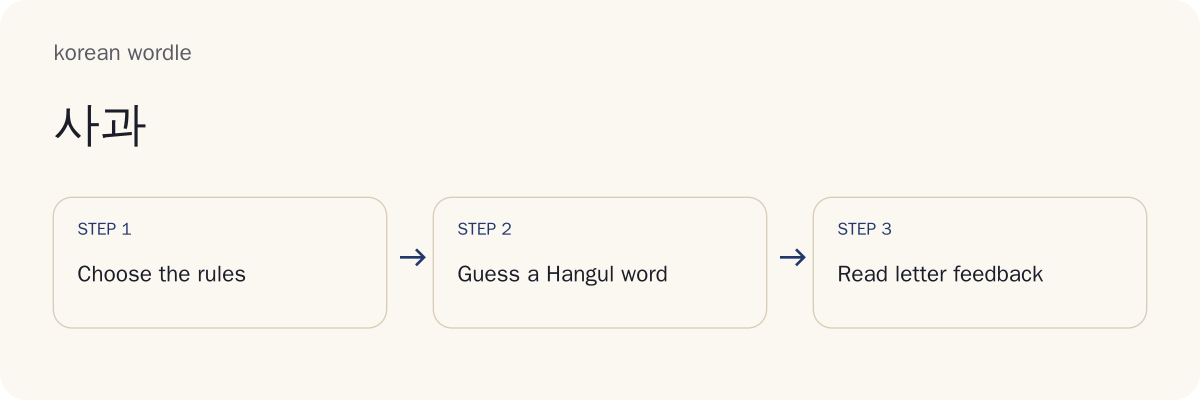
Play by choosing a spelling rule, entering an eligible guess and using the labels to narrow the answer. The core game gives six tries. Private supplied-key practice is available now; a public daily puzzle needs a complete eligible word bank and answer schedule before it can run dependably.
Read the selected rule before using a clue. A tile can represent a whole syllable, a written component or an expanded game token. The same displayed Korean text can therefore produce different boards without changing its spelling.
1. Choose a Spelling Rule
Choose a rule whose units you understand. Syllable comparison treats a block as the unit. Component rules inspect its initial, vowel and final parts, while expanded rules apply an additional splitting policy.
Keep that choice fixed during a puzzle. Your checkpoint is being able to explain what one position on the board represents. If you cannot, open the rule explanation rather than treating the tiles like English alphabet letters.
2. Enter a Word and Check the Clues
Enter a word that matches the selected puzzle's requirements, then submit it after completing any keyboard composition. A rejected guess-list check does not spend a try. Read the message and adjust the input or record an omission.
After an accepted submission, inspect the exact, present and absent labels. Your next guess should test a specific remaining possibility. Avoid immediately removing every letter with an absent copy; repeated tokens need closer reading.
3. Review the Meaning and Save a Word
When you finish, compare the answer with its supplied meaning. A private custom puzzle's gloss comes from its supplied data, so confirm uncertain meanings rather than assuming that winning verifies them.
Save a useful item locally and note what you learned about its spelling. One saved word understood well is a clearer learning result than a long list of answers you cannot recognise later. First, learn how the tile labels support that deduction.
What Do the Tile Labels Mean?
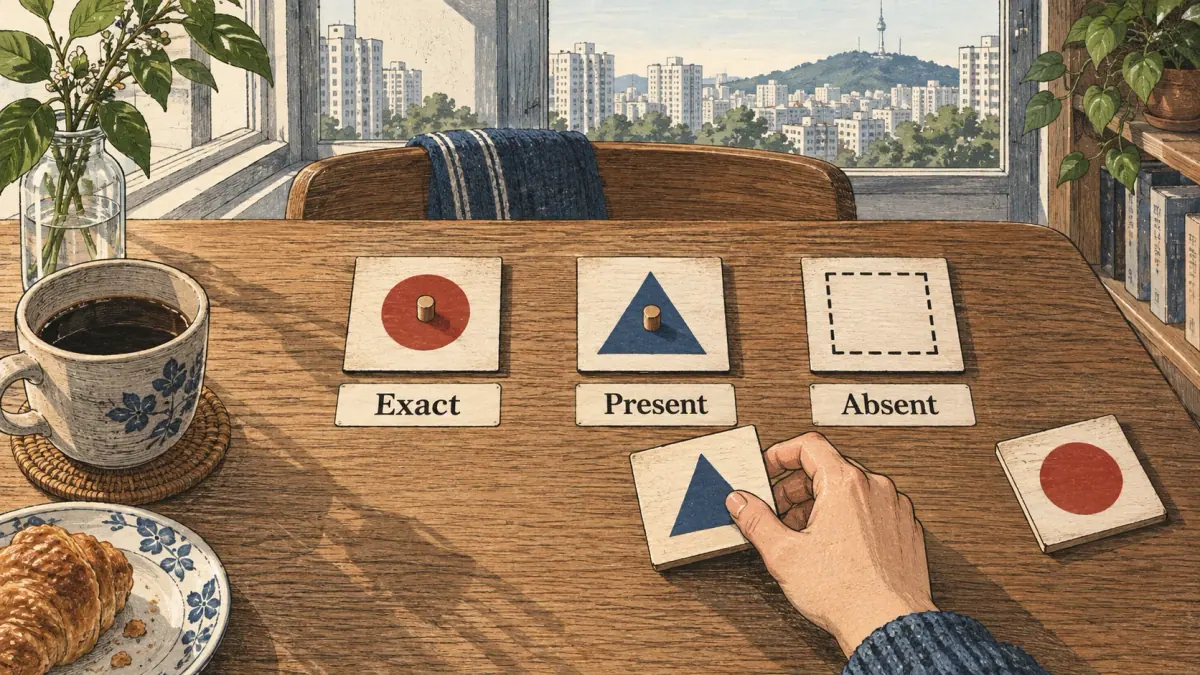
Exact means that the comparison token matches the answer at that position. Present means an available answer copy exists elsewhere under the selected rule. Absent means that this guessed occurrence has no remaining match. These labels describe occurrences, not necessarily every copy of a letter.
| Label | Information It Gives | What It Does Not Establish |
|---|---|---|
| Exact | Matching token at this position | That another guessed copy must also occur |
| Present | An unused matching copy elsewhere | The specific position where it belongs |
| Absent | No remaining match for this occurrence | That a positive copy elsewhere should be discarded |
Use labels and symbols as well as colour. A coloured pattern alone can be difficult to read, particularly when comparing many guesses. The rule name is also part of the clue: role-aware comparison distinguishes written positions that a global rule may combine.
Exact, Present and Absent Examples
Consider a symbolic answer A–B–C and a guess A–C–D. A is exact, C is present and D is absent. These symbols demonstrate the matching process; they are not Korean words or an eligible guess list.
Read the clue as three statements: keep A here, move C elsewhere and do not allocate an answer copy to this D. A second guess can test C's location while checking another token. In a role-aware Korean board, the permitted matching positions also depend on the component's role.
An empty final slot is a structural state, not an extra pronounced letter. Follow the selected policy's treatment of it. Duplicate counting explains why a later absent label may seem to conflict with an earlier positive one.
Why Can the Same Letter Be Both Right and Absent?
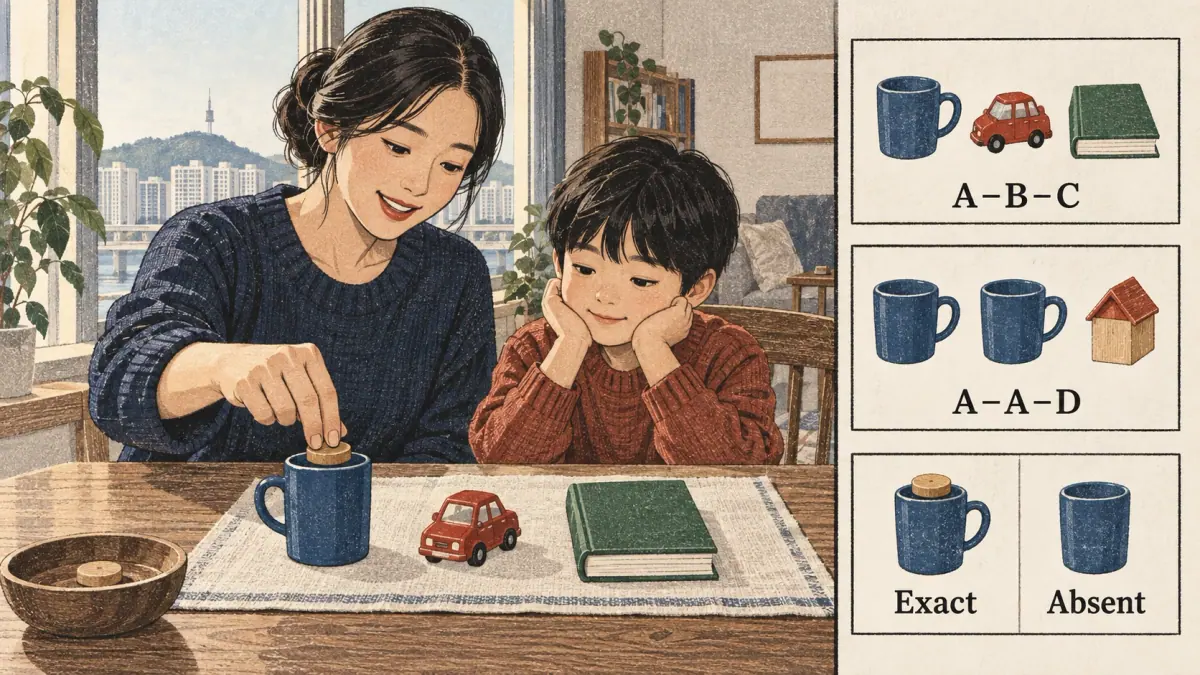
The same letter can have an exact or present copy and an absent surplus copy because the answer contains only a limited number of occurrences. Each positive match uses one answer copy. Extra guessed copies cannot reuse it.
For a symbolic example, let the answer be A–B–C and the guess A–A–D. The first A is exact. The second A is absent because the only answer A has already been used. D is also absent. The clues say “one A here,” rather than “A is both allowed and forbidden.”
This is a counting deduction. Keep the positive copy and use the absent copy to limit how many copies remain possible. Removing A from all future guesses would ignore the strongest clue you have.
How Are Repeated Letters Counted?
Repeated letters are counted in two passes. First, exact positions are marked and their answer copies are consumed. Second, the remaining guessed occurrences are compared with the unused answer copies. A match consumes another copy; a surplus occurrence is absent.
For answer A–A–B and guess A–B–A, the first A is exact. The remaining B and A can each match an unused copy elsewhere. Both receive present labels. The answer has two copies of A, so both can earn positive feedback.
The keyboard summary cannot replace this row-by-row information. A letter may have a positive overall status while one occurrence in a particular guess is surplus. Count the positive copies within the selected comparison rule before applying a hard-mode constraint. Understanding the comparison units makes that counting more reliable.
Syllables, Atomic Jamo and Expanded Letters
A syllable rule, an atomic-component rule and an expanded rule count different units. These are game policies, not competing claims about how Korean must be pronounced.
Syllable rules compare complete written blocks. Atomic-component rules retain a compound vowel or tense consonant as a single token. Expanded policies can split selected compound shapes into basic tokens. Role-aware rules additionally distinguish an initial consonant from a final consonant with a similar shape.
The syllable builder gives 과 as an example. Its occupied slots are ㄱ and ㅘ. A keyboard-level expansion gives ㄱ, ㅗ and ㅏ. One block can therefore correspond to two occupied component slots or three expanded tokens, depending on the declared policy.
Unicode decomposition and game expansion are also different operations. A computer can expose the canonical initial, vowel and final without splitting every compound shape into its keyboard-level parts. The game should identify its own expansion rather than implying that all token counts are universal.
Learn what jamo means if the individual shapes are unfamiliar. Learning how Hangul blocks combine clarifies which letters occupy each position.
How Many Tiles Does 한국 Need?
한국 has two written blocks. The syllable-block lesson shows 한 as ㅎ + ㅏ + ㄴ and 국 as ㄱ + ㅜ + ㄱ. Counting occupied atomic components gives six: three in each block.
These particular components do not require compound-shape expansion, so the expanded occupied-token count is also six under that policy. This example shows why expansion does not always increase a count.
A layout that displays initial, vowel and final cells is describing positions, while a compressed token row is describing counted items. Check the rule label before comparing boards. A different word containing a compound vowel can produce a different relationship between the counts.
Can a Beginner Play without a Korean Keyboard?

A beginner can use the touch letter bank without installing a Korean keyboard. Knowing the basic jamo and block structure still helps: an input aid lets you choose letters, but it does not identify the hidden word for you.
Use the displayed bank to construct a complete guess and check the preview before submission. If you choose candidate-word assistance, treat that as support for the attempt rather than independent recall. A supplied list can narrow possibilities beyond the information you deduced yourself.
Keyboard and touch entry should lead to the same intended written text. When an input looks unexpected, inspect the whole block rather than adding more letters blindly. Remove or rebuild the affected portion before using a try.
Native IME and the Touch Letter Bank
A native input method, or IME, combines source letters into Korean blocks. While a syllable is still being composed, an Enter key can finish composition rather than submit the guess. Complete the block and check its preview before submitting again.
The touch bank offers another route, including when your physical keyboard uses a different layout. Keep initial, vowel and final roles in mind as you assemble the text. An unfinished component sequence is not necessarily a dictionary word.
If block construction is the difficulty, pause the puzzle and build a Hangul syllable. Practice there isolates composition from guessing, so a keyboard problem does not become a misleading deduction problem.
Daily Puzzles, Practice and the Archive
Daily, private practice and archive play have different sources and expectations. A daily puzzle needs a stable public answer schedule and eligible word bank. Those materials are not supplied as a complete public daily service here. Private supplied-key puzzles let you practise the engine now.
A practice puzzle does not become an official daily result merely because you play it on a particular date. Keep its rule, source and assistance information with the session. An archive entry also needs an actual retained puzzle; the interface cannot recreate a missing public answer schedule.
Version information matters when saving a game. Changes to comparison policy or the accepted list can change what a guess means. A retained session should keep the original rule instead of silently being interpreted by another policy.
Treat availability messages as practical guidance. Choose a supported private puzzle rather than assuming an empty daily board means you entered the wrong Korean word.
When Does the Korean Day Change?
The daily date policy uses midnight in Korea Standard Time, UTC plus nine hours. As a time-zone calculation, 15:00 UTC begins the following Korean calendar day. This boundary describes the policy; it does not imply that a public answer is available for every date.
A saved session keeps its original date and rule across midnight. Starting another day's session is deliberate, so a nearly finished game does not need to be discarded just because the clock changed.
Check the displayed date when comparing results. Local midnight in another country can fall at a different point in the Korean day. Hints and assistance give another reason that two results need context before comparison.
Hints, Difficulty and Hard Mode
Hints give optional help, while hard mode restricts later guesses using information already revealed. Choose the kind of practice you want before comparing your result with someone else's.
A category or initial clue can narrow the possibilities without directly naming the word. A meaning, picture or audio hint may reveal much more, depending on the supplied puzzle data. Hints remain hidden until requested, so you can try the deduction independently first.
An assisted result can still be useful learning. Its value is in what you understood afterwards, not in presenting it as the same task as an unaided solve. Keep assistance information attached to your record.
Hard mode follows the selected policy's positive clues and duplicate limits. A single present token does not justify guessing unlimited copies of it. Likewise, an absent surplus copy must not erase an exact occurrence. Apply the counted clue information rather than a broad “use every coloured letter” rule.
Difficulty also comes from word familiarity and token policy. A short word can be difficult when its spelling is unfamiliar; a more detailed board can reveal more information while requiring more component knowledge.
Which Hints Reveal the Answer?
An answer reveal gives the solution directly. Other hints can become effectively revealing when they leave only one familiar possibility. A private puzzle's supplied meaning or image may identify its answer even though it is called a hint rather than a reveal.
Ask for help intentionally and keep its effect in mind. If your goal is spelling practice, a meaning hint may be appropriate. If your goal is independent deduction, postpone it until you have used the row clues.
Do not assume that media hints exist for every puzzle. Supplied private data determines their availability; a complete public collection of licensed pictures and audio is not provided. The worked structural examples below need no imagined media.
Worked Examples with Hangul Words
Four structural examples use letters and blocks already present in the site's jamo and syllable lessons. They explain comparison policies rather than expose a current daily answer. Meaning and pronunciation remain separate from the deterministic spelling operations.
과 and the Compound Vowel
Input: inspect 과. Syllable output: one complete block. Atomic output: ㄱ and ㅘ. Expanded output: ㄱ, ㅗ and ㅏ under the splitting policy illustrated by the syllable builder.
An exact match in syllable mode establishes the whole block at that position. An exact atomic vowel establishes the selected vowel token. An expanded clue supplies information about one expanded position instead. These outputs answer different questions.
Do not call the atomic vowel two tiles merely because its shape has several strokes. Follow the policy, and return to the full block when reading the text.
ㄲ and a Tense Consonant
Input: inspect ㄲ from the jamo lesson. Atomic output: one tense-consonant token. Expanded game output: two basic ㄱ tokens under the explicitly defined expansion policy.
The written tense consonant does not turn into two independently pronounced consonants because a game displays two tiles. Game expansion is a comparison convention. It can change duplicate counts and clue positions while leaving the intended written letter unchanged.
Check the rule before interpreting feedback for this token. One exact atomic match and two expanded matches are different representations of the same supplied shape, not different pronunciation instructions.
국 and Two Roles for ㄱ
Input: inspect 국 from the syllable-block lesson. Occupied roles: initial ㄱ, vowel ㅜ and final ㄱ.
A role-aware comparison keeps the initial and final consonant positions distinct. A positive clue about the initial does not by itself confirm the final. A global component policy can instead count matching shapes across its defined positions.
This is why the policy name belongs beside the result. Two boards can legitimately give different information about similar-looking letters. Neither result establishes how the final consonant sounds in connected speech; this tool compares spelling.
한국 and Repeated Letters
Input: inspect 한국 using its six occupied components. 국 contains two ㄱ shapes in different roles. Under a global shape-counting policy, the answer's inventory includes two copies; under a role-aware policy, their roles also matter.
A guess using three comparable copies could receive positive feedback for available matches and an absent label for a surplus one. Which copies match first depends on exact positions before remaining-copy allocation.
Count within the selected rule, and retain the positive occurrence when another is absent. This connects a real written structure to the earlier symbolic duplicate examples without inventing a new Korean guess or meaning.
Can Friends Solve the Same Puzzle?

Friends can practise the same private supplied-key puzzle by sharing the intended custom settings. This is asynchronous play: each person works through their own session. Hosted live rooms and trusted public rankings are not supplied here.
Distinguish a result share from a custom challenge link. An ordinary result grid excludes the answer and gloss. A personal challenge fragment contains a decodable answer, so it is not a secure hidden-answer mechanism. Someone inspecting it can recover the solution.
For classroom practice, share a puzzle only after checking its spelling, meaning and selected rule. Decide whether hints are allowed and explain what the score represents. A shared task is easier to discuss when everyone uses the same token policy.
Keep personal media and progress exports separate from the challenge. Sending a custom puzzle need not send a private collection or someone else's recordings. Advanced modes introduce additional comparison requirements.
Advanced Word-Game Modes
Advanced modes change the task structure rather than certify a higher Korean level. A multiboard game asks you to track more than one answer, and each board needs its own clue interpretation and stated attempt limit. Do not assume that every advanced mode inherits the core six-try rule.
A ladder task uses its declared one-change policy. “One change” must refer to the selected units: changing a block and changing an expanded component are different operations. Read that definition before judging whether a move fits.
A sequence challenge can add time pressure or ask you to continue across puzzles. Keep timing, pauses and assistance visible when comparing performances. Quickly selecting familiar shapes does not by itself show that you understand word meanings.
Choose a single-board private puzzle when a complex layout makes it difficult to explain your clues. Increasing the number of boards is useful only if the extra task supports what you want to practise. Saved statistics need the same careful interpretation.
What Happens to Saved Words and Statistics?

Saved words and statistics remain local to this browser unless you deliberately export or share them. Use the private collection to retain an answer, supplied meaning and a note about its spelling. Keep uncertain meanings marked for your own follow-up rather than assuming that a successful solve has verified them.
A result distribution describes attempts under its recorded settings. An assisted private solve, an imported result and an unaided solve are different records. Imported solo results remain private and unverified; they do not enter trusted public rankings.
Export JSON before moving devices or clearing browser storage. Import into the intended browser and confirm that the records refer to the right game and rule. A backup preserves the data you exported, not every external media source or future public puzzle.
Offline private packs also depend on what you saved explicitly. Test the exact puzzle and its available hints before disconnecting. Keep collection review separate from deduction: return to a saved spelling later and try to recognise it without the previous grid. Limits and omission handling complete that routine.
Limits, Accessibility and Word-List Corrections
A selected game's guess list is narrower than the Korean language. A familiar spelling can be absent from the list without being declared non-Korean. An explicit local omission report retains the word, rule and bank version without spending a try.
Use textual labels, symbols and keyboard or touch controls rather than relying on colour alone. Finish IME composition before submitting, and choose a simpler policy if component roles are unfamiliar.
The game checks written tokens. It does not score pronunciation, validate every private gloss or provide an official language assessment. Offline readiness covers saved material, while public daily availability depends on the missing complete bank and schedule. Preserve the exact puzzle information when asking about a surprising result.
Frequently Asked Questions
Can I Finish Yesterday's Puzzle after Midnight?
A saved session retains its original date and rule across midnight. Starting a new day is an explicit action; daily puzzles are currently unavailable.
Why Does a Familiar Korean Word Fail the Guess-List Check?
It may be absent from the selected game's list. That does not declare the spelling non-Korean. An explicit local omission report preserves the word, rule and bank version without spending a try.
Does Sharing a Result Reveal My Answer or My Account?
Ordinary result grids exclude the answer, gloss and private media. A personal challenge fragment contains a decodable answer; the custom creator explains this before copying a link.
Can I Move My Saved Games to Another Device without Signing In?
Yes. Export private progress as JSON and import it into another browser. Imported solo results stay private and unverified; they do not enter trusted public rankings.
Do Tense Consonants Always Use Two Tiles?
No. Atomic rules retain a tense consonant as one token. The explicitly defined expanded game policy splits it into two basic consonants. This difference describes game spelling tokens rather than pronunciation.
Your Next Korean Wordle Practice
Choose one Korean Wordle spelling rule and finish a supported private puzzle. Then explain a duplicate clue and revisit one saved item without its grid. If composition caused trouble, use the Hangul syllable builder before guessing again. Keep meanings and pronunciation as separate learning tasks.