[TOOL: SeoulTransitEstimator]
Seoul Transit Pass Calculator: Current Facts
Start with the date of travel, because fare and coverage policies have effective periods. The current short-pass reference used here was updated by Seoul on October 1, 2026. It lists one-, two-, three-, five- and seven-day load prices separately from a physical card purchase. The calculator retains that policy version and the date checked. A selected future date remains an entered scenario, not a guarantee that every fare or coverage rule will remain unchanged.
The ordinary adult rail example uses a 1,550-won card base fare effective after June 28, 2025. It applies to the ordinary short-distance rule; distance supplements and special operators can change a complete route fare. The average-fare input remains editable. A bus boarding is not automatically a separate base fare when it forms part of an eligible transfer group. Count independently charged journeys for the quick comparison.
Current Policy Intervals
The old thirty-day prepaid Climate product is not offered for new current loading. Its published transition allowed the last reload on August 31, 2026 and last use on September 29; the former postpaid benefit ended September 30. Historical price rows on an older page do not reopen those products. Resident Climate Pass reimbursement is a separate system and must not replace a tourist unlimited-pass comparison.
How to Use the Calculator

- Choose the travel start date and stay length. The result preserves the date rather than using the browser’s location as a Korean service day.
- Enter independently charged journeys per day and an appropriate ordinary fare. Use itinerary mode when travel varies across dates.
- Check existing card ownership. A new Climate card and an already owned payment card are different acquisition assumptions.
- Add excluded airport, intercity or special-operator costs. Confirm coverage before accepting a pass result.
- Press Calculate, inspect the load plan and copy the assumptions with the total. Save locally only if you want the plan retained.
What Counts as One Chargeable Journey?
A journey group can contain several eligible boardings under the transfer rules. For example, an eligible tagged ordinary metro-and-bus chain within the permitted window can charge one basic group fare plus any distance supplement. Adding a new base for both boardings would exaggerate pay-as-you-go cost and make a pass look better than it is. The transfer editor keeps boarding events and charged groups separate.
Use the advanced day editor for no-travel days, expensive journeys and excluded segments. A day with zero travel still occupies a calendar position; it is not deleted from the pass validity interval. Preserve quiet days between two busy dates. The optimizer can choose separate short loads with pay-as-you-go travel between them rather than assuming that one continuous pass covers every stay optimally.
How Are Seoul Subway Fares Calculated?
For ordinary adult card rail travel, the displayed source rule starts at 1,550 won for the first ten kilometres. Beyond that, begun five-kilometre bands add 100 won through fifty kilometres, followed by begun eight-kilometre bands. The calculator uses whole source-backed metres so a boundary is handled deliberately. A distance of 10,000 metres has no supplement; 10,001 metres enters the first extra band.
The selectable formula is: base plus increment multiplied by the sum of the begun bands between ten and fifty kilometres and the begun eight-kilometre bands beyond fifty. Registered teen and child examples use their distinct base and increment. This formula does not establish a special-line, airport-zone or complete metropolitan fare. Operator tables override generic distance arithmetic where their rules differ.
How Do Card, Cash and Deposit Costs Differ?
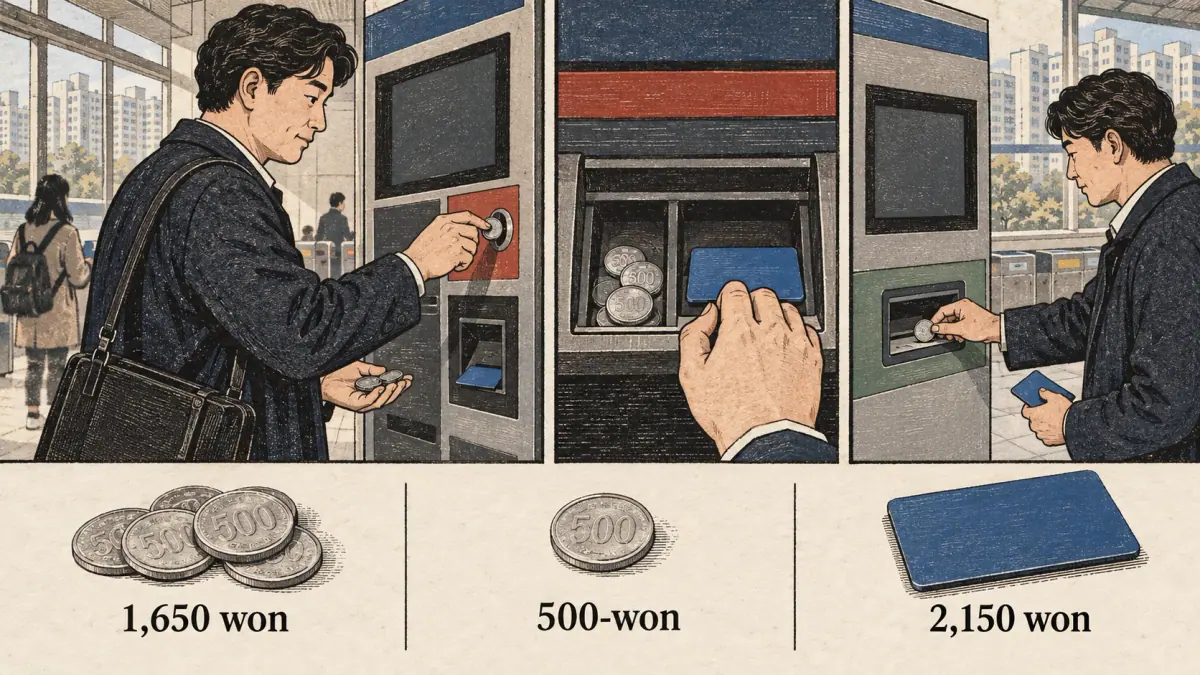
The ordinary short-distance adult card base is 1,550 won, while the cited cash single-ride adult base is 1,650 won. A refundable single-use ticket deposit is a separate 500-won cash requirement. Paying 2,150 won initially does not mean the ordinary fare is 2,150 if the deposit is returned. Keep fare, initial cash and final net expense in different fields.
The referenced teen cash base differs from a registered teen card fare. A child cash case uses its own source rule. Existing transit credit and a prepaid payment facility are also separate balances. Buying a card, loading spendable credit and consuming a fare are three events; adding every top-up to expense can count unused credit as though it were already spent.
Distance Bands and Age Categories
At 15,000 metres, the ordinary adult card example is 1,650 won; at 15,001 metres it becomes 1,750. At 50,000 metres it is 2,350, and 50,001 metres begins the next eight-kilometre band at 2,450. A registered teen example at 15,001 metres is 1,060; a registered child example is 650. Confirm the operator’s registration and category rules before using a discounted fare.
Early boarding uses a published discounted basic fare rather than discounting every supplement blindly. The tested minute boundary distinguishes 06:29 from 06:30. The ordinary early card bases in the retained source are 1,240 adult, 720 teen and 440 child. Special-line and transfer credit exceptions still require their own confirmed policy. A clear ordinary estimate is more useful than a falsely exact network-wide fare.
When Does a Transfer Add a New Fare?
Eligible card transfers normally use a thirty-minute window, with a sixty-minute night window determined by the next boarding time. The retained rule also limits a group to four transfers, or five boardings. Required tagging, route restrictions and the same-card condition matter. Reboarding the same bus route or vehicle is not automatically an eligible discounted transfer. Missing tap-out metadata prevents an unconditional discount assumption.
The editor records next boarding time, gap seconds, distance, route, mode and tags. Exact endpoints are tested, including a thirty-minute gap versus thirty minutes and one second, and the night-to-day boundary. These are source-based proposed policy fixtures awaiting transport review; the calculator does not certify every operator exception. When a group includes a special mode, enter its verified fare policy or retain uncertainty.
Current Tourist Cards and Short Passes

The referenced short-pass load prices are shown below. Each is distinct from any new physical media purchase. Existing media costs nothing new in the comparison. The optimizer considers these durations together, so a stay length does not force the same-length product. A seven-day load can tie a combination covering six active days, while a sparse week can favor two one-day loads.
| Short-pass duration | Load price, KRW | New physical media reference |
|---|---|---|
| One day | 5,000 | 3,000 once |
| Two days | 8,000 | 3,000 once |
| Three days | 10,000 | 3,000 once |
| Five days | 15,000 | 3,000 once |
| Seven days | 20,000 | 3,000 once |
Does the Pass Price Include Its Card?
The load and the card are separate in this calculation. A five-day 15,000-won load with new 3,000-won media costs 18,000 before any excluded travel or backup-card acquisition. Reusing that physical card for a later eligible load does not buy the same hardware again. Check whether you actually own compatible media and whether an existing period permits the proposed next load.
Pay-as-You-Go Payment Cards
The product editor includes T-money or EZL, T-money Travel Card, Travel Card Plus, WOWPASS transit facilities and Mpass. Retained references show Travel Card media at 4,000 won, Plus at 6,000 and WOWPASS at 5,000, while ordinary card designs can have different purchase prices. Enter your actual hardware quote when needed. A payment-card balance is not automatically the same as transit credit.
Mpass operator validation remains necessary for deposit-inclusive prices, activation, after-17:00 conditions, the daily boarding definition and any twenty-first ride charge. A manually confirmed quote can be inspected, but an incomplete capacity rule cannot produce an automatic complete recommendation. Korea Tour Card new sales have ended according to the retained operator evidence; previous ownership is different from advising a new purchase.
Does the Pass Cover Your Route?
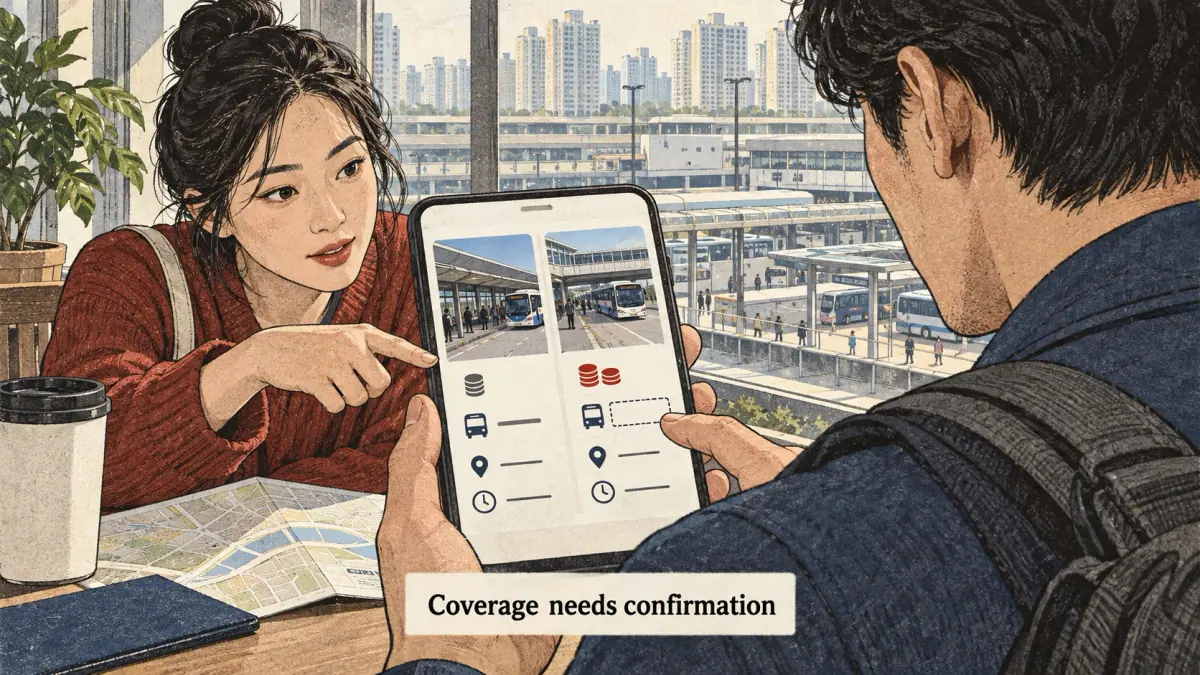
Coverage depends on the service, operator, direction and date. The October short-pass policy describes Seoul-region subway coverage with the stated Incheon airport exit exception. It excludes Shinbundang, GTX, other outside-area subway travel without an applicable exception, regional or airport buses and other-region licensed buses. A broad map label such as “within Seoul” cannot answer all of those questions.
Subway Stations and Exclusions
For a covered origin followed by a non-exception outside exit, retain the whole ordinary origin-to-destination fare. Do not charge only an imagined outside-zone supplement. The route view can load a real licensed Seoul Metro jurisdiction distance file, but that file does not cover the entire metropolitan network. Its topology reconstruction identifies disconnected branch starts and incomplete operators. The result therefore discloses the limitation instead of claiming an exact universal route.
Station fields accept Korean names and available English aliases from the selected records. A manual source-backed distance remains possible when the desired pair is absent. Check the official operator fare and coverage interface before relying on a special or ambiguous route. No private station-search backing endpoint is scraped to manufacture completeness. A complete licensed graph and every special fare table remain a separate data-release requirement.
Bus Licensing Versus Location
A qualifying Seoul-licensed bus can operate outside Seoul and still fit the cited coverage policy. Conversely, another region’s bus inside Seoul is not automatically covered. Confirm the licence region and eligible bus class rather than deciding from geography alone. Unknown operator data produces Coverage needs confirmation and leaves the winning plan conditional. Your explicit manual scenario can still compare costs without pretending the source metadata is complete.
Incheon Airport: Arrival and Departure Costs
The cited ordinary adult all-stop Seoul Station-to-Terminal1 card fare is 4,750 won; Terminal2 is 5,350. The operator has separate station pairs and zones, including a 1,200-won Terminal1-to-Terminal2 example. Its published table overrides the generic 1,550-won metropolitan base. Select the terminal and payment type, or enter an operator quote for a pair without a retained fare.
Why Can Airport Directions Differ?
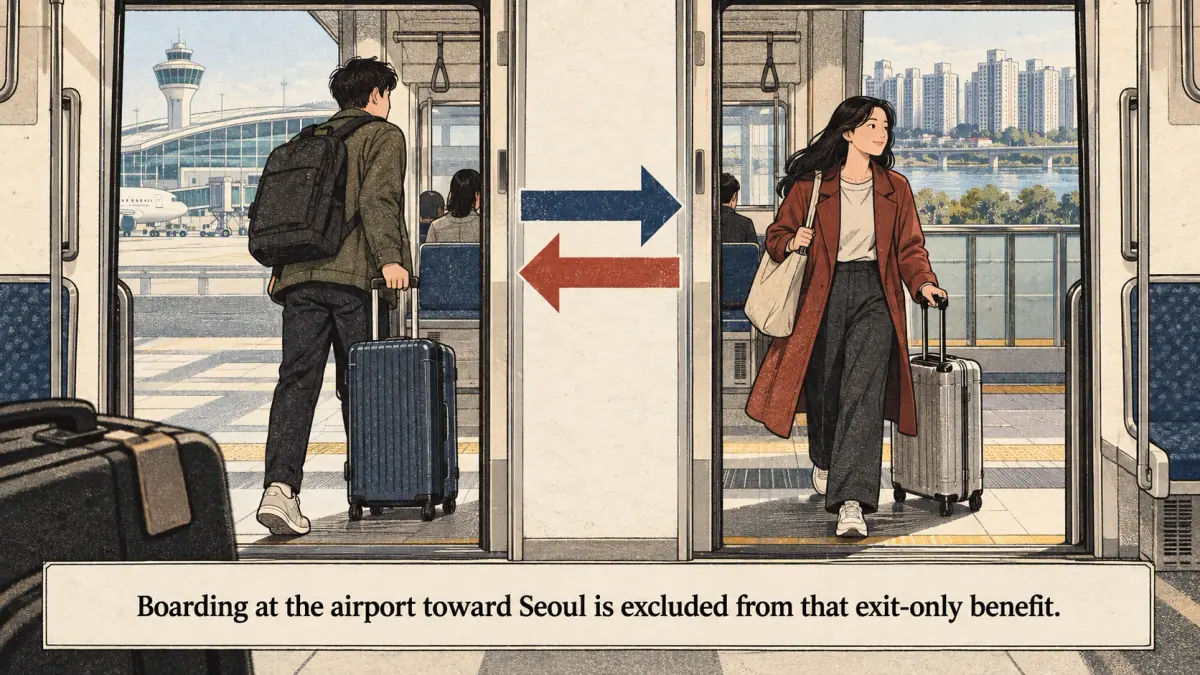
Under the current short-pass coverage reference, an eligible covered-origin all-stop journey may exit at Incheon Terminal1 or Terminal2. Boarding at the airport toward Seoul is excluded from that exit-only benefit. The calculator keeps arrival and departure separate. An airport arrival can therefore remain an ordinary extra fare even if a later departure qualifies under the active pass and confirmed origin conditions.
All-Stop, Express and Bus
An express train is a different product from the all-stop airport exit exception. Its dated offer, normal price and eligibility must be confirmed independently. Airport buses and taxis use their actual quoted conditions and remain excluded in this short-pass model. The manual field does not insert a universal airport bus or taxi price. Capacity, bags, terminal and late-arrival service conditions belong with the actual offer.
When Is a Climate Card Cheaper?

A strict quick break-even count is floor of pass load plus incremental media cost divided by a positive ordinary fare, then add one. The extra one matters: exact equality is a tie, not savings. With a new five-day card costing 18,000 and a 1,550-won fare, eleven charged groups cost 17,050 and favor pay as you go. Twelve cost 18,600 and let that specific pass save 600.
If you already own Climate media, a 15,000-won five-day load crosses strictly at ten 1,550-won groups. The nine-group pay-as-you-go cost is 13,950 and stays cheaper. Hardware shared by both alternatives cancels only when both actually need it. A zero ordinary fare has no finite break-even count. Excluded fares common to both choices cancel from the simple threshold but remain in the complete total.
The sensitivity view shows every duration’s crossover under the entered fare and ownership. It does not claim that four journeys per day is a universal answer. Different fares, transfers, quiet days and excluded routes change the result. If a pass needs a backup payment card for excluded services, include that acquisition under the stated ownership assumption. A mathematically precise comparison must still describe a feasible set of cards.
When Does Your Loaded Pass End?
A short pass follows service-day activation and the actual final-service boundary. A one-day load is not a rolling twenty-four-hour ticket. Loading at 23:00 can leave only the remainder of that service day. The preview identifies the last service date and an ordinary next-day boundary; confirm the actual timetable when a journey lies close to expiry. A supplied 03:45 endpoint must not be replaced with midnight or a next-evening expiry.
Which Refunds and Deposits Can You Reclaim?
The conditional Climate refund calculation subtracts ordinary fares used and a 500-won fee from the charged load, clamped at zero. Eligibility includes registration and requesting before expiry. Media remains spent. For a 15,000-won load with 6,200 won of normal usage, the conditional amount is 8,300. An unregistered card or expired request gets no assumed refund. Confirm the operator’s process and the stated foreign-visitor cash route separately.
Worked Examples with Complete Costs
For a five-day product covering twelve eligible charged groups at 1,550 won, pay as you go costs 18,600 and a new five-day Climate load plus media costs 18,000. The difference is 600 under those explicit assumptions. This example evaluates that product and coverage; a complete optimizer can inspect shorter loads when all the journeys fall on fewer active days. Distribution matters as well as total count.
With owned media and ten charged groups, the same five-day load is 15,000 versus 15,500 pay as you go. In a sparse seven-day itinerary with high travel only on the first and last dates, two one-day loads can total 5,000 plus 5,000 plus one 3,000-won card, or 13,000. The five quiet dates are retained. Recharging media does not automatically repurchase the physical card.
For eight consecutive days at 6,200 covered won per day, the tested minimum is 28,000 including new media. Seven-plus-one and five-plus-three loads can tie in cost. Six such active dates can yield a 23,000-won tie among a seven-day load and several two-load combinations; the displayed preference uses fewer loads while acknowledging equal costs. A tie preference is about practical plan structure, not invented monetary savings.
Add an excluded 4,750-won arrival separately when your confirmed airport direction requires it. A covered departure is considered only within a valid active load and eligible origin conditions. Do not remove both directions with one blanket airport checkbox. Exporting the selected scenario to the trip budget carries loads, media and outside costs; the budget import asks you to confirm exactly matched fare-service identifiers before suppressing old lines.
Eligibility, Resident Plans and Policy Changes
The current verified thirteen-to-eighteen teen seven-day product is distinct from ordinary card fare registration and from the resident youth category. Its retained load price is 13,000 won only after the required operator verification. A visiting seventeen-year-old does not receive that recommendation solely from age. Use the registration controls, and keep uncertain visiting-minor access conditional until the operator confirms the process.
Resident Climate Pass or K-Pass reimbursement needs current address eligibility, monthly qualifying rides, caps and repayment timing. A tourist without the required residence cannot substitute it for the short-pass plan. The resident editor is a labelled user-confirmed policy scenario while complete current primary thresholds remain a release gate. It does not collect registration numbers or imply that checking a box creates actual operator registration.
Limits, Local Saving and Corrections
The calculator retains at most ninety calendar days and two hundred charged journey groups per person for detailed planning. Larger imports fail with a clear limit error rather than truncating expensive days. Source monitoring matters: beyond a week the dated reference deserves a freshness warning, and older or announced-changing rules need confirmation. An observation checked recently does not override a closure already scheduled before your travel date.
Local plans and favorites are optional. Save, reopen, export or delete them without an account. Reopening asks for recalculation and policy checks. A loaded offline snapshot retains its source age; it cannot know a new fare announcement without a later update. Default sharing excludes private stations and dates. Include them only after reviewing the share setting. Copy and print retain assumptions; email sharing opens your own draft and never sends automatically.
Use the Korean number converter to read a won fare, and the Korean trip budget calculator to account for several journeys. The subway vocabulary guide explains transfer words, while Korean subway signs prepares you for station instructions. These language lessons complement the route conditions; recognizing a word does not prove pass eligibility.
FAQ and Your Next Seoul Transit Pass Calculator Check
Can I Recharge a Short Pass before Its Current Period Finishes?
Confirm the current operator’s reload rule before planning overlapping loads on one card. The optimizer uses sequential eligible load periods and does not assume simultaneous active short passes. Check the proposed load date and existing expiry with the official source; a hypothetical combination must also be operationally feasible.
What Happens If I Forget to Tap Out?
Missing required tagging prevents an unconditional transfer-discount calculation. Keep the journey uncertain and check the operator’s missing-tag charge or recovery process. The tool does not invent a universal penalty or silently apply the normal discount when its prerequisites are absent.
Can Two Travelers Share One Unlimited Pass?
No shared unlimited-card assumption is used here. Each traveler has an independent card profile and optimization. A family total adds their separate results, including ownership and verified discounts. Confirm the operator’s individual-card conditions before buying; one person’s eligibility does not transfer to another.
What Should I Do When My Card Has Credit Left?
Keep unused credit separate from fares already spent. Refund routes, limits and fees depend on the product and location, so inspect its current operator instructions. A payment facility can have a different balance from transit credit. The calculator does not guarantee that every remaining balance is refundable.
Does an Offline Saved Plan Know about a New Fare?
No. An offline plan retains its dated engine and source snapshot. It can calculate entered assumptions but cannot discover a newer announcement without updating. Check source dates after reconnecting and recalculate before treating the saved result as current.
Why Can Two Equally Priced Pass Combinations Differ?
Equal-cost plans can require different load dates, numbers of loads or card arrangements. The optimizer prefers fewer loads as a practical tie rule while showing that costs are equal. Inspect activation, expiry and travel gaps before choosing; a tie does not become a guaranteed saving.
Before using the Seoul transit pass calculator again, confirm the date, charged journey groups, media ownership, airport direction and coverage metadata. The current short-pass policy, verified discount policy, AREX ordinary fare page and Seoul Metro distance dataset support scoped facts with their own limits. Keep your source version with the result and continue through the tools hub or the Korean for travel course when preparing the language for the actual journey.