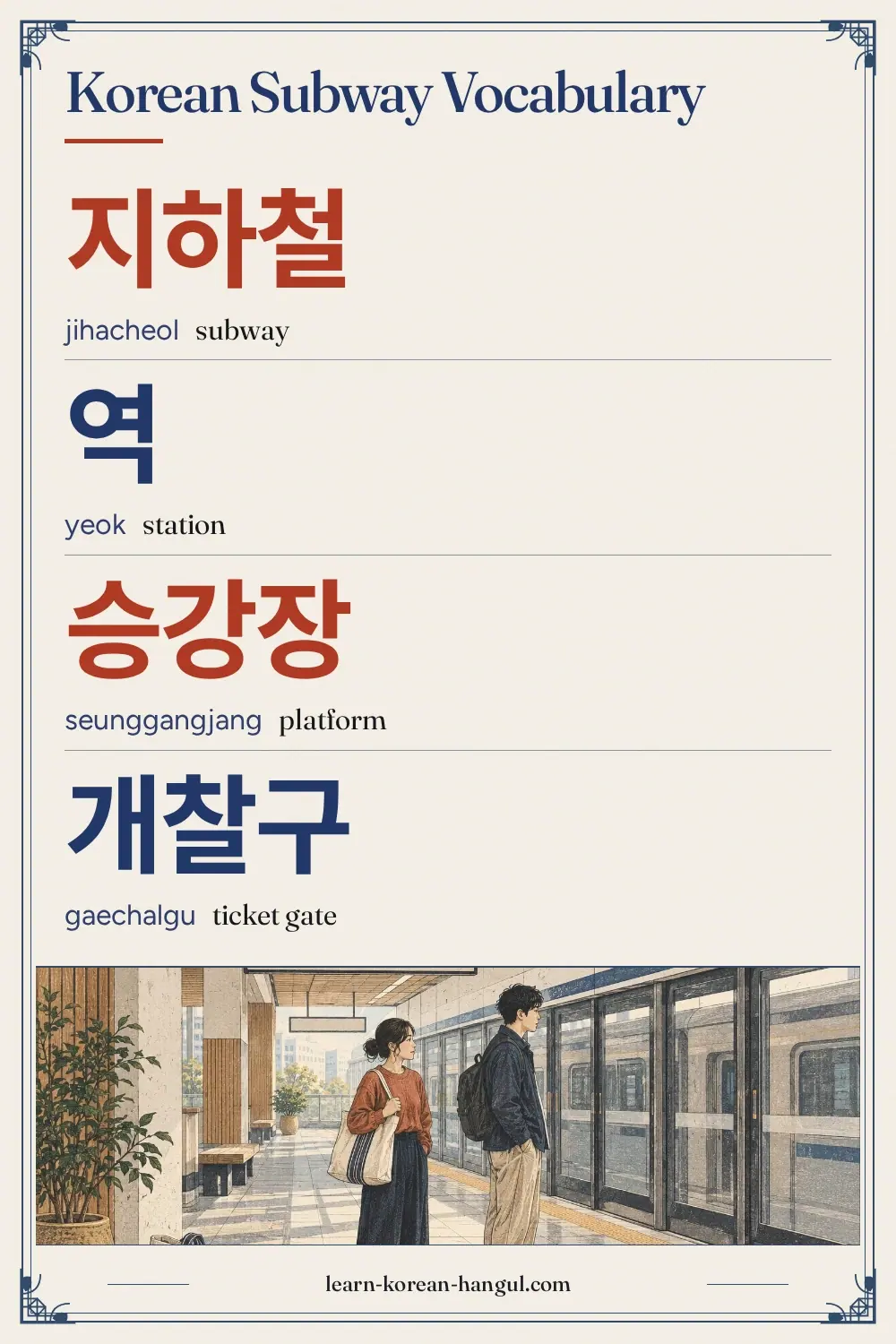
Korean Subway Vocabulary at a Glance
The list has 35 words in five groups of seven. It follows a ride in order: you enter a station, find the line, pay, listen to the announcements and change trains. It belongs to Transportation, and it is built for the Seoul-style system, where lines are numbered and every stop is announced in Korean.
| Group | Words | Use |
|---|---|---|
| Station parts | 7 | Gates, platforms, stairs and exits |
| Lines and directions | 7 | Reading a platform sign |
| Tickets and cards | 7 | Paying and topping up |
| Announcements | 7 | Understanding the train script |
| Transfers | 7 | Changing lines and the first and last train |
This page is a themed word list. If you only want the single word for subway with its meaning and one use, the dedicated page on subway in Korean gives that answer.
Which Subway Words Should You Learn First?
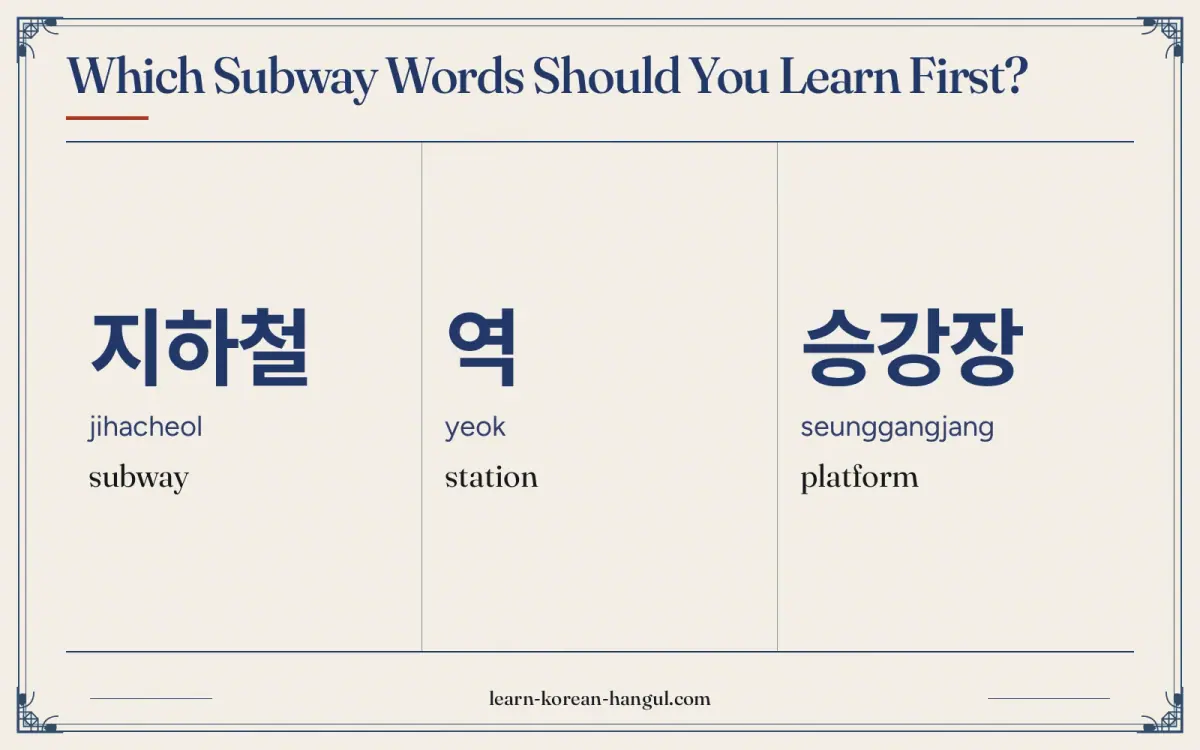
Learn 지하철 (subway), 역 (station), 호선 (line), 출구 (exit) and 환승 (transfer) first. With only these five you can ask which line, which exit and where to change. A short question such as 몇 호선이에요? (Which line is it?) needs just 호선 and the copula.
- Words to say. 지하철, 역, 호선, 출구, 환승.
- Words to recognise. 승강장, 개찰구, 방면, 종착역. You read them on signs more than you say them.
- Phrases to hear. 이번 역은 and 다음 역은 begin the two announcements you will hear at every stop.
The scene below numbers ten of the objects in a station, so you can tie each word to something you can point at.
Word · 10
- 1
지하철
jihacheol
subway
- 2
역
yeok
station
- 3
승강장
seunggangjang
platform
- 4
개찰구
gaechalgu
ticket gate
- 5
출구
chulgu
exit
- 6
호선
hoseon
line (number)
- 7
교통카드
gyotongkadeu
transit card
- 8
환승
hwanseung
transfer
- 9
막차
makcha
last train
- 10
문
mun
door
Station Parts
A Seoul subway trip starts with the nouns you meet on the way in. 지하철 is the system, 역 is a station, and the rest name what you walk through: the gate, the platform, the stairs and the exit. Most of these are Sino-Korean compounds, so their parts repeat across the page. 승강장 joins 승 (go up, board) and 강 (go down), and 개찰구 joins 개찰 (opening the ticket check) and 구 (mouth, opening). The same 구 ends 출구 (exit).
| No. | Hangul | Revised Romanization | Meaning and note | Example sentence | Audio assetId |
|---|---|---|---|---|---|
| 1 | 지하철 | jihacheol | subway. 지하 is underground; 철 is iron or rail. | 지하철을 타요. (I ride the subway.) | au-pg-vocabulary-places-transportation-subway-1; example: au-pg-vocabulary-places-transportation-subway-36 |
| 2 | 역 | yeok | station. Also the last word in station names. | 역이 가까워요. (The station is close.) | au-pg-vocabulary-places-transportation-subway-2; example: au-pg-vocabulary-places-transportation-subway-37 |
| 3 | 승강장 | seunggangjang | platform. The word printed on platform signs. | 승강장에서 기다려요. (I wait on the platform.) | au-pg-vocabulary-places-transportation-subway-3; example: au-pg-vocabulary-places-transportation-subway-38 |
| 4 | 개찰구 | gaechalgu | ticket gate. The barrier you tap through. | 개찰구를 지나가요. (I pass through the ticket gate.) | au-pg-vocabulary-places-transportation-subway-4; example: au-pg-vocabulary-places-transportation-subway-39 |
| 5 | 출구 | chulgu | exit. Exits are numbered; see the note below. | 3번 출구로 나가요. (I go out through exit 3.) | au-pg-vocabulary-places-transportation-subway-5; example: au-pg-vocabulary-places-transportation-subway-40 |
| 6 | 계단 | gyedan | stairs. Often paired with 엘리베이터 on signs. | 계단이 많아요. (There are many stairs.) | au-pg-vocabulary-places-transportation-subway-6; example: au-pg-vocabulary-places-transportation-subway-41 |
| 7 | 엘리베이터 | ellibeiteo | elevator. Loanword. Signs also show it as an icon. | 엘리베이터가 어디에 있어요? (Where is the elevator?) | au-pg-vocabulary-places-transportation-subway-7; example: au-pg-vocabulary-places-transportation-subway-42 |
Exit numbers use the counter 번: 1번 출구 is read il-beon chulgu, with a Sino-Korean number before 번 here. The number tells you which part of the street you will come up on, so learners who read 3번 출구 on a map can walk straight to it. The verb 나가요 (go out) fits exits, while 내려요 (get off) fits the vehicle, a split that returns in the mistakes section. See Sino-Korean numbers for the number words.
Lines and Directions
Lines are numbered and written with 호선, so Line 2 is 2호선, read i-hoseon. Directions are given with 방면, which names the area the train is heading toward rather than a compass point. The signs on a platform pair the line number with a 방면 name and the next station, so these seven words let you read a platform sign.
| No. | Hangul | Revised Romanization | Meaning and note | Example sentence | Audio assetId |
|---|---|---|---|---|---|
| 8 | 호선 | hoseon | line (number). Follows a Sino-Korean number. | 2호선을 타요. (I take Line 2.) | au-pg-vocabulary-places-transportation-subway-8; example: au-pg-vocabulary-places-transportation-subway-43 |
| 9 | 노선도 | noseondo | route map. 노선 is route; 도 is map or diagram. | 노선도를 봐요. (I look at the route map.) | au-pg-vocabulary-places-transportation-subway-9; example: au-pg-vocabulary-places-transportation-subway-44 |
| 10 | 방면 | bangmyeon | direction (toward). Names the area the train heads to. | 강남 방면이에요. (It is toward Gangnam.) | au-pg-vocabulary-places-transportation-subway-10; example: au-pg-vocabulary-places-transportation-subway-45 |
| 11 | 종착역 | jongchangnyeok | terminal station. Said [종창녁]. | 종착역에서 내려요. (I get off at the terminal station.) | au-pg-vocabulary-places-transportation-subway-11; example: au-pg-vocabulary-places-transportation-subway-46 |
| 12 | 다음 역 | daeum yeok | next station. Two words; 다음 means next. | 다음 역은 서울역이에요. (The next station is Seoul Station.) | au-pg-vocabulary-places-transportation-subway-12; example: au-pg-vocabulary-places-transportation-subway-47 |
| 13 | 이번 역 | ibeon yeok | this station. The stop being announced now. | 이번 역은 시청이에요. (This station is City Hall.) | au-pg-vocabulary-places-transportation-subway-13; example: au-pg-vocabulary-places-transportation-subway-48 |
| 14 | 급행 | geuphaeng | express. Said [그팽]. | 급행은 빨라요. (The express is fast.) | au-pg-vocabulary-places-transportation-subway-14; example: au-pg-vocabulary-places-transportation-subway-49 |
Notice the pair 이번 역 and 다음 역. 이번 means this time or this one, and 다음 means next. Together they carry most of what an in-train announcement says about position. The adjective in the express sentence follows the 르 pattern: 빠르다 becomes 빨라요, with the extra ㄹ that every 르 verb gains.
Tickets and Cards
Most riders never buy a paper ticket. They carry a 교통카드, which works on subways and buses, and top it up at a machine. A visitor who needs only one ride can buy a single-use card, which carries a small deposit that is refunded when the card is returned. These seven words cover the cards, the money and the balance screen.
| No. | Hangul | Revised Romanization | Meaning and note | Example sentence | Audio assetId |
|---|---|---|---|---|---|
| 15 | 교통카드 | gyotongkadeu | transit card. 교통 is traffic or transport. | 교통카드를 충전해요. (I top up my transit card.) | au-pg-vocabulary-places-transportation-subway-15; example: au-pg-vocabulary-places-transportation-subway-50 |
| 16 | 일회용 교통카드 | ilhoeyong gyotongkadeu | single-use transit card. 일회 is one use; 용 is for use. | 일회용 교통카드를 사요. (I buy a single-use transit card.) | au-pg-vocabulary-places-transportation-subway-16; example: au-pg-vocabulary-places-transportation-subway-51 |
| 17 | 보증금 | bojeunggeum | deposit. Refunded when you return the card. | 보증금을 돌려받아요. (I get the deposit back.) | au-pg-vocabulary-places-transportation-subway-17; example: au-pg-vocabulary-places-transportation-subway-52 |
| 18 | 충전 | chungjeon | top-up. The same word is used for phone charging. | 충전이 필요해요. (I need to top up.) | au-pg-vocabulary-places-transportation-subway-18; example: au-pg-vocabulary-places-transportation-subway-53 |
| 19 | 요금 | yogeum | fare. Shown on the gate and the machine. | 요금이 얼마예요? (How much is the fare?) | au-pg-vocabulary-places-transportation-subway-19; example: au-pg-vocabulary-places-transportation-subway-54 |
| 20 | 잔액 | janaek | balance. The money left on the card. | 잔액이 부족해요. (The balance is not enough.) | au-pg-vocabulary-places-transportation-subway-20; example: au-pg-vocabulary-places-transportation-subway-55 |
| 21 | 정기권 | jeonggigwon | commuter pass. 정기 is regular; 권 is ticket. | 정기권은 한 달 동안 써요. (I use the commuter pass for one month.) | au-pg-vocabulary-places-transportation-subway-21; example: au-pg-vocabulary-places-transportation-subway-56 |
The word 권 in 정기권 means ticket or voucher, the same 권 as in 승차권 (ride ticket) and 입장권 (admission ticket). Once you know it, many ticket names become guessable. The verb in the deposit sentence, 돌려받다, is a compound of 돌려 (returning) and 받다 (receive), and it conjugates as a regular verb: 돌려받아요.
Which Words Do Subway Announcements Use?
Announcements in a Seoul train follow a fixed script, so a handful of nouns unlocks most of it. The script names this station (이번 역은 …), tells you which side the doors open on (내리실 문은 왼쪽입니다, the doors for getting off are on the left) and names the next station (다음 역은 …). You already know the station parts. The words below cover the door side, the speaker and the safety line at the platform edge.
| No. | Hangul | Revised Romanization | Meaning and note | Example sentence | Audio assetId |
|---|---|---|---|---|---|
| 22 | 안내 | annae | guidance; announcement. Used for public information. | 안내 방송이 나와요. (An announcement comes on.) | au-pg-vocabulary-places-transportation-subway-22; example: au-pg-vocabulary-places-transportation-subway-57 |
| 23 | 방송 | bangsong | broadcast; PA announcement. Also TV and radio. | 방송을 들어요. (I listen to the announcement.) | au-pg-vocabulary-places-transportation-subway-23; example: au-pg-vocabulary-places-transportation-subway-58 |
| 24 | 왼쪽 | oenjjok | left. As in 내리실 문은 왼쪽입니다. | 문이 왼쪽에 있어요. (The door is on the left.) | au-pg-vocabulary-places-transportation-subway-24; example: au-pg-vocabulary-places-transportation-subway-59 |
| 25 | 오른쪽 | oreunjjok | right. The other door side in announcements. | 오른쪽 문이 열려요. (The right-hand door opens.) | au-pg-vocabulary-places-transportation-subway-25; example: au-pg-vocabulary-places-transportation-subway-60 |
| 26 | 문 | mun | door. Doors open (열려요) and close (닫혀요). | 문이 닫혀요. (The door is closing.) | au-pg-vocabulary-places-transportation-subway-26; example: au-pg-vocabulary-places-transportation-subway-61 |
| 27 | 승객 | seunggaek | passenger. 승 is ride; 객 is guest. | 승객이 많아요. (There are many passengers.) | au-pg-vocabulary-places-transportation-subway-27; example: au-pg-vocabulary-places-transportation-subway-62 |
| 28 | 안전선 | anjeonseon | safety line. The line to stand behind. | 안전선 뒤에 서요. (I stand behind the safety line.) | au-pg-vocabulary-places-transportation-subway-28; example: au-pg-vocabulary-places-transportation-subway-63 |
Door sentences use passive-looking verbs that are actually separate words: 열리다 (open by itself) gives 열려요, and 닫히다 (close by itself) gives 닫혀요. They differ from 열다 and 닫다, where a person opens or closes something. Use the by-itself verbs when you describe the doors yourself: 문이 열려요 (the door opens) and 문이 닫혀요 (the door is closing).
Transfers
Seoul has many lines, so most trips include a change. A 환승 is a transfer, and 환승 할인 is the discount for changing within a set time. Late-night travellers also need the words for the first and last train. Here are the seven words that cover changing lines and catching the right train.
| No. | Hangul | Revised Romanization | Meaning and note | Example sentence | Audio assetId |
|---|---|---|---|---|---|
| 29 | 환승 | hwanseung | transfer. Noun; add 하다 for the verb. | 환승이 편해요. (Transferring is convenient.) | au-pg-vocabulary-places-transportation-subway-29; example: au-pg-vocabulary-places-transportation-subway-64 |
| 30 | 환승역 | hwanseungnyeok | transfer station. Said [환승녁]. | 환승역에서 갈아타요. (I change trains at the transfer station.) | au-pg-vocabulary-places-transportation-subway-30; example: au-pg-vocabulary-places-transportation-subway-65 |
| 31 | 갈아타다 | garatada | to change (trains). Verb; 갈다 is to replace. | 2호선으로 갈아타요. (I change to Line 2.) | au-pg-vocabulary-places-transportation-subway-31; example: au-pg-vocabulary-places-transportation-subway-66 |
| 32 | 환승 할인 | hwanseung harin | transfer discount. 할인 is discount. | 환승 할인을 받아요. (I get a transfer discount.) | au-pg-vocabulary-places-transportation-subway-32; example: au-pg-vocabulary-places-transportation-subway-67 |
| 33 | 환승 통로 | hwanseung tongno | transfer passage. Said [환승 통노]. | 환승 통로가 길어요. (The transfer passage is long.) | au-pg-vocabulary-places-transportation-subway-33; example: au-pg-vocabulary-places-transportation-subway-68 |
| 34 | 막차 | makcha | last train. Also last bus. | 막차를 놓쳐요. (I miss the last train.) | au-pg-vocabulary-places-transportation-subway-34; example: au-pg-vocabulary-places-transportation-subway-69 |
| 35 | 첫차 | cheotcha | first train. Said [첟차]. | 첫차를 타요. (I take the first train.) | au-pg-vocabulary-places-transportation-subway-35; example: au-pg-vocabulary-places-transportation-subway-70 |
Learners often mix 환승 and 갈아타다. The first is a noun and the second a verb, and both appear on signs and in speech: 환승해요 and 갈아타요 mean nearly the same thing. 막차 and 첫차 are worth learning together, since 차 (vehicle) is the shared part. The same two words work for buses.
How Do You Pronounce Korean Subway Words?
Subway words show several kinds of change. In many compounds that end in a consonant before 역, a ㄴ sound is added, and the consonant before it can turn into a nasal sound. A ㅂ or ㄱ before ㅎ merges with it into a single aspirated sound, a final ㅅ is said as ㄷ, and ㄹ after ㅇ is said as ㄴ. The National Institute of Korean Language (국립국어원) sets these in its standard pronunciation rules. Revised Romanization shows some of the changes and not others.
| Spelling | Sounds like | What changes |
|---|---|---|
| 종착역 | [종창녁] | ㄴ is added before 역, then the final ㄱ becomes ㅇ before ㄴ. |
| 환승역 | [환승녁] | ㄴ is added before 역, then the final ㅇ stays. |
| 급행 | [그팽] | ㅂ and ㅎ merge into an aspirated ㅍ. |
| 첫차 | [첟차] | The final ㅅ is said as ㄷ. |
| 환승 통로 | [환승 통노] | The ㄹ after ㅇ is said as ㄴ in 통로. |
Audio and Slow Playback
Each word and sentence has its own clip. The five clips below play the harder words slowly. Play a clip, say the word, then play it again and compare the ends of the syllables.
What Mistakes Do Learners Make with Subway Words?
Five patterns catch beginners on the subway.
- Using 번 for a line. Lines take 호선, as in 2호선. Exits take 번, as in 3번 출구. Saying 2번 호선 or 3호 출구 sounds wrong.
- Using 나가요 for the train. 출구로 나가요 (I go out through the exit) is right, but you leave the train with 내려요, as in 종착역에서 내려요.
- Treating 방면 as a station. 강남 방면 means toward the Gangnam area. The train may not stop at a station called 강남 at all, so check the next station name.
- Reading 종착역 as written. The sound is [종창녁], with an added ㄴ. If you say jong-chak-yeok, native listeners may still follow you, but the standard sound is different.
- Mixing 환승 and 갈아타다. 환승 is a noun, so 환승이 편해요 works. 갈아타다 is a verb and usually names the new line with (으)로, as in 2호선으로 갈아타요.
If you learn the 호선 and 번 split and the announcement script, most of the trouble goes away. The practice section turns the list into drills.
Practice: Flashcards and Worksheet
Study in three steps. First, run the deck in recognition mode until the 35 words feel familiar. Second, switch to listening mode and tap the clip before the card turns. Third, take the five-question quiz below. The deck stores your progress in your browser. The vocabulary flashcard decks page lists the other decks.
Practice · 75
- 01지하철
Show answer
headword 1: subway
- 02역
Show answer
headword 2: station
- 03승강장
Show answer
headword 3: platform
- 04개찰구
Show answer
headword 4: ticket gate
- 05출구
Show answer
headword 5: exit
- 06계단
Show answer
headword 6: stairs
- 07엘리베이터
Show answer
headword 7: elevator
- 08호선
Show answer
headword 8: line (number)
- 09노선도
Show answer
headword 9: route map
- 10방면
Show answer
headword 10: direction (toward)
- 11종착역
Show answer
headword 11: terminal station
- 12다음 역
Show answer
headword 12: next station
- 13이번 역
Show answer
headword 13: this station
- 14급행
Show answer
headword 14: express
- 15교통카드
Show answer
headword 15: transit card
- 16일회용 교통카드
Show answer
headword 16: single-use transit card
- 17보증금
Show answer
headword 17: deposit
- 18충전
Show answer
headword 18: top-up
- 19요금
Show answer
headword 19: fare
- 20잔액
Show answer
headword 20: balance
- 21정기권
Show answer
headword 21: commuter pass
- 22안내
Show answer
headword 22: guidance; announcement
- 23방송
Show answer
headword 23: broadcast; PA announcement
- 24왼쪽
Show answer
headword 24: left
- 25오른쪽
Show answer
headword 25: right
- 26문
Show answer
headword 26: door
- 27승객
Show answer
headword 27: passenger
- 28안전선
Show answer
headword 28: safety line
- 29환승
Show answer
headword 29: transfer
- 30환승역
Show answer
headword 30: transfer station
- 31갈아타다
Show answer
headword 31: to change (trains)
- 32환승 할인
Show answer
headword 32: transfer discount
- 33환승 통로
Show answer
headword 33: transfer passage
- 34막차
Show answer
headword 34: last train
- 35첫차
Show answer
headword 35: first train
- 36지하철을 타요.
Show answer
example sentence for 지하철
- 37역이 가까워요.
Show answer
example sentence for 역
- 38승강장에서 기다려요.
Show answer
example sentence for 승강장
- 39개찰구를 지나가요.
Show answer
example sentence for 개찰구
- 403번 출구로 나가요.
Show answer
example sentence for 출구
- 41계단이 많아요.
Show answer
example sentence for 계단
- 42엘리베이터가 어디에 있어요?
Show answer
example sentence for 엘리베이터
- 432호선을 타요.
Show answer
example sentence for 호선
- 44노선도를 봐요.
Show answer
example sentence for 노선도
- 45강남 방면이에요.
Show answer
example sentence for 방면
- 46종착역에서 내려요.
Show answer
example sentence for 종착역
- 47다음 역은 서울역이에요.
Show answer
example sentence for 다음 역
- 48이번 역은 시청이에요.
Show answer
example sentence for 이번 역
- 49급행은 빨라요.
Show answer
example sentence for 급행
- 50교통카드를 충전해요.
Show answer
example sentence for 교통카드
- 51일회용 교통카드를 사요.
Show answer
example sentence for 일회용 교통카드
- 52보증금을 돌려받아요.
Show answer
example sentence for 보증금
- 53충전이 필요해요.
Show answer
example sentence for 충전
- 54요금이 얼마예요?
Show answer
example sentence for 요금
- 55잔액이 부족해요.
Show answer
example sentence for 잔액
- 56정기권은 한 달 동안 써요.
Show answer
example sentence for 정기권
- 57안내 방송이 나와요.
Show answer
example sentence for 안내
- 58방송을 들어요.
Show answer
example sentence for 방송
- 59문이 왼쪽에 있어요.
Show answer
example sentence for 왼쪽
- 60오른쪽 문이 열려요.
Show answer
example sentence for 오른쪽
- 61문이 닫혀요.
Show answer
example sentence for 문
- 62승객이 많아요.
Show answer
example sentence for 승객
- 63안전선 뒤에 서요.
Show answer
example sentence for 안전선
- 64환승이 편해요.
Show answer
example sentence for 환승
- 65환승역에서 갈아타요.
Show answer
example sentence for 환승역
- 662호선으로 갈아타요.
Show answer
example sentence for 갈아타다
- 67환승 할인을 받아요.
Show answer
example sentence for 환승 할인
- 68환승 통로가 길어요.
Show answer
example sentence for 환승 통로
- 69막차를 놓쳐요.
Show answer
example sentence for 막차
- 70첫차를 타요.
Show answer
example sentence for 첫차
- 71종착역
Show answer
slow playback of 종착역
- 72환승
Show answer
slow playback of 환승
- 73환승 할인
Show answer
slow playback of 환승 할인
- 74막차
Show answer
slow playback of 막차
- 75첫차
Show answer
slow playback of 첫차
Practice · 5
What does 지하철 (jihacheol) mean?
Show answer
subway
지하철 means subway. Example: 지하철을 타요. (I ride the subway.)
What does 호선 (hoseon) mean?
Show answer
line (number)
호선 means line (number). Example: 2호선을 타요. (I take Line 2.)
What does 출구 (chulgu) mean?
Show answer
exit
출구 means exit. Example: 3번 출구로 나가요. (I go out through exit 3.)
What does 환승 (hwanseung) mean?
Show answer
transfer
환승 means transfer. Example: 환승이 편해요. (Transferring is convenient.)
What does 막차 (makcha) mean?
Show answer
last train
막차 means last train. Example: 막차를 놓쳐요. (I miss the last train.)
Korean Subway Vocabulary Worksheet (PDF)
A printable worksheet for these words (word list, matching, writing practice, fill-in-the-blank exercises and answer key) is available in A4 and US Letter from the download card on this page. For additional practice, copy the announcement script by hand: this station is X, the next station is Y, the doors open on the left.
Where to Go Next
After this page, continue with Korean Bus and Taxi Vocabulary for the buses you will use after you leave the station, or with Korean Train and KTX Vocabulary for long-distance trains. To move up a level, return to Transportation.
Frequently Asked Questions
How Do You Say Subway in Korean?
Subway is 지하철 (jihacheol). 지하 means underground and 철 comes from the word for rail. People also say 전철 for the electric railway, and the two are close in daily use. A station is 역 (yeok). The single-word page on subway in Korean gives more detail.
How Do You Pronounce 역 (yeok)?
Say yeok as one short syllable. It starts with a y glide, then the vowel eo, close to the u in the English word bus, and ends with a held k that you stop without releasing. It means station. Press the audio button on this page to hear it, then repeat it.
How Many Subway Words Should I Learn First?
Five first: 지하철, 역, 호선, 출구 and 환승. They let you name a line, pick an exit and ask where to change. At five new words a day the 35 words take a week plus review. Learn the announcement pair 이번 역 and 다음 역 alongside them.
What Is the Difference between 호선 and 번 on the Subway?
호선 counts lines (2호선, Line 2) and 번 numbers exits (3번 출구, exit 3). Both follow a Sino-Korean number, so the numbers themselves are the same. Only the counter word changes. See Sino-Korean numbers for the numbers.
Where Can I Practise Subway Words with Flashcards?
Use the vocabulary flashcard decks. The deck for this page holds all 35 words with Hangul, romanization and audio, in recognition and listening modes. Your progress stays in your browser. Give the announcement group extra time in listening mode, because 이번 역은 and 다음 역은 are heard on the train, not read.
Is There a Printable Worksheet for Subway Words?
A printable worksheet for these words (word list, matching, writing practice, fill-in-the-blank exercises and answer key) is available in A4 and US Letter from the download card on this page. For practice, the tables on this page can be copied by hand, and the deck carries the same 35 words.