
What Is TOPIK Reading?

TOPIK reading (읽기, ilgi) is the section that tests whether you can understand written Korean quickly enough to answer every question in the time given. It does not test whether you can translate. You read a notice, an article or a passage, and you pick the option that matches it. The numbers below are for the paper-based test.
| TOPIK I | TOPIK II | |
|---|---|---|
| Questions | 40 | 50 |
| Time | 60 minutes | 70 minutes |
| Average time per question | about 90 seconds | about 84 seconds |
| Points | 100 | 100 |
| Answer format | four-option multiple choice | four-option multiple choice |
| Typical texts | signs, notices, messages, short everyday passages | news headlines, articles, opinion pieces, literary extracts, academic passages |
The averages hide the real problem. Early questions are short and late questions are long, so a candidate who spends the average everywhere runs out of time at the end. TOPIK II adds a second difficulty: many later questions come in pairs, with two questions about one long text, so a misreading costs more than one point.
These figures come from the exam rules and can change. Confirm them for your session on topik.go.kr, the official site of the National Institute for International Education (NIIED, 국립국제교육원). Under the current rules a wrong answer and a blank both score zero, which is why the tips page tells you never to leave an answer empty. Dictionaries and electronic devices are not allowed in the test room.
What Kinds of Questions Appear?
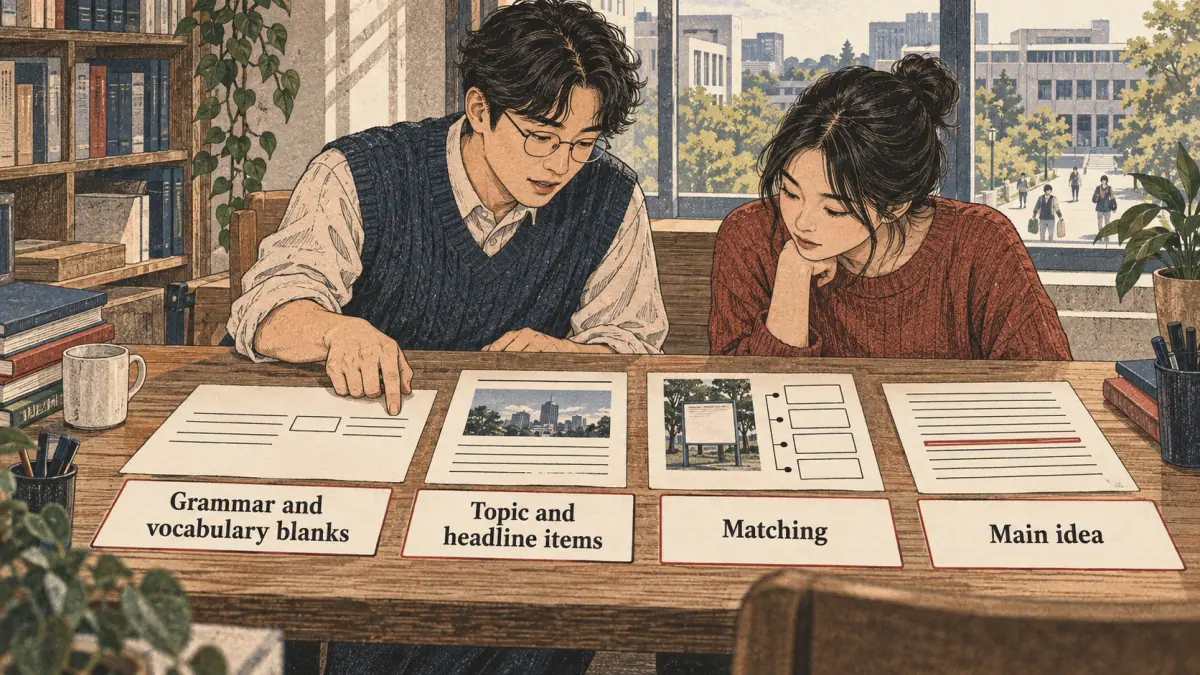
The questions fall into recurring families, and the same families appear in roughly the same order in each session. Learning to recognise a family on sight tells you what to look for before you read the text. The table maps the six families used in this section's pages to what they ask and where they matter most.
| Family | What it asks you to do | Where it matters most |
|---|---|---|
| Grammar and vocabulary blanks | Choose the word or ending that completes the sentence | both tests, in the first part |
| Topic and headline items | Say what a text or a headline is about | both tests, more in TOPIK II |
| Matching | Find the option that agrees with a notice, message or short text | both tests |
| Main idea | Choose the central point of a longer passage | mostly TOPIK II |
| Sentence order and insertion | Put sentences in order or place a missing sentence | mostly TOPIK II |
| Inference and attitude | Decide what the writer implies, feels or wants | TOPIK II |
This is an editorial grouping, not an official list. The official papers do not publish a count of question types, and the instruction line at the top of each item, written in Korean, is the real signal. Two examples of reading instructions are below.
| Korean | Romanization | Meaning |
|---|---|---|
| 다음을 읽고 물음에 답하십시오. | daeumeul ilgo mureume dapasipsio. | Read the following and answer the question. |
| 다음 글의 주제로 알맞은 것을 고르십시오. | daeum geurui jujero almajeun geoseul goreusipsio. | Choose what fits as the topic of the following text. |
Both instructions use the formal ending -십시오, which is the usual style of exam instructions. The next section shows which page teaches the method for each family.
What Pages Are in This Subhub?
This subhub has two pages that work as a pair. The strategy page is about time and habits, and the question-types page is about how each family is built and solved. Read the one that matches your problem first.
Strategy

TOPIK reading tips turns the timing figures into a plan. It explains why you should spend less than the average on early questions and more at the end, gives checkpoints such as question 20 by minute 20 in TOPIK II, and describes a skip-and-return rule that stops one hard item from costing several easy ones. The checkpoints are editorial suggestions built from the official timings, not official rules.
Question Types
TOPIK reading question types groups the recurring tasks into six families and teaches a method for each, with original practice items in the style of the test. It also compares TOPIK I, which uses the core families on short practical texts, with TOPIK II, which uses all of them on longer and more abstract texts.
Which Page Should You Open First?
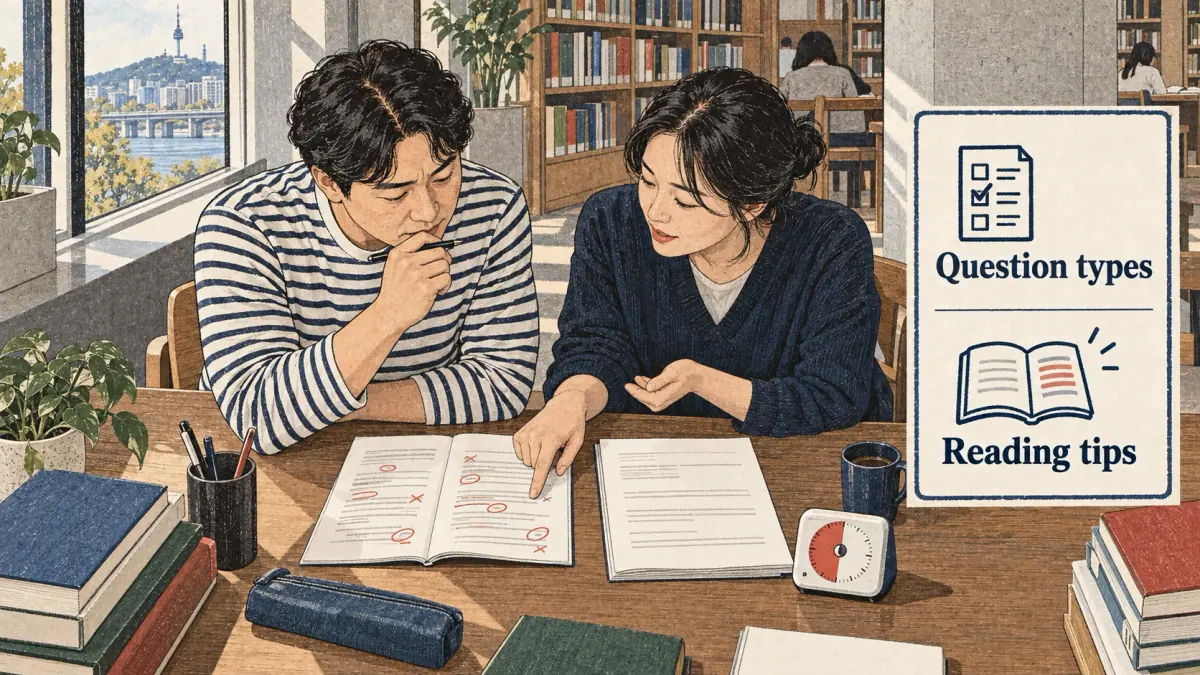
Open the page that fixes your biggest loss. If you finish the paper but make mistakes, the problem is method, so start with question types. If you do not finish the paper, the problem is time, so start with the tips.
| Your problem | Start with | What you will get |
|---|---|---|
| I run out of time before the last texts | Reading tips | Pace checkpoints and a skip-and-return rule |
| I do not recognise what a question asks | Question types | Six families, each with a method |
| I know the grammar but miss the main idea | Question types | The difference between main idea and inference |
| I want a full paper under real timing | Mock test guide | How to sit, score and review a mock |
| I want general Korean reading practice | Korean reading practice | Graded stories, real-world texts and strategies |
One habit helps with every family: read the question and the four options before the text, so you know what to look for. This costs a few seconds and saves many.
How Should You Pace the Reading Section?

Pace by the clock, not by feeling. In TOPIK I, 90 seconds per question is the average, and the short early items should take far less. In TOPIK II, 84 seconds is the average, and the long paired texts near the end need more than that. A simple split is to bank time early, then spend it on the long texts. For example, if you finish the first 20 questions of TOPIK II in about 20 minutes, you have 50 minutes left for 30 questions, which is 100 seconds each.
That arithmetic is an editorial example and not an official rule. What matters is that you rehearse it with timed practice before the real test. The past papers guide shows where to find official papers for this, and the tips page gives the full set of checkpoints.
What Does This Section Not Cover?
This section is about the reading skill and the reading test. It does not cover the TOPIK II writing tasks, listening question types or registration and test-centre rules. It does not reproduce official questions, so every example in the child pages is original practice. For comparison with the other sections, see TOPIK listening, and for the whole exam see the TOPIK exam guide.
Frequently Asked Questions
How many reading questions are on TOPIK? TOPIK I has 40 reading questions in 60 minutes, and TOPIK II has 50 reading questions in 70 minutes on the paper-based test. Both sections are worth 100 points and use four-option multiple choice. Confirm the figures for your session on topik.go.kr, because the exam can change.
How should I pace reading? Use the averages as a ceiling, not a target. That is about 90 seconds a question in TOPIK I and about 84 in TOPIK II. Go faster on the short early questions, save time for the long texts at the end, and move on after about 90 seconds on a hard item, marking a guess first.
Which reading type is hardest? There is no official ranking. Many learners find sentence ordering and inference questions hardest, because they need cohesion clues and vocabulary together. Difficulty also depends on your own gaps, so a timed mock and a log of errors by question family will show you which type costs you the most points.
Is a dictionary allowed? No. Dictionaries, phones, translation apps and other electronic devices are not allowed in the test room. Read the current rules for your session on topik.go.kr. Because you cannot look words up, practise guessing meaning from the surrounding sentence and from Sino-Korean word roots.
Should I guess when I do not know the answer? Yes. Under the current rules a wrong answer and a blank both score zero, so a guess can only help. Mark your best option, note the question number to return to, and keep moving. The tips page explains how to use the last minutes of the section.
About this page. Last updated 2026-10-09. The Korean text on this page was machine-generated and reviewed and signed off by Min-ji Park on 15 October 2026. Romanization follows the Revised Romanization of Korean and is shown only as a learning aid.