How to Use the TOPIK Mock Test
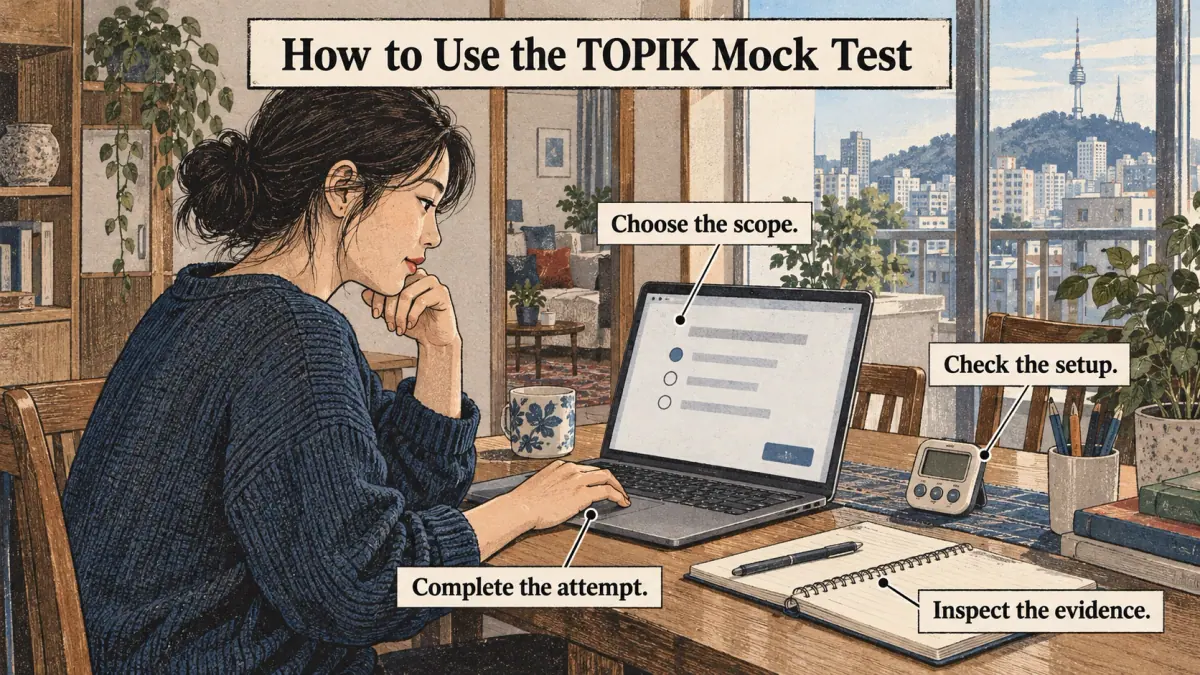
Choose a clear practice goal before starting. A short reading set can reveal a misunderstanding or a timing problem, while a complete exam rehearsal requires every relevant section and the correct conditions. The tool's local exercises support the first task; do not mistake them for a complete official assessment.
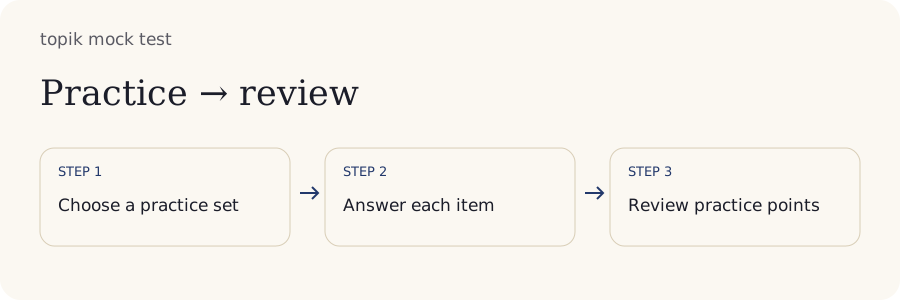
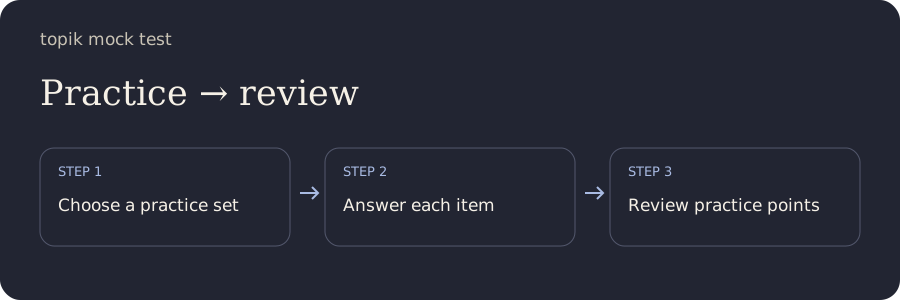
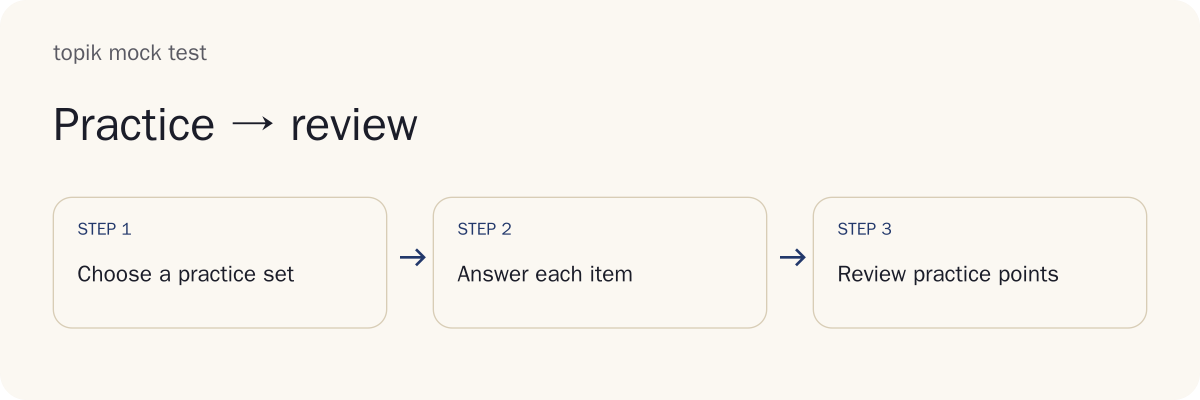
- Choose the scope. Select the available exercise type and session settings. Check that the question set matches the skill you want to practice.
- Check the setup. Confirm the timer, answer method and media availability. A silent listening item is not usable listening input.
- Complete the attempt. Answer without inspecting the key if you want a first-attempt result. Save an uncertainty note rather than opening the explanation immediately.
- Inspect the evidence. Compare your response with the stored answer and explanation. Identify the passage detail or rule supporting the answer.
- Save and plan. Export a session you want to keep, then choose one error type for the next study block. A higher score without a changed study plan may simply reflect familiar questions.
Choose the Right Exam
Identify the test you are preparing for and its delivery format. TOPIK I and TOPIK II have different scopes; paper and internet delivery also require different habits. Use the TOPIK exam format guide to connect your practice goal with the section structure. Selecting a label in a tool does not supply missing full-form material.
Start, Answer and Save
Use a short session first to learn the answer controls. Check how typed text, ordering answers and ordinary choices are submitted before adding time pressure. Local session recovery is useful, but browser storage can be cleared. Export important work and verify that the saved file can be found. The next choice is which format your practice should imitate.
Which TOPIK Format Should You Practise?

Practice the format of the exam you intend to sit. A familiar topic is useful language study, but it does not replace rehearsal of the answer method, section order and time limits. Confirm current instructions for your session before attempting an exact simulation; an adjustable practice timer is not an official timing notice.
| Preparation Goal | What To Rehearse | What A Short Local Set Cannot Establish |
|---|---|---|
| TOPIK I paper practice | Listening and reading, paper answer handling | A complete result from reading alone |
| TOPIK II paper practice | Listening, writing and reading together | A total while writing remains unassessed |
| Internet-based practice | Screen reading, typed responses and digital actions | The exact official interface or scaled score |
| Separate speaking practice | Spoken response planning and delivery | A TOPIK I or II listening/reading result |
PBT I and II
PBT means paper-based test. The linked format guide describes TOPIK I as listening and reading, while TOPIK II adds writing. That additional section changes the work you must rehearse. Multiple-choice accuracy alone cannot show how you organize an essay or complete a writing task under time pressure.
Use a printable worksheet for reading and written answer practice. A worksheet without the corresponding audio supports reading the listening questions, but cannot measure listening. Keep those activities labeled separately in your notes.
What Changes in IBT?
IBT means internet-based test. Reading from a screen, entering Korean text and managing digital controls add practical demands. Familiarity with an online exercise helps you learn an answer method, but this page does not reproduce every official interface rule. Do not transfer a paper-format total, timer or cutoff to an internet-format result without checking the relevant current guide.
Speaking, Basic and EPS Are Separate
Speaking, Basic and EPS have their own purposes and boundaries. A recording exercise here is spoken practice rather than a certificate assessment. Likewise, EPS material should not be silently substituted for a TOPIK I or II form. Match the source and test before comparing results. After choosing the scope, examine how the local question set is assembled.
How Are Practice Questions Selected?
Practice questions come from the available exercise bank or a deliberately imported private set. A generated form arranges those questions; generation is not proof that a full examination blueprint has been met. Inspect the set's scope and question versions before relying on it as a repeatable assignment.
Blueprint, Seed and Passage Balance
A blueprint describes the intended mix of tasks, passages and difficulty. A seed makes a selection or order reproducible under the same conditions. A frozen form preserves the actual selected questions and versions, which is stronger evidence of what a learner saw than a seed alone.
Passage balance matters because several questions can share one text. Five questions about one familiar passage do not provide the same variety as five independent passages. When comparing two sessions, note whether they reuse passages or answer keys. A different display order does not automatically create new language input.
Private questions also need their original context and key. Preserve any source-rights information when exporting them. The existence of an export option does not authorize copying material you lack permission to distribute.
What Makes a Question Suitable?
A suitable question has clear instructions, usable input, an answer supported by that input and an explanation of the competing choices. A natural sentence alone is insufficient if two choices satisfy the prompt equally well.
The current tool does not claim a complete approved examination form, a calibrated difficulty scale or a public native-recording corpus. Private question authors retain responsibility for their keys. If a question appears ambiguous, flag it and preserve its ID, version and context for discussion. These limits shape the conditions under which you should practice.
Practice Mode and Exam Conditions

Study conditions let you inspect language; exam conditions ask you to perform without those aids. Both are useful, but they answer different questions. A result after translations, explanations or repeated playback should be recorded as assisted work.
When Should You Turn Aids Off?
Turn aids off when you want to observe what you can answer before help. Keep them available when the goal is learning why a choice fits. Decide the goal before starting rather than changing it halfway through and treating the result as uniform.
A study sequence can begin with an unassisted answer, continue with the explanation, then finish with a second attempt. Save the first response separately. A correct retry shows that the explanation helped; it does not erase the original difficulty.
For listening, a transcript changes the task into a combination of reading and hearing. Replaying one difficult sentence is valuable study, while a continuous-audio attempt tests different timing demands. Use only playable recordings and state the playback conditions.
Adjustable Timers and Accessible Controls
An adjustable timer allows a learner to investigate time pressure at a manageable pace. Start untimed if you are still learning the controls, then add a limit suitable for the selected drill. A short drill's timer should not be presented as the duration of a complete exam.
Use readable text and the answer controls that work with your device. Ordering tasks should be completed as deliberate sequences, rather than accidental pointer movements. If access needs affect timing or playback, record the conditions without treating them as a language error. Understanding the score requires the same attention to conditions.
How Is a TOPIK Mock Test Scored?

This tool scores the selected exercises using their stored answers and assigned points. Practice points are not an official scaled result. A short reading set, a private assignment and a complete released paper have different scopes, even if all display a percentage.
Weighted Points and Unfinished Sections
For a weighted practice fraction, add the points earned on eligible items and divide by the available points on those items. Multiply that fraction by one hundred to express it as a percentage. The denominator is available points, not necessarily the number of questions.
For example, a drill has three questions worth two, three and four points. Its maximum is nine. If you earn two points on the first and four on the third, your total is six of nine, about 66.7 percent. Two correct questions out of three also happens to be about 66.7 percent in this example, but different weights can make those fractions diverge. Always label which fraction you report.
A blank answer, an unfinished section and an excluded ambiguous item are different states. Preserve their status in the result rather than assuming all are correct or all have the same meaning. Flagged items are excluded from subsequent sets and from the scoring denominator, so compare only results with a clear scope.
A complete TOPIK II result requires writing to be accounted for. You cannot infer the missing writing points from a reading drill. Leave an unassessed section unassessed rather than filling it with a convenient estimate.
Can a Short Quiz Predict Your Level?
No. A short local quiz cannot establish an official level or reliably predict an official score. It samples too little, may reuse familiar material and does not reproduce every section or assessment condition.
Use the score to identify errors in this exercise. Use official reported scores and current format-specific guidance when interpreting official bands. A practice percentage should not be converted into a certificate level by multiplying it by an exam maximum. Concrete examples make the distinction between answer evidence and score interpretation clearer.
Four Worked Examples
The examples below teach answer reasoning. They are not claims that these exact items or recordings form part of a complete public exam. Korean quoted here comes from the linked site lessons; English-only examples illustrate a task without introducing an unverified Korean sentence.
Notice Meaning and Distractors
Input: The format guide gives 도서관은 9시에 문을 연다, “The library opens at 9.” A practice question asks what time the library opens.
Answer: Nine o'clock. The statement supplies an opening time, not a closing time, price or day off.
Reason: The noun identifies the place, while the verb identifies the action. Choosing an option merely because it mentions a library ignores the actual question. A distractor can contain a familiar word yet contradict the requested detail.
Next Action: Underline the expression supporting the answer, then name what information each other choice would require. Do not add “morning” or “evening” when the quoted statement does not establish it.
Listening without Keyword Guessing
Input: An English-only reasoning example says, “The office is closed on Saturday and opens again on Monday.” The question asks which day it is closed.
Answer: Saturday. Monday is present in the same message but describes reopening.
Reason: Hearing a day name is only the first step; the action and relationship determine its meaning. A Korean listening exercise requires a playable Korean recording that supplies the corresponding evidence. This English illustration cannot produce a Korean listening score.
Next Action: With suitable audio, note the key event before checking the choices. Replay during study to locate the relationship you missed, then return to an unassisted item.
Ordering a Short Paragraph
Input: An English practice sequence contains “I borrowed a book there,” “I went to the library,” and “After borrowing it, I read it at home.”
Answer: Go to the library, borrow the book, read it at home.
Reason: “There” needs the previously established place, and “after borrowing it” establishes a later action. The sequence follows both reference and time. It does not depend only on guessing a sensible story.
Next Action: Enter or move each item into its chosen position using the available ordering controls. Inspect the full sequence before submitting; a correct first sentence with the remaining items reversed is still a different sequence.
Checking a Writing Response
Input: The linked writing example describes cyclists increasing from 30,000 to 120,000 across ten years, with two causes and an outlook. A learner writes only that the number increased.
Answer: The trend is correct, but the response lacks the numerical comparison, causes and outlook requested by the data.
Reason: A true sentence is not necessarily a complete response. The final total is four times the initial total; the increase itself is three times the initial total. Label the quantity before choosing a comparison.
Next Action: Use the TOPIK writing examples to compare coverage and organization. No exact official writing mark follows from this short checklist. The examples suggest what to record after an attempt.
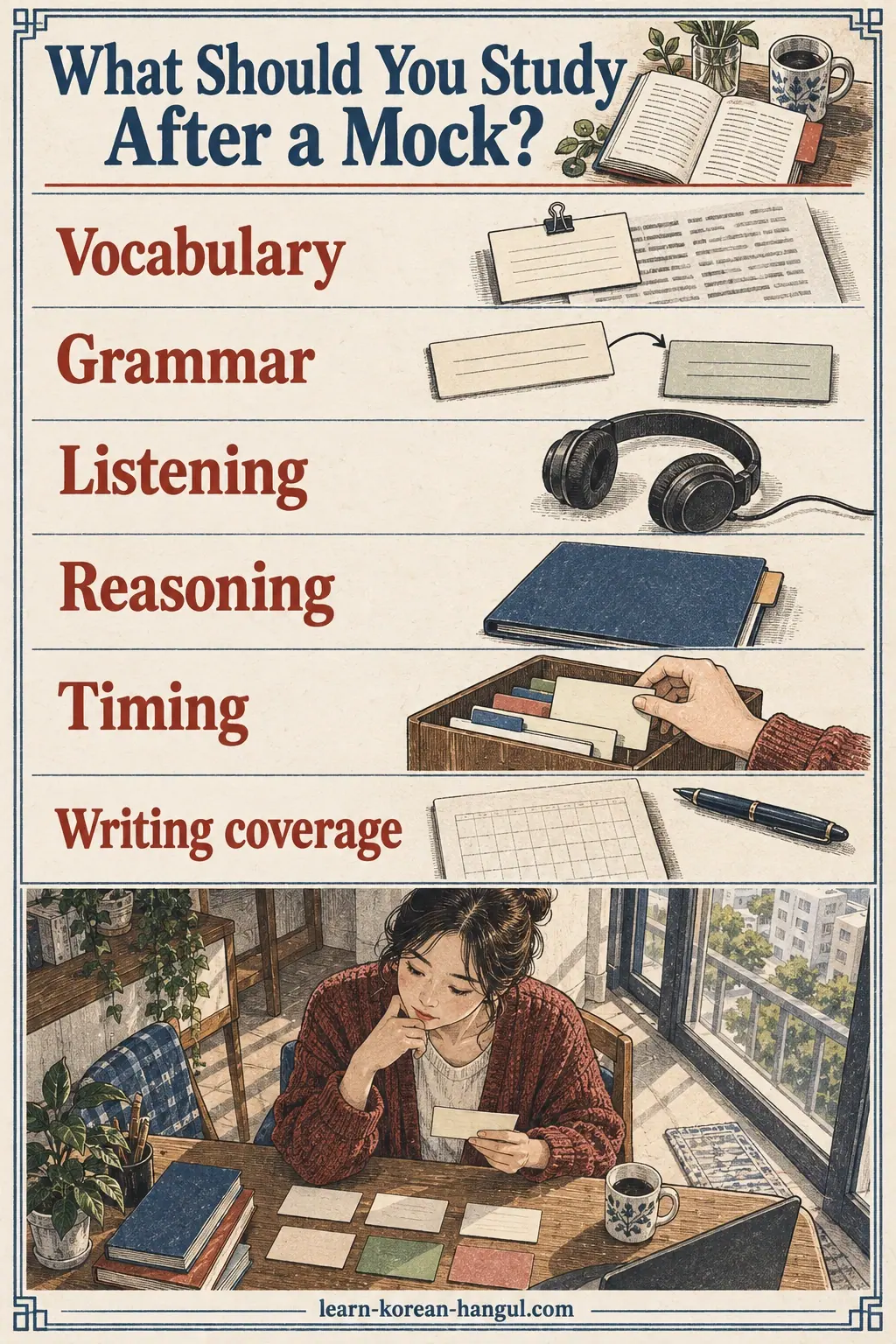
What Should You Study after a Mock?

Inspect the reason for each mistake, not only the correct option. Separate a language gap from a reasoning error and a timing problem. This makes the next study session specific enough to act on.
| Error Type | Evidence To Look For | Follow-Up Task |
|---|---|---|
| Vocabulary | A key word was unknown | Learn it with the passage context |
| Grammar | Words were known but the relationship was misread | Compare the relevant pattern |
| Listening | The recording was understood only after help | Replay and inspect the difficult segment |
| Reasoning | The text contradicted the chosen option | Identify supporting and conflicting details |
| Timing | The item was unfinished despite later understanding | Practice a comparable timed set |
| Writing coverage | A requested point was missing | Outline every required point before drafting |
Error Notebook and Repeat Practice
Save the question ID, your answer and one sentence explaining the cause. “Missed the source of the journey” is more useful than “bad grammar.” If two explanations seem possible, retain the context instead of choosing a label prematurely.
Repeat a familiar item to consolidate the correction, then use different material to check whether it transfers. Repeating the identical paper mainly shows what happens after exposure. Keep an unseen set for a later unassisted attempt.
Revision Lessons, Cards and Shadowing
Use cards for a word or pattern you can explain clearly. Use a lesson when the rule itself remains uncertain. Shadowing means listening and repeating with the speaker; it can support speech and listening study when suitable audio is available.
A practical week can alternate one focused correction session, one recall session and one comparable fresh drill. Let the cause of the error choose the task rather than taking another full mock every day. Writing and speaking need a further distinction between feedback and assessment.
Writing and Speaking Feedback
Writing and speaking feedback can identify useful changes without establishing an official mark. A writing checklist can ask whether all requested points appear; a speech recording can help you notice pauses or omitted content. Neither alone reproduces trained examiner judgment.
What Can Automated Feedback Assess?
Automatic checks can inspect properties such as whether an answer was entered, whether it matches a stored key or whether an ordering sequence matches the answer. Broader writing judgments need evidence about the task and response. A character count cannot decide whether an argument addresses the prompt.
Speech recognition, where available elsewhere in a workflow, produces a transcription rather than a direct measure of pronunciation quality. A transcription error may arise from recording conditions or recognition behavior. This page does not send voice to an assessment server or claim validated pronunciation scoring.
Imported audio is temporary and must be selected again after a reload. Use the local recorder's controls to delete a take or saved recording. Keep a record only when you want it for further study.
Teacher Feedback and Score Uncertainty
Ask a teacher to connect a comment with a specific sentence, omitted requirement or spoken segment. “Needs improvement” is hard to act on; “the second guiding question has no supporting example” suggests a revision.
The writing lesson's models are examples, not the only acceptable answers. Different wording can fulfill the task, and accurate wording can still omit required content. A teacher's practice estimate should be labeled as such, especially if it comes from a short response or an incomplete exam. Preserve that uncertainty when saving or sharing the result. File exports help a teacher inspect the same work.
Offline Tests, Downloads and Classroom Forms

Offline practice depends on having the needed question data, media and working page available. A saved configuration alone does not supply recordings. Check the intended setup before a journey or class, and keep a printable version if the screen-based activity is not available.
Can You Finish without an Account?
Yes. Available local exercises, private sets and exports do not require a hosted class account. Sessions remain on the device unless you deliberately export or share them. An exported frozen form lets a tutor inspect the same question versions rather than reconstructing them from a score screenshot.
Private questions belong in their assignment file rather than a public URL. Keep the worksheet and answer key separate when distributing practice. Hosted class codes and shared response collection are unavailable; sending an assignment does not automatically gather learner results.
Where Do Official past Papers Belong?
Official released papers are a separate source for complete-paper practice. The TOPIK past-paper guide explains matching a release with its audio and answer key. A release may include different supporting files, so inspect what is actually present.
Use a paper you have not already studied for an unseen attempt. Keep familiar papers for analysis and revision. A local original exercise and a released examination question can both support learning, but preserve their identities and source rights when saving material. The final troubleshooting checks keep those sessions interpretable.
Common Problems and Fixes
A missing response or unavailable recording can have a technical cause. Check the input and media state before interpreting an empty result as a language problem. Preserve the question and session details when a problem is repeatable.
Why Did Audio Stop?
Check device volume, the selected audio output and whether the actual file is present. A page or question can load while its recording is unavailable. Public listening corpus availability remains limited here, so do not treat silence as an intentional prompt.
If you imported private audio and reloaded the page, select the file again. Do not assume temporary media will survive session recovery. Test offline playback before starting a timed attempt; interruptions change the conditions you are trying to observe.
For typed input, finish composing the Korean text before submitting. If an answer appears blank, check the field and instruction rather than repeatedly pressing a choice shortcut. Keep an export before clearing browser data to troubleshoot storage.
Repeated Mocks Measure a Different Performance
A repeated mock includes memory of passages, answers and explanations. A higher result can show successful learning, but it is not equivalent to improvement on an unseen form. Changing the order does not remove that familiarity.
Record whether a set is fresh, repeated or assisted. Then choose a new task that uses the same skill with different evidence. Use the TOPIK mock test result to plan one specific study action, and keep the attempt conditions with the saved report.
TOPIK Mock Test FAQ
Can I share the same generated questions with my tutor?
Yes. Export a frozen form or session file for your tutor. The export preserves question IDs, versions, answers and source rights. Private questions stay in the file rather than a public URL. Hosted class codes and shared response collection are not available. Share the file deliberately when you want another person to inspect it.
Does changing answer order change my score?
No. The exercise engine checks the accepted answer rather than its display position. Ordering questions use the sequence in the answer key. Practice points use the points assigned to the original question; a changed display order does not create an official scaled score. Keep the question version when comparing results from two sessions.
Will my saved mock survive a question-bank update?
An exported session contains frozen question versions and keys. Importing that supported file restores those questions rather than silently replacing them with the latest bank. Local browser storage can be cleared by your browser, so keep an export if a session matters to you. A saved file is more dependable than assuming local storage persists.
Can I remove my voice recording after feedback?
Recordings belong to the local recorder, where you can delete a take or saved recording. This practice page does not send voice to an assessment server or keep a hidden voice copy. Imported audio is temporary and must be selected again after a page reload. Delete any separate exported copy yourself if you saved one.
How do I report an answer that seems ambiguous?
Open More, then Answer and evidence, and flag the question. It is excluded from subsequent sets and the scoring denominator. Export the session with the question ID and version so a teacher can see the exact key, response and context. Include the interpretation you intended rather than only a screenshot of the final score.
Does this practice report count as a TOPIK certificate?
No. The report shows performance on this selected practice set. It is neither an official TOPIK result nor a certificate, and short reading sets cannot establish an official level. Use official reported scores with current format-specific guidance for official bands. A TOPIK mock test is useful for finding what to practice next.