TOPIK past papers are real exam papers from earlier sessions, and the official TOPIK website, topik.go.kr, publishes a selection of them free of charge with listening audio and answer keys. Use papers in the current format for your test, TOPIK I or TOPIK II, keep the newest ones for timed mocks, and study the rest in detail.
Where Can You Find TOPIK past Papers?
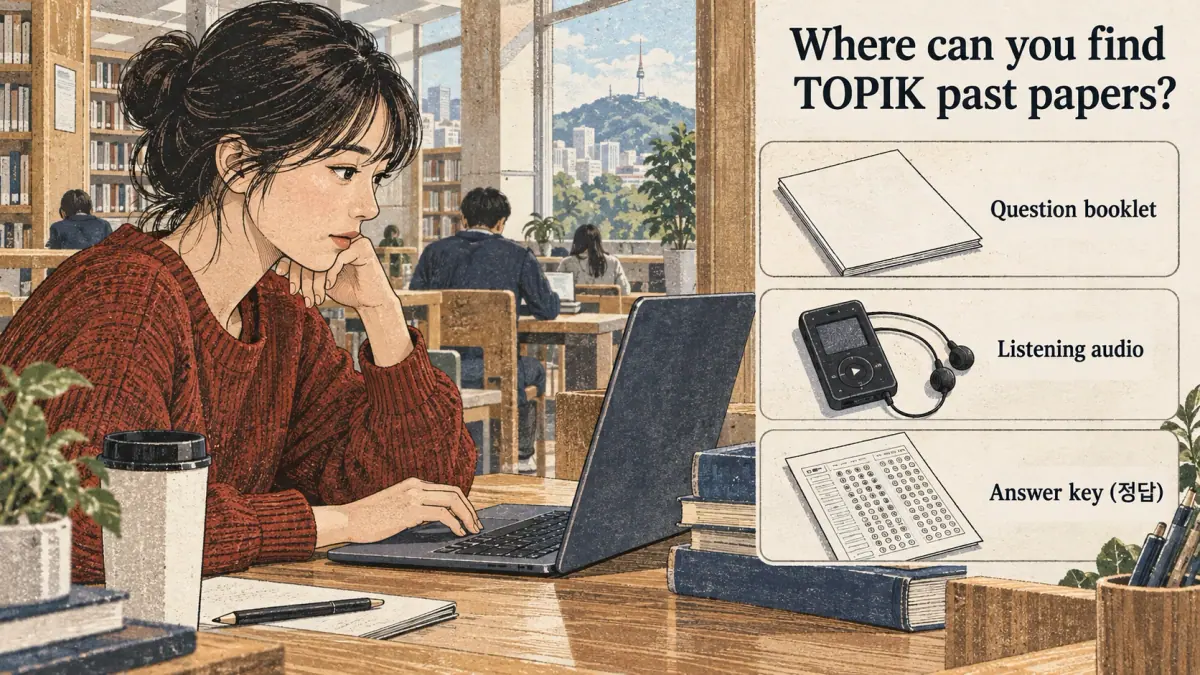
You can find TOPIK past papers on the official TOPIK website, topik.go.kr, in its resources area. The papers are published by NIIED, the government body that runs the test, and they are free to download. On the Korean-language site, the section names to look for are 기출문제 (gichulmunje, "past exam questions") and 자료실 (jaryosil, "resource room"); the English-language version of the site uses English labels.
The site layout changes from time to time, so menu names and paths can move. If you cannot find the section, search the site for 기출문제, or start from the main menu and look for resources or past questions. Avoid search-engine results that lead to other websites: those copies may be incomplete or altered.
Sessions are numbered in order, and the number appears in Korean as 제 + number + 회, so 제64회 means "the 64th session". Paper files are usually labelled with this number, the test (TOPIK Ⅰ or TOPIK Ⅱ) and the section, for example 듣기 (listening), 쓰기 (writing) or 읽기 (reading).
What Does a past-Paper Release Contain?
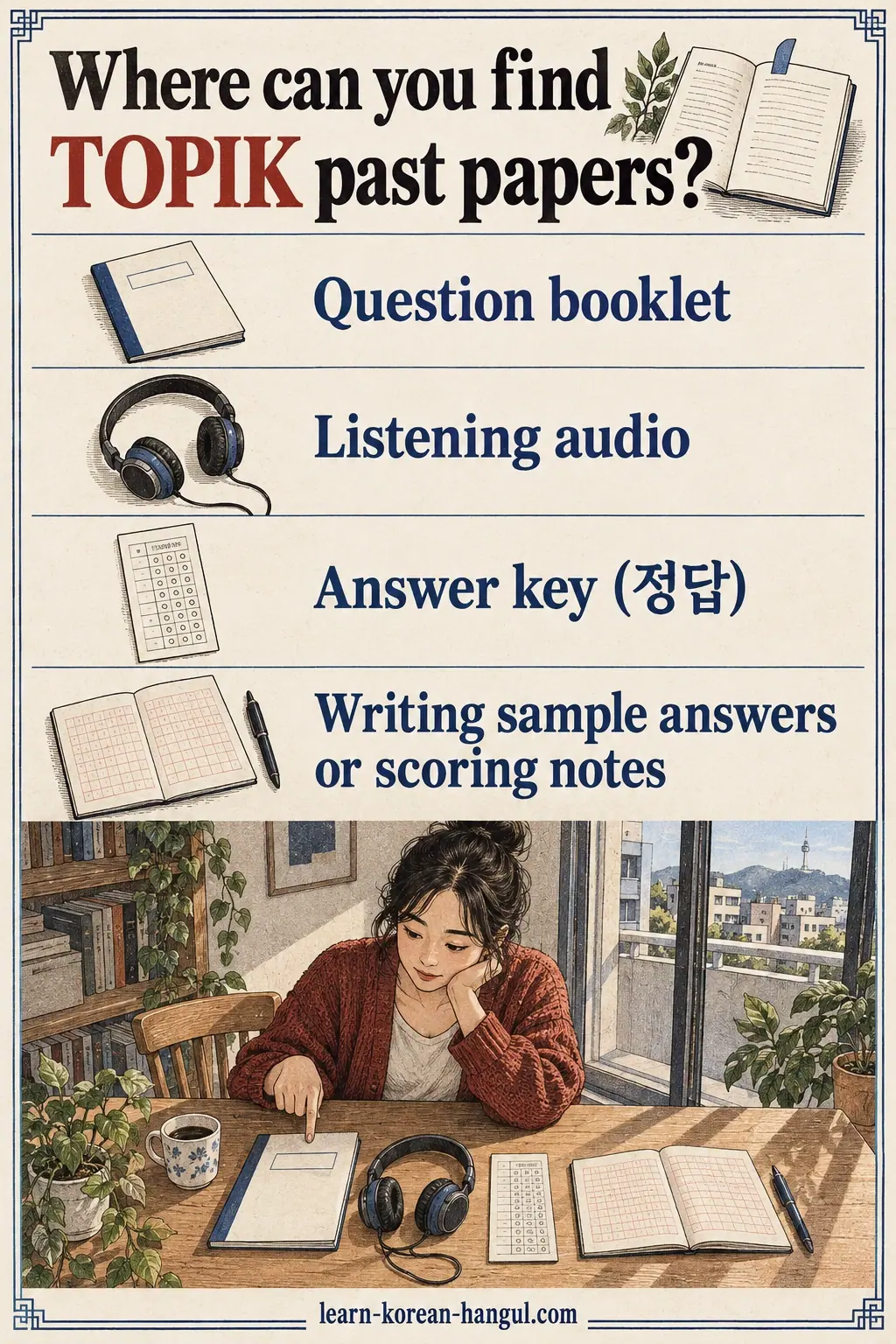
A typical official release contains three things for each test, and some contain a fourth. Check each release, because the contents have not been the same for every session.
| Item | Format | What it is for |
|---|---|---|
| Question booklet | the printed paper, with instructions in Korean only | |
| Listening audio | MP3 or similar audio file | the exact recording played in the exam room |
| Answer key (정답) | PDF or a page inside the booklet | the correct option for every multiple-choice question |
| Writing sample answers or scoring notes | PDF, some releases only | sample answers for questions 51-54 and notes on what raters look for |
The answer key, 정답 (jeongdap), covers listening and reading fully. Writing has no single right answer for questions 53 and 54, so where a release includes sample answers, treat them as models, not as the only correct text.
Some releases also include a listening script, 듣기 대본 (deutgi daebon), the full text of the recordings. If a script is not included, you can still use the audio for practice; you just cannot read along afterwards.
Knowing what is in a release makes the next choice easier: which papers to use, and in what order.
Which Papers Should You Start With?
Start with papers in the current format for the test you will sit, beginning with the most recent sessions available. Recent papers are closest to the questions you will meet, while older current-format papers are good study material.
- Match the test. Use TOPIK I papers for Levels 1-2 and TOPIK II papers for Levels 3-6. The two tests have different structures; the TOPIK exam format page shows both.
- Use the current format. The current split into TOPIK I and TOPIK II began with the 2014 reform. Papers from before the reform used beginner, intermediate and advanced papers with a separate vocabulary-and-grammar section, so their scores cannot be compared with today's cut scores.
- Keep the newest papers for mocks. Choose your two or three most recent current-format papers and do not open them until you sit them as timed mocks.
- Study with the rest. Older current-format papers are ideal for learning: vocabulary lists, listening shadowing and reading analysis.
- Check for changes. NIIED can adjust question types or timing. If the official guide for your session describes a change, give more weight to the papers released after it.
How Many past Papers Do You Need?
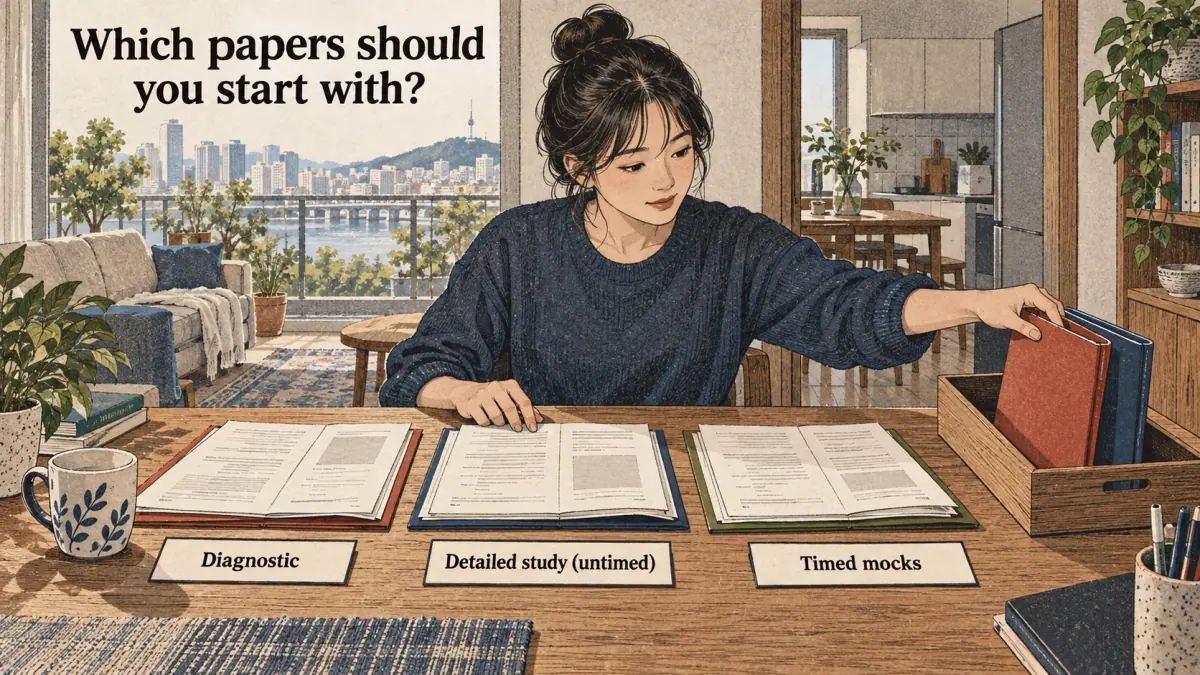
Most learners need about five to seven complete papers for one test cycle: one for a diagnostic, two or three for detailed study and two or three for timed mocks. That covers a 12-week plan with a diagnostic paper at the start and two full mocks at the end.
| Use | Papers needed | When |
|---|---|---|
| Diagnostic | 1 | week 1 of your plan |
| Detailed study (untimed) | 2-3 | weeks 2-8 |
| Timed mocks | 2-3 | the last 4 weeks |
If fewer papers are available for your test, re-use study papers as section drills and keep at least two unseen papers for the final mocks.
Old-Format Papers: Use or Skip?
Old-format papers, from before the 2014 reform, are useful for reading and vocabulary practice but should not be used as mocks. Their questions are still real Korean written by the test makers, and many reading texts are at the right difficulty. But the sections, timing and scoring differ, so a score on them does not tell you your level today.
The order of use matters as much as the choice of paper. The next section is the method.
How to Use TOPIK past Papers
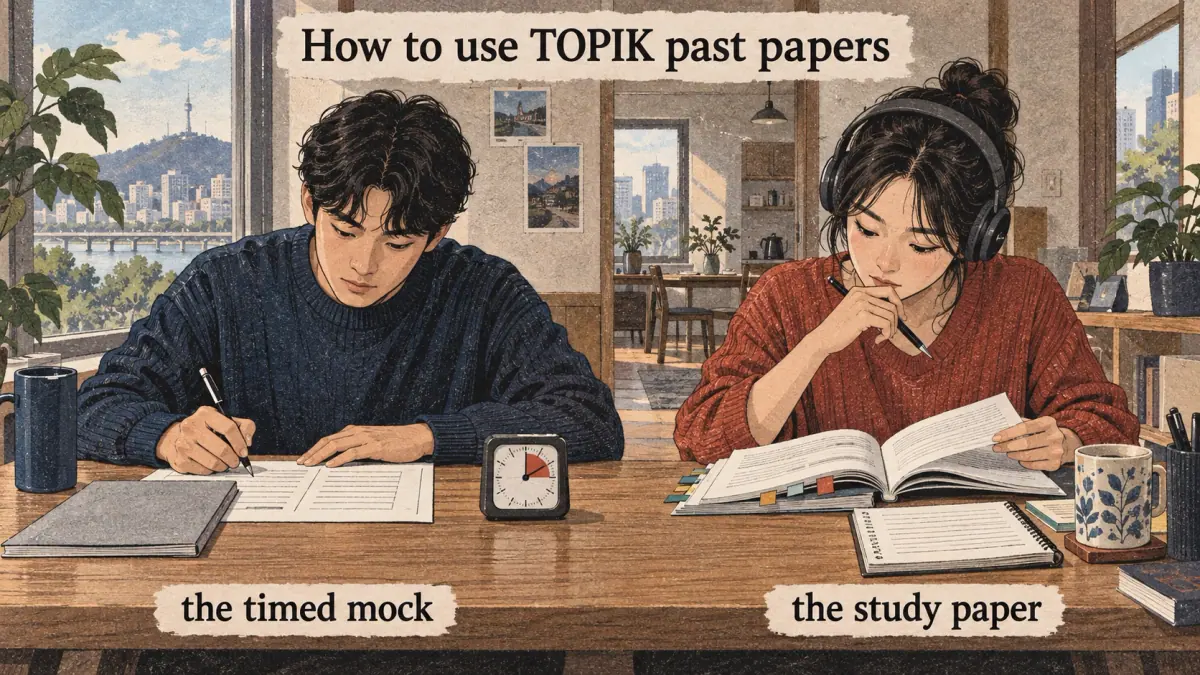
Use TOPIK past papers in two different modes: as unseen timed mocks that measure your level, and as study texts that you take apart line by line. Mixing the two modes, for example by studying a paper and then timing it, gives a score that is too high.
Mode 1: the Timed Mock
- Choose an unseen paper. It must be one you have not opened.
- Sit it under official timing. No pauses, no dictionary, no replays. The full procedure, with a scoring sheet and an error taxonomy, is on TOPIK mock test.
- Mark it with the answer key. Record the section scores and the total.
- Log every error. Note the question number and the cause.
Mode 2: the Study Paper
- Do the paper untimed first. Answer every question, looking nothing up, but take as long as you need. This shows what you know without time pressure.
- Mark it and compare with a timed score. The gap between your untimed score and your last timed score is your time-pressure cost.
- Mine the vocabulary. Write every unknown word with the sentence it came from. Five or six papers give a vocabulary list that reflects the real test better than a generic list.
- Shadow the listening. Play each recording, pause after each sentence and repeat it aloud. Use the script, if the release includes one, only after three plays without it.
- Analyse the reading. For each wrong answer, find the sentence in the passage that proves the right answer. This trains the habit of answering from the text, not from general knowledge.
- Rewrite the writing answers. For TOPIK II, write questions 51-54 yourself, then compare with any sample answers in the release and rewrite your answer a day later.
A study paper can take five to eight hours spread across a week. That time is well spent: one paper studied in depth teaches more than three papers answered and marked only.
Here is a sentence pattern that appears in many reading and listening items, the kind of line to collect when you mine a paper:
다음을 듣고 내용과 같은 것을 고르십시오.
daeumeul deutgo naeyonggwa gateun geoseul goreusipsio.
Listen and choose the statement that matches the content.
Instructions like this are in Korean only and are never translated on the paper, so learning their wording early saves seconds on every item.
Worked Example: One Study Paper in One Week
Sofia is preparing for TOPIK II and aims for Level 4. She has five hours this week for one older current-format paper. Her week looks like this:
| Day | Task | Time | Output |
|---|---|---|---|
| Monday | answer listening and reading untimed, then mark | 90 minutes | untimed total: 128 of 200 for the two sections |
| Tuesday | mine vocabulary from the reading passages she got wrong | 45 minutes | 34 new words, each with its sentence |
| Wednesday | shadow the 10 listening recordings she missed | 60 minutes | a list of 6 phrases she could not hear at speed |
| Thursday | find the proof sentence for every wrong reading answer | 45 minutes | 9 of 14 errors caused by skimming past a key connector |
| Saturday | write questions 53 and 54, then compare with the release's sample answers | 60 minutes | two drafts and a list of 5 written-style endings to practise |
Her untimed listening-and-reading total (128) is 14 points higher than her last timed score for the same two sections (114). That gap is her time-pressure cost, so next week she adds two timed reading drills. The study paper did not measure her level; it told her what to study and why.
Practical Set-up for Printing and Audio
Print booklets double-sided on A4 paper to save paper; a TOPIK II booklet set runs to many pages. If the release has no answer sheet, draw a simple grid with the question numbers and four columns, ①-④, and fill circles with a pencil, because transferring answers takes real time on test day.
For audio, download the file once and play it from a device with notifications off. Check the volume with the opening instructions, not with question 1, so that you never need to rewind during a mock.
What about Unofficial Papers?
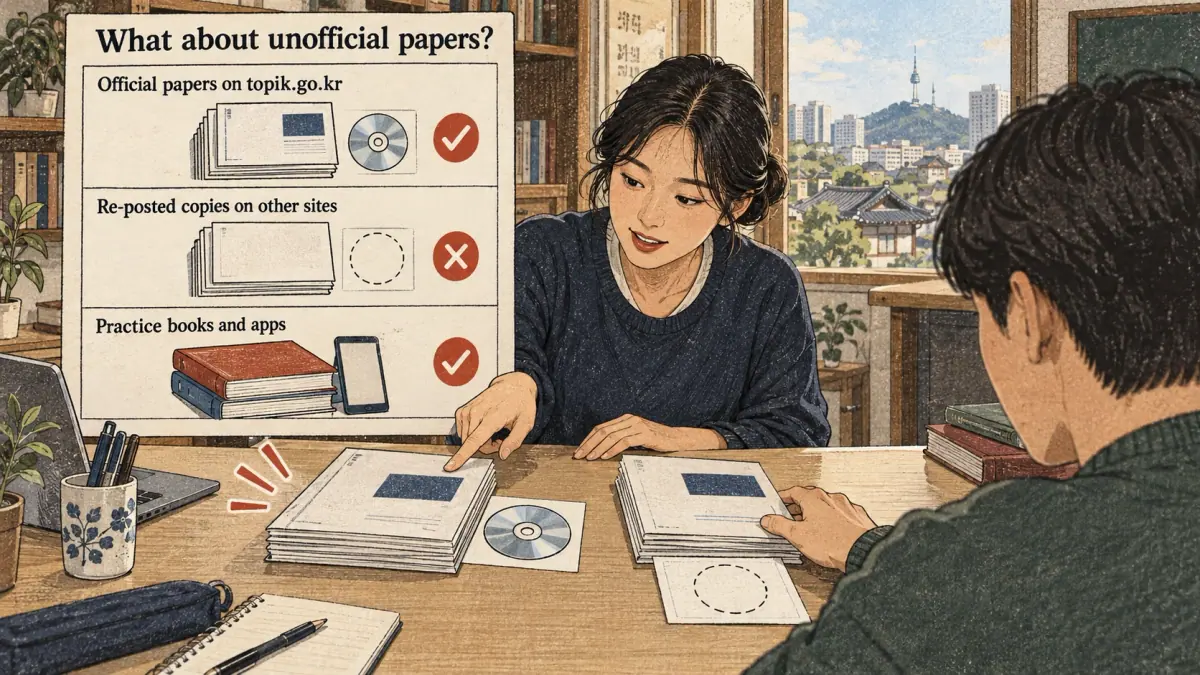
Unofficial papers come in two kinds, and they need different caution. The first kind is copies of official papers re-posted on other websites; the second is practice tests written by teachers, publishers or apps.
Copies of official papers on other sites. These are often the same files, but they can be incomplete, mislabelled or missing the audio or answer key, and some have answer keys typed by hand with mistakes. The papers are the copyright material of the test's publisher, and re-posting them may not be permitted. This site does not host past papers or link to copies; download them from topik.go.kr, where the files are complete and current.
Practice tests written by others. Books and apps sell or offer TOPIK-style practice tests. Some are carefully made; others are easier or harder than the real exam, or use question types the test no longer uses. They are useful for extra practice once you have used the official papers, but do not use their scores to decide whether you are ready.
| Source | Accuracy of questions | Answer key | Best use |
|---|---|---|---|
| Official papers on topik.go.kr | real exam questions | official | timed mocks and detailed study |
| Re-posted copies on other sites | usually the same, but files may be incomplete or altered | sometimes retyped | avoid; use the official files |
| Practice books and apps | varies by author | by the author | extra practice after official papers |
TOPIK past Papers vs EPS-TOPIK Papers
EPS-TOPIK papers are not TOPIK papers. EPS-TOPIK is a separate Korean test for the Employment Permit System, run by a different organisation, the Human Resources Development Service of Korea (HRD Korea), with its own format and its own practice materials. Searches for "EPS TOPIK past papers PDF" lead to that test, not to the TOPIK on topik.go.kr. The differences are on TOPIK vs EPS-TOPIK.
Past Papers for the Internet-Based Test
The internet-based test (IBT) has its own question counts, timing and screen layout. Paper-based past papers are still useful for vocabulary, listening and reading practice, but before an IBT session, look for the IBT sample or practice materials on topik.go.kr and practise at least once on screen. The TOPIK IBT guide covers the format.
How Do past Papers Fit a Study Plan?
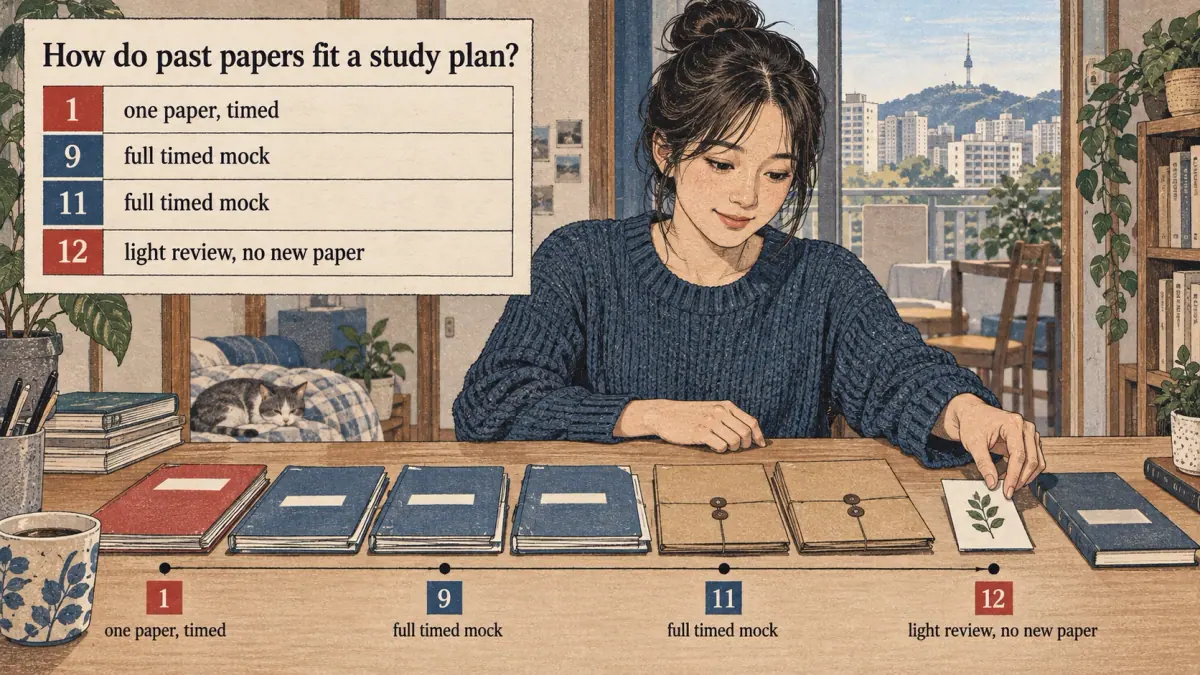
Past papers fit a study plan as the measuring points at the start and end, and as study material in between. A 12-week plan uses one paper as a diagnostic in week 1, two or three as study papers in weeks 2-8, and two or three unseen papers as timed mocks in weeks 9-12.
| Weeks | Paper use | Purpose |
|---|---|---|
| 1 | one paper, timed | diagnostic: your starting total and weakest section |
| 2-4 | one study paper | vocabulary mining and listening shadowing |
| 5-8 | one or two study papers, plus section drills | reading analysis and writing rewrites |
| 9 | full timed mock | first measurement against the target |
| 10 | targeted practice from the error log | fix the top error type |
| 11 | full timed mock | second measurement |
| 12 | light review, no new paper | consolidate and rest before the exam |
The full schedule, with daily minutes for each skill, is on the TOPIK study plan page. If you have fewer than 12 weeks, keep the diagnostic and the two mocks and shorten the study phase.
Common Mistakes with TOPIK past Papers

Learners often use their newest papers first, because they look most relevant. Actually, that wastes the best mock material. Keep the newest papers unseen until the final weeks.
Learners also repeat the same paper and count the higher score as progress. Actually, the second score reflects memory of the answers. A repeated paper is for study, not for measurement.
A third mistake is skipping the listening audio and reading the script instead. TOPIK listening tests speed, and a script removes the speed. Listen first, read last.
A fourth mistake is practising only multiple choice and skipping TOPIK II writing because it has no answer key. Writing is a third of the TOPIK II total. Write the answers, then compare them with any sample answers and the scoring criteria on the TOPIK score page.
What This Page Covers and Does Not
This page explains where official TOPIK past papers are published, what a release usually contains, how to choose papers and how to use them. It does not reproduce or host any exam paper; practice items on this site are original. Which sessions are available, the file formats and the site layout can change, so check topik.go.kr for the current list. For the rest of the exam-preparation guides, see the TOPIK preparation hub.
Frequently Asked Questions
Are the TOPIK answer keys included with past papers? Yes, official past-paper releases on topik.go.kr include answer keys for the listening and reading questions. For TOPIK II writing there is no single correct answer, but some releases include sample answers or scoring notes for questions 51-54. Check each release's file list, because contents have varied between sessions.
Can I download the TOPIK listening audio? Yes. Official past-paper releases include the listening recordings as audio files, usually MP3, that you can download and play on any device. Play them through without pausing for mocks. For study, you can pause and repeat, and you can read the script afterwards if the release includes one.
How long does it take to study one TOPIK past paper? A full study pass on one paper takes about five to eight hours, spread across a week: untimed answering and marking, vocabulary mining, listening shadowing, reading analysis and, for TOPIK II, writing rewrites. A timed mock alone takes 100 minutes for TOPIK I or about three hours plus a break for TOPIK II.
Is it legal to use unofficial TOPIK papers? Using a paper for your own study is not the same as re-posting it. The papers are the copyright material of the test's publisher, and sharing copies on other websites may not be permitted. The safe choice is to download papers from topik.go.kr, which is free, complete and current. Check the official site's terms of use for details.
Is there a TOPIK past papers PDF for every session? No. Not every session is released, and the selection on the official site can change over time. The released sessions are listed on topik.go.kr. If your target test has few papers, keep the unseen ones for timed mocks and use books or apps for extra practice.
The Bottom Line on TOPIK past Papers
TOPIK past papers come from one official source, topik.go.kr, where NIIED publishes a selection of sessions free with audio and answer keys. Use current-format papers for your own test, keep the newest ones unseen for timed mocks, and take the older ones apart for vocabulary, listening and reading practice. Avoid re-posted copies, which may be incomplete, and remember that not every session is released. Your next step is TOPIK mock test, which shows how to sit, score and review your first paper.