
What Is TOPIK Listening?

TOPIK listening (듣기, deutgi) is the section that tests whether you understand spoken Korean without reading anything except the four printed options. In both tests it is scored out of 100 points and every question is multiple choice. On the paper-based test, the numbers are as follows.
| TOPIK I | TOPIK II | |
|---|---|---|
| Questions | 30 | 50 |
| Time | 40 minutes | 60 minutes |
| Points | 100 | 100 |
| Position in the test | first section, followed by reading | first section, followed by writing and reading |
| Typical spoken material | short exchanges, picture-based items, everyday dialogues, notices | longer dialogues, announcements, talks, interviews and discussions |
The two tests ask the same kind of thing: what is said, who says it, and what happens next. The difference is length and abstraction. TOPIK I recordings are short and practical, such as a conversation in a shop or a notice at a station. TOPIK II recordings run longer and move toward opinion, explanation and argument.
Because these numbers come from the exam rules, they can change. Check the current figures for your session on the official TOPIK website, topik.go.kr, which is run by the National Institute for International Education (NIIED, 국립국제교육원). The internet-based test follows its own timetable, and the TOPIK exam format page compares the formats.
How Does the Listening Section Work?
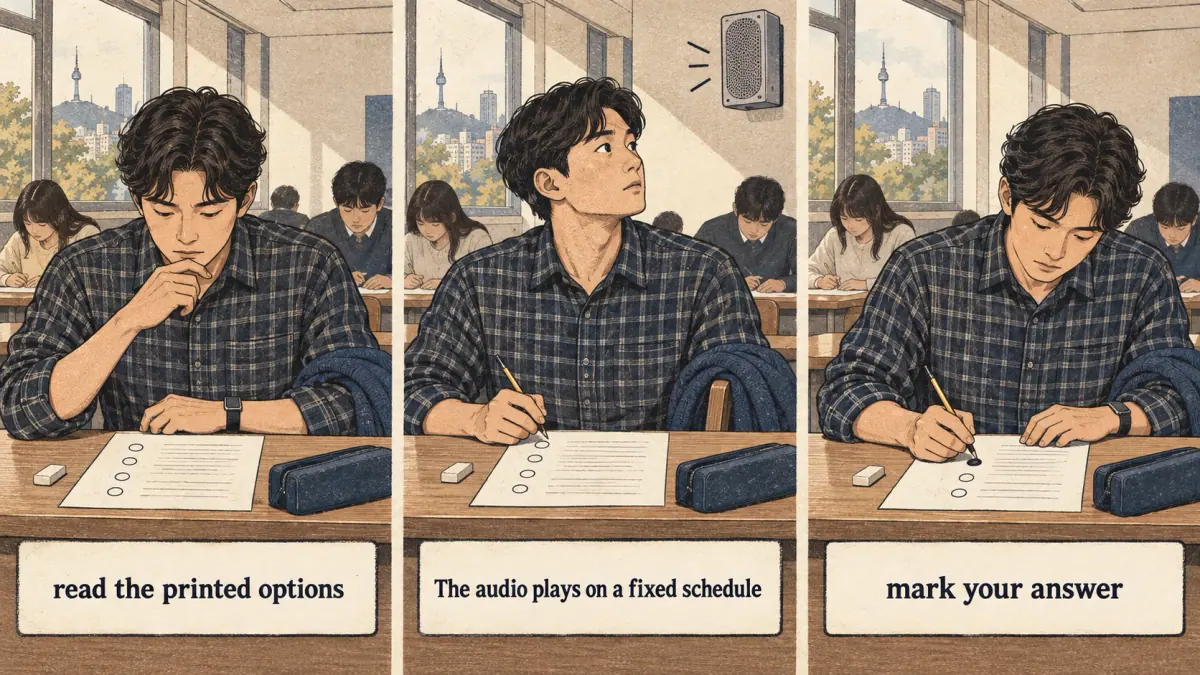
The audio plays on a fixed schedule: you cannot pause, rewind or choose when a recording starts. A short gap before each recording lets you read the printed options, and a gap after it lets you mark your answer. The number of times a recording plays depends on the item type, and the official instructions for your session decide it, so never plan on hearing an item twice.
The question instruction is also spoken in Korean, and it is worth knowing in advance. Two typical instruction sentences are below, with their meaning. The exact wording varies between item types and sessions, so treat them as models rather than quotations.
| Korean | Romanization | Meaning |
|---|---|---|
| 다음을 듣고 이어질 수 있는 말을 고르십시오. | daeumeul deutgo ieojil su inneun mareul goreusipsio. | Listen and choose what could come next. |
| 다음을 듣고 들은 내용과 같은 것을 고르십시오. | daeumeul deutgo deureun naeyonggwa gateun geoseul goreusipsio. | Listen and choose the option that matches what you heard. |
Learning these instructions saves seconds, and seconds matter because the next recording starts whether you are ready or not. The pages in this section turn that fact into habits.
What Pages Are in This Subhub?
This subhub has two pages. One teaches how to listen under exam conditions, and the other gives you audio to practise on. Use them in that order if you are new to the test, and swap the order if you already know the format and want to find your weak spots first.
Tips

TOPIK listening tips explains how to use the pause before each recording, how to recognise a distractor that repeats words from the audio but changes the meaning, and why the last number or time stated after a correction is usually the answer. It also covers note-taking in Hangul for long recordings, a short daily dictation habit and shadowing at slow speed. The page ends with a weekly training routine, so you leave with a schedule and not only a list of ideas.
Practice

TOPIK listening practice gives you Set A, six items in TOPIK I style, and Set B, four items in TOPIK II style for levels 3 and 4. Every item has audio with a normal and a slow speed, a built-in quiz, a transcript and an answer key that explains each trap. The items are original practice written for this site and are not official questions; for real papers, use the official site.
Which Page Should You Open First?
Choose by what you need today. The table matches five common situations to a page, so you do not have to read both before you start.
| Your situation | Open | Why |
|---|---|---|
| You have never seen a TOPIK listening paper | Tips | It names the item types and the habits that work from the first question |
| You know the format and want to train | Practice | Timed-style sets with answer keys |
| You keep choosing the wrong option that repeats words | Tips | The distractor strategy is its second tip |
| You want to find out why you lose points | Practice | The self-check log sorts errors by item type and cause |
| You want listening practice that is not TOPIK-specific | Korean listening practice | The general listening hub has dialogues, dictation and sound drills |
A sensible first week is two sessions with the tips page and three short sessions with a practice set, in 10 to 20 minutes each. That is an editorial suggestion, not an official rule, and you should adjust it to the time you have before your exam date.
How Does Listening Fit the Rest of Your Preparation?

Listening is one of the skills that improves with volume and with the vocabulary you already know. A word you cannot recognise by sound is a word you cannot answer, so the work on this section pairs naturally with vocabulary and grammar study. The TOPIK preparation section has study plans that schedule listening alongside the other sections, and the mock test guide shows how to take a full paper under exam timing.
For the sections around listening, see TOPIK reading. If you are still choosing between the two tests, TOPIK I vs TOPIK II compares levels and scores.
What Does This Section Not Cover?
This section is about the listening skill and the listening test. It does not cover registration, test-centre rules or equipment, which are on the exam logistics pages, and it does not reproduce official recordings. Question numbers and recording lengths vary between sessions, so treat the figures here as the paper-based pattern and verify them on topik.go.kr.
Frequently Asked Questions
Is the audio played twice? Do not count on it. How many times a recording plays depends on the item type, and the official instructions for your session decide it. Treat every recording as one hearing, use the pause to read the options first, and check the current rules on topik.go.kr.
Can I read the questions first? You can read the printed options during the gap before each recording, and that is the most useful habit on the listening test. Preview what differs between the four options, then listen for exactly that. The tips page makes this its first strategy.
What speed is the audio? Recordings are meant to sound like natural speech and are clear, but they are not slowed down for learners. No official speed figure is published. If the speed worries you, train with shadowing: repeat a transcript at slow speed, then at normal speed, until you keep up.
How can I improve fast? Short daily practice beats long weekly sessions. Ten to twenty minutes of dictation or shadowing every day, plus one timed set a week, builds the habit. Mark each wrong answer by cause, such as a missed word or a trap option, and train the most common cause first.
How many listening questions does each test have? TOPIK I has 30 listening questions in 40 minutes, and TOPIK II has 50 in 60 minutes on the paper-based test. Each section is worth 100 points. Confirm the figures for your session and test format on topik.go.kr, because the exam can change.
About this page. Last updated 2026-10-09. The Korean text on this page was machine-generated and reviewed and signed off by Min-ji Park on 15 October 2026. Romanization follows the Revised Romanization of Korean and is shown only as a learning aid.