What Is TOPIK Question 52?
TOPIK question 52 is the second writing task of TOPIK II: a paragraph of about four to six sentences explaining an idea, with two missing parts marked ㉠ and ㉡. You write one sentence or clause for each blank in the plain written style. The topics are general: habits, health, the environment, technology, psychology and everyday science.
| Feature | Question 52 |
|---|---|
| Text type | explanatory or argumentative paragraph |
| Blanks | two, marked ㉠ and ㉡ |
| Answer length | one sentence or clause per blank |
| Style | plain written style (-다) |
| Main clue | connectors and the paragraph's argument |
| Points | 10 in total (commonly published breakdown; check topik.go.kr) |
| Suggested time | about 5 minutes |
The plain written style, also called 한다체, ends sentences in -ㄴ다/-는다 for verbs and -다 for adjectives, as in 줄인다 (reduces) and 중요하다 (is important). The Korean plain style lesson covers the forms, and TOPIK writing style shows how the test uses them. The difference from question 51 is the next thing to fix in your mind.
How Is Q52 Different from Q51?
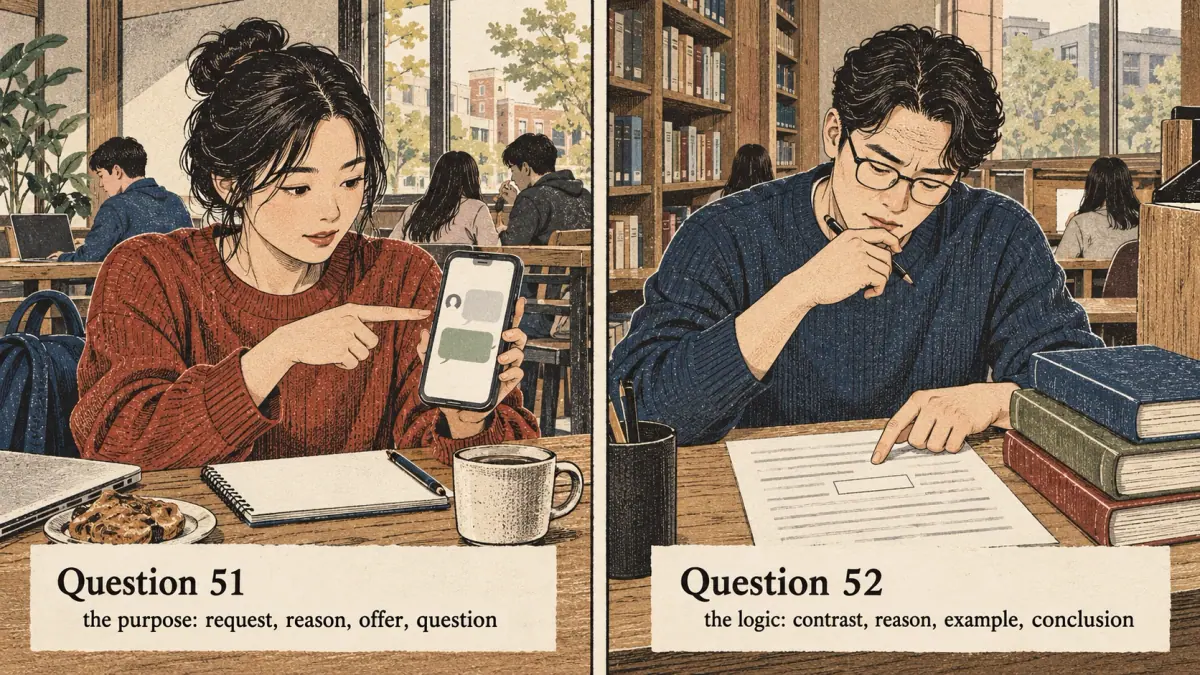
Question 52 differs from question 51 in text type, style and clues: it is an explanatory paragraph in -다, and the clues are logical connectors rather than a practical purpose. The two tasks look alike on the page, which is why learners often answer question 52 in the polite style they just used for question 51.
| Feature | Question 51 | Question 52 |
|---|---|---|
| Text | notice, email, message, advertisement | explanatory paragraph |
| Reader | a specific person or the public | a general reader |
| Style to write | the text's polite style: -(스)ㅂ니다 or -아/어요 | plain written style: -다 |
| Main clue | the purpose: request, reason, offer, question | the logic: contrast, reason, example, conclusion |
| Typical answer | 연락해 주시기 바랍니다 | 쉽게 포기하게 된다 |
The method on TOPIK question 51 still applies in outline; what changes is how you decide what the blank must say. The method below adapts it to an argument.
How Do You Solve Q52 Step by Step?
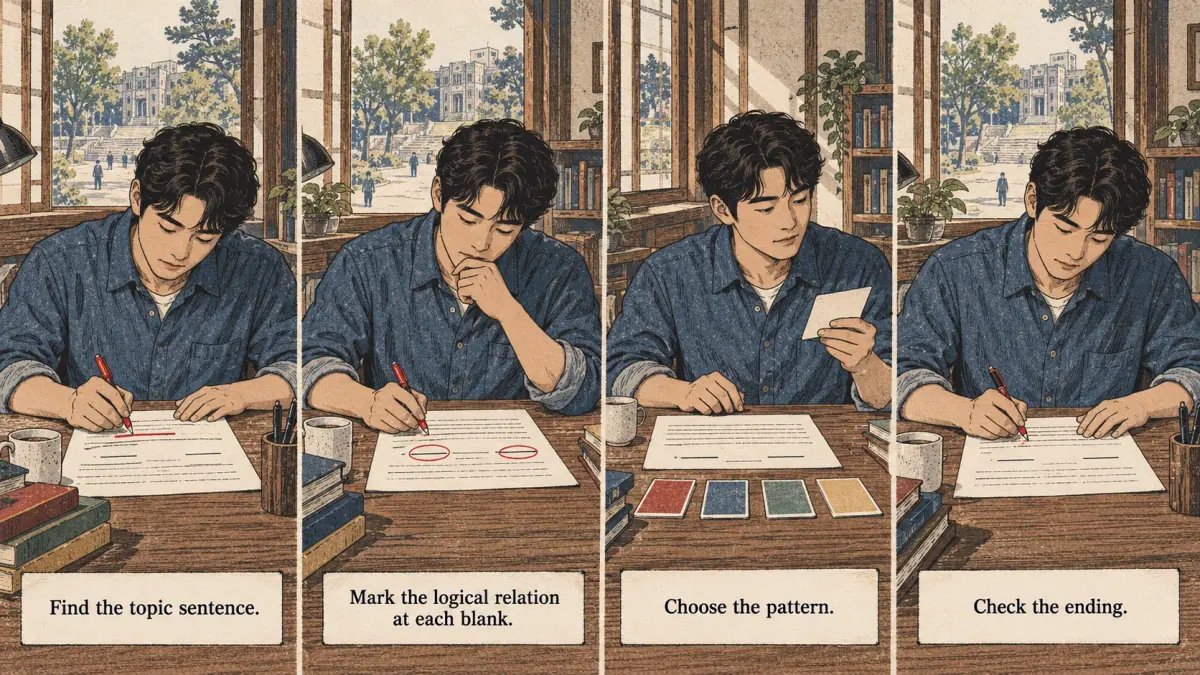
Solve question 52 in four steps: find the topic sentence, mark the logical relation at each blank, choose a pattern that expresses it, and check the ending. Allow about five minutes in total.
- Find the topic sentence. Usually the first or second sentence states the main idea, such as "people set big goals when starting a habit". Underline it, because both blanks must support it.
- Mark the logical relation at each blank. Circle the connector before or after the blank and name its job: 그러나/하지만 (contrast), 따라서/그러므로 (conclusion), 예를 들어 (example), 왜냐하면 or 그 이유는 (reason), 그래서/그 결과 (result). If there is no connector, ask what the next sentence assumes the blank said.
- Choose the pattern. Each relation has a set of reliable patterns, listed in the next section: a reason takes -기 때문이다, a recommendation takes -는 것이 좋다 or -아/어야 한다. Choose words already in the passage where you can.
- Check the ending. Verbs in -ㄴ다/-는다, adjectives and 있다/없다 in -다, nouns in -이다. Read the passage through with your answers in place; one -요 or -습니다 is enough to break the style.
The common mistake at each step mirrors question 51. Learners skip the topic sentence and write something true but off-topic, ignore the connector, choose an English-style structure that Korean does not use, or slip back into -요 out of habit. The patterns are what make step 3 fast.
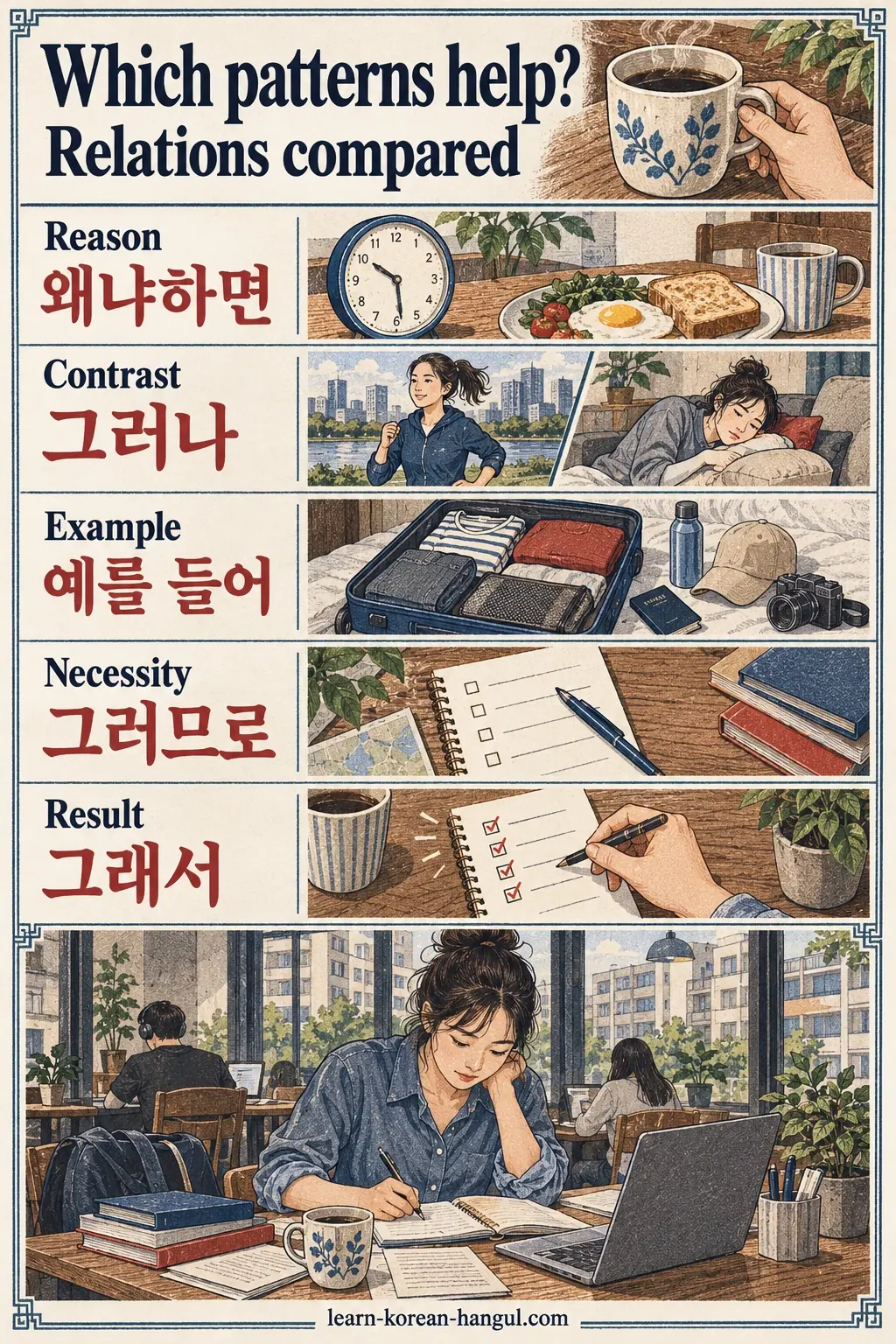
Which Patterns Help? Relations Compared
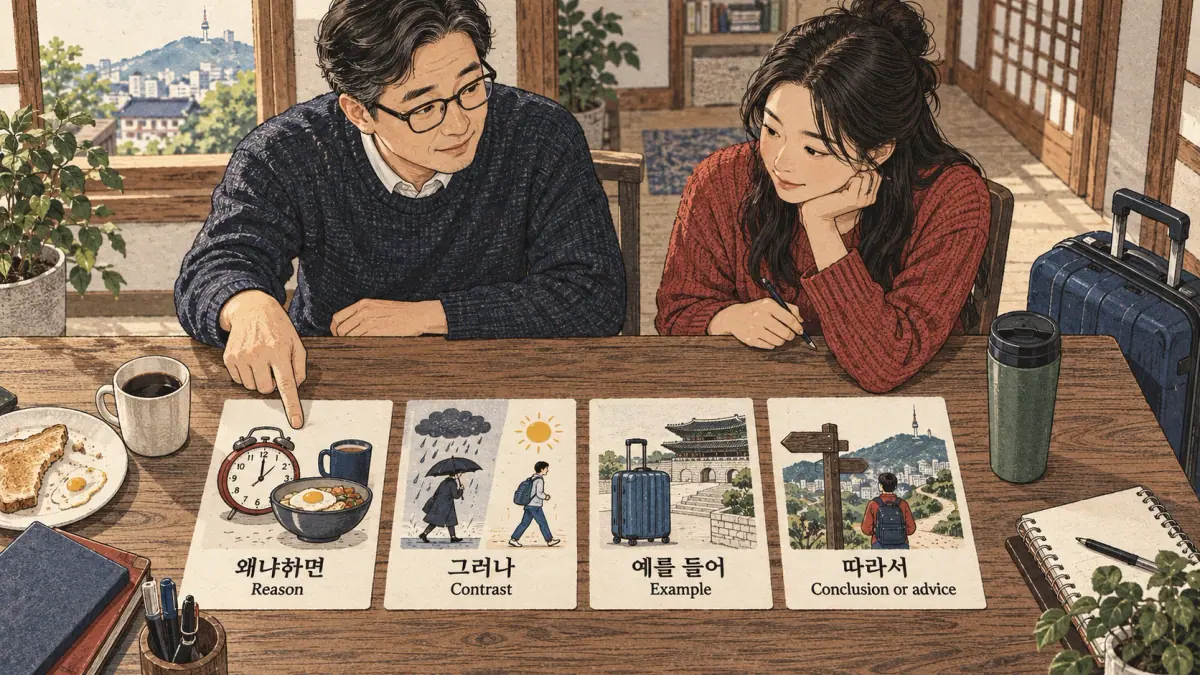
The patterns that help most are the ones that match a logical relation, because question 52 blanks almost always continue an argument in one of six ways. The table pairs each relation with its connectors and with endings that fit the plain style.
| Relation | Connectors that signal it | Patterns for the blank | Example answer |
|---|---|---|---|
| Reason | 왜냐하면, 그 이유는 | -기 때문이다 | 시간이 부족하기 때문이다 |
| Contrast | 그러나, 하지만, 반면에 | -지 않다, -(으)ㄹ 수도 있다 | 오히려 건강을 해칠 수 있다 |
| Example | 예를 들어, 예컨대 | -는 것이 그 예이다, -아/어야 한다 | 숙소를 예약해야 한다 |
| Necessity | 그러므로, 이를 위해서는 | -(으)ㄹ 필요가 있다, -아/어야 한다 | 미리 계획을 세울 필요가 있다 |
| Conclusion or advice | 따라서, 그러므로 | -는 것이 중요하다, -는 것이 좋다 | 충분히 자는 것이 중요하다 |
| Result | 그래서, 그 결과 | -게 되다, -(으)ㄴ/는다 | 쉽게 포기하게 된다 |
충분히 자는 것이 중요하다.
chungbunhi janeun geosi jungyohada.
It is important to get enough sleep.
쉽게 포기하게 된다.
swipge pogihage doenda.
People end up giving up easily.
-기 때문이다, -(으)ㄹ 필요가 있다 and -는 것이 중요하다 are the three endings most worth automating, because they fit the largest number of blanks. The connectors themselves are explained in the Korean connectors hub. The worked examples show the patterns inside full passages.
What Do Model Answers Look Like? Two Passages Compared

The two passages below are original practice texts in the style of question 52, one about habits and one about the environment. Each shows the reasoning, a model answer, acceptable alternatives and an answer that loses marks.
Example 1: Starting a New Habit
사람들은 보통 새로운 습관을 만들 때 처음부터 큰 목표를 세운다. 하지만 목표가 너무 크면 ( ㉠ ). 그래서 처음에는 매일 10분 운동하기처럼 작은 목표부터 시작하는 것이 좋다. 작은 목표를 이루면 자신감이 생기고, 이 자신감은 ( ㉡ ).
People usually set a big goal from the start when they form a new habit. But if the goal is too big, (㉠). So it is better to start with a small goal, such as exercising for ten minutes a day. Reaching a small goal builds confidence, and this confidence (㉡).
- Topic sentence: the passage argues for small goals.
- Blank ㉠: 하지만 contrasts with "set a big goal", and 그래서 after the blank recommends small goals, so ㉠ must give the problem with big goals.
- Blank ㉡: the confidence must lead somewhere positive that connects small and big goals.
- Model answer ㉠: 쉽게 포기하게 된다
- Model answer ㉡: 더 큰 목표에 도전하는 힘이 된다
- Also acceptable: ㉠ 목표를 지키기 어렵다; ㉡ 더 큰 목표를 이루는 데 도움이 된다.
- Loses marks: ㉠ 포기하기 쉬워요 (right idea, wrong style); ㉡ 매일 10분 운동한다 (repeats the passage and does not continue the sentence).
Example 2: Disposable Cups
일회용 컵은 편리하지만 환경에 큰 부담을 준다. 일회용 컵은 대부분 재활용이 쉽지 않아서 ( ㉠ ). 이 문제를 줄이기 위해서는 개인의 노력도 필요하다. 예를 들어 카페에 갈 때 ( ㉡ ).
Disposable cups are convenient but put a heavy burden on the environment. Most disposable cups are not easy to recycle, so (㉠). To reduce this problem, individual effort is needed too. For example, when going to a café, (㉡).
- Topic sentence: disposable cups harm the environment.
- Blank ㉠: -아/어서 after "not easy to recycle" needs the consequence, and 이 문제 in the next sentence refers to it, so ㉠ must name a problem.
- Blank ㉡: 예를 들어 after "individual effort is needed" asks for an example of that effort.
- Model answer ㉠: 쓰레기로 버려지는 경우가 많다
- Model answer ㉡: 개인 컵을 가지고 가는 것이 좋다
- Also acceptable: ㉠ 그대로 쓰레기가 된다; ㉡ 텀블러를 사용할 수 있다.
- Loses marks: ㉠ 환경이 좋아진다 (contradicts the passage); ㉡ 개인 컵을 가지고 가세요 (a spoken command in the wrong style).
개인 컵을 가지고 가는 것이 좋다.
gaein keobeul gajigo ganeun geosi jota.
It is better to bring your own cup.
In both passages, the sentence after the blank mattered as much as the connector before it. That is also where most lost marks come from.
How Is Question 52 Scored?
Question 52 is scored like question 51: on whether each answer fits the content and logic of the passage, and on whether its language is accurate and in the plain written style. Published scoring guidance gives full marks to an answer that does both, partial marks to one that fits but has errors or the wrong style, and few or no marks to one that breaks the argument. TOPIK can revise scoring details, so check the current guidance on topik.go.kr.
Mistakes That Lose Marks
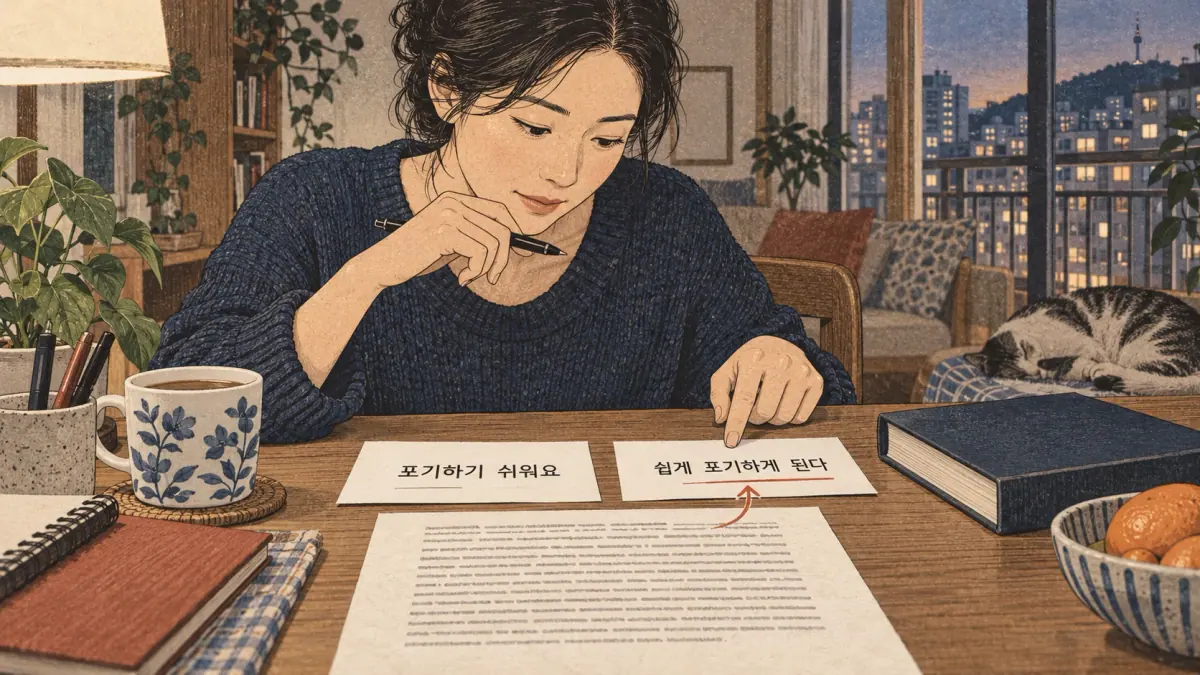
These six mistakes cost the most points in question 52 answers. Each comes with a fix.
- Using -요 or -습니다. The commonest error, often carried over from question 51. Fix: before writing, underline one -다 ending in the passage.
- Ignoring the connector. Writing a supporting point after 그러나. Fix: name the relation (contrast, reason, example) before you write a word.
- Breaking the sentence. Writing a full sentence when the blank is the second half of one. Fix: read the words after the blank and make sure they still attach.
- Repeating the passage. Copying an earlier sentence instead of adding the missing step. Fix: ask what the next sentence assumes the reader already knows.
- Adding personal opinion. Writing 나는 이렇게 생각한다 in an explanatory paragraph. Fix: keep the passage's neutral voice.
- Plain-style form errors. Writing 중요한다 or 먹다 for "eats". Fix: verbs take -ㄴ다/-는다 (먹는다), adjectives take -다 (중요하다).
Practise: Five Question 52 Blanks
Each item is a two-sentence passage with one blank. Choose the only option that fits the logic and the plain written style.
Practice · 5
Choose the best completion in the passage's style: 운동은 건강에 좋다. 그러나 너무 무리해서 운동하면 ( ).
Show answer
오히려 건강을 해칠 수 있다
그러나 signals a contrast with "exercise is good", so the blank must say it can harm health, in -다: 오히려 건강을 해칠 수 있다. The -어요 version has the right meaning but the wrong style.
Choose the best completion in the passage's style: 많은 사람들이 아침을 거른다. 그 이유는 ( ).
Show answer
아침에 시간이 부족하기 때문이다
그 이유는 asks for a reason ending in -기 때문이다. The -습니다 version breaks the plain style, and the other two do not give a reason for skipping breakfast.
Choose the best completion in the passage's style: 여행을 가기 전에는 미리 준비할 것이 많다. 예를 들어 ( ).
Show answer
숙소를 예약하고 날씨를 확인해야 한다
예를 들어 needs examples of preparation, in -다. The -요 version breaks the style, and the other two give no example.
Choose the best completion in the passage's style: 온라인 쇼핑은 편리하다. 하지만 ( ).
Show answer
직접 보고 살 수 없다는 단점이 있다
하지만 needs a drawback that contrasts with "convenient". Only the first option gives one in the plain style.
Choose the best completion in the passage's style: 잠이 부족하면 집중력이 떨어지고 실수가 늘어난다. 따라서 ( ).
Show answer
충분히 자는 것이 중요하다
따라서 draws a conclusion from the problem, so the answer recommends enough sleep, in -다: 충분히 자는 것이 중요하다. The -요 version has the right idea in the wrong style.
Question 52 checklist before you move on
- I found the topic sentence and the connector at each blank.
- Each answer does the job the connector asks for: contrast, reason, example, conclusion or result.
- Every ending is in the plain style: -ㄴ다/-는다, -다 or -이다.
- The words after each blank still attach to my answer.
- I added no personal opinion and repeated no sentence from the passage.
Question 52 is the bridge from short answers to paragraphs. The next task, TOPIK question 53, asks you to write a whole paragraph of 200-300 characters in the same plain style, so the endings you practised here carry straight over. For a weekly routine that includes two question 51-52 pairs, see the TOPIK 2 study plan.
What This Guide Does Not Cover
This guide to TOPIK question 52 teaches a method, the plain style and the relation patterns; the practice passages are original, not official exam texts. Scoring details and the point value follow published guidance and can change, so confirm them on topik.go.kr. Model answers show one good solution each, and other answers that fit the logic and the style can score equally well.
Frequently Asked Questions
Is Q52 Harder than Q51?
For most learners, yes. Question 51 uses everyday texts in a polite style you already speak, while question 52 uses an explanatory paragraph in the plain written style and asks you to follow its argument. The language in the answer is not much harder, but finding what the blank must say takes more careful reading.
Can I Use -습니다 in Question 52?
No. The passage is written in the plain style ending in -다, so -(스)ㅂ니다 or -아/어요 in your answer breaks the style of the text and loses language marks. Turn 중요합니다 into 중요하다, 필요해요 into 필요하다 and 줄여야 합니다 into 줄여야 한다.
What Connectors Help?
The connectors that help most are the ones in the passage itself: 그러나 and 하지만 signal a contrast, 따라서 and 그러므로 a conclusion, 예를 들어 an example, 왜냐하면 a reason ending in -기 때문이다, and 그 결과 a result. Find the connector before or after the blank, and the job of your sentence follows.
How Do I Check My Ending?
Read the sentence before the blank and copy its style: verbs take -ㄴ다 or -는다 (줄인다, 먹는다), adjectives and 있다 take -다 (중요하다, 있다), and nouns take -이다. Then read the whole passage aloud in your head with your answer in place. If one sentence sounds like speech, rewrite it.
How Long Should My Answer Be?
One clause or sentence per blank, usually about 10 to 25 syllables. Long answers are not rewarded and add chances for errors. If the blank sits in the middle of a sentence, write only the missing part, so the words after the blank still join it correctly.