What Is TOPIK Question 51?
TOPIK question 51 is a gap-fill writing task on a real-life text of about four to six sentences. Two parts of the text are replaced by blanks marked ㉠ and ㉡, and you write the missing sentence or clause for each. The question sits in the first period of TOPIK II, after listening, inside the 50 minutes for all four writing questions.
| Feature | Question 51 |
|---|---|
| Text type | practical: notice, email, message, advertisement, invitation |
| Blanks | two, marked ㉠ and ㉡ |
| Answer length | one sentence or clause per blank |
| Style | same as the text, usually -(스)ㅂ니다 or -아/어요 |
| Points | 10 in total (commonly published breakdown; check topik.go.kr) |
| Suggested time | about 5 minutes |
| Answer sheet | lines on the written answer sheet, not 원고지 grid paper |
The point value follows the breakdown published for the current format, which is also used on the TOPIK exam format page. Because TOPIK can revise its tasks, check the current guide on topik.go.kr before the test. Knowing the task is half the work; the other half is a reliable method.
How Do You Solve Q51 Step by Step?
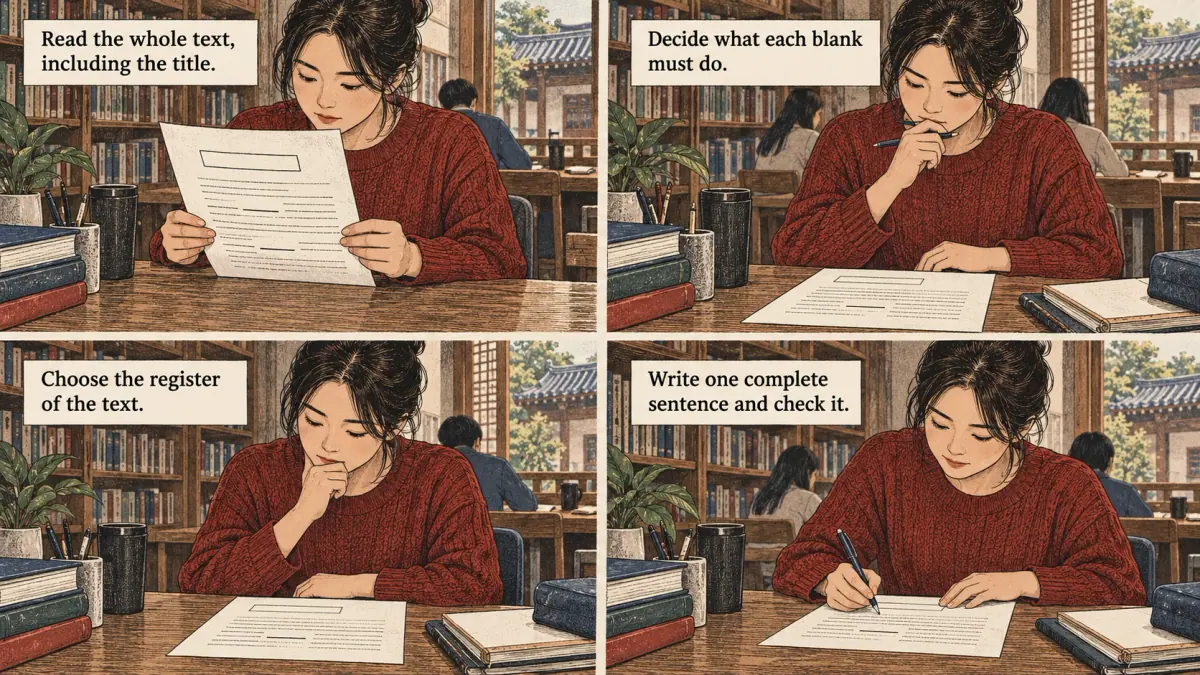
Solve question 51 in four steps: read the whole text, decide what each blank must do, choose the text's register, then write one complete sentence and check it. The whole routine takes about five minutes.
- Read the whole text, including the title. The title tells you the purpose: 분실물을 찾습니다 (looking for a lost item), 초대합니다 (invitation), 환불 문의 (refund enquiry). Read past the blanks too, because the sentence after a blank often holds the strongest clue.
- Decide what each blank must do. Ask whether the blank gives a reason, makes a request, offers something, explains a problem or asks a question. Look at the words right before and after it: a question mark after the blank means you must write a question, and 그래서 after it means the blank gave a reason.
- Choose the register of the text. Find two or three verb endings elsewhere in the text. If they end in -(스)ㅂ니다, write -(스)ㅂ니다; if they end in -아/어요, write -아/어요. Never mix the two, and never use casual speech.
- Write one complete sentence and check it. Check the tense against time words (어제, 다음 주), the particles, the spelling and the ending. Then read the text from the start with your answer in place; if it sounds like one writer, you are done.
Each step has a typical failure. In step 1, learners skip the sentence after the blank; in step 2, they write something true but off-purpose; in step 3, they switch to the style they feel more comfortable with; in step 4, they leave a tense that contradicts the text. The text types themselves follow a few recurring patterns.
Which Text Types Appear?
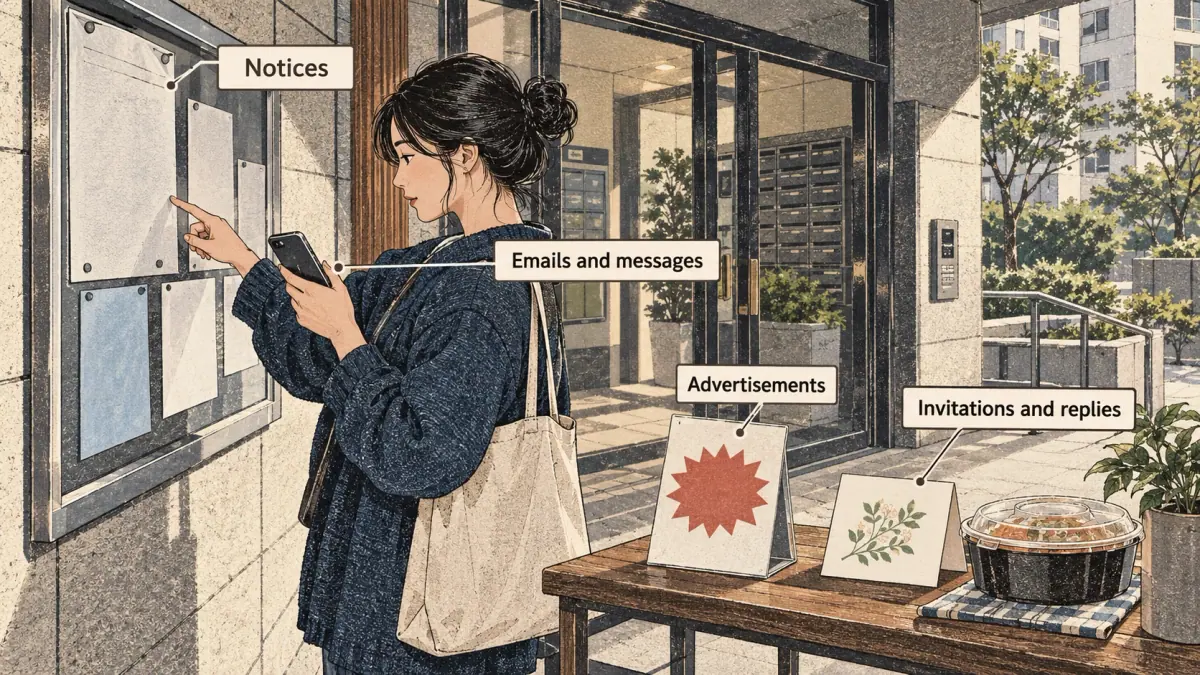
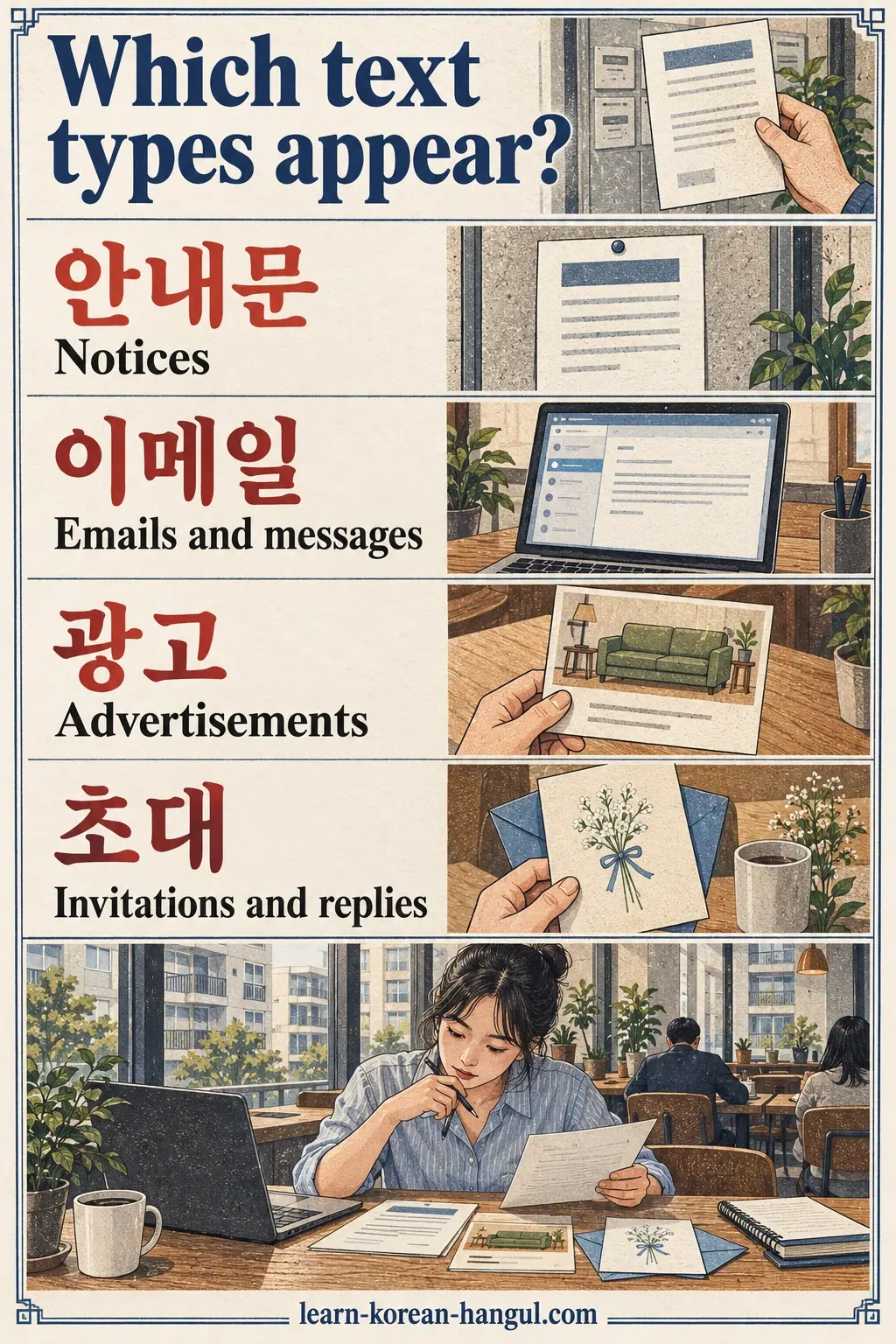
Question 51 texts are short everyday documents of the kind posted in a building or sent by email. Published past papers show four recurring types, though TOPIK can introduce others, so check recent papers on the TOPIK past papers page.
- Notices (안내문, 공지): a building, school or shop tells the public about a change, a closure or a lost item. Register: -(스)ㅂ니다. Typical blank: an instruction or a request, such as 연락해 주시기 바랍니다.
- Emails and messages (이메일, 문자): one person writes to a teacher, colleague, company or friend. Register: -(스)ㅂ니다 for formal emails, -아/어요 for friendly messages. Typical blank: a reason or a question.
- Advertisements (광고): someone sells an item or offers lessons or a room. Register: usually -(스)ㅂ니다. Typical blank: what is offered and how to contact the writer.
- Invitations and replies (초대): an invitation to a party, event or opening, or the reply to one. Register: -아/어요 between friends, -(스)ㅂ니다 for public events. Typical blank: the invitation itself, or a reason for not coming.
In every type, the blanks carry the purpose of the text: the request, the reason or the offer. The register you write them in is the next decision.
Which Register Should You Use? a Comparison
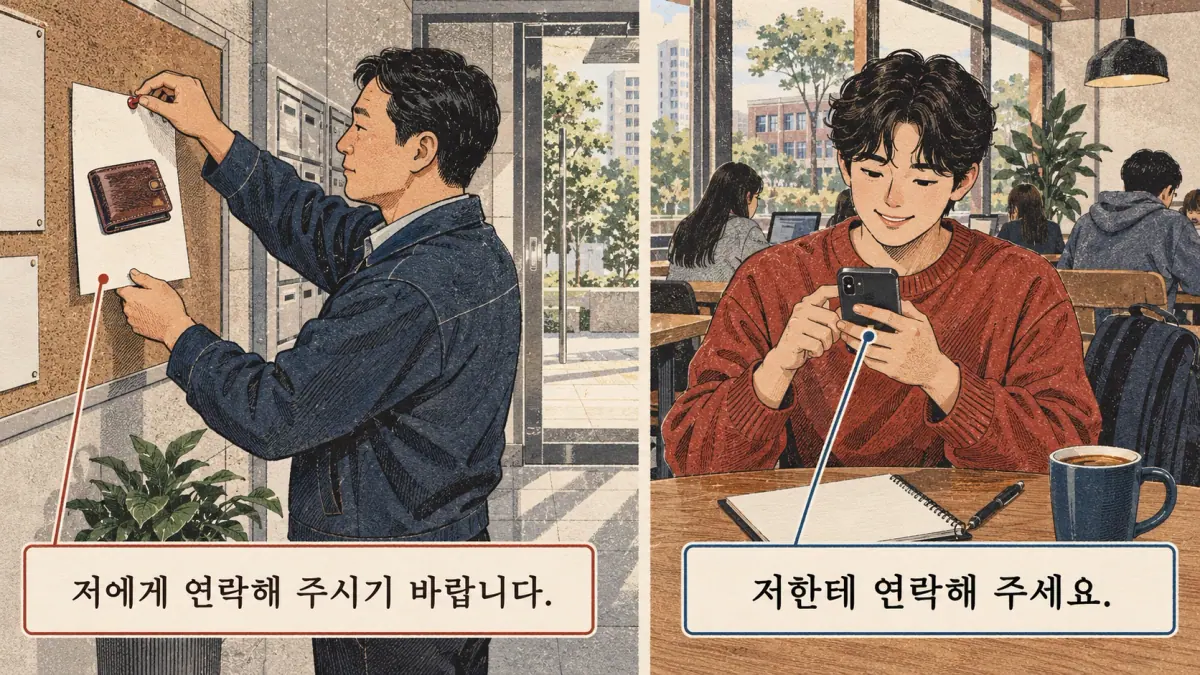
Use the register the text already uses, so the finished text reads as if one person wrote it. Register here means the speech style shown by the verb endings. Question 51 texts use two polite styles, and the comparison below shows how the same blank changes with each.
| Text style | How to spot it | Model blank: "please contact me" | Model blank: "I can't come" |
|---|---|---|---|
| Formal, -(스)ㅂ니다 (합쇼체) | 있습니다, 바랍니다, 입니다 | 저에게 연락해 주시기 바랍니다. | 참석할 수 없습니다. |
| Polite, -아/어요 (해요체) | 있어요, 주세요, 이에요 | 저한테 연락해 주세요. | 못 갈 것 같아요. |
| Casual (반말), never correct here | 있어, 줘, 이야 | (do not use) | (do not use) |
The two polite styles and how they differ are explained in Korean speech levels. A useful rule of thumb: if the text has a title and addresses many people, it is almost always -(스)ㅂ니다; if it opens with a person's name followed by 씨 or 에게, check the endings, because it may be -아/어요.
저에게 연락해 주시기 바랍니다.
jeoege yeollakae jusigi baramnida.
Please contact me. (formal notice style)
저한테 연락해 주세요.
jeohante yeollakae juseyo.
Please get in touch with me. (polite message style)
The plain written style (-다) used in questions 52 to 54, explained on TOPIK writing style, does not belong in question 51 either, because these texts speak to a reader. The worked examples below put the method and the register rule together.
What Do Model Answers Look Like? Three Examples Compared

The three texts below are original practice texts in the style of question 51. Each shows the clues, a model answer, acceptable alternatives and an answer that loses marks.
Example 1: a Lost-Item Notice
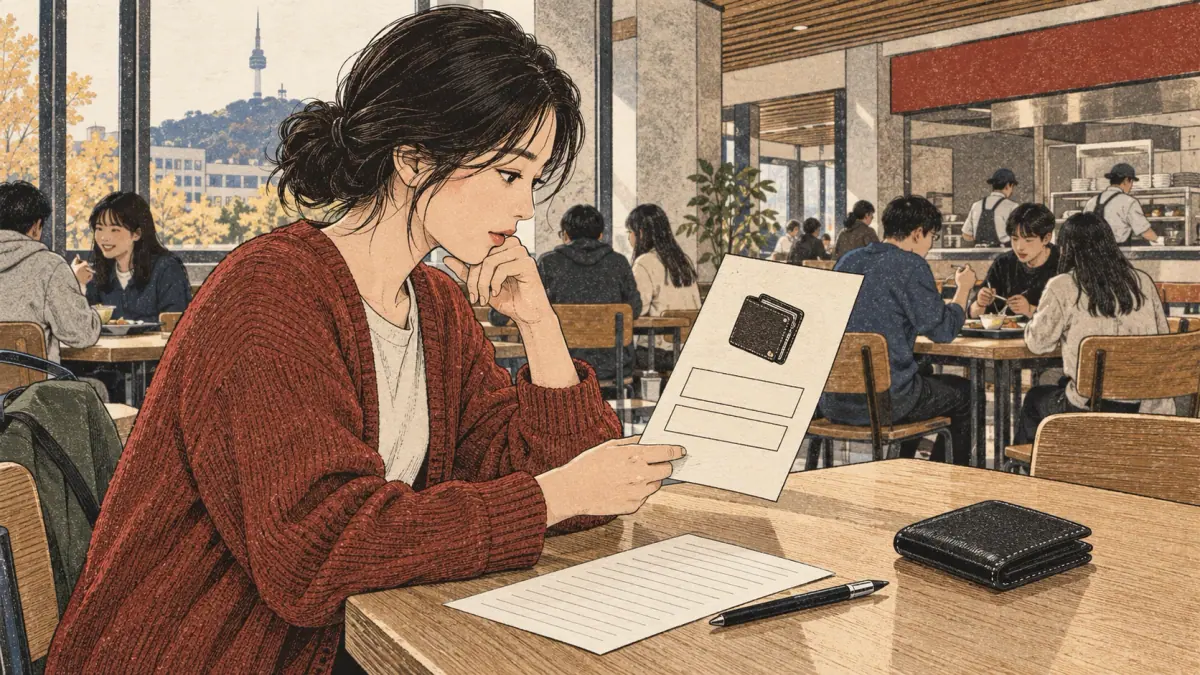
분실물을 찾습니다 어제 오후 3시쯤 학생회관 2층 식당에서 검은색 지갑을 ( ㉠ ). 지갑 안에는 학생증과 가족사진이 들어 있습니다. 지갑을 보신 분은 ( ㉡ ). 제 전화번호는 010-1234-5678입니다.
Looking for a lost item. Yesterday at about 3 p.m. I (㉠) a black wallet in the second-floor cafeteria of the student union. My student ID and a family photo are inside. If you have seen the wallet, (㉡). My phone number is 010-1234-5678.
- Clues: the title says something was lost; 어제 needs the past tense; 입니다 and 있습니다 set the formal style; the phone number after ㉡ means ㉡ asks for contact.
- Model answer ㉠: 잃어버렸습니다
- Model answer ㉡: 저에게 연락해 주시기 바랍니다
- Also acceptable: ㉠ 분실했습니다 (a more formal word for "lost"); ㉡ 이 번호로 연락해 주십시오.
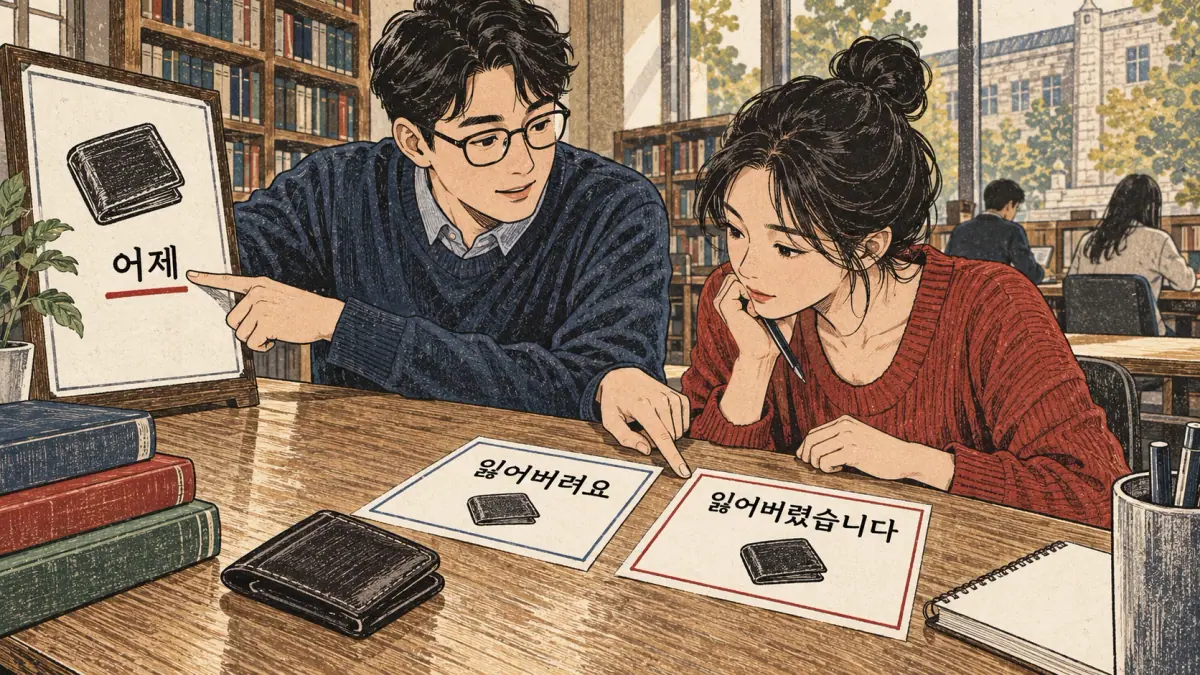
- Loses marks: ㉠ 잃어버려요 (present tense and wrong style); ㉡ 전화해 (casual).
지갑을 보신 분은 저에게 연락해 주시기 바랍니다.
jigabeul bosin buneun jeoege yeollakae jusigi baramnida.
If you have seen the wallet, please contact me.
Example 2: a Reply to an Invitation
수진 씨에게 집들이에 초대해 줘서 고마워요. 그런데 그날은 회사 일로 출장을 가야 해서 ( ㉠ ). 정말 미안해요. 대신 다음 주에 ( ㉡ )? 맛있는 저녁은 제가 살게요. 민호
To Sujin. Thanks for inviting me to your housewarming. But I have to go on a business trip that day, so (㉠). I'm really sorry. Instead, (㉡) next week? Dinner is on me. Minho.
- Clues: 고마워요 and 미안해요 set the -아/어요 style; -아/어야 해서 gives a reason, so ㉠ is the result (not coming); 정말 미안해요 confirms the refusal; the question mark after ㉡ needs a question; 저녁은 제가 살게요 says ㉡ suggests meeting for a meal.
- Model answer ㉠: 집들이에 못 갈 것 같아요
- Model answer ㉡: 같이 저녁을 먹을까요
- Also acceptable: ㉠ 갈 수 없어요; ㉡ 따로 만날 수 있을까요.
- Loses marks: ㉠ 집들이에 가겠습니다 (contradicts 미안해요 and switches style); ㉡ 저녁을 먹었어요 (not a suggestion, wrong tense).
Example 3: a Refund Email
제목: 환불 문의 안녕하십니까? 저는 지난주에 귀사 홈페이지에서 운동화를 구입한 사람입니다. 그런데 받은 운동화가 너무 작아서 ( ㉠ ). 환불을 받으려면 ( ㉡ )? 빠른 답변 부탁드립니다.
Subject: refund enquiry. Hello. I bought trainers on your company's website last week. But the trainers I received are too small, so (㉠). To get a refund, (㉡)? I look forward to a quick reply.
- Clues: 안녕하십니까 and 사람입니다 set the formal style; -아/어서 after 작다 needs a consequence; the title and the next sentence point to a refund; the question mark after ㉡ needs a question about the procedure.
- Model answer ㉠: 신을 수가 없습니다
- Model answer ㉡: 어떻게 해야 합니까
- Also acceptable: ㉠ 환불을 받고 싶습니다; ㉡ 무엇을 준비해야 합니까.
- Loses marks: ㉠ 신을 수 없어요 (right meaning, wrong style); ㉡ 환불해 주세요 (not a question, and it ignores 받으려면).
환불을 받으려면 어떻게 해야 합니까?
hwanbureul badeuryeomyeon eotteoke haeya hamnikka?
What do I need to do to get a refund?
Across the three examples, the clue after the blank decided as much as the clue before it. The scoring explains why a fitting sentence matters as much as a correct one.
How Is Question 51 Scored?
Question 51 is scored on two things: whether each answer fits the content and purpose of the text, and whether its language is accurate and in the right style. Published scoring guidance gives full marks to a sentence that does both. A sentence that fits but contains errors earns partial marks, and an off-purpose sentence earns little even if its grammar is perfect. TOPIK can revise scoring details, so check the current guidance on topik.go.kr.
The consequence for practice is clear: a simple sentence that does the right job beats a complex one that does not. 연락해 주세요 in a formal notice loses less than a perfect sentence about the wallet's colour, because the colour sentence does not ask for anything. Knowing how marks are lost leads straight to the most common errors.
Mistakes That Lose Marks
These six mistakes cost the most points in question 51 answers. Each comes with a fix.
- Switching register. Writing 연락해 주세요 into a -(스)ㅂ니다 notice. Fix: copy the ending of the sentence just before the blank.
- Ignoring the sentence after the blank. Writing a reason where the next sentence shows a request was needed. Fix: read the next sentence before you write.
- Wrong tense. Writing the present tense after 어제 or the past after 다음 주. Fix: circle every time word in the text.
- Not matching punctuation. Writing a statement before a question mark. Fix: check what punctuation follows the blank.
- Writing two sentences. A second sentence adds no points and doubles the chance of errors. Fix: one clause per blank.
- Repeating words from the text. Copying a nearby sentence does not answer the blank. Fix: say something new that the text needs.
Practise: Five Question 51 Blanks
Each item is a short practical text with one blank. Choose the only option that fits both the meaning and the style of the text.
Practice · 5
Choose the sentence that fits the blank and the style of the notice: 이번 주 토요일에는 도서관 공사가 있어서 ( ). 이용에 참고하시기 바랍니다.
Show answer
도서관 문을 열지 않습니다
The notice uses -(스)ㅂ니다 and talks about a coming Saturday, so the answer is formal and in the present: 도서관 문을 열지 않습니다. 안 열어 is casual, 열었습니다 is past, and coming early contradicts the closure.
Choose the sentence that fits the blank and the style of the message: 다음 주 모임 장소를 아직 못 정했어요. 혹시 ( )? 좋은 곳이 있으면 알려 주세요.
Show answer
좋은 식당을 알고 있어요
The writer is asking for ideas in the -아/어요 style, so 좋은 식당을 알고 있어요? fits. 알고 있습니까 switches to the formal style, and the other two do not ask for a place.
Choose the sentence that fits the blank and the style of the advertisement: 중고 자전거를 ( ). 산 지 1년이 되었지만 거의 타지 않아서 깨끗합니다.
Show answer
팔려고 합니다
An advertisement for a used bike offers it for sale in the formal style: 팔려고 합니다. 팔아요 has the right meaning but the wrong style, and the other two do not advertise anything.
Choose the sentence that fits the blank and the style of the invitation: 다음 주 토요일이 제 생일이에요. 그래서 ( ). 저녁 7시에 우리 집으로 오세요.
Show answer
여러분을 생일 파티에 초대하고 싶어요
The next sentence tells people when to come, so the blank must invite them in the -아/어요 style. The other options cancel the party, refuse guests or leave the sentence unfinished in the wrong style.
Choose the sentence that fits the blank and the style of the notice: 오늘 오후 2시부터 4시까지 엘리베이터 점검이 있습니다. 점검 시간에는 ( ). 불편을 드려 죄송합니다.
Show answer
계단을 이용해 주시기 바랍니다
During the check the lift cannot be used, so residents are asked politely to take the stairs: 계단을 이용해 주시기 바랍니다. The casual 이용해 and the past 이용했습니다 break the style, and using the lift contradicts the notice.
Question 51 checklist before you move on
- I read the title and the sentence after each blank.
- Each answer does the job the text needs: reason, request, offer or question.
- My endings match the text: -(스)ㅂ니다 or -아/어요, no casual speech.
- Tense matches the time words, and punctuation matches the blank.
- Each blank has one sentence or clause, with correct spelling and particles.
Question 51 trains reading for purpose; question 52 adds the plain written style and the logic of an explanatory paragraph, so continue with TOPIK question 52. For all four tasks, see the TOPIK writing hub and TOPIK exam format, and for a weekly writing routine that includes question 51, see the TOPIK 2 study plan.
What This Guide Does Not Cover
This guide to TOPIK question 51 teaches a method and the register rule; it does not reproduce official exam texts, and the practice texts above are original. Scoring details and the point value follow published guidance and can change, so confirm them on topik.go.kr. The guide also cannot mark your own answers: a teacher or a careful comparison with model answers is still needed.
Frequently Asked Questions
How Many Sentences per Blank?
One. Each blank stands for one sentence or the end of one sentence, so write a single complete clause that joins smoothly to the words around it. A second sentence does not earn extra points and adds chances for errors. If the blank is followed by a question mark, your answer must be a question.
Can I Use Informal Speech?
No. Question 51 texts are written to the public or to someone you address politely, so casual endings such as -아/어 or -자 clash with the text and lose language marks. Copy the ending the text uses: -(스)ㅂ니다 in notices and formal emails, -아/어요 in friendly messages and invitations.
What If I Do Not Know the Vocabulary?
Paraphrase with words you know. If you cannot remember 분실하다, write 잃어버렸습니다; if 문의하다 escapes you, write 물어보고 싶습니다. The graders mark whether the sentence fits and is accurate, not whether it uses the most advanced word. A simple correct sentence beats an ambitious broken one.
How Long Should I Spend on Q51?
About five minutes, including a final check. The writing time is 50 minutes for all four questions, and question 54 alone needs about 25. A common split is about 5 minutes each for questions 51 and 52, 15 for question 53 and 25 for question 54.
Where Do I Write the Answer?
On paper tests, you write question 51 on the lines of the written answer sheet, not on the 원고지 grid used for questions 53 and 54. Write each answer next to its letter, ㉠ or ㉡. On the internet-based test you type it into the answer box instead.