What Is TOPIK Question 53?

TOPIK question 53 is the third writing task of TOPIK II and the first that asks for a whole paragraph. The prompt shows data, usually one or two charts, graphs or survey tables, and you write 200-300 characters that report it accurately. It is the most mechanical writing task: the content is given, so marks depend on structure and language.
| Feature | Question 53 |
|---|---|
| Input | one or two charts, graphs or survey tables, sometimes with causes or an outlook |
| Output | one paragraph, 200-300 characters including spaces |
| Style | plain written style (-다) |
| Answer sheet | 원고지 grid paper on the paper test; a text box on the internet-based test |
| Points | 30 (commonly published breakdown; check topik.go.kr) |
| Suggested time | about 15 minutes |
| Not wanted | a title, an introduction about yourself, personal opinion |
The 30 points make question 53 worth as much as questions 51 and 52 together, plus another 10. Because the task is predictable, it is the best return on practice time in the writing section. The predictable part is the structure.
How Do You Structure a Q53 Answer?
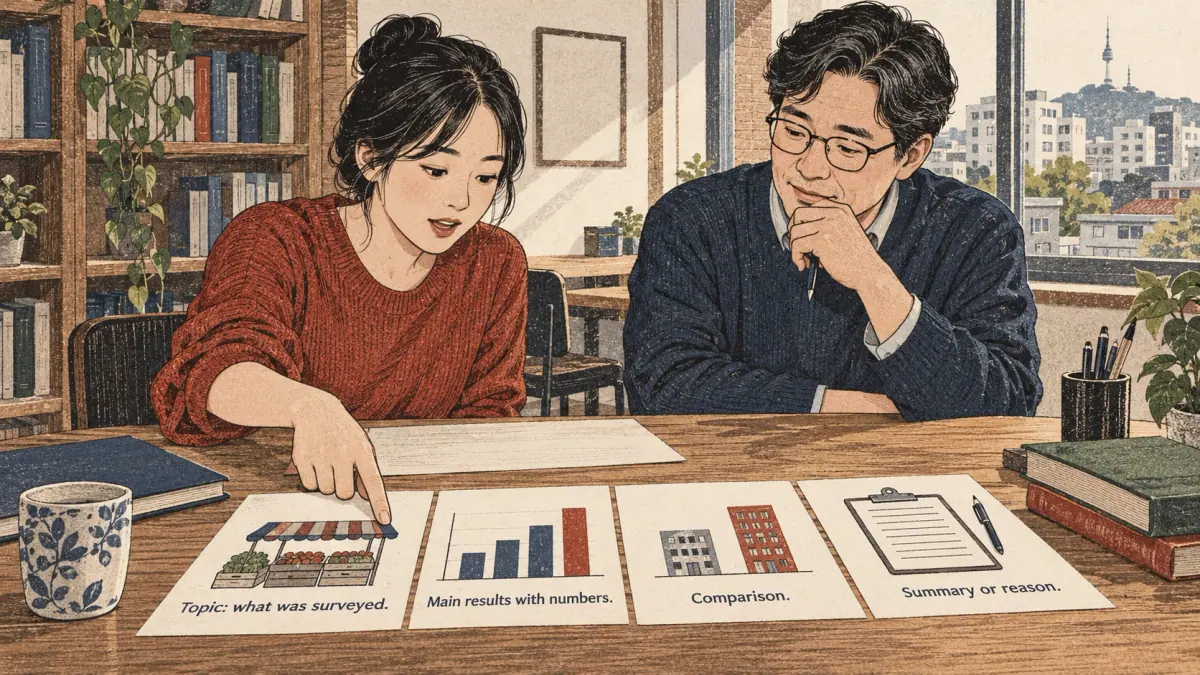
Structure a question 53 answer in four parts: what was surveyed, the main results with numbers, a comparison, and a one-sentence summary or reason. Each part is one or two sentences, and the whole paragraph usually has four to six sentences.
- Topic: what was surveyed. Name who surveyed whom about what, in one sentence: OO연구소에서 대학생 300명을 대상으로 아르바이트에 대해 조사했다.
- Main results with numbers. Report the key figure or trend with 증가했다, 감소했다 or 나타났다, copying every number exactly.
- Comparison. Rank the items or compare groups or years: 가장 많았다, 그 뒤를 이었다, -에 비해, 반면.
- Summary or reason. If the task gives causes or an outlook, report them; if not, close with one sentence on what the data shows: 이를 통해 ... -다는 것을 알 수 있다.
- Planning tip: before writing, number the four parts in the margin of the question paper and write the figures you will use next to each.
- Common mistake: spending half the characters on part 1. One sentence is enough for the topic; the data carries the score.
조사 결과 아르바이트를 하는 대학생의 비율은 증가한 것으로 나타났다.
josa gyeolgwa areubaiteureul haneun daehaksaengui biyureun jeungahan geoseuro natanatda.
The survey showed that the share of university students with part-time jobs has risen.
The frame only works if you have the words for trends and rankings ready.
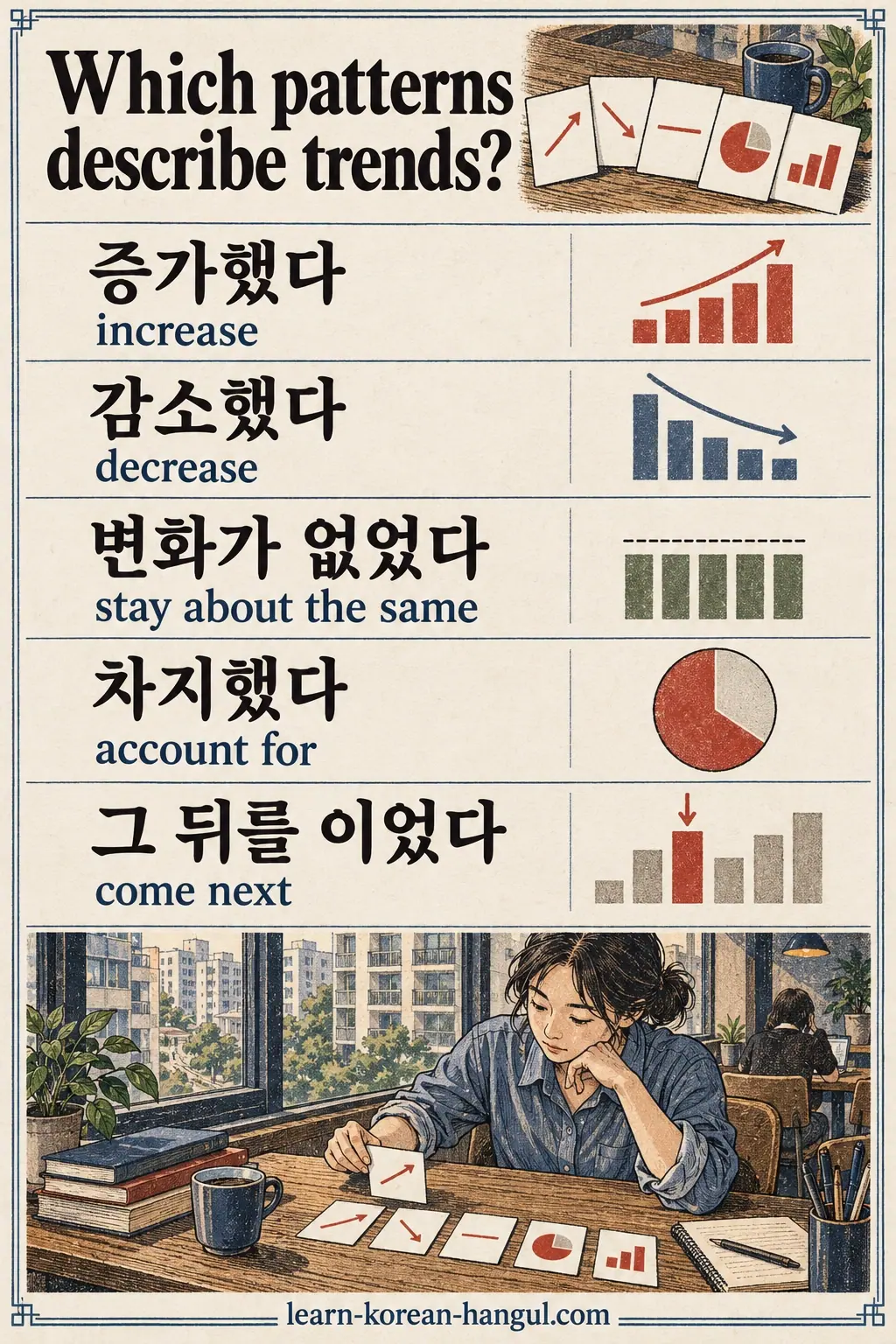
Which Patterns Describe Trends?

The patterns that describe trends fall into four groups: rising, falling, staying level and ranking. Learn the pairs below in their plain past forms, because question 53 reports finished surveys.
| Meaning | Formal word (Sino-Korean) | Native or everyday word | Pattern in a sentence |
|---|---|---|---|
| increase | 증가했다 | 늘어났다 | 40%에서 55%로 증가했다 |
| decrease | 감소했다 | 줄어들었다 | 30%에서 20%로 감소했다 |
| rise sharply / fall sharply | 급증했다 / 급감했다 | 크게 늘어났다 / 크게 줄어들었다 | 2020년 이후 급증했다 |
| stay about the same | 변화가 없었다 | 비슷했다 | 두 해 모두 비슷했다 |
| account for | 차지했다 | none | 전체의 45%를 차지했다 |
| be the largest | 가장 높았다 | 가장 많았다 | '생활비 마련'이 가장 많았다 |
| come next | 그 뒤를 이었다 | 다음으로 | '용돈'이 30%로 그 뒤를 이었다 |
| compared with | -에 비해 | -보다 | 2015년에 비해 15%포인트 높았다 |
Survey vocabulary completes the set: 조사 결과 (survey results), 응답자 (respondents), 비율 (proportion or share), 대상 (subjects), and -(으)로 나타났다 (turned out to be). Two rules keep numbers safe. First, write each figure exactly as the chart shows it and keep one format: Arabic numerals with %, as in 45%. Second, a change between two percentages is written in 퍼센트포인트 (percentage points) if you compare them, so 40% to 55% is 15%포인트, not 15%. The plain-past endings themselves are covered in the plain past -았다/었다 lesson. With the words in place, the scoring explains what graders look for.
How Is Q53 Scored? the Rubric Compared

Question 53 is scored in three categories: content and task completion, structure, and language use. Published TOPIK scoring guidance uses these categories for both question 53 and question 54, and language use carries the largest share of the points. Check the current weights on topik.go.kr, because TOPIK can revise them.
| Category (Korean name) | What graders check | How to earn it in question 53 |
|---|---|---|
| Content and task (내용 및 과제 수행) | all key data included, accurately, within 200-300 characters | report every chart, every key figure and the causes or outlook if given |
| Structure (글의 전개 구조) | logical order and linking | follow the four-part frame; link with 반면, 그 뒤를 이었다, 이를 통해 |
| Language use (언어 사용) | grammar, vocabulary, spelling, written style | plain style throughout; varied trend words; correct particles with numbers |
The practical lesson is that a plain, accurate, well-ordered paragraph scores well. Rare vocabulary helps only once the data and the structure are right. The model answer shows all three categories at work.
What Does a Model Answer Look Like? Annotated Example
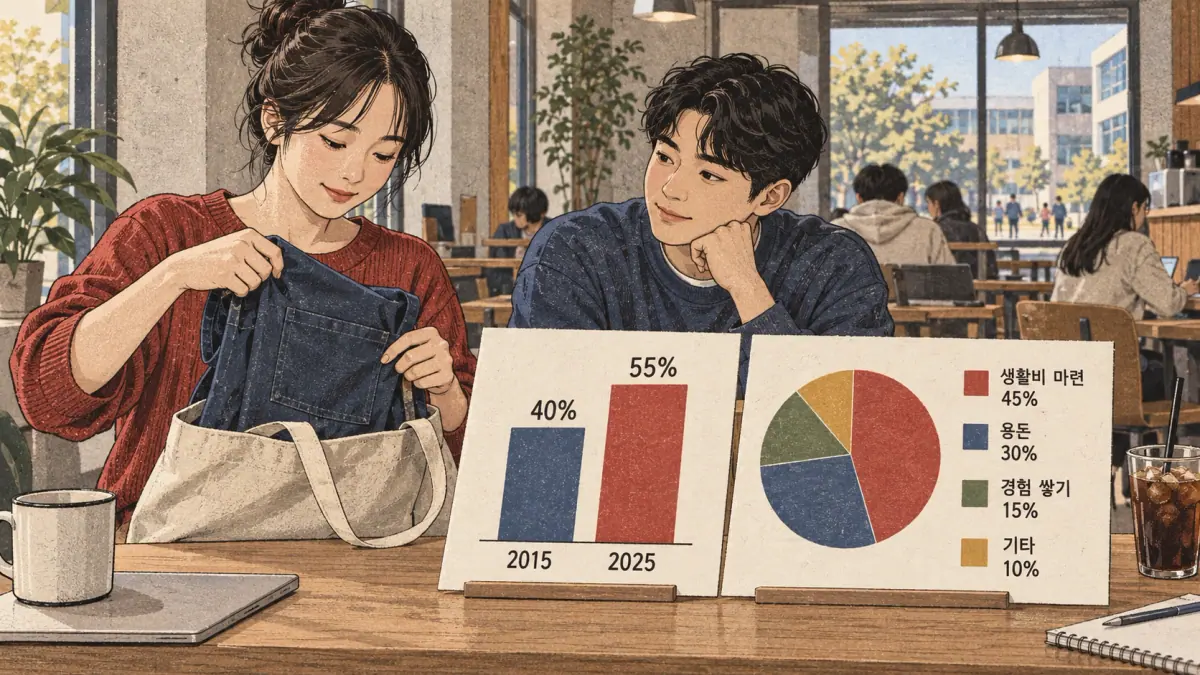
The prompt and model answer below are original practice material in the style of question 53. The data is invented for practice.
Practice prompt. 다음은 'OO연구소'에서 대학생 300명을 대상으로 조사한 내용이다. 이 내용을 200~300자의 글로 쓰시오. 단, 글의 제목은 쓰지 마시오. (The following is a survey by OO Research Institute of 300 university students. Write it up in 200-300 characters. Do not write a title.)
| Data set | Figures |
|---|---|
| Share of students with a part-time job | 2015: 40% → 2025: 55% |
| Reasons for working (2025) | living costs (생활비 마련) 45%, pocket money (용돈) 30%, experience (경험 쌓기) 15%, other (기타) 10% |
Model answer (219 characters including spaces):
OO연구소에서 대학생 300명을 대상으로 아르바이트에 대해 조사했다. 조사 결과 아르바이트를 하는 대학생의 비율은 2015년 40%에서 2025년 55%로 증가한 것으로 나타났다. 아르바이트를 하는 이유로는 '생활비 마련'이 45%로 가장 많았으며, '용돈'이 30%, '경험 쌓기'가 15%로 그 뒤를 이었다. 이를 통해 경제적인 이유로 아르바이트를 하는 대학생이 많다는 것을 알 수 있다.
OO Research Institute surveyed 300 university students about part-time work. The survey showed that the share of students with a part-time job rose from 40% in 2015 to 55% in 2025. The most common reason for working was living costs at 45%, followed by pocket money at 30% and gaining experience at 15%. This shows that many students work for financial reasons.
Annotation
- Sentence 1 (topic): who, whom, what, in one sentence. -에서 marks the organisation that carried out the survey; -을 대상으로 means "targeting" or "among".
- Sentence 2 (result): the trend with both years and both figures, -에서 ... -(으)로 for the change, and -ㄴ 것으로 나타났다 for a survey finding.
- Sentence 3 (comparison): ranks three reasons with 가장 많았으며 and 그 뒤를 이었다; -(으)며 is the written form of -고.
- Sentence 4 (summary): 이를 통해 ... -다는 것을 알 수 있다 draws a conclusion from the data only, without personal opinion.
- Length check: 219 characters including spaces, inside the 200-300 range with room to spare. "Other" (10%) is left out because it adds no information; including it would also be correct.
이를 통해 경제적인 이유로 아르바이트를 하는 대학생이 많다는 것을 알 수 있다.
ireul tonghae gyeongjejeogin iyuro areubaiteureul haneun daehaksaengi mantaneun geoseul al su itda.
This shows that many university students work part-time for financial reasons.
On grid paper, the square count differs a little from the character count, because two digits share one square under 원고지 rules. The full manuscript rules come with the most frequent errors below.
Mistakes That Lose Marks

These six mistakes cost the most points in question 53 answers. Each comes with a fix.
- Writing in -요 or -습니다. The paragraph must be in -다 throughout. Fix: check the last syllable of every sentence before you finish.
- Leaving out a data set. Two charts mean two parts of the answer. Fix: tick each chart and each figure in the prompt as you use it.
- Adding opinion. 나는 아르바이트가 좋다고 생각한다 has no place in question 53. Fix: end with what the data shows, not what you think.
- Copying numbers wrongly. A wrong figure is a content error. Fix: copy numbers last, directly from the chart.
- Writing too little or too much. Under 200 characters loses content points; over 300 is not wanted. Fix: aim for about 220-260 and count lines on the grid.
- Adding a title or an introduction about yourself. The prompt usually forbids a title. Fix: start straight with the survey sentence.
The 원고지 rules that trip learners most: start the paragraph with one empty square, write one Hangul syllable per square, give spaces and punctuation their own square, and put two Arabic digits in one square. Each rule is shown on a worked grid on TOPIK writing rules, and TOPIK writing style covers the -다 endings. The TOPIK exam format page shows where question 53 sits in the writing section.
Practise: Five Question 53 Checks
Each item tests one part of a question 53 answer: the trend sentence, the opening, survey vocabulary, ranking and content. Choose the only correct option.
Practice · 5
The share of students with part-time jobs went from 40% to 55%. Which sentence describes it correctly?
Show answer
비율이 40%에서 55%로 증가했다
A change is written -에서 (from) ... -(으)로 (to) with 증가했다. The first option uses the wrong particle, the second reverses the data and the last uses the spoken -요 style.
Which is the best opening sentence for a question 53 answer?
Show answer
OO연구소에서 대학생 300명을 대상으로 아르바이트에 대해 조사했다
The opening names who surveyed whom about what, in -다. Announcing what you will write, giving an opinion or using -요 all lose marks.
Which word means "respondents" (people who answered a survey)?
Show answer
응답자
응답자 is a respondent. 비율 is a proportion, 조사자 is the person carrying out the survey, and 증가 is an increase.
"Living costs" was the top reason at 45%. Complete: '생활비 마련'이 45%로 ___.
Show answer
가장 많았다
가장 많았다 (was the most common) is the standard plain-style phrase for the top item. 가장 적었다 is the opposite, 많았어요 is spoken style, and 많게 했다 is ungrammatical here.
Which of these does NOT belong in a question 53 answer?
Show answer
a long personal opinion that the chart does not support
Question 53 describes data. Opinions that the chart does not support add nothing to the content score and use up characters.
Question 53 checklist before you move on
- My paragraph has the four parts: topic, results, comparison, summary.
- Every chart and every key figure from the prompt appears, copied exactly.
- Every sentence ends in the plain style (-다).
- There is no title, no self-introduction and no unsupported opinion.
- The answer is between 200 and 300 characters, spaces included.
Question 53 sits between the short blanks of TOPIK question 52 and the TOPIK 54 essay of 600-700 characters, which adds an argument to the same written style. Grammar for that essay is collected on TOPIK 2 grammar advanced, and a weekly routine with two question 53 answers is part of the TOPIK 2 study plan.
What This Guide Does Not Cover
This guide to TOPIK question 53 teaches a frame, the trend vocabulary and the scoring categories; the practice prompt and data are invented, not taken from an exam. Point values and rubric weights follow published guidance and can change, so confirm them on topik.go.kr. Character limits on the internet-based test are counted by the system, so check its current rules before choosing that format.
Frequently Asked Questions
Do I Have to Explain Reasons?
Only if the task gives them. Many question 53 charts include causes, such as 원인 (cause) boxes, or an outlook, such as 전망 (outlook). If they are there, describe them in one or two sentences. If they are not, do not invent reasons: question 53 rewards an accurate description of the data, not your opinion.
How Do I Count Characters?
Count every square you fill on the 원고지: each Hangul syllable, each space and each punctuation mark takes a square, and two Arabic digits share one square. In practice, a line of the grid holds a fixed number of squares, so count lines rather than single characters and stop between the 200 and 300 marks.
Can I Use Numerals?
Yes. Arabic numerals with % are normal in question 53 answers, as in 2015년 40%에서 2025년 55%로. Be consistent: if you write 45% once, do not switch to 사십오 퍼센트 later. Copy each figure exactly from the chart, because a wrong number counts as a content error.
What If the Chart Has Two Data Sets?
Give each data set its own part of the paragraph, in the order the task shows them. A common layout is a trend graph followed by a reasons chart: describe the trend first with 증가했다 or 감소했다, then rank the reasons with 가장 많았다 and 그 뒤를 이었다, then summarise both in one sentence.
How Long Should I Spend on Question 53?
About 15 minutes: two to plan, ten to write and three to check. Question 54 needs at least 25 minutes of the 50 for writing, so do not polish question 53 for longer. A finished paragraph of 220-260 characters is a safe target.