Key facts
- The order is an editorial study order, not a count from a corpus. The page also shows how the example sentences change in the written plain style.
Korean Words 801 to 900 at a Glance
Korean words 801 to 900 are the fourth unit of the Top 1000 Korean Words list. The earlier units give you the things in a text. This unit gives you the words that connect them: the nouns that organise an argument (근거, 결론, 주장), the adverbs that show when and how much, and the words that show what the writer thinks of an idea (과연, 설마, 도무지).
Of the 100 words, 65 are Sino-Korean (built from syllables of Chinese origin) and 35 are native Korean. The origin column marks each word. Many of the time and degree words are adverbs, and many adverbs are native words. The first column is a suggested study order for a B1 learner. It is an editorial judgement and not a frequency count. Common connectors such as 결국 (in the end), 사실 (fact), 그러나 (but) and 따라서 (therefore) are in the Top 500, so this unit goes beyond them.
| Group | Words | What it lets you do |
|---|---|---|
| Formal and written words | 20 | Organise an argument and read an article |
| Time expressions | 20 | Say when, how often and for how long |
| Reasoning words | 20 | Show certainty, doubt, contrast and surprise |
| Quantity and degree | 20 | Say how much, how many and how often |
| Everyday life details | 20 | Talk about home, neighbours and small tasks |
The tables assume you can read Hangul. If you cannot yet, start with reading Hangul.
Which Words Ranked 801 to 900 Should You Learn First?
Learn the reasoning words and the time words first, because they change a flat sentence into an argument and a story. A learner who has only the nouns can say that a thing exists, and a learner who adds 하지만, 마침내 and 도무지 can say what happened and what they think about it. Choose by goal:
- If you want to write short essays. 근거, 결론, 주장, 사례, 방식 and 대부분.
- If you want to tell stories. 마침내, 어느새, 순식간, 곧바로, 한동안 and 당장.
- If you want to give opinions. 차라리, 어차피, 굳이, 실은, 아예 and 오히려 (from the Top 500).
- If you want to ask better questions. 도대체, 설마, 하필 and 과연.
- If you live in Korea. 주민, 이사, 청소, 빨래, 연락 and 초대.
At 10 words a day the unit takes ten days. Add a review day after each group.
Formal and Written Words
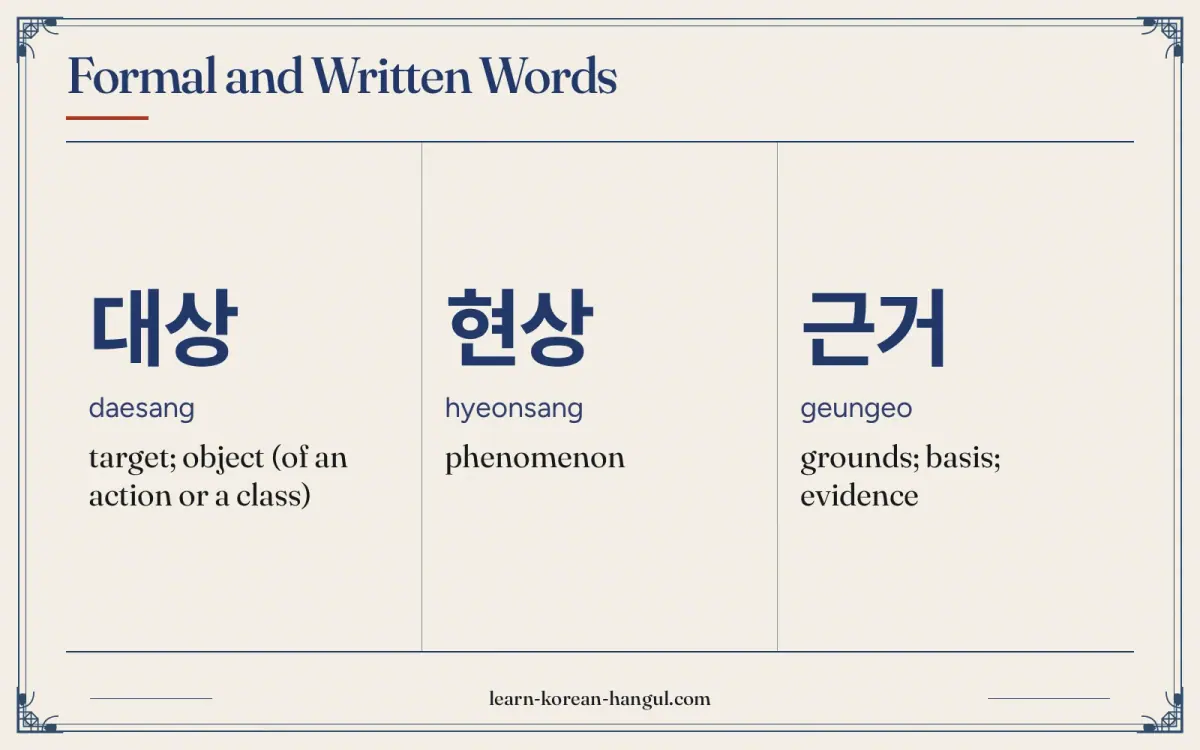
Formal words are the frame of a written argument. 주제 (topic) opens a text, 현상 (phenomenon) and 항목 (item) lay it out, 근거 (grounds) and 사례 (case) support it, 주장 (claim), 입장 (position) and 관점 (viewpoint) take a side, 논의 (discussion) develops it, and 결론 (conclusion) closes it. They are almost all Sino-Korean, and the syllables repeat across words, so each word you learn helps with the next.
| No. | Hangul | Revised Romanization | Origin | Meaning and note | Example sentence | Audio assetId |
|---|---|---|---|---|---|---|
| 801 | 대상 | daesang | Sino-Korean | target; object (of an action or a class) | 이 수업은 초보자가 대상이에요. (This class is aimed at beginners.) | au-pg-vocabulary-core-words-top-1000-801-900-1; example: au-pg-vocabulary-core-words-top-1000-801-900-101 |
| 802 | 현상 | hyeonsang | Sino-Korean | phenomenon | 이상한 현상이 일어났어요. (A strange phenomenon occurred.) | au-pg-vocabulary-core-words-top-1000-801-900-2; example: au-pg-vocabulary-core-words-top-1000-801-900-102 |
| 803 | 근거 | geungeo | Sino-Korean | grounds; basis; evidence | 근거 없는 소문이에요. (It is a groundless rumour.) | au-pg-vocabulary-core-words-top-1000-801-900-3; example: au-pg-vocabulary-core-words-top-1000-801-900-103 |
| 804 | 결론 | gyeollon | Sino-Korean | conclusion. The partner of 근거 (grounds) | 결론부터 말씀드릴게요. (I will start with the conclusion.) | au-pg-vocabulary-core-words-top-1000-801-900-4; example: au-pg-vocabulary-core-words-top-1000-801-900-104 |
| 805 | 요소 | yoso | Sino-Korean | element; factor | 건강에는 여러 요소가 있어요. (There are several factors in health.) | au-pg-vocabulary-core-words-top-1000-801-900-5; example: au-pg-vocabulary-core-words-top-1000-801-900-105 |
| 806 | 대안 | daean | Sino-Korean | alternative | 다른 대안을 찾아봐요. (Let us look for another alternative.) | au-pg-vocabulary-core-words-top-1000-801-900-6; example: au-pg-vocabulary-core-words-top-1000-801-900-106 |
| 807 | 주장 | jujang | Sino-Korean | claim; argument | 그의 주장은 이해하기 어려워요. (His claim is hard to understand.) | au-pg-vocabulary-core-words-top-1000-801-900-7; example: au-pg-vocabulary-core-words-top-1000-801-900-107 |
| 808 | 내용 | naeyong | Sino-Korean | content | 책의 내용이 재미있어요. (The content of the book is interesting.) | au-pg-vocabulary-core-words-top-1000-801-900-8; example: au-pg-vocabulary-core-words-top-1000-801-900-108 |
| 809 | 항목 | hangmok | Sino-Korean | item; entry (in a list or form) | 빈 항목을 채워 주세요. (Please fill in the empty items.) | au-pg-vocabulary-core-words-top-1000-801-900-9; example: au-pg-vocabulary-core-words-top-1000-801-900-109 |
| 810 | 사례 | sarye | Sino-Korean | case; example | 비슷한 사례를 찾아봤어요. (I looked for similar cases.) | au-pg-vocabulary-core-words-top-1000-801-900-10; example: au-pg-vocabulary-core-words-top-1000-801-900-110 |
| 811 | 분야 | bunya | Sino-Korean | field; area (of work or study) | 어느 분야에서 일해요? (Which field do you work in?) | au-pg-vocabulary-core-words-top-1000-801-900-11; example: au-pg-vocabulary-core-words-top-1000-801-900-111 |
| 812 | 입장 | ipjang | Sino-Korean | position; standpoint. A different word, 입장 (entry), has the same spelling | 제 입장에서는 어려워요. (From my position it is difficult.) | au-pg-vocabulary-core-words-top-1000-801-900-12; example: au-pg-vocabulary-core-words-top-1000-801-900-112 |
| 813 | 측면 | cheungmyeon | Sino-Korean | aspect; side | 다른 측면에서 생각해 보세요. (Please think about it from another aspect.) | au-pg-vocabulary-core-words-top-1000-801-900-13; example: au-pg-vocabulary-core-words-top-1000-801-900-113 |
| 814 | 형태 | hyeongtae | Sino-Korean | form; shape | 이 책은 종이와 전자 형태로 나와요. (This book comes in paper and electronic form.) | au-pg-vocabulary-core-words-top-1000-801-900-14; example: au-pg-vocabulary-core-words-top-1000-801-900-114 |
| 815 | 방식 | bangsik | Sino-Korean | way; manner; style | 사람마다 공부 방식이 달라요. (Everyone has a different way of studying.) | au-pg-vocabulary-core-words-top-1000-801-900-15; example: au-pg-vocabulary-core-words-top-1000-801-900-115 |
| 816 | 논의 | nonui | Sino-Korean | discussion; deliberation | 회의에서 논의가 길어졌어요. (The discussion got long in the meeting.) | au-pg-vocabulary-core-words-top-1000-801-900-16; example: au-pg-vocabulary-core-words-top-1000-801-900-116 |
| 817 | 구조 | gujo | Sino-Korean | structure | 문장의 구조를 설명해요. (I explain the structure of the sentence.) | au-pg-vocabulary-core-words-top-1000-801-900-17; example: au-pg-vocabulary-core-words-top-1000-801-900-117 |
| 818 | 관점 | gwanjeom | Sino-Korean | viewpoint | 제 관점에서는 괜찮아요. (From my point of view it is fine.) | au-pg-vocabulary-core-words-top-1000-801-900-18; example: au-pg-vocabulary-core-words-top-1000-801-900-118 |
| 819 | 과제 | gwaje | Sino-Korean | task; assignment; challenge | 과제는 내일까지 내야 해요. (The assignment has to be handed in by tomorrow.) | au-pg-vocabulary-core-words-top-1000-801-900-19; example: au-pg-vocabulary-core-words-top-1000-801-900-119 |
| 820 | 주제 | juje | Sino-Korean | topic; theme | 오늘 토론의 주제는 환경이에요. (Today's discussion topic is the environment.) | au-pg-vocabulary-core-words-top-1000-801-900-20; example: au-pg-vocabulary-core-words-top-1000-801-900-120 |
근거 and 결론 are a pair: the grounds come first and the conclusion follows. 입장 and 관점 are close: 입장 is the position you take in a situation, and 관점 is the angle from which you see it. 입장 has a second meaning, entry, as in 입장료 (admission fee), so context decides. 방식 and 방법 (method, from the Top 500) are close too. 방법 is a way to do something, as in 해결 방법, and 방식 is a style or pattern, as in 생활 방식 (lifestyle).
Example Sentences
Each example is a short polite sentence. The polite -요 ending suits speech, but formal articles use another ending, and you see that in the plain-style section below. Say each sentence aloud, then swap the noun. In 책의 내용이 재미있어요 you can replace 내용 with 구조 and say 책의 구조가 재미있어요 (the structure of the book is interesting). The particles are explained in the Korean particles guide.
How Do You Say Time Expressions in Korean?
Time expressions place an event on the clock or the calendar. 올해, 작년, 내년, 매일 and 매년 are fixed dates. 평소, 늘 and 매번 say how often. 마침내, 어느새, 순식간 and 곧바로 move a story forward. 당분간, 한동안, 오랫동안 and 여태 describe a span. They are mostly adverbs and take no particle, so you put them before the verb.
| No. | Hangul | Revised Romanization | Origin | Meaning and note | Example sentence | Audio assetId |
|---|---|---|---|---|---|---|
| 821 | 당분간 | dangbungan | Sino-Korean | for the time being | 당분간 쉬고 싶어요. (I want to rest for the time being.) | au-pg-vocabulary-core-words-top-1000-801-900-21; example: au-pg-vocabulary-core-words-top-1000-801-900-121 |
| 822 | 평소 | pyeongso | Sino-Korean | usual times; normally | 평소에는 일찍 일어나요. (Normally I get up early.) | au-pg-vocabulary-core-words-top-1000-801-900-22; example: au-pg-vocabulary-core-words-top-1000-801-900-122 |
| 823 | 한동안 | handongan | native Korean | for a while | 한동안 비가 안 왔어요. (It has not rained for a while.) | au-pg-vocabulary-core-words-top-1000-801-900-23; example: au-pg-vocabulary-core-words-top-1000-801-900-123 |
| 824 | 종종 | jongjong | Sino-Korean | now and then | 종종 친구와 영화를 봐요. (I sometimes watch films with friends.) | au-pg-vocabulary-core-words-top-1000-801-900-24; example: au-pg-vocabulary-core-words-top-1000-801-900-124 |
| 825 | 일단 | ildan | Sino-Korean | for now; first of all. Said [일딴] | 일단 앉으세요. (Please sit down first.) | au-pg-vocabulary-core-words-top-1000-801-900-25; example: au-pg-vocabulary-core-words-top-1000-801-900-125 |
| 826 | 늘 | neul | native Korean | always; all the time | 그는 늘 웃어요. (He is always smiling.) | au-pg-vocabulary-core-words-top-1000-801-900-26; example: au-pg-vocabulary-core-words-top-1000-801-900-126 |
| 827 | 마침내 | machimnae | native Korean | at last; finally | 마침내 시험에 합격했어요. (At last I passed the exam.) | au-pg-vocabulary-core-words-top-1000-801-900-27; example: au-pg-vocabulary-core-words-top-1000-801-900-127 |
| 828 | 앞으로 | apeuro | native Korean | from now on; in the future | 앞으로 열심히 공부할게요. (From now on I will study hard.) | au-pg-vocabulary-core-words-top-1000-801-900-28; example: au-pg-vocabulary-core-words-top-1000-801-900-128 |
| 829 | 여태 | yeotae | native Korean | until now; so far. Used with a negative: not yet, up to now | 여태 소식이 없어요. (There has been no news until now.) | au-pg-vocabulary-core-words-top-1000-801-900-29; example: au-pg-vocabulary-core-words-top-1000-801-900-129 |
| 830 | 오랫동안 | oraetdongan | native Korean | for a long time | 오랫동안 기다렸어요. (I waited for a long time.) | au-pg-vocabulary-core-words-top-1000-801-900-30; example: au-pg-vocabulary-core-words-top-1000-801-900-130 |
| 831 | 어느새 | eoneusae | native Korean | before one knows it | 어느새 가을이 왔어요. (Autumn came before I knew it.) | au-pg-vocabulary-core-words-top-1000-801-900-31; example: au-pg-vocabulary-core-words-top-1000-801-900-131 |
| 832 | 순식간 | sunsikgan | Sino-Korean | an instant; a flash | 순식간에 일이 끝났어요. (The work was finished in an instant.) | au-pg-vocabulary-core-words-top-1000-801-900-32; example: au-pg-vocabulary-core-words-top-1000-801-900-132 |
| 833 | 당장 | dangjang | Sino-Korean | right away; at once | 당장 출발해야 해요. (We have to leave right away.) | au-pg-vocabulary-core-words-top-1000-801-900-33; example: au-pg-vocabulary-core-words-top-1000-801-900-133 |
| 834 | 매번 | maebeon | Sino-Korean | every time | 매번 지각해요. (I am late every time.) | au-pg-vocabulary-core-words-top-1000-801-900-34; example: au-pg-vocabulary-core-words-top-1000-801-900-134 |
| 835 | 매일 | maeil | Sino-Korean | every day | 매일 한국어를 공부해요. (I study Korean every day.) | au-pg-vocabulary-core-words-top-1000-801-900-35; example: au-pg-vocabulary-core-words-top-1000-801-900-135 |
| 836 | 매년 | maenyeon | Sino-Korean | every year | 매년 여름에 바다에 가요. (Every year I go to the sea in summer.) | au-pg-vocabulary-core-words-top-1000-801-900-36; example: au-pg-vocabulary-core-words-top-1000-801-900-136 |
| 837 | 올해 | olhae | native Korean | this year | 올해 목표가 뭐예요? (What is your goal this year?) | au-pg-vocabulary-core-words-top-1000-801-900-37; example: au-pg-vocabulary-core-words-top-1000-801-900-137 |
| 838 | 작년 | jangnyeon | Sino-Korean | last year | 작년에 한국에 왔어요. (I came to Korea last year.) | au-pg-vocabulary-core-words-top-1000-801-900-38; example: au-pg-vocabulary-core-words-top-1000-801-900-138 |
| 839 | 내년 | naenyeon | Sino-Korean | next year | 내년에 졸업해요. (I graduate next year.) | au-pg-vocabulary-core-words-top-1000-801-900-39; example: au-pg-vocabulary-core-words-top-1000-801-900-139 |
| 840 | 곧바로 | gotbaro | native Korean | straight away | 퇴근 후 곧바로 집에 갔어요. (After work I went straight home.) | au-pg-vocabulary-core-words-top-1000-801-900-40; example: au-pg-vocabulary-core-words-top-1000-801-900-140 |
Frequency words go in a scale: 늘 (always), 매번 (every time), 평소 (usually), 종종 (now and then). The words 마침내 and 드디어 (finally, from the Top 500) are close. 드디어 shows relief at something long awaited, and 마침내 is a more neutral word that marks the end of a long process, so it often appears in written stories. 매 in 매일, 매년 and 매번 means every, and you can add it to other nouns, as in 매주 (every week) and 매달 (every month).
Reasoning Words
Reasoning words show the speaker's stance. Some show certainty (확실히, and 당연히 and 분명히 from the previous unit), some show contrast or condition (반대로, 만약, 비록, 아무리), and some show doubt, surprise or annoyance (도대체, 설마, 하필, 과연). Others, such as 차라리, 대신, 어차피, 실은, 아예 and 비로소, show a choice, a reveal or an unavoidable result. The table gives the stance of seven words, two of which (당연히 and 분명히) come from the previous unit.
| Word | Stance | Short use |
|---|---|---|
| 당연히 | It is obvious | 당연히 도와줘야죠. (Of course we should help.) |
| 분명히 | I am sure | 분명히 어제 말했어요. (I definitely said it yesterday.) |
| 과연 | It is as I expected | 과연 유명한 식당이네요. (As expected, it is a famous restaurant.) |
| 설마 | I doubt that | 설마 그 말을 믿어요? (Surely you do not believe that?) |
| 하필 | What bad luck | 하필 오늘 비가 와요. (Of all days, it rains today.) |
| 어차피 | It cannot be avoided | 어차피 늦었어요. (It is late anyway.) |
| 차라리 | This is the better of two bad choices | 차라리 집에서 쉬는 게 좋아요. (It is better to rest at home.) |
| No. | Hangul | Revised Romanization | Origin | Meaning and note | Example sentence | Audio assetId |
|---|---|---|---|---|---|---|
| 841 | 실은 | sireun | Sino-Korean | in fact; actually. Used to admit or reveal something | 실은 저도 몰랐어요. (In fact, I did not know either.) | au-pg-vocabulary-core-words-top-1000-801-900-41; example: au-pg-vocabulary-core-words-top-1000-801-900-141 |
| 842 | 아예 | aye | native Korean | altogether; from the start. Often with a negative: not at all | 아예 안 가는 게 나아요. (It is better not to go at all.) | au-pg-vocabulary-core-words-top-1000-801-900-42; example: au-pg-vocabulary-core-words-top-1000-801-900-142 |
| 843 | 확실히 | hwaksilhi | Sino-Korean | certainly; indeed. Stance: this confirms what I thought | 확실히 어제보다 따뜻해요. (It is certainly warmer than yesterday.) | au-pg-vocabulary-core-words-top-1000-801-900-43; example: au-pg-vocabulary-core-words-top-1000-801-900-143 |
| 844 | 반대로 | bandaero | Sino-Korean | on the contrary; conversely | 반대로 저는 더운 날씨가 좋아요. (On the contrary, I like hot weather.) | au-pg-vocabulary-core-words-top-1000-801-900-44; example: au-pg-vocabulary-core-words-top-1000-801-900-144 |
| 845 | 만약 | manyak | Sino-Korean | if (by any chance) | 만약 비가 오면 취소해요. (If it rains, we cancel.) | au-pg-vocabulary-core-words-top-1000-801-900-45; example: au-pg-vocabulary-core-words-top-1000-801-900-145 |
| 846 | 비록 | birok | native Korean | although; even though. Pairs with an ending such as -지만 | 비록 작지만 깨끗해요. (Although it is small, it is clean.) | au-pg-vocabulary-core-words-top-1000-801-900-46; example: au-pg-vocabulary-core-words-top-1000-801-900-146 |
| 847 | 아무리 | amuri | native Korean | however much. Pairs with -아도/-어도 | 아무리 바빠도 연락할게요. (However busy I am, I will keep in touch.) | au-pg-vocabulary-core-words-top-1000-801-900-47; example: au-pg-vocabulary-core-words-top-1000-801-900-147 |
| 848 | 어차피 | eochapi | Sino-Korean | anyway; in any case | 어차피 늦었어요. (It is late anyway.) | au-pg-vocabulary-core-words-top-1000-801-900-48; example: au-pg-vocabulary-core-words-top-1000-801-900-148 |
| 849 | 도대체 | dodaeche | Sino-Korean | on earth; what in the world. Used in questions to show surprise or annoyance | 도대체 무슨 일이에요? (What on earth is going on?) | au-pg-vocabulary-core-words-top-1000-801-900-49; example: au-pg-vocabulary-core-words-top-1000-801-900-149 |
| 850 | 도무지 | domuji | native Korean | at all; (cannot) possibly. Always used with a negative or a verb like 모르겠다 | 도무지 이해가 안 돼요. (I cannot understand it at all.) | au-pg-vocabulary-core-words-top-1000-801-900-50; example: au-pg-vocabulary-core-words-top-1000-801-900-150 |
| 851 | 과연 | gwayeon | Sino-Korean | indeed; as expected | 과연 유명한 식당이네요. (As expected, it is a famous restaurant.) | au-pg-vocabulary-core-words-top-1000-801-900-51; example: au-pg-vocabulary-core-words-top-1000-801-900-151 |
| 852 | 설마 | seolma | native Korean | surely not; you don't mean. Used when you doubt something | 설마 그 말을 믿어요? (Surely you do not believe that?) | au-pg-vocabulary-core-words-top-1000-801-900-52; example: au-pg-vocabulary-core-words-top-1000-801-900-152 |
| 853 | 하필 | hapil | Sino-Korean | of all things; why of all | 하필 오늘 비가 와요. (Of all days, it rains today.) | au-pg-vocabulary-core-words-top-1000-801-900-53; example: au-pg-vocabulary-core-words-top-1000-801-900-153 |
| 854 | 굳이 | guji | native Korean | necessarily; going out of one's way. Often in the pattern 굳이 -지 않아도 돼요 | 굳이 가지 않아도 돼요. (You do not have to go.) | au-pg-vocabulary-core-words-top-1000-801-900-54; example: au-pg-vocabulary-core-words-top-1000-801-900-154 |
| 855 | 차라리 | charari | native Korean | rather; better to | 차라리 집에서 쉬는 게 좋아요. (It is better to rest at home.) | au-pg-vocabulary-core-words-top-1000-801-900-55; example: au-pg-vocabulary-core-words-top-1000-801-900-155 |
| 856 | 비로소 | biroso | native Korean | only then; at last | 그때 비로소 알았어요. (Only then did I realise it.) | au-pg-vocabulary-core-words-top-1000-801-900-56; example: au-pg-vocabulary-core-words-top-1000-801-900-156 |
| 857 | 사실상 | sasilsang | Sino-Korean | in fact; practically | 사실상 끝났어요. (It is practically over.) | au-pg-vocabulary-core-words-top-1000-801-900-57; example: au-pg-vocabulary-core-words-top-1000-801-900-157 |
| 858 | 대신 | daesin | Sino-Korean | instead; in place of | 커피 대신 차를 마셔요. (I drink tea instead of coffee.) | au-pg-vocabulary-core-words-top-1000-801-900-58; example: au-pg-vocabulary-core-words-top-1000-801-900-158 |
| 859 | 마찬가지로 | machangajiro | native Korean | likewise; in the same way | 저도 마찬가지로 피곤해요. (I am tired too, in the same way.) | au-pg-vocabulary-core-words-top-1000-801-900-59; example: au-pg-vocabulary-core-words-top-1000-801-900-159 |
| 860 | 오직 | ojik | native Korean | only; solely | 오직 한 사람만 알아요. (Only one person knows.) | au-pg-vocabulary-core-words-top-1000-801-900-60; example: au-pg-vocabulary-core-words-top-1000-801-900-160 |
Some reasoning words come in pairs with a verb ending. 비록 pairs with -지만 or -아도/-어도, as in 비록 작지만 깨끗해요. 아무리 pairs with -아도/-어도, as in 아무리 바빠도 연락할게요. 도무지 always needs a negative or a word like 모르겠다: 도무지 이해가 안 돼요. If you learn each word with its ending, you will avoid the commonest mistakes. The Korean grammar connectors lessons cover the endings themselves.
How Do You Say Quantity and Degree in Korean?
Quantity words say how many or how much. 대부분 (most), 절반 (half), 전부 (all), 대다수 (the great majority) and 대개 (usually) describe a share. 최대, 최소 and 평균 describe a range. Degree words such as 퍽, 제법, 한결, 지나치게 and 부쩍 say how strong something is, and 거듭 and 차츰 say how often or how fast it changes. 약 means about, and 정도 can mean degree or about. The common degree words 상당히, 꽤, 몹시 and 대략 are in the previous unit.
| No. | Hangul | Revised Romanization | Origin | Meaning and note | Example sentence | Audio assetId |
|---|---|---|---|---|---|---|
| 861 | 대부분 | daebubun | Sino-Korean | most; mostly | 대부분의 학생이 지하철을 타요. (Most students take the subway.) | au-pg-vocabulary-core-words-top-1000-801-900-61; example: au-pg-vocabulary-core-words-top-1000-801-900-161 |
| 862 | 퍽 | peok | native Korean | quite; rather | 오늘은 퍽 따뜻해요. (Today it is quite warm.) | au-pg-vocabulary-core-words-top-1000-801-900-62; example: au-pg-vocabulary-core-words-top-1000-801-900-162 |
| 863 | 제법 | jebeop | native Korean | fairly; quite well | 한국어를 제법 잘해요. (You speak Korean fairly well.) | au-pg-vocabulary-core-words-top-1000-801-900-63; example: au-pg-vocabulary-core-words-top-1000-801-900-163 |
| 864 | 한결 | hangyeol | native Korean | much more; noticeably | 약을 먹으니 한결 나아요. (After taking medicine I feel much better.) | au-pg-vocabulary-core-words-top-1000-801-900-64; example: au-pg-vocabulary-core-words-top-1000-801-900-164 |
| 865 | 거듭 | geodeup | native Korean | again and again; repeatedly | 거듭 사과드려요. (I apologise again and again.) | au-pg-vocabulary-core-words-top-1000-801-900-65; example: au-pg-vocabulary-core-words-top-1000-801-900-165 |
| 866 | 각각 | gakgak | Sino-Korean | each; respectively | 각각 다른 의견이 있어요. (Each has a different opinion.) | au-pg-vocabulary-core-words-top-1000-801-900-66; example: au-pg-vocabulary-core-words-top-1000-801-900-166 |
| 867 | 최대 | choedae | Sino-Korean | maximum; the largest | 최대 열 명까지 탈 수 있어요. (Up to ten people can ride.) | au-pg-vocabulary-core-words-top-1000-801-900-67; example: au-pg-vocabulary-core-words-top-1000-801-900-167 |
| 868 | 최소 | choeso | Sino-Korean | minimum; the least | 최소 두 시간은 필요해요. (At least two hours are needed.) | au-pg-vocabulary-core-words-top-1000-801-900-68; example: au-pg-vocabulary-core-words-top-1000-801-900-168 |
| 869 | 평균 | pyeonggyun | Sino-Korean | average | 평균 점수가 높아요. (The average score is high.) | au-pg-vocabulary-core-words-top-1000-801-900-69; example: au-pg-vocabulary-core-words-top-1000-801-900-169 |
| 870 | 절반 | jeolban | Sino-Korean | half | 절반은 먹었어요. (I ate half.) | au-pg-vocabulary-core-words-top-1000-801-900-70; example: au-pg-vocabulary-core-words-top-1000-801-900-170 |
| 871 | 대다수 | daedasu | Sino-Korean | the great majority | 대다수가 찬성했어요. (The great majority agreed.) | au-pg-vocabulary-core-words-top-1000-801-900-71; example: au-pg-vocabulary-core-words-top-1000-801-900-171 |
| 872 | 여러 | yeoreo | native Korean | several; various. Comes before a noun | 여러 사람이 도와줬어요. (Several people helped me.) | au-pg-vocabulary-core-words-top-1000-801-900-72; example: au-pg-vocabulary-core-words-top-1000-801-900-172 |
| 873 | 지나치게 | jinachige | native Korean | excessively; too much | 지나치게 짜지 않게 해 주세요. (Please do not make it too salty.) | au-pg-vocabulary-core-words-top-1000-801-900-73; example: au-pg-vocabulary-core-words-top-1000-801-900-173 |
| 874 | 부쩍 | bujjeok | native Korean | suddenly and a lot | 아이가 부쩍 컸어요. (The child has suddenly grown a lot.) | au-pg-vocabulary-core-words-top-1000-801-900-74; example: au-pg-vocabulary-core-words-top-1000-801-900-174 |
| 875 | 차츰 | chacheum | native Korean | gradually; little by little | 차츰 나아질 거예요. (It will get better little by little.) | au-pg-vocabulary-core-words-top-1000-801-900-75; example: au-pg-vocabulary-core-words-top-1000-801-900-175 |
| 876 | 대개 | daegae | Sino-Korean | usually; mostly | 대개 아침에 운동해요. (I usually exercise in the morning.) | au-pg-vocabulary-core-words-top-1000-801-900-76; example: au-pg-vocabulary-core-words-top-1000-801-900-176 |
| 877 | 정도 | jeongdo | Sino-Korean | degree; extent; about | 이 정도면 충분해요. (This much is enough.) | au-pg-vocabulary-core-words-top-1000-801-900-77; example: au-pg-vocabulary-core-words-top-1000-801-900-177 |
| 878 | 전부 | jeonbu | Sino-Korean | all; everything | 숙제를 전부 했어요. (I did all the homework.) | au-pg-vocabulary-core-words-top-1000-801-900-78; example: au-pg-vocabulary-core-words-top-1000-801-900-178 |
| 879 | 약 | yak | Sino-Korean | about; approximately. Comes before a number | 여기서 약 십 분 걸려요. (It takes about ten minutes from here.) | au-pg-vocabulary-core-words-top-1000-801-900-79; example: au-pg-vocabulary-core-words-top-1000-801-900-179 |
| 880 | 각종 | gakjong | Sino-Korean | various kinds of | 각종 서류가 필요해요. (Various documents are needed.) | au-pg-vocabulary-core-words-top-1000-801-900-80; example: au-pg-vocabulary-core-words-top-1000-801-900-180 |
Sino-Korean 약 is the common word for about in writing and in the news, and it comes before the number: 약 십 분. 정도 comes after: 십 분 정도. Both give the same meaning, and the combination 약 십 분 정도 is understood but a little heavy. 대부분 usually takes 의 when it comes before a noun: 대부분의 학생 (most students). 여러 also comes before a noun but takes no particle: 여러 사람 (several people).
Everyday Life Details
The last group is the small talk of living somewhere: housework (청소, 빨래, 설거지, 집안일), things in the home (서랍, 이불, 거울, 가구, 세탁기), and social life (주민, 마을, 모임, 초대, 선물, 인사, 연락, 예절). These words are mostly native or short Sino-Korean words, and they appear in the chats you have with neighbours. See also the home vocabulary lists.
| No. | Hangul | Revised Romanization | Origin | Meaning and note | Example sentence | Audio assetId |
|---|---|---|---|---|---|---|
| 881 | 일상 | ilsang | Sino-Korean | daily life; routine | 일상이 조금 바빠졌어요. (My daily life got a bit busier.) | au-pg-vocabulary-core-words-top-1000-801-900-81; example: au-pg-vocabulary-core-words-top-1000-801-900-181 |
| 882 | 취미 | chwimi | Sino-Korean | hobby | 제 취미는 사진 찍기예요. (My hobby is taking photos.) | au-pg-vocabulary-core-words-top-1000-801-900-82; example: au-pg-vocabulary-core-words-top-1000-801-900-182 |
| 883 | 주민 | jumin | Sino-Korean | resident; local people | 주민들이 모여 회의를 했어요. (The residents gathered for a meeting.) | au-pg-vocabulary-core-words-top-1000-801-900-83; example: au-pg-vocabulary-core-words-top-1000-801-900-183 |
| 884 | 마을 | maeul | native Korean | village; small community | 마을 입구에 큰 나무가 있어요. (There is a big tree at the village entrance.) | au-pg-vocabulary-core-words-top-1000-801-900-84; example: au-pg-vocabulary-core-words-top-1000-801-900-184 |
| 885 | 이사 | isa | Sino-Korean | moving house | 다음 달에 이사해요. (I move house next month.) | au-pg-vocabulary-core-words-top-1000-801-900-85; example: au-pg-vocabulary-core-words-top-1000-801-900-185 |
| 886 | 청소 | cheongso | Sino-Korean | cleaning | 토요일마다 청소해요. (I clean every Saturday.) | au-pg-vocabulary-core-words-top-1000-801-900-86; example: au-pg-vocabulary-core-words-top-1000-801-900-186 |
| 887 | 빨래 | ppallae | native Korean | laundry | 빨래를 널었어요. (I hung out the laundry.) | au-pg-vocabulary-core-words-top-1000-801-900-87; example: au-pg-vocabulary-core-words-top-1000-801-900-187 |
| 888 | 설거지 | seolgeoji | native Korean | washing the dishes | 저녁 먹고 설거지를 해요. (After dinner I wash the dishes.) | au-pg-vocabulary-core-words-top-1000-801-900-88; example: au-pg-vocabulary-core-words-top-1000-801-900-188 |
| 889 | 가구 | gagu | Sino-Korean | furniture | 새 가구를 샀어요. (I bought new furniture.) | au-pg-vocabulary-core-words-top-1000-801-900-89; example: au-pg-vocabulary-core-words-top-1000-801-900-189 |
| 890 | 집안일 | jibannil | native Korean | housework | 집안일을 나눠서 해요. (We share the housework.) | au-pg-vocabulary-core-words-top-1000-801-900-90; example: au-pg-vocabulary-core-words-top-1000-801-900-190 |
| 891 | 예절 | yejeol | Sino-Korean | manners; etiquette | 한국의 식사 예절을 배웠어요. (I learned Korean table manners.) | au-pg-vocabulary-core-words-top-1000-801-900-91; example: au-pg-vocabulary-core-words-top-1000-801-900-191 |
| 892 | 인사 | insa | Sino-Korean | greeting | 만나면 먼저 인사해요. (When we meet, I greet first.) | au-pg-vocabulary-core-words-top-1000-801-900-92; example: au-pg-vocabulary-core-words-top-1000-801-900-192 |
| 893 | 연락 | yeollak | Sino-Korean | contact. Said [열락] | 연락 주세요. (Please contact me.) | au-pg-vocabulary-core-words-top-1000-801-900-93; example: au-pg-vocabulary-core-words-top-1000-801-900-193 |
| 894 | 모임 | moim | native Korean | gathering; meeting (social) | 이번 주말에 모임이 있어요. (There is a gathering this weekend.) | au-pg-vocabulary-core-words-top-1000-801-900-94; example: au-pg-vocabulary-core-words-top-1000-801-900-194 |
| 895 | 초대 | chodae | Sino-Korean | invitation | 친구를 집에 초대했어요. (I invited a friend to my home.) | au-pg-vocabulary-core-words-top-1000-801-900-95; example: au-pg-vocabulary-core-words-top-1000-801-900-195 |
| 896 | 선물 | seonmul | Sino-Korean | gift; present | 생일 선물을 샀어요. (I bought a birthday present.) | au-pg-vocabulary-core-words-top-1000-801-900-96; example: au-pg-vocabulary-core-words-top-1000-801-900-196 |
| 897 | 서랍 | seorap | native Korean | drawer | 열쇠는 서랍에 있어요. (The key is in the drawer.) | au-pg-vocabulary-core-words-top-1000-801-900-97; example: au-pg-vocabulary-core-words-top-1000-801-900-197 |
| 898 | 이불 | ibul | native Korean | blanket; duvet | 이불을 덮고 잤어요. (I slept under the blanket.) | au-pg-vocabulary-core-words-top-1000-801-900-98; example: au-pg-vocabulary-core-words-top-1000-801-900-198 |
| 899 | 세탁기 | setakgi | Sino-Korean | washing machine | 세탁기를 돌렸어요. (I ran the washing machine.) | au-pg-vocabulary-core-words-top-1000-801-900-99; example: au-pg-vocabulary-core-words-top-1000-801-900-199 |
| 900 | 거울 | geoul | native Korean | mirror | 거울을 보고 머리를 빗어요. (I look in the mirror and comb my hair.) | au-pg-vocabulary-core-words-top-1000-801-900-100; example: au-pg-vocabulary-core-words-top-1000-801-900-200 |
The word 집안일 (housework) is a compound: 집안 (inside the home) and 일 (work). It is written without a space and said [지반닐], with an added ㄴ sound before 일. The word 인사 means a greeting and the act of greeting. To greet someone you say 인사하다. To introduce yourself or others you say 소개하다. Do not confuse them.
How Do the Example Sentences Look in the Written Plain Style?
Articles, essays, textbooks and diaries use the plain style (한다체) instead of the polite -요 style. It sounds neutral and does not address the reader. The verb changes as follows. A verb stem that ends in a vowel adds -ㄴ다, and a stem that ends in a consonant adds -는다. An adjective adds -다. After a noun, -이에요 becomes -이다, and -예요 becomes -다 or -이다. The past tense keeps -았/었/했 and adds -다. The table shows six sentences from this page.
| Polite style (speech) | Plain style (writing) | What changes |
|---|---|---|
| 대부분의 학생이 지하철을 타요. | 대부분의 학생이 지하철을 탄다. | 타 is a vowel stem, so it adds -ㄴ다 |
| 매일 한국어를 공부해요. | 매일 한국어를 공부한다. | 공부하다 becomes 공부한다 |
| 평균 점수가 높아요. | 평균 점수가 높다. | An adjective adds -다 |
| 오늘 토론의 주제는 환경이에요. | 오늘 토론의 주제는 환경이다. | -이에요 becomes -이다 |
| 숙제를 전부 했어요. | 숙제를 전부 했다. | The past tense keeps 했 and adds -다 |
| 도무지 이해가 안 돼요. | 도무지 이해가 안 된다. | 돼요 becomes 된다 |
Notice that the plain style has no polite ending for the listener. It is the form to learn for reading. When you speak to someone you have just met, keep the polite -요 ending, because the plain style is not polite.
How Do You Pronounce These Words?
Most words in this unit are said as they are spelled. The table shows eight that learners often get wrong.
| Spelling | Pronunciation | What happens |
|---|---|---|
| 일단 | [일딴] | ㄷ is said as a tense sound after ㄹ in this Sino-Korean word |
| 연락 | [열락] | ㄴ becomes ㄹ before ㄹ |
| 굳이 | [구지] | ㄷ before 이 is said as ㅈ |
| 입장 | [입짱] | ㅈ is said as a tense sound after ㅂ |
| 확실히 | [확씰히] | ㅅ is said as a tense sound after ㄱ |
| 순식간 | [순식깐] | ㄱ is said as a tense sound after ㄱ |
| 측면 | [층면] | ㄱ becomes ㅇ before ㅁ |
| 집안일 | [지반닐] | The final ㅂ links to the next syllable, and ㄴ is added before 일 |
The rules come from the Standard Pronunciation rules (표준 발음법) of the 국립국어원. Revised Romanization does not write tensing caused by a neighbouring sound, so it writes 일단 as ildan and 입장 as ipjang even though they are said [일딴] and [입짱]. It does write the changes in 연락 (yeollak), 굳이 (guji), 측면 (cheungmyeon) and 집안일 (jibannil).
Audio and Slow Playback
Each word has a normal clip, and five harder words also have a slow clip at 0.8 times the speed: 일단, 연락, 굳이, 확실히 and 집안일. Nothing plays until you press a button.
Listen to 연락 first. You should hear a clear l sound twice, so the word sounds like yeol-lak. Then listen to 굳이, where the middle sound is j, not d.
What Mistakes Do Learners Make with Words Ranked 801 to 900?
- Using 도무지 without a negative. Say 도무지 이해가 안 돼요 (I cannot understand it at all). 도무지 이해가 돼요 does not work.
- Using 비록 with a cause ending. Say 비록 작지만 깨끗해요 (although it is small, it is clean). 비록 작아서 깨끗해요 does not work, because -아서 gives a reason and 비록 expects a contrast.
- Putting 약 after the number. Say 약 십 분 or 십 분 정도. 십 분 약 is not Korean.
- Writing 굳이 as 구지. The spelling is 굳이, with a final ㄷ, even though it is said [구지].
- Reading 연락 as yeon-rak. It is said [열락], with two l sounds.
The 도무지 rule is the one that makes the biggest difference to your sentences, because a missing negative breaks the sentence. The next sections turn the list into drills.
Practice: Flashcards and Worksheet
Study in three steps. First, run the deck in recognition mode until the 100 words feel familiar. Second, switch to listening mode and press the clip before the card turns. Third, take the quiz below. The deck stores your progress only in your browser. The vocabulary flashcard decks page lists the other decks, and the vocabulary worksheets page lists printable sheets. A printable worksheet for these words (word list, matching, writing practice, fill-in-the-blank exercises and answer key) is available in A4 and US Letter from the download card on this page.
The deck holds the same 100 cards as the tables above: Hangul, Revised Romanization and meaning.
Practice · 100
- 01대상
Show answer
daesang
target; object (of an action or a class)
- 02현상
Show answer
hyeonsang
phenomenon
- 03근거
Show answer
geungeo
grounds; basis; evidence
- 04결론
Show answer
gyeollon
conclusion
- 05요소
Show answer
yoso
element; factor
- 06대안
Show answer
daean
alternative
- 07주장
Show answer
jujang
claim; argument
- 08내용
Show answer
naeyong
content
- 09항목
Show answer
hangmok
item; entry (in a list or form)
- 10사례
Show answer
sarye
case; example
- 11분야
Show answer
bunya
field; area (of work or study)
- 12입장
Show answer
ipjang
position; standpoint
- 13측면
Show answer
cheungmyeon
aspect; side
- 14형태
Show answer
hyeongtae
form; shape
- 15방식
Show answer
bangsik
way; manner; style
- 16논의
Show answer
nonui
discussion; deliberation
- 17구조
Show answer
gujo
structure
- 18관점
Show answer
gwanjeom
viewpoint
- 19과제
Show answer
gwaje
task; assignment; challenge
- 20주제
Show answer
juje
topic; theme
- 21당분간
Show answer
dangbungan
for the time being
- 22평소
Show answer
pyeongso
usual times; normally
- 23한동안
Show answer
handongan
for a while
- 24종종
Show answer
jongjong
now and then
- 25일단
Show answer
ildan
for now; first of all
- 26늘
Show answer
neul
always; all the time
- 27마침내
Show answer
machimnae
at last; finally
- 28앞으로
Show answer
apeuro
from now on; in the future
- 29여태
Show answer
yeotae
until now; so far
- 30오랫동안
Show answer
oraetdongan
for a long time
- 31어느새
Show answer
eoneusae
before one knows it
- 32순식간
Show answer
sunsikgan
an instant; a flash
- 33당장
Show answer
dangjang
right away; at once
- 34매번
Show answer
maebeon
every time
- 35매일
Show answer
maeil
every day
- 36매년
Show answer
maenyeon
every year
- 37올해
Show answer
olhae
this year
- 38작년
Show answer
jangnyeon
last year
- 39내년
Show answer
naenyeon
next year
- 40곧바로
Show answer
gotbaro
straight away
- 41실은
Show answer
sireun
in fact; actually
- 42아예
Show answer
aye
altogether; from the start
- 43확실히
Show answer
hwaksilhi
certainly; indeed
- 44반대로
Show answer
bandaero
on the contrary; conversely
- 45만약
Show answer
manyak
if (by any chance)
- 46비록
Show answer
birok
although; even though
- 47아무리
Show answer
amuri
however much
- 48어차피
Show answer
eochapi
anyway; in any case
- 49도대체
Show answer
dodaeche
on earth; what in the world
- 50도무지
Show answer
domuji
at all; (cannot) possibly
- 51과연
Show answer
gwayeon
indeed; as expected
- 52설마
Show answer
seolma
surely not; you don't mean
- 53하필
Show answer
hapil
of all things; why of all
- 54굳이
Show answer
guji
necessarily; going out of one's way
- 55차라리
Show answer
charari
rather; better to
- 56비로소
Show answer
biroso
only then; at last
- 57사실상
Show answer
sasilsang
in fact; practically
- 58대신
Show answer
daesin
instead; in place of
- 59마찬가지로
Show answer
machangajiro
likewise; in the same way
- 60오직
Show answer
ojik
only; solely
- 61대부분
Show answer
daebubun
most; mostly
- 62퍽
Show answer
peok
quite; rather
- 63제법
Show answer
jebeop
fairly; quite well
- 64한결
Show answer
hangyeol
much more; noticeably
- 65거듭
Show answer
geodeup
again and again; repeatedly
- 66각각
Show answer
gakgak
each; respectively
- 67최대
Show answer
choedae
maximum; the largest
- 68최소
Show answer
choeso
minimum; the least
- 69평균
Show answer
pyeonggyun
average
- 70절반
Show answer
jeolban
half
- 71대다수
Show answer
daedasu
the great majority
- 72여러
Show answer
yeoreo
several; various
- 73지나치게
Show answer
jinachige
excessively; too much
- 74부쩍
Show answer
bujjeok
suddenly and a lot
- 75차츰
Show answer
chacheum
gradually; little by little
- 76대개
Show answer
daegae
usually; mostly
- 77정도
Show answer
jeongdo
degree; extent; about
- 78전부
Show answer
jeonbu
all; everything
- 79약
Show answer
yak
about; approximately
- 80각종
Show answer
gakjong
various kinds of
- 81일상
Show answer
ilsang
daily life; routine
- 82취미
Show answer
chwimi
hobby
- 83주민
Show answer
jumin
resident; local people
- 84마을
Show answer
maeul
village; small community
- 85이사
Show answer
isa
moving house
- 86청소
Show answer
cheongso
cleaning
- 87빨래
Show answer
ppallae
laundry
- 88설거지
Show answer
seolgeoji
washing the dishes
- 89가구
Show answer
gagu
furniture
- 90집안일
Show answer
jibannil
housework
- 91예절
Show answer
yejeol
manners; etiquette
- 92인사
Show answer
insa
greeting
- 93연락
Show answer
yeollak
contact
- 94모임
Show answer
moim
gathering; meeting (social)
- 95초대
Show answer
chodae
invitation
- 96선물
Show answer
seonmul
gift; present
- 97서랍
Show answer
seorap
drawer
- 98이불
Show answer
ibul
blanket; duvet
- 99세탁기
Show answer
setakgi
washing machine
- 100거울
Show answer
geoul
mirror
Korean Words 801 to 900 Worksheet
Try this eight-question check.
Practice · 8
What does 근거 (geungeo) mean?
Show answer
grounds; basis
근거 means grounds or basis. Example: 근거 없는 소문이에요. (It is a groundless rumour.)
What does 마침내 (machimnae) mean?
Show answer
at last
마침내 means at last. Example: 마침내 시험에 합격했어요. (At last I passed the exam.)
Which word means "however much"?
Show answer
아무리
아무리 means however much. Example: 아무리 바빠도 연락할게요. (However busy I am, I will keep in touch.)
What kind of ending must 도무지 (domuji) go with?
Show answer
A negative ending
도무지 goes with a negative. Example: 도무지 이해가 안 돼요. (I cannot understand it at all.)
What does 평소 (pyeongso) mean?
Show answer
usual times; normally
평소 means usual times or normally. Example: 평소에는 일찍 일어나요. (Normally I get up early.)
What is the plain style (한다체) of 평균 점수가 높아요?
Show answer
평균 점수가 높다.
An adjective adds -다 in the plain style, so 높아요 becomes 높다.
How is 연락 pronounced?
Show answer
[열락]
ㄴ becomes ㄹ before ㄹ, so 연락 is said [열락].
Which word means "about; approximately" and comes before a number?
Show answer
약
약 means about and comes before a number, as in 약 십 분 (about ten minutes).
Where to Go Next
Go back to Korean words 701 to 800 if you need to review, or continue with Korean words 901 to 1000, the last unit, which finishes the 1000 and ends with a review quiz. The parent page is Top 1000 Korean Words.
Frequently Asked Questions
How Do You Say in the End in Korean?
In the end is 결국 (gyeolguk). It is already in the Top 500, in words 401 to 500, and it states a conclusion after a process. This unit adds related time words: 마침내 (at last), 어느새 (before one knows it) and 곧바로 (straight away). Use 결국 for a final result and 마침내 for the end of a long effort.
How Do You Pronounce 사실 (sasil)?
사실 is said sa-sil. Both syllables are short. The first has a plain s and the vowel a. The second begins with s and the vowel i, and it ends in the l sound made by touching the tongue behind the upper teeth. There is no sound change, so say it evenly and compare it with the audio for 확실히 and 실은, which share the syllable 실.
How Many Words Ranked 801 to 900 Should I Learn First?
Learn about 30 first. Take 10 reasoning words (과연, 설마, 어차피, 차라리, 도무지, 아무리, 비록, 도대체, 실은 and 하필), 10 time words (마침내, 어느새, 곧바로, 당분간, 평소, 늘, 매일, 올해, 작년 and 내년) and 10 formal nouns (근거, 결론, 주장, 사례, 방식, 입장, 관점, 주제, 분야 and 논의). Add the rest over two weeks.
Where Can I Practise Words Ranked 801 to 900 with Flashcards?
Use the vocabulary flashcard decks, which list every deck with audio. This page also carries a deck with all 100 words in recognition mode. Your progress stays in your browser, so it is not shared with other devices.
Is the Romanization on This Page Official?
It follows the Revised Romanization of Korean, which South Korea officially adopted on 7 July 2000 and whose rules the National Institute of Korean Language (국립국어원) publishes. It is a learning aid that does not show tensing caused by a neighbouring sound, so learn the Hangul and use the audio.
Is There a Printable Worksheet for Words Ranked 801 to 900?
A printable worksheet for these words (word list, matching, writing practice, fill-in-the-blank exercises and answer key) is available in A4 and US Letter from the download card on this page. For practice, write the Hangul from memory, cover the English column and check your answers against the tables.