Korean Words 901 to 1000 at a Glance
Korean words 901 to 1000 are the fifth and last unit of the Top 1000 Korean Words list. The earlier units give you daily life, society, culture and the connecting words of written texts. This unit finishes the list with the words of public life, abstract ideas, paperwork and services, relationships, and the short fillers that make speech sound natural.
Of the 100 words, 80 are Sino-Korean (built from syllables of Chinese origin) and 20 are native Korean. The native words are mostly in the last group, because fillers such as 어쨌든 and 글쎄 are old Korean words. The origin column marks each word. The first column is a suggested study order for a B1 learner. It is an editorial judgement and not a frequency count. Politics (정치) and science (과학) are already in the Top 500, so this unit builds on them.
| Group | Words | What it lets you do |
|---|---|---|
| Society and politics | 20 | Follow news about government and public life |
| Science and ideas | 20 | Read about research, thought and discovery |
| Daily-life details | 20 | Handle forms, deliveries, repairs and refunds |
| Emotions and relationships | 20 | Describe friends, colleagues and feelings |
| Useful set phrases | 20 | Sound natural in short replies and links |
The tables assume you can read Hangul. If you cannot yet, start with reading Hangul.
Which Words Ranked 901 to 1000 Should You Learn First?
Learn the daily-life details and the set phrases first, because you will use them in the next week, and keep the politics and science words for reading. A learner who has 서류, 신청, 환불, 확인 and 어쨌든 can handle most office counters in Korea. Choose by goal:
- If you live in Korea. 서류, 신분증, 신청, 접수, 택배, 수리 and 환불.
- If you talk with Koreans. 어쨌든, 글쎄, 하긴, 그러게, 오랜만에 and 덕분에.
- If you follow the news. 국회, 정당, 투표, 후보, 개혁 and 외교.
- If you read essays. 철학, 개념, 분석, 통계, 윤리 and 현실.
- If you work in a Korean team. 상사, 동기, 고민, 응원, 역할 and 영향.
At 10 words a day the unit takes ten days. Add a review day after each group.
Society and Politics
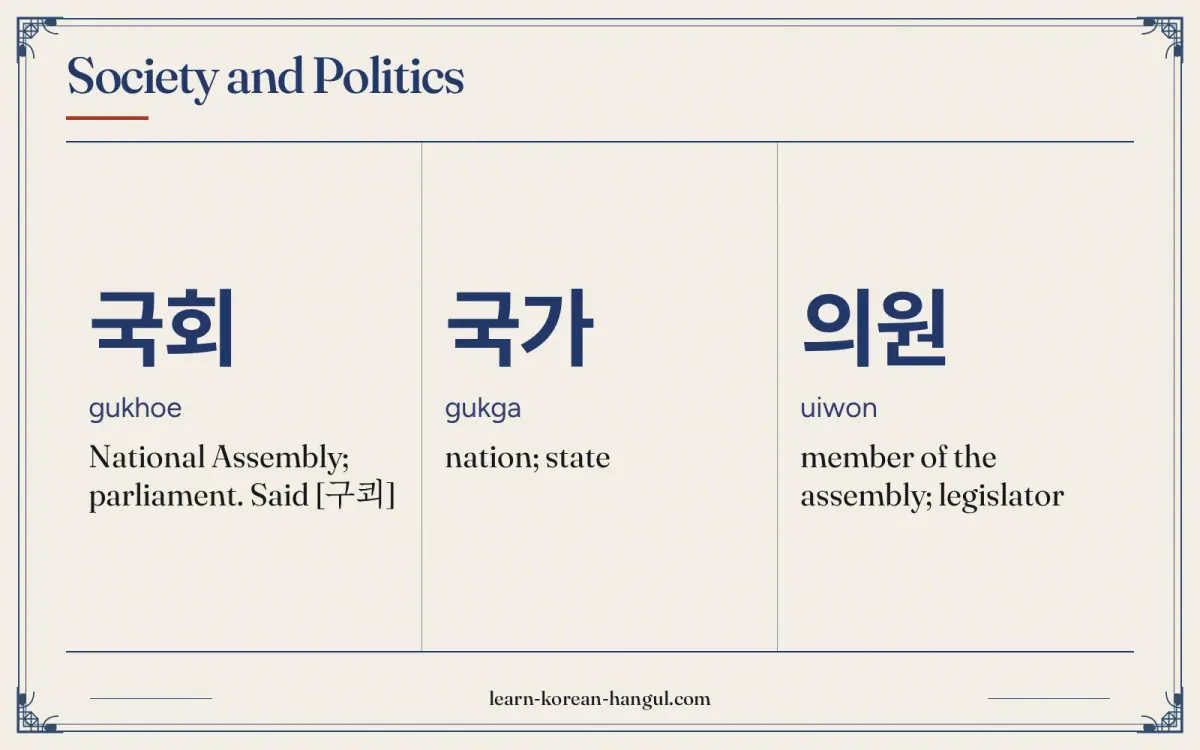
Politics words describe how a country makes decisions. The people are 의원, 후보 and 공무원. The places and bodies are 국회, 정당 and 행정. The acts are 투표 (voting), 개혁 (reform), 시위 (protest) and 외교 (diplomacy). 헌법 (constitution), 인권 (human rights) and 민주주의 (democracy) are the base ideas. Nearly all of these are Sino-Korean, and several share a syllable you can recognise: 국 in 국회, 국가 and 국제 means country.
| No. | Hangul | Revised Romanization | Origin | Meaning and note | Example sentence | Audio assetId |
|---|---|---|---|---|---|---|
| 901 | 국회 | gukhoe | Sino-Korean | National Assembly; parliament. Said [구쾨] | 국회에서 새 법을 만들어요. (The National Assembly makes new laws.) | au-pg-vocabulary-core-words-top-1000-901-1000-1; example: au-pg-vocabulary-core-words-top-1000-901-1000-101 |
| 902 | 국가 | gukga | Sino-Korean | nation; state | 모든 국가는 문화가 달라요. (Every nation has a different culture.) | au-pg-vocabulary-core-words-top-1000-901-1000-2; example: au-pg-vocabulary-core-words-top-1000-901-1000-102 |
| 903 | 의원 | uiwon | Sino-Korean | member of the assembly; legislator | 의원이 질문을 했어요. (The assembly member asked a question.) | au-pg-vocabulary-core-words-top-1000-901-1000-3; example: au-pg-vocabulary-core-words-top-1000-901-1000-103 |
| 904 | 정당 | jeongdang | Sino-Korean | political party | 정당마다 의견이 달라요. (Each party has different views.) | au-pg-vocabulary-core-words-top-1000-901-1000-4; example: au-pg-vocabulary-core-words-top-1000-901-1000-104 |
| 905 | 투표 | tupyo | Sino-Korean | vote; voting | 일요일에 투표를 해요. (I vote on Sunday.) | au-pg-vocabulary-core-words-top-1000-901-1000-5; example: au-pg-vocabulary-core-words-top-1000-901-1000-105 |
| 906 | 후보 | hubo | Sino-Korean | candidate | 후보들이 토론을 했어요. (The candidates held a debate.) | au-pg-vocabulary-core-words-top-1000-901-1000-6; example: au-pg-vocabulary-core-words-top-1000-901-1000-106 |
| 907 | 민주주의 | minjujuui | Sino-Korean | democracy | 민주주의에서는 국민이 선거로 대표를 뽑아요. (In a democracy, citizens choose their representatives by election.) | au-pg-vocabulary-core-words-top-1000-901-1000-7; example: au-pg-vocabulary-core-words-top-1000-901-1000-107 |
| 908 | 권력 | gwollyeok | Sino-Korean | power; authority. Said [궐력] | 그는 큰 권력을 가졌어요. (He holds great power.) | au-pg-vocabulary-core-words-top-1000-901-1000-8; example: au-pg-vocabulary-core-words-top-1000-901-1000-108 |
| 909 | 개혁 | gaehyeok | Sino-Korean | reform | 정부는 교육 개혁을 약속했어요. (The government promised education reform.) | au-pg-vocabulary-core-words-top-1000-901-1000-9; example: au-pg-vocabulary-core-words-top-1000-901-1000-109 |
| 910 | 외교 | oegyo | Sino-Korean | diplomacy | 외교는 나라 사이의 대화예요. (Diplomacy is dialogue between countries.) | au-pg-vocabulary-core-words-top-1000-901-1000-10; example: au-pg-vocabulary-core-words-top-1000-901-1000-110 |
| 911 | 국제 | gukje | Sino-Korean | international | 국제 뉴스를 매일 봐요. (I watch international news every day.) | au-pg-vocabulary-core-words-top-1000-901-1000-11; example: au-pg-vocabulary-core-words-top-1000-901-1000-111 |
| 912 | 전쟁 | jeonjaeng | Sino-Korean | war | 전쟁이 빨리 끝나기를 바라요. (I hope the war ends soon.) | au-pg-vocabulary-core-words-top-1000-901-1000-12; example: au-pg-vocabulary-core-words-top-1000-901-1000-112 |
| 913 | 시위 | siwi | Sino-Korean | demonstration; protest | 시위가 평화롭게 끝났어요. (The protest ended peacefully.) | au-pg-vocabulary-core-words-top-1000-901-1000-13; example: au-pg-vocabulary-core-words-top-1000-901-1000-113 |
| 914 | 인권 | ingwon | Sino-Korean | human rights. Said [인꿘] | 인권은 모든 사람의 권리예요. (Human rights are the rights of all people.) | au-pg-vocabulary-core-words-top-1000-901-1000-14; example: au-pg-vocabulary-core-words-top-1000-901-1000-114 |
| 915 | 지방 | jibang | Sino-Korean | provinces; regions outside the capital | 지방에도 대학이 많아요. (There are many universities in the provinces too.) | au-pg-vocabulary-core-words-top-1000-901-1000-15; example: au-pg-vocabulary-core-words-top-1000-901-1000-115 |
| 916 | 행정 | haengjeong | Sino-Korean | administration | 행정 서류를 냈어요. (I submitted administrative documents.) | au-pg-vocabulary-core-words-top-1000-901-1000-16; example: au-pg-vocabulary-core-words-top-1000-901-1000-116 |
| 917 | 공무원 | gongmuwon | Sino-Korean | civil servant | 저는 공무원이 되고 싶어요. (I want to become a civil servant.) | au-pg-vocabulary-core-words-top-1000-901-1000-17; example: au-pg-vocabulary-core-words-top-1000-901-1000-117 |
| 918 | 헌법 | heonbeop | Sino-Korean | constitution. Said [헌뻡] | 헌법은 나라의 기본 법이에요. (The constitution is the basic law of a country.) | au-pg-vocabulary-core-words-top-1000-901-1000-18; example: au-pg-vocabulary-core-words-top-1000-901-1000-118 |
| 919 | 통일 | tongil | Sino-Korean | unification | 통일은 하나가 되는 것을 뜻해요. (Unification means becoming one.) | au-pg-vocabulary-core-words-top-1000-901-1000-19; example: au-pg-vocabulary-core-words-top-1000-901-1000-119 |
| 920 | 복지 | bokji | Sino-Korean | welfare | 노인 복지가 중요해요. (Welfare for the elderly is important.) | au-pg-vocabulary-core-words-top-1000-901-1000-20; example: au-pg-vocabulary-core-words-top-1000-901-1000-120 |
국회 (the National Assembly) is the lawmaking body, and 의원 is one of its members. 정치 (politics) and 선거 (election) are in the Top 500, and this unit adds the words around them. For more words in this field, see the politics and government vocabulary page and the news and media vocabulary page. Words in this group are formal and are used in news and speeches more than in daily talk, so recognise them first.
Example Sentences
Each example is a short polite sentence. Many follow the pattern noun + 이/가 + verb, where 이/가 is the subject particle. Say a sentence aloud, then swap the noun. In 국회에서 새 법을 만들어요 you can replace 국회 with 정부 and say 정부에서 새 법을 만들어요. The particles are explained in the Korean particles guide.
How Do You Say Science and Ideas in Korean?
Idea words describe how people think. 관찰, 가설, 증거, 분석 and 통계 are the steps of research. 철학, 사상, 개념, 원리 and 논리 are the tools of thought. 윤리, 판단, 현실 and 진리 are the large questions. 발견 (discovery) and 창의력 (creativity) describe the results.
| No. | Hangul | Revised Romanization | Origin | Meaning and note | Example sentence | Audio assetId |
|---|---|---|---|---|---|---|
| 921 | 관찰 | gwanchal | Sino-Korean | observation | 아이들은 개미를 관찰했어요. (The children observed ants.) | au-pg-vocabulary-core-words-top-1000-901-1000-21; example: au-pg-vocabulary-core-words-top-1000-901-1000-121 |
| 922 | 사상 | sasang | Sino-Korean | thought; ideology | 그는 독특한 사상을 가졌어요. (He held a unique philosophy.) | au-pg-vocabulary-core-words-top-1000-901-1000-22; example: au-pg-vocabulary-core-words-top-1000-901-1000-122 |
| 923 | 철학 | cheolhak | Sino-Korean | philosophy | 철학 수업이 재미있어요. (Philosophy class is interesting.) | au-pg-vocabulary-core-words-top-1000-901-1000-23; example: au-pg-vocabulary-core-words-top-1000-901-1000-123 |
| 924 | 원리 | wolli | Sino-Korean | principle. Said [월리] | 이 기계의 원리를 설명해 주세요. (Please explain this machine's principle.) | au-pg-vocabulary-core-words-top-1000-901-1000-24; example: au-pg-vocabulary-core-words-top-1000-901-1000-124 |
| 925 | 증거 | jeunggeo | Sino-Korean | evidence | 확실한 증거가 필요해요. (Clear evidence is needed.) | au-pg-vocabulary-core-words-top-1000-901-1000-25; example: au-pg-vocabulary-core-words-top-1000-901-1000-125 |
| 926 | 분석 | bunseok | Sino-Korean | analysis | 데이터 분석을 시작했어요. (I started the data analysis.) | au-pg-vocabulary-core-words-top-1000-901-1000-26; example: au-pg-vocabulary-core-words-top-1000-901-1000-126 |
| 927 | 통계 | tonggye | Sino-Korean | statistics | 통계를 보면 인구가 줄고 있어요. (According to the statistics, the population is declining.) | au-pg-vocabulary-core-words-top-1000-901-1000-27; example: au-pg-vocabulary-core-words-top-1000-901-1000-127 |
| 928 | 윤리 | yulli | Sino-Korean | ethics. Said [율리] | 의사는 윤리를 지켜야 해요. (Doctors must keep to ethics.) | au-pg-vocabulary-core-words-top-1000-901-1000-28; example: au-pg-vocabulary-core-words-top-1000-901-1000-128 |
| 929 | 개념 | gaenyeom | Sino-Korean | concept | 이 개념은 어려워요. (This concept is difficult.) | au-pg-vocabulary-core-words-top-1000-901-1000-29; example: au-pg-vocabulary-core-words-top-1000-901-1000-129 |
| 930 | 판단 | pandan | Sino-Korean | judgement | 판단은 제가 할게요. (I will make the judgement.) | au-pg-vocabulary-core-words-top-1000-901-1000-30; example: au-pg-vocabulary-core-words-top-1000-901-1000-130 |
| 931 | 논리 | nolli | Sino-Korean | logic. Said [놀리] | 그의 말은 논리가 있어요. (What he says is logical.) | au-pg-vocabulary-core-words-top-1000-901-1000-31; example: au-pg-vocabulary-core-words-top-1000-901-1000-131 |
| 932 | 상상 | sangsang | Sino-Korean | imagination | 아이는 상상을 잘해요. (The child is good at imagining.) | au-pg-vocabulary-core-words-top-1000-901-1000-32; example: au-pg-vocabulary-core-words-top-1000-901-1000-132 |
| 933 | 창의력 | changuiryeok | Sino-Korean | creativity. 창의 means creative thinking, and -력 means power | 창의력이 필요한 일이에요. (It is a job that needs creativity.) | au-pg-vocabulary-core-words-top-1000-901-1000-33; example: au-pg-vocabulary-core-words-top-1000-901-1000-133 |
| 934 | 지능 | jineung | Sino-Korean | intelligence | 돌고래는 지능이 높아요. (Dolphins have high intelligence.) | au-pg-vocabulary-core-words-top-1000-901-1000-34; example: au-pg-vocabulary-core-words-top-1000-901-1000-134 |
| 935 | 발견 | balgyeon | Sino-Korean | discovery. A thing that already existed and is found | 새로운 발견이 뉴스에 나왔어요. (A new discovery was in the news.) | au-pg-vocabulary-core-words-top-1000-901-1000-35; example: au-pg-vocabulary-core-words-top-1000-901-1000-135 |
| 936 | 가설 | gaseol | Sino-Korean | hypothesis | 가설을 세우고 실험해요. (We set up a hypothesis and test it.) | au-pg-vocabulary-core-words-top-1000-901-1000-36; example: au-pg-vocabulary-core-words-top-1000-901-1000-136 |
| 937 | 현실 | hyeonsil | Sino-Korean | reality | 꿈과 현실은 달라요. (Dreams and reality are different.) | au-pg-vocabulary-core-words-top-1000-901-1000-37; example: au-pg-vocabulary-core-words-top-1000-901-1000-137 |
| 938 | 인간 | ingan | Sino-Korean | human being | 인간은 사회적인 동물이에요. (Humans are social animals.) | au-pg-vocabulary-core-words-top-1000-901-1000-38; example: au-pg-vocabulary-core-words-top-1000-901-1000-138 |
| 939 | 진리 | jilli | Sino-Korean | truth (universal). Said [질리] | 진리를 찾는 것이 철학이에요. (Philosophy is the search for truth.) | au-pg-vocabulary-core-words-top-1000-901-1000-39; example: au-pg-vocabulary-core-words-top-1000-901-1000-139 |
| 940 | 의식 | uisik | Sino-Korean | consciousness; awareness. Also means a ceremony | 환경에 대한 의식이 높아졌어요. (Awareness of the environment has risen.) | au-pg-vocabulary-core-words-top-1000-901-1000-40; example: au-pg-vocabulary-core-words-top-1000-901-1000-140 |
발견 and 발명 (invention, from words 501 to 600) are a pair. 발견 is finding something that already existed, and 발명 is making something new. The suffix -력 in 창의력 means power or ability. It turns 창의 (creative thinking) into 창의력 (creativity) and also appears in 능력 (ability) and 협력 (cooperation) from earlier units. 의식 has two meanings. It means awareness, as in 환경에 대한 의식, and it means a ceremony, as in 종교 의식 (a religious ceremony), so context decides. Word families such as these are explained in Hanja word families.
Daily-Life Details
Daily-life details are the words of forms, counters and services. You 신청 (apply) and the office gives 접수 (acceptance). You bring a 서류 (document) and 신분증 (ID). A parcel arrives by 택배 or 배달, and when something breaks you ask for 수리, 교환 or 환불. You finish with 확인 (confirmation).
| No. | Hangul | Revised Romanization | Origin | Meaning and note | Example sentence | Audio assetId |
|---|---|---|---|---|---|---|
| 941 | 서류 | seoryu | Sino-Korean | document; papers | 서류를 내일까지 내세요. (Please submit the documents by tomorrow.) | au-pg-vocabulary-core-words-top-1000-901-1000-41; example: au-pg-vocabulary-core-words-top-1000-901-1000-141 |
| 942 | 신분증 | sinbunjeung | Sino-Korean | ID card | 신분증을 보여 주세요. (Please show your ID.) | au-pg-vocabulary-core-words-top-1000-901-1000-42; example: au-pg-vocabulary-core-words-top-1000-901-1000-142 |
| 943 | 우편 | upyeon | Sino-Korean | mail; post | 우편이 아직 안 왔어요. (The mail has not come yet.) | au-pg-vocabulary-core-words-top-1000-901-1000-43; example: au-pg-vocabulary-core-words-top-1000-901-1000-143 |
| 944 | 택배 | taekbae | Sino-Korean | parcel delivery | 택배가 오늘 도착해요. (The parcel arrives today.) | au-pg-vocabulary-core-words-top-1000-901-1000-44; example: au-pg-vocabulary-core-words-top-1000-901-1000-144 |
| 945 | 신청 | sincheong | Sino-Korean | application; request | 수업 신청은 오늘까지예요. (Registration for the class is until today.) | au-pg-vocabulary-core-words-top-1000-901-1000-45; example: au-pg-vocabulary-core-words-top-1000-901-1000-145 |
| 946 | 접수 | jeopsu | Sino-Korean | reception; registration (accepting an application) | 접수는 일 층에서 해요. (Registration is on the first floor.) | au-pg-vocabulary-core-words-top-1000-901-1000-46; example: au-pg-vocabulary-core-words-top-1000-901-1000-146 |
| 947 | 취향 | chwihyang | Sino-Korean | taste; preference | 사람마다 취향이 달라요. (Everyone has different tastes.) | au-pg-vocabulary-core-words-top-1000-901-1000-47; example: au-pg-vocabulary-core-words-top-1000-901-1000-147 |
| 948 | 번호 | beonho | Sino-Korean | number (serial or phone) | 번호를 메모했어요. (I noted down the number.) | au-pg-vocabulary-core-words-top-1000-901-1000-48; example: au-pg-vocabulary-core-words-top-1000-901-1000-148 |
| 949 | 일정 | iljeong | Sino-Korean | schedule; itinerary | 이번 주 일정이 많아요. (I have many things scheduled this week.) | au-pg-vocabulary-core-words-top-1000-901-1000-49; example: au-pg-vocabulary-core-words-top-1000-901-1000-149 |
| 950 | 준비 | junbi | Sino-Korean | preparation | 여행 준비를 다 했어요. (I finished the trip preparations.) | au-pg-vocabulary-core-words-top-1000-901-1000-50; example: au-pg-vocabulary-core-words-top-1000-901-1000-150 |
| 951 | 정리 | jeongni | Sino-Korean | tidying; organising | 방 정리를 했어요. (I tidied my room.) | au-pg-vocabulary-core-words-top-1000-901-1000-51; example: au-pg-vocabulary-core-words-top-1000-901-1000-151 |
| 952 | 보관 | bogwan | Sino-Korean | storage; keeping | 짐 보관은 무료예요. (Luggage storage is free.) | au-pg-vocabulary-core-words-top-1000-901-1000-52; example: au-pg-vocabulary-core-words-top-1000-901-1000-152 |
| 953 | 분실 | bunsil | Sino-Korean | loss (of an item) | 분실 신고를 했어요. (I reported the loss.) | au-pg-vocabulary-core-words-top-1000-901-1000-53; example: au-pg-vocabulary-core-words-top-1000-901-1000-153 |
| 954 | 수리 | suri | Sino-Korean | repair | 수리는 이틀 걸려요. (The repair takes two days.) | au-pg-vocabulary-core-words-top-1000-901-1000-54; example: au-pg-vocabulary-core-words-top-1000-901-1000-154 |
| 955 | 교환 | gyohwan | Sino-Korean | exchange (of goods) | 옷을 교환하고 싶어요. (I want to exchange the clothes.) | au-pg-vocabulary-core-words-top-1000-901-1000-55; example: au-pg-vocabulary-core-words-top-1000-901-1000-155 |
| 956 | 환불 | hwanbul | Sino-Korean | refund | 환불은 일주일 안에 돼요. (A refund can be made within a week.) | au-pg-vocabulary-core-words-top-1000-901-1000-56; example: au-pg-vocabulary-core-words-top-1000-901-1000-156 |
| 957 | 배달 | baedal | Sino-Korean | delivery (of food or goods) | 저녁은 배달을 시켰어요. (I ordered delivery for dinner.) | au-pg-vocabulary-core-words-top-1000-901-1000-57; example: au-pg-vocabulary-core-words-top-1000-901-1000-157 |
| 958 | 시설 | siseol | Sino-Korean | facility | 이 호텔은 시설이 좋아요. (This hotel has good facilities.) | au-pg-vocabulary-core-words-top-1000-901-1000-58; example: au-pg-vocabulary-core-words-top-1000-901-1000-158 |
| 959 | 이용 | iyong | Sino-Korean | use (of a service) | 도서관 이용은 무료예요. (Using the library is free.) | au-pg-vocabulary-core-words-top-1000-901-1000-59; example: au-pg-vocabulary-core-words-top-1000-901-1000-159 |
| 960 | 확인 | hwagin | Sino-Korean | confirmation; check | 예약 확인 부탁드려요. (Please confirm the reservation.) | au-pg-vocabulary-core-words-top-1000-901-1000-60; example: au-pg-vocabulary-core-words-top-1000-901-1000-160 |
택배 (parcel delivery) and 배달 (delivery of food or goods) are close but differ. 택배 is a courier service that ships a package to your home. 배달 is the general word, and it is the one used for food: 배달 음식 (delivery food). 신청 starts the process and 접수 is the other side accepting it, so 접수 is what you hear at a counter: 접수 도와 드릴까요? (Shall I help with registration?) The post office vocabulary page and the shopping vocabulary page have more service words.
How Do You Say Emotions and Relationships in Korean?
Relationship words describe people who work and live together. 상사 (boss) and 동기 (peer from the same intake) are two roles at work. 관심, 역할 and 영향 describe how people affect each other. 고민, 위로, 응원, 화해 and 고백 are what passes between people, and 짝사랑 and 첫사랑 are two kinds of love. 정 (affection) and 인연 (fate) are two Korean ideas that English handles with a phrase. Words 501 to 600 already have 동료, 선배, 후배, 신뢰 and 우정.
| No. | Hangul | Revised Romanization | Origin | Meaning and note | Example sentence | Audio assetId |
|---|---|---|---|---|---|---|
| 961 | 관심 | gwansim | Sino-Korean | interest; attention | 저는 한국 음악에 관심이 있어요. (I am interested in Korean music.) | au-pg-vocabulary-core-words-top-1000-901-1000-61; example: au-pg-vocabulary-core-words-top-1000-901-1000-161 |
| 962 | 역할 | yeokhal | Sino-Korean | role | 모두 각자의 역할이 있어요. (Everyone has their own role.) | au-pg-vocabulary-core-words-top-1000-901-1000-62; example: au-pg-vocabulary-core-words-top-1000-901-1000-162 |
| 963 | 영향 | yeonghyang | Sino-Korean | influence; effect | 부모님의 영향을 많이 받았어요. (I was greatly influenced by my parents.) | au-pg-vocabulary-core-words-top-1000-901-1000-63; example: au-pg-vocabulary-core-words-top-1000-901-1000-163 |
| 964 | 상사 | sangsa | Sino-Korean | boss; superior | 상사에게 보고했어요. (I reported to my boss.) | au-pg-vocabulary-core-words-top-1000-901-1000-64; example: au-pg-vocabulary-core-words-top-1000-901-1000-164 |
| 965 | 동기 | donggi | Sino-Korean | peer who joined at the same time. Another word 동기 means motive | 회사 동기들과 점심을 먹어요. (I eat lunch with my peers from the same intake.) | au-pg-vocabulary-core-words-top-1000-901-1000-65; example: au-pg-vocabulary-core-words-top-1000-901-1000-165 |
| 966 | 고민 | gomin | Sino-Korean | worry; trouble on one's mind | 요즘 고민이 많아요. (I have many worries lately.) | au-pg-vocabulary-core-words-top-1000-901-1000-66; example: au-pg-vocabulary-core-words-top-1000-901-1000-166 |
| 967 | 위로 | wiro | Sino-Korean | comfort; consolation. Also a different word meaning upward | 친구의 위로가 힘이 됐어요. (My friend's comfort gave me strength.) | au-pg-vocabulary-core-words-top-1000-901-1000-67; example: au-pg-vocabulary-core-words-top-1000-901-1000-167 |
| 968 | 양보 | yangbo | Sino-Korean | giving way; concession | 버스에서 자리를 양보했어요. (I gave up my seat on the bus.) | au-pg-vocabulary-core-words-top-1000-901-1000-68; example: au-pg-vocabulary-core-words-top-1000-901-1000-168 |
| 969 | 질투 | jiltu | Sino-Korean | jealousy | 친구의 성공에 질투를 느꼈어요. (I felt jealous of my friend's success.) | au-pg-vocabulary-core-words-top-1000-901-1000-69; example: au-pg-vocabulary-core-words-top-1000-901-1000-169 |
| 970 | 응원 | eungwon | Sino-Korean | cheering; support | 가족의 응원이 큰 힘이 돼요. (My family's support is a great strength.) | au-pg-vocabulary-core-words-top-1000-901-1000-70; example: au-pg-vocabulary-core-words-top-1000-901-1000-170 |
| 971 | 정 | jeong | Sino-Korean | affection; attachment. A Korean idea of warmth that grows between people | 오래 같이 살아서 정이 들었어요. (After living together a long time, we have grown attached.) | au-pg-vocabulary-core-words-top-1000-901-1000-71; example: au-pg-vocabulary-core-words-top-1000-901-1000-171 |
| 972 | 인연 | inyeon | Sino-Korean | fate; karmic connection | 우리는 좋은 인연이에요. (We have a good bond.) | au-pg-vocabulary-core-words-top-1000-901-1000-72; example: au-pg-vocabulary-core-words-top-1000-901-1000-172 |
| 973 | 화해 | hwahae | Sino-Korean | reconciliation | 친구와 화해했어요. (I made up with my friend.) | au-pg-vocabulary-core-words-top-1000-901-1000-73; example: au-pg-vocabulary-core-words-top-1000-901-1000-173 |
| 974 | 고백 | gobaek | Sino-Korean | confession (of love or a secret) | 좋아한다고 고백했어요. (I confessed that I liked them.) | au-pg-vocabulary-core-words-top-1000-901-1000-74; example: au-pg-vocabulary-core-words-top-1000-901-1000-174 |
| 975 | 짝사랑 | jjaksarang | native Korean | unrequited love. Said [짝싸랑] | 그는 오래 짝사랑을 했어요. (He loved someone without being loved back for a long time.) | au-pg-vocabulary-core-words-top-1000-901-1000-75; example: au-pg-vocabulary-core-words-top-1000-901-1000-175 |
| 976 | 분위기 | bunwigi | Sino-Korean | atmosphere; mood | 이 카페는 분위기가 좋아요. (This cafe has a nice atmosphere.) | au-pg-vocabulary-core-words-top-1000-901-1000-76; example: au-pg-vocabulary-core-words-top-1000-901-1000-176 |
| 977 | 연애 | yeonae | Sino-Korean | romantic relationship; dating | 연애는 어려워요. (Romance is difficult.) | au-pg-vocabulary-core-words-top-1000-901-1000-77; example: au-pg-vocabulary-core-words-top-1000-901-1000-177 |
| 978 | 첫사랑 | cheotsarang | native Korean | first love. Said [첟싸랑] | 첫사랑은 잊기 어려워요. (A first love is hard to forget.) | au-pg-vocabulary-core-words-top-1000-901-1000-78; example: au-pg-vocabulary-core-words-top-1000-901-1000-178 |
| 979 | 칭찬 | chingchan | Sino-Korean | praise | 선생님께 칭찬을 받았어요. (I received praise from my teacher.) | au-pg-vocabulary-core-words-top-1000-901-1000-79; example: au-pg-vocabulary-core-words-top-1000-901-1000-179 |
| 980 | 사과 | sagwa | Sino-Korean | apology. Same spelling as the fruit 사과 (apple) | 먼저 사과하는 것이 중요해요. (It is important to apologise first.) | au-pg-vocabulary-core-words-top-1000-901-1000-80; example: au-pg-vocabulary-core-words-top-1000-901-1000-180 |
상사 is the person above you at work, and 동기 is someone who joined at the same time as you. 동기 has a second meaning, motive, so context decides. 위로 is comfort for someone who is sad, and 응원 is support for someone who is trying something. 화해 is making up after a quarrel. 짝사랑 is a love that is not returned, and 첫사랑 is a first love, and both are common in songs and dramas. The word 사과 means apology here and apple in the fruit list. They are different words with the same spelling and sound, written 謝過 and 沙果 in Hanja. The sentence tells you which one you hear. See also the emotion vocabulary page.
Useful Set Phrases
The last group holds short words that you use to start, link and soften sentences. Some agree or doubt (그러게, 글쎄, 하긴, 어쩐지). Some turn a topic (어쨌든, 아무튼, 그나저나). Some show a view (아무래도, 어쩌면, 이왕이면). And some describe a manner (제대로, 마음껏, 저절로, 되도록). They are mostly native adverbs and discourse markers, and you hear them often in everyday talk and in Korean dramas.
| No. | Hangul | Revised Romanization | Origin | Meaning and note | Example sentence | Audio assetId |
|---|---|---|---|---|---|---|
| 981 | 어쨌든 | eojjaetdeun | native Korean | anyway; in any case | 어쨌든 한번 해 봐요. (Anyway, let us try it once.) | au-pg-vocabulary-core-words-top-1000-901-1000-81; example: au-pg-vocabulary-core-words-top-1000-901-1000-181 |
| 982 | 아무튼 | amuteun | native Korean | anyway; at any rate | 아무튼 고마워요. (Anyway, thank you.) | au-pg-vocabulary-core-words-top-1000-901-1000-82; example: au-pg-vocabulary-core-words-top-1000-901-1000-182 |
| 983 | 그나저나 | geunajeona | native Korean | by the way; anyhow | 그나저나 저녁은 먹었어요? (By the way, have you eaten dinner?) | au-pg-vocabulary-core-words-top-1000-901-1000-83; example: au-pg-vocabulary-core-words-top-1000-901-1000-183 |
| 984 | 그러게 | geureoge | native Korean | I know; you are right. Agreeing with what someone just said. Add 요 to be polite | 그러게요, 정말 덥네요. (Right? It is really hot.) | au-pg-vocabulary-core-words-top-1000-901-1000-84; example: au-pg-vocabulary-core-words-top-1000-901-1000-184 |
| 985 | 글쎄 | geulsse | native Korean | well...; I wonder. Said when you are unsure | 글쎄요, 잘 모르겠어요. (Well, I do not really know.) | au-pg-vocabulary-core-words-top-1000-901-1000-85; example: au-pg-vocabulary-core-words-top-1000-901-1000-185 |
| 986 | 하긴 | hagin | native Korean | come to think of it; true | 하긴, 그 말이 맞아요. (True, you are right.) | au-pg-vocabulary-core-words-top-1000-901-1000-86; example: au-pg-vocabulary-core-words-top-1000-901-1000-186 |
| 987 | 어쩐지 | eojjeonji | native Korean | no wonder | 어쩐지 오늘 조용하더라고요. (No wonder it was quiet today.) | au-pg-vocabulary-core-words-top-1000-901-1000-87; example: au-pg-vocabulary-core-words-top-1000-901-1000-187 |
| 988 | 아무래도 | amuraedo | native Korean | probably; one way or another | 아무래도 비가 올 것 같아요. (It looks like it will probably rain.) | au-pg-vocabulary-core-words-top-1000-901-1000-88; example: au-pg-vocabulary-core-words-top-1000-901-1000-188 |
| 989 | 이왕이면 | iwangimyeon | Sino-Korean | if you have the choice; while you are at it | 이왕이면 큰 걸로 주세요. (If possible, give me the big one.) | au-pg-vocabulary-core-words-top-1000-901-1000-89; example: au-pg-vocabulary-core-words-top-1000-901-1000-189 |
| 990 | 오랜만에 | oraenmane | native Korean | after a long time | 오랜만에 친구를 만났어요. (I met a friend after a long time.) | au-pg-vocabulary-core-words-top-1000-901-1000-90; example: au-pg-vocabulary-core-words-top-1000-901-1000-190 |
| 991 | 덕분에 | deokbune | Sino-Korean | thanks to. Used when the result is good | 선생님 덕분에 합격했어요. (Thanks to my teacher, I passed.) | au-pg-vocabulary-core-words-top-1000-901-1000-91; example: au-pg-vocabulary-core-words-top-1000-901-1000-191 |
| 992 | 마침 | machim | native Korean | just in time; as it happens | 마침 버스가 왔어요. (The bus came just in time.) | au-pg-vocabulary-core-words-top-1000-901-1000-92; example: au-pg-vocabulary-core-words-top-1000-901-1000-192 |
| 993 | 뜻밖에 | tteutbakke | native Korean | unexpectedly | 뜻밖에 선물을 받았어요. (I unexpectedly received a gift.) | au-pg-vocabulary-core-words-top-1000-901-1000-93; example: au-pg-vocabulary-core-words-top-1000-901-1000-193 |
| 994 | 하마터면 | hamateomyeon | native Korean | nearly; almost (a bad outcome). Goes with -ㄹ 뻔했다 | 하마터면 넘어질 뻔했어요. (I nearly fell.) | au-pg-vocabulary-core-words-top-1000-901-1000-94; example: au-pg-vocabulary-core-words-top-1000-901-1000-194 |
| 995 | 어쩌면 | eojjeomyeon | native Korean | maybe; perhaps | 어쩌면 내일 갈 수도 있어요. (Maybe I might go tomorrow.) | au-pg-vocabulary-core-words-top-1000-901-1000-95; example: au-pg-vocabulary-core-words-top-1000-901-1000-195 |
| 996 | 차마 | chama | native Korean | (cannot) bring oneself to. Used with a negative or can't | 차마 거절할 수 없었어요. (I could not bring myself to refuse.) | au-pg-vocabulary-core-words-top-1000-901-1000-96; example: au-pg-vocabulary-core-words-top-1000-901-1000-196 |
| 997 | 마음껏 | maeumkkeot | native Korean | to one's heart's content | 마음껏 드세요. (Please eat as much as you like.) | au-pg-vocabulary-core-words-top-1000-901-1000-97; example: au-pg-vocabulary-core-words-top-1000-901-1000-197 |
| 998 | 제대로 | jedaero | native Korean | properly; as it should be | 제대로 이해했어요? (Did you understand properly?) | au-pg-vocabulary-core-words-top-1000-901-1000-98; example: au-pg-vocabulary-core-words-top-1000-901-1000-198 |
| 999 | 되도록 | doedorok | native Korean | as much as possible | 되도록 일찍 오세요. (Please come as early as possible.) | au-pg-vocabulary-core-words-top-1000-901-1000-99; example: au-pg-vocabulary-core-words-top-1000-901-1000-199 |
| 1000 | 저절로 | jeojeollo | native Korean | by itself; naturally | 저절로 문이 열렸어요. (The door opened by itself.) | au-pg-vocabulary-core-words-top-1000-901-1000-100; example: au-pg-vocabulary-core-words-top-1000-901-1000-200 |
Three of these need a note. 그러게 agrees with what someone just said, as in 그러게요, 정말 덥네요 (Right? It is really hot). Add 요 to make it polite. 하마터면 always goes with -ㄹ 뻔했다 (nearly did), as in 하마터면 넘어질 뻔했어요 (I nearly fell). 차마 goes with a negative or an impossible verb, as in 차마 거절할 수 없었어요 (I could not bring myself to refuse). You should also know how 덕분에 works. It gives credit for a good result, and for a bad result Korean uses 탓에 (because of). Compare 선생님 덕분에 합격했어요 (thanks to my teacher, I passed) with 비 탓에 늦었어요 (because of the rain, I was late).
Which Words Are Safe in Speech?
Some words in this unit are used in news and writing, and some are used in conversation. This guide helps you decide where to use them.
| Safe in conversation | Mostly written or formal |
|---|---|
| 분위기, 칭찬, 고민, 응원, 사과, 오랜만에, 제대로, 글쎄, 어쨌든 | 헌법, 행정, 가설, 진리, 분석, 통계, 개념, 외교 |
| 서류, 택배, 환불, 수리, 확인, 준비 | 접수, 보관, 분실 (often on signs and forms) |
A written word is not wrong in speech, but it sounds formal or like a news reader. If you want to sound natural in a chat, use the left column first.
What Can You Read with 1000 Words?
After 1000 words you can usually read short notices, simple news headlines and graded stories with some help from a dictionary. This is an editorial estimate and not a research finding, and it depends on the topic. A text on a familiar topic is much easier than the same length on an unfamiliar one.
| Words known | Typical reading |
|---|---|
| 500 | Signs, menus, short messages |
| 1000 | Notices, easy headlines, graded stories with a dictionary |
| Beyond 1000 | Longer news, blog posts, exam passages |
For reading practice, try the reading hub and the graded stories, and for listening try the dialogues with audio.
Where Should You Go after 1000 Words?
Choose the next step by goal. For exams, study the TOPIK vocabulary page and the TOPIK II guide, and check the official exam information on topik.go.kr, because dates and rules can change. For reading, work through graded stories and short news articles. For speaking, learn the common verbs and adjectives with their conjugations, since these 1000-word lists hold nouns, adverbs and connectors and not verbs. For K-drama listening, start with short scenes and read the subtitles in Korean.
How Do You Pronounce These Words?
Most words in this unit are said as they are spelled, but many Sino-Korean words have sound changes. The table shows eight that learners often get wrong.
| Spelling | Pronunciation | What happens |
|---|---|---|
| 국회 | [구쾨] | ㄱ and ㅎ join into a ㅋ sound |
| 인권 | [인꿘] | ㄱ is said as a tense sound in this Sino-Korean word |
| 헌법 | [헌뻡] | ㅂ is said as a tense sound in this word (dictionary pronunciation) |
| 권력 | [궐력] | ㄴ becomes ㄹ before ㄹ |
| 원리 | [월리] | ㄴ becomes ㄹ before ㄹ |
| 논리 | [놀리] | ㄴ becomes ㄹ before ㄹ |
| 진리 | [질리] | ㄴ becomes ㄹ before ㄹ |
| 짝사랑 | [짝싸랑] | ㅅ is said as a tense sound after the final ㄱ |
The rules come from the Standard Pronunciation rules (표준 발음법) of the 국립국어원. Revised Romanization does not write tensing caused by a neighbouring sound, so it writes 인권 as ingwon and 헌법 as heonbeop even though they are said [인꿘] and [헌뻡]. It does write the ㄴ and ㄹ changes: 권력 (gwollyeok), 원리 (wolli), 논리 (nolli) and 진리 (jilli). In 국회 the ㅎ is kept in the romanization of a noun: gukhoe.
Audio and Slow Playback
Each word has a normal clip, and five harder words also have a slow clip at 0.8 times the speed: 국회, 인권, 헌법, 권력 and 짝사랑. Nothing plays until you press a button.
Listen to 권력 first. You should hear a long l sound in the middle, so the word sounds like gwol-lyeok. Then listen to 국회, where the middle sound is a single k.
What Mistakes Do Learners Make with Words Ranked 901 to 1000?
- Reading 권력 as gwon-ryeok. The ㄴ becomes ㄹ, so it is [궐력]. The same is true of 원리, 논리 and 진리.
- Reading 국회 as guk-hoe. The ㄱ and ㅎ join, so it is [구쾨].
- Using 덕분에 for a bad result. 덕분에 credits a good result. For a bad result use 탓에 or 때문에.
- Using 하마터면 without -ㄹ 뻔했다. Say 하마터면 넘어질 뻔했어요. 하마터면 넘어졌어요 does not work.
- Mixing 택배 and 배달. 택배 ships a package, and 배달 brings food or goods from a shop.
- Writing 어쨌든 as 어쨋든. The spelling has 쨌 with a double ㅆ, then 든: 어쨌든.
The 덕분에 rule is the one that most often changes the feeling of a sentence, because a wrong choice makes thanks sound like blame. The next sections turn the list into drills.
Practice: Flashcards, Worksheet and Final Review
Study in three steps. First, run the deck in recognition mode until the 100 words feel familiar. Second, switch to listening mode and press the clip before the card turns. Third, take the review quiz at the end. The deck stores your progress only in your browser. The vocabulary flashcard decks page lists the other decks, and the vocabulary worksheets page lists printable sheets. A printable worksheet for these words (word list, matching, writing practice, fill-in-the-blank exercises and answer key) is available in A4 and US Letter from the download card on this page.
The deck holds the same 100 cards as the tables above: Hangul, Revised Romanization and meaning.
Practice · 100
- 01국회
Show answer
gukhoe
National Assembly; parliament
- 02국가
Show answer
gukga
nation; state
- 03의원
Show answer
uiwon
member of the assembly; legislator
- 04정당
Show answer
jeongdang
political party
- 05투표
Show answer
tupyo
vote; voting
- 06후보
Show answer
hubo
candidate
- 07민주주의
Show answer
minjujuui
democracy
- 08권력
Show answer
gwollyeok
power; authority
- 09개혁
Show answer
gaehyeok
reform
- 10외교
Show answer
oegyo
diplomacy
- 11국제
Show answer
gukje
international
- 12전쟁
Show answer
jeonjaeng
war
- 13시위
Show answer
siwi
demonstration; protest
- 14인권
Show answer
ingwon
human rights
- 15지방
Show answer
jibang
provinces; regions outside the capital
- 16행정
Show answer
haengjeong
administration
- 17공무원
Show answer
gongmuwon
civil servant
- 18헌법
Show answer
heonbeop
constitution
- 19통일
Show answer
tongil
unification
- 20복지
Show answer
bokji
welfare
- 21관찰
Show answer
gwanchal
observation
- 22사상
Show answer
sasang
thought; ideology
- 23철학
Show answer
cheolhak
philosophy
- 24원리
Show answer
wolli
principle
- 25증거
Show answer
jeunggeo
evidence
- 26분석
Show answer
bunseok
analysis
- 27통계
Show answer
tonggye
statistics
- 28윤리
Show answer
yulli
ethics
- 29개념
Show answer
gaenyeom
concept
- 30판단
Show answer
pandan
judgement
- 31논리
Show answer
nolli
logic
- 32상상
Show answer
sangsang
imagination
- 33창의력
Show answer
changuiryeok
creativity
- 34지능
Show answer
jineung
intelligence
- 35발견
Show answer
balgyeon
discovery
- 36가설
Show answer
gaseol
hypothesis
- 37현실
Show answer
hyeonsil
reality
- 38인간
Show answer
ingan
human being
- 39진리
Show answer
jilli
truth (universal)
- 40의식
Show answer
uisik
consciousness; awareness
- 41서류
Show answer
seoryu
document; papers
- 42신분증
Show answer
sinbunjeung
ID card
- 43우편
Show answer
upyeon
mail; post
- 44택배
Show answer
taekbae
parcel delivery
- 45신청
Show answer
sincheong
application; request
- 46접수
Show answer
jeopsu
reception; registration (accepting an application)
- 47취향
Show answer
chwihyang
taste; preference
- 48번호
Show answer
beonho
number (serial or phone)
- 49일정
Show answer
iljeong
schedule; itinerary
- 50준비
Show answer
junbi
preparation
- 51정리
Show answer
jeongni
tidying; organising
- 52보관
Show answer
bogwan
storage; keeping
- 53분실
Show answer
bunsil
loss (of an item)
- 54수리
Show answer
suri
repair
- 55교환
Show answer
gyohwan
exchange (of goods)
- 56환불
Show answer
hwanbul
refund
- 57배달
Show answer
baedal
delivery (of food or goods)
- 58시설
Show answer
siseol
facility
- 59이용
Show answer
iyong
use (of a service)
- 60확인
Show answer
hwagin
confirmation; check
- 61관심
Show answer
gwansim
interest; attention
- 62역할
Show answer
yeokhal
role
- 63영향
Show answer
yeonghyang
influence; effect
- 64상사
Show answer
sangsa
boss; superior
- 65동기
Show answer
donggi
peer who joined at the same time
- 66고민
Show answer
gomin
worry; trouble on one's mind
- 67위로
Show answer
wiro
comfort; consolation
- 68양보
Show answer
yangbo
giving way; concession
- 69질투
Show answer
jiltu
jealousy
- 70응원
Show answer
eungwon
cheering; support
- 71정
Show answer
jeong
affection; attachment
- 72인연
Show answer
inyeon
fate; karmic connection
- 73화해
Show answer
hwahae
reconciliation
- 74고백
Show answer
gobaek
confession (of love or a secret)
- 75짝사랑
Show answer
jjaksarang
unrequited love
- 76분위기
Show answer
bunwigi
atmosphere; mood
- 77연애
Show answer
yeonae
romantic relationship; dating
- 78첫사랑
Show answer
cheotsarang
first love
- 79칭찬
Show answer
chingchan
praise
- 80사과
Show answer
sagwa
apology
- 81어쨌든
Show answer
eojjaetdeun
anyway; in any case
- 82아무튼
Show answer
amuteun
anyway; at any rate
- 83그나저나
Show answer
geunajeona
by the way; anyhow
- 84그러게
Show answer
geureoge
I know; you are right
- 85글쎄
Show answer
geulsse
well...; I wonder
- 86하긴
Show answer
hagin
come to think of it; true
- 87어쩐지
Show answer
eojjeonji
no wonder
- 88아무래도
Show answer
amuraedo
probably; one way or another
- 89이왕이면
Show answer
iwangimyeon
if you have the choice; while you are at it
- 90오랜만에
Show answer
oraenmane
after a long time
- 91덕분에
Show answer
deokbune
thanks to
- 92마침
Show answer
machim
just in time; as it happens
- 93뜻밖에
Show answer
tteutbakke
unexpectedly
- 94하마터면
Show answer
hamateomyeon
nearly; almost (a bad outcome)
- 95어쩌면
Show answer
eojjeomyeon
maybe; perhaps
- 96차마
Show answer
chama
(cannot) bring oneself to
- 97마음껏
Show answer
maeumkkeot
to one's heart's content
- 98제대로
Show answer
jedaero
properly; as it should be
- 99되도록
Show answer
doedorok
as much as possible
- 100저절로
Show answer
jeojeollo
by itself; naturally
Korean Words 901 to 1000 Worksheet
This review quiz has 10 questions. It samples the Top 500 and the units from 601 to 1000, so it also shows which earlier unit to revisit.
Practice · 10
What does 환경 (hwangyeong) mean?
Show answer
environment
환경 means environment. It is word 419 in the Top 500.
What does 법률 (beomnyul) mean?
Show answer
law; statute
법률 is from words 601 to 700 and means law or statute.
What does 쓰레기 (sseuregi) mean?
Show answer
rubbish; trash
쓰레기 is from words 701 to 800 and means rubbish.
What does 해변 (haebyeon) mean?
Show answer
beach
해변 is from words 701 to 800 and means beach. 항구 is a harbour, 섬 is an island and 사막 is a desert.
What does 당분간 (dangbungan) mean?
Show answer
for the time being
당분간 is from words 801 to 900 and means for the time being.
What does 대다수 (daedasu) mean?
Show answer
the great majority
대다수 is from words 801 to 900 and means the great majority. 절반 is half.
What does 국회 (gukhoe) mean?
Show answer
National Assembly
국회 means the National Assembly, where laws are made.
What does 철학 (cheolhak) mean?
Show answer
philosophy
철학 means philosophy.
What does 환불 (hwanbul) mean?
Show answer
refund
환불 means refund. 교환 is an exchange, 수리 is a repair and 배달 is a delivery.
What does 칭찬 (chingchan) mean?
Show answer
praise
칭찬 means praise. 질투 is jealousy, 고백 is a confession and 화해 is a reconciliation.
Where to Go Next
Go back to Korean words 801 to 900 if you need to review. You have now finished the list. Return to the Top 1000 Korean Words page for the full map, or continue with the TOPIK vocabulary page.
Frequently Asked Questions
How Do You Say Politics in Korean?
Politics is 정치 (jeongchi). It is already in the Top 500, in words 401 to 500, and it is also used in 정치인 (politician). This unit adds the words around it: 국회 (National Assembly), 정당 (political party), 투표 (vote), 후보 (candidate) and 개혁 (reform).
How Do You Pronounce 과학 (gwahak)?
과학 is said gwa-hak. The first syllable, gwa, glides from a w sound into a. The second syllable begins with h and ends in a k that is not released, so your tongue stops without a puff of air. The Revised Romanization writes it gwahak. Say it in two beats and compare with the audio.
How Many Words Ranked 901 to 1000 Should I Learn First?
Learn about 30 first. Take 10 daily-life words (서류, 신분증, 신청, 접수, 택배, 수리, 교환, 환불, 확인, 일정), 10 relationship words (상사, 동기, 고민, 위로, 응원, 관심, 역할, 영향, 칭찬, 분위기) and 10 set phrases (어쨌든, 아무튼, 글쎄, 하긴, 그러게, 어쩐지, 아무래도, 오랜만에, 덕분에, 제대로). Keep the politics and science words for reading.
Where Can I Practise Words Ranked 901 to 1000 with Flashcards?
Use the vocabulary flashcard decks, which list every deck with audio. This page also carries a deck with all 100 words in recognition mode. Your progress stays in your browser, so it is not shared with other devices.
Is the Romanization on This Page Official?
It follows the Revised Romanization of Korean, which South Korea officially adopted on 7 July 2000 and whose rules the National Institute of Korean Language (국립국어원) publishes. It is a learning aid that does not show tensing caused by a neighbouring sound, so learn the Hangul and use the audio.
Is There a Printable Worksheet for Words Ranked 901 to 1000?
A printable worksheet for these words (word list, matching, writing practice, fill-in-the-blank exercises and answer key) is available in A4 and US Letter from the download card on this page. For practice, write the Hangul from memory, cover the English column and check your answers against the tables.