Korean House Vocabulary at a Glance
This page holds 50 words in five groups of ten and works as the hub of the House and Home section. It begins with the rooms, moves to the structure of a building, then to doors, windows and floors, then to the types of housing Koreans live in, and ends with features that are specific to Korean homes. It sits inside Daily Life. Each word has an example sentence, so the page doubles as a ready deck.
| Group | Words | Use |
|---|---|---|
| Rooms | 10 | Naming the rooms of a home |
| House structure | 10 | Naming parts of the building |
| Doors, windows and floors | 10 | Entering, locking up and the floor coverings |
| Types of housing | 10 | Talking about where you live |
| Korean home features | 10 | Understanding features specific to Korean homes |
Beyond the 50 words, the section has eight deeper pages that each cover one room or kind of object. The list near the end of the page shows where to go for more.
Which House Words Should You Learn First?
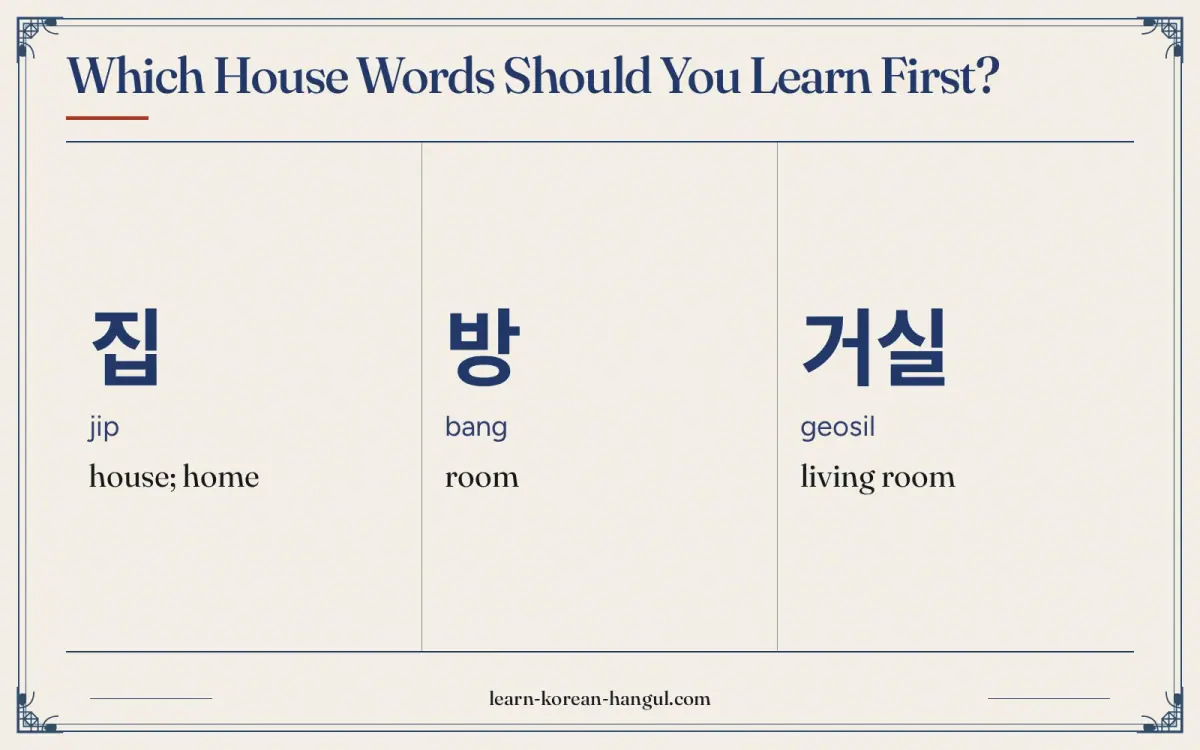
Learn 집 (house, home), 방 (room), 문 (door), 화장실 (restroom), 아파트 (apartment) and 현관 (entryway) first. They are the words you hear on day one in a Korean home: someone asks you to take off your shoes at the 현관, shows you your 방 and points out the 화장실. Add the housing types when you start looking for a place to stay.
- Words to say. 집, 방, 문, 열쇠, 비밀번호. Use these to ask, enter and lock up.
- Words to recognise. 현관, 층, 지하, 분리수거 signs and 관리비 on bills. Learn these by reading.
- Words for housing talk. 아파트, 빌라, 원룸, 전세, 월세. They come up when you search for a home.
Four easily confused words deserve a note. 집 is the whole house or home, 방 is a single room, 아파트 is a building with many flats, and 우리 집 (our home) is how Koreans say my home. Koreans often say 우리 where English says my, so 우리 집 is the natural way to say my house. The scene below is a cutaway house with numbered objects that match words in the list.
Word · 10
- 1
집
jip
house; home
- 2
방
bang
room
- 3
거실
geosil
living room
- 4
부엌
bueok
kitchen
- 5
침실
chimsil
bedroom
- 6
욕실
yoksil
bathroom (bathing room)
- 7
현관
hyeongwan
entryway
- 8
지붕
jibung
roof
- 9
계단
gyedan
stairs
- 10
온돌
ondol
underfloor heating
Rooms
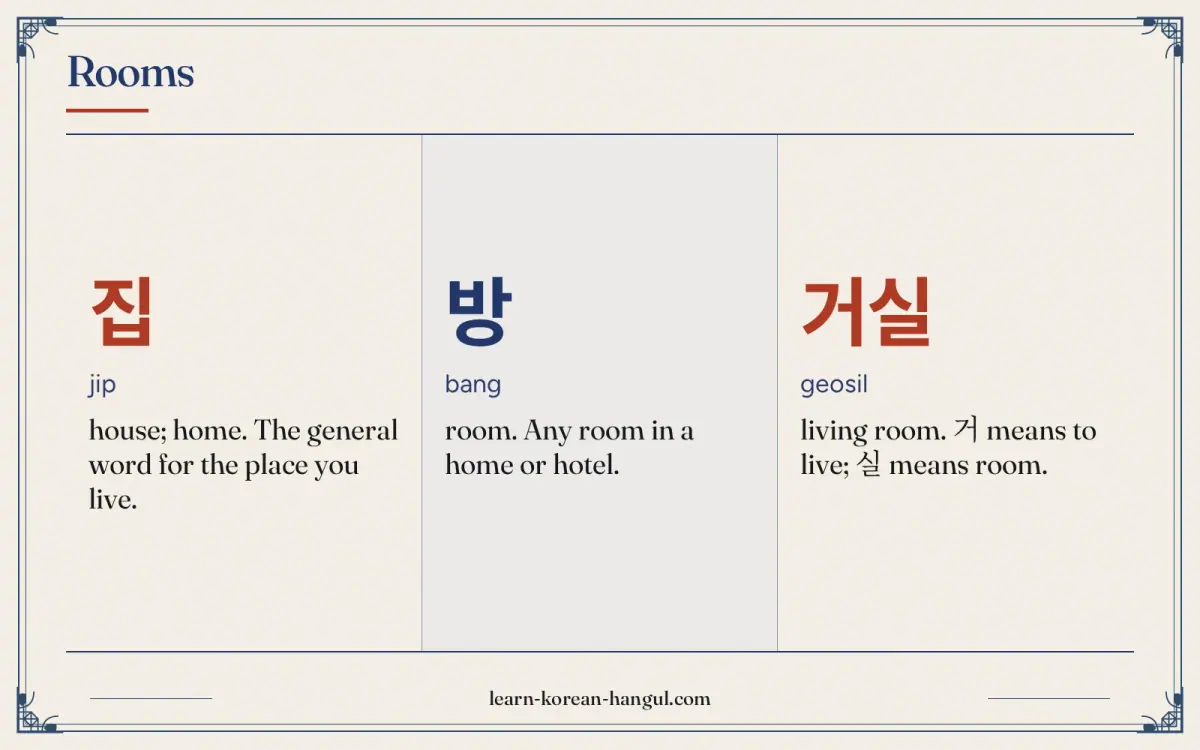
Korean room names are mostly Sino-Korean compounds that end in 실 (room), such as 거실, 침실 and 욕실. The exceptions are the native words 집 (house) and 부엌 (kitchen), and the one-syllable Sino-Korean word 방 (room). A beginner needs only the ten words here, because each room has a deeper page in this section. The restroom word 화장실 is the one you will use most often.
| No. | Hangul | Revised Romanization | Meaning and note | Example sentence | Audio assetId |
|---|---|---|---|---|---|
| 1 | 집 | jip | house; home. The general word for the place you live. | 우리 집이에요. (It is our home.) | au-pg-vocabulary-daily-life-home-1; example: au-pg-vocabulary-daily-life-home-51 |
| 2 | 방 | bang | room. Any room in a home or hotel. | 방이 커요. (The room is big.) | au-pg-vocabulary-daily-life-home-2; example: au-pg-vocabulary-daily-life-home-52 |
| 3 | 거실 | geosil | living room. 거 means to live; 실 means room. | 거실에서 텔레비전을 봐요. (I watch television in the living room.) | au-pg-vocabulary-daily-life-home-3; example: au-pg-vocabulary-daily-life-home-53 |
| 4 | 부엌 | bueok | kitchen. Another common word is 주방, often in restaurants. | 부엌에서 요리해요. (I cook in the kitchen.) | au-pg-vocabulary-daily-life-home-4; example: au-pg-vocabulary-daily-life-home-54 |
| 5 | 침실 | chimsil | bedroom. 침 means sleep (bed); the main bedroom is 안방. | 침실은 이 층에 있어요. (The bedroom is on the second floor.) | au-pg-vocabulary-daily-life-home-5; example: au-pg-vocabulary-daily-life-home-55 |
| 6 | 욕실 | yoksil | bathroom (bathing room). Said [욕씰]; the room for washing. | 욕실이 깨끗해요. (The bathroom is clean.) | au-pg-vocabulary-daily-life-home-6; example: au-pg-vocabulary-daily-life-home-56 |
| 7 | 화장실 | hwajangsil | toilet; restroom. What you ask for in shops and restaurants. | 화장실은 어디예요? (Where is the restroom?) | au-pg-vocabulary-daily-life-home-7; example: au-pg-vocabulary-daily-life-home-57 |
| 8 | 현관 | hyeongwan | entryway. Shoes come off here before you step up. | 현관에서 신발을 벗어요. (I take off my shoes at the entryway.) | au-pg-vocabulary-daily-life-home-8; example: au-pg-vocabulary-daily-life-home-58 |
| 9 | 베란다 | beranda | balcony; veranda. Often used to dry laundry. | 베란다에 화분이 있어요. (There is a plant pot on the balcony.) | au-pg-vocabulary-daily-life-home-9; example: au-pg-vocabulary-daily-life-home-59 |
| 10 | 서재 | seojae | study; home library. Only larger homes have one. | 서재에서 책을 읽어요. (I read books in the study.) | au-pg-vocabulary-daily-life-home-10; example: au-pg-vocabulary-daily-life-home-60 |
Note the difference between 화장실 and 욕실. In daily speech 화장실 is the toilet room, while 욕실 is the room with the bath or shower. In many Korean flats the two are one room, and people call it 화장실, so the word is also used to mean the whole bathroom. The bathroom page goes further.
Example Sentences
Two sentence frames carry most of the examples. The first is place + 에서 + verb (do something at a place), as in 거실에서 텔레비전을 봐요. The second is noun + 이/가 + descriptive verb, as in 방이 커요. Add 우리 to make a possessive: 우리 집이 커요 (our house is big). Say each sentence aloud after the audio and then replace the noun. Particles mark roles: 에서 marks where an action happens, 에 marks a position or a goal, and 이/가 marks the subject.
How Do You Say House Structure in Korean?
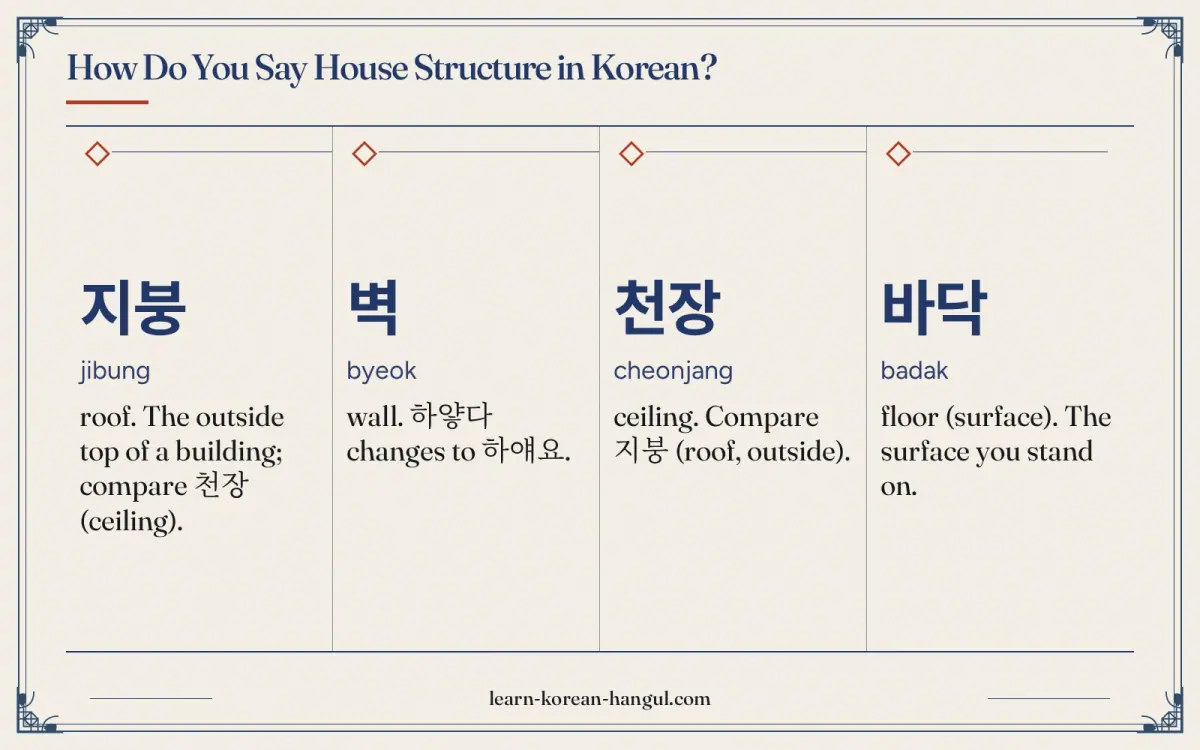
Structure words describe the shell of a building: the roof, the walls, the ceiling and the stairs. Most are native or Sino-Korean nouns that take the particle 이 or 가 as subjects. 층 (cheung) is a counter-like noun for floors and works with Sino-Korean numbers, so 이 층 is the second floor. 지하 is the basement level and appears on elevator panels.
| No. | Hangul | Revised Romanization | Meaning and note | Example sentence | Audio assetId |
|---|---|---|---|---|---|
| 11 | 지붕 | jibung | roof. The outside top of a building; compare 천장 (ceiling). | 지붕이 높아요. (The roof is high.) | au-pg-vocabulary-daily-life-home-11; example: au-pg-vocabulary-daily-life-home-61 |
| 12 | 벽 | byeok | wall. 하얗다 changes to 하얘요. | 벽이 하얘요. (The wall is white.) | au-pg-vocabulary-daily-life-home-12; example: au-pg-vocabulary-daily-life-home-62 |
| 13 | 천장 | cheonjang | ceiling. Compare 지붕 (roof, outside). | 천장이 높아요. (The ceiling is high.) | au-pg-vocabulary-daily-life-home-13; example: au-pg-vocabulary-daily-life-home-63 |
| 14 | 바닥 | badak | floor (surface). The surface you stand on. | 바닥이 따뜻해요. (The floor is warm.) | au-pg-vocabulary-daily-life-home-14; example: au-pg-vocabulary-daily-life-home-64 |
| 15 | 계단 | gyedan | stairs. 올라가다 means to go up. | 계단을 올라가요. (I go up the stairs.) | au-pg-vocabulary-daily-life-home-15; example: au-pg-vocabulary-daily-life-home-65 |
| 16 | 엘리베이터 | ellibeiteo | elevator. Ride with 타다. | 엘리베이터를 타요. (I take the elevator.) | au-pg-vocabulary-daily-life-home-16; example: au-pg-vocabulary-daily-life-home-66 |
| 17 | 층 | cheung | floor; storey. Use Sino-Korean numbers: 일 층, 이 층. | 몇 층이에요? (What floor is it?) | au-pg-vocabulary-daily-life-home-17; example: au-pg-vocabulary-daily-life-home-67 |
| 18 | 마당 | madang | yard. Typical of houses, not apartments. | 마당에 나무가 있어요. (There is a tree in the yard.) | au-pg-vocabulary-daily-life-home-18; example: au-pg-vocabulary-daily-life-home-68 |
| 19 | 담 | dam | wall; fence (outside). Marks the edge of a lot. | 담이 낮아요. (The fence is low.) | au-pg-vocabulary-daily-life-home-19; example: au-pg-vocabulary-daily-life-home-69 |
| 20 | 지하 | jiha | basement; underground. Seen as B1, B2 on elevator panels. | 지하에 주차장이 있어요. (There is a parking lot in the basement.) | au-pg-vocabulary-daily-life-home-20; example: au-pg-vocabulary-daily-life-home-70 |
Korean has two words for wall: 벽 is the wall of a room, and 담 is the outside wall around a yard. Floors are counted with Sino-Korean numbers plus 층, so ground level is 일 층 (first floor), and underground levels use 지하, as in 지하 이 층 (second basement floor).
Doors, Windows and Floors
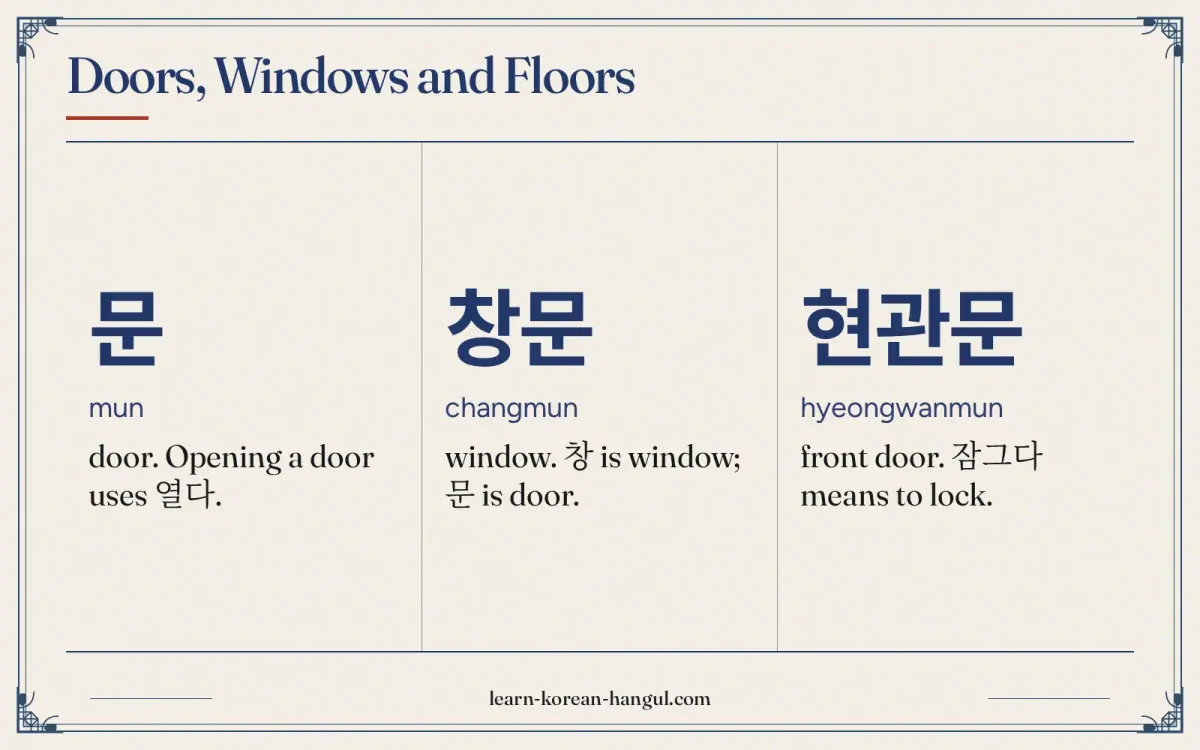
Door words matter early, because you will lock, open and ring them every day. A key is 열쇠, but many modern flats use a keypad with a 비밀번호 (passcode) instead. Floor coverings split in two: 마루 is a wooden floor, and 장판 is a vinyl or paper floor covering common in Korean homes that sits on a heated floor.
| No. | Hangul | Revised Romanization | Meaning and note | Example sentence | Audio assetId |
|---|---|---|---|---|---|
| 21 | 문 | mun | door. Opening a door uses 열다. | 문을 열어요. (I open the door.) | au-pg-vocabulary-daily-life-home-21; example: au-pg-vocabulary-daily-life-home-71 |
| 22 | 창문 | changmun | window. 창 is window; 문 is door. | 창문을 닫아요. (I close the window.) | au-pg-vocabulary-daily-life-home-22; example: au-pg-vocabulary-daily-life-home-72 |
| 23 | 현관문 | hyeongwanmun | front door. 잠그다 means to lock. | 현관문을 잠가요. (I lock the front door.) | au-pg-vocabulary-daily-life-home-23; example: au-pg-vocabulary-daily-life-home-73 |
| 24 | 열쇠 | yeolsoe | key. Said [열쐬]. | 열쇠가 없어요. (I do not have the key.) | au-pg-vocabulary-daily-life-home-24; example: au-pg-vocabulary-daily-life-home-74 |
| 25 | 비밀번호 | bimilbeonho | passcode; password. Used on door pads and Wi-Fi alike. | 비밀번호가 뭐예요? (What is the passcode?) | au-pg-vocabulary-daily-life-home-25; example: au-pg-vocabulary-daily-life-home-75 |
| 26 | 초인종 | choinjong | doorbell. 누르다 means to press. | 초인종을 눌러요. (I press the doorbell.) | au-pg-vocabulary-daily-life-home-26; example: au-pg-vocabulary-daily-life-home-76 |
| 27 | 손잡이 | sonjabi | handle. 손 is hand; 잡이 is a grip. | 손잡이가 고장 났어요. (The handle is broken.) | au-pg-vocabulary-daily-life-home-27; example: au-pg-vocabulary-daily-life-home-77 |
| 28 | 커튼 | keoteun | curtain. 치다 is the verb for drawing. | 커튼을 쳐요. (I draw the curtains.) | au-pg-vocabulary-daily-life-home-28; example: au-pg-vocabulary-daily-life-home-78 |
| 29 | 마루 | maru | wooden floor. Also means a raised wooden hall in a hanok. | 마루가 깨끗해요. (The wooden floor is clean.) | au-pg-vocabulary-daily-life-home-29; example: au-pg-vocabulary-daily-life-home-79 |
| 30 | 장판 | jangpan | floor covering (vinyl or paper). Sits over an underfloor heating system. | 장판이 따뜻해요. (The floor covering is warm.) | au-pg-vocabulary-daily-life-home-30; example: au-pg-vocabulary-daily-life-home-80 |
Korean locks differ from the English pattern of a key and a lock. Many apartments open with a 도어락 (door lock, a keypad), which is why 비밀번호 is more useful than 열쇠 for a visitor. Asking 비밀번호가 뭐예요? works for both a door and a Wi-Fi network.
How Do You Say Types of Housing in Korean?
Several Korean housing words are loanwords from English, and their meanings differ from English. 아파트 is a high-rise block of flats, usually the most common type in cities. 빌라 is a low-rise block with a handful of units. 원룸 is a studio, and 오피스텔 is a studio-type unit in a mixed-use building. 한옥 is a traditional Korean house.
| No. | Hangul | Revised Romanization | Meaning and note | Example sentence | Audio assetId |
|---|---|---|---|---|---|
| 31 | 아파트 | apateu | apartment (high-rise block). Usually a large, multi-storey block. | 아파트에 살아요. (I live in an apartment.) | au-pg-vocabulary-daily-life-home-31; example: au-pg-vocabulary-daily-life-home-81 |
| 32 | 빌라 | billa | low-rise multi-unit house. Not a luxury villa: a small block. | 빌라에 살아요. (I live in a villa-style building.) | au-pg-vocabulary-daily-life-home-32; example: au-pg-vocabulary-daily-life-home-82 |
| 33 | 원룸 | wollum | studio apartment. One main room plus a bathroom. | 원룸에 살아요. (I live in a studio.) | au-pg-vocabulary-daily-life-home-33; example: au-pg-vocabulary-daily-life-home-83 |
| 34 | 오피스텔 | opiseutel | studio-type unit in a mixed-use building. Office and residential use together. | 오피스텔에 살아요. (I live in an officetel.) | au-pg-vocabulary-daily-life-home-34; example: au-pg-vocabulary-daily-life-home-84 |
| 35 | 한옥 | hanok | traditional Korean house. Often has a tiled roof and ondol. | 한옥은 전통 집이에요. (A hanok is a traditional house.) | au-pg-vocabulary-daily-life-home-35; example: au-pg-vocabulary-daily-life-home-85 |
| 36 | 단독주택 | dandokjutaek | detached house. Single-family house with a yard. | 단독주택에 살아요. (I live in a detached house.) | au-pg-vocabulary-daily-life-home-36; example: au-pg-vocabulary-daily-life-home-86 |
| 37 | 기숙사 | gisuksa | dormitory. Common for university students. | 기숙사에 살아요. (I live in a dormitory.) | au-pg-vocabulary-daily-life-home-37; example: au-pg-vocabulary-daily-life-home-87 |
| 38 | 하숙집 | hasukjip | boarding house. Room and meals provided. | 하숙집에 살아요. (I live in a boarding house.) | au-pg-vocabulary-daily-life-home-38; example: au-pg-vocabulary-daily-life-home-88 |
| 39 | 전세 | jeonse | lump-sum deposit lease. Pay a large deposit instead of monthly rent. | 전세로 살아요. (I live on a jeonse lease.) | au-pg-vocabulary-daily-life-home-39; example: au-pg-vocabulary-daily-life-home-89 |
| 40 | 월세 | wolse | monthly rent. Often paired with a smaller deposit. | 월세가 얼마예요? (How much is the monthly rent?) | au-pg-vocabulary-daily-life-home-40; example: au-pg-vocabulary-daily-life-home-90 |
Two words of money need a note. 전세 is a lease closely associated with Korea in which a tenant pays a large deposit and gets it back at the end, with no monthly rent. 월세 is rent paid each month. The housing words connect to housing and renting, where the deposit systems are covered in more detail.
Korean Home Features
This group covers features that learners meet in their first week in Korea. 온돌 is the traditional floor heating system, now a boiler-powered water-pipe system in most flats. 보일러 is the boiler that runs it. 신발장 is the cabinet by the 현관 where shoes go. 관리비 is the monthly maintenance fee for a block, which appears on a bill.
| No. | Hangul | Revised Romanization | Meaning and note | Example sentence | Audio assetId |
|---|---|---|---|---|---|
| 41 | 온돌 | ondol | underfloor heating. A traditional heating system. | 온돌이 따뜻해요. (The underfloor heating is warm.) | au-pg-vocabulary-daily-life-home-41; example: au-pg-vocabulary-daily-life-home-91 |
| 42 | 보일러 | boilleo | boiler. 켜다 means to switch on. | 보일러를 켜요. (I turn on the boiler.) | au-pg-vocabulary-daily-life-home-42; example: au-pg-vocabulary-daily-life-home-92 |
| 43 | 신발장 | sinbaljang | shoe cabinet. Found beside the 현관. | 신발장에 신발이 있어요. (The shoes are in the shoe cabinet.) | au-pg-vocabulary-daily-life-home-43; example: au-pg-vocabulary-daily-life-home-93 |
| 44 | 안방 | anbang | main bedroom. Traditionally the parents’ room. | 안방은 부모님 방이에요. (The main bedroom is my parents’ room.) | au-pg-vocabulary-daily-life-home-44; example: au-pg-vocabulary-daily-life-home-94 |
| 45 | 다용도실 | dayongdosil | utility room. Often next to the balcony. | 다용도실에 세탁기가 있어요. (The washing machine is in the utility room.) | au-pg-vocabulary-daily-life-home-45; example: au-pg-vocabulary-daily-life-home-95 |
| 46 | 관리비 | gwallibi | maintenance fee. Paid monthly for shared costs. | 관리비가 얼마예요? (How much is the maintenance fee?) | au-pg-vocabulary-daily-life-home-46; example: au-pg-vocabulary-daily-life-home-96 |
| 47 | 이웃 | iut | neighbor. Said [이욷] alone; 이웃이 is said [이우시]. | 이웃이 친절해요. (The neighbors are kind.) | au-pg-vocabulary-daily-life-home-47; example: au-pg-vocabulary-daily-life-home-97 |
| 48 | 경비실 | gyeongbisil | security office. Packages are often left here. | 경비실에 맡겨요. (I leave it at the security office.) | au-pg-vocabulary-daily-life-home-48; example: au-pg-vocabulary-daily-life-home-98 |
| 49 | 주차장 | juchajang | parking lot. Basement parking is typical in apartments. | 주차장은 지하에 있어요. (The parking lot is in the basement.) | au-pg-vocabulary-daily-life-home-49; example: au-pg-vocabulary-daily-life-home-99 |
| 50 | 단지 | danji | apartment complex; estate. Used with 아파트: 아파트 단지. | 단지가 커요. (The complex is large.) | au-pg-vocabulary-daily-life-home-50; example: au-pg-vocabulary-daily-life-home-100 |
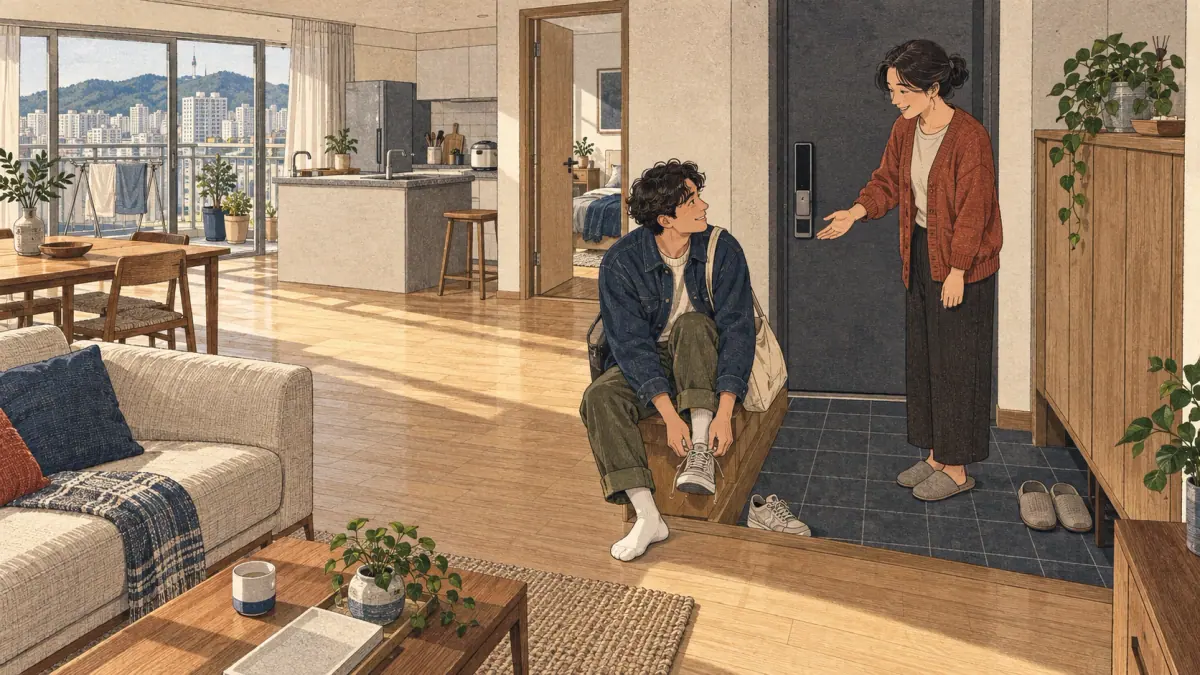
The shoe rule at the entryway is worth a sentence of its own. Koreans take shoes off at the 현관 before stepping onto the raised floor, and a host will often say 신발을 벗으세요 (please take off your shoes). Guests answer by removing their shoes at the 현관. A host also says 들어오세요 (deureooseyo, please come in), and a guest says 실례합니다 (sillyehamnida, excuse me) or the more formal 실례하겠습니다 (sillyehagetseumnida) while stepping in. This habit is why the 신발장 sits beside the front door and why a slippers shelf is common.
How Do You Pronounce These Words?
Most house words are pronounced as written, but several sound changes appear. Standard pronunciation follows the National Institute of Korean Language (국립국어원) rules, and the romanization follows the Revised Romanization of Korean, which does not mark every sound change.
| Spelling | Sounds like | What changes |
|---|---|---|
| 욕실 | [욕씰] | After a final ㄱ, the ㅅ is said as a tense [ㅆ]. |
| 열쇠 | [열쐬] | The ㅅ after a final ㄹ is said tense in this word. |
| 이웃 | [이욷] | The final ㅅ is said as [ㄷ] when nothing follows. |
| 부엌 | [부억] | The final ㅋ is said as [ㄱ] at the end of a word. |
| 거실에서 | [거시레서] | The final ㄹ links to the vowel of the next syllable. |
Final consonants in Korean are said in a reduced way: ㅋ in 부엌 sounds like ㄱ, and ㅅ in 이웃 sounds like ㄷ. When a vowel follows, the original consonant returns, so 부엌이 is said [부어키]. This is one reason that learners find the written and spoken forms differ.
Audio and Slow Playback
Each word and sentence has its own clip. The five clips below replay the trickiest words slowly. Play one, repeat it aloud, then play it again and compare.
What Mistakes Do Learners Make with House Words?
Five mistakes are especially common with this topic.
- Saying 집 for a single room. 집 is the whole house or home, while 방 is a room. 방이 두 개 있어요 means there are two rooms.
- Using 화장실 only for the toilet. 화장실 is a toilet room in public and, in many homes, the whole bathroom. 욕실 is the bathing room. Use 화장실 when you ask in a shop.
- Treating 아파트 as an English apartment. 아파트 is usually a large block, often with a complex name and a 단지. A small low-rise is a 빌라, and a studio is an 원룸.
- Forgetting to take shoes off. 신발을 벗으세요 is not a rude command but a house rule. Remove shoes at the 현관 and look for slippers.
- Using 열쇠 where a keypad is used. Many flats use a 비밀번호 pad. Ask 비밀번호가 뭐예요? when a door has a keypad.
Avoiding these five mistakes covers most of the confusion in a first week in a Korean home. The practice tools below help you lock in the words.
Practice: Flashcards and Worksheet
Study in three steps. First, run the flashcard deck in recognition mode until you can read all 50 words. Second, switch to listening mode. Third, take the quiz. The deck holds all 50 words with audio, and your progress stays in your browser. The vocabulary flashcard decks page lists the other decks.
Practice · 105
- 01집
Show answer
headword 1: house; home
- 02방
Show answer
headword 2: room
- 03거실
Show answer
headword 3: living room
- 04부엌
Show answer
headword 4: kitchen
- 05침실
Show answer
headword 5: bedroom
- 06욕실
Show answer
headword 6: bathroom (bathing room)
- 07화장실
Show answer
headword 7: toilet; restroom
- 08현관
Show answer
headword 8: entryway
- 09베란다
Show answer
headword 9: balcony; veranda
- 10서재
Show answer
headword 10: study; home library
- 11지붕
Show answer
headword 11: roof
- 12벽
Show answer
headword 12: wall
- 13천장
Show answer
headword 13: ceiling
- 14바닥
Show answer
headword 14: floor (surface)
- 15계단
Show answer
headword 15: stairs
- 16엘리베이터
Show answer
headword 16: elevator
- 17층
Show answer
headword 17: floor; storey
- 18마당
Show answer
headword 18: yard
- 19담
Show answer
headword 19: wall; fence (outside)
- 20지하
Show answer
headword 20: basement; underground
- 21문
Show answer
headword 21: door
- 22창문
Show answer
headword 22: window
- 23현관문
Show answer
headword 23: front door
- 24열쇠
Show answer
headword 24: key
- 25비밀번호
Show answer
headword 25: passcode; password
- 26초인종
Show answer
headword 26: doorbell
- 27손잡이
Show answer
headword 27: handle
- 28커튼
Show answer
headword 28: curtain
- 29마루
Show answer
headword 29: wooden floor
- 30장판
Show answer
headword 30: floor covering (vinyl or paper)
- 31아파트
Show answer
headword 31: apartment (high-rise block)
- 32빌라
Show answer
headword 32: low-rise multi-unit house
- 33원룸
Show answer
headword 33: studio apartment
- 34오피스텔
Show answer
headword 34: studio-type unit in a mixed-use building
- 35한옥
Show answer
headword 35: traditional Korean house
- 36단독주택
Show answer
headword 36: detached house
- 37기숙사
Show answer
headword 37: dormitory
- 38하숙집
Show answer
headword 38: boarding house
- 39전세
Show answer
headword 39: lump-sum deposit lease
- 40월세
Show answer
headword 40: monthly rent
- 41온돌
Show answer
headword 41: underfloor heating
- 42보일러
Show answer
headword 42: boiler
- 43신발장
Show answer
headword 43: shoe cabinet
- 44안방
Show answer
headword 44: main bedroom
- 45다용도실
Show answer
headword 45: utility room
- 46관리비
Show answer
headword 46: maintenance fee
- 47이웃
Show answer
headword 47: neighbor
- 48경비실
Show answer
headword 48: security office
- 49주차장
Show answer
headword 49: parking lot
- 50단지
Show answer
headword 50: apartment complex; estate
- 51우리 집이에요.
Show answer
example sentence for headword 1
- 52방이 커요.
Show answer
example sentence for headword 2
- 53거실에서 텔레비전을 봐요.
Show answer
example sentence for headword 3
- 54부엌에서 요리해요.
Show answer
example sentence for headword 4
- 55침실은 이 층에 있어요.
Show answer
example sentence for headword 5
- 56욕실이 깨끗해요.
Show answer
example sentence for headword 6
- 57화장실은 어디예요?
Show answer
example sentence for headword 7
- 58현관에서 신발을 벗어요.
Show answer
example sentence for headword 8
- 59베란다에 화분이 있어요.
Show answer
example sentence for headword 9
- 60서재에서 책을 읽어요.
Show answer
example sentence for headword 10
- 61지붕이 높아요.
Show answer
example sentence for headword 11
- 62벽이 하얘요.
Show answer
example sentence for headword 12
- 63천장이 높아요.
Show answer
example sentence for headword 13
- 64바닥이 따뜻해요.
Show answer
example sentence for headword 14
- 65계단을 올라가요.
Show answer
example sentence for headword 15
- 66엘리베이터를 타요.
Show answer
example sentence for headword 16
- 67몇 층이에요?
Show answer
example sentence for headword 17
- 68마당에 나무가 있어요.
Show answer
example sentence for headword 18
- 69담이 낮아요.
Show answer
example sentence for headword 19
- 70지하에 주차장이 있어요.
Show answer
example sentence for headword 20
- 71문을 열어요.
Show answer
example sentence for headword 21
- 72창문을 닫아요.
Show answer
example sentence for headword 22
- 73현관문을 잠가요.
Show answer
example sentence for headword 23
- 74열쇠가 없어요.
Show answer
example sentence for headword 24
- 75비밀번호가 뭐예요?
Show answer
example sentence for headword 25
- 76초인종을 눌러요.
Show answer
example sentence for headword 26
- 77손잡이가 고장 났어요.
Show answer
example sentence for headword 27
- 78커튼을 쳐요.
Show answer
example sentence for headword 28
- 79마루가 깨끗해요.
Show answer
example sentence for headword 29
- 80장판이 따뜻해요.
Show answer
example sentence for headword 30
- 81아파트에 살아요.
Show answer
example sentence for headword 31
- 82빌라에 살아요.
Show answer
example sentence for headword 32
- 83원룸에 살아요.
Show answer
example sentence for headword 33
- 84오피스텔에 살아요.
Show answer
example sentence for headword 34
- 85한옥은 전통 집이에요.
Show answer
example sentence for headword 35
- 86단독주택에 살아요.
Show answer
example sentence for headword 36
- 87기숙사에 살아요.
Show answer
example sentence for headword 37
- 88하숙집에 살아요.
Show answer
example sentence for headword 38
- 89전세로 살아요.
Show answer
example sentence for headword 39
- 90월세가 얼마예요?
Show answer
example sentence for headword 40
- 91온돌이 따뜻해요.
Show answer
example sentence for headword 41
- 92보일러를 켜요.
Show answer
example sentence for headword 42
- 93신발장에 신발이 있어요.
Show answer
example sentence for headword 43
- 94안방은 부모님 방이에요.
Show answer
example sentence for headword 44
- 95다용도실에 세탁기가 있어요.
Show answer
example sentence for headword 45
- 96관리비가 얼마예요?
Show answer
example sentence for headword 46
- 97이웃이 친절해요.
Show answer
example sentence for headword 47
- 98경비실에 맡겨요.
Show answer
example sentence for headword 48
- 99주차장은 지하에 있어요.
Show answer
example sentence for headword 49
- 100단지가 커요.
Show answer
example sentence for headword 50
- 101욕실
Show answer
slow playback of headword 6: bathroom (bathing room)
- 102열쇠
Show answer
slow playback of headword 24: key
- 103부엌
Show answer
slow playback of headword 4: kitchen
- 104현관
Show answer
slow playback of headword 8: entryway
- 105관리비
Show answer
slow playback of headword 46: maintenance fee
Practice · 5
What does 집 (jip) mean?
Show answer
house; home
집 means house; home. Example: 우리 집이에요. (It is our home.)
What does 방 (bang) mean?
Show answer
room
방 means room. Example: 방이 커요. (The room is big.)
What does 현관 (hyeongwan) mean?
Show answer
entryway
현관 means entryway. Example: 현관에서 신발을 벗어요. (I take off my shoes at the entryway.)
What does 온돌 (ondol) mean?
Show answer
underfloor heating
온돌 means underfloor heating. Example: 온돌이 따뜻해요. (The underfloor heating is warm.)
What does 월세 (wolse) mean?
Show answer
monthly rent
월세 means monthly rent. Example: 월세가 얼마예요? (How much is the monthly rent?)
Korean House Vocabulary Worksheet (PDF)
A printable worksheet for these words (word list, matching, writing practice, fill-in-the-blank exercises and answer key) is available in A4 and US Letter from the download card on this page. For practice, draw a simple floor plan of your home and write the Korean name for each room. Writing the words in place is a quick, personal way to fix them.
Where to Go Next
After this page, continue with Clothing or Daily Routines. For furniture, see furniture. For the single query on its own, the page on house in Korean gives the one-word answer. To move up a level, return to Daily Life.
Pages in This Section
The House and Home section has eight deeper pages, each with its own word list, audio, deck and worksheet. Use them to go beyond the 50 words here.
- Korean House and Furniture Vocabulary: 40 words for seating, storage, bedding, lights and room appliances, including floor-living items such as 요 and 방석.
- Korean Kitchen Vocabulary: 40 words for cutlery, pots, appliances, prep tools and the sink, with 수저, 뚝배기 and 밥솥.
- Korean Bathroom Vocabulary: 30 words for fixtures, toiletries, towels and bins, polite requests and public restrooms.
- Korean Bedroom Vocabulary: 25 words for bedding, sleep, clothes storage, alarms and lights, and floor sleeping.
- Korean Household Appliances Vocabulary: 30 words for machines and gadgets, with the -기 ending and the counter 대.
- Korean Cleaning Vocabulary: 30 words for cleaning tools, laundry, dishes, recycling and cleaning products.
- Korean Everyday Objects Vocabulary: 45 words for things in your bag, on your desk, on a key ring, in a drawer and in gift wrapping.
- Korean Tools and Hardware Vocabulary: hammers, screwdrivers, nails and repair words.
Frequently Asked Questions
How Do You Say House in Korean?
House or home is 집 (jip). It covers both the building and the idea of home, and Koreans often say 우리 집 (our home) for my house. A room is 방 (bang), and an apartment is 아파트 (apateu). The single-word page on house in Korean gives more detail.
How Do You Pronounce 방 (bang)?
Say bang as one short syllable. The b is soft, between b and p. The vowel is an open ah, as in father, and the ng at the end is a nasal sound made at the back of the mouth, with no g sound. It means room. Press the audio button to hear it.
How Many House Words Should I Learn First?
Six first: 집, 방, 문, 화장실, 아파트 and 현관. At five new words a day the whole list of 50 takes ten days plus review. Learn the rooms before the structure words, then add the housing types when you search for a home.
Where Can I Practise House Words with Flashcards?
Use the vocabulary flashcard decks. The deck for this page holds all 50 words with Hangul, romanization and audio, with recognition and listening modes. Your progress stays in your browser. Return daily and review the cards you missed.
Is the Romanization on This Page Official?
It follows the Revised Romanization of Korean, which South Korea adopted on 7 July 2000 and whose rules the National Institute of Korean Language (국립국어원) publishes. It is a learning aid and does not mark every sound change, so rely on the Hangul and the audio.
Is There a Printable Worksheet for House Words?
A printable worksheet for these words (word list, matching, writing practice, fill-in-the-blank exercises and answer key) is available in A4 and US Letter from the download card on this page. For practice, copy the tables on this page by hand or use the flashcard deck, which carries the same 50 words.