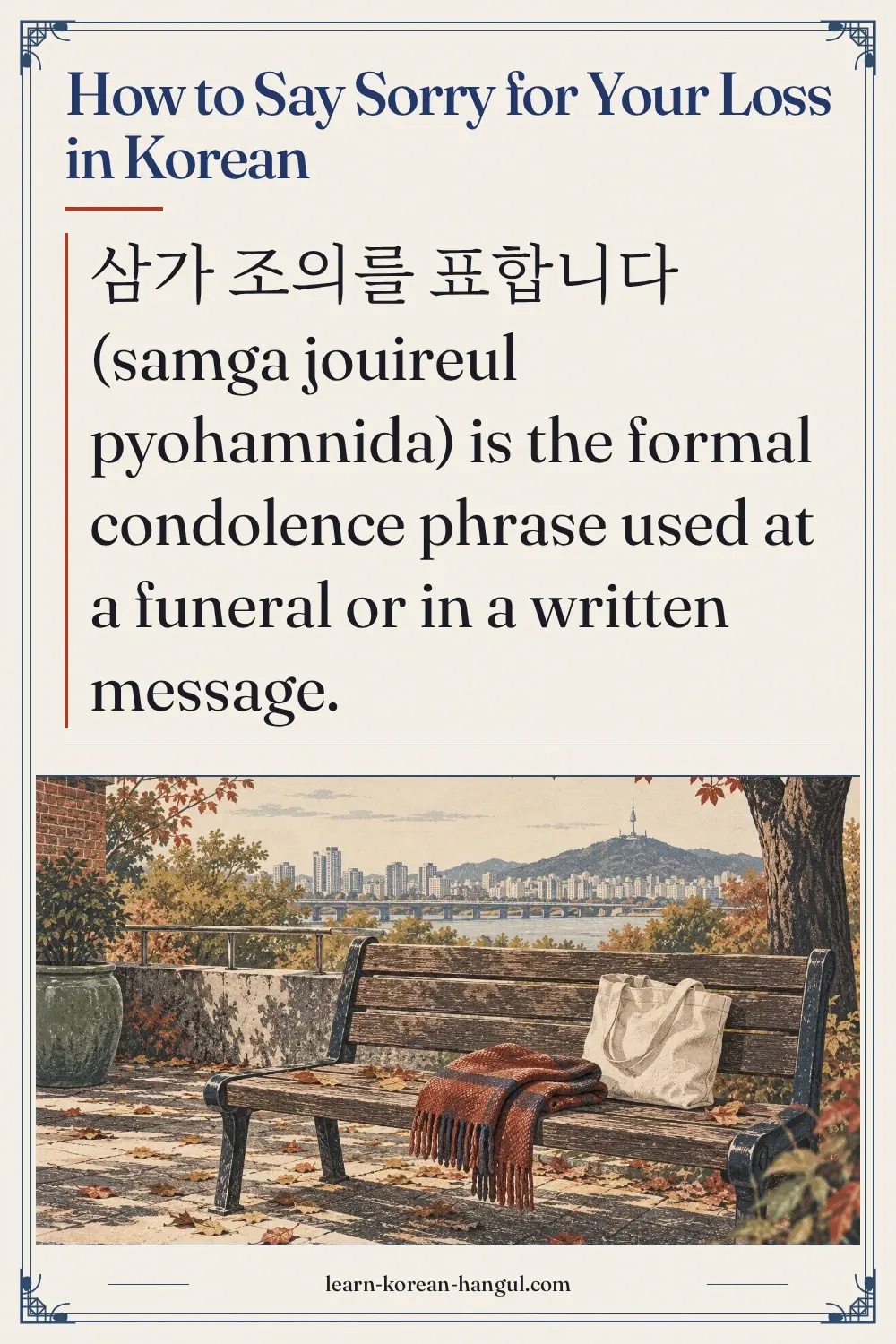
삼가 조의를 표합니다
삼가 조의를 표합니다
What you'll learn
- Say condolences in formal, polite and casual Korean.
- Explain why 죄송합니다 alone is the wrong phrase.
- Pronounce 조의를 and 표합니다 correctly.
- Follow the basic manners of a Korean funeral hall.
Before you start: knowing sorry in Korean helps, because it shows why 죄송합니다 is an apology and not a condolence. Time: about 12 minutes. Audio plays only when you press a button.
Key facts
- 삼가 고인의 명복을 빕니다 means I respectfully pray for the repose of the deceased.
- 얼마나 힘드세요 and 힘내세요 are polite words of sympathy for people you know.
- 죄송합니다 alone is an apology and is not a condolence.
How Do You Say Sorry for Your Loss in Korean?
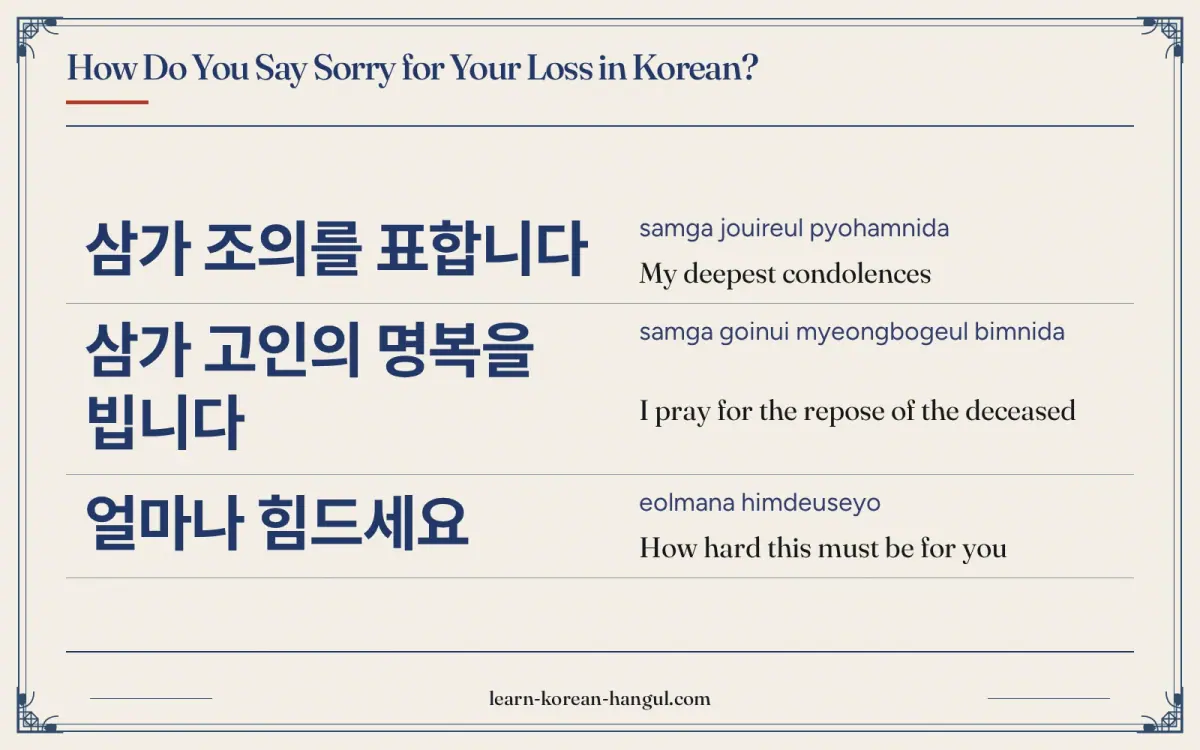
The standard way to say sorry for your loss in Korean is 삼가 조의를 표합니다. 삼가 means "respectfully", 조의 (弔意) means "condolence", and 표하다 means "to express". The phrase is formal and is spoken at funerals or written in condolence messages and cards.
| Situation | Korean | Romanization | Meaning |
|---|---|---|---|
| Funeral hall, to the family | 삼가 조의를 표합니다 | samga jouireul pyohamnida | My deepest condolences |
| Funeral hall or card | 삼가 고인의 명복을 빕니다 | samga goinui myeongbogeul bimnida | I pray for the repose of the deceased |
| Colleague or acquaintance | 얼마나 힘드세요 | eolmana himdeuseyo | How hard this must be for you |
| Message to someone you know | 힘내세요 | himnaeseyo | Stay strong |
| Close friend | 많이 힘들지? 힘내 | mani himdeulji? himnae | This must be so hard. Hang in there |
Notice that none of the phrases say sorry. Korean treats grief as something you share and honour, not as a mistake to apologise for. The next section explains each form.
What Are the Formal, Polite and Casual Ways to Offer Condolences?
Korean changes the sentence ending to match the listener, a system called speech levels. The guide to Korean speech levels explains them in depth, and this page uses three: formal (합쇼체), polite (해요체) and casual (해체).
Formal: 삼가 조의를 표합니다 (samga jouireul pyohamnida)
Formal · 합쇼체삼가 조의를 표합니다 is the standard formal condolence. Say it quietly to the chief mourner or the family at a funeral, and write it in a card or an email. It suits strangers, seniors and colleagues, because the formal ending shows the highest respect.
삼가 조의를 표합니다.
samga jouireul pyohamnida
My deepest condolences.
Formal: 삼가 고인의 명복을 빕니다 (samga goinui myeongbogeul bimnida)
Formal · 합쇼체삼가 고인의 명복을 빕니다 means "I respectfully pray for the repose of the deceased". 고인 (故人) is "the deceased", and 명복 (冥福) is "happiness in the afterlife". It is common on funeral flowers, in cards and in formal messages.
삼가 고인의 명복을 빕니다.
samga goinui myeongbogeul bimnida
I respectfully pray for the repose of the deceased.
Polite: 얼마나 힘드세요 (eolmana himdeuseyo)
Polite · 해요체얼마나 힘드세요 means "how hard this must be for you". The honorific -시- in 힘드세요 shows respect. It suits a colleague, a teacher or a neighbour you know, often in a message or after the formal phrase.
얼마나 힘드세요.
eolmana himdeuseyo
How hard this must be for you.
Polite: 힘내세요 (himnaeseyo)
Polite · 해요체힘내세요 means "stay strong" and is a gentle word of comfort. It is common in messages and among people who know each other, often with an offer of support such as 곁에 있을게요 (I'll be by your side).
힘내세요. 곁에 있을게요.
himnaeseyo. gyeote isseulgeyo
Stay strong. I'll be by your side.
Casual: 많이 힘들지? 힘내 (mani himdeulji? himnae)
Casual · 반말With a close friend, drop the polite endings: 많이 힘들지? means "this must be so hard, isn't it?" and 힘내 means "hang in there". Say it softly, and listen more than you speak.
많이 힘들지? 힘내.
mani himdeulji? himnae
This must be so hard. Hang in there.
The formal phrase is the safe choice with anyone you do not know well. Now the sounds.
How Do You Pronounce 삼가 조의를 표합니다?
삼가 조의를 표합니다 is pronounced [삼가 조의를 표함니다] or [삼가 조이를 표함니다], in nine syllables, with a nasal sound at the end. Say it in four chunks.
- 삼가 (sam-ga): "sahm-gah", with a soft g.
- 조의를 (jo-ui-reul): written 조의를, said jo-ui-reul or jo-i-reul.
- 표 (pyo): "pyoh", with a clear p before the y.
- 함니다 (ham-ni-da): the written 합니다 is read ham-ni-da.
Sound Changes to Listen For
Three points explain the differences between spelling and sound.
- The letter 의. At the start of a word, 의 is read [의]. In a later syllable of a word, the National Institute of Korean Language Standard Pronunciation rules (표준 발음법) allow [이], so 조의를 can be [조이를] in everyday speech.
- Nasalization (비음화). The ㅂ of 합 turns into ㅁ before the ㄴ of 니, giving [표함니다]. See ㅂ-to-ㅁ nasalization.
- Liaison (연음). In 명복을, the ㄱ of 복 moves onto 을, so it is said [명보글]. See Korean liaison.
Clear pronunciation matters less than calm delivery, so the next section looks at when to speak.
When Should You Use 삼가 조의를 표합니다, and When Should You Not?
Use 삼가 조의를 표합니다 when you meet the family at a funeral or write a condolence note. Use 얼마나 힘드세요 and 힘내세요 with people you know, and use the casual form only with close friends.
Situations Where It Fits
- Funeral hall, to the family. 삼가 조의를 표합니다, then a bow.
- Condolence card or flowers. 삼가 고인의 명복을 빕니다.
- A coworker's loss. 소식 들었어요. 얼마나 힘드세요?
- A close friend's loss. 많이 힘들지? 곁에 있을게.
Situations to Avoid
- Saying only 죄송합니다. It reads as an apology, not as sympathy.
- Long speeches at the funeral hall. Short and quiet is the norm.
- Asking how the person died. Wait until the family chooses to tell you.
- Casual speech with the family of a stranger. Keep the formal ending.
Short example exchanges show how little needs to be said.
What Does Sorry for Your Loss Sound Like in a Real Conversation?
Condolence exchanges are brief and quiet, and the family often answers with thanks.
At the Funeral Hall
Guest
삼가 조의를 표합니다.
samga jouireul pyohamnida
My deepest condolences.
Family Member
와 주셔서 감사합니다.
wa jusyeoseo gamsahamnida
Thank you for coming.
What to notice: the family answers with thanks for coming, not with a long reply. The thanks vocabulary is covered in thank you in Korean.
A Coworker's Loss
You
소식 들었어요. 얼마나 힘드세요?
sosik deureosseoyo. eolmana himdeuseyo?
I heard the news. How hard this must be for you.
Coworker
감사합니다. 와 주셔서 고맙습니다.
gamsahamnida. wa jusyeoseo gomapseumnida
Thank you. Thank you for coming.
What to notice: 소식 들었어요 (I heard the news) opens the conversation without asking questions. Comfort that follows later can include cheer up in Korean.
A Close Friend's Loss
You
많이 힘들지? 곁에 있을게.
mani himdeulji? gyeote isseulge
This must be so hard. I'll be by your side.
Friend
고마워. 큰 힘이 돼.
gomawo. keun himi dwae
Thank you. It means a lot.
What to notice: a friend offers presence, not advice. The phrase 큰 힘이 돼 literally says "it becomes great strength". After the first days, a message that ends with take care in Korean is also welcome. These exchanges reflect how Koreans treat funerals.
What Should You Know about the Culture behind Sorry for Your Loss?
Korean funerals follow clear customs, and the words are only part of a set of gestures. The points below are general guidance, and families and regions differ.
- Dark clothing. Guests usually wear black or very dark clothes.
- A white envelope. Guests often bring condolence money (부의금 or 조의금) in a white envelope, handed over or placed on the table.
- A bow to the portrait. Many guests bow or offer flowers to the portrait of the deceased, then bow to the family.
- Short and quiet words. Say the formal phrase softly. The family may be speaking with many guests.
- Funeral length. Funerals commonly last about three days, so guests may visit on any day.
An expert insight: learners often want to say more than the standard phrase. In Korean, the shortest formal phrase, said sincerely with a bow, is the respectful choice. Personal words come later, in a message or when you meet again. The mistakes below show the main pitfalls.
What Mistakes Do Learners Make with Sorry for Your Loss in Korean?
Most mistakes come from translating "sorry" directly or from choosing a tone that is too light.
| Mistake | Why it is a problem | Fix |
|---|---|---|
| Saying only 죄송합니다 | It is an apology | Say 삼가 조의를 표합니다 |
| 힘내 to the family at the funeral | Too casual | Say the formal phrase |
| Using 미안해 | It is casual and an apology | Say the formal phrase, or 많이 힘들지? to a close friend |
| Asking about the cause | Intrudes on grief | Wait for the family to speak |
| Reading 표합니다 as "pyo-hap-ni-da" | The nasal sound is missing | Say [표함니다] |
Learners often assume sorry for your loss needs the word for sorry. Actually, Korean uses words of respect and prayer (조의 and 명복), so the equivalent has no apology in it.
Is It the Same as Condolences or My Condolences?
Yes. The English variants all map to the phrases on this page. The short answers below cover the other searches folded into this page.
- Condolences in Korean: 조의 (弔意) as a word; the phrase is 삼가 조의를 표합니다.
- My condolences in Korean: 삼가 조의를 표합니다.
- Sorry for your loss, formal, in Korean: 삼가 고인의 명복을 빕니다.
- I am sorry for your loss, to someone you know: 얼마나 힘드세요 or 힘내세요.
The pattern holds across all of them: formal words for the funeral, warm words for people you know. Now practise.
Practice: Say It Aloud
Play the slow clip of 삼가 조의를 표합니다 three times, then say 삼가 고인의 명복을 빕니다. Choose a phrase for each situation. Answers follow.
- You greet the family at a funeral hall.
- You write on a condolence card.
- A colleague's parent has passed away and you send a message.
- A close friend tells you about the loss.
Answers
- 삼가 조의를 표합니다.
- 삼가 고인의 명복을 빕니다.
- 소식 들었어요. 얼마나 힘드세요?
- 많이 힘들지? 곁에 있을게.
The phrase flashcards drill these with audio.
Related Phrases to Learn Next
Condolences lead to comfort and thanks, so these are the natural next phrases.
- Cheer up in Korean: phrases of encouragement such as 힘내세요.
- Thank you in Korean: 감사합니다, the usual reply.
- Take care in Korean: caring phrases to end a message or a visit.
This guide belongs to the polite Korean phrases collection. What this page does not cover: full funeral procedures and religious differences, which depend on the family. Use the formal phrase at the funeral, a warm line for people you know and a short quiet message afterwards, and you can say sorry for your loss in Korean with care.
Frequently Asked Questions
Can I say 죄송합니다 at a funeral?
Not by itself. 죄송합니다 means I apologise, so it can sound as if you caused the loss. Say 삼가 조의를 표합니다 or 삼가 고인의 명복을 빕니다 instead. If you know the family well, you can add a short personal line such as 얼마나 힘드세요 after the formal phrase.
What do I say in a text message to a grieving friend?
Write 소식 들었어요. 얼마나 힘드세요? (I heard the news. How hard this must be.) to a colleague or acquaintance. To a close friend, write 많이 힘들지? 곁에 있을게 (This must be so hard. I'll be by your side). Keep messages short and do not ask about the cause.
What is 명복 and when do I use 명복을 빕니다?
명복 means happiness in the afterlife, and 명복을 빕니다 means I pray for it. Use 삼가 고인의 명복을 빕니다 at a funeral, in a condolence card or in a message to the family. 고인 means the deceased. It suits formal and written settings more than casual talk.
How should the family reply to condolences?
The family usually answers with 와 주셔서 감사합니다 (thank you for coming) or 감사합니다 with a bow. Chief mourners may add 고맙습니다 to close friends. Guests do not need to say more, and a short quiet exchange is normal. Do not expect a long conversation at the funeral hall.
Is it rude to say 힘내세요 to someone who lost a relative?
It depends. 힘내세요 (stay strong) is gentle and common in messages and among people who know each other well. At the funeral hall itself, short formal phrases such as 삼가 조의를 표합니다 are safer. If unsure, say the formal phrase first and add 힘내세요 afterwards.