Chuseok in Korean at a Glance
Seollal and Chuseok are the two biggest 명절 (traditional holidays) of the Korean year. Each lasts three days, and both follow the lunar calendar, so their dates on the Western calendar change every year. Seollal falls on the first day of the first lunar month, and Chuseok falls on the fifteenth day of the eighth lunar month.
This page holds 35 words in six groups. It is a child of Holidays and Celebrations, which lists the other holiday words. The table compares the two holidays, so you can see which words belong to which.
| Seollal (설날) | Chuseok (추석) | |
|---|---|---|
| Date | First day of the first lunar month, with the day before and after | Fifteenth day of the eighth lunar month, with the day before and after |
| Season | Late January to mid-February | September to early October |
| Signature food | 떡국 (rice-cake soup) | 송편 (half-moon rice cake) |
| Main customs | 차례, 세배, 세뱃돈 | 차례, 성묘, 선물 |
| Typical greeting | 새해 복 많이 받으세요 | 추석 잘 보내세요 |
Both holidays share the ancestral rite 차례, the family gathering and the mass trip home. The next section says which words to learn first.
Which Seollal and Chuseok Words Should You Learn First?
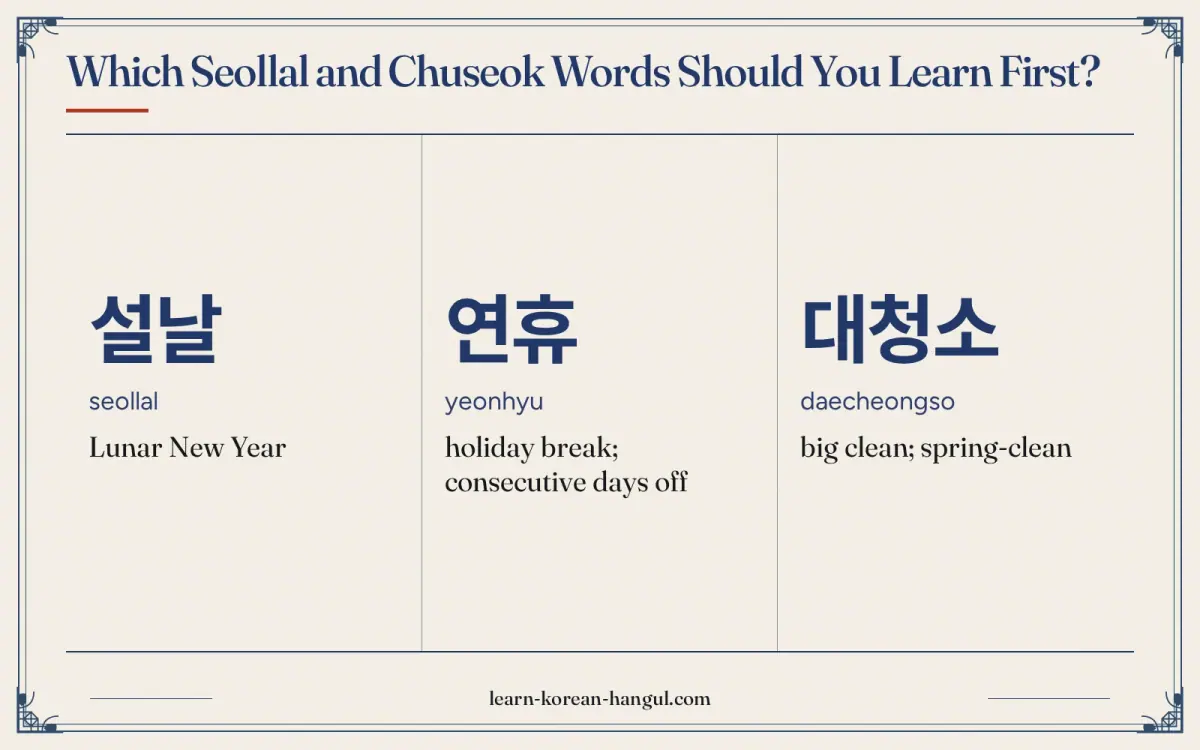
Learn the two holiday names, the foods and the greeting first. They are the words you hear in shops, on television and from friends in the days before a holiday. The ritual words matter if you are invited to a family home, and the travel words matter if you live in Korea.
- Before any holiday. 설날, 추석, 명절, 연휴 and the greeting 새해 복 많이 받으세요.
- If you are invited. 차례, 세배, 절, 세뱃돈, 선물 and 한복.
- If you eat together. 떡국, 송편, 전, 나물 and 식혜.
- If you travel. 귀성, 귀성길, 고향, 귀경 and 고속도로.
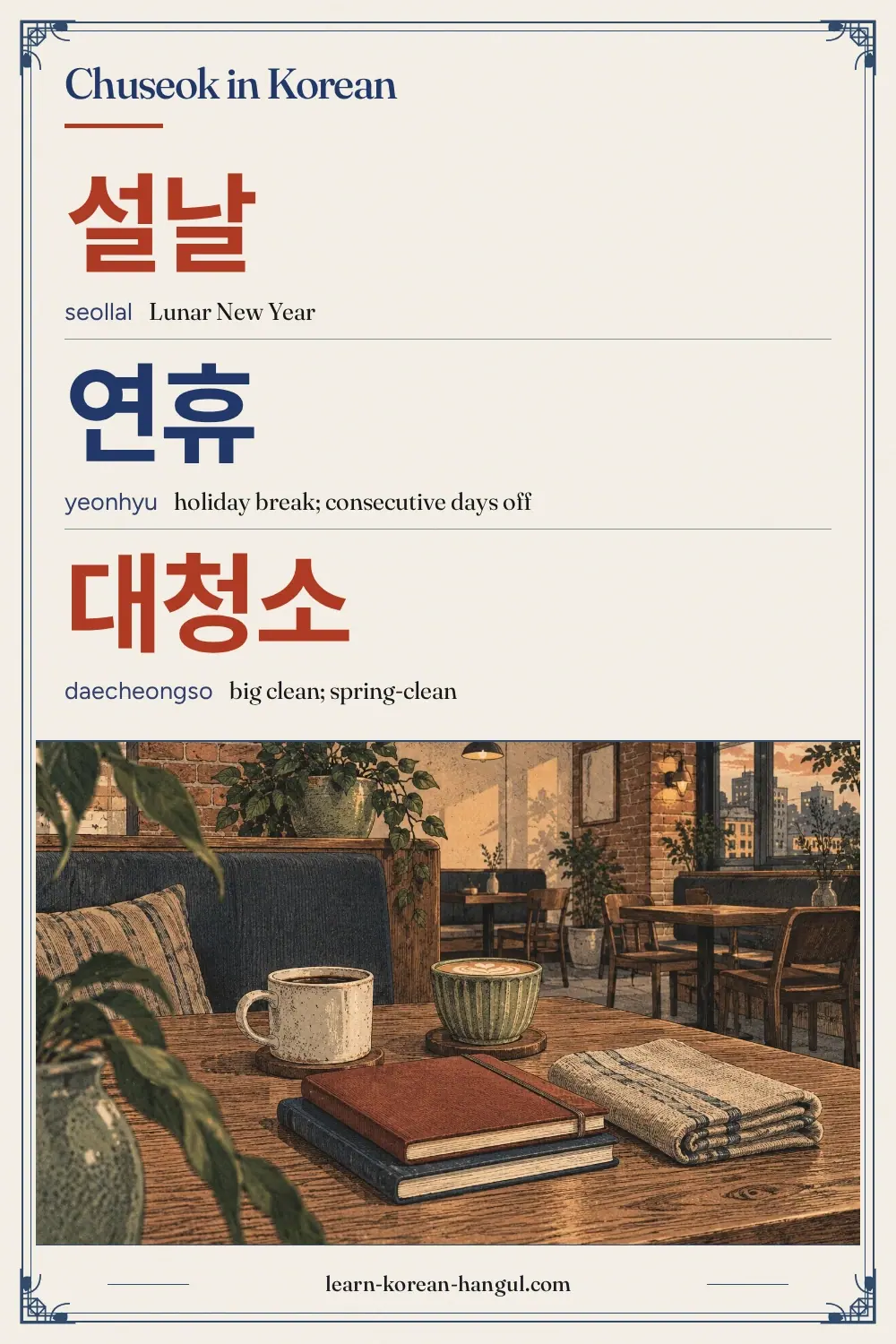
At 8 to 10 words a day, the list takes four days plus review. Here is a scene that puts eight of the words on one picture.
Word · 8
- 1
설날
seollal
Lunar New Year
- 2
연휴
yeonhyu
holiday break; consecutive days off
- 3
대청소
daecheongso
big clean; spring-clean
- 4
차례
charye
ancestral rite held on the morning of the holiday
- 5
조상
josang
ancestors
- 6
전
jeon
pan-fried battered food
- 7
새해 복 많이 받으세요
saehae bok mani badeuseyo
Happy New Year (lit. receive many blessings)
- 8
선물 세트
seonmul seteu
gift set
The list is mostly Sino-Korean, which is typical for ritual vocabulary. The foods are mainly native Korean words. The first group names the holidays.
The Two Holidays
설날 and 추석 are the holiday names, and 명절 is the general word for a traditional holiday. 음력 (the lunar calendar) explains the moving dates, and 연휴 names the long break. For example, 추석 연휴 means the Chuseok holiday break.
| No. | Hangul | Revised Romanization | Origin | Meaning | Example sentence | Audio assetId |
|---|---|---|---|---|---|---|
| 1 | 설날 | seollal | native | Lunar New Year | 설날에 떡국을 먹어요. (We eat tteokguk on Seollal.) | au-pg-vocabulary-culture-holidays-seollal-chuseok-1; example: au-pg-vocabulary-culture-holidays-seollal-chuseok-36 |
| 2 | 추석 | chuseok | Sino-Korean | Chuseok (Korean harvest festival) | 추석에 고향에 가요. (I go to my hometown at Chuseok.) | au-pg-vocabulary-culture-holidays-seollal-chuseok-2; example: au-pg-vocabulary-culture-holidays-seollal-chuseok-37 |
| 3 | 명절 | myeongjeol | Sino-Korean | traditional holiday | 명절에는 가족이 모여요. (Families gather on traditional holidays.) | au-pg-vocabulary-culture-holidays-seollal-chuseok-3; example: au-pg-vocabulary-culture-holidays-seollal-chuseok-38 |
| 4 | 음력 | eumnyeok | Sino-Korean | lunar calendar | 설날은 음력 1월 1일이에요. (Seollal is on the first day of the first lunar month.) | au-pg-vocabulary-culture-holidays-seollal-chuseok-4; example: au-pg-vocabulary-culture-holidays-seollal-chuseok-39 |
| 5 | 연휴 | yeonhyu | Sino-Korean | holiday break; consecutive days off | 추석 연휴에 여행을 가요. (I travel during the Chuseok holiday.) | au-pg-vocabulary-culture-holidays-seollal-chuseok-5; example: au-pg-vocabulary-culture-holidays-seollal-chuseok-40 |
| 6 | 한복 | hanbok | Sino-Korean | hanbok (traditional Korean clothes) | 설날에 한복을 입어요. (I wear hanbok on Seollal.) | au-pg-vocabulary-culture-holidays-seollal-chuseok-6; example: au-pg-vocabulary-culture-holidays-seollal-chuseok-41 |
Seollal is a native Korean word, built from 설 (the first of the year) and 날 (day). Chuseok is Sino-Korean, written with the characters for autumn and evening. An older native name for Chuseok is 한가위, which you may see on greeting cards and in shops.
Example Sentences
Each example is a short polite sentence. Note the particle 에, which marks a time: 설날에 (on Seollal) and 추석에 (at Chuseok). Say each sentence aloud and swap the holiday. Replace 설날에 with 추석에 in 설날에 한복을 입어요 and you get 추석에 한복을 입어요, which is also natural.
The next group covers the work that starts a few days before the holiday.
How Do Koreans Prepare for the Holiday?
Koreans prepare by shopping, cooking and cleaning, and the words for these tasks are 장보기, 음식 준비 and 대청소. The 차례상 is the table on which the food for the ancestral rite is set out, and 가족 and 친척 are the people who gather at it.
| No. | Hangul | Revised Romanization | Origin | Meaning | Example sentence | Audio assetId |
|---|---|---|---|---|---|---|
| 7 | 장보기 | jangbogi | mixed | grocery shopping | 오늘 장보기를 해요. (I do the grocery shopping today.) | au-pg-vocabulary-culture-holidays-seollal-chuseok-7; example: au-pg-vocabulary-culture-holidays-seollal-chuseok-42 |
| 8 | 음식 준비 | eumsik junbi | Sino-Korean | food preparation | 어머니가 음식 준비를 해요. (Mother prepares the food.) | au-pg-vocabulary-culture-holidays-seollal-chuseok-8; example: au-pg-vocabulary-culture-holidays-seollal-chuseok-43 |
| 9 | 대청소 | daecheongso | Sino-Korean | big clean; spring-clean | 설날 전에 대청소를 해요. (We do a big clean before Seollal.) | au-pg-vocabulary-culture-holidays-seollal-chuseok-9; example: au-pg-vocabulary-culture-holidays-seollal-chuseok-44 |
| 10 | 차례상 | charyesang | Sino-Korean | ritual table for the ancestral rite | 차례상에 과일을 놓아요. (We put fruit on the ritual table.) | au-pg-vocabulary-culture-holidays-seollal-chuseok-10; example: au-pg-vocabulary-culture-holidays-seollal-chuseok-45 |
| 11 | 가족 | gajok | Sino-Korean | family | 가족이 모두 모였어요. (The whole family gathered.) | au-pg-vocabulary-culture-holidays-seollal-chuseok-11; example: au-pg-vocabulary-culture-holidays-seollal-chuseok-46 |
| 12 | 친척 | chincheok | Sino-Korean | relatives | 친척들이 와요. (The relatives are coming.) | au-pg-vocabulary-culture-holidays-seollal-chuseok-12; example: au-pg-vocabulary-culture-holidays-seollal-chuseok-47 |
Two words need a note. 음식 준비 is a noun phrase, not a single word, and it is on the list because it is the usual way to say food preparation. 장보기 is formed from the noun 장 (market) and the verb 보다 (to look), and it is the standard name for a grocery run.
The rite itself comes next.
How Do You Say Rituals (차례, 세배, 성묘) in Korean?
The three core rituals are 차례, the ancestral rite held on the morning of the holiday, 세배, the bow to elders on Seollal, and 성묘, the visit to the family graves. 제사 is a related rite held on the anniversary of an ancestor's death.
| No. | Hangul | Revised Romanization | Origin | Meaning | Example sentence | Audio assetId |
|---|---|---|---|---|---|---|
| 13 | 차례 | charye | Sino-Korean | ancestral rite held on the morning of the holiday | 우리는 아침에 차례를 지내요. (We hold the ancestral rite in the morning.) | au-pg-vocabulary-culture-holidays-seollal-chuseok-13; example: au-pg-vocabulary-culture-holidays-seollal-chuseok-48 |
| 14 | 세배 | sebae | Sino-Korean | New Year bow to elders | 할머니께 세배를 해요. (I make the New Year bow to my grandmother.) | au-pg-vocabulary-culture-holidays-seollal-chuseok-14; example: au-pg-vocabulary-culture-holidays-seollal-chuseok-49 |
| 15 | 성묘 | seongmyo | Sino-Korean | visiting ancestors' graves | 추석에 성묘를 가요. (We visit the family graves at Chuseok.) | au-pg-vocabulary-culture-holidays-seollal-chuseok-15; example: au-pg-vocabulary-culture-holidays-seollal-chuseok-50 |
| 16 | 제사 | jesa | Sino-Korean | memorial rite on an ancestor's death anniversary | 우리 집은 제사를 지내요. (My family holds the memorial rite.) | au-pg-vocabulary-culture-holidays-seollal-chuseok-16; example: au-pg-vocabulary-culture-holidays-seollal-chuseok-51 |
| 17 | 조상 | josang | Sino-Korean | ancestors | 조상께 인사해요. (We greet our ancestors.) | au-pg-vocabulary-culture-holidays-seollal-chuseok-17; example: au-pg-vocabulary-culture-holidays-seollal-chuseok-52 |
| 18 | 절 | jeol | native | bow (also: temple) | 어른께 절을 해요. (I bow to the elder.) | au-pg-vocabulary-culture-holidays-seollal-chuseok-18; example: au-pg-vocabulary-culture-holidays-seollal-chuseok-53 |
Do not mix up 차례 and 제사. 차례 is for the two big holidays, in the morning, and 제사 is for a death anniversary, usually at night. Both honour 조상 (ancestors). The word 절 also means temple, and context decides which sense is meant: 절을 해요 is to bow, and 절에 가요 is to go to a temple.
These customs vary by family and region, and some families skip them. After the rites, the family eats.
What Food Words Do You Need for the Holidays?
The Seollal food is 떡국, a soup of sliced rice cakes, and the Chuseok food is 송편, a half-moon rice cake steamed over pine needles. Both holidays also have 전 (pan-fried battered food), 나물 (seasoned vegetables) and 식혜 (a sweet rice drink).
| No. | Hangul | Revised Romanization | Origin | Meaning | Example sentence | Audio assetId |
|---|---|---|---|---|---|---|
| 19 | 떡국 | tteokguk | native | rice-cake soup, eaten on Seollal | 떡국을 먹으면 한 살 더 먹어요. (If you eat tteokguk, you get one year older.) | au-pg-vocabulary-culture-holidays-seollal-chuseok-19; example: au-pg-vocabulary-culture-holidays-seollal-chuseok-54 |
| 20 | 송편 | songpyeon | mixed | half-moon rice cake eaten at Chuseok | 송편은 반달 모양이에요. (Songpyeon is half-moon shaped.) | au-pg-vocabulary-culture-holidays-seollal-chuseok-20; example: au-pg-vocabulary-culture-holidays-seollal-chuseok-55 |
| 21 | 전 | jeon | Sino-Korean | pan-fried battered food | 전을 부쳐요. (I pan-fry jeon.) | au-pg-vocabulary-culture-holidays-seollal-chuseok-21; example: au-pg-vocabulary-culture-holidays-seollal-chuseok-56 |
| 22 | 떡 | tteok | native | rice cake | 떡이 맛있어요. (The rice cake is delicious.) | au-pg-vocabulary-culture-holidays-seollal-chuseok-22; example: au-pg-vocabulary-culture-holidays-seollal-chuseok-57 |
| 23 | 나물 | namul | native | seasoned vegetable side dish | 나물을 무쳐요. (I season the vegetables.) | au-pg-vocabulary-culture-holidays-seollal-chuseok-23; example: au-pg-vocabulary-culture-holidays-seollal-chuseok-58 |
| 24 | 식혜 | sikhye | Sino-Korean | sweet rice drink | 식혜는 달아요. (Sikhye is sweet.) | au-pg-vocabulary-culture-holidays-seollal-chuseok-24; example: au-pg-vocabulary-culture-holidays-seollal-chuseok-59 |
There is a saying that eating 떡국 makes you a year older, as in the example sentence. It comes from the traditional way of counting age, in which everyone gains a year at the New Year. The word 떡 on its own means rice cake, and it is the root of 떡국 and 떡볶이. You can look up the single word on the songpyeon in Korean page.
How Do You Say Greetings and Gifts in Korean?
The Seollal greeting is 새해 복 많이 받으세요, which literally asks someone to receive many blessings in the new year. The Chuseok greeting is 추석 잘 보내세요, which means have a good Chuseok. Both are polite and suit teachers, bosses and elders.
| No. | Hangul | Revised Romanization | Origin | Meaning | Example sentence | Audio assetId |
|---|---|---|---|---|---|---|
| 25 | 새해 복 많이 받으세요 | saehae bok mani badeuseyo | phrase | Happy New Year (lit. receive many blessings) | 선생님, 새해 복 많이 받으세요. (Teacher, happy New Year.) | au-pg-vocabulary-culture-holidays-seollal-chuseok-25; example: au-pg-vocabulary-culture-holidays-seollal-chuseok-60 |
| 26 | 세뱃돈 | sebaetdon | mixed | New Year money given after the bow | 세뱃돈을 받았어요. (I received New Year money.) | au-pg-vocabulary-culture-holidays-seollal-chuseok-26; example: au-pg-vocabulary-culture-holidays-seollal-chuseok-61 |
| 27 | 덕담 | deokdam | Sino-Korean | words of blessing | 어른들이 덕담을 해 주셨어요. (The elders gave us words of blessing.) | au-pg-vocabulary-culture-holidays-seollal-chuseok-27; example: au-pg-vocabulary-culture-holidays-seollal-chuseok-62 |
| 28 | 선물 | seonmul | Sino-Korean | gift | 부모님께 선물을 드려요. (I give a gift to my parents.) | au-pg-vocabulary-culture-holidays-seollal-chuseok-28; example: au-pg-vocabulary-culture-holidays-seollal-chuseok-63 |
| 29 | 선물 세트 | seonmul seteu | mixed | gift set | 추석에 선물 세트를 사요. (I buy a gift set at Chuseok.) | au-pg-vocabulary-culture-holidays-seollal-chuseok-29; example: au-pg-vocabulary-culture-holidays-seollal-chuseok-64 |
| 30 | 한과 | hangwa | Sino-Korean | traditional confection | 한과는 전통 과자예요. (Hangwa is a traditional confection.) | au-pg-vocabulary-culture-holidays-seollal-chuseok-30; example: au-pg-vocabulary-culture-holidays-seollal-chuseok-65 |
After a 세배, elders give 세뱃돈 and 덕담. Children keep the money, and adults who visit bring a 선물 or a 선물 세트, a boxed set of fruit, ginseng, oil or similar goods. The celebration phrases page has more greetings for other occasions.
Gift culture around the holidays can create real pressure on hosts and guests, and Koreans sometimes call the stress 명절 증후군. This page only teaches the words and does not advise on etiquette. The last group is the trip itself.
What Do the Travel Home Words Mean?
귀성 is the trip to your hometown for a holiday, and 귀성길 is the road you take. 귀경 is the return trip to Seoul. 고속도로 (expressway) is the word you hear in traffic reports, because millions of people travel on the same days.
| No. | Hangul | Revised Romanization | Origin | Meaning | Example sentence | Audio assetId |
|---|---|---|---|---|---|---|
| 31 | 귀성 | gwiseong | Sino-Korean | travelling to one's hometown for a holiday | 귀성은 고향에 가는 것이에요. (Gwiseong means going to your hometown.) | au-pg-vocabulary-culture-holidays-seollal-chuseok-31; example: au-pg-vocabulary-culture-holidays-seollal-chuseok-66 |
| 32 | 귀성길 | gwiseonggil | mixed | road trip home for the holiday | 귀성길에 차가 막혀요. (The roads are jammed on the way home.) | au-pg-vocabulary-culture-holidays-seollal-chuseok-32; example: au-pg-vocabulary-culture-holidays-seollal-chuseok-67 |
| 33 | 고향 | gohyang | Sino-Korean | hometown | 고향이 어디예요? (Where is your hometown?) | au-pg-vocabulary-culture-holidays-seollal-chuseok-33; example: au-pg-vocabulary-culture-holidays-seollal-chuseok-68 |
| 34 | 귀경 | gwigyeong | Sino-Korean | returning to Seoul after a holiday | 일요일에 귀경해요. (I return to Seoul on Sunday.) | au-pg-vocabulary-culture-holidays-seollal-chuseok-34; example: au-pg-vocabulary-culture-holidays-seollal-chuseok-69 |
| 35 | 고속도로 | gosokdoro | Sino-Korean | expressway | 고속도로가 복잡해요. (The expressway is crowded.) | au-pg-vocabulary-culture-holidays-seollal-chuseok-35; example: au-pg-vocabulary-culture-holidays-seollal-chuseok-70 |
Traffic news in these weeks uses 귀성 and 귀경 constantly. A report may say 귀성길 정체 (traffic jam on the way home). The word 고향 also means the place your family comes from, even if you live elsewhere.
How Do You Pronounce These Words?
Most of these words follow the spelling, but several undergo sound changes between consonants. The table shows the six that learners most often get wrong.
| Spelling | Pronunciation | What happens |
|---|---|---|
| 설날 | [설랄] | ㄴ after ㄹ becomes ㄹ, so the two syllables share the sound ㄹㄹ |
| 음력 | [음녁] | ㄹ after ㅁ becomes ㄴ |
| 떡국 | [떡꾹] | ㄱ after a final ㄱ becomes a tense sound |
| 식혜 | [시켸/시케] | Final ㄱ and ㅎ merge into the aspirated ㅋ, and ㅖ after a consonant may be said [ㅔ] |
| 덕담 | [덕땀] | ㄷ after a final ㄱ becomes tense |
| 고속도로 | [고속또로] | ㄷ after a final ㄱ becomes tense |
The rules come from the Standard Pronunciation rules (표준 발음법) of the 국립국어원. The audio is generated with text-to-speech and checked by a Korean teacher before publication.
Audio and Slow Playback
Each word has a normal clip, and 5 key words also have a slow clip at 0.8 times the speed: 설날, 추석, 성묘, 떡국 and 귀성길. Nothing plays until you press a button.
Listen to 설날 first. You should hear a long, clear ㄹ in the middle, as if the word were spelled 설랄.
What Mistakes Do Learners Make with Seollal and Chuseok Words?
- Treating Seollal and Chuseok as dates on a fixed day. Both move on the Western calendar because they follow the lunar calendar. Check a current calendar each year.
- Using 새해 복 많이 받으세요 at Chuseok. It is a New Year greeting; at Chuseok say 추석 잘 보내세요 or 즐거운 한가위 보내세요.
- Reading 설날 as seol-nal. The spoken form is [설랄], and the same happens in 신라 [실라].
- Confusing 차례 and 제사. One is held on the holiday morning and the other on a death anniversary.
- Dropping the time particle 에. Say 추석에 고향에 가요 (I go to my hometown at Chuseok), not 추석 고향에 가요.
Of these, the sound change in 설날 is the one that sounds odd to a Korean ear if you miss it. The next section turns the list into practice.
Practice: Flashcards and Worksheet
Drill these words with the vocabulary flashcard decks. A printable worksheet for these words (word list, matching, writing practice, fill-in-the-blank exercises and answer key) is available in A4 and US Letter from the download card on this page. Progress in the decks is saved only in your browser.
Seollal and Chuseok Worksheet
Try this five-question check, then say the 35 words aloud once more.
Practice · 5
What does 설날 mean?
Show answer
Lunar New Year
설날 (seollal) means Lunar New Year.
What does 대청소 mean?
Show answer
big clean; spring-clean
대청소 (daecheongso) means big clean; spring-clean.
What does 조상 mean?
Show answer
ancestors
조상 (josang) means ancestors.
What does 떡 mean?
Show answer
rice cake
떡 (tteok) means rice cake.
What does 한과 mean?
Show answer
traditional confection
한과 (hangwa) means traditional confection.
Where to Go Next
This list sits inside Holidays and Celebrations. After you finish the Chuseok in Korean words, go back to that page for birthdays and public holidays, or open the celebration phrases to practise greetings in sentences. The Korean culture section also has lists for K-pop and K-drama if you want to move to a lighter topic.
Frequently Asked Questions
How Do You Say Lunar New Year in Korean?
Lunar New Year is 설날 (seollal). It falls on the first day of the first lunar month, and the holiday lasts three days. Pronounce it [설랄], with a long ㄹ sound in the middle. The greeting for the day is 새해 복 많이 받으세요, which wishes the listener many blessings.
How Do You Pronounce 추석 (chuseok)?
추석 is said chu-seok. The first syllable 추 starts with an aspirated ㅊ, a ch with a puff of air. The second syllable 석 ends in ㄱ, which is unreleased, so the word stops with the tongue back and no extra sound. Press the audio button and repeat it.
How Many Seollal and Chuseok Words Should I Learn First?
Learn about 15 first: the holiday names, the foods, the two greetings and the words 차례, 세배 and 성묘. That is two days at 8 to 10 words a day. Add the preparing and travel words when you plan to be in Korea during a holiday.
Where Can I Practise Seollal and Chuseok Words with Flashcards?
Use the vocabulary flashcard decks, which list every deck with audio. The holiday words from this page are planned as their own deck. Progress stays in your browser. The Holidays and Celebrations page has the wider holiday list that overlaps with this one.
Is the Romanization on This Page Official?
It follows the Revised Romanization of Korean, which South Korea officially adopted on 7 July 2000 and whose rules the National Institute of Korean Language (국립국어원) publishes. It is a learning aid that does not mark every sound change, so learn the Hangul and use the audio to hear the real sound.
Is There a Printable Worksheet for Seollal and Chuseok Words?
A printable worksheet for these words (word list, matching, writing practice, fill-in-the-blank exercises and answer key) is available in A4 and US Letter from the download card on this page. For practice, copy the tables above by hand: write the Hangul, cover the English column, and check your answers against the page.