How to Use the Korean Lunar Calendar Converter

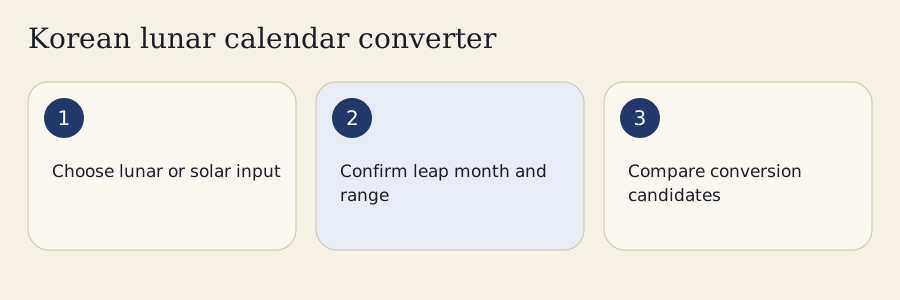
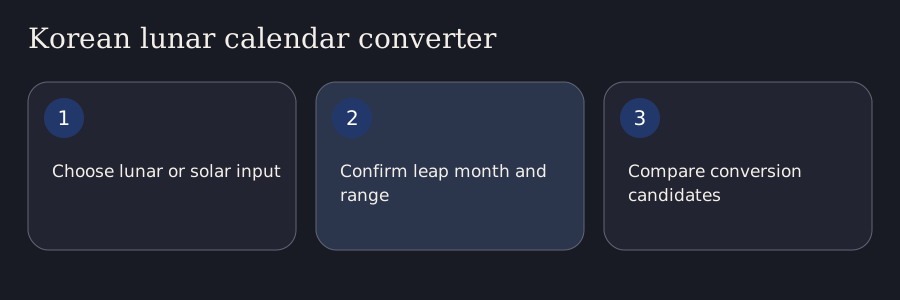
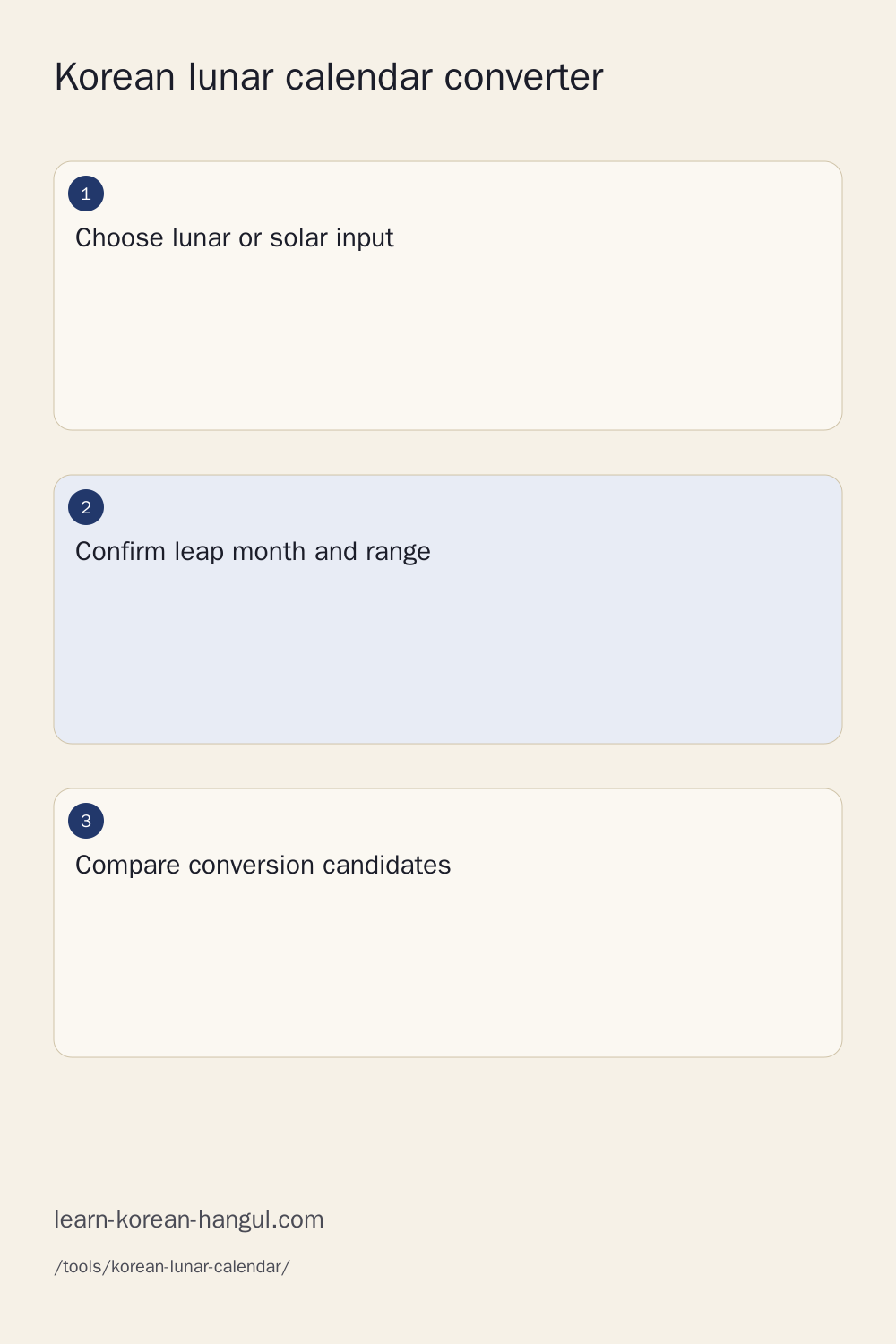
Choose Solar → Lunar when the original record gives a Gregorian date. Choose Lunar → Solar when the record gives a Korean lunar year, month and day. Enter the three numbers in the labelled fields rather than treating an unlabelled slash-separated date as a universal format. A date such as 03/04 can mean different things in different locales; explicit year, month and day fields avoid that ambiguity.
Press Convert, then inspect the calendar label and month state beside the result. The primary date is Gregorian, with a weekday. The Korean lunar tuple retains its lunar year, month, day and ordinary or leap status. Next detail shows month length, absolute day and calendar naming. The final detail shows the source and supported modern range.
Step 1: Identify the Calendar on the Record
Look for a written calendar label or ask whoever created the record. A familiar month and day does not prove that the date is solar. Age, season and a relative's recollection can suggest a question to ask, but they cannot establish the missing calendar. Use Family uncertainty to compare interpretations before choosing one.
Step 2: Choose Ordinary, Leap or Unknown
For a lunar input, select Ordinary if the record refers to the regular month, Leap month if it explicitly refers to the repeated intercalary month, or Unknown if that information is missing. Unknown produces every valid interpretation in the selected table. It does not pick whichever date seems more convenient. Two candidates are a signal to verify the record, not an error to hide.
After conversion, Copy includes source details. Share defaults to a clean tool link. Export offers a preview before creating a local file. Start with one known date, confirm it against your record, and only then plan recurring birthdays.
What Do 음력, 양력 and 윤달 Mean?

음력 identifies the lunar calendar in the everyday Korean date context. 양력 identifies the solar calendar, usually the Gregorian calendar for contemporary civil dates. The traditional calendar is more precisely lunisolar: lunar months are coordinated with the solar year through intercalation. Calling it lunar is a practical shorthand, not a claim that seasons are ignored.
윤달 is a leap or intercalary month. It is a repeated month inserted into a lunar year, rather than an extra day added to February. 평달 refers to an ordinary month. If month six repeats, ordinary month six and leap month six have separate starts and can have different lengths. The year, month and day numbers alone may therefore identify two dates.
| Korean term | English meaning | What to preserve |
|---|---|---|
| 양력 | Solar calendar | Civil calendar basis |
| 음력 | Lunar calendar | Lunar year, month and day |
| 평달 | Ordinary month | Ordinary month flag |
| 윤달 | Leap or intercalary month | Repeated month flag |
| 생일 | Birthday | Original date and event policy |
Use the dates guide to practise reading a converted date in Korean. Use 생일 and birthday expressions for the vocabulary around the event. Calendar conversion and language practice are related tasks, but neither replaces the other.
How Does the Two-Way Conversion Work?
A reliable table-based converter identifies the absolute start of each lunar month, its length and whether it is ordinary or leap. Solar to lunar conversion finds the month whose absolute-day interval contains the selected civil date. The lunar day is the distance from that month start plus one. Lunar to solar conversion locates the exact month key and adds the lunar day minus one to its start.
There is no single fixed offset between a lunar birthday and its solar date. The interval changes as months of 29 and 30 days and repeated months accumulate. Subtracting eleven days from last year's celebration can therefore fail. A converter must look up the target year and the actual month configuration.
Which Month Lengths and Leap Flags Must You Preserve?
Every supported month has 29 or 30 days. An exact conversion rejects day 30 in a 29-day month. It also rejects a leap-month request when the named month does not repeat in that year. That strictness protects the meaning of the original record. A celebration policy may choose a replacement, but it runs separately after exact conversion fails.
Absolute Days and Round-Trip Checks
A round trip converts the input to the other calendar and back. The returned lunar tuple must preserve ordinary or leap status, not just the three numbers. The receipt includes the source identifier, version, hash and Julian day number so that a later correction can refer to a specific dataset.
This build uses the pinned korean-lunar-calendar 0.4.0 library for modern table calculations. Its code carries an MIT licence. Selected KASI source anchors have been compared; that does not certify every bundled date or establish a completed independent review of the underlying table. Source details remain part of the result.
Why Can the Korean and Chinese Dates Differ?
Korean and Chinese lunisolar calendars share many concepts, but their regional calculation conventions can produce different civil-day boundaries. They are not interchangeable datasets. A generic Chinese-calendar result should not be relabelled Korean simply because many familiar dates agree.
October 10, 2026 is a useful example. The Korean reference month starts put lunar month nine, day one on October 11. October 10 therefore remains Korean lunar month eight, day thirty. A Chinese model can show month nine, day one on October 10. The result changes by a day near this boundary, while both models still follow lunisolar principles.
The KASI 2026 calendar table lists the relevant Korean month starts. Its page explicitly describes preliminary material, so important records deserve a check against final official data or the institute's converter. The tool's Korean/Chinese comparison labels runtime models as such; it does not use the Chinese result to assign a Korean birthday or holiday.
If two converters disagree, record the exact date, regional calendar and source versions. Do not resolve the disagreement by assuming the most familiar interface is authoritative. The next examples show how month-start evidence makes the conversion understandable.
Worked Examples: Dates and Family Records

Seollal 2026: Lunar 1/1 to February 17
Enter lunar year 2026, month one, day one, Ordinary. The result is February 17, 2026, a Tuesday. The lunar month has thirty days. Converting February 17 back to lunar gives the same year, month and day with the ordinary flag intact.
This example identifies the cultural lunar-new-year date. The surrounding public-holiday period and substitute-day rules are separate legal questions. A converter's correct lunar date does not independently establish which businesses close or which employees receive a day off. Learn the Seollal and Chuseok vocabulary for cultural context.
Month 6 of 2025: Ordinary and Leap Alternatives
Enter lunar 2025, month six, day one, Unknown. Ordinary month six begins on June 25, 2025. Leap month six begins on July 25, 2025. The ordinary month contains thirty days; the leap month contains twenty-nine.
The two month starts are distinct, not two spellings for one birthday. Leap month six, day twenty-nine maps to August 22. Leap month six, day thirty is invalid. If a family note says only month six and omits the repeated-month flag, both first-day dates can remain possible until someone confirms the record.
The 30th Day of a Short Lunar Month
Lunar month two of 2026 has twenty-nine days. Entering day thirty in exact conversion produces an error. Under an explicitly selected last-day celebration policy, the occurrence becomes lunar two/twenty-nine, April 16, 2026. Under next-month-day-one policy, it becomes lunar three/one, April 17.
Skip policy leaves a missing-year row. The original month two/day thirty remains attached to every outcome. This separation lets someone see which date was recorded and which date was chosen for a celebration, without silently rewriting the family record.
A Late Lunar Birthday in the Next Solar Year
Lunar 2026, month twelve, day twenty maps to January 27, 2027. Its lunar year is still 2026. A list requested for lunar years 2026 through 2036 can include solar dates in the following January or February. A list requested for solar year 2026 filters by the returned Gregorian year instead.
That difference explains why a December lunar birthday can appear to be missing from a civil-year list unless adjacent lunar years are considered. The header states which interval you selected. Read the returned solar year before copying an event into another calendar.
How Do You Plan a Lunar Birthday Every Year?

First establish the original lunar month, day and leap status. If you only know the original solar birthday, convert that actual birth date to its lunar counterpart. Do not convert this year's solar birthday and assume that the result reconstructs the original record; it is a different date in a different year.
Open Birthdays / memorials, choose a start and end year, and choose the interval basis. The standard eleven-year interval is a convenient planning window, but you can adjust it within the supported source range. Select both missing-month and missing-day rules before Generate annual dates. There is no automatic substitution policy.
The list keeps exact dates, substituted dates and missing rows. Two rows per page keep the phone view readable, while export preserves the complete list. A specific occurrence is a date-only event. Countdown calculations should compare civil dates in the intended reference timezone, rather than rounded hours remaining.
Does the Interval Use Solar or Lunar Years?
A lunar-year interval asks for occurrences in each target lunar year. A solar-year interval asks for occurrences whose returned Gregorian dates fall within the requested civil years. The latter can need adjacent lunar years because the lunar year crosses Gregorian New Year.
Choose solar years when preparing a January-to-December household calendar. Choose lunar years when comparing the traditional year's month structure. Keep that choice with your export so that a family member understands why a late-month occurrence appears in the next civil year.
Missing Months and Days: Choose a Family Rule

A repeated leap month does not occur every year. If the original event belongs to a leap month, a family can skip years without it or celebrate in the same-number ordinary month. Some families consider both occurrences when the month repeats. Those are event conventions, not corrections to the exact lunar calendar.
Likewise, a thirtieth-day birthday may fall in a twenty-nine-day target month. Skip, last-day and next-month-day-one policies produce different results. The calculator requires a deliberate choice and marks substitutions. It never describes one family's rule as the universal Korean custom.
| Missing condition | Explicit policy | Result treatment |
|---|---|---|
| Leap month absent | Skip | Missing-year row |
| Leap month absent | Same-number ordinary | Labelled ordinary-month substitution |
| Repeated month present | Both | Separate ordinary and leap dates |
| Day 30 absent | Last day | Day 29 substitution |
| Day 30 absent | Next month day 1 | Next-month substitution |
Ask the person organising the observance which rule they intend to follow. Memorials may have their own family or religious convention. Save the choice with the event only if you want the browser to remember it. An unsaved calculation stays in memory, while the original date remains available in the receipt.
Save Dates, Notes and Private Reminders

Conversion needs no account, name or birth time. Optional saved events can include a name or note and a family group. Saving stores a versioned record in this browser. You can search names and groups, update the optional labels, star an event, remove a record or delete the entire saved list.
Export saved-event JSON before moving to another device. Import is an explicit transfer, not automatic synchronisation. Browser storage can be cleared, private browsing may not retain it, and a storage failure leaves the current session usable. Keep exported birthday information in a place appropriate for personal records.
Calendar Export without a False Yearly Repeat
ICS exports contain explicit dated occurrences, each with a stable identifier and its source and policy explanation. The converter does not create a Gregorian annual repeat rule for a lunar birthday. Such a rule would repeat the same Gregorian month and day rather than calculate each year's lunar occurrence.
CSV and JSON retain missing-year rows. ICS can only create events for real dated occurrences, so the export preview identifies years without an event. Check the preview before importing a file into your calendar app. Repeated imports and edits may be handled differently by different apps; stable identifiers support reconciliation but cannot guarantee every application's behaviour.
Saved Information and Notification Delivery
An optional ICS alarm requests a reminder one day before the event. Your calendar app decides how to honour the alarm and whether notifications are enabled. This tool does not claim that a browser tab can reliably wake up and notify you after the browser closes.
Persistent Web Push requires a separately configured subscription service, platform support and explicit permission. That service is not connected in the current workspace. Use calendar-app alarms as the available exported option. Disabling future export alarms does not remove an event already imported elsewhere; remove or edit that event in its calendar app.
Which Range and Historical Calendar Should You Choose?
The modern product range is solar January 31, 1900 through December 31, 2050. The corresponding lunar range begins at 1900/1/1 and ends at 2050/11/18. The last lunar year is partial because the supported solar table stops before its lunar year ends. Solar and lunar endpoint labels must not be confused.
The upstream software can return earlier dates, but those observations do not establish an approved historical calendar. Historical records require a source pack with an explicit chronology, civil basis and year-numbering convention. The modern adapter therefore does not silently extend its historical guarantee simply because the library accepts an older number.
Official Reference Data and Modelled Future Dates
Historical source packs and the modelled 2051–2100 extension require separate acquisition and verification. A predicted calendar is not an officially announced future almanac. A runtime formatting result is also not a pinned independent model pack. Missing packs return an unavailable state rather than guessed lunar dates.
The JDN reference view is available for civil-date arithmetic. Gregorian and Julian civil calendars have different leap-year rules and assign different labels to some absolute days. JDN identifies the shared absolute day; it is not a third calendar of month names.
The 1582 reference hybrid goes from Julian October 4 to Gregorian October 15 on the next absolute day. It omits the intervening civil labels under that particular reference convention. This does not assert that Korea changed its civil calendar on that date. Astronomical year zero means 1 BCE; keep that numbering explicit when interpreting negative years. A historical lunar conclusion still needs the appropriate source pack.
Read Holidays and the 24 Solar Terms
A lunar festival, a public holiday and a substitute day are different kinds of label. Seollal and Chuseok have cultural lunar dates; surrounding statutory days and substitutions depend on an effective-dated Korean holiday rule. A preliminary almanac may contain useful lunar month starts while still being unsuitable as a current legal holiday oracle.
The calendar workspace shows the source status rather than inventing a legal closure. Use a current public-holiday reference when planning work schedules or travel. The date of a festival alone cannot establish whether a particular museum, employer or transport service operates normally.
Solar terms are astronomical seasonal markers. Their exact epochs require source data and an explicit timezone. They are not obtained by dividing the civil year into twenty-four equal date intervals. Ipchun, for example, can have a specific time within its civil date, which matters in some alternate boundary traditions.
Exact term and effective-dated holiday overlays are separate shared source packs. When those packs are unavailable, the converter preserves valid lunar arithmetic and states the limitation. It does not fill the gap with undocumented approximate holiday or solar-term dates.
When Should You Verify a Result with KASI?
Verify important family records, disputed leap status, historical dates, unsupported ranges and source disagreements. The KASI solar/lunar converter provides a primary reference for comparison. Select the intended conversion direction and preserve the ordinary or leap choice when comparing results.
If the source record itself is uncertain, an accurate converter cannot supply the missing intent. Ask whether the notation is solar or lunar and whether the month repeats. Family uncertainty can display alternatives, but choosing an alternative is still a human record decision.
For a correction, include the source identifier and version if useful. You do not need to disclose a private birth date to report a general interface problem. A reproducible receipt helps distinguish a table issue, a parsing issue and a disagreement about an event policy. It does not turn an unreviewed source into an official identity determination.
Reference Table and Source Updates
The following month starts are selected facts from the KASI 2026 preliminary table, checked on October 10, 2026. They are useful explanatory anchors, not a claim that every date in the software has received independent specialist approval.
| Lunar month start | Gregorian date | Month length |
|---|---|---|
| 2026/1/1 ordinary | February 17, 2026 | 30 days |
| 2026/2/1 ordinary | March 19, 2026 | 29 days |
| 2026/8/1 ordinary | September 11, 2026 | 30 days |
| 2026/9/1 ordinary | October 11, 2026 | 29 days |
| 2026/12/1 ordinary | January 8, 2027 | 30 days |
Dataset updates should receive a new version and preserve old receipts. An exported event can reflect an older source or family policy, so changing an underlying pack should not silently rewrite a saved personal event. Compare the original tuple and chosen rule before regenerating a list. For a civil birthday and the three age systems, continue to the Korean age calculator.
Frequently Asked Questions
Can This Change the Birthday on My Passport?
No. A calendar conversion interprets a date under a named calendar and source. It does not amend an official identity record or establish which birthday an authority registered. If a family record conflicts with a passport, ask the relevant authority which documents and procedures apply before making any change.
Will a Saved Date Survive a New Phone?
Local saved events belong to the browser where you saved them. They are not automatically synchronised to a new phone or another browser. Export the versioned saved-event JSON, keep a private copy, and import it on the new device. Clearing browser storage can remove the original local list.
Can Two Family Members Use Different Celebration Rules?
Yes. A family may choose different rules for a missing leap month or a missing thirtieth day. Save the rule with each event instead of assuming one universal custom. The annual list identifies substitutions and missing years, helping each person recognise how their chosen celebration date was determined.
What Happens When an Exported Year Has No Valid Date?
The annual list keeps a missing-year row instead of silently selecting another date. CSV and JSON retain that record; ICS contains only actual dated occurrences and the export preview reports missing years. Choose a different explicit family policy if you want a substituted celebration, then regenerate the list.
How Can I Check a Converted Date?
Compare the original calendar, year, month, day and leap-month choice with the converted result. Keep the source and supported range with your record. For important family dates, check the institute’s converter and confirm the celebration policy before saving or sharing the date.
Keep the Source and Family Rule with the Date
Keep the original lunar month, day and leap status together with the chosen family rule. The Korean lunar calendar converter provides a dated result and source, while important historical or family records deserve an independent KASI check. Export specific annual occurrences, then use the dates lesson to read them in Korean.
Practise happy birthday phrases after choosing the celebration date. Find other Korean learning tools for the next task, or practise reading your chosen date with the date vocabulary already introduced here. A clear record of calendar, source and policy makes the date useful beyond a single screenshot.