Korean K-Drama Vocabulary at a Glance
Korean K-drama vocabulary has two layers. The first layer is ordinary Korean, such as 오해 (misunderstanding) and 이별 (parting). The second is fan and industry shorthand, such as 남주 and 여주, which you will meet in reviews, social media and the titles of fan videos but not usually in a textbook. This page covers both, and each table marks which words are shorthand. If you search for kdrama terms in Korean or a kdrama words list, this is the place to start the roles and tropes.
Of the 35 words, 20 are Sino-Korean (built from Chinese-derived syllables), 4 are native Korean, 3 are loanwords and the rest are mixed words or phrases. The page is a child of K-Drama Words, which covers drama basics, fan words and settings. This page goes deeper on the story side.
| Group | Words | What it covers |
|---|---|---|
| Character roles | 7 | Leads, villains and stock figures |
| Romance tropes | 7 | First love, triangles, misunderstandings |
| Family and class | 7 | Wealth, birth secrets and in-laws |
| Workplace and school settings | 7 | Ranks and relationships in offices and schools |
| Plot twists | 7 | Identities, betrayals and impossible events |
A trope is a recurring device in storytelling. Dramas worldwide have tropes, and Korean dramas have a recognisable set. The next section says which to learn first.
Which K-Drama Trope Words Should You Learn First?
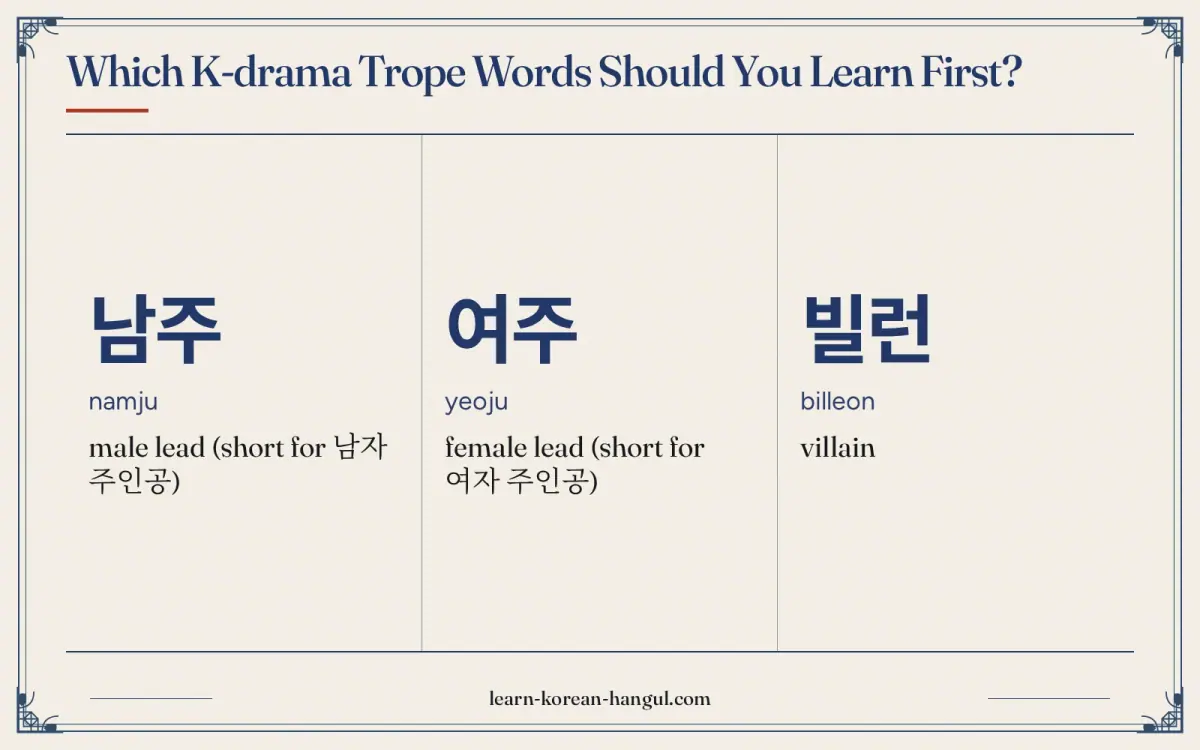
Learn 남주, 여주, 첫사랑, 삼각관계 and 재벌 first. They are the words a Korean friend will use to describe almost any drama in one sentence, as in 재벌 남주와 흙수저 여주의 삼각관계. That sentence means a love triangle between a chaebol male lead and a poor female lead. Learning those five lets you decode most drama summaries.
- To read a drama summary. 남주, 여주, 서브 남주, 빌런, 첫사랑 and 삼각관계.
- To understand the class setting. 재벌 3세, 금수저, 흙수저 and 출생의 비밀.
- To follow an office or school drama. 실장님, 신입, 선배, 후배 and 전학생.
- To talk about the story without spoilers. 오해, 정체, 배신 and 환생.
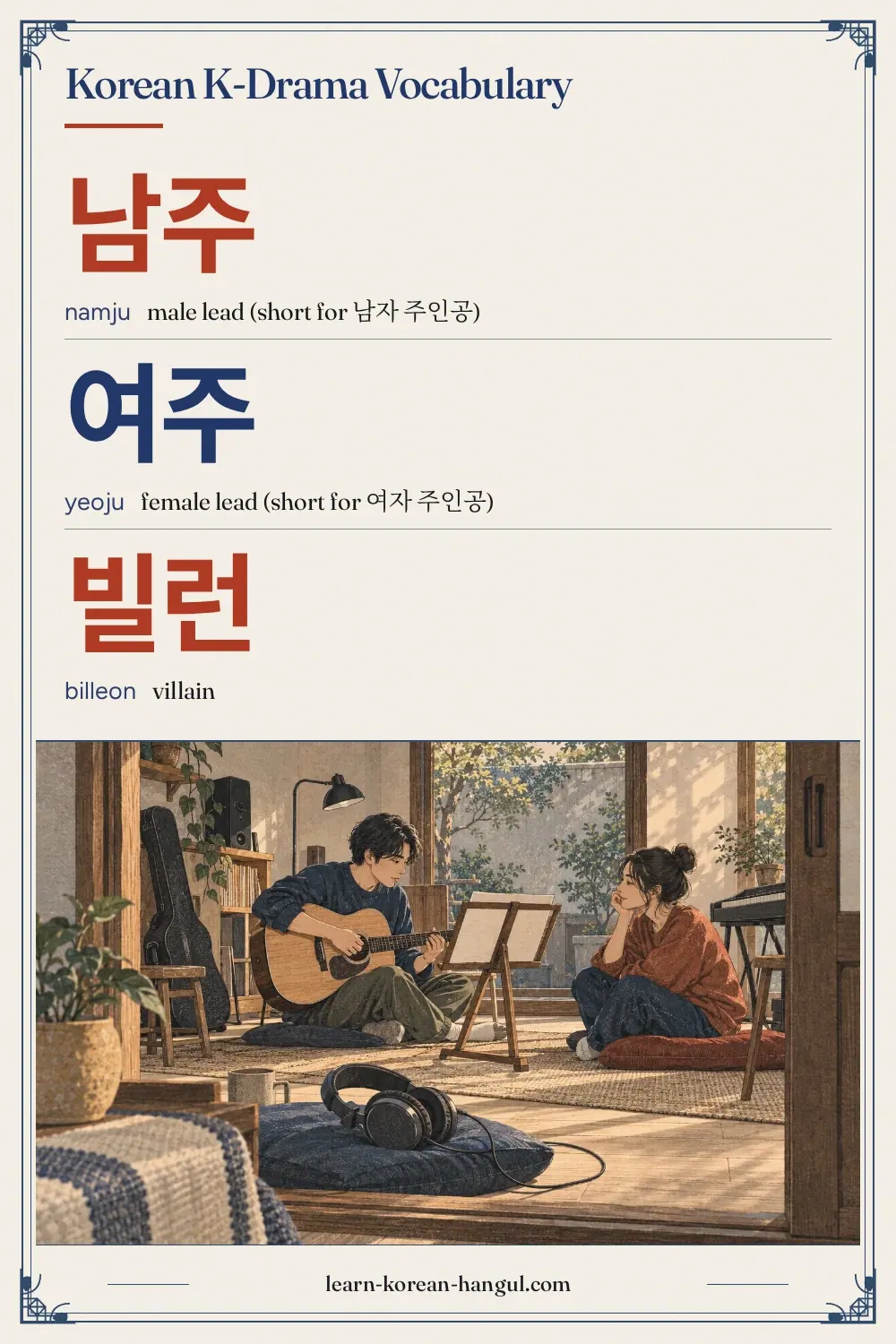
At 8 to 10 words a day, the list takes four days plus review. The scene below puts eight of the words on one picture.
Word · 8
- 1
남주
namju
male lead (short for 남자 주인공)
- 2
여주
yeoju
female lead (short for 여자 주인공)
- 3
빌런
billeon
villain
- 4
재벌 3세
jaebeol samse
chaebol heir (third generation)
- 5
첫사랑
cheotsarang
first love
- 6
출생의 비밀
chulsaengui bimil
secret of birth
- 7
이사님
isanim
director (a company executive)
- 8
정체
jeongche
true identity
Most of these words are Sino-Korean, and several are abbreviations. 남주 is 남자 (man) plus 주인공 (main character) with the middle syllables dropped. Korean fans shorten long Sino-Korean compounds this way all the time. A few of these words, such as 금수저 and 시월드, are slang and a little humorous, so they suit chat among friends better than a formal essay.
Character Roles
Character roles are the stock figures of a drama. 남주 and 여주 are the leads, 서브 남주 is the rival or the second lead, and 빌런 is the villain. Two more stock figures are tied to wealth and work: the 재벌 3세, the grandchild of a chaebol family, and the 실장님, the polished manager.
| No. | Hangul | Revised Romanization | Origin | Meaning | Example sentence | Audio assetId |
|---|---|---|---|---|---|---|
| 1 | 남주 | namju | Sino-Korean | male lead (short for 남자 주인공) | 남주가 너무 멋있어요. (The male lead is so cool.) | au-pg-vocabulary-culture-kdrama-tropes-1; example: au-pg-vocabulary-culture-kdrama-tropes-36 |
| 2 | 여주 | yeoju | Sino-Korean | female lead (short for 여자 주인공) | 여주가 회사에 들어가요. (The female lead joins the company.) | au-pg-vocabulary-culture-kdrama-tropes-2; example: au-pg-vocabulary-culture-kdrama-tropes-37 |
| 3 | 서브 남주 | seobeu namju | mixed | second male lead | 서브 남주가 여주를 좋아해요. (The second male lead likes the female lead.) | au-pg-vocabulary-culture-kdrama-tropes-3; example: au-pg-vocabulary-culture-kdrama-tropes-38 |
| 4 | 빌런 | billeon | loanword | villain | 이 드라마의 빌런은 무서워요. (The villain of this drama is scary.) | au-pg-vocabulary-culture-kdrama-tropes-4; example: au-pg-vocabulary-culture-kdrama-tropes-39 |
| 5 | 재벌 3세 | jaebeol samse | phrase | chaebol heir (third generation) | 남주는 재벌 3세예요. (The male lead is a chaebol heir.) | au-pg-vocabulary-culture-kdrama-tropes-5; example: au-pg-vocabulary-culture-kdrama-tropes-40 |
| 6 | 실장님 | siljangnim | Sino-Korean | office manager (a stock role for the male lead) | 실장님은 항상 바빠요. (The manager is always busy.) | au-pg-vocabulary-culture-kdrama-tropes-6; example: au-pg-vocabulary-culture-kdrama-tropes-41 |
| 7 | 비서 | biseo | Sino-Korean | secretary | 비서가 일정을 말해요. (The secretary tells the schedule.) | au-pg-vocabulary-culture-kdrama-tropes-7; example: au-pg-vocabulary-culture-kdrama-tropes-42 |
The 서브 남주 is the second male lead, and in fan talk he is often the one viewers wish had won. In a drama summary, a 서브 남주 usually shows up in a love triangle. Notice that 빌런 is a loanword from English villain, while the older Korean word 악당 (villain) is a Sino-Korean word and is still used. 재벌 refers to a large family-owned business group. In dramas the 재벌 3세 is often rich, cold and secretly kind. The word is a fictional stereotype in this context, and not a claim about real people.
For the chaebol term alone, see chaebol in Korean. The next group is about love.
Example Sentences
Each example is a short polite sentence. Most follow the pattern noun + 이/가 + verb, as in 남주가 멋있어요 (the male lead is cool), or noun + 을/를 + verb, as in 첫사랑을 만났어요. Say each sentence aloud, then swap the noun. Replace 남주 with 여주 in 남주가 너무 멋있어요 and you get 여주가 너무 멋있어요, which is also natural.
How Do You Say Romance Tropes in Korean?
Romance tropes are the love-story devices that keep audiences watching. 첫사랑 is the first love who returns, 짝사랑 is a one-sided love, and 삼각관계 is the love triangle. Others are 계약 연애, a fake relationship that turns real, 오해 (misunderstanding), 이별 (parting) and 재회 (reunion).
| No. | Hangul | Revised Romanization | Origin | Meaning | Example sentence | Audio assetId |
|---|---|---|---|---|---|---|
| 8 | 첫사랑 | cheotsarang | native | first love | 첫사랑을 다시 만났어요. (I met my first love again.) | au-pg-vocabulary-culture-kdrama-tropes-8; example: au-pg-vocabulary-culture-kdrama-tropes-43 |
| 9 | 삼각관계 | samgakgwangye | Sino-Korean | love triangle | 삼각관계가 시작돼요. (A love triangle begins.) | au-pg-vocabulary-culture-kdrama-tropes-9; example: au-pg-vocabulary-culture-kdrama-tropes-44 |
| 10 | 짝사랑 | jjaksarang | native | unrequited love | 여주는 오래 짝사랑했어요. (The female lead had an unrequited love for a long time.) | au-pg-vocabulary-culture-kdrama-tropes-10; example: au-pg-vocabulary-culture-kdrama-tropes-45 |
| 11 | 계약 연애 | gyeyak yeonae | Sino-Korean | contract dating (a fake relationship) | 계약 연애로 시작해요. (It starts as contract dating.) | au-pg-vocabulary-culture-kdrama-tropes-11; example: au-pg-vocabulary-culture-kdrama-tropes-46 |
| 12 | 오해 | ohae | Sino-Korean | misunderstanding | 작은 오해가 커져요. (A small misunderstanding grows.) | au-pg-vocabulary-culture-kdrama-tropes-12; example: au-pg-vocabulary-culture-kdrama-tropes-47 |
| 13 | 이별 | ibyeol | Sino-Korean | parting; breakup | 이별 장면에서 울어요. (I cry at the breakup scene.) | au-pg-vocabulary-culture-kdrama-tropes-13; example: au-pg-vocabulary-culture-kdrama-tropes-48 |
| 14 | 재회 | jaehoe | Sino-Korean | reunion | 십 년 후에 재회해요. (They reunite ten years later.) | au-pg-vocabulary-culture-kdrama-tropes-14; example: au-pg-vocabulary-culture-kdrama-tropes-49 |
These seven words follow the arc of a story: love begins (첫사랑, 짝사랑), gets complicated (삼각관계, 오해), ends (이별) and sometimes returns (재회). 계약 연애 is a trope word made from 계약 (contract) and 연애 (dating). It is mostly a story device, so you rarely hear it outside talk about dramas and webtoons.
The lookup page for love triangle in Korean has the single-word answer for 삼각관계. The next group moves from love to family.
Family and Class
Family and class words explain why the characters cannot simply be together. A 금수저 (gold spoon) is born rich and a 흙수저 (dirt spoon) is born poor. A 출생의 비밀 (secret of birth) changes who a character is, and the 시월드 (in-laws' world) is the other family a spouse marries into.
| No. | Hangul | Revised Romanization | Origin | Meaning | Example sentence | Audio assetId |
|---|---|---|---|---|---|---|
| 15 | 출생의 비밀 | chulsaengui bimil | phrase | secret of birth | 출생의 비밀이 드러나요. (The secret of birth comes out.) | au-pg-vocabulary-culture-kdrama-tropes-15; example: au-pg-vocabulary-culture-kdrama-tropes-50 |
| 16 | 금수저 | geumsujeo | mixed | gold spoon (born into a rich family) | 금수저는 부자 부모를 둔 사람이에요. (A gold spoon is someone with rich parents.) | au-pg-vocabulary-culture-kdrama-tropes-16; example: au-pg-vocabulary-culture-kdrama-tropes-51 |
| 17 | 흙수저 | heuksujeo | mixed | dirt spoon (born into a poor family) | 흙수저 주인공이 성공해요. (The dirt-spoon hero succeeds.) | au-pg-vocabulary-culture-kdrama-tropes-17; example: au-pg-vocabulary-culture-kdrama-tropes-52 |
| 18 | 시월드 | siwoldeu | mixed | in-laws' world (slang for the husband's family) | 시월드 이야기가 많아요. (There are many stories about in-laws.) | au-pg-vocabulary-culture-kdrama-tropes-18; example: au-pg-vocabulary-culture-kdrama-tropes-53 |
| 19 | 며느리 | myeoneuri | native | daughter-in-law | 며느리가 요리를 해요. (The daughter-in-law cooks.) | au-pg-vocabulary-culture-kdrama-tropes-19; example: au-pg-vocabulary-culture-kdrama-tropes-54 |
| 20 | 시어머니 | sieomeoni | mixed | mother-in-law (husband's mother) | 시어머니가 전화하세요. (Her mother-in-law is calling.) | au-pg-vocabulary-culture-kdrama-tropes-20; example: au-pg-vocabulary-culture-kdrama-tropes-55 |
| 21 | 상속 | sangsok | Sino-Korean | inheritance | 상속 문제로 싸워요. (They fight over the inheritance.) | au-pg-vocabulary-culture-kdrama-tropes-21; example: au-pg-vocabulary-culture-kdrama-tropes-56 |
Two words carry a cultural note. 금수저 and 흙수저 are everyday slang about family wealth, and they can sound harsh when used about a real person, so they are best kept for talk about stories. 시월드 is a slang word made from 시 (the prefix for the husband's family, as in 시어머니) and the English word world. It is half-joking, and Koreans who use it usually mean the pressure of the in-laws.
Notice the family terms: 며느리 is the daughter-in-law as seen from the husband's parents, and 시어머니 is the husband's mother. See Korean family titles for the other family terms. The next group moves to rooms and ranks.
How Do You Say Workplace and School Settings in Korean?
Workplace and school settings are where much of the story happens. Offices have ranks such as 이사님 (director) and newcomers called 신입. Schools have 선배 and 후배, the seniors and juniors, a 전학생 who arrives mid-term and the clubs called 동아리.
| No. | Hangul | Revised Romanization | Origin | Meaning | Example sentence | Audio assetId |
|---|---|---|---|---|---|---|
| 22 | 이사님 | isanim | Sino-Korean | director (a company executive) | 이사님이 회의에 들어가요. (The director goes into the meeting.) | au-pg-vocabulary-culture-kdrama-tropes-22; example: au-pg-vocabulary-culture-kdrama-tropes-57 |
| 23 | 신입 | sinip | Sino-Korean | new hire; newcomer | 신입이 첫 출근을 해요. (The new hire has a first day of work.) | au-pg-vocabulary-culture-kdrama-tropes-23; example: au-pg-vocabulary-culture-kdrama-tropes-58 |
| 24 | 선배 | seonbae | Sino-Korean | senior (at school or work) | 선배가 도와줘요. (The senior helps me.) | au-pg-vocabulary-culture-kdrama-tropes-24; example: au-pg-vocabulary-culture-kdrama-tropes-59 |
| 25 | 후배 | hubae | Sino-Korean | junior (at school or work) | 후배가 선배를 따라가요. (The junior follows the senior.) | au-pg-vocabulary-culture-kdrama-tropes-25; example: au-pg-vocabulary-culture-kdrama-tropes-60 |
| 26 | 전학생 | jeonhaksaeng | Sino-Korean | transfer student | 전학생이 교실에 들어와요. (A transfer student comes into the classroom.) | au-pg-vocabulary-culture-kdrama-tropes-26; example: au-pg-vocabulary-culture-kdrama-tropes-61 |
| 27 | 동아리 | dongari | native | club (at school) | 동아리에서 친구를 만나요. (I meet friends in the club.) | au-pg-vocabulary-culture-kdrama-tropes-27; example: au-pg-vocabulary-culture-kdrama-tropes-62 |
| 28 | 인턴 | inteon | loanword | intern | 인턴이 회사에 와요. (The intern comes to the company.) | au-pg-vocabulary-culture-kdrama-tropes-28; example: au-pg-vocabulary-culture-kdrama-tropes-63 |
선배 and 후배 describe a relationship based on when each person joined, and they are used at school and at work. A 선배 is not just an older person: the word means someone who entered the group before you. In English subtitles, 선배 is often rendered as senior or left as sunbae, and 오빠 may be glossed as older brother or kept as oppa. That is the subtitle trap: the same Korean word can be translated differently on different streaming services. The honorific system is explained on the Korean honorifics page.
The suffix 님 in 실장님 and 이사님 is the honorific that Koreans add to titles. The last group collects the twists that end an episode.
Plot Twists
Plot twists are the devices that change a story at the end of an episode. A 정체 (true identity) comes out, a 누명 (false accusation) is cleared, a friend commits a 배신 (betrayal), or the story turns to 쌍둥이 (twins), 납치 (kidnapping), 타임슬립 (time slip) or 환생 (reincarnation).
| No. | Hangul | Revised Romanization | Origin | Meaning | Example sentence | Audio assetId |
|---|---|---|---|---|---|---|
| 29 | 정체 | jeongche | Sino-Korean | true identity | 남주의 정체를 몰라요. (I do not know the male lead's true identity.) | au-pg-vocabulary-culture-kdrama-tropes-29; example: au-pg-vocabulary-culture-kdrama-tropes-64 |
| 30 | 누명 | numyeong | Sino-Korean | false accusation | 누명을 써요. (He is falsely accused.) | au-pg-vocabulary-culture-kdrama-tropes-30; example: au-pg-vocabulary-culture-kdrama-tropes-65 |
| 31 | 배신 | baesin | Sino-Korean | betrayal | 친구의 배신에 놀라요. (I am shocked by a friend's betrayal.) | au-pg-vocabulary-culture-kdrama-tropes-31; example: au-pg-vocabulary-culture-kdrama-tropes-66 |
| 32 | 쌍둥이 | ssangdungi | mixed | twins | 주인공에게 쌍둥이 동생이 있어요. (The main character has a twin sibling.) | au-pg-vocabulary-culture-kdrama-tropes-32; example: au-pg-vocabulary-culture-kdrama-tropes-67 |
| 33 | 납치 | napchi | Sino-Korean | kidnapping | 납치 장면이 무서워요. (The kidnapping scene is scary.) | au-pg-vocabulary-culture-kdrama-tropes-33; example: au-pg-vocabulary-culture-kdrama-tropes-68 |
| 34 | 타임슬립 | taimseullip | loanword | time slip (time travel) | 타임슬립 드라마를 좋아해요. (I like time-slip dramas.) | au-pg-vocabulary-culture-kdrama-tropes-34; example: au-pg-vocabulary-culture-kdrama-tropes-69 |
| 35 | 환생 | hwansaeng | Sino-Korean | reincarnation | 환생 이야기가 재미있어요. (The reincarnation story is fun.) | au-pg-vocabulary-culture-kdrama-tropes-35; example: au-pg-vocabulary-culture-kdrama-tropes-70 |
Plot-twist words are the ones to avoid saying to a friend who has not finished the episode. Korean fans say 스포 (spoiler) for a leak, a shortening of the loanword 스포일러. 누명 is almost always used in the idiom 누명을 쓰다 (to be falsely accused) and 누명을 벗다 (to clear one's name). 타임슬립 is a loanword from English, written as it sounds.
Most of these words are rare in daily life, which is exactly why they are worth learning from drama: you meet them in context, with a scene to hold them in memory. The next section covers the sounds.
How Do You Pronounce These Words?
Most of these words follow the spelling, but several undergo sound changes between consonants. The table shows seven that learners often get wrong.
| Spelling | Pronunciation | What happens |
|---|---|---|
| 첫사랑 | [첟싸랑] | The final ㅅ is said as ㄷ, and the ㅅ of 사 is said as a tense sound |
| 짝사랑 | [짝싸랑] | ㅅ after a final ㄱ is said as a tense sound |
| 흙수저 | [흑쑤저] | The final ㄺ is said as ㄱ, and ㅅ after it is tense |
| 신입 | [시닙] | The final ㄴ links to the vowel of the next syllable |
| 전학생 | [전학쌩] | ㅅ after a final ㄱ is said as a tense sound |
| 출생의 비밀 | [출쌩의 비밀] or [출쌩에 비밀] | ㅅ after a final ㄹ is tense in this Sino-Korean word, and the possessive 의 may be said [에] |
| 삼각관계 | [삼각꽌계] or [삼각꽌게] | ㄱ after a final ㄱ is said as a tense sound, and ㅖ in 계 may be said [ㅔ] |
The rules come from the Standard Pronunciation rules (표준 발음법) of the 국립국어원. Revised Romanization does not show tensing caused by a neighbouring sound, so it writes 첫사랑 as cheotsarang even though it is said [첟싸랑].
Audio and Slow Playback
Each word has a normal clip, and 5 key words also have a slow clip at 0.8 times the speed: 남주, 첫사랑, 흙수저, 출생의 비밀 and 전학생. Nothing plays until you press a button.
Listen to 첫사랑 first. You should hear a stop at the end of 첫 and then a strong 싸, as if the word were spelled 첟싸랑. Then listen to 남주. In the second syllable the ㅜ is a rounded vowel, and the ㅈ is a plain, unaspirated sound.
What Mistakes Do Learners Make with K-Drama Trope Words?
- Using 남주 and 여주 in formal writing. They are fan shorthand, and the full forms 남자 주인공 and 여자 주인공 suit essays and exams.
- Taking 금수저 and 흙수저 literally. They are slang for family wealth and do not describe cutlery.
- Using 시월드 in front of your own in-laws. It is half-joking slang and can sound rude to the family it describes.
- Trusting a single subtitle translation of 선배 or 오빠. Streaming services translate them differently, so learn the Korean word.
- Reading 첫사랑 as cheot-sarang. It is said [첟싸랑].
- Treating drama stereotypes as facts about Korea. A 재벌 3세 or a 실장님 is a stock figure in stories, not a portrait of real people.
Of these, the subtitle trap is the one that confuses new fans most. The next section turns the list into practice.
Practice: Flashcards and Worksheet
Drill these words with the vocabulary flashcard decks. A printable worksheet for these words (word list, matching, writing practice, fill-in-the-blank exercises and answer key) is available in A4 and US Letter from the download card on this page. Progress in the decks is saved only in your browser.
K-Drama Tropes and Roles Worksheet
Try this five-question check, then say the 35 words aloud once more.
Practice · 5
What does 빌런 mean?
Show answer
villain
빌런 (billeon) means villain.
What does 계약 연애 mean?
Show answer
contract dating (a fake relationship)
계약 연애 (gyeyak yeonae) means contract dating (a fake relationship).
What does 시월드 mean?
Show answer
in-laws' world (slang for the husband's family)
시월드 (siwoldeu) means in-laws' world (slang for the husband's family).
What does 후배 mean?
Show answer
junior (at school or work)
후배 (hubae) means junior (at school or work).
What does 쌍둥이 mean?
Show answer
twins
쌍둥이 (ssangdungi) means twins.
Where to Go Next
This list sits inside K-Drama Words. After the tropes, many learners move on to Korean Squid Game vocabulary, which covers the game names and the money words of one famous series. For full lines of dialogue, open the K-drama phrases page.
Frequently Asked Questions
How Do You Say Male Lead in Korean?
Male lead is 남주 (namju), the fan shorthand for 남자 주인공 (namja juingong). The female lead is 여주 (yeoju). Use the short forms in chat and reviews, and the full forms in formal writing. The second male lead is 서브 남주.
How Do You Pronounce 여주 (yeoju)?
여주 is said yeo-ju. The first syllable starts with a y glide into ㅓ, an unrounded vowel, so keep your lips relaxed and do not round them as for ㅗ. The second syllable 주 has a plain ㅈ and a rounded ㅜ. Nothing changes between the two syllables.
How Many K-Drama Trope Words Should I Learn First?
Learn about 12 first: 남주, 여주, 서브 남주, 빌런, 재벌 3세, 첫사랑, 삼각관계, 짝사랑, 오해, 이별, 선배 and 후배. They let you read most drama summaries. Add the family, class and plot-twist words as you watch more, and review the first 12 again after two days so that they stay in memory.
Where Can I Practise K-Drama Trope Words with Flashcards?
There is no deck for this list yet, but the Kdrama Korean words flashcards cover several of these words, such as 주인공, 첫사랑, 삼각관계 and 재벌, with audio. Progress stays in your browser. For the rest, copy the five tables above onto cards: Hangul on one side, English on the other.
Is the Romanization on This Page Official?
It follows the Revised Romanization of Korean, which South Korea officially adopted on 7 July 2000 and whose rules the National Institute of Korean Language (국립국어원) publishes. It is a learning aid that does not show tensing caused by a neighbouring sound, so learn the Hangul and use the audio.
Is There a Printable Worksheet for K-Drama Trope Words?
A printable worksheet for these words (word list, matching, writing practice, fill-in-the-blank exercises and answer key) is available in A4 and US Letter from the download card on this page. For practice, write the Hangul from memory, cover the English column and check your answers against the tables.