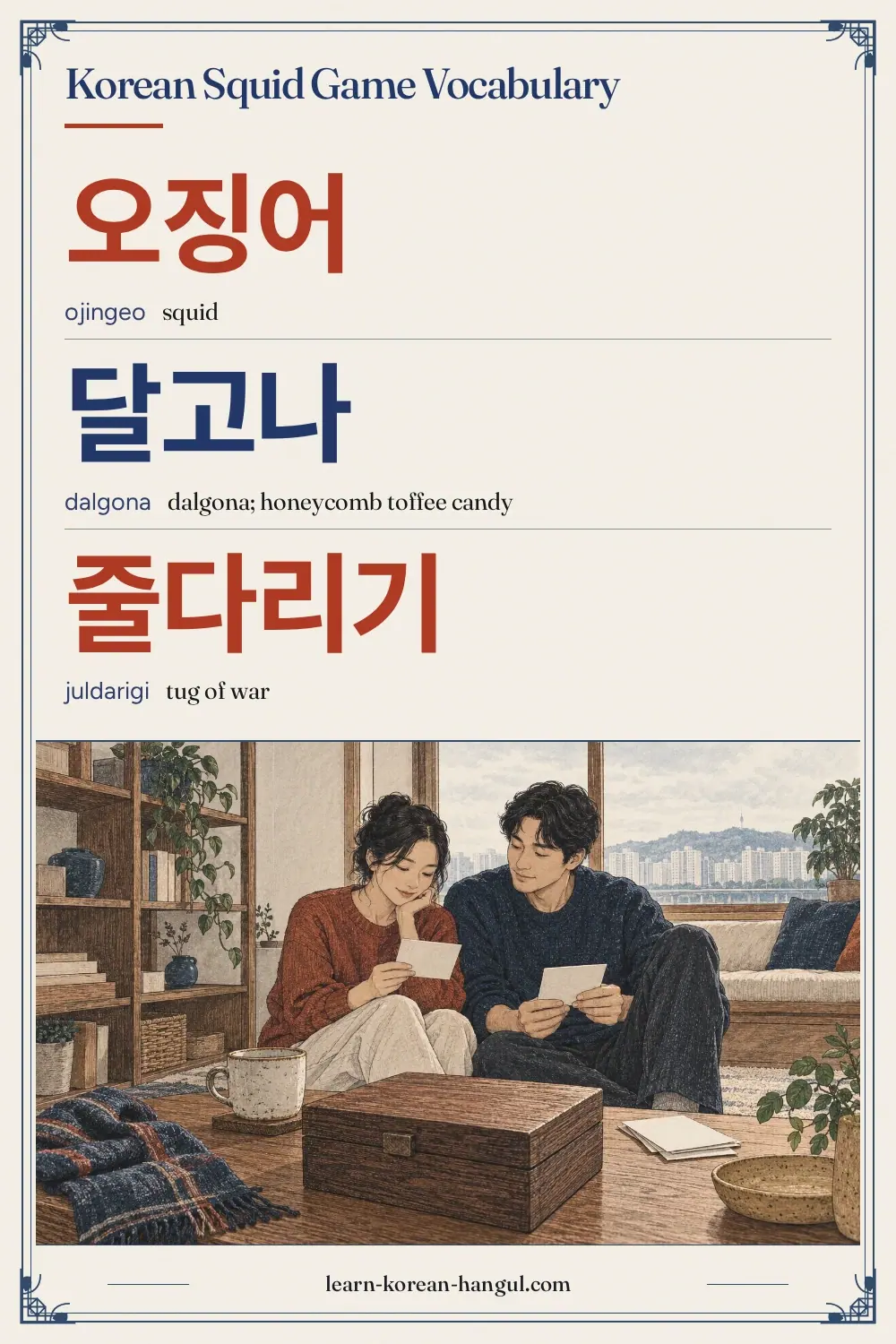
Korean Squid Game Vocabulary at a Glance
The Korean title of the series is 오징어 게임, literally Squid Game, and it is also the name of an old Korean children's game that is played on a chalk-drawn court on the ground. Many of the games in the series are real children's games from Korea, so the Korean words in them are everyday childhood words. That makes this list a good way to learn words that most Koreans know from their own childhood: 달고나, 줄다리기, 구슬치기 and 딱지치기.
The page uses game names and a very small number of publicly known words. It does not describe the plot. Of the 30 words, 14 are Sino-Korean (built from Chinese-derived syllables), 11 are native Korean, and the rest are loanwords, phrases or slang. The page is a child of K-Drama Words.
| Group | Words | What it covers |
|---|---|---|
| Title and setting | 6 | The title, the squid and the places where children play |
| Game words | 8 | The names of the children's games and their equipment |
| Characters and roles | 6 | Participants, the host and the winner |
| Money and debt | 6 | Prize money, cash, loans and gambling |
| Famous lines and rules | 4 | Buddy, foul play, rules and start |
If you only want the single-word answer, the page on Squid Game in Korean gives it. The next section says which words to learn first.
Which Squid Game Words Should You Learn First?
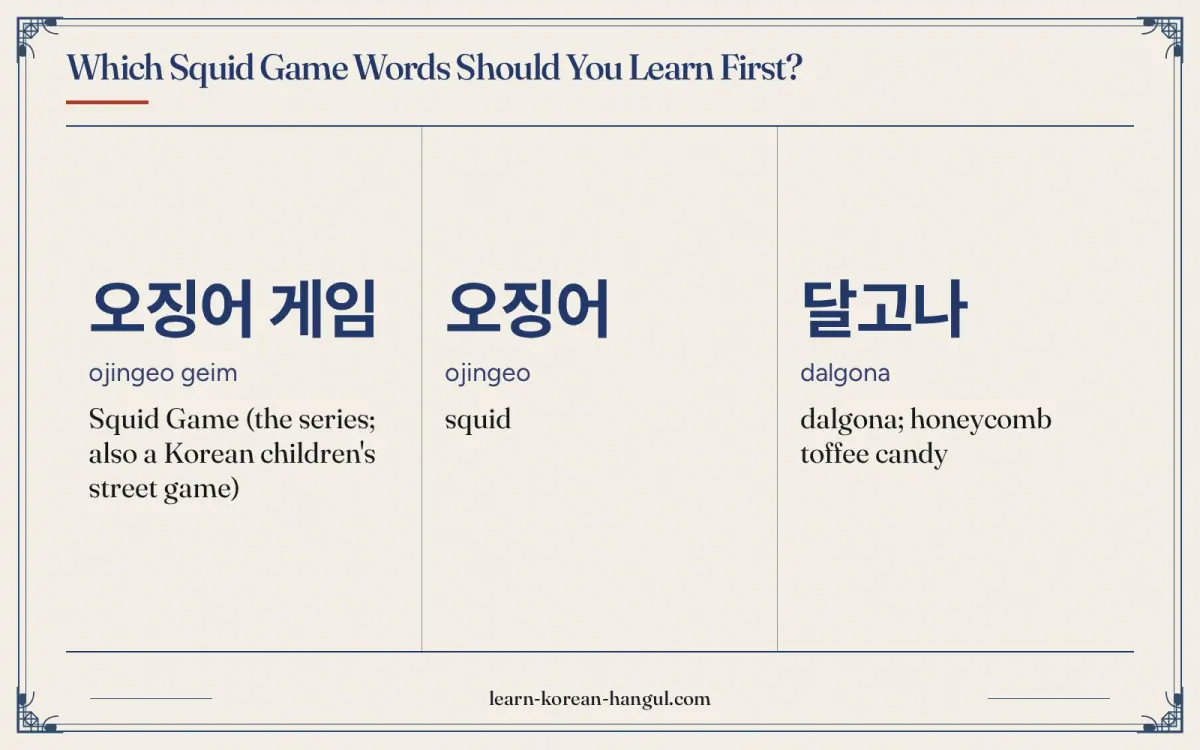
Learn 게임, 놀이, 상금 and 규칙 first, then the names of the games. These four are ordinary words that you will use outside the series. The game names are the fun part, and they come with real cultural context: you can say you played 구슬치기 as a child and Koreans will know what you mean.
- For everyday use. 게임, 놀이, 규칙, 시작, 번호 and 현금.
- For the game names. 달고나, 줄다리기, 구슬치기, 징검다리 and 딱지치기.
- For talking about money. 상금, 빚, 대출 and 도박.
- For fans. 오징어 게임, 참가자, 우승자, 가면 and 깐부.
At 8 to 10 words a day, the list takes three days plus review. The scene below puts eight of the words on one picture.
Word · 8
- 1
오징어 게임
ojingeo geim
Squid Game (the series; also a Korean children's street game)
- 2
오징어
ojingeo
squid
- 3
달고나
dalgona
dalgona; honeycomb toffee candy
- 4
줄다리기
juldarigi
tug of war
- 5
구슬치기
guseulchigi
playing marbles
- 6
징검다리
jinggeomdari
stepping stones
- 7
딱지치기
ttakjichigi
ddakji; flipping paper tiles
- 8
상금
sanggeum
prize money
Most of the game names are native Korean words. They are built from a noun and a verb stem that has been turned into a noun: 줄다리기 contains 줄 (rope), 구슬치기 is 구슬 (marbles) + 치다 (to hit), and 딱지치기 is 딱지 (paper tile) + 치다. The ending -기 turns a verb into a noun, which is why so many game names end in 기.
Title and Setting
The title and setting words describe where and what. 오징어 게임 is the title, 오징어 is the squid, and 게임 is a loanword for game. 놀이 is the native word for play and for a traditional game, and 골목 is the narrow alley where children used to play. 어린 시절 is childhood.
| No. | Hangul | Revised Romanization | Origin | Meaning | Example sentence | Audio assetId |
|---|---|---|---|---|---|---|
| 1 | 오징어 게임 | ojingeo geim | phrase | Squid Game (the series; also a Korean children's street game) | 오징어 게임은 한국 아이들의 놀이예요. (Squid Game is a Korean children's game.) | au-pg-vocabulary-culture-kdrama-squid-game-1; example: au-pg-vocabulary-culture-kdrama-squid-game-31 |
| 2 | 오징어 | ojingeo | native | squid | 오징어를 좋아해요. (I like squid.) | au-pg-vocabulary-culture-kdrama-squid-game-2; example: au-pg-vocabulary-culture-kdrama-squid-game-32 |
| 3 | 게임 | geim | loanword | game | 친구와 게임을 해요. (I play a game with a friend.) | au-pg-vocabulary-culture-kdrama-squid-game-3; example: au-pg-vocabulary-culture-kdrama-squid-game-33 |
| 4 | 놀이 | nori | native | play; a traditional game | 아이들이 놀이를 해요. (The children play a game.) | au-pg-vocabulary-culture-kdrama-squid-game-4; example: au-pg-vocabulary-culture-kdrama-squid-game-34 |
| 5 | 골목 | golmok | native | alley; narrow street | 골목에서 놀아요. (We play in the alley.) | au-pg-vocabulary-culture-kdrama-squid-game-5; example: au-pg-vocabulary-culture-kdrama-squid-game-35 |
| 6 | 어린 시절 | eorin sijeol | phrase | childhood | 어린 시절이 생각나요. (It reminds me of my childhood.) | au-pg-vocabulary-culture-kdrama-squid-game-6; example: au-pg-vocabulary-culture-kdrama-squid-game-36 |
The words 게임 and 놀이 both mean a game, but they are not the same. 게임 is a loanword and is used for video games, board games and contests. 놀이 is a native word and is used for play and traditional children's games. That is why the series title uses 게임 while the traditional games on this page are 놀이. Notice also 어린 시절, two separate words, which is spaced in writing.
The traditional games page has more game names. The next group covers the games in detail.
Example Sentences
Each example is a short polite sentence. Most follow the pattern noun + 을/를 + verb, as in 징검다리를 건너요, or noun + 이/가 + adjective, as in 상금이 커요. Say each sentence aloud, then swap the noun. Replace 구슬 in 주머니에 구슬이 있어요 with 딱지 and you get 주머니에 딱지가 있어요, which is also natural.
How Do You Say Game Words in Korean?
The game words are the names of the traditional children's games and their equipment. 달고나 is a honeycomb toffee candy, 줄다리기 is tug of war, 구슬치기 is playing marbles, 징검다리 is a path of stepping stones across a stream and 딱지치기 is flipping paper tiles. 술래 is the player who is it.
| No. | Hangul | Revised Romanization | Origin | Meaning | Example sentence | Audio assetId |
|---|---|---|---|---|---|---|
| 7 | 무궁화 꽃이 피었습니다 | mugunghwa kkochi pieotseumnida | phrase | The mugunghwa flower has bloomed (the chant of a children's freeze game) | 무궁화 꽃이 피었습니다, 하고 술래가 말해요. (The tagger says, "The mugunghwa flower has bloomed.") | au-pg-vocabulary-culture-kdrama-squid-game-7; example: au-pg-vocabulary-culture-kdrama-squid-game-37 |
| 8 | 술래 | sullae | native | the tagger; the player who is 'it' | 오늘은 내가 술래예요. (Today I am the tagger.) | au-pg-vocabulary-culture-kdrama-squid-game-8; example: au-pg-vocabulary-culture-kdrama-squid-game-38 |
| 9 | 달고나 | dalgona | native | dalgona; honeycomb toffee candy | 달고나는 설탕으로 만들어요. (Dalgona is made from sugar.) | au-pg-vocabulary-culture-kdrama-squid-game-9; example: au-pg-vocabulary-culture-kdrama-squid-game-39 |
| 10 | 줄다리기 | juldarigi | native | tug of war | 줄다리기는 팀으로 해요. (Tug of war is played in teams.) | au-pg-vocabulary-culture-kdrama-squid-game-10; example: au-pg-vocabulary-culture-kdrama-squid-game-40 |
| 11 | 구슬치기 | guseulchigi | native | playing marbles | 어릴 때 구슬치기를 했어요. (I played marbles when I was young.) | au-pg-vocabulary-culture-kdrama-squid-game-11; example: au-pg-vocabulary-culture-kdrama-squid-game-41 |
| 12 | 구슬 | guseul | native | marble; bead | 주머니에 구슬이 있어요. (There are marbles in my pocket.) | au-pg-vocabulary-culture-kdrama-squid-game-12; example: au-pg-vocabulary-culture-kdrama-squid-game-42 |
| 13 | 징검다리 | jinggeomdari | native | stepping stones | 징검다리를 건너요. (We cross the stepping stones.) | au-pg-vocabulary-culture-kdrama-squid-game-13; example: au-pg-vocabulary-culture-kdrama-squid-game-43 |
| 14 | 딱지치기 | ttakjichigi | native | ddakji; flipping paper tiles | 딱지치기는 종이로 해요. (Ddakji is played with paper.) | au-pg-vocabulary-culture-kdrama-squid-game-14; example: au-pg-vocabulary-culture-kdrama-squid-game-44 |
무궁화 꽃이 피었습니다 is the chant of a freeze game that Koreans play as children, and it is the Korean name of that game. The mugunghwa, or rose of Sharon, is widely regarded as Korea's national flower. The sentence ends in -습니다, the formal ending, and it is said in a slow, drawn-out way so that the other players can sneak forward. Learners often find it easy to remember because it is long and rhythmic.
달고나 is a sugar candy that many Koreans remember from street stalls, where children tried to cut out the stamped shape without breaking it. In some regions the same sweet is called 뽑기. 구슬 is a marble, and the word 구슬치기 is built from it. 징검다리 also has a figurative meaning, a bridge between two things, as in 두 나라의 징검다리 (a stepping stone between two countries). The next group is about people.
Characters and Roles
Characters and roles are described in general terms here. 참가자 is a participant, 진행자 is the host who runs the event, and 우승자 is the winner. 번호 is a number, and in a competition each participant is called by a number. 가면 is a mask. 탈락 means being eliminated.
| No. | Hangul | Revised Romanization | Origin | Meaning | Example sentence | Audio assetId |
|---|---|---|---|---|---|---|
| 15 | 참가자 | chamgaja | Sino-Korean | participant | 참가자가 모두 모여요. (All the participants gather.) | au-pg-vocabulary-culture-kdrama-squid-game-15; example: au-pg-vocabulary-culture-kdrama-squid-game-45 |
| 16 | 번호 | beonho | Sino-Korean | number | 번호를 불러요. (They call the number.) | au-pg-vocabulary-culture-kdrama-squid-game-16; example: au-pg-vocabulary-culture-kdrama-squid-game-46 |
| 17 | 가면 | gamyeon | Sino-Korean | mask | 가면을 써요. (He wears a mask.) | au-pg-vocabulary-culture-kdrama-squid-game-17; example: au-pg-vocabulary-culture-kdrama-squid-game-47 |
| 18 | 진행자 | jinhaengja | Sino-Korean | host; person who runs the event | 진행자가 규칙을 설명해요. (The host explains the rules.) | au-pg-vocabulary-culture-kdrama-squid-game-18; example: au-pg-vocabulary-culture-kdrama-squid-game-48 |
| 19 | 탈락 | tallak | Sino-Korean | elimination; being knocked out | 첫 게임에서 탈락했어요. (I was knocked out in the first game.) | au-pg-vocabulary-culture-kdrama-squid-game-19; example: au-pg-vocabulary-culture-kdrama-squid-game-49 |
| 20 | 우승자 | useungja | Sino-Korean | winner of a contest | 우승자가 상금을 받아요. (The winner receives the prize money.) | au-pg-vocabulary-culture-kdrama-squid-game-20; example: au-pg-vocabulary-culture-kdrama-squid-game-50 |
These are ordinary words that you can use anywhere. 참가자 and 우승자 appear on signs at sports days and marathons, and 진행자 is the word for the host of a TV show or an event. 탈락 is used for any competition, such as an audition or a football match, and 탈락하다 is the verb. 번호 is used for phone numbers, seat numbers and more.
The suffix 자 in 참가자, 진행자 and 우승자 means a person who does something. It is a handy building block: 학자 (scholar), 기자 (reporter) and 소비자 (consumer) work the same way. The next group is the money.
How Do You Say Money and Debt in Korean?
Money and debt words explain why people take part in a contest for a prize. 빚 is a debt, 대출 is a loan from a bank, and 현금 is cash. 상금 is prize money and 총상금 is the total of all the prize money. 도박 is gambling.
| No. | Hangul | Revised Romanization | Origin | Meaning | Example sentence | Audio assetId |
|---|---|---|---|---|---|---|
| 21 | 빚 | bit | native | debt | 빚이 많아요. (I have a lot of debt.) | au-pg-vocabulary-culture-kdrama-squid-game-21; example: au-pg-vocabulary-culture-kdrama-squid-game-51 |
| 22 | 상금 | sanggeum | Sino-Korean | prize money | 상금이 커요. (The prize money is big.) | au-pg-vocabulary-culture-kdrama-squid-game-22; example: au-pg-vocabulary-culture-kdrama-squid-game-52 |
| 23 | 현금 | hyeongeum | Sino-Korean | cash | 현금으로 내요. (I pay in cash.) | au-pg-vocabulary-culture-kdrama-squid-game-23; example: au-pg-vocabulary-culture-kdrama-squid-game-53 |
| 24 | 대출 | daechul | Sino-Korean | loan | 은행에서 대출을 받아요. (I take out a loan from the bank.) | au-pg-vocabulary-culture-kdrama-squid-game-24; example: au-pg-vocabulary-culture-kdrama-squid-game-54 |
| 25 | 도박 | dobak | Sino-Korean | gambling | 도박은 위험해요. (Gambling is risky.) | au-pg-vocabulary-culture-kdrama-squid-game-25; example: au-pg-vocabulary-culture-kdrama-squid-game-55 |
| 26 | 총상금 | chongsanggeum | Sino-Korean | total prize money | 총상금이 얼마예요? (How much is the total prize money?) | au-pg-vocabulary-culture-kdrama-squid-game-26; example: au-pg-vocabulary-culture-kdrama-squid-game-56 |
빚 is a native word and is said [빋] when it stands alone. With a particle it links: 빚이 is [비지]. 상금 is made of 상 (prize) and 금 (money), and 총상금 adds 총 (total). Money words are very common in the news. For example, 대출 is a key word in stories about housing and household debt.
The word 도박 often appears in news reports and in stories about debt. This page uses it only as vocabulary. The last group is the shortest.
Famous Lines and Rules
The famous words of a series stick in the memory. 깐부 is a slang word for a close buddy, and many viewers learned it from the series. 반칙 is foul play, 규칙 is a rule, and 시작 is a start. They are short and easy to use.
| No. | Hangul | Revised Romanization | Origin | Meaning | Example sentence | Audio assetId |
|---|---|---|---|---|---|---|
| 27 | 깐부 | kkanbu | slang (origin unclear) | buddy; close partner (slang from marble games) | 우리는 깐부예요. (We are buddies.) | au-pg-vocabulary-culture-kdrama-squid-game-27; example: au-pg-vocabulary-culture-kdrama-squid-game-57 |
| 28 | 반칙 | banchik | Sino-Korean | foul play; breaking the rules | 반칙은 안 돼요. (Foul play is not allowed.) | au-pg-vocabulary-culture-kdrama-squid-game-28; example: au-pg-vocabulary-culture-kdrama-squid-game-58 |
| 29 | 규칙 | gyuchik | Sino-Korean | rule | 규칙을 지켜요. (We follow the rules.) | au-pg-vocabulary-culture-kdrama-squid-game-29; example: au-pg-vocabulary-culture-kdrama-squid-game-59 |
| 30 | 시작 | sijak | Sino-Korean | start; beginning | 이제 시작이에요. (It starts now.) | au-pg-vocabulary-culture-kdrama-squid-game-30; example: au-pg-vocabulary-culture-kdrama-squid-game-60 |
깐부 is slang for a close friend or a partner that you trust, from the vocabulary of children playing marbles. Use it only with friends and in a joking, friendly way. 반칙 is a word used in sports: 반칙을 하다 means to commit a foul. 규칙 is the general word for a rule, and 규칙을 지키다 means to follow the rules.
The chant 무궁화 꽃이 피었습니다 from the game words group is the other famous line, and it is easy to say once you know the pronunciation. The next section covers it.
How Do You Pronounce These Words?
Most of these words follow the spelling, but several undergo sound changes between syllables. The table shows seven that learners often get wrong.
| Spelling | Pronunciation | What happens |
|---|---|---|
| 무궁화 꽃이 피었습니다 | [무궁화 꼬치 피어씀니다] | 꽃이 links the final ㅊ to the next vowel, and 습니다 is said [씀니다], with a tense ㅆ and ㅂ before ㄴ becoming ㅁ |
| 딱지치기 | [딱찌치기] | ㅈ after a final ㄱ is said as a tense sound |
| 시작이에요 | [시자기에요] | The final ㄱ links to the vowel of the next syllable |
| 놀이 | [노리] | The final ㄹ links to the vowel of the next syllable |
| 골목에서 | [골모게서] | The final ㄱ links to the vowel of the next syllable |
| 빚이 | [비지] | The final ㅈ links to the vowel of the next syllable |
| 빚 | [빋] | Alone, a final ㅈ is said as ㄷ |
The rules come from the Standard Pronunciation rules (표준 발음법) of the 국립국어원. Revised Romanization does not show tensing caused by a neighbouring sound, so it writes 딱지치기 as ttakjichigi even though the middle is said [딱찌]. It does show the liaison in 꽃이, written kkochi.
Audio and Slow Playback
Each word has a normal clip, and 5 key words also have a slow clip at 0.8 times the speed: 오징어 게임, 달고나, 줄다리기, 징검다리 and 무궁화 꽃이 피었습니다. Nothing plays until you press a button.
Listen to 달고나 first. All three syllables are light, and the ㄹ in the first syllable is a single flap of the tongue, as in the Spanish r. Then listen to 무궁화 꽃이 피었습니다, and note how the ㅊ of 꽃이 moves to the next syllable.
What Mistakes Do Learners Make with Squid Game Words?
- Treating 게임 and 놀이 as the same word. 게임 is a loanword for a game or contest, while 놀이 is the native word for play and traditional games.
- Reading 달고나 as dal-go-na with a long second syllable. All three syllables are short and even.
- Reading 꽃이 as kkot-i. It is said [꼬치], and the Revised Romanization is kkochi.
- Using 깐부 with strangers or elders. It is slang for a close buddy, and it sounds odd outside friendships.
- Confusing 빚 and 빛. 빚 is a debt and 빛 is light. Both are said [빋] when they stand alone, so context decides.
- Writing 오징어게임 without a space. The title is written 오징어 게임 as two words.
Of these, the 빚 and 빛 pair is the one that causes real misunderstandings. The next section turns the list into practice.
Practice: Flashcards and Worksheet
Drill these words with the vocabulary flashcard decks. A printable worksheet for these words (word list, matching, writing practice, fill-in-the-blank exercises and answer key) is available in A4 and US Letter from the download card on this page. Progress in the decks is saved only in your browser.
Korean Squid Game Vocabulary Worksheet
Try this five-question check, then say the 30 words aloud once more.
Practice · 5
What does 놀이 mean?
Show answer
play; a traditional game
놀이 (nori) means play; a traditional game.
What does 줄다리기 mean?
Show answer
tug of war
줄다리기 (juldarigi) means tug of war.
What does 번호 mean?
Show answer
number
번호 (beonho) means number.
What does 상금 mean?
Show answer
prize money
상금 (sanggeum) means prize money.
What does 반칙 mean?
Show answer
foul play; breaking the rules
반칙 (banchik) means foul play; breaking the rules.
Where to Go Next
This list sits inside K-Drama Words. After the game words, many learners move on to K-drama tropes and roles vocabulary for the story side of dramas. For the single-word lookup of the title, open Squid Game in Korean, and for more game names open the traditional games page.
Frequently Asked Questions
How Do You Say Squid Game in Korean?
Squid Game is 오징어 게임 (ojingeo geim). 오징어 means squid and 게임 is the loanword for game. It is also the name of a real Korean children's street game. Write it as two words with a space, and say 오징어 as o-jing-eo with all the vowels clear.
How Do You Pronounce 달고나 (dalgona)?
달고나 is said dal-go-na, with three short even syllables. The first syllable 달 starts with a plain ㄷ, with no puff of air, and ends in a light ㄹ. The second and third syllables are open vowels. Nothing changes between the syllables, so say them evenly and compare with the audio.
How Many Squid Game Words Should I Learn First?
Learn about 12 first: 게임, 놀이, 규칙, 시작, 번호 and 상금, then the five game names 달고나, 줄다리기, 구슬치기, 징검다리 and 딱지치기, and the title 오징어 게임. Add the money words later if you need them, and review the first 12 again after two days so that the game names stay in memory.
Where Can I Practise Squid Game Words with Flashcards?
There is no deck for this list yet, but the Kdrama Korean words flashcards include 오징어 게임 and other drama words, with audio. Progress stays in your browser. For the game and money words, copy the five tables above onto cards: Hangul on one side, English on the other.
Is the Romanization on This Page Official?
It follows the Revised Romanization of Korean, which South Korea officially adopted on 7 July 2000 and whose rules the National Institute of Korean Language (국립국어원) publishes. It is a learning aid that does not show tensing caused by a neighbouring sound, so learn the Hangul and use the audio.
Is There a Printable Worksheet for Squid Game Words?
A printable worksheet for these words (word list, matching, writing practice, fill-in-the-blank exercises and answer key) is available in A4 and US Letter from the download card on this page. For practice, write the Hangul from memory, cover the English column and check your answers against the tables.