Korean Traditional House Vocabulary at a Glance
Korean traditional house vocabulary starts with 한옥, a house with a tiled roof, paper doors and a heated floor. The heated floor is 온돌, and it is the part of the house that surprises most visitors, because people sit and sleep on it. A hanok also has a wooden-floored hall called 대청마루 and an open yard called 마당. This page holds 30 words in five groups.
| Group | Words | Use |
|---|---|---|
| Parts of a hanok | 8 | Naming the roof, rooms and doors |
| Heating (온돌) | 7 | Explaining how the floor is heated |
| Materials | 6 | Naming paper, wood and clay |
| Courtyards and gates | 5 | Naming the yard, walls and well |
| Hanok stays | 4 | Booking and staying in a hanok |
The list belongs to Traditional Culture. For the rooms and furniture of an ordinary modern home, use the house vocabulary list. The next section says where to start.
Which Hanok and Ondol Words Should You Learn First?
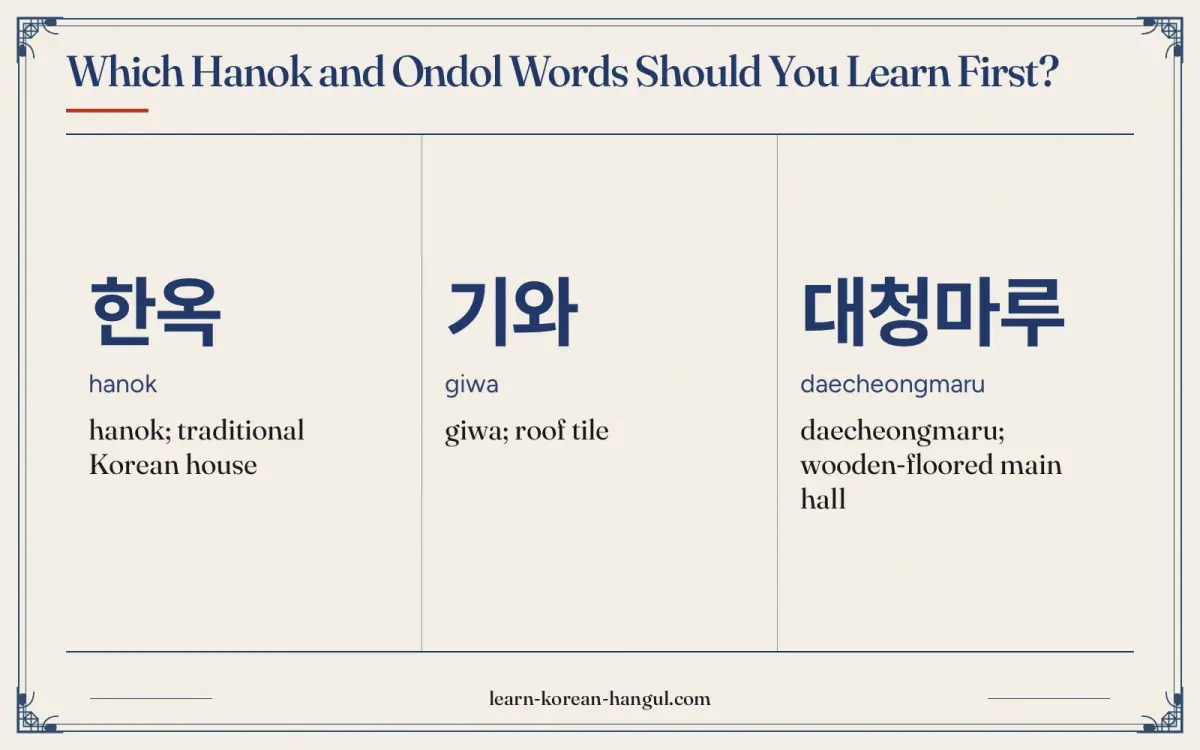
Learn 한옥, 온돌, 마당 and 기와 first. They name the house, its heating, its yard and its roof, and they are the words signs and guides use most. Then learn the heating words in order, because they explain how the floor gets warm.
- Day one. 한옥, 온돌, 마당, 기와 and 대문.
- Day two. The parts of the house: 대청마루, 안채, 사랑채, 처마, 문살 and 툇마루.
- Day three. The heating words in order: 아궁이, 구들, 아랫목, 윗목 and 굴뚝.
- Day four. The materials, the yard words and the words for a hanok stay.
At 8 to 10 words a day, the list takes three to four days plus review. This scene puts eight of the words on one picture.
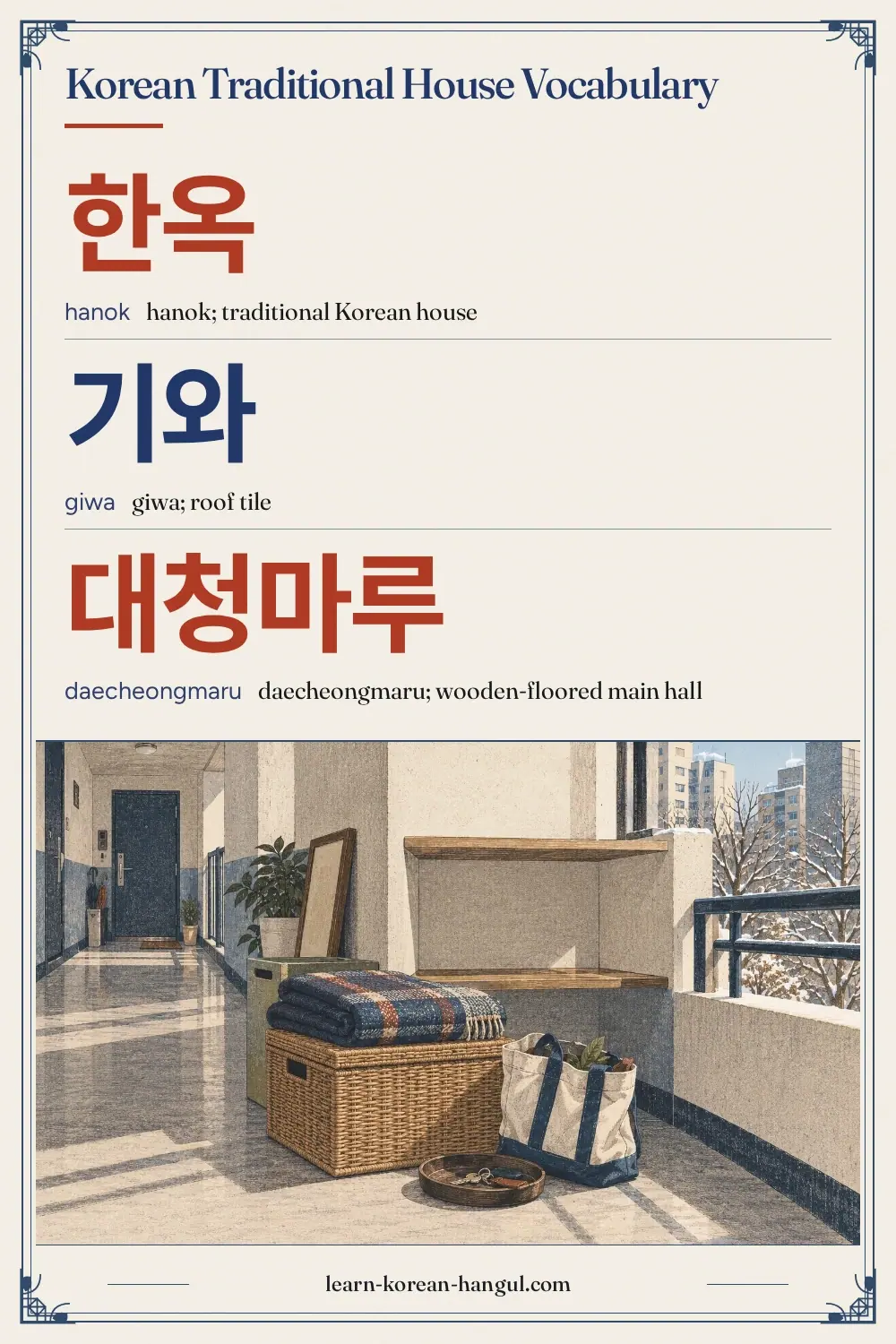
Word · 8
- 1
한옥
hanok
hanok; traditional Korean house
- 2
기와
giwa
giwa; roof tile
- 3
대청마루
daecheongmaru
daecheongmaru; wooden-floored main hall
- 4
온돌
ondol
ondol; underfloor heating
- 5
아궁이
agungi
agungi; the opening where the fire is lit
- 6
굴뚝
gulttuk
chimney
- 7
마당
madang
madang; yard; courtyard
- 8
대문
daemun
daemun; main gate
By origin, the list has 9 Sino-Korean words, 13 native words, 1 loanword and 7 mixed words. Native words such as 마당, 기와 and 굴뚝 name the everyday parts, and Sino-Korean words such as 온돌, 한지 and 예약 come from Chinese-based vocabulary. The origin column in each table marks them. The first group names the house itself.
Parts of a Hanok
A traditional house is a group of buildings around a yard. The family lived in the 안채 (inner building), and guests stayed in the 사랑채 (outer building). Between the rooms was the 대청마루, a wide wooden hall that stays cool in summer, and a narrow porch called a 툇마루. The roof is covered with 기와 tiles, and its wide 처마 (eaves) shade the walls. The doors are a wooden frame, the 문살, covered with paper.
| No. | Hangul | Revised Romanization | Origin | Meaning | Example sentence | Audio assetId |
|---|---|---|---|---|---|---|
| 1 | 한옥 | hanok | Sino-Korean | hanok; traditional Korean house | 한옥에서 하룻밤 잤어요. (I slept one night in a hanok.) | au-pg-vocabulary-culture-traditional-hanok-1; example: au-pg-vocabulary-culture-traditional-hanok-31 |
| 2 | 대청마루 | daecheongmaru | mixed | daecheongmaru; wooden-floored main hall | 대청마루에서 쉬어요. (I rest on the daecheongmaru.) | au-pg-vocabulary-culture-traditional-hanok-2; example: au-pg-vocabulary-culture-traditional-hanok-32 |
| 3 | 안채 | anchae | native | anchae; the inner building where the family lives | 안채에는 가족이 살아요. (The family lives in the anchae.) | au-pg-vocabulary-culture-traditional-hanok-3; example: au-pg-vocabulary-culture-traditional-hanok-33 |
| 4 | 사랑채 | sarangchae | mixed | sarangchae; the outer building for guests | 손님은 사랑채에 있어요. (The guest is in the sarangchae.) | au-pg-vocabulary-culture-traditional-hanok-4; example: au-pg-vocabulary-culture-traditional-hanok-34 |
| 5 | 기와 | giwa | native | giwa; roof tile | 지붕에 기와가 있어요. (There are roof tiles on the roof.) | au-pg-vocabulary-culture-traditional-hanok-5; example: au-pg-vocabulary-culture-traditional-hanok-35 |
| 6 | 처마 | cheoma | native | eaves; the edge of the roof that sticks out | 처마가 길어요. (The eaves are long.) | au-pg-vocabulary-culture-traditional-hanok-6; example: au-pg-vocabulary-culture-traditional-hanok-36 |
| 7 | 문살 | munsal | mixed | munsal; wooden lattice of a door | 문살이 예뻐요. (The door lattice is pretty.) | au-pg-vocabulary-culture-traditional-hanok-7; example: au-pg-vocabulary-culture-traditional-hanok-37 |
| 8 | 툇마루 | toenmaru | mixed | toenmaru; narrow porch floor | 툇마루에 앉아요. (I sit on the toenmaru.) | au-pg-vocabulary-culture-traditional-hanok-8; example: au-pg-vocabulary-culture-traditional-hanok-38 |
Notice that 안채 and 사랑채 both end in 채, which means a building within a house compound. The word 한옥 is a Sino-Korean compound: 한 (Korean) and 옥 (house). In everyday talk, a house is 집, and 한옥 names the traditional type.
Example Sentences
Each example is a short polite sentence. Most use the pattern place + 에 + 있어요 (is at a place) or place + 에서 + action. For example, 마당에 우물이 있어요 means there is a well in the yard, and 대청마루에서 쉬어요 means I rest on the hall floor. Say the sentences aloud, then swap in another part of the house.
The heating group follows the path of the heat, so its sentences read like a story. The materials come next.
How Do You Say Heating (온돌) in Korean?
Ondol is a heating system built into the floor. A fire is lit in the 아궁이, an opening at the edge of the kitchen. The hot air passes through channels under the floor stones, called 구들, and warms the room above. The smoke leaves through a 굴뚝 (chimney). The place nearest the fire is the 아랫목, the warmest spot, and the far side is the 윗목, which is cooler. Modern homes use a 보일러 (boiler) to warm water pipes in the floor, which is the same idea.
| No. | Hangul | Revised Romanization | Origin | Meaning | Example sentence | Audio assetId |
|---|---|---|---|---|---|---|
| 9 | 온돌 | ondol | Sino-Korean | ondol; underfloor heating | 한옥에는 온돌이 있어요. (A hanok has ondol.) | au-pg-vocabulary-culture-traditional-hanok-9; example: au-pg-vocabulary-culture-traditional-hanok-39 |
| 10 | 구들 | gudeul | native | gudeul; the heated flues under the floor | 구들이 바닥을 데워요. (The gudeul warms the floor.) | au-pg-vocabulary-culture-traditional-hanok-10; example: au-pg-vocabulary-culture-traditional-hanok-40 |
| 11 | 아궁이 | agungi | native | agungi; the opening where the fire is lit | 아궁이에 불을 때요. (I light a fire in the agungi.) | au-pg-vocabulary-culture-traditional-hanok-11; example: au-pg-vocabulary-culture-traditional-hanok-41 |
| 12 | 아랫목 | araenmok | native | araenmok; the warmest part of the floor | 겨울에는 아랫목이 따뜻해요. (The araenmok is warm in winter.) | au-pg-vocabulary-culture-traditional-hanok-12; example: au-pg-vocabulary-culture-traditional-hanok-42 |
| 13 | 윗목 | winmok | native | winmok; the cooler part of the floor | 윗목은 좀 추워요. (The winmok is a little cold.) | au-pg-vocabulary-culture-traditional-hanok-13; example: au-pg-vocabulary-culture-traditional-hanok-43 |
| 14 | 굴뚝 | gulttuk | native | chimney | 굴뚝에서 연기가 나요. (Smoke comes out of the chimney.) | au-pg-vocabulary-culture-traditional-hanok-14; example: au-pg-vocabulary-culture-traditional-hanok-44 |
| 15 | 보일러 | boilleo | loanword | boiler | 요즘 한옥에도 보일러가 있어요. (Hanok today have boilers too.) | au-pg-vocabulary-culture-traditional-hanok-15; example: au-pg-vocabulary-culture-traditional-hanok-45 |
The flow of heat gives you the words in order. Read the table below from top to bottom, and say each word as you go.
| Step | Word | What happens |
|---|---|---|
| 1 | 아궁이 | A fire is lit at the edge of the floor |
| 2 | 구들 | Hot air runs through channels under the floor stones |
| 3 | 아랫목 / 윗목 | The floor is warmest near the fire and cooler far from it |
| 4 | 굴뚝 | The smoke leaves through the chimney |
In a modern home with a 보일러, the floor still stays warm, but a gas or electric burner replaces the open fire. A common phrase in winter is 바닥이 따뜻해요 (the floor is warm).
Materials
A hanok is built from materials found near the village: wood, clay and paper. Posts called 기둥 hold up the roof, and the walls are filled with 흙 (soil) or 황토 (a reddish-yellow clay). Doors and windows are covered with 한지, a paper made from the bark of the mulberry tree. The paper used for doors is called 창호지, and it lets soft light into the room.
| No. | Hangul | Revised Romanization | Origin | Meaning | Example sentence | Audio assetId |
|---|---|---|---|---|---|---|
| 16 | 한지 | hanji | Sino-Korean | hanji; traditional Korean paper | 한지는 튼튼해요. (Hanji is strong.) | au-pg-vocabulary-culture-traditional-hanok-16; example: au-pg-vocabulary-culture-traditional-hanok-46 |
| 17 | 창호지 | changhoji | Sino-Korean | changhoji; paper for doors and windows | 창호지를 문에 붙여요. (I stick changhoji on the door.) | au-pg-vocabulary-culture-traditional-hanok-17; example: au-pg-vocabulary-culture-traditional-hanok-47 |
| 18 | 목재 | mokjae | Sino-Korean | timber; wood for building | 목재로 한옥을 지어요. (People build hanok with timber.) | au-pg-vocabulary-culture-traditional-hanok-18; example: au-pg-vocabulary-culture-traditional-hanok-48 |
| 19 | 흙 | heuk | native | soil; earth; clay | 벽에 흙을 발라요. (I spread clay on the wall.) | au-pg-vocabulary-culture-traditional-hanok-19; example: au-pg-vocabulary-culture-traditional-hanok-49 |
| 20 | 기둥 | gidung | native | pillar; post | 기둥이 굵어요. (The pillar is thick.) | au-pg-vocabulary-culture-traditional-hanok-20; example: au-pg-vocabulary-culture-traditional-hanok-50 |
| 21 | 황토 | hwangto | Sino-Korean | hwangto; reddish-yellow clay | 황토로 벽을 만들어요. (I make a wall with hwangto.) | au-pg-vocabulary-culture-traditional-hanok-21; example: au-pg-vocabulary-culture-traditional-hanok-51 |
The word 흙 ends in two consonants, ㄹ and ㄱ, but you say only one before a pause: [흑]. Before a vowel, both sounds appear, as in 흙을 [흘글]. The verb 바르다 in the example is irregular: 바르다 becomes 발라요, not 바라요.
How Do You Say Courtyards and Gates in Korean?
The 마당 is the open yard at the centre of the compound, where the family dried food and held celebrations. A 대문 (main gate) leads in from the lane, and a low 돌담 (stone wall) often runs around the yard. On a raised platform called the 장독대 stood the large jars for soy sauce and other fermented foods, and many houses had an 우물 (well).
| No. | Hangul | Revised Romanization | Origin | Meaning | Example sentence | Audio assetId |
|---|---|---|---|---|---|---|
| 22 | 마당 | madang | native | madang; yard; courtyard | 마당이 넓어요. (The yard is wide.) | au-pg-vocabulary-culture-traditional-hanok-22; example: au-pg-vocabulary-culture-traditional-hanok-52 |
| 23 | 대문 | daemun | Sino-Korean | daemun; main gate | 대문을 열어요. (I open the main gate.) | au-pg-vocabulary-culture-traditional-hanok-23; example: au-pg-vocabulary-culture-traditional-hanok-53 |
| 24 | 돌담 | doldam | native | doldam; stone wall | 돌담이 낮아요. (The stone wall is low.) | au-pg-vocabulary-culture-traditional-hanok-24; example: au-pg-vocabulary-culture-traditional-hanok-54 |
| 25 | 장독대 | jangdokdae | mixed | jangdokdae; platform for soy-sauce jars | 장독대에 항아리가 많아요. (There are many jars on the jangdokdae.) | au-pg-vocabulary-culture-traditional-hanok-25; example: au-pg-vocabulary-culture-traditional-hanok-55 |
| 26 | 우물 | umul | native | well | 마당에 우물이 있어요. (There is a well in the yard.) | au-pg-vocabulary-culture-traditional-hanok-26; example: au-pg-vocabulary-culture-traditional-hanok-56 |
The word 마당 also appears in 마당놀이, a traditional performance given in a yard, but in this list it means the yard of a house.
Hanok Stays
Many hanok today are guesthouses. You choose a 한옥 스테이, make a 예약 (reservation), sleep on bedding laid on the warm floor, and sometimes eat 조식 (breakfast) in the morning. Some towns keep whole streets of hanok, which are called a 한옥마을. Jeonju Hanok Village is a well-known example.
| No. | Hangul | Revised Romanization | Origin | Meaning | Example sentence | Audio assetId |
|---|---|---|---|---|---|---|
| 27 | 한옥 스테이 | hanok seutei | mixed | hanok stay; a night in a hanok guesthouse | 이번 주말에 한옥 스테이를 해요. (I am doing a hanok stay this weekend.) | au-pg-vocabulary-culture-traditional-hanok-27; example: au-pg-vocabulary-culture-traditional-hanok-57 |
| 28 | 한옥마을 | hanokmaeul | mixed | hanok village | 전주 한옥마을에 가고 싶어요. (I want to go to Jeonju Hanok Village.) | au-pg-vocabulary-culture-traditional-hanok-28; example: au-pg-vocabulary-culture-traditional-hanok-58 |
| 29 | 예약 | yeyak | Sino-Korean | reservation; booking | 한옥을 예약했어요. (I booked a hanok.) | au-pg-vocabulary-culture-traditional-hanok-29; example: au-pg-vocabulary-culture-traditional-hanok-59 |
| 30 | 조식 | josik | Sino-Korean | breakfast (used in hotel and guesthouse listings) | 조식이 포함돼요. (Breakfast is included.) | au-pg-vocabulary-culture-traditional-hanok-30; example: au-pg-vocabulary-culture-traditional-hanok-60 |
On booking sites, 조식 is the word for breakfast, and 아침 식사 is the everyday phrase. The same listing may say 온돌방 (ondol room), which means a room with a heated floor and bedding, and 침대방 (bed room), which has a bed. Check which room you are booking.
How Do You Pronounce These Words?
Many of these words change in speech because a final consonant meets a following consonant or vowel. The table lists the changes that learners most often miss.
| Spelling | Pronunciation | What happens |
|---|---|---|
| 한옥 | [하녹] | The final ㄴ moves onto the vowel ㅗ, so you hear ha-nok |
| 아랫목 | [아랜목] | The final ㅅ is said as ㄷ and then as ㄴ before ㅁ |
| 윗목 | [윈목] | The final ㅅ is said as ㄷ and then as ㄴ before ㅁ |
| 툇마루 | [퇸마루] | The final ㅅ is said as ㄷ and then as ㄴ before ㅁ |
| 돌담 | [돌땀] | In this compound, the ㄷ of 담 is said as a tense ㄸ |
| 흙을 | [흘글] | Both final letters are heard before a vowel: the ㄹ stays and the ㄱ moves to the next syllable |
| 굴뚝 | [굴뚝] | The first ㄹ is a light l, and ㄸ is tense, said without a puff of air |
The rules come from the Standard Pronunciation rules (표준 발음법) of the 국립국어원.
Audio and Slow Playback
Each word has a normal clip, and 5 key words also have a slow clip at 0.8 times the speed: 한옥, 온돌, 아랫목, 굴뚝 and 창호지. Nothing plays until you press a button.
Listen to 아랫목 first. You should hear four syllables with an n sound before the m: a-raen-mok, and the middle is a clear nasal, not a t.
What Mistakes Do Learners Make with Hanok and Ondol Words?
- Calling the whole house 온돌. 온돌 is the heating system, and the house is a 한옥.
- Reading 한옥 as han-ok. The spoken form is [하녹], with the ㄴ moved onto the vowel.
- Using 방 for the whole house. 방 is a room, and 집 is a house.
- Thinking 아랫목 means the lower floor. It means the warmest part of the heated floor, nearest the fire.
- Spelling 아랫목 as 아래목. The standard spelling keeps the ㅅ, which shows up when the word is said as [아랜목].
The first and fourth mistakes change the meaning, and the others only change how natural you sound. The next section turns the list into practice.
Practice: Flashcards and Worksheet
Drill these words with the vocabulary flashcard decks. A printable worksheet for these words (word list, matching, writing practice, fill-in-the-blank exercises and answer key) is available in A4 and US Letter from the download card on this page. Progress in the decks is saved only in your browser.
Hanok and Ondol Vocabulary Worksheet
Try this five-question check, then say the 30 words aloud once more.
Practice · 5
What does 한옥 mean?
Show answer
hanok; traditional Korean house
한옥 (hanok) means hanok; traditional Korean house.
What does 온돌 mean?
Show answer
ondol; underfloor heating
온돌 (ondol) means ondol; underfloor heating.
What does 아궁이 mean?
Show answer
agungi; the opening where the fire is lit
아궁이 (agungi) means agungi; the opening where the fire is lit.
What does 한지 mean?
Show answer
hanji; traditional Korean paper
한지 (hanji) means hanji; traditional Korean paper.
What does 조식 mean?
Show answer
breakfast (used in hotel and guesthouse listings)
조식 (josik) means breakfast (used in hotel and guesthouse listings).
For the heating word on its own, see underfloor heating in Korean, and for the house on its own, see traditional house in Korean.
Where to Go Next
This list sits inside Traditional Culture. After Korean traditional house vocabulary, many learners move on to Hanbok Vocabulary for the clothing, or to Korean Palaces and History Vocabulary for the royal buildings.
Frequently Asked Questions
How Do You Say Traditional House in Korean?
A traditional Korean house is 한옥 (hanok). The word joins 한 (Korean) and 옥 (house). It is said [하녹], because the ㄴ moves onto the next vowel. A regular house is 집. To say you slept in a traditional house, use 한옥에서 잤어요 (hanogeseo jasseoyo). The word 한옥 is the one signs use.
How Do You Pronounce 온돌 (ondol)?
온돌 is said on-dol, in two beats. The first syllable 온 has a rounded ㅗ and ends in n. The second syllable 돌 starts with a plain ㄷ and ends in a light ㄹ, made by touching the tongue just behind the upper teeth. Use the slow clip to match the rhythm, and keep both syllables even.
How Many Hanok and Ondol Words Should I Learn First?
Learn five first: 한옥, 온돌, 마당, 기와 and 대문. That takes one day. Then add the heating words in order, the parts of the house and the materials. The whole list of 30 takes three to four days at 8 to 10 words a day, with review on the fifth day.
Where Can I Practise Hanok and Ondol Words with Flashcards?
Use the traditional Korean culture words flashcards, a 29-card deck with audio that includes 한옥, 온돌, 기와 and 한지. A deck for the full hanok list is not available yet. Progress stays in your browser. The house vocabulary list covers rooms and furniture in a modern home, so review it together with this page to keep the two kinds of house vocabulary apart.
Is the Romanization on This Page Official?
It follows the Revised Romanization of Korean, which South Korea officially adopted on 7 July 2000 and whose rules the National Institute of Korean Language (국립국어원) publishes. It is a learning aid that does not mark every sound change, so learn the Hangul and use the audio to hear the real sound.
Is There a Printable Worksheet for Hanok and Ondol Words?
A printable worksheet for these words (word list, matching, writing practice, fill-in-the-blank exercises and answer key) is available in A4 and US Letter from the download card on this page. For practice, copy the tables above by hand: write the Hangul, cover the English column, and check your answers against the page.