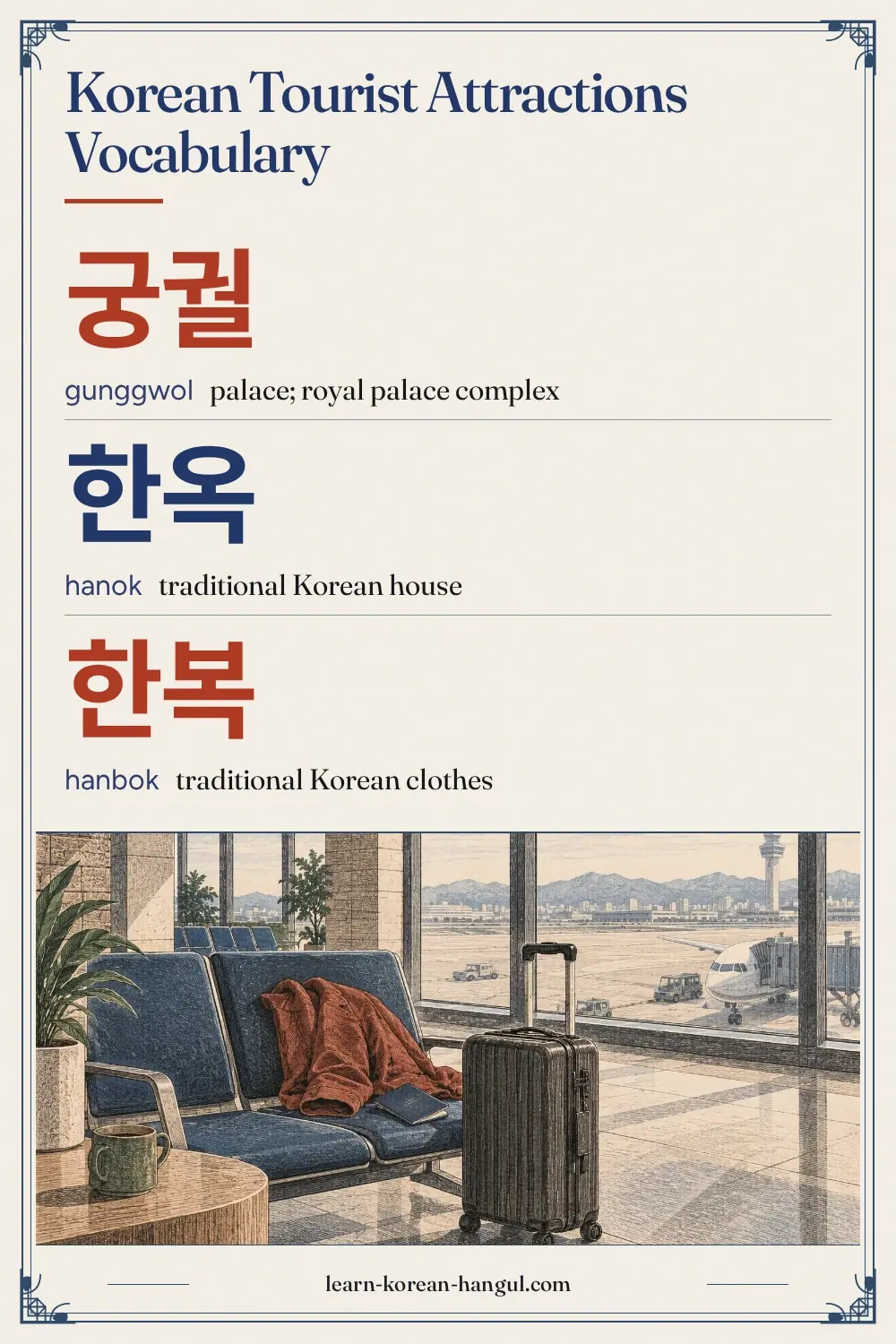
Korean Tourist Attractions Vocabulary at a Glance
The list has 35 words in five groups of seven. It follows a day of sightseeing: a palace in the morning, a museum, a market or a food street in the afternoon, a walk in nature and the tickets and desks that make it possible. It belongs to Travel and Airport, and it is the third deeper page after the airport and Korean Immigration and Visa Vocabulary. Many place names end in a short word you can reuse: 궁 (palace), 관 (hall), 장 (market or place) and 산 (mountain).
| Group | Words | Use |
|---|---|---|
| Palaces and heritage | 7 | Palaces, hanok, temples and sites |
| Museums and art | 7 | Museums, exhibitions and guides |
| Markets and districts | 7 | Markets, food streets and shopping |
| Nature and islands | 7 | Mountains, sea, parks and islands |
| Tours and tickets | 7 | Sightseeing, fees and information |
Which Tourist Attraction Words Should You Learn First?
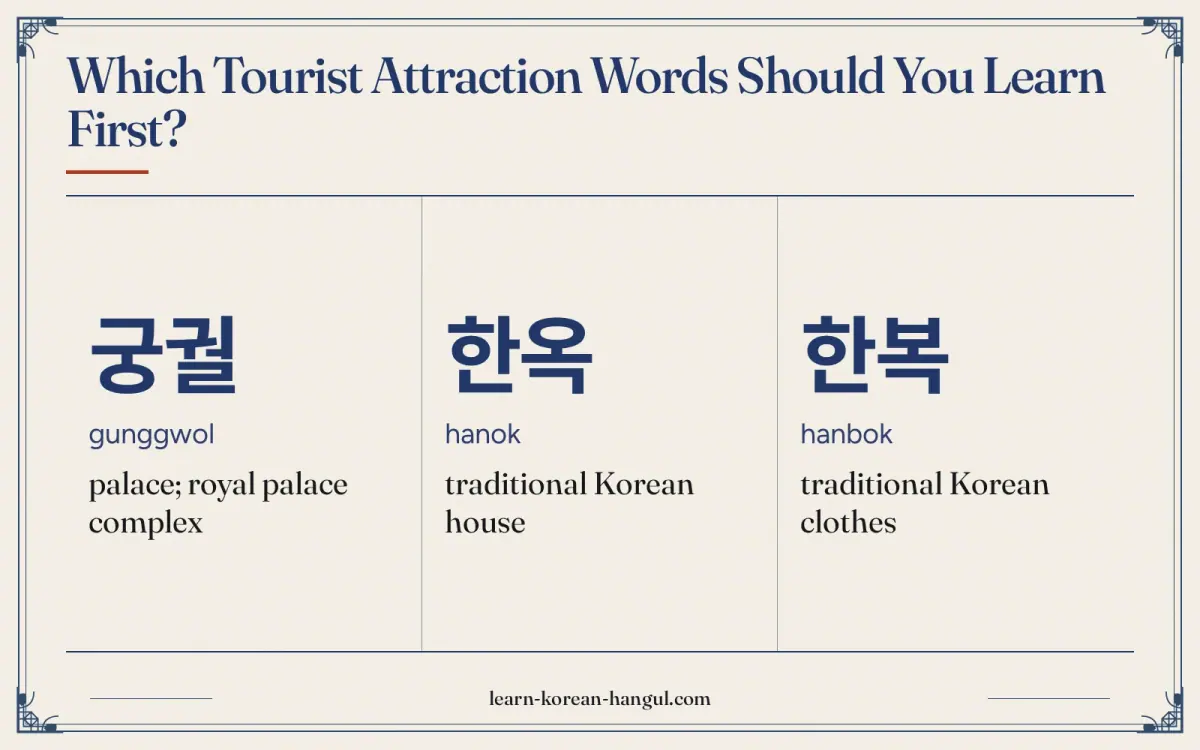
Learn 관광 (sightseeing), 박물관 (museum), 시장 (market), 입장료 (admission fee) and 무료 (free) first. They let you ask where to go and how much it costs. Add 궁궐 and 한복 if you plan to visit a palace, and 등산 if you plan to hike.
- Words to say. 관광, 박물관, 시장, 입장료, 무료.
- Words to recognise. 문화재, 관람, 안내소, 기념품. They are printed on signs and tickets.
- Words for trips outside the city. 산, 바다, 섬, 해변, 국립공원.
The scene below numbers ten of the 35 words, from the palace to the souvenir shop. Play the clip on each item to hear the headword.
Word · 10
- 1
궁궐
gunggwol
palace; royal palace complex
- 2
한옥
hanok
traditional Korean house
- 3
한복
hanbok
traditional Korean clothes
- 4
박물관
bangmulgwan
museum
- 5
시장
sijang
market
- 6
야시장
yasijang
night market
- 7
산
san
mountain
- 8
섬
seom
island
- 9
입장료
ipjangnyo
admission fee
- 10
기념품
ginyeompum
souvenir
Palaces and Heritage
The oldest sights in Seoul are the royal palaces of the Joseon dynasty, and the words for them are the first ones visitors need. 궁궐 is the general word for a palace complex, and individual palaces end in 궁, as in 경복궁. Around the palaces you find the traditional house, 한옥, and the traditional clothes, 한복, that many visitors wear for photos. The group also covers temples and the wider idea of heritage.
| No. | Hangul | Revised Romanization | Meaning and note | Example sentence | Audio assetId |
|---|---|---|---|---|---|
| 1 | 궁궐 | gunggwol | palace; royal palace complex. The word for the royal palaces of the Joseon dynasty. | 궁궐을 구경해요. (I look around the palace.) | au-pg-vocabulary-places-travel-attractions-1; example: au-pg-vocabulary-places-travel-attractions-36 |
| 2 | 경복궁 | Gyeongbokgung | Gyeongbokgung Palace. The main Joseon palace, in Seoul. 궁 at the end of a name means palace. | 경복궁은 서울에 있어요. (Gyeongbokgung is in Seoul.) | au-pg-vocabulary-places-travel-attractions-2; example: au-pg-vocabulary-places-travel-attractions-37 |
| 3 | 한옥 | hanok | traditional Korean house. Said [하녹]. Hanok villages are popular places to walk. | 한옥 마을에 가요. (I go to a hanok village.) | au-pg-vocabulary-places-travel-attractions-3; example: au-pg-vocabulary-places-travel-attractions-38 |
| 4 | 한복 | hanbok | traditional Korean clothes. Visitors can rent it near the main palaces. | 한복을 입어 봐요. (I try on a hanbok.) | au-pg-vocabulary-places-travel-attractions-4; example: au-pg-vocabulary-places-travel-attractions-39 |
| 5 | 문화재 | munhwajae | cultural property; heritage. 문화 (culture) plus 재 (property). | 이 건물은 문화재예요. (This building is a cultural property.) | au-pg-vocabulary-places-travel-attractions-5; example: au-pg-vocabulary-places-travel-attractions-40 |
| 6 | 유적지 | yujeokji | historic site. Said [유적찌]. 유적 is a remain and 지 is a place. | 유적지를 천천히 걸어요. (I walk slowly around the historic site.) | au-pg-vocabulary-places-travel-attractions-6; example: au-pg-vocabulary-places-travel-attractions-41 |
| 7 | 사찰 | sachal | Buddhist temple. The formal word. In speech people say 절. | 산속 사찰에 가요. (I go to a temple in the mountains.) | au-pg-vocabulary-places-travel-attractions-7; example: au-pg-vocabulary-places-travel-attractions-42 |
The word 문화재 is worth a note. It has long been the standard word for a cultural property, and the national agency was called the Cultural Heritage Administration (문화재청). In 2024 the agency was renamed the Korea Heritage Service (국가유산청), and official texts have begun to use 국가유산 (national heritage), although 문화재 is still widely used and still appears on older signs. For opening days, ticket prices and any rules about hanbok, check the official site of the palace or the agency, because they change. The verb 구경하다 (look around) in the first example is the everyday verb for sightseeing on foot. The palaces page goes deeper into palace vocabulary, and the single-word page on palace in Korean covers 궁 and 궁궐.
How Do You Say Museums and Art in Korean?
Korea has many museums, from national museums with palace-age relics to small private galleries. Two words name the building: 박물관 for a museum of history and objects, and 미술관 for a museum of art. Inside, you look at 유물 (relics) or 작품 (works), you may join a 도슨트 tour and you check the 관람 hours before you go. The same ending 관 (hall) appears in the library, 도서관, so the pattern is easy to carry over.
| No. | Hangul | Revised Romanization | Meaning and note | Example sentence | Audio assetId |
|---|---|---|---|---|---|
| 8 | 박물관 | bangmulgwan | museum. Said [방물관]. 관 means a hall. | 박물관에서 오래된 물건을 봐요. (I see old objects in the museum.) | au-pg-vocabulary-places-travel-attractions-8; example: au-pg-vocabulary-places-travel-attractions-43 |
| 9 | 미술관 | misulgwan | art museum; gallery. 미술 means fine art. | 미술관에서 그림을 봐요. (I look at paintings in the art museum.) | au-pg-vocabulary-places-travel-attractions-9; example: au-pg-vocabulary-places-travel-attractions-44 |
| 10 | 전시회 | jeonsihoe | exhibition. 전시 is a display and 회 is an event. | 전시회가 다음 주에 열려요. (The exhibition opens next week.) | au-pg-vocabulary-places-travel-attractions-10; example: au-pg-vocabulary-places-travel-attractions-45 |
| 11 | 작품 | jakpum | artwork; a work. Used for paintings, films and books. | 이 작품이 마음에 들어요. (I like this work.) | au-pg-vocabulary-places-travel-attractions-11; example: au-pg-vocabulary-places-travel-attractions-46 |
| 12 | 유물 | yumul | relic; artifact. An object left from the past. | 유물은 유리 안에 있어요. (The artifacts are inside glass.) | au-pg-vocabulary-places-travel-attractions-12; example: au-pg-vocabulary-places-travel-attractions-47 |
| 13 | 도슨트 | doseonteu | docent; museum guide. A loanword for a guide who explains a museum. | 도슨트가 설명해 줘요. (The docent explains it to us.) | au-pg-vocabulary-places-travel-attractions-13; example: au-pg-vocabulary-places-travel-attractions-48 |
| 14 | 관람 | gwallam | viewing; visiting an exhibit. Said [괄람], and RR follows the sound. | 관람 시간을 확인해요. (I check the viewing hours.) | au-pg-vocabulary-places-travel-attractions-14; example: au-pg-vocabulary-places-travel-attractions-49 |
Use 박물관 for a place of history and 미술관 for a place of paintings and sculpture. The line is not strict, but the word tells you what to expect. The noun 관람 means going to see something that is displayed, and it is used for exhibitions, films and sports matches, so 영화 관람 is watching a film in a cinema. Where 전시 describes the exhibitor's side (putting things on display), 관람 describes the visitor's side. Tour guides at museums and palaces often give their explanations at fixed times, and the schedule is usually posted at the entrance. A 도슨트 (the English word docent) is a guide who explains the exhibits; 가이드 in the last group is the broader word for a guide of any kind.
Markets and Districts
Markets and busy streets are where most visitors eat and shop. A 시장 is any market, a 전통시장 is a traditional market of small stalls, and a 야시장 is held at night. A 골목 is a narrow lane, and a 먹자골목 is a lane lined with restaurants where you walk and choose. The 번화가 is the busy district around them, and 쇼핑 is what you do there.
| No. | Hangul | Revised Romanization | Meaning and note | Example sentence | Audio assetId |
|---|---|---|---|---|---|
| 15 | 시장 | sijang | market. The general word for a market. | 시장에서 과일을 사요. (I buy fruit at the market.) | au-pg-vocabulary-places-travel-attractions-15; example: au-pg-vocabulary-places-travel-attractions-50 |
| 16 | 전통시장 | jeontongsijang | traditional market. 전통 means tradition. | 전통시장은 구경할 것이 많아요. (A traditional market has a lot to see.) | au-pg-vocabulary-places-travel-attractions-16; example: au-pg-vocabulary-places-travel-attractions-51 |
| 17 | 야시장 | yasijang | night market. 야 means night. | 야시장에서 길거리 음식을 먹어요. (I eat street food at the night market.) | au-pg-vocabulary-places-travel-attractions-17; example: au-pg-vocabulary-places-travel-attractions-52 |
| 18 | 골목 | golmok | alley; lane. A narrow lane between buildings. | 골목이 좁아요. (The alley is narrow.) | au-pg-vocabulary-places-travel-attractions-18; example: au-pg-vocabulary-places-travel-attractions-53 |
| 19 | 먹자골목 | meokjagolmok | food street; eating alley. Said [먹짜골목]. 먹자 means "let's eat". | 먹자골목에서 저녁을 먹어요. (I eat dinner in the food alley.) | au-pg-vocabulary-places-travel-attractions-19; example: au-pg-vocabulary-places-travel-attractions-54 |
| 20 | 번화가 | beonhwaga | busy downtown area. A lively shopping and eating district. | 번화가는 밤에도 밝아요. (The busy district is bright even at night.) | au-pg-vocabulary-places-travel-attractions-20; example: au-pg-vocabulary-places-travel-attractions-55 |
| 21 | 쇼핑 | syoping | shopping. A loanword; the verb is 쇼핑하다. | 명동에서 쇼핑해요. (I shop in Myeongdong.) | au-pg-vocabulary-places-travel-attractions-21; example: au-pg-vocabulary-places-travel-attractions-56 |
The word 먹자골목 is a compound of two ideas: 먹자, from 먹다 (to eat) in its "let's" form, and 골목. It is a good example of how Korean builds place names from a verb. The tense sound in [먹짜골목] comes from the ㅈ after the final ㄱ of 먹. Notice also the loanword 쇼핑. Revised Romanization writes syoping, with sy for ㅅ plus ㅛ, not shoping. A name such as 명동 (Myeongdong) is a district well known for shopping, and 동 at the end of a district name means neighbourhood. Opening hours of markets and night markets vary by day and season, so check before you go.
How Do You Say Nature and Islands in Korean?
Away from the city, the attractions are mountains, coasts and islands. Korea is a mountainous country, and 등산 (hiking) is a popular weekend activity, so the word 산 appears in many names. The sea is 바다, a beach is 해변 and an island is 섬. Jeju, 제주도, is the best-known island, and many visitors reach it by plane. The group ends with 국립공원, the protected national parks.
| No. | Hangul | Revised Romanization | Meaning and note | Example sentence | Audio assetId |
|---|---|---|---|---|---|
| 22 | 산 | san | mountain. Also written -san at the end of mountain names. | 서울에는 산이 많아요. (There are many mountains in Seoul.) | au-pg-vocabulary-places-travel-attractions-22; example: au-pg-vocabulary-places-travel-attractions-57 |
| 23 | 등산 | deungsan | hiking; mountain climbing. A very common weekend activity. | 주말에 등산해요. (I go hiking on weekends.) | au-pg-vocabulary-places-travel-attractions-23; example: au-pg-vocabulary-places-travel-attractions-58 |
| 24 | 바다 | bada | sea. The general word for the sea. | 바다가 보여요. (I can see the sea.) | au-pg-vocabulary-places-travel-attractions-24; example: au-pg-vocabulary-places-travel-attractions-59 |
| 25 | 해변 | haebyeon | beach. 해 means sea and 변 means edge. | 해변에서 산책해요. (I take a walk on the beach.) | au-pg-vocabulary-places-travel-attractions-25; example: au-pg-vocabulary-places-travel-attractions-60 |
| 26 | 섬 | seom | island. Jeju, 제주도, is the largest island. | 제주도는 큰 섬이에요. (Jeju is a big island.) | au-pg-vocabulary-places-travel-attractions-26; example: au-pg-vocabulary-places-travel-attractions-61 |
| 27 | 폭포 | pokpo | waterfall. Written -pokpo in place names. | 폭포 소리가 커요. (The sound of the waterfall is loud.) | au-pg-vocabulary-places-travel-attractions-27; example: au-pg-vocabulary-places-travel-attractions-62 |
| 28 | 국립공원 | gungnipgongwon | national park. Said [궁닙공원]. 국립 means national. | 국립공원에서 사진을 찍어요. (I take photos in the national park.) | au-pg-vocabulary-places-travel-attractions-28; example: au-pg-vocabulary-places-travel-attractions-63 |
Place names combine these words with a Sino-Korean or native ending. A mountain name takes -산 (설악산, Seoraksan), an island takes -도 (제주도, Jejudo) and a waterfall takes -폭포. The suffix 도 (island) is a different word from 도 (province), which is the same sound. Context separates them: 제주도 is both an island and a province. The word 해변 is a written, slightly formal word, and in speech people also say 바닷가 (the seaside). The verb 산책하다 (to take a walk) in the example gives 산책해요 and is used for any easy outdoor walk. For hiking, trail names, signs and opening rules are posted at park entrances and on the national park service's official site.
Tours and Tickets
The last group is the vocabulary of the visit itself. 관광 is sightseeing, a 관광지 is a place for it, and the 입장료 is what you pay to go in. Some places are 무료, and most have an 안내소 where you can pick up a map or ask a question. A 가이드 can lead the tour, and you may leave with a 기념품. These words are on tickets, brochures and signs more than in speech.
| No. | Hangul | Revised Romanization | Meaning and note | Example sentence | Audio assetId |
|---|---|---|---|---|---|
| 29 | 관광 | gwangwang | sightseeing; tourism. Narrower than 여행 (travel): it means looking at sights. | 서울 관광을 해요. (I go sightseeing in Seoul.) | au-pg-vocabulary-places-travel-attractions-29; example: au-pg-vocabulary-places-travel-attractions-64 |
| 30 | 관광지 | gwangwangji | tourist spot. 지 means a place. | 이곳은 유명한 관광지예요. (This is a famous tourist spot.) | au-pg-vocabulary-places-travel-attractions-30; example: au-pg-vocabulary-places-travel-attractions-65 |
| 31 | 입장료 | ipjangnyo | admission fee. Said [입짱뇨]. 입장 is entering and 료 is a fee. | 입장료가 얼마예요? (How much is the admission fee?) | au-pg-vocabulary-places-travel-attractions-31; example: au-pg-vocabulary-places-travel-attractions-66 |
| 32 | 무료 | muryo | free of charge. The word on signs. In speech people also say 공짜. | 오늘은 입장이 무료예요. (Admission is free today.) | au-pg-vocabulary-places-travel-attractions-32; example: au-pg-vocabulary-places-travel-attractions-67 |
| 33 | 안내소 | annaeso | information desk. 소 means a place. | 안내소에서 지도를 받아요. (I get a map at the information desk.) | au-pg-vocabulary-places-travel-attractions-33; example: au-pg-vocabulary-places-travel-attractions-68 |
| 34 | 가이드 | gaideu | guide. A loanword for a person or a guidebook. | 가이드가 한국어로 설명해요. (The guide explains in Korean.) | au-pg-vocabulary-places-travel-attractions-34; example: au-pg-vocabulary-places-travel-attractions-69 |
| 35 | 기념품 | ginyeompum | souvenir. 기념 means commemoration and 품 means goods. | 기념품을 사요. (I buy a souvenir.) | au-pg-vocabulary-places-travel-attractions-35; example: au-pg-vocabulary-places-travel-attractions-70 |
The words 관광 and 여행 overlap but are not the same. 여행 is a trip of any kind, so 해외여행 is a trip abroad. 관광 is the sightseeing part, so a 관광버스 is a tour bus. If you say 한국 관광 the listener hears "tourism in Korea", and if you say 한국 여행 they hear "a trip to Korea". Tickets are counted with 장, and the question 몇 장 필요해요? (how many tickets do you need?) is common at the entrance. Fees for children and groups are often posted by the ticket office. A price is shown as a number plus 원, and the Korean won page explains how to read it.
How Do You Pronounce These Words?
Tourist words contain many nasal sounds, tense sounds and linked syllables, so say them aloud before you rely on the spelling. A final ㄱ before ㅁ or ㄹ becomes ㅇ, ㄴ next to ㄹ turns to ㄹ, and a plain ㅈ after a final consonant is often tense. Standard pronunciation follows the National Institute of Korean Language (국립국어원) rules. Revised Romanization shows the nasal and linking changes but not the tensing.
| Spelling | Sounds like | What changes |
|---|---|---|
| 박물관 | [방물관] | The final ㄱ of 박 becomes ㅇ before ㅁ. |
| 관람 | [괄람] | The ㄴ of 관 becomes ㄹ before ㄹ. |
| 입장료 | [입짱뇨] | The ㅈ after the final ㅂ is tense, and the ㄹ of 료 becomes ㄴ after ㅇ. |
| 먹자골목 | [먹짜골목] | The ㅈ after the final ㄱ of 먹 is tense. |
| 국립공원 | [궁닙공원] | The ㄹ of 립 becomes ㄴ, then the final ㄱ of 국 becomes ㅇ before it. |
| 한옥 | [하녹] | The final ㄴ of 한 links to the vowel of 옥. |
Audio and Slow Playback
Each word and example has its own clip, and five more replay the hardest words slowly. Play 박물관 first and listen for the ng sound in the middle, then say 입장료 slowly and compare the tense ㅉ and the ny in the last syllable.
What Mistakes Do Learners Make with Tourist Attraction Words?
Five slips are common at Korean attractions.
- Using 관광 for any trip. 관광 is sightseeing. For a trip in general, say 여행. 한국 여행 is a trip to Korea, and 한국 관광 is tourism in Korea.
- Mixing 박물관 and 미술관. A 박물관 shows history and objects, and a 미술관 shows art. Ask for the one you want.
- Adding "palace" after a name that already has 궁. 경복궁 already means Gyeongbokgung Palace, so 경복궁 궁궐 repeats the word.
- Saying 입장료 as written. It is said [입짱뇨], with a tense sound and ny at the end. Reading it letter by letter sounds unnatural.
- Confusing 절 the temple with 절 the bow. 절 means both, and the verb separates them: 절에 가요 is "I go to a temple", and 절해요 is "I bow".
Use the full word 사찰 in writing and 절 in speech, and check the opening times and ticket rules on an official site before you travel, because they change from place to place.
Practice: Flashcards and Worksheet
Study in three steps. First, run the deck in recognition mode until the 35 words feel familiar. Second, switch to listening mode and play the clip before you flip each card. Third, take the five-question quiz. Your deck progress stays in your browser, and the vocabulary flashcard decks page lists the other decks.
Practice · 75
- 01궁궐
Show answer
headword 1: palace; royal palace complex
- 02경복궁
Show answer
headword 2: Gyeongbokgung Palace
- 03한옥
Show answer
headword 3: traditional Korean house
- 04한복
Show answer
headword 4: traditional Korean clothes
- 05문화재
Show answer
headword 5: cultural property; heritage
- 06유적지
Show answer
headword 6: historic site
- 07사찰
Show answer
headword 7: Buddhist temple
- 08박물관
Show answer
headword 8: museum
- 09미술관
Show answer
headword 9: art museum; gallery
- 10전시회
Show answer
headword 10: exhibition
- 11작품
Show answer
headword 11: artwork; a work
- 12유물
Show answer
headword 12: relic; artifact
- 13도슨트
Show answer
headword 13: docent; museum guide
- 14관람
Show answer
headword 14: viewing; visiting an exhibit
- 15시장
Show answer
headword 15: market
- 16전통시장
Show answer
headword 16: traditional market
- 17야시장
Show answer
headword 17: night market
- 18골목
Show answer
headword 18: alley; lane
- 19먹자골목
Show answer
headword 19: food street; eating alley
- 20번화가
Show answer
headword 20: busy downtown area
- 21쇼핑
Show answer
headword 21: shopping
- 22산
Show answer
headword 22: mountain
- 23등산
Show answer
headword 23: hiking; mountain climbing
- 24바다
Show answer
headword 24: sea
- 25해변
Show answer
headword 25: beach
- 26섬
Show answer
headword 26: island
- 27폭포
Show answer
headword 27: waterfall
- 28국립공원
Show answer
headword 28: national park
- 29관광
Show answer
headword 29: sightseeing; tourism
- 30관광지
Show answer
headword 30: tourist spot
- 31입장료
Show answer
headword 31: admission fee
- 32무료
Show answer
headword 32: free of charge
- 33안내소
Show answer
headword 33: information desk
- 34가이드
Show answer
headword 34: guide
- 35기념품
Show answer
headword 35: souvenir
- 36궁궐을 구경해요.
Show answer
example sentence for 궁궐
- 37경복궁은 서울에 있어요.
Show answer
example sentence for 경복궁
- 38한옥 마을에 가요.
Show answer
example sentence for 한옥
- 39한복을 입어 봐요.
Show answer
example sentence for 한복
- 40이 건물은 문화재예요.
Show answer
example sentence for 문화재
- 41유적지를 천천히 걸어요.
Show answer
example sentence for 유적지
- 42산속 사찰에 가요.
Show answer
example sentence for 사찰
- 43박물관에서 오래된 물건을 봐요.
Show answer
example sentence for 박물관
- 44미술관에서 그림을 봐요.
Show answer
example sentence for 미술관
- 45전시회가 다음 주에 열려요.
Show answer
example sentence for 전시회
- 46이 작품이 마음에 들어요.
Show answer
example sentence for 작품
- 47유물은 유리 안에 있어요.
Show answer
example sentence for 유물
- 48도슨트가 설명해 줘요.
Show answer
example sentence for 도슨트
- 49관람 시간을 확인해요.
Show answer
example sentence for 관람
- 50시장에서 과일을 사요.
Show answer
example sentence for 시장
- 51전통시장은 구경할 것이 많아요.
Show answer
example sentence for 전통시장
- 52야시장에서 길거리 음식을 먹어요.
Show answer
example sentence for 야시장
- 53골목이 좁아요.
Show answer
example sentence for 골목
- 54먹자골목에서 저녁을 먹어요.
Show answer
example sentence for 먹자골목
- 55번화가는 밤에도 밝아요.
Show answer
example sentence for 번화가
- 56명동에서 쇼핑해요.
Show answer
example sentence for 쇼핑
- 57서울에는 산이 많아요.
Show answer
example sentence for 산
- 58주말에 등산해요.
Show answer
example sentence for 등산
- 59바다가 보여요.
Show answer
example sentence for 바다
- 60해변에서 산책해요.
Show answer
example sentence for 해변
- 61제주도는 큰 섬이에요.
Show answer
example sentence for 섬
- 62폭포 소리가 커요.
Show answer
example sentence for 폭포
- 63국립공원에서 사진을 찍어요.
Show answer
example sentence for 국립공원
- 64서울 관광을 해요.
Show answer
example sentence for 관광
- 65이곳은 유명한 관광지예요.
Show answer
example sentence for 관광지
- 66입장료가 얼마예요?
Show answer
example sentence for 입장료
- 67오늘은 입장이 무료예요.
Show answer
example sentence for 무료
- 68안내소에서 지도를 받아요.
Show answer
example sentence for 안내소
- 69가이드가 한국어로 설명해요.
Show answer
example sentence for 가이드
- 70기념품을 사요.
Show answer
example sentence for 기념품
- 71박물관
Show answer
slow playback: museum
- 72입장료
Show answer
slow playback: admission fee
- 73국립공원
Show answer
slow playback: national park
- 74먹자골목
Show answer
slow playback: food street; eating alley
- 75관람
Show answer
slow playback: viewing; visiting an exhibit
Practice · 5
What does 한복 (hanbok) mean?
Show answer
traditional Korean clothes
한복 means traditional Korean clothes. Example: 한복을 입어 봐요. (I try on a hanbok.)
What does 박물관 (bangmulgwan) mean?
Show answer
museum
박물관 means museum. Example: 박물관에서 오래된 물건을 봐요. (I see old objects in the museum.)
What does 시장 (sijang) mean?
Show answer
market
시장 means market. Example: 시장에서 과일을 사요. (I buy fruit at the market.)
What does 섬 (seom) mean?
Show answer
island
섬 means island. Example: 제주도는 큰 섬이에요. (Jeju is a big island.)
What does 입장료 (ipjangnyo) mean?
Show answer
admission fee
입장료 means admission fee. Example: 입장료가 얼마예요? (How much is the admission fee?)
Korean Tourist Attractions Vocabulary Worksheet (PDF)
A printable worksheet for these words (word list, matching, writing practice, fill-in-the-blank exercises and answer key) is available in A4 and US Letter from the download card on this page. Meanwhile, plan a day out in Korean: write one sentence for a palace, a museum, a market, a walk and a ticket, and say each aloud.
Where to Go Next
After this page, continue with Korean Immigration and Visa Vocabulary for the words you meet at passport control, or go back to Travel and Airport for the airport and planning lists. For palace and heritage words in more depth, see palaces.
Frequently Asked Questions
How Do You Say Sightseeing in Korean?
Sightseeing is 관광 (gwangwang). A tourist spot is a 관광지, and a tour bus is a 관광버스. For a trip in general, use 여행 (yeohaeng). You can say 서울 관광을 해요 for I go sightseeing in Seoul, using 하다 (to do).
How Do You Pronounce 관광지 (gwangwangji)?
Say gwan-gwang-ji in three even beats. The first two syllables start with gw, a quick g plus w, and the second ends with the ng sound, as in "sing". The standard pronunciation is [관광지], with no sound change. Press the audio button to hear it.
How Many Tourist Attraction Words Should I Learn First?
Five: 관광, 박물관, 시장, 입장료 and 무료. They cover where to go and how much it costs. At five new words a day the full 35 take a week plus review. Add 궁궐 and 한복 if you plan to visit a palace.
Where Can I Practise Tourist Attraction Words with Flashcards?
Use the vocabulary flashcard decks. The deck for this page holds all 35 words with Hangul, romanization and audio. Your progress stays in your browser. Try listening mode on 박물관, 입장료 and 국립공원, because their spoken forms differ from the spelling.
Is the Romanization on This Page Official?
It follows the Revised Romanization of Korean, which South Korea adopted on 7 July 2000 and whose rules the National Institute of Korean Language (국립국어원) publishes. It is a learning aid. It shows nasal changes such as bangmulgwan, but it does not show tensing caused by a neighbouring sound, such as the [ㅉ] in 입장료 [입짱뇨], so rely on the Hangul and the audio.
Is There a Printable Worksheet for Tourist Attraction Words?
A printable worksheet for these words (word list, matching, writing practice, fill-in-the-blank exercises and answer key) is available in A4 and US Letter from the download card on this page. For practice, copy the tables by hand and write one example sentence for each of the five groups.