Korean Tools and Hardware Vocabulary at a Glance
The list follows a small repair job. You walk into a 철물점, name the tool, pick the right fastener, check the size and the safety gear, and then finish the work. That is why the groups run from hand tools to power tools, then fasteners, then measuring and safety, and last repair and DIY. The page belongs to House and Home and it sits next to the Korean Everyday Objects Vocabulary page, which covers the household items you already own.
| Group | Words | Use |
|---|---|---|
| Hand tools | 6 | Naming the tools you hold in your hand |
| Power tools and electricity | 6 | Naming powered tools and what they run on |
| Fasteners and hardware | 6 | Choosing nails, screws, bolts and adhesives |
| Measuring and safety | 6 | Measuring, protecting yourself and reading warnings |
| Repair and DIY | 6 | Talking about repair jobs and where to buy supplies |
Almost every word here is a noun. Only a handful behave differently: 못 also has a second life as the adverb for cannot, 위험 and 주의 are sign words that take 하다 to become a describing word or a verb, and 공사 is the word on the sign outside a building site. The next section ranks the words by how soon you will need them.
Which Tools and Hardware Words Should You Learn First?
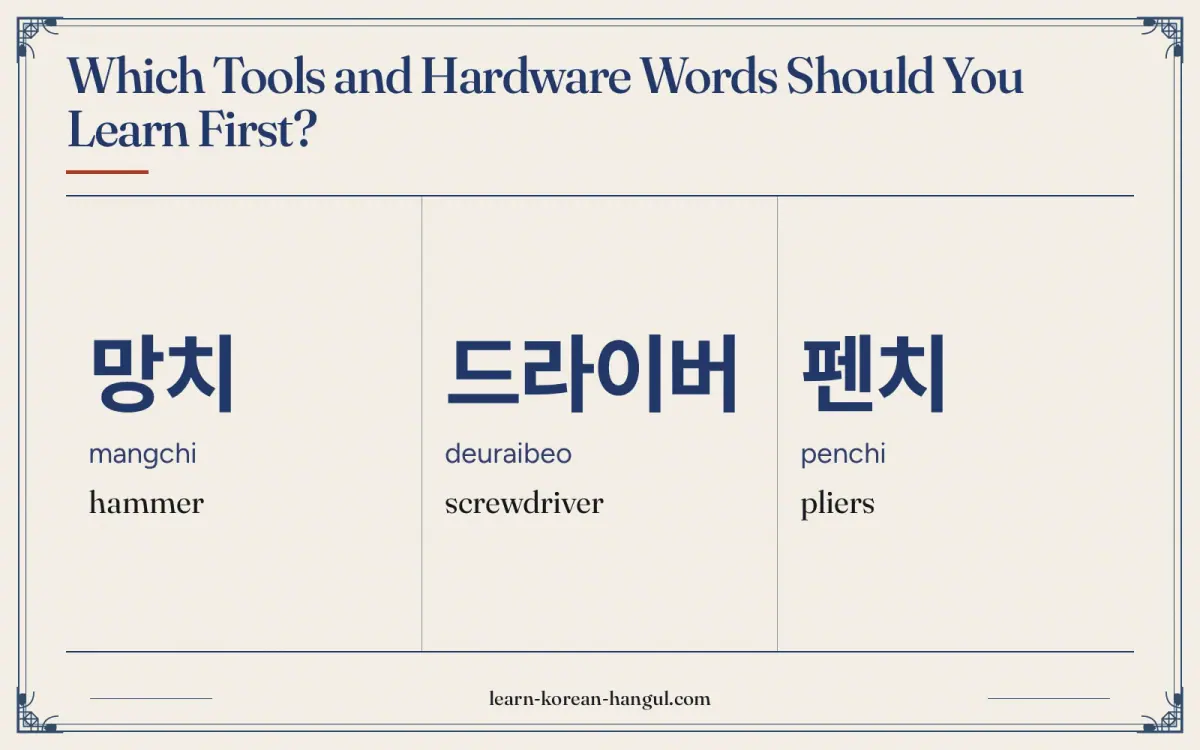
Learn 망치 (hammer), 드라이버 (screwdriver), 못 (nail), 나사 (screw) and 철물점 (hardware shop) first. With those five you can walk into a shop, name the thing you need and say where you are shopping. Add 펜치 (pliers) and 톱 (saw) when you start real repair work.
- Words to say. 망치, 드라이버, 펜치, 못, 나사, 테이프. These are the things you ask a shop owner for.
- Words to recognise. 위험, 주의, 공사. You read these on signs and fences, so you do not need to say them.
- Words to understand when spoken. 수리 and 공사 in a landlord's or building manager's message, and the size and count words below.
Many learners meet this vocabulary in a rented flat. A shelf has to go up, a drawer handle comes loose, or a landlord says a repair person is coming. If you plan to rent in Korea, learn the third group, fasteners, before the power tools.
At the counter, sizes are given in millimetres and centimetres, and Korean uses Sino-Korean numbers for those units. A 30 mm screw is 삼십 밀리 나사 (samsip milli nasa), and a 2 cm nail is 이 센티 못 (i senti mot). Counts of items use native numbers and the counter 개: 못 열 개 (mot yeol gae) is ten nails. The page on counting things explains why 열 stays 열 before 개 and why 하나 shortens to 한.
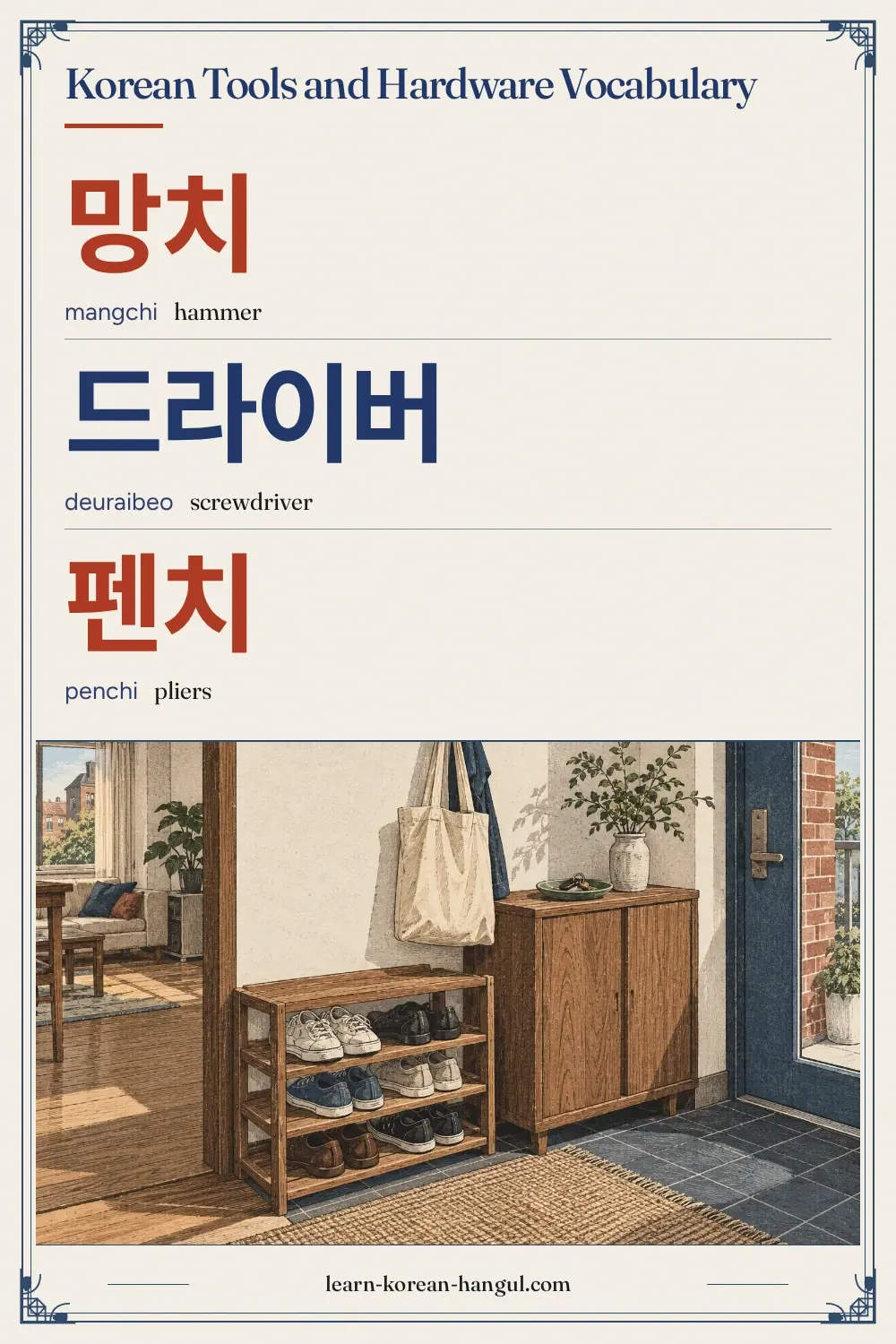
This scene puts eight of the 30 words on one picture, so you can see what each one looks like.
Word · 8
- 1
망치
mangchi
hammer
- 2
드라이버
deuraibeo
screwdriver
- 3
펜치
penchi
pliers
- 4
톱
top
saw
- 5
드릴
deuril
drill
- 6
못
mot
nail
- 7
나사
nasa
screw
- 8
사다리
sadari
ladder
Where Do You Buy Tools in Korea?
The classic place is a 철물점, a small shop whose name means ironware shop. It stocks nails, screws, hinges, locks, pipe parts and simple tools, and the owner usually knows where everything is. Learners do well here because you can ask for an item by pointing, then learn its name. The owner is normally called 사장님 (sajangnim), a title for the person who runs a shop, rather than by name.
Larger home-improvement stores and cheap household-goods shops also sell basic tools, and many people buy small items online. The word list below works in all of them. When you cannot remember a name, say the job: 이거 어디에 써요? (Where do you use this?) is a safe, polite question, and the answer teaches you the word.
One more habit helps. Many tool names are loanwords, so sound out the Hangul slowly: 드라이버 read syllable by syllable is deu-ra-i-beo, and you will often hear the English word inside it.
Hand Tools
The first group holds the words for ordinary hand tools. 공구 (gonggu) is the general word for a tool, and the words after it name the five tools most households own. Notice how many are loanwords: 드라이버 and 렌치 came into Korean from English and 펜치 came in through Japanese, while 망치 and 톱 are old native words that every Korean child knows.
| No. | Hangul | Revised Romanization | Meaning and note | Example sentence | Audio assetId |
|---|---|---|---|---|---|
| 1 | 공구 | gonggu | tool. A general, slightly technical word, written on shop signs and toolboxes. In daily talk people often say 도구 for tool in a wider sense. | 공구가 필요해요. (I need tools.) | au-pg-vocabulary-daily-life-home-tools-1; example: au-pg-vocabulary-daily-life-home-tools-31 |
| 2 | 망치 | mangchi | hammer. Native word. The verb 박다 means to drive in, as in a nail. | 망치로 못을 박아요. (I drive in a nail with a hammer.) | au-pg-vocabulary-daily-life-home-tools-2; example: au-pg-vocabulary-daily-life-home-tools-32 |
| 3 | 드라이버 | deuraibeo | screwdriver. Loanword from English driver. It can also mean a golf club or a software driver, so context matters. | 드라이버 있어요? (Do you have a screwdriver?) | au-pg-vocabulary-daily-life-home-tools-3; example: au-pg-vocabulary-daily-life-home-tools-33 |
| 4 | 펜치 | penchi | pliers. Loanword. Used for gripping and cutting wire. | 펜치로 전선을 잘라요. (I cut the wire with pliers.) | au-pg-vocabulary-daily-life-home-tools-4; example: au-pg-vocabulary-daily-life-home-tools-34 |
| 5 | 톱 | top | saw. Native word. Said [톱], with the lips closing on the final sound. | 톱이 날카로워요. (The saw is sharp.) | au-pg-vocabulary-daily-life-home-tools-5; example: au-pg-vocabulary-daily-life-home-tools-35 |
| 6 | 렌치 | renchi | wrench. Loanword. People also say 스패너 for an open-ended spanner. | 렌치 좀 주세요. (Please give me the wrench.) | au-pg-vocabulary-daily-life-home-tools-6; example: au-pg-vocabulary-daily-life-home-tools-36 |
With 주세요 (please give me) you can ask for any of these, and 좀 softens the request, as in 렌치 좀 주세요. The ending -(으)로 means with or by means of: it becomes 로 after a vowel, as in 망치로, and 으로 after a consonant, as in 톱으로. Say each sentence aloud after the audio, then change the tool and say it again.
Hand tools do the shaping. Power tools do the same work with electricity, and they come with their own vocabulary.
Power Tools and Electricity
Power tool names are almost all loanwords, so they are easy to guess once you know how Korean writes English sounds. 드릴 is drill, 그라인더 is grinder, and 배터리 is battery. Two plain Sino-Korean words, 충전기 and 전선, cover charging and wiring. All of them come up in a repair conversation.
| No. | Hangul | Revised Romanization | Meaning and note | Example sentence | Audio assetId |
|---|---|---|---|---|---|
| 7 | 드릴 | deuril | drill. Loanword. Said with the unrounded ㅡ in 드: spread the lips, do not round them. | 드릴로 벽에 구멍을 뚫어요. (I drill a hole in the wall with a drill.) | au-pg-vocabulary-daily-life-home-tools-7; example: au-pg-vocabulary-daily-life-home-tools-37 |
| 8 | 전기톱 | jeongitop | electric saw. 전기 (electricity) plus 톱 (saw). The same pattern names many powered tools. | 전기톱은 위험해요. (An electric saw is dangerous.) | au-pg-vocabulary-daily-life-home-tools-8; example: au-pg-vocabulary-daily-life-home-tools-38 |
| 9 | 그라인더 | geuraindeo | grinder. Loanword. The ㅓ in the last syllable is unrounded, as in 어. | 그라인더 소리가 커요. (The grinder is loud.) | au-pg-vocabulary-daily-life-home-tools-9; example: au-pg-vocabulary-daily-life-home-tools-39 |
| 10 | 배터리 | baeteori | battery. Loanword used for rechargeable batteries. Small household batteries are usually called 건전지. | 배터리가 없어요. (The battery is dead.) | au-pg-vocabulary-daily-life-home-tools-10; example: au-pg-vocabulary-daily-life-home-tools-40 |
| 11 | 충전기 | chungjeongi | charger. 충전 means charging and 기 means machine. | 충전기를 꽂아요. (I plug in the charger.) | au-pg-vocabulary-daily-life-home-tools-11; example: au-pg-vocabulary-daily-life-home-tools-41 |
| 12 | 전선 | jeonseon | electric wire; cable. 전 (electric) plus 선 (line). Also used for extension cords. | 전선을 연결해요. (I connect the wire.) | au-pg-vocabulary-daily-life-home-tools-12; example: au-pg-vocabulary-daily-life-home-tools-42 |
The verb 꽂다 (to plug in, to stick into) is the verb for a plug, a key or a flower in a vase. The verb 뚫다 (to drill through, to pierce) is said [뚤타] in its dictionary form but [뚜러요] in 뚫어요, because the ㅎ of the final cluster ㅀ is silent before a vowel and the ㄹ moves across.
These words matter most for safety. If a landlord says 전선 or 배터리 in a message about your flat, treat it as a reason to read the message slowly.
Next come the small pieces that hold things together.
Fasteners and Hardware
Fasteners are what you actually buy most often. 못 and 나사 are the two everyday words, and 볼트 and 너트 are always a pair. 접착제 and 테이프 cover the things that stick instead of screw. Shop shelves group them by size, so the size words in the earlier section help here.
| No. | Hangul | Revised Romanization | Meaning and note | Example sentence | Audio assetId |
|---|---|---|---|---|---|
| 13 | 못 | mot | nail. Native word. Said [몯] alone, but 못이 is said [모시]. The same sound is the adverb 못 (cannot). | 벽에 못이 있어요. (There is a nail in the wall.) | au-pg-vocabulary-daily-life-home-tools-13; example: au-pg-vocabulary-daily-life-home-tools-43 |
| 14 | 나사 | nasa | screw. A threaded fastener. Shops sort screws by length in millimetres and by head type. | 나사가 풀렸어요. (The screw came loose.) | au-pg-vocabulary-daily-life-home-tools-14; example: au-pg-vocabulary-daily-life-home-tools-44 |
| 15 | 볼트 | bolteu | bolt. Loanword. Almost always sold with a 너트. | 볼트를 조여 주세요. (Please tighten the bolt.) | au-pg-vocabulary-daily-life-home-tools-15; example: au-pg-vocabulary-daily-life-home-tools-45 |
| 16 | 너트 | neoteu | nut (hardware). Loanword. The ㅓ in 너 is unrounded. A nut you eat is a 견과 (edible nut), not a 너트. | 너트가 안 맞아요. (The nut does not fit.) | au-pg-vocabulary-daily-life-home-tools-16; example: au-pg-vocabulary-daily-life-home-tools-46 |
| 17 | 접착제 | jeopchakje | glue; adhesive. Said [접착쩨]. 접착 means sticking together and 제 marks a preparation or agent, as in 진통제. | 접착제로 붙여요. (I stick it with glue.) | au-pg-vocabulary-daily-life-home-tools-17; example: au-pg-vocabulary-daily-life-home-tools-47 |
| 18 | 테이프 | teipeu | tape. Loanword. It covers masking tape, packing tape and double-sided tape. | 테이프가 떨어졌어요. (I ran out of tape.) | au-pg-vocabulary-daily-life-home-tools-18; example: au-pg-vocabulary-daily-life-home-tools-48 |
Notice 조여 주세요. The verb 조이다 (to tighten) becomes 조여, and 주세요 turns it into a polite request, which is the same pattern as 렌치 좀 주세요. The frame verb + -아/어 주세요 is how you ask someone to do something for you, and it appears all through this page.
The word 못 deserves a warning. As a noun it is a nail. As an adverb it means cannot and goes in front of a verb, as in 못 가요 (I cannot go). A noun nail takes particles, as in 못을 and 못이, so the particle or the verb that follows tells you which 못 you are hearing.
Fasteners are chosen by size, and a mistake in size is the commonest repair error. That brings us to measuring and safety.
Measuring and Safety
The fourth group mixes a measuring tool with the gear and the signs that keep you safe. 줄자 is a tape measure. 안전모, 장갑 and 보안경 are protective gear. 위험 and 주의 are the two warning words that you will see on signs, fences and product labels long before you need to say them.
| No. | Hangul | Revised Romanization | Meaning and note | Example sentence | Audio assetId |
|---|---|---|---|---|---|
| 19 | 줄자 | julja | tape measure. Said [줄짜]. 줄 means line or string and 자 is a ruler. | 줄자로 길이를 재요. (I measure the length with a tape measure.) | au-pg-vocabulary-daily-life-home-tools-19; example: au-pg-vocabulary-daily-life-home-tools-49 |
| 20 | 안전모 | anjeonmo | hard hat; safety helmet. 안전 means safety and 모 means hat. Worn on building sites. | 안전모를 써요. (I wear a hard hat.) | au-pg-vocabulary-daily-life-home-tools-20; example: au-pg-vocabulary-daily-life-home-tools-50 |
| 21 | 장갑 | janggap | gloves. Used with the verb 끼다, to put on something that fits closely. | 장갑을 껴요. (I put on gloves.) | au-pg-vocabulary-daily-life-home-tools-21; example: au-pg-vocabulary-daily-life-home-tools-51 |
| 22 | 보안경 | boangyeong | safety glasses. 보 (protect) plus 안경 (glasses). Said as written: bo-an-gyeong. | 보안경을 챙겨요. (I bring safety glasses.) | au-pg-vocabulary-daily-life-home-tools-22; example: au-pg-vocabulary-daily-life-home-tools-52 |
| 23 | 위험 | wiheom | danger; dangerous. Add 하다 to make an adjective: 위험하다. It is a sign word that you can read before you can say it. | 여기는 위험해요. (It is dangerous here.) | au-pg-vocabulary-daily-life-home-tools-23; example: au-pg-vocabulary-daily-life-home-tools-53 |
| 24 | 주의 | juui | caution; attention. Said [주의] or [주이]. Add 하다 for the verb: 주의하세요 is a polite request to be careful. | 주의하세요. (Please be careful.) | au-pg-vocabulary-daily-life-home-tools-24; example: au-pg-vocabulary-daily-life-home-tools-54 |
Two sign phrases are worth recognising. 공사 중 (gongsa jung) means under construction. 감전 주의 (gamjeon juui) means beware of electric shock. You can learn both by recognising 주의 and 공사 from this list.
Korean units of length follow the metric system: 밀리미터 (millimetre), 센티미터 (centimetre) and 미터 (metre), usually shortened in speech to 밀리, 센티 and 미터. The measuring verb is 재다, as in 길이를 재요 (I measure the length). The related noun 길이 (length) is said [기리] because the ㄹ moves across to the vowel.
Safety words let you read a site. The last group is for talking about the work itself.
Repair and DIY
The last group is the work itself. 철물점 is the shop where you buy supplies. 수리 is repair, and 공사 is a larger construction or renovation job. 페인트 and 사다리 are two things almost every home job needs, and 공구함 is the box that holds your tools.
| No. | Hangul | Revised Romanization | Meaning and note | Example sentence | Audio assetId |
|---|---|---|---|---|---|
| 25 | 철물점 | cheolmuljeom | hardware store. Said [철물쩜]. 철물 means ironware. The small neighbourhood shop that sells nails, screws and simple tools. | 철물점에 가요. (I go to the hardware store.) | au-pg-vocabulary-daily-life-home-tools-25; example: au-pg-vocabulary-daily-life-home-tools-55 |
| 26 | 수리 | suri | repair. A noun. Add 하다 for the verb 수리하다 (to repair). Also the word on repair-shop signs. | 수리를 맡겨요. (I leave it for repair.) | au-pg-vocabulary-daily-life-home-tools-26; example: au-pg-vocabulary-daily-life-home-tools-56 |
| 27 | 공사 | gongsa | construction work. Used for building and renovation work, including road works. The sign 공사 중 means under construction. | 공사 중이에요. (It is under construction.) | au-pg-vocabulary-daily-life-home-tools-27; example: au-pg-vocabulary-daily-life-home-tools-57 |
| 28 | 페인트 | peinteu | paint. Loanword. The verb 칠하다 means to paint or coat a surface. | 페인트를 칠해요. (I paint it.) | au-pg-vocabulary-daily-life-home-tools-28; example: au-pg-vocabulary-daily-life-home-tools-58 |
| 29 | 사다리 | sadari | ladder. Native word. The verb 올라가다 means to go up. | 사다리를 올라가요. (I climb up the ladder.) | au-pg-vocabulary-daily-life-home-tools-29; example: au-pg-vocabulary-daily-life-home-tools-59 |
| 30 | 공구함 | gongguham | toolbox. 공구 (tool) plus 함 (box). | 공구함이 어디에 있어요? (Where is the toolbox?) | au-pg-vocabulary-daily-life-home-tools-30; example: au-pg-vocabulary-daily-life-home-tools-60 |
The verb 맡기다 (to leave something with someone, to entrust it) is the natural verb for a repair: you leave the object with a repair person. If you do the job yourself, the verb is 고치다 (to fix, to mend), as in 제가 고쳐요 (I fix it).
Putting a short job together uses almost every group. For a loose shelf you would say: 철물점에 가요. 나사하고 드라이버가 필요해요. (I go to the hardware store. I need screws and a screwdriver.) Read that aloud, then swap in 못 and 망치.
Which Tools and Hardware Words Come from English?
A third of this list, ten words, are loanwords, and they follow predictable patterns. Korean writes English sounds with its own letters and adds a vowel after a final consonant: bolt becomes 볼트 (bol-teu), nut becomes 너트 (neo-teu), paint becomes 페인트 (pe-in-teu) and tape becomes 테이프 (te-i-peu). The extra ㅡ vowel is why English words look longer in Hangul.
Several tool words keep a meaning that English does not have. 드라이버 is a screwdriver here, but it is also the golf club called a driver. 배터리 is a rechargeable battery, while 건전지 is the dry cell in a remote control. Native words such as 망치, 톱, 못 and 사다리 are the oldest names on the page. A few words, such as 공구, 수리 and 안전모, are built from Sino-Korean syllables, so the same syllable appears again in other words: 공 (work) appears in 공구, 공사 and 공구함.
A good study habit is to group by shape: the loanwords give you a guess from English, and the Sino-Korean words give you reusable syllables.
How Do You Pronounce These Words?
Tools and hardware words contain several sound changes, because many end in a consonant that changes before the next sound. Standard pronunciation follows the National Institute of Korean Language (국립국어원) rules. The romanization follows the Revised Romanization of Korean, which writes tense letters such as kk and tt but does not show tensing caused by a neighbouring sound.
| Spelling | Sounds like | What changes |
|---|---|---|
| 못 | [몯] | A final ㅅ is said as ㄷ at the end of a word. Before a vowel it links across: 못이 is [모시]. |
| 접착제 | [접착쩨] | A final ㄱ makes the next ㅈ tense, so 제 is said [쩨]. |
| 철물점 | [철물쩜] | In a Sino-Korean word, ㄹ makes a following ㅈ tense. |
| 줄자 | [줄짜] | The ㅈ after ㄹ is said tense in this compound. |
| 뚫어요 | [뚜러요] | The ㅎ of the final cluster ㅀ is silent before a vowel, and the ㄹ links across. |
| 주의 | [주의] or [주이] | ㅢ in a later syllable may be said [이]. Both are accepted. |
| 길이 | [기리] | The final ㄹ of 길 links to the vowel 이. |
The tense sounds in 접착제, 철물점 and 줄자 are the ones learners most often miss. Say the tense sound with a tight throat and no puff of breath. Remember also that the vowels ㅓ and ㅡ, in 너트, 렌치, 드릴 and 드라이버, are said with unrounded lips. Round lips would turn ㅓ into ㅗ.
Audio and Slow Playback
Every word and every example sentence has its own clip. The five clips below replay the trickiest words slowly. Play one, repeat it aloud, then play it again and compare.
What Mistakes Do Learners Make with Tools and Hardware Words?
These five mistakes cause most of the confusion at a hardware counter.
- Mixing up 못 the noun and 못 the adverb. 못 is a nail, and 못 before a verb means cannot. Say 못을 박아요 for I drive in a nail. For cannot, put 못 straight before a verb, as in 못 가요.
- Saying 나사 for any small metal piece. 나사 is a screw, a threaded fastener. A nail without a thread is 못, and a bolt with a nut is 볼트.
- Forgetting the vowel after a final consonant in loanwords. English bolt has one syllable, but 볼트 has two: bol-teu. Write and say every syllable.
- Using 드라이버 for a golf driver. In the right context the word has two meanings. At a hardware counter, it is the screwdriver. At a golf shop, it is the club.
- Reading 위험 and 주의 as the same. 위험 names the danger itself, while 주의 asks you to take care. A sign may use both: 감전 위험 means electric shock hazard, and 감전 주의 means take care about electric shock.
Check each habit against the audio, because the two meanings of a word are said in exactly the same way.
Practice: Flashcards and Worksheet
Study in three steps. First, run the flashcard deck in recognition mode until you recognise each of the 30 words. Second, switch to listening mode. Third, take the quiz. The deck covers all 30 words with audio, and your progress stays in your browser. The vocabulary flashcard decks page lists the other decks.
Practice · 65
- 01공구
Show answer
headword 1: tool
- 02망치
Show answer
headword 2: hammer
- 03드라이버
Show answer
headword 3: screwdriver
- 04펜치
Show answer
headword 4: pliers
- 05톱
Show answer
headword 5: saw
- 06렌치
Show answer
headword 6: wrench
- 07드릴
Show answer
headword 7: drill
- 08전기톱
Show answer
headword 8: electric saw
- 09그라인더
Show answer
headword 9: grinder
- 10배터리
Show answer
headword 10: battery
- 11충전기
Show answer
headword 11: charger
- 12전선
Show answer
headword 12: electric wire; cable
- 13못
Show answer
headword 13: nail
- 14나사
Show answer
headword 14: screw
- 15볼트
Show answer
headword 15: bolt
- 16너트
Show answer
headword 16: nut (hardware)
- 17접착제
Show answer
headword 17: glue; adhesive
- 18테이프
Show answer
headword 18: tape
- 19줄자
Show answer
headword 19: tape measure
- 20안전모
Show answer
headword 20: hard hat; safety helmet
- 21장갑
Show answer
headword 21: gloves
- 22보안경
Show answer
headword 22: safety glasses
- 23위험
Show answer
headword 23: danger; dangerous
- 24주의
Show answer
headword 24: caution; attention
- 25철물점
Show answer
headword 25: hardware store
- 26수리
Show answer
headword 26: repair
- 27공사
Show answer
headword 27: construction work
- 28페인트
Show answer
headword 28: paint
- 29사다리
Show answer
headword 29: ladder
- 30공구함
Show answer
headword 30: toolbox
- 31공구가 필요해요.
Show answer
example sentence for headword 1
- 32망치로 못을 박아요.
Show answer
example sentence for headword 2
- 33드라이버 있어요?
Show answer
example sentence for headword 3
- 34펜치로 전선을 잘라요.
Show answer
example sentence for headword 4
- 35톱이 날카로워요.
Show answer
example sentence for headword 5
- 36렌치 좀 주세요.
Show answer
example sentence for headword 6
- 37드릴로 벽에 구멍을 뚫어요.
Show answer
example sentence for headword 7
- 38전기톱은 위험해요.
Show answer
example sentence for headword 8
- 39그라인더 소리가 커요.
Show answer
example sentence for headword 9
- 40배터리가 없어요.
Show answer
example sentence for headword 10
- 41충전기를 꽂아요.
Show answer
example sentence for headword 11
- 42전선을 연결해요.
Show answer
example sentence for headword 12
- 43벽에 못이 있어요.
Show answer
example sentence for headword 13
- 44나사가 풀렸어요.
Show answer
example sentence for headword 14
- 45볼트를 조여 주세요.
Show answer
example sentence for headword 15
- 46너트가 안 맞아요.
Show answer
example sentence for headword 16
- 47접착제로 붙여요.
Show answer
example sentence for headword 17
- 48테이프가 떨어졌어요.
Show answer
example sentence for headword 18
- 49줄자로 길이를 재요.
Show answer
example sentence for headword 19
- 50안전모를 써요.
Show answer
example sentence for headword 20
- 51장갑을 껴요.
Show answer
example sentence for headword 21
- 52보안경을 챙겨요.
Show answer
example sentence for headword 22
- 53여기는 위험해요.
Show answer
example sentence for headword 23
- 54주의하세요.
Show answer
example sentence for headword 24
- 55철물점에 가요.
Show answer
example sentence for headword 25
- 56수리를 맡겨요.
Show answer
example sentence for headword 26
- 57공사 중이에요.
Show answer
example sentence for headword 27
- 58페인트를 칠해요.
Show answer
example sentence for headword 28
- 59사다리를 올라가요.
Show answer
example sentence for headword 29
- 60공구함이 어디에 있어요?
Show answer
example sentence for headword 30
- 61철물점
Show answer
slow playback of headword 25: hardware store
- 62접착제
Show answer
slow playback of headword 17: glue; adhesive
- 63줄자
Show answer
slow playback of headword 19: tape measure
- 64드라이버
Show answer
slow playback of headword 3: screwdriver
- 65전기톱
Show answer
slow playback of headword 8: electric saw
Practice · 5
What does 망치 (mangchi) mean?
Show answer
hammer
망치 means hammer. Example: 망치로 못을 박아요. (I drive in a nail with a hammer.)
What does 드라이버 (deuraibeo) mean?
Show answer
screwdriver
드라이버 means screwdriver. Example: 드라이버 있어요? (Do you have a screwdriver?)
What does 못 (mot) mean?
Show answer
nail
못 means nail. Example: 벽에 못이 있어요. (There is a nail in the wall.)
What does 접착제 (jeopchakje) mean?
Show answer
glue; adhesive
접착제 means glue; adhesive. Example: 접착제로 붙여요. (I stick it with glue.)
What does 철물점 (cheolmuljeom) mean?
Show answer
hardware store
철물점 means hardware store. Example: 철물점에 가요. (I go to the hardware store.)
Korean Tools and Hardware Vocabulary Worksheet (PDF)
A printable worksheet for these words (word list, matching, writing practice, fill-in-the-blank exercises and answer key) is available in A4 and US Letter from the download card on this page. For practice, copy the 30 words by hand and write the meaning beside each one. Then write two sentences of your own, such as 망치하고 못이 필요해요 (I need a hammer and nails).
Where to Go Next
After this page, continue with Korean Everyday Objects Vocabulary, which covers the household items you use every day, or go back up to House and Home for the other rooms. If you are planning to rent a home, learn the counters for things next, because tools and fasteners are bought by count.
Frequently Asked Questions
How Do You Say Hammer in Korean?
A hammer is 망치 (mangchi). Add 로 for the tool you use, as in 망치로 못을 박아요 (I drive in a nail with a hammer). 망치 is a native Korean word, so it has no English origin to guess. A nail is 못 (mot), and 박다 is the verb for driving it in.
How Do You Say Screwdriver in Korean?
A screwdriver is 드라이버 (deuraibeo), a loanword from English driver. Ask 드라이버 있어요? (Do you have a screwdriver?) at a hardware shop. The word also means a golf club, so at a golf shop the meaning changes. The screw itself is 나사 (nasa).
How Do You Pronounce 철물점 (cheolmuljeom)?
Say cheol-mul-jeom, but make the last sound tense: [철물쩜]. After a final ㄹ in a Sino-Korean word, the next ㅈ is said tight and unaspirated, with no puff of breath. Press the audio button on this page for the normal and slow versions.
Which Tools and Hardware Words Should Beginners Learn First?
Five first: 망치, 드라이버, 못, 나사 and 철물점. At five new words a day, the whole list of 30 takes six days plus review. Add 위험 and 주의 early because you read them on signs even when you do not speak.
Is the Romanization on This Page Official?
It follows the Revised Romanization of Korean, which South Korea adopted on 7 July 2000 and whose rules the National Institute of Korean Language (국립국어원) publishes. It is a learning aid and does not show every sound change, so rely on the Hangul and the audio.
Is There a Printable Worksheet for Tools and Hardware Words?
A printable worksheet for these words (word list, matching, writing practice, fill-in-the-blank exercises and answer key) is available in A4 and US Letter from the download card on this page. For practice, copy the tables on this page by hand or use the flashcard deck, which carries the same 30 words.