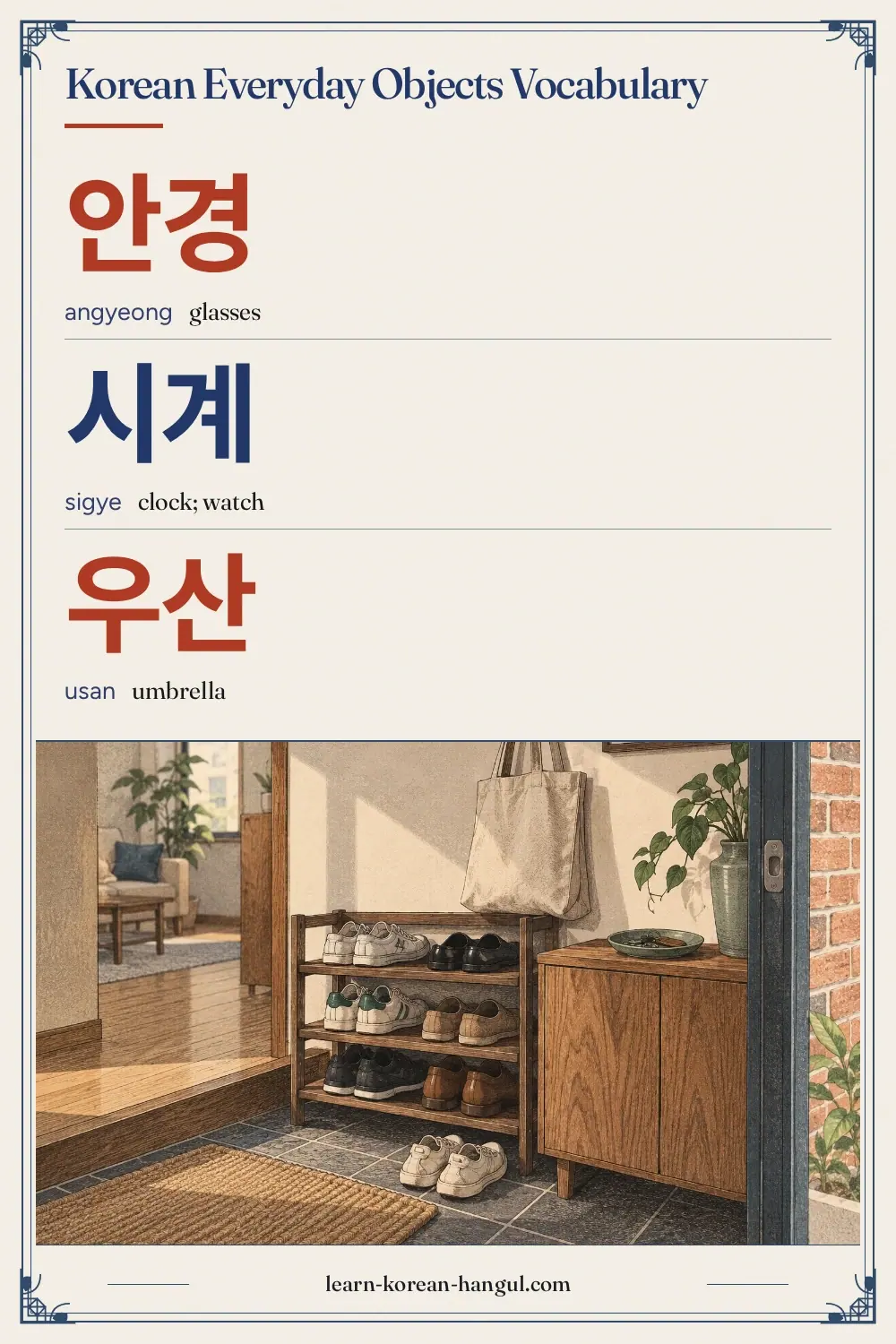
Korean Everyday Objects Vocabulary at a Glance
Small objects are the words you need when something is lost, borrowed or given. Koreans use a mix of origins for them: native words for old tools (열쇠, 가위, 풀), Sino-Korean words for items from the written world (책, 편지, 신문) and English loanwords for newer items (테이프, 이어폰, 라이터). Sorting words by where you find the thing is a good memory aid, because you can walk through a bag or a desk in your head.
The list holds 45 words. By origin, the list has 11 native Korean, 18 Sino-Korean (built from Chinese-derived syllables), 12 loanwords and 4 mixed. Knowing the origin helps you guess how a new word will behave. The groups are:
| Group | Words | Examples |
|---|---|---|
| Personal items | 9 | 안경, 시계, 우산, 휴대폰 |
| Paper and writing | 10 | 책, 공책, 노트, 종이 |
| Keys, wallets and bags | 9 | 열쇠, 열쇠고리, 키, 자물쇠 |
| Small tools | 9 | 가위, 테이프, 풀, 자 |
| Gifts and packaging | 8 | 선물, 상자, 포장지, 리본 |
Two features of Korean help here. First, you can name any object in one frame, 이거 뭐예요? (What is this?) and the answer 이건 열쇠예요 (This is a key). Second, objects are counted with counters, not just numbers: 개 for small objects and 권 for books. The origin column marks each word as native, Sino-Korean or a loanword. This list sits inside House and Home, where you can find the related topics.
Which Everyday Objects Should You Learn First?
Start with five words that you will say often: 책, 선물, 열쇠, 지갑 and 우산. Press play, then the slow button, and say each word aloud.
책 (chaek) means book. Count it with 권: 책 한 권 (one book), 책 두 권 (two books). Note that the final ㄱ is closed with no puff of air, and the vowel ㅐ is like the e in "bed". Example: 책을 읽어요. (I read a book.)
선물 (seonmul) means gift or present. 선물을 주다 is to give a gift and 선물을 받다 is to receive one. It is a central word in Korean culture, from holiday boxes to small thank-you gifts. Example: 친구에게 선물을 줘요. (I give a gift to a friend.)
열쇠 (yeolsoe) means key. It is the native word for door keys, padlock keys and keys to a locker. It is said [열쐬], with a tense ㅅ. For car keys and keyboard keys, Koreans use the loanword 키. Example: 열쇠를 찾고 있어요. (I am looking for my key.)
지갑 (jigap) means wallet. Ask 지갑 어디 있어요? (Where is my wallet?) when you cannot find it. The final ㅂ is closed with no puff of air, so it sounds like jigap. Example: 지갑에 돈이 있어요. (There is money in the wallet.)
우산 (usan) means umbrella. In the rainy season (장마) it is the object you take with you, so the sentence 우산 가져왔어요? (Did you bring an umbrella?) is a good everyday phrase. Example: 우산을 가져가요. (I take an umbrella.)
Personal Items
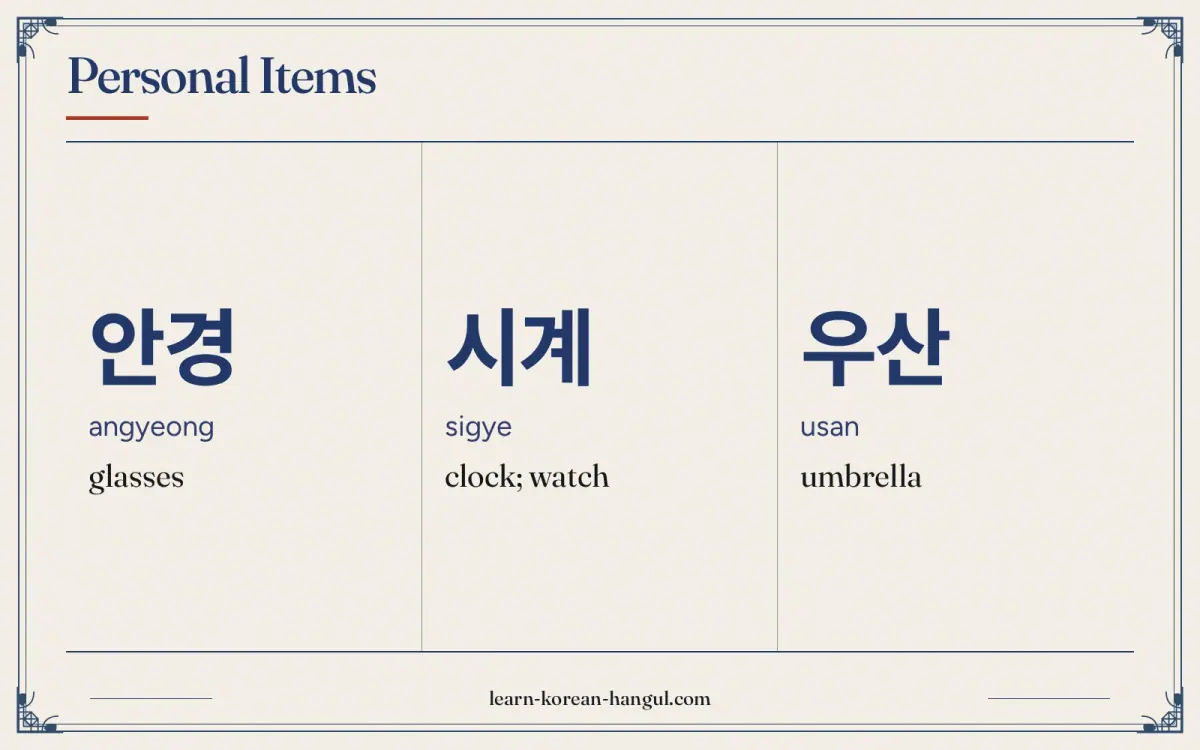
These nine items go with you every day. Many of them you can find in pockets, bags and on your face.
| No. | Hangul | Revised Romanization | Meaning | Origin | Example sentence | Audio assetId |
|---|---|---|---|---|---|---|
| 1 | 안경 | angyeong | glasses | Sino-Korean | 안경을 써요. (angyeongeul sseoyo; I wear glasses.) | au-pg-vocabulary-daily-life-home-everyday-objects-1; example: au-pg-vocabulary-daily-life-home-everyday-objects-101 |
| 2 | 시계 | sigye | clock; watch | Sino-Korean | 시계가 느려요. (sigyega neuryeoyo; The clock is slow.) | au-pg-vocabulary-daily-life-home-everyday-objects-2; example: au-pg-vocabulary-daily-life-home-everyday-objects-102 |
| 3 | 우산 | usan | umbrella | Sino-Korean | 우산을 가져가요. (usaneul gajyeogayo; I take an umbrella.) | au-pg-vocabulary-daily-life-home-everyday-objects-3; example: au-pg-vocabulary-daily-life-home-everyday-objects-103 |
| 4 | 휴대폰 | hyudaepon | mobile phone | mixed | 휴대폰이 어디 있어요? (hyudaeponi eodi isseoyo; Where is my phone?) | au-pg-vocabulary-daily-life-home-everyday-objects-4; example: au-pg-vocabulary-daily-life-home-everyday-objects-104 |
| 5 | 충전기 | chungjeongi | charger | Sino-Korean | 충전기를 빌려요. (chungjeongireul billyeoyo; I borrow a charger.) | au-pg-vocabulary-daily-life-home-everyday-objects-5; example: au-pg-vocabulary-daily-life-home-everyday-objects-105 |
| 6 | 이어폰 | ieopon | earphones | loanword | 이어폰을 끼고 걸어요. (ieoponeul kkigo georeoyo; I walk wearing earphones.) | au-pg-vocabulary-daily-life-home-everyday-objects-6; example: au-pg-vocabulary-daily-life-home-everyday-objects-106 |
| 7 | 마스크 | maseukeu | face mask | loanword | 마스크를 써요. (maseukeureul sseoyo; I wear a mask.) | au-pg-vocabulary-daily-life-home-everyday-objects-7; example: au-pg-vocabulary-daily-life-home-everyday-objects-107 |
| 8 | 손수건 | sonsugeon | handkerchief | mixed | 손수건으로 땀을 닦아요. (sonsugeoneuro ttameul dakkayo; I wipe sweat with a handkerchief.) | au-pg-vocabulary-daily-life-home-everyday-objects-8; example: au-pg-vocabulary-daily-life-home-everyday-objects-108 |
| 9 | 휴지 | hyuji | tissue; toilet paper | Sino-Korean | 휴지가 필요해요. (hyujiga piryohaeyo; I need a tissue.) | au-pg-vocabulary-daily-life-home-everyday-objects-9; example: au-pg-vocabulary-daily-life-home-everyday-objects-109 |
- The verb for wearing glasses, a mask or a hat is 쓰다, spelled the same as 쓰다 (write): 안경을 써요 and 편지를 써요. Context makes the meaning clear.
- 휴대폰 joins Sino-Korean 휴대 (carrying) and the loanword 폰 (phone). The formal term is 휴대전화, and in daily talk many people say 핸드폰 or just 폰.
- 시계 means both clock and watch. For a wristwatch, say 손목시계.
Example Sentences
Use one frame to name any object: 이거 뭐예요? (What is this?) and the answer 이건 ○○예요 (This is a ○○). Use 예요 after a vowel and 이에요 after a consonant: 이건 열쇠예요 (This is a key) and 이건 책이에요 (This is a book). For your own items, add 제 (my): 제 우산이에요 (It is my umbrella). Ask where something is with 어디 있어요?: 열쇠 어디 있어요? (Where is the key?). Each noun in the tables fits these frames, so pick any five and say your own sentences aloud.
How Do You Say Paper and Writing in Korean?
This group covers reading and writing things. Most are Sino-Korean words for the written world.
| No. | Hangul | Revised Romanization | Meaning | Origin | Example sentence | Audio assetId |
|---|---|---|---|---|---|---|
| 10 | 책 | chaek | book | Sino-Korean | 책을 읽어요. (chaegeul ilgeoyo; I read a book.) | au-pg-vocabulary-daily-life-home-everyday-objects-10; example: au-pg-vocabulary-daily-life-home-everyday-objects-110 |
| 11 | 공책 | gongchaek | notebook | Sino-Korean | 공책에 단어를 써요. (gongchaege daneoreul sseoyo; I write words in the notebook.) | au-pg-vocabulary-daily-life-home-everyday-objects-11; example: au-pg-vocabulary-daily-life-home-everyday-objects-111 |
| 12 | 노트 | noteu | notebook | loanword | 새 노트를 샀어요. (sae noteureul sasseoyo; I bought a new notebook.) | au-pg-vocabulary-daily-life-home-everyday-objects-12; example: au-pg-vocabulary-daily-life-home-everyday-objects-112 |
| 13 | 종이 | jongi | paper | native | 종이가 없어요. (jongiga eopseoyo; There is no paper.) | au-pg-vocabulary-daily-life-home-everyday-objects-13; example: au-pg-vocabulary-daily-life-home-everyday-objects-113 |
| 14 | 연필 | yeonpil | pencil | Sino-Korean | 연필로 써요. (yeonpillo sseoyo; I write with a pencil.) | au-pg-vocabulary-daily-life-home-everyday-objects-14; example: au-pg-vocabulary-daily-life-home-everyday-objects-114 |
| 15 | 볼펜 | bolpen | ballpoint pen | loanword | 볼펜을 빌려 주세요. (bolpeneul billyeo juseyo; Please lend me a pen.) | au-pg-vocabulary-daily-life-home-everyday-objects-15; example: au-pg-vocabulary-daily-life-home-everyday-objects-115 |
| 16 | 지우개 | jiugae | eraser | native | 지우개로 지워요. (jiugaero jiwoyo; I erase with an eraser.) | au-pg-vocabulary-daily-life-home-everyday-objects-16; example: au-pg-vocabulary-daily-life-home-everyday-objects-116 |
| 17 | 편지 | pyeonji | letter | Sino-Korean | 친구에게 편지를 써요. (chinguege pyeonjireul sseoyo; I write a letter to a friend.) | au-pg-vocabulary-daily-life-home-everyday-objects-17; example: au-pg-vocabulary-daily-life-home-everyday-objects-117 |
| 18 | 잡지 | japji | magazine | Sino-Korean | 잡지를 읽어요. (japjireul ilgeoyo; I read a magazine.) | au-pg-vocabulary-daily-life-home-everyday-objects-18; example: au-pg-vocabulary-daily-life-home-everyday-objects-118 |
| 19 | 신문 | sinmun | newspaper | Sino-Korean | 아침에 신문을 봐요. (achime sinmuneul bwayo; I read the newspaper in the morning.) | au-pg-vocabulary-daily-life-home-everyday-objects-19; example: au-pg-vocabulary-daily-life-home-everyday-objects-119 |
- 공책 and 노트 both mean notebook. 공책 is the school word and 노트 is the loanword used in shops. The word 노트북 means a laptop, not a notebook.
- Count things with their counter: 책 두 권 (two books), 종이 세 장 (three sheets) and 편지 한 통 (one letter). See counters for things.
- With 신문 and 잡지 you can use 읽다 (read) or 보다 (look at); 신문을 봐요 is the everyday way to say you read the newspaper.
Keys, Wallets and Bags
The bag group is the lost-and-found list. If you lose something in Korea, one of these nine words is likely the one you need.
| No. | Hangul | Revised Romanization | Meaning | Origin | Example sentence | Audio assetId |
|---|---|---|---|---|---|---|
| 20 | 열쇠 | yeolsoe | key | native | 열쇠를 찾고 있어요. (yeolsoereul chatgo isseoyo; I am looking for my key.) | au-pg-vocabulary-daily-life-home-everyday-objects-20; example: au-pg-vocabulary-daily-life-home-everyday-objects-120 |
| 21 | 열쇠고리 | yeolsoegori | keyring | native | 열쇠고리가 귀여워요. (yeolsoegoriga gwiyeowoyo; The keyring is cute.) | au-pg-vocabulary-daily-life-home-everyday-objects-21; example: au-pg-vocabulary-daily-life-home-everyday-objects-121 |
| 22 | 키 | ki | key (car key; keyboard key) | loanword | 차 키를 주세요. (cha kireul juseyo; Please give me the car key.) | au-pg-vocabulary-daily-life-home-everyday-objects-22; example: au-pg-vocabulary-daily-life-home-everyday-objects-122 |
| 23 | 자물쇠 | jamulsoe | padlock | native | 자물쇠를 잠가요. (jamulsoereul jamgayo; I lock the padlock.) | au-pg-vocabulary-daily-life-home-everyday-objects-23; example: au-pg-vocabulary-daily-life-home-everyday-objects-123 |
| 24 | 지갑 | jigap | wallet | Sino-Korean | 지갑에 돈이 있어요. (jigabe doni isseoyo; There is money in the wallet.) | au-pg-vocabulary-daily-life-home-everyday-objects-24; example: au-pg-vocabulary-daily-life-home-everyday-objects-124 |
| 25 | 가방 | gabang | bag | loanword | 가방이 무거워요. (gabangi mugeowoyo; The bag is heavy.) | au-pg-vocabulary-daily-life-home-everyday-objects-25; example: au-pg-vocabulary-daily-life-home-everyday-objects-125 |
| 26 | 배낭 | baenang | backpack | Sino-Korean | 배낭을 메요. (baenangeul meyo; I carry a backpack.) | au-pg-vocabulary-daily-life-home-everyday-objects-26; example: au-pg-vocabulary-daily-life-home-everyday-objects-126 |
| 27 | 핸드백 | haendeubaek | handbag | loanword | 핸드백이 예뻐요. (haendeubaegi yeppeoyo; The handbag is pretty.) | au-pg-vocabulary-daily-life-home-everyday-objects-27; example: au-pg-vocabulary-daily-life-home-everyday-objects-127 |
| 28 | 파우치 | pauchi | pouch | loanword | 파우치에 화장품이 있어요. (pauchie hwajangpumi isseoyo; There are cosmetics in the pouch.) | au-pg-vocabulary-daily-life-home-everyday-objects-28; example: au-pg-vocabulary-daily-life-home-everyday-objects-128 |
- 열쇠 is the older native word and 키 is the English loanword. 키 also means a person's height, so listen to the sentence: 차 키 is a car key but 키가 커요 means someone is tall.
- 가방 is the general word for a bag. 배낭 is a backpack, 핸드백 is a woman's handbag, and 파우치 is a small pouch for cosmetics or cables.
- Lost items are called 분실물 or 유실물, and a lost-and-found office is a 유실물 센터.
How Do You Say Small Tools in Korean?
Small tools are the objects you keep in a drawer. Most of these are short native Korean words that are easy to say.
| No. | Hangul | Revised Romanization | Meaning | Origin | Example sentence | Audio assetId |
|---|---|---|---|---|---|---|
| 29 | 가위 | gawi | scissors | native | 가위로 종이를 잘라요. (gawiro jongireul jallayo; I cut paper with scissors.) | au-pg-vocabulary-daily-life-home-everyday-objects-29; example: au-pg-vocabulary-daily-life-home-everyday-objects-129 |
| 30 | 테이프 | teipeu | tape | loanword | 테이프를 붙여요. (teipeureul butyeoyo; I stick on the tape.) | au-pg-vocabulary-daily-life-home-everyday-objects-30; example: au-pg-vocabulary-daily-life-home-everyday-objects-130 |
| 31 | 풀 | pul | glue | native | 풀로 붙여요. (pullo butyeoyo; I stick it with glue.) | au-pg-vocabulary-daily-life-home-everyday-objects-31; example: au-pg-vocabulary-daily-life-home-everyday-objects-131 |
| 32 | 자 | ja | ruler | native | 자로 길이를 재요. (jaro girireul jaeyo; I measure the length with a ruler.) | au-pg-vocabulary-daily-life-home-everyday-objects-32; example: au-pg-vocabulary-daily-life-home-everyday-objects-132 |
| 33 | 건전지 | geonjeonji | battery | Sino-Korean | 건전지를 바꿔요. (geonjeonjireul bakkwoyo; I change the battery.) | au-pg-vocabulary-daily-life-home-everyday-objects-33; example: au-pg-vocabulary-daily-life-home-everyday-objects-133 |
| 34 | 손전등 | sonjeondeung | flashlight | mixed | 손전등이 필요해요. (sonjeondeungi piryohaeyo; I need a flashlight.) | au-pg-vocabulary-daily-life-home-everyday-objects-34; example: au-pg-vocabulary-daily-life-home-everyday-objects-134 |
| 35 | 라이터 | raiteo | lighter | loanword | 라이터가 없어요. (raiteoga eopseoyo; I do not have a lighter.) | au-pg-vocabulary-daily-life-home-everyday-objects-35; example: au-pg-vocabulary-daily-life-home-everyday-objects-135 |
| 36 | 바늘 | baneul | needle | native | 바늘에 실을 끼워요. (baneure sireul kkiwoyo; I thread the needle.) | au-pg-vocabulary-daily-life-home-everyday-objects-36; example: au-pg-vocabulary-daily-life-home-everyday-objects-136 |
| 37 | 실 | sil | thread | native | 실이 끊어졌어요. (siri kkeuneojyeosseoyo; The thread broke.) | au-pg-vocabulary-daily-life-home-everyday-objects-37; example: au-pg-vocabulary-daily-life-home-everyday-objects-137 |
- 라이터 is the English word lighter, not writer. The English word writer is 작가 in Korean.
- 풀 means glue in this list, but the same word also means grass. The sentence tells you which: 풀로 붙여요 is about glue.
- 건전지 is a dry cell, the AA or AAA battery. A phone battery is 배터리, another loanword.
Gifts and Packaging
Gift giving is important in Korean life. These eight words cover the gift and everything that wraps it.
| No. | Hangul | Revised Romanization | Meaning | Origin | Example sentence | Audio assetId |
|---|---|---|---|---|---|---|
| 38 | 선물 | seonmul | gift | Sino-Korean | 친구에게 선물을 줘요. (chinguege seonmureul jwoyo; I give a gift to a friend.) | au-pg-vocabulary-daily-life-home-everyday-objects-38; example: au-pg-vocabulary-daily-life-home-everyday-objects-138 |
| 39 | 상자 | sangja | box | Sino-Korean | 상자에 선물을 넣어요. (sangjae seonmureul neoeoyo; I put the gift in the box.) | au-pg-vocabulary-daily-life-home-everyday-objects-39; example: au-pg-vocabulary-daily-life-home-everyday-objects-139 |
| 40 | 포장지 | pojangji | wrapping paper | Sino-Korean | 포장지로 싸요. (pojangjiro ssayo; I wrap it with wrapping paper.) | au-pg-vocabulary-daily-life-home-everyday-objects-40; example: au-pg-vocabulary-daily-life-home-everyday-objects-140 |
| 41 | 리본 | ribon | ribbon | loanword | 리본을 묶어요. (riboneul mukkeoyo; I tie a ribbon.) | au-pg-vocabulary-daily-life-home-everyday-objects-41; example: au-pg-vocabulary-daily-life-home-everyday-objects-141 |
| 42 | 쇼핑백 | syopingbaek | shopping bag | loanword | 쇼핑백에 선물을 담아요. (syopingbaege seonmureul damayo; I put the gift in the shopping bag.) | au-pg-vocabulary-daily-life-home-everyday-objects-42; example: au-pg-vocabulary-daily-life-home-everyday-objects-142 |
| 43 | 봉투 | bongtu | envelope; bag | Sino-Korean | 봉투에 편지를 넣어요. (bongtue pyeonjireul neoeoyo; I put the letter in the envelope.) | au-pg-vocabulary-daily-life-home-everyday-objects-43; example: au-pg-vocabulary-daily-life-home-everyday-objects-143 |
| 44 | 비닐봉지 | binilbongji | plastic bag | mixed | 비닐봉지에 담아요. (binilbongjie damayo; I put it in a plastic bag.) | au-pg-vocabulary-daily-life-home-everyday-objects-44; example: au-pg-vocabulary-daily-life-home-everyday-objects-144 |
| 45 | 끈 | kkeun | string; cord | native | 끈으로 묶어요. (kkeuneuro mukkeoyo; I tie it with string.) | au-pg-vocabulary-daily-life-home-everyday-objects-45; example: au-pg-vocabulary-daily-life-home-everyday-objects-145 |
- 봉투 can be a paper envelope or a shop bag. At a shop till, 봉투 필요하세요? asks whether you want a bag. For more shopping words, see shopping phrases.
- 쇼핑백 is the carrying bag from a store, and 비닐봉지 is a thin plastic bag. 포장 is the act of wrapping, and 포장해 주세요 asks the store to wrap a gift.
How Do You Pronounce These Words?
Most object words are said as they look, but five show sound rules that learners often miss. The table follows the Standard Pronunciation rules (표준 발음법) of the 국립국어원.
| Word | Romanization | Said | Rule |
|---|---|---|---|
| 잡지 | japji | [잡찌] | ㅈ after ㅂ becomes tense |
| 열쇠 | yeolsoe | [열쐬] | ㅅ after ㄹ is said tense in this word; the standard lists ㅚ among the 10 simple vowels and allows [we], and most speakers use the diphthong |
| 책이 | chaegi | [채기] | final ㄱ moves onto the empty ㅇ of the next syllable |
| 시계 | sigye | [시계] | the standard allows [시게] too |
| 쇼핑백 | syopingbaek | [쇼핑백] | final ㄱ is closed with no puff of air |
Revised Romanization is the official romanization system of South Korea, announced on 7 July 2000. It follows most sound changes, but it does not show tensing caused by a neighbouring sound, so it is only a learning aid. Always read the Hangul as well.
Audio and Slow Playback
Each headword and each example sentence has its own audio clip, and the 5 words in the first-words section also have a slow clip at 0.8 times the speed. Nothing plays until you press a button. Listen once, repeat aloud, and only then check the romanization.
What Mistakes Do Learners Make with Everyday Objects?
- Using 열쇠 and 키 for the same keys. Use 열쇠 for door keys and 키 for car keys and keyboard keys.
- Reading 라이터 as "writer". It means lighter.
- Using 노트북 for a notebook. It means a laptop computer.
- Forgetting the counter: when you count books, say 책 한 권 rather than 책 하나.
- Leaving out 이/가 or 을/를 after the object. Compare 열쇠가 없어요 (I do not have a key) and 열쇠를 찾아요 (I look for a key).
Practice: Flashcards and Worksheet
Drill these 45 words with the vocabulary flashcard decks: each card shows the Hangul on one side and the meaning on the other, so you can test recall instead of recognition. Print a labelling sheet from the vocabulary worksheets and write the Korean word for each numbered object in the scene above. A simple plan is to learn 8 to 10 words a day: read the table, press play, say the word, cover the English, then write one sentence of your own. Come back after a day and again after a week.
Self-Test: 10 Sentences
Fill each blank with a word from this page. Say the whole sentence aloud when you have it. The answers follow the test.
- ___을 써요. (I wear glasses.)
- ___를 빌려요. (I borrow a charger.)
- ___가 필요해요. (I need a tissue.)
- ___가 없어요. (There is no paper.)
- 친구에게 ___를 써요. (I write a letter to a friend.)
- ___가 귀여워요. (The keyring is cute.)
- ___이 무거워요. (The bag is heavy.)
- ___로 종이를 잘라요. (I cut paper with scissors.)
- ___를 바꿔요. (I change the battery.)
- ___이 끊어졌어요. (The thread broke.)
Answers: 1. 안경; 2. 충전기; 3. 휴지; 4. 종이; 5. 편지; 6. 열쇠고리; 7. 가방; 8. 가위; 9. 건전지; 10. 실.
A score of 8 or more suggests the words are settling in. If you scored lower, reread the groups where you missed words.
Where to Go Next
After everyday objects, many learners move on to Korean Cleaning Vocabulary and Korean Tools and Hardware Vocabulary. This list sits inside House and Home.
FAQ
How Do You Say Book in Korean?
Say 책 (chaek) for a book. Count books with the counter 권: 책 한 권 is one book. To say "I read a book", use 책을 읽어요.
How Do You Pronounce 선물 (seonmul)?
선물 is read seonmul. The first syllable has ㅓ, which is said with an open mouth and relaxed lips, not like English "sun" or "son". The final ㄹ is light, with the tip of the tongue touching the gum ridge for a moment.
How Many Everyday Objects Should I Learn First?
Learn the 19 words in the first two groups (personal items, and paper and writing) first, because they are objects you use daily. At 8 to 10 new words a day that takes two days; add the other three groups over the next three days, and keep reviewing for a week.
Where Can I Practise Everyday Objects with Flashcards?
Use the vocabulary flashcard decks. Start with the first 10 words of this page, then add 10 more each day. Review the older cards before you add new ones, so the earlier words do not fade.
Is the Romanization on This Page Official?
Yes, as a learning aid. It follows the Revised Romanization of Korean, the system South Korea has officially used since 7 July 2000, and the page also gives the Hangul for every word. It follows most sound changes, but it does not show tensing caused by a neighbouring sound: 잡지 is written japji but said [잡찌]. Treat the Hangul as the real spelling.
Is There a Printable Worksheet for Everyday Objects?
The vocabulary worksheets page lists the printable sheets. The sheet for this topic is a labelling task built on the same illustrated scene as this page, so you write the Korean word next to each numbered object.