
Korean Counter for Things: the Essentials
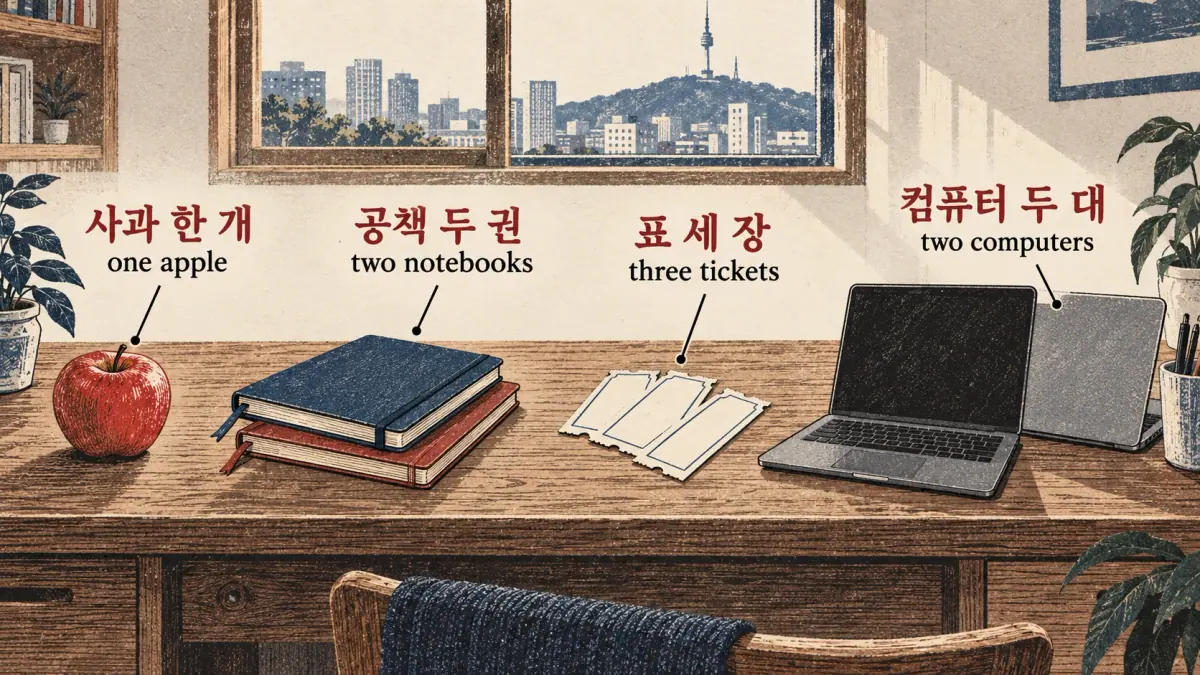
A Korean counter is a small word that follows a number and says what kind of thing you are counting. The Korean counter for things changes with the shape or type of the object, but the sentence pattern stays the same: noun, native number, counter.
| Object | Counter | Example | Meaning |
|---|---|---|---|
| apple | 개 | 사과 한 개 | one apple |
| notebook | 권 | 공책 두 권 | two notebooks |
| ticket | 장 | 표 세 장 | three tickets |
| photo | 장 | 사진 네 장 | four photos |
| car | 대 | 차 한 대 | one car |
| computer | 대 | 컴퓨터 두 대 | two computers |
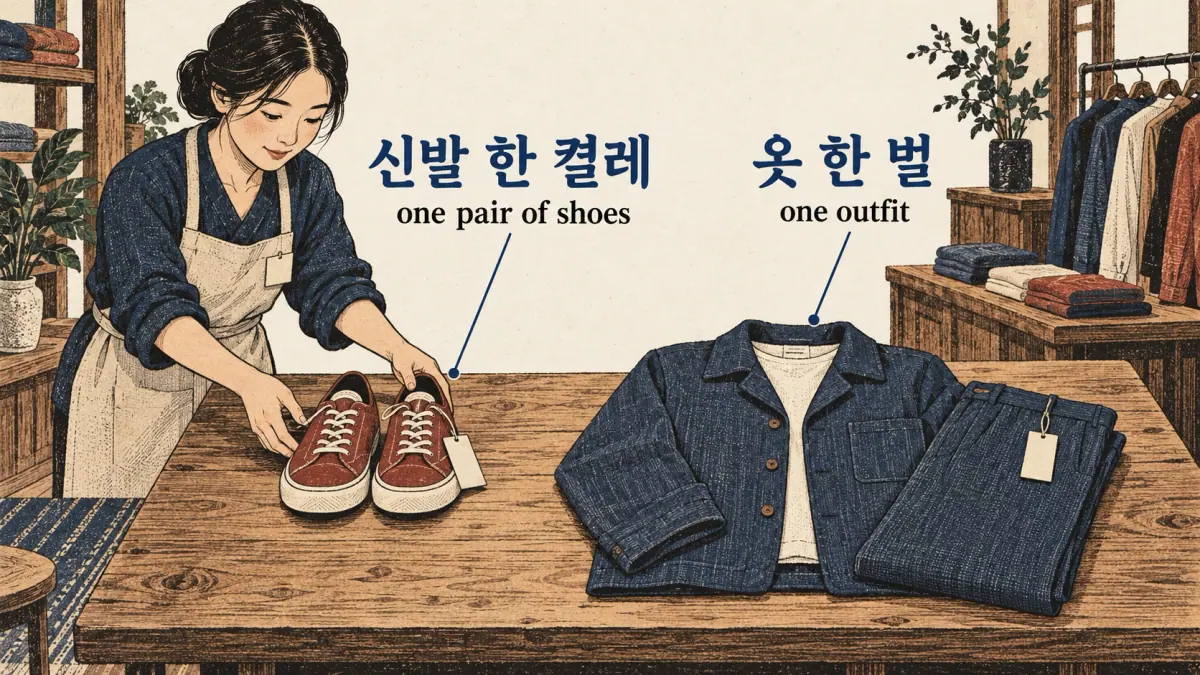
| shoes | 켤레 | 신발 한 켤레 | one pair of shoes |
| outfit | 벌 | 옷 한 벌 | one outfit |
There is a second word order that you will see in writing: number, counter, 의 and then the noun, as in 세 개의 사과. It means the same as 사과 세 개 but sounds more formal, and speakers use it less in conversation. Both are correct.
Numbers follow the same rule as for people: native numbers up to 99 and Sino-Korean numbers from 100 on. Five native numbers shorten before any counter: 한, 두, 세, 네 and 스무. The next section lists the lessons in this group.
What Pages Are in This Group?
Five lessons cover the object counters. Two groups make them easier to scan: the general counter, and the specific counters that replace it when you know what the object is.
General
The 개 counter lesson teaches the default counter for objects. It shows which things take 개, how to order with 하나 주세요 and 두 개 주세요, and where 개 stops working, such as for books or people. Read it first, because the other four pages build on it.
Specific
The 권 counter lesson teaches how to count books, notebooks and magazines. It explains why 권 refers to a bound volume, not to a single page, and shows how to ask 몇 권? at a library or bookshop.
The 장 counter lesson covers flat, thin items: paper, tickets, photos and cards. It uses the shape of the item as a memory aid and compares 장 with 개 for objects that look similar.
The 대 counter lesson teaches vehicles and machines, such as cars, bicycles, computers and televisions. It also shows why a phone can take 대 or 개 depending on the speaker.
The page on clothes and shoes counters teaches 벌 for outfits and 켤레 for pairs. It clarifies why one shoe is not counted alone, and how to ask for shoes and socks in a shop.
Knowing the group is half the job. The other half is a plan for the moment when you cannot remember the counter.
What Should You Do When You Forget the Counter?

When you forget the counter, use 개 for any small, countable object. Korean speakers understand 개 in nearly every shop and kitchen situation, so it works as a safe fallback while you learn the specific counters.
The fallback has limits. Use it only for objects, and avoid it for these categories:
- People: use 명 or 분, never 개.
- Animals: use 마리, never 개.
- Drinks in cups or bottles: use 잔 or 병.
- Books, tickets and cars: 개 is understood but sounds unnatural, so learn 권, 장 and 대.
Expert tip: if you are unsure, point at the item and say the number with a gesture, or say 하나 (one) and 둘 (two) without a counter. Most shop staff will follow, and a clear gesture is better than a wrong counter.
Why Do These Counters Fit Their Objects?
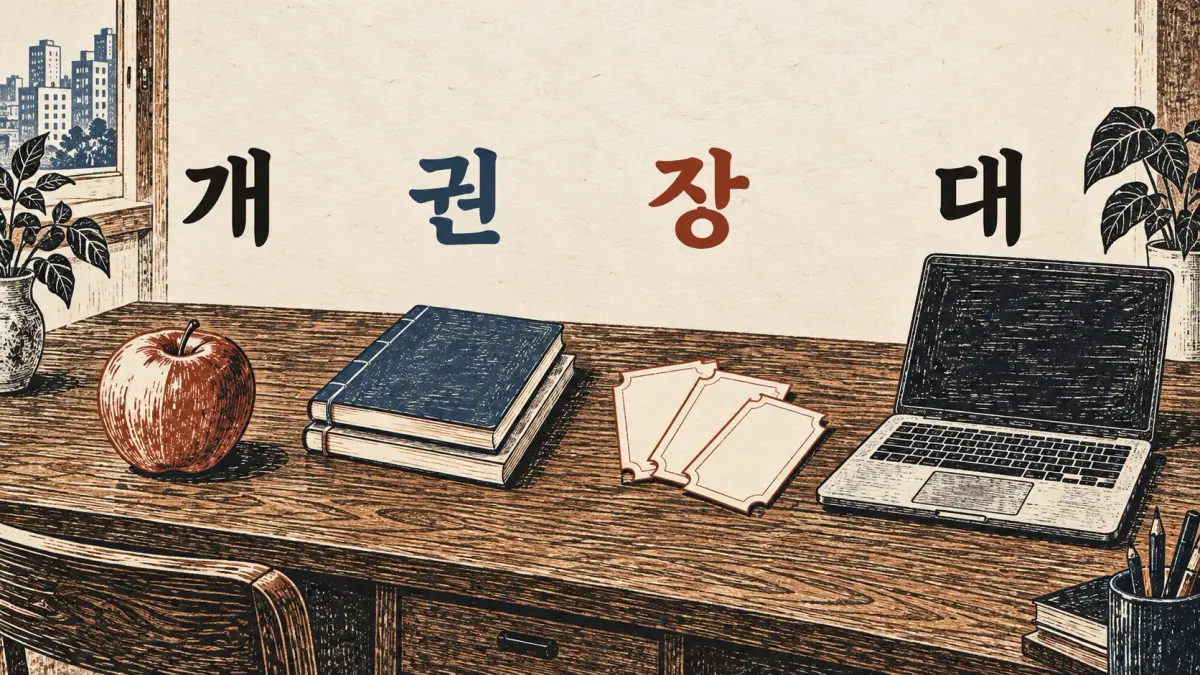
Each specific counter carries a small piece of logic, and that logic makes it easier to remember. 권 refers to a bound volume, so a book that is bound or stapled takes 권. 장 refers to a flat sheet, so anything thin and flat takes 장, including a leaf of paper, a train ticket or a photograph. 대 refers to a mechanical unit, so a vehicle or a device that has parts and power takes 대. 켤레 refers to a matched pair, and 벌 refers to a set or outfit.
This is a rule of thumb, not a law. A few objects can take two counters. A phone, for example, may take 대 or 개, and both are heard. When two counters seem possible, the one tied to the object's category is safer.
How Do the Object Counters Compare?
The five object counters differ in what they count, in the memory cue that goes with them, and in the question you ask. The table puts them side by side.
| Counter | Counts | Memory cue | Question | Example |
|---|---|---|---|---|
| 개 | general objects | anything small | 몇 개예요? | 사과 두 개 |
| 권 | books, notebooks | bound volume | 몇 권이에요? | 책 세 권 |
| 장 | paper, tickets, photos | flat sheet | 몇 장이에요? | 사진 네 장 |
| 대 | cars, computers | machine with parts | 몇 대예요? | 차 한 대 |
| 벌 / 켤레 | outfits / pairs | set or pair | 몇 벌이에요? / 몇 켤레예요? | 신발 두 켤레 |
Notice that the question always repeats the counter after 몇 (how many). So the counter you choose also decides the question: 몇 개, 몇 권, 몇 장, 몇 대.
Mistakes to Avoid with Object Counters
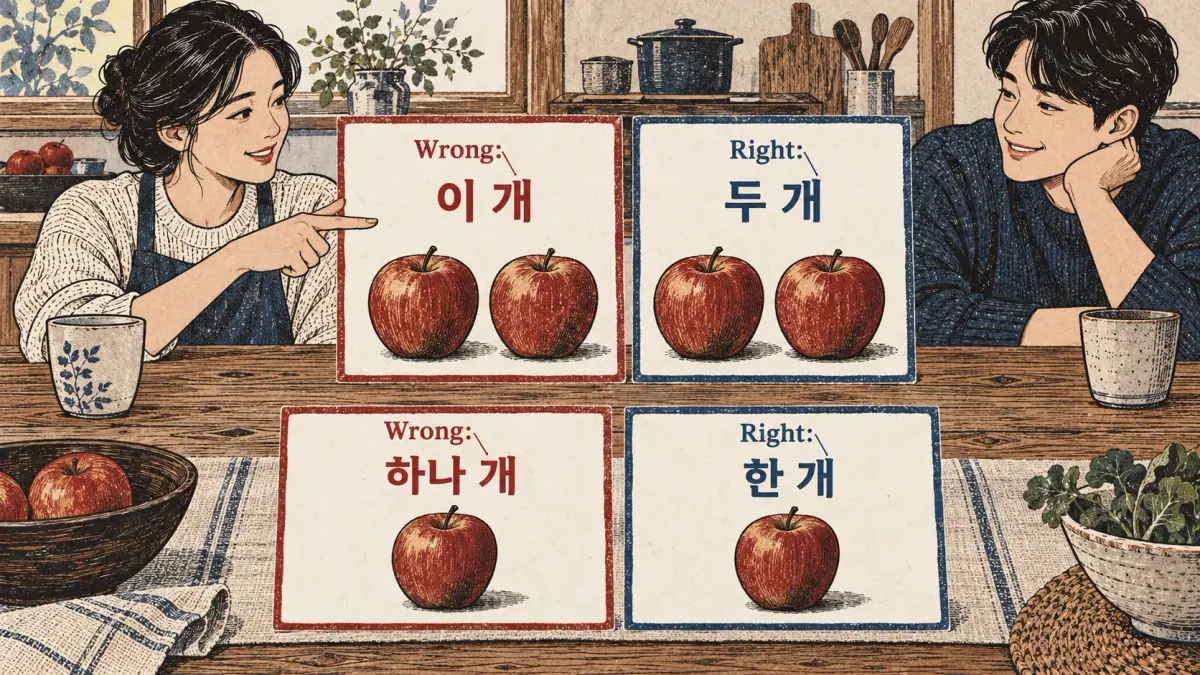
Three errors account for most mistakes in this group.
- Using Sino-Korean numbers. Wrong: 이 개, 삼 권. Right: 두 개, 세 권.
- Using 개 for everything. Less natural: 표 세 개 for tickets. Better: 표 세 장.
- Using a full number form. Wrong: 하나 개, 스물 장. Right: 한 개, 스무 장.
Each correction is small, but a native listener will notice it. Fix them early, and the specific counters will feel natural.
Where to Start
If you are new to object counters, learn 개 first, then add 권, 장 and 대 as you meet those objects. Practise by counting the objects around you, and write one sentence per counter. For the wider system, return to Korean Counters, or compare the Korean counter for things with the people and animal set in Counting People and Animals. For food and drink containers, see Counting Food and Drinks.
Frequently Asked Questions
Is 개 rude or too casual?
No. 개 is a neutral, everyday counter used in shops, offices and homes, and it is polite when you add a polite ending, as in 사과 세 개 주세요. It is never rude. The only issue is accuracy: for books, tickets or cars, a specific counter such as 권, 장 or 대 sounds more natural.
How do I count clothes?
Clothes use two counters. Use 벌 for an outfit or a single garment such as a jacket or a pair of trousers: 옷 한 벌. Use 켤레 for pairs of shoes or socks: 신발 한 켤레, 양말 두 켤레. Say 개 only for small loose items such as a hat or a button.
Can 개 replace every counter?
No. 개 works for many objects, but it fails for people (명), animals (마리), bottles (병), cups (잔) and others. Using 개 for a book or a ticket is understood but sounds unnatural. Using it for a person is a mistake. Treat 개 as a safe fallback for objects, not a universal counter.
Do things take native or Sino-Korean numbers?
Nearly all counters for things take native numbers up to 99: 한 개, 두 권, 세 장, 네 대. From 100 on, switch to Sino-Korean numbers: 백 개, 이백 장. A few counters, such as 원 for money and 층 for floors, take Sino-Korean numbers even below 100.