Korean Opposites Vocabulary at a Glance
This list has 35 words, arranged in pairs so that each word sits next to its opposite. It starts with pairs of nouns about size and quantity, moves to direction, time, people and feelings, and ends with the prefix pair 가능 and 불가능 and the three words you need to talk about opposites. It belongs to Shapes, Materials and Measurements in Korean and follows Korean Quantity Words Vocabulary.
| Group | Words | Use |
|---|---|---|
| Size and quantity | 8 | Pairs of nouns for more and less |
| Direction and position | 8 | Pairs of position and side words |
| Time | 8 | Pairs of time words |
| People and feelings | 6 | Pairs of people and emotions |
| Antonym tools | 5 | Prefixes and dictionary terms |
The list is made of nouns, with a few adverbs and noun-like words. Adjective opposites, such as 크다 and 작다 or 뜨겁다 and 차갑다, work with different endings, so they are on the descriptive adjectives pages. Here you learn the nouns, which do not change form. Because the pairs sit side by side in each table, you can learn them two at a time.
Which Opposites Should You Learn First?
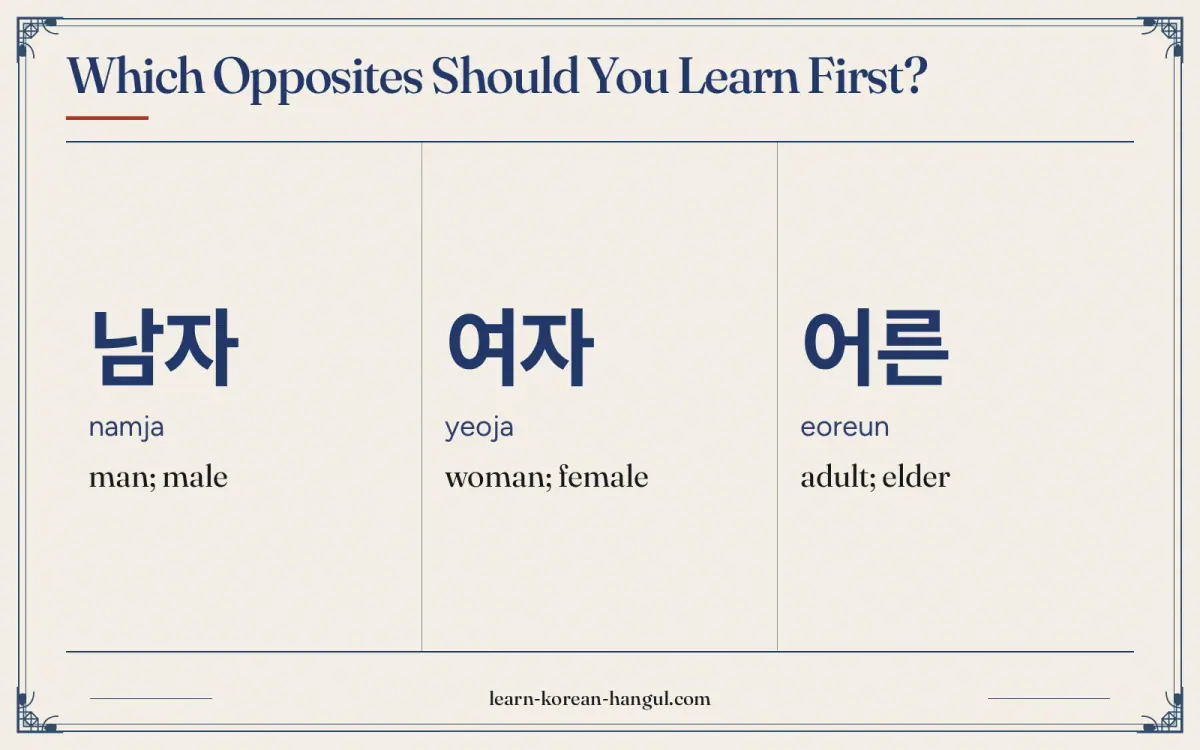
Learn 위 and 아래 (above and below), 앞 and 뒤 (front and back), 안 and 밖 (inside and outside), 남자 and 여자 (man and woman), and 시작 and 끝 (start and end) first. These ten words are among the most frequent nouns in the list, and learning them in pairs halves the work. After them, add 아침 and 저녁 (morning and evening), and 왼쪽 and 오른쪽 (left and right).
- Words to say. 위, 아래, 앞, 뒤, 안, 밖, 남자, 여자, 아침, 저녁. They appear in daily talk and directions.
- Words to recognise. 시작, 끝, 왼쪽, 오른쪽, 어른, 아이. You see them on signs, schedules and tickets.
- Words to understand when spoken. 증가, 감소, 확대, 축소, 최대, 최소. A news report or a presentation uses them.
Korean makes a pair in three ways. Some pairs are two unrelated words, such as 위 and 아래. Some pairs are built with a Sino-Korean prefix, such as 가능 and 불가능, where 불 means not. And some pairs keep one syllable and change the other, such as 최대 and 최소, where 최 means most, 대 big and 소 small. Pairs such as 증가 and 감소 or 확대 and 축소 share no syllable, so learn them as unrelated pairs. Spotting the type helps you remember a new pair. For the two position pairs in more depth, see Korean Position Words Vocabulary.
Word · 12
- 1
남자
namja
man; male
- 2
여자
yeoja
woman; female
- 3
어른
eoreun
adult; elder
- 4
아이
ai
child; kid
- 5
위
wi
above; on top of
- 6
아래
arae
below; underneath
- 7
앞
ap
front; in front of
- 8
뒤
dwi
back; behind
- 9
안
an
inside; in
- 10
밖
bak
outside
- 11
왼쪽
oenjjok
left; left side
- 12
오른쪽
oreunjjok
right; right side
Size and Quantity
Four pairs of nouns say that something is whole or partial, more or less, biggest or smallest, bigger or smaller. They are Sino-Korean words, built from short parts that repeat. They are common in news, schoolwork and workplace talk.
| No. | Hangul | Revised Romanization | Meaning and note | Example sentence | Audio assetId |
|---|---|---|---|---|---|
| 1 | 전체 | jeonche | whole; all of it. The opposite of 부분. 전체 is the entire thing, or the whole of a group, as in 전체 학생 (all the students). | 전체 이야기를 들었어요. (I heard the whole story.) | au-pg-vocabulary-descriptions-opposites-1; example: au-pg-vocabulary-descriptions-opposites-36 |
| 2 | 부분 | bubun | part; section. The opposite of 전체. A part of a thing: 이 부분 means this part. | 이 부분이 어려워요. (This part is difficult.) | au-pg-vocabulary-descriptions-opposites-2; example: au-pg-vocabulary-descriptions-opposites-37 |
| 3 | 증가 | jeungga | increase; rise. The opposite of 감소. With 하다 it becomes the verb 증가하다 (to increase). | 인구가 증가하고 있어요. (The population is increasing.) | au-pg-vocabulary-descriptions-opposites-3; example: au-pg-vocabulary-descriptions-opposites-38 |
| 4 | 감소 | gamso | decrease; decline. The opposite of 증가. With 하다 it becomes 감소하다 (to decrease). | 손님이 감소했어요. (The number of customers decreased.) | au-pg-vocabulary-descriptions-opposites-4; example: au-pg-vocabulary-descriptions-opposites-39 |
| 5 | 최대 | choedae | maximum; the largest. The opposite of 최소. 최 means the most. The related 최대한 means as much as possible. | 최대 열 명까지 탈 수 있어요. (Up to ten people can ride.) | au-pg-vocabulary-descriptions-opposites-5; example: au-pg-vocabulary-descriptions-opposites-40 |
| 6 | 최소 | choeso | minimum; the least. The opposite of 최대. The related 최소한 means at the very least. | 최소 한 시간은 걸려요. (It takes at least an hour.) | au-pg-vocabulary-descriptions-opposites-6; example: au-pg-vocabulary-descriptions-opposites-41 |
| 7 | 확대 | hwakdae | enlargement; zoom in. Said [확때]. The opposite of 축소. The button on a screen to zoom in. The ㄷ is tense after the final ㄱ. | 사진을 확대해요. (I enlarge the photo.) | au-pg-vocabulary-descriptions-opposites-7; example: au-pg-vocabulary-descriptions-opposites-42 |
| 8 | 축소 | chukso | reduction; zoom out. Said [축쏘]. The opposite of 확대. The ㅅ is tense after the final ㄱ. | 글자를 축소해요. (I shrink the text.) | au-pg-vocabulary-descriptions-opposites-8; example: au-pg-vocabulary-descriptions-opposites-43 |
Example Sentences
Four of these nouns become verbs with 하다: 증가 becomes 증가하다, 감소 becomes 감소하다, 확대 becomes 확대하다 and 축소 becomes 축소하다. The sentences use both forms: the noun alone (이 부분이 어려워요, where 부분 is the subject) and the noun with 하다 (사진을 확대해요, where 확대하다 is the verb). The frame for the noun is thing + 이/가 + description. The frame for the verb is object + 을/를 + noun + 하다. After a vowel the subject particle is 가, and after a consonant it is 이, so 인구가 but 부분이. Say each sentence aloud after its clip.
Direction and Position
The next four pairs are the most useful in daily life, because they tell you where something is. Each pair is two unrelated words. The first three pairs are position nouns, which take the particle 에, and the last pair names the left and right sides.
| No. | Hangul | Revised Romanization | Meaning and note | Example sentence | Audio assetId |
|---|---|---|---|---|---|
| 9 | 위 | wi | above; on top of. The opposite of 아래. It covers both 'on' and 'above'. | 모자가 선반 위에 있어요. (The hat is on the shelf.) | au-pg-vocabulary-descriptions-opposites-9; example: au-pg-vocabulary-descriptions-opposites-44 |
| 10 | 아래 | arae | below; underneath. The opposite of 위. The lower area in general. | 가방이 의자 아래에 있어요. (The bag is under the chair.) | au-pg-vocabulary-descriptions-opposites-10; example: au-pg-vocabulary-descriptions-opposites-45 |
| 11 | 앞 | ap | front; in front of. Said [압]. The opposite of 뒤. Before 에 it links: 앞에 is [아페]. Also means 'ahead' in time. | 극장 앞에서 만나요. (Let us meet in front of the theatre.) | au-pg-vocabulary-descriptions-opposites-11; example: au-pg-vocabulary-descriptions-opposites-46 |
| 12 | 뒤 | dwi | back; behind. The opposite of 앞. Also means 'after' in some time phrases. | 학교 뒤에 공원이 있어요. (There is a park behind the school.) | au-pg-vocabulary-descriptions-opposites-12; example: au-pg-vocabulary-descriptions-opposites-47 |
| 13 | 안 | an | inside; in. The opposite of 밖. Do not confuse it with the negative adverb 안. | 방 안에 아무도 없어요. (There is nobody in the room.) | au-pg-vocabulary-descriptions-opposites-13; example: au-pg-vocabulary-descriptions-opposites-48 |
| 14 | 밖 | bak | outside. Said [박]. The opposite of 안. Before a vowel it links: 밖에 is [바께]. | 밖이 추워요. (It is cold outside.) | au-pg-vocabulary-descriptions-opposites-14; example: au-pg-vocabulary-descriptions-opposites-49 |
| 15 | 왼쪽 | oenjjok | left; left side. The opposite of 오른쪽. 쪽 means side or direction. The ㅉ is tense from the start. | 약국은 왼쪽에 있어요. (The pharmacy is on the left.) | au-pg-vocabulary-descriptions-opposites-15; example: au-pg-vocabulary-descriptions-opposites-50 |
| 16 | 오른쪽 | oreunjjok | right; right side. The opposite of 왼쪽. Also used in directions: 오른쪽으로 가세요. | 화장실은 오른쪽에 있어요. (The restroom is on the right.) | au-pg-vocabulary-descriptions-opposites-16; example: au-pg-vocabulary-descriptions-opposites-51 |
All eight are nouns that work with the location particle 에, so you say 선반 위에, 의자 아래에, 극장 앞에, 집 뒤에, 방 안에, 밖에, 왼쪽에 and 오른쪽에. The pairs 위/아래 and 앞/뒤 also appear in Korean Position Words Vocabulary, where they are taught with more position nouns, and 안/밖 appear there too. Here they appear as opposites. The sentence 오른쪽으로 가세요 uses 으로 (toward), which marks direction, and 가세요 is the honorific polite form of 가다. For the particle, see the 으로 particle.
How Do You Say Opposites about Time in Korean?
Time pairs mark the parts of a day, the beginning and the end, and the past and the future. Two of them, 아침 and 저녁, also name meals. The parts of a day take the time particle 에 when you say when something happens.
| No. | Hangul | Revised Romanization | Meaning and note | Example sentence | Audio assetId |
|---|---|---|---|---|---|
| 17 | 아침 | achim | morning; breakfast. The opposite of 저녁. The same word means breakfast. | 아침에 커피를 마셔요. (I drink coffee in the morning.) | au-pg-vocabulary-descriptions-opposites-17; example: au-pg-vocabulary-descriptions-opposites-52 |
| 18 | 저녁 | jeonyeok | evening; dinner. The opposite of 아침. The same word means dinner. | 저녁에 책을 읽어요. (I read in the evening.) | au-pg-vocabulary-descriptions-opposites-18; example: au-pg-vocabulary-descriptions-opposites-53 |
| 19 | 낮 | nat | daytime; day. Said [낟]. The opposite of 밤. Before 이 it links: 낮이 is [나지]. | 낮에는 사람이 많아요. (There are many people during the day.) | au-pg-vocabulary-descriptions-opposites-19; example: au-pg-vocabulary-descriptions-opposites-54 |
| 20 | 밤 | bam | night; chestnut. The opposite of 낮. The same word is also a chestnut, so context decides. | 밤에는 별이 잘 보여요. (You can see the stars well at night.) | au-pg-vocabulary-descriptions-opposites-20; example: au-pg-vocabulary-descriptions-opposites-55 |
| 21 | 시작 | sijak | start; beginning. The opposite of 끝. With 하다 it becomes 시작하다 (to start). | 영화가 일곱 시에 시작해요. (The movie starts at seven.) | au-pg-vocabulary-descriptions-opposites-21; example: au-pg-vocabulary-descriptions-opposites-56 |
| 22 | 끝 | kkeut | end; finish. Said [끋]. The opposite of 시작. The verb is 끝나다 (to end). | 수업이 열두 시에 끝나요. (Class ends at twelve.) | au-pg-vocabulary-descriptions-opposites-22; example: au-pg-vocabulary-descriptions-opposites-57 |
| 23 | 과거 | gwageo | past. The opposite of 미래. The past in time. In grammar, 과거 시제 is the past tense. | 과거 시제를 배워요. (I learn the past tense.) | au-pg-vocabulary-descriptions-opposites-23; example: au-pg-vocabulary-descriptions-opposites-58 |
| 24 | 미래 | mirae | future. The opposite of 과거. Also a given name. | 미래를 생각해요. (I think about the future.) | au-pg-vocabulary-descriptions-opposites-24; example: au-pg-vocabulary-descriptions-opposites-59 |
The time of day is useful in a sentence: 아침에, 낮에, 저녁에, 밤에. Each takes the particle 에 (at, in), and the sentences above show the pattern. The pairs 아침 and 저녁 are interesting, because the words also name meals: 아침 is breakfast, and 저녁 is dinner. The middle meal, lunch, is 점심. So 아침을 먹어요 can mean I eat breakfast.
The words 시작 and 끝 are a pair that you will hear and read all the time. Schedules print 시작 and 끝 on the same line, as in 시작 시간 (start time) and 끝나는 시간 (end time). If you need an alternative pair, 처음 (the first time, the beginning) and 마지막 (the last) are also opposites: 처음 and 마지막 are the first and last items in a list.
How Do You Say Man and Woman, Adult and Child in Korean?
People pairs help you describe who is in a room, and the feelings pair names joy and sorrow. The first four are plain nouns for kinds of people. The last two are emotion nouns that you will also meet in stories and songs.
| No. | Hangul | Revised Romanization | Meaning and note | Example sentence | Audio assetId |
|---|---|---|---|---|---|
| 25 | 남자 | namja | man; male. The opposite of 여자. A boyfriend is 남자 친구, written with a space. | 저 남자는 우리 선생님이에요. (That man is our teacher.) | au-pg-vocabulary-descriptions-opposites-25; example: au-pg-vocabulary-descriptions-opposites-60 |
| 26 | 여자 | yeoja | woman; female. The opposite of 남자. Used for adult women and as a general word for the female sex. | 저 여자는 제 친구예요. (That woman is my friend.) | au-pg-vocabulary-descriptions-opposites-26; example: au-pg-vocabulary-descriptions-opposites-61 |
| 27 | 어른 | eoreun | adult; elder. The opposite of 아이. It also means an older person who deserves respect. | 어른 표 두 장 주세요. (Two adult tickets, please.) | au-pg-vocabulary-descriptions-opposites-27; example: au-pg-vocabulary-descriptions-opposites-62 |
| 28 | 아이 | ai | child; kid. The opposite of 어른. 어린이 is the word for a child used on notices and tickets. | 아이가 공원에서 놀아요. (The child plays in the park.) | au-pg-vocabulary-descriptions-opposites-28; example: au-pg-vocabulary-descriptions-opposites-63 |
| 29 | 기쁨 | gippeum | joy; gladness. The opposite of 슬픔. The noun of the adjective 기쁘다 (be glad). | 기쁨을 함께 나눠요. (We share the joy.) | au-pg-vocabulary-descriptions-opposites-29; example: au-pg-vocabulary-descriptions-opposites-64 |
| 30 | 슬픔 | seulpeum | sadness; sorrow. The opposite of 기쁨. The noun of the adjective 슬프다 (be sad). | 슬픔이 컸어요. (The sadness was great.) | au-pg-vocabulary-descriptions-opposites-30; example: au-pg-vocabulary-descriptions-opposites-65 |
The pair 남자 and 여자 is used as a shorthand in many places, such as on toilet doors and in lists. A boyfriend is 남자 친구, and a girlfriend is 여자 친구, written with a space. The words for a husband and a wife are different, and are on the family words page.
Two other pairs worth knowing are 어른 and 아이, which you will use in tickets (어른 표 and 어린이 표), and the feeling pair 기쁨 and 슬픔. Both feeling words are made by adding the ending -ㅁ to the stem of an adjective: 기쁘다 gives 기쁨, and 슬프다 gives 슬픔. That pattern turns many adjectives into nouns.
How Do Korean Prefixes Make Opposites?
The last group gives one example of a prefix pair and the three words you need to talk about opposites. The pair 가능 and 불가능 shows a very common prefix, 불. The final three words are the dictionary terms for opposite, antonym and synonym.
| No. | Hangul | Revised Romanization | Meaning and note | Example sentence | Audio assetId |
|---|---|---|---|---|---|
| 31 | 가능 | ganeung | possible; possibility. The opposite of 불가능. With 하다 it becomes 가능하다 (be possible). | 예약이 가능해요? (Is a reservation possible?) | au-pg-vocabulary-descriptions-opposites-31; example: au-pg-vocabulary-descriptions-opposites-66 |
| 32 | 불가능 | bulganeung | impossible; impossibility. The opposite of 가능. 불 (not) + 가능. Note that it is not tensed: [불가능]. | 오늘은 불가능해요. (Today is not possible.) | au-pg-vocabulary-descriptions-opposites-32; example: au-pg-vocabulary-descriptions-opposites-67 |
| 33 | 반대 | bandae | opposite; opposition. Means the opposite side or direction, and also disagreement. 찬성 and 반대 are 'for' and 'against'. | 이 단어의 반대는 뭐예요? (What is the opposite of this word?) | au-pg-vocabulary-descriptions-opposites-33; example: au-pg-vocabulary-descriptions-opposites-68 |
| 34 | 반의어 | banuieo | antonym; opposite word. Said [바늬어] or [바니어]. 반 (opposite) + 의 (meaning) + 어 (word). The word you look up to find an opposite. | "크다"의 반의어는 "작다"예요. (The antonym of 크다 is 작다.) | au-pg-vocabulary-descriptions-opposites-34; example: au-pg-vocabulary-descriptions-opposites-69 |
| 35 | 동의어 | donguieo | synonym. 동 (same) + 의 (meaning) + 어 (word). A word with the same or a similar meaning. | 이 단어의 동의어를 찾아요. (I look for a synonym of this word.) | au-pg-vocabulary-descriptions-opposites-35; example: au-pg-vocabulary-descriptions-opposites-70 |
Four Sino-Korean prefixes make opposites by attaching to a word. Each meaning is a form of "not" or "opposite", and the table below gives one pair for each.
| Prefix | Meaning | Pair | Meaning of the pair |
|---|---|---|---|
| 불- (bul) | not | 가능 and 불가능 (ganeung, bulganeung) | possible and impossible |
| 비- (bi) | not; un- | 정상 and 비정상 (jeongsang, bijeongsang) | normal and abnormal |
| 무- (mu) | without | 관심 and 무관심 (gwansim, mugwansim) | interest and indifference |
| 반- (ban) | opposite; anti- | 사회적 and 반사회적 (sahoejeok, bansahoejeok) | social and antisocial |
The prefix has to match the word. You cannot freely choose any prefix: 불편 (inconvenient) and 불가능 take 불, but 비정상 takes 비. The safest way is to learn each pair as a unit and not to invent new ones. When you hear a word you do not know with 불 or 무 in front, the meaning "not" or "without" is usually a good guess.
How Do Synonyms and Antonyms Work in Korean?
A synonym (동의어) is a word with the same or nearly the same meaning, and an antonym (반의어) is a word with the opposite meaning. Dictionaries list both. In a Korean dictionary you may see the labels 비슷한말 (similar word) and 반대말 (opposite word), and a learner's dictionary shows them under the main entry.
Korean is rich in synonym pairs because it has two layers of vocabulary: native Korean words and Sino-Korean words. Often a native word and a Sino-Korean word mean the same thing, and the Sino-Korean word sounds more formal.
| Native word | Sino-Korean word | Meaning | Feeling |
|---|---|---|---|
| 값 | 가격 | price | 값 is everyday, 가격 is formal |
| 아이 | 아동 | child | 아동 is formal, used in law and public services |
| 이 | 치아 | tooth | 치아 is formal, used at the dentist |
| 밥 | 식사 | meal | 식사 is formal or polite |
Antonyms come in different kinds. A pair can be one of three types: a complementary pair (남자 and 여자, where one excludes the other), a gradable pair (아침 and 저녁, which have a middle in between), and a directional pair (위 and 아래, 앞 and 뒤). Learning the type helps you see why 가능 and 불가능 leave no middle, but 아침 and 저녁 do.
How Can You Practise Opposites with Flip Cards?
Opposites are easy to practise with flip cards, because the back of one card is the front of another. Write a word on one side of a card, and its opposite on the other. When you flip the card, you recall the pair.
- Make a card for each pair: 위 on the front and 아래 on the back.
- Read the front aloud, say its opposite, and flip to check.
- Then do the reverse: read the back, say the front.
- Mix the pairs from different groups, so you do not rely on the order of the table.
- Finish by writing a sentence that uses both words: 모자는 책상 위에 있고 가방은 책상 아래에 있어요 (the hat is on the desk, and the bag is under the desk).
The sentence in step 5 uses the connective -고 (and), which joins two statements. The deck on this page works the same way: it shows one word, and you recall the meaning and the opposite.
How Do You Pronounce These Words?
Most of these words are short, and a few have sounds that differ from the spelling. The main changes are tensing after a final stop, final consonants that change before a vowel, and the vowel ㅢ in the two terms with 의. Standard pronunciation follows the National Institute of Korean Language (국립국어원) rules, and the romanization follows the Revised Romanization of Korean, which records some sound changes and ignores others.
| Spelling | Sounds like | What changes |
|---|---|---|
| 확대 | [확때] | The ㄷ becomes tense after the final ㄱ. The Romanization does not show it: hwakdae. |
| 축소 | [축쏘] | The ㅅ becomes tense after the final ㄱ: chukso. |
| 낮 | [낟] | A final ㅈ is said as [ㄷ] at the end of a word. Before a vowel, it links: 낮이 is [나지]. |
| 끝 | [끋] | A final ㅌ is said as [ㄷ] at the end of a word. Before a vowel, it links: 끝이 is [끄치]. |
| 밖 | [박] | A final ㄲ is said as [ㄱ] at the end of a word. With 에 it links: 밖에 is [바께]. |
| 반의어 | [바늬어] or [바니어] | The final ㄴ links to the next syllable. The ㅢ of 의, which is not the first syllable of the word, is read [의], and [이] is also accepted. The Romanization keeps ui: banuieo. |
| 불가능 | [불가능] | No tensing. After a final ㄹ in a Sino-Korean word, only ㄷ, ㅅ and ㅈ become tense, so ㄱ stays plain. |
The vowel ㅟ in 위 (wi) is a quick glide: round the lips for "w" and move to "ee". Do not say 우이 as two separate syllables. Also listen for the final consonants. 앞 sounds like [압] when it stands alone, and 밖 sounds like [박]. Listening to the clip is the fastest fix.
Audio and Slow Playback
Every headword and every example sentence has its own audio. The five clips below replay the trickiest words slowly. Play one, repeat it aloud, then play it again and compare.
What Mistakes Do Learners Make with Opposites?
These five mistakes come up often with opposite pairs.
- Treating 안 and 밖 as only position words. 안 is also the negative adverb in 안 가요, and 밖에 followed by a negative means only, as in 하나밖에 없어요 (there is only one). The sentence ending shows which.
- Mixing up 증가 and 감소 in a sentence. 인구가 증가해요 means the population rises, and 인구가 감소해요 means it falls. Nothing in the spelling tells you which is which, so learn the pair.
- Inventing opposites with a prefix. 불가능 is correct, but 불큰 and 무가능 are not. Learn each pair as it is.
- Using 반대 to mean only physical opposite. 반대 also means disagree: 저는 반대예요 means I am against it. The sentence tells which meaning applies.
- Writing 남자친구 as one word in a formal text. The standard form is spaced: 남자 친구. The closed form is common online, but a formal text uses the space.
A habit that avoids most of these: always learn a word together with its opposite, and say both aloud. A word learned as half of a pair is easier to recall than a word learned alone.
Practice: Flashcards and Worksheet
Study in three steps. First, run the flashcard deck in recognition mode until you know each of the 35 words. Second, switch to listening mode and answer from the audio alone. Third, take the quiz. The deck covers all 35 words with audio, and your progress stays in your browser. The vocabulary flashcard decks page lists the other decks.
Practice · 75
- 01전체
Show answer
headword 1: whole; all of it
- 02부분
Show answer
headword 2: part; section
- 03증가
Show answer
headword 3: increase; rise
- 04감소
Show answer
headword 4: decrease; decline
- 05최대
Show answer
headword 5: maximum; the largest
- 06최소
Show answer
headword 6: minimum; the least
- 07확대
Show answer
headword 7: enlargement; zoom in
- 08축소
Show answer
headword 8: reduction; zoom out
- 09위
Show answer
headword 9: above; on top of
- 10아래
Show answer
headword 10: below; underneath
- 11앞
Show answer
headword 11: front; in front of
- 12뒤
Show answer
headword 12: back; behind
- 13안
Show answer
headword 13: inside; in
- 14밖
Show answer
headword 14: outside
- 15왼쪽
Show answer
headword 15: left; left side
- 16오른쪽
Show answer
headword 16: right; right side
- 17아침
Show answer
headword 17: morning; breakfast
- 18저녁
Show answer
headword 18: evening; dinner
- 19낮
Show answer
headword 19: daytime; day
- 20밤
Show answer
headword 20: night; chestnut
- 21시작
Show answer
headword 21: start; beginning
- 22끝
Show answer
headword 22: end; finish
- 23과거
Show answer
headword 23: past
- 24미래
Show answer
headword 24: future
- 25남자
Show answer
headword 25: man; male
- 26여자
Show answer
headword 26: woman; female
- 27어른
Show answer
headword 27: adult; elder
- 28아이
Show answer
headword 28: child; kid
- 29기쁨
Show answer
headword 29: joy; gladness
- 30슬픔
Show answer
headword 30: sadness; sorrow
- 31가능
Show answer
headword 31: possible; possibility
- 32불가능
Show answer
headword 32: impossible; impossibility
- 33반대
Show answer
headword 33: opposite; opposition
- 34반의어
Show answer
headword 34: antonym; opposite word
- 35동의어
Show answer
headword 35: synonym
- 36전체 이야기를 들었어요.
Show answer
example sentence for 전체: I heard the whole story.
- 37이 부분이 어려워요.
Show answer
example sentence for 부분: This part is difficult.
- 38인구가 증가하고 있어요.
Show answer
example sentence for 증가: The population is increasing.
- 39손님이 감소했어요.
Show answer
example sentence for 감소: The number of customers decreased.
- 40최대 열 명까지 탈 수 있어요.
Show answer
example sentence for 최대: Up to ten people can ride.
- 41최소 한 시간은 걸려요.
Show answer
example sentence for 최소: It takes at least an hour.
- 42사진을 확대해요.
Show answer
example sentence for 확대: I enlarge the photo.
- 43글자를 축소해요.
Show answer
example sentence for 축소: I shrink the text.
- 44모자가 선반 위에 있어요.
Show answer
example sentence for 위: The hat is on the shelf.
- 45가방이 의자 아래에 있어요.
Show answer
example sentence for 아래: The bag is under the chair.
- 46극장 앞에서 만나요.
Show answer
example sentence for 앞: Let us meet in front of the theatre.
- 47학교 뒤에 공원이 있어요.
Show answer
example sentence for 뒤: There is a park behind the school.
- 48방 안에 아무도 없어요.
Show answer
example sentence for 안: There is nobody in the room.
- 49밖이 추워요.
Show answer
example sentence for 밖: It is cold outside.
- 50약국은 왼쪽에 있어요.
Show answer
example sentence for 왼쪽: The pharmacy is on the left.
- 51화장실은 오른쪽에 있어요.
Show answer
example sentence for 오른쪽: The restroom is on the right.
- 52아침에 커피를 마셔요.
Show answer
example sentence for 아침: I drink coffee in the morning.
- 53저녁에 책을 읽어요.
Show answer
example sentence for 저녁: I read in the evening.
- 54낮에는 사람이 많아요.
Show answer
example sentence for 낮: There are many people during the day.
- 55밤에는 별이 잘 보여요.
Show answer
example sentence for 밤: You can see the stars well at night.
- 56영화가 일곱 시에 시작해요.
Show answer
example sentence for 시작: The movie starts at seven.
- 57수업이 열두 시에 끝나요.
Show answer
example sentence for 끝: Class ends at twelve.
- 58과거 시제를 배워요.
Show answer
example sentence for 과거: I learn the past tense.
- 59미래를 생각해요.
Show answer
example sentence for 미래: I think about the future.
- 60저 남자는 우리 선생님이에요.
Show answer
example sentence for 남자: That man is our teacher.
- 61저 여자는 제 친구예요.
Show answer
example sentence for 여자: That woman is my friend.
- 62어른 표 두 장 주세요.
Show answer
example sentence for 어른: Two adult tickets, please.
- 63아이가 공원에서 놀아요.
Show answer
example sentence for 아이: The child plays in the park.
- 64기쁨을 함께 나눠요.
Show answer
example sentence for 기쁨: We share the joy.
- 65슬픔이 컸어요.
Show answer
example sentence for 슬픔: The sadness was great.
- 66예약이 가능해요?
Show answer
example sentence for 가능: Is a reservation possible?
- 67오늘은 불가능해요.
Show answer
example sentence for 불가능: Today is not possible.
- 68이 단어의 반대는 뭐예요?
Show answer
example sentence for 반대: What is the opposite of this word?
- 69"크다"의 반의어는 "작다"예요.
Show answer
example sentence for 반의어: The antonym of 크다 is 작다.
- 70이 단어의 동의어를 찾아요.
Show answer
example sentence for 동의어: I look for a synonym of this word.
- 71확대
Show answer
slow playback of the headword 확대
- 72낮
Show answer
slow playback of the headword 낮
- 73끝
Show answer
slow playback of the headword 끝
- 74반의어
Show answer
slow playback of the headword 반의어
- 75불가능
Show answer
slow playback of the headword 불가능
Practice · 8
What does 전체 (jeonche) mean?
Show answer
whole; all of it
전체 means whole; all of it. Example: 전체 이야기를 들었어요. (I heard the whole story.)
What does 최소 (choeso) mean?
Show answer
minimum; the least
최소 means minimum; the least. Example: 최소 한 시간은 걸려요. (It takes at least an hour.)
What does 축소 (chukso) mean?
Show answer
reduction; zoom out
축소 means reduction; zoom out. Example: 글자를 축소해요. (I shrink the text.)
What does 왼쪽 (oenjjok) mean?
Show answer
left; left side
왼쪽 means left; left side. Example: 약국은 왼쪽에 있어요. (The pharmacy is on the left.)
What does 낮 (nat) mean?
Show answer
daytime; day
낮 means daytime; day. Example: 낮에는 사람이 많아요. (There are many people during the day.)
What does 과거 (gwageo) mean?
Show answer
past
과거 means past. Example: 과거 시제를 배워요. (I learn the past tense.)
What does 어른 (eoreun) mean?
Show answer
adult; elder
어른 means adult; elder. Example: 어른 표 두 장 주세요. (Two adult tickets, please.)
What does 동의어 (donguieo) mean?
Show answer
synonym
동의어 means synonym. Example: 이 단어의 동의어를 찾아요. (I look for a synonym of this word.)
Korean Opposites Vocabulary Worksheet (PDF)
A printable worksheet for these words (word list, matching, writing practice, fill-in-the-blank exercises and answer key) is available in A4 and US Letter from the download card on this page. For practice, make your own flip cards for the pairs on this page, with one word on each side. Saying the pair while you flip the card fixes both words together.
Where to Go Next
After this page, go back to Korean Quantity Words Vocabulary for amounts, or move on to the adjective pairs on the descriptive adjectives pages. To return to the full set, go to Shapes, Materials and Measurements in Korean.
Frequently Asked Questions
How Do You Say above in Korean?
Above is 위 (wi). It also means "on top of", so it covers both "on the shelf" and "above the shelf". Say 선반 위에 (on the shelf) with the particle 에. Its opposite is 아래 (arae), meaning below. Both words are nouns, so they follow the place they describe.
How Do You Pronounce 아래 (arae)?
Say a-rae, with two short syllables. The ㄹ between vowels is a light tap, like the "tt" in the American "butter". The final ㅐ is open, like the vowel in "bed". Press the audio button on this page for the normal and slow versions.
How Many Opposites Should I Learn First?
Ten words first: 위 and 아래, 앞 and 뒤, 안 and 밖, 남자 and 여자, and 시작 and 끝. At five new words a day, the whole list of 35 takes seven days plus review. Learn each word with its opposite.
Where Can I Practise Opposites with Flashcards?
Use the vocabulary flashcard decks. The deck for this page holds all 35 words with Hangul, romanization and audio, and it offers recognition and listening modes. Your progress stays in your browser, so return daily and review the cards you missed.
Is the Romanization on This Page Official?
It follows the Revised Romanization of Korean, which South Korea adopted on 7 July 2000 and whose rules the National Institute of Korean Language (국립국어원) publishes. It is a learning aid and does not show every sound change, so rely on the Hangul and the audio.
Is There a Printable Worksheet for Opposites?
A printable worksheet for these words (word list, matching, writing practice, fill-in-the-blank exercises and answer key) is available in A4 and US Letter from the download card on this page. For practice, copy the tables on this page by hand or use the flashcard deck, which carries the same 35 words.