Korean Quantity Words Vocabulary at a Glance
This list has 25 words in five groups of five. It runs from a lot to a little, then from all to none, then part of a whole, then the words for about and nearly, and ends with the degree and manner adverbs that most learners use daily. It belongs to Shapes, Materials and Measurements in Korean and follows Korean Position Words Vocabulary.
| Group | Words | Use |
|---|---|---|
| Many and few | 5 | Amounts from a lot to a little |
| All and none | 5 | Everything and nothing |
| Some and part | 5 | Parts of a whole |
| About and nearly | 5 | Approximate numbers |
| Degree and manner | 5 | How much and how |
Most of these words are adverbs, and a few are nouns. Adverbs sit right before the verb or adjective, so 많이 먹어요 means I eat a lot. The nouns, such as 일부 and 절반, take particles like other nouns. The big grammar point is the negative pairing, explained in the section on negation below. For the grammar of negative sentences, see negation.
Which Quantity Words Should You Learn First?
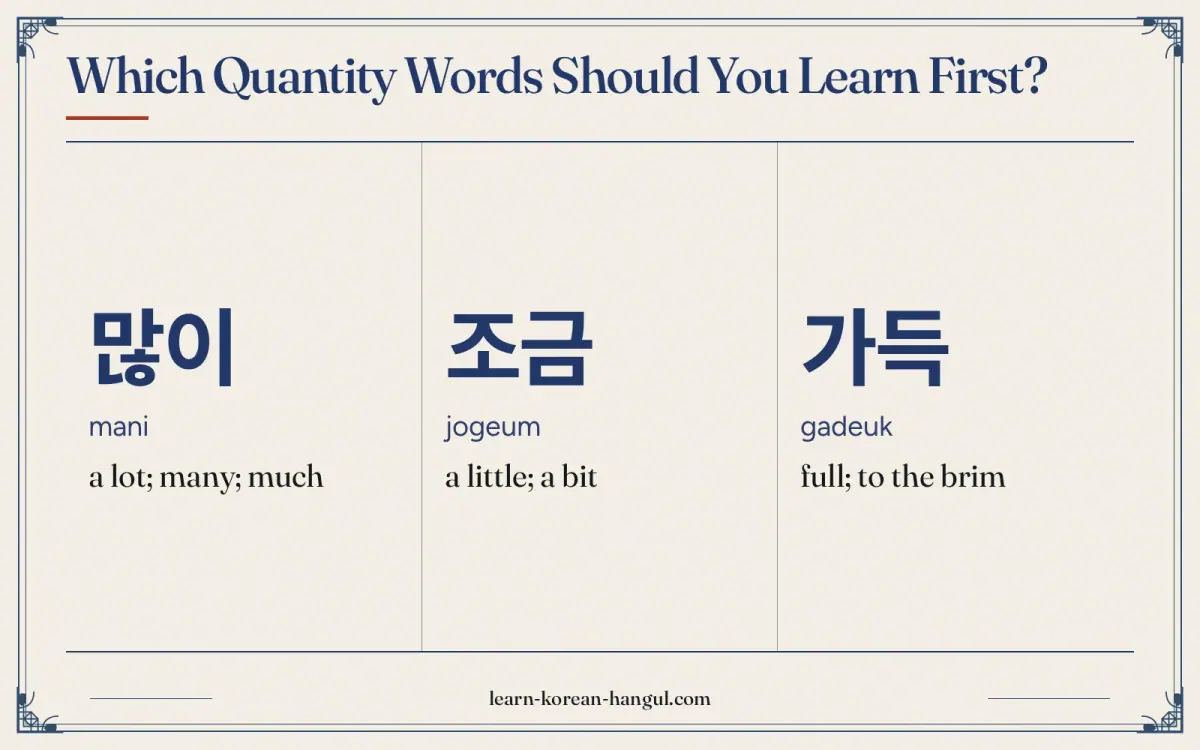
Learn 많이 (a lot), 조금 (a little), 다 (all), 너무 (too much) and 정말 (really) first. These five words change the size of almost any sentence, and they are short. Add 하나도 and 전혀 next, because they unlock the negative sentences that learners need for "I have none" and "I do not know at all".
- Words to say. 많이, 조금, 좀, 다, 너무, 정말, 빨리, 천천히. They appear in daily requests and reactions.
- Words to recognise. 모두, 전부, 대부분, 일부, 약간, 거의. They are common in speech and in news.
- Words to understand when spoken. 대략, 잔뜩, 가득, 나머지. A speaker uses them to be precise or lively.
The words run on a scale. The next table puts the ones that mean an amount in order from none to all. Learn the order, and you can pick the right word for how much you mean.
| Amount | Korean word | Meaning |
|---|---|---|
| None | 하나도 (with a negative) | not even one |
| Almost none | 거의 (with a negative) | hardly any |
| A little | 조금 | a little |
| Slightly | 약간 | slightly |
| Part | 일부 | some of it |
| Half | 절반 | half |
| Most | 대부분 | most |
| Nearly all | 거의 다 | almost all |
| All | 모두 / 전부 / 다 | all |
Several of these words, such as 많이 and 조금, also appear in the list of the top 100 Korean words.
Word · 10
- 1
많이
mani
a lot; many; much
- 2
조금
jogeum
a little; a bit
- 3
가득
gadeuk
full; to the brim
- 4
모두
modu
everyone; all
- 5
다
da
all; completely; (a finished action)
- 6
하나도
hanado
not even one; none at all
- 7
일부
ilbu
some; a part
- 8
절반
jeolban
half; one half
- 9
나머지
nameoji
the rest; remainder
- 10
약
yak
about; approximately (before a number)
How Do You Say a Lot and a Little in Korean?
These five words cover the amounts you mention in daily life: a lot, a little, a bit, full and heaps. 많이 and 조금 are the pair to learn first, and the others add shades. All five are adverbs, so they sit before the verb.
| No. | Hangul | Revised Romanization | Meaning and note | Example sentence | Audio assetId |
|---|---|---|---|---|---|
| 1 | 많이 | mani | a lot; many; much. Said [마니]. The adverb of the adjective 많다 (be many). The ㅎ is silent, so the ㄴ links to 이. Use it before an action verb. | 비가 많이 와요. (It rains a lot.) | au-pg-vocabulary-descriptions-quantities-1; example: au-pg-vocabulary-descriptions-quantities-26 |
| 2 | 조금 | jogeum | a little; a bit. The standard word for a small amount. It is usually shortened to 좀 in speech. | 설탕을 조금 넣어요. (I add a little sugar.) | au-pg-vocabulary-descriptions-quantities-2; example: au-pg-vocabulary-descriptions-quantities-27 |
| 3 | 좀 | jom | a bit; please (softener). The short form of 조금. It also makes a request softer: 좀 도와주세요 means please help me. | 문 좀 열어 주세요. (Please open the door for me.) | au-pg-vocabulary-descriptions-quantities-3; example: au-pg-vocabulary-descriptions-quantities-28 |
| 4 | 가득 | gadeuk | full; to the brim. Describes a container filled to the top. It often goes with the verb 차다 (be full). | 컵에 물이 가득 찼어요. (The cup is full of water.) | au-pg-vocabulary-descriptions-quantities-4; example: au-pg-vocabulary-descriptions-quantities-29 |
| 5 | 잔뜩 | jantteuk | heaps; a great deal. An informal word for a very large amount. It can also mean looking angry or tense, as in 잔뜩 화가 났어요. | 시장에서 과일을 잔뜩 샀어요. (I bought heaps of fruit at the market.) | au-pg-vocabulary-descriptions-quantities-5; example: au-pg-vocabulary-descriptions-quantities-30 |
Example Sentences
The sentences in this group follow one frame: the adverb sits right before the verb, as in 비가 많이 와요 (it rains a lot), 설탕을 조금 넣어요 (I add a little sugar) and 문 좀 열어 주세요 (please open the door for me). The adverb does not normally go at the end of the sentence. A related pattern uses 이/가 + adverb + verb, as in 컵에 물이 가득 찼어요, where the water is the subject and 가득 describes how it is full. In requests, 좀 or 조금 sits before the verb. Say each sentence aloud after its clip.
How Do You Say All and Not at All in Korean?
These five words say that every one of something is included or that none is. Three mean all, and two need a negative verb to mean none. The negative pairing is the most important grammar point on this page.
| No. | Hangul | Revised Romanization | Meaning and note | Example sentence | Audio assetId |
|---|---|---|---|---|---|
| 6 | 모두 | modu | everyone; all. Can refer to people (everyone) or things (all of them). It is also the plain word for 'all together'. | 모두 오셨어요? (Has everyone come?) | au-pg-vocabulary-descriptions-quantities-6; example: au-pg-vocabulary-descriptions-quantities-31 |
| 7 | 전부 | jeonbu | all; the whole lot. A noun and an adverb. It stresses that nothing is left out. | 숙제를 전부 했어요. (I did all of my homework.) | au-pg-vocabulary-descriptions-quantities-7; example: au-pg-vocabulary-descriptions-quantities-32 |
| 8 | 다 | da | all; completely; (a finished action). The shortest and most common word for all. With a verb, it can also mean 'finished', as in 다 먹었어요. | 밥을 다 먹었어요. (I finished all my rice.) | au-pg-vocabulary-descriptions-quantities-8; example: au-pg-vocabulary-descriptions-quantities-33 |
| 9 | 하나도 | hanado | not even one; none at all. Always paired with a negative: 없어요, 몰라요, 안 …. It literally means even one. | 돈이 하나도 없어요. (I have no money at all.) | au-pg-vocabulary-descriptions-quantities-9; example: au-pg-vocabulary-descriptions-quantities-34 |
| 10 | 전혀 | jeonhyeo | not at all; never at all. Always paired with a negative verb. It is stronger than 별로 and is used for a complete denial. | 그 사람은 전혀 몰라요. (I do not know that person at all.) | au-pg-vocabulary-descriptions-quantities-10; example: au-pg-vocabulary-descriptions-quantities-35 |
Negative sentences are the part to watch. 하나도 and 전혀 cannot be used with a positive verb. You say 하나도 없어요 (I have none), not 하나도 있어요. The same is true of the phrase 아무것도 (nothing), as in 아무것도 없어요 (there is nothing). These words are called negative polarity items, because they only work in a negative sentence. The grammar is explained on the negative polarity items page.
The three words for all have different feelings. 모두 is warm and covers people, 전부 stresses the whole and is good for things, and 다 is the casual everyday word. In speech, learners can use 다 almost all the time and be understood.
How Do You Say Some and Most in Korean?
Between none and all lie the words for part. These five words say some, most, slightly, half and the rest. 일부, 절반 and 나머지 are nouns and take particles, 약간 is an adverb, and 대부분 can be either. They are the words a news report or a survey result uses.
| No. | Hangul | Revised Romanization | Meaning and note | Example sentence | Audio assetId |
|---|---|---|---|---|---|
| 11 | 일부 | ilbu | some; a part. A noun meaning a part of a whole. 일부 학생 is some students, and it is usually followed by a noun. | 일부 학생만 왔어요. (Only some students came.) | au-pg-vocabulary-descriptions-quantities-11; example: au-pg-vocabulary-descriptions-quantities-36 |
| 12 | 대부분 | daebubun | most; the majority. Both a noun and an adverb. It means most of a whole, more than half. | 대부분의 사람이 지하철을 타요. (Most people take the subway.) | au-pg-vocabulary-descriptions-quantities-12; example: au-pg-vocabulary-descriptions-quantities-37 |
| 13 | 약간 | yakgan | slightly; a little. Said [약깐]. The ㄱ of 간 is tense after the final ㄱ. Common in speech, and often used with adjectives to soften them. | 약간 매워요. (It is slightly spicy.) | au-pg-vocabulary-descriptions-quantities-13; example: au-pg-vocabulary-descriptions-quantities-38 |
| 14 | 절반 | jeolban | half; one half. The word for exactly half of a whole. 반 is the shorter everyday word. | 케이크의 절반을 먹었어요. (I ate half of the cake.) | au-pg-vocabulary-descriptions-quantities-14; example: au-pg-vocabulary-descriptions-quantities-39 |
| 15 | 나머지 | nameoji | the rest; remainder. What is left after the first part. It is also the word for the remainder in division. | 나머지는 제가 할게요. (I will do the rest.) | au-pg-vocabulary-descriptions-quantities-15; example: au-pg-vocabulary-descriptions-quantities-40 |
The words 일부 and 대부분 both go before a noun: 일부 학생 (some students) and 대부분의 사람 (most people). With 대부분 the particle 의 is the careful form, and it is often dropped in speech. They do not need the plural marker 들. Korean nouns are plural only when the plural needs to be clear, so 학생 can mean one student or many students depending on the context. The marker 들 can be added, as in 학생들, but it is optional, and with words that already say many (많은, 모두, 대부분) it is usually left out.
Approximately (약, 정도)
Approximate words let you give a number without being exact. Korean has five common words: one goes before the number, two go after it, and two work alone. Learn the position of each, because that is the main difference.
| No. | Hangul | Revised Romanization | Meaning and note | Example sentence | Audio assetId |
|---|---|---|---|---|---|
| 16 | 약 | yak | about; approximately (before a number). Goes before the number, in a slightly formal register. Also the word for medicine (약), so context decides. | 약 열 명이 왔어요. (About ten people came.) | au-pg-vocabulary-descriptions-quantities-16; example: au-pg-vocabulary-descriptions-quantities-41 |
| 17 | 정도 | jeongdo | about; to a degree (after a number). Goes after the number or amount. It also means level or degree on its own. | 한 시간 정도 걸려요. (It takes about an hour.) | au-pg-vocabulary-descriptions-quantities-17; example: au-pg-vocabulary-descriptions-quantities-42 |
| 18 | 쯤 | jjeum | around; about (after a number). Attached right after a time or number. It sounds friendlier than 정도. | 여섯 시쯤 일어나요. (I get up around six.) | au-pg-vocabulary-descriptions-quantities-18; example: au-pg-vocabulary-descriptions-quantities-43 |
| 19 | 거의 | geoui | almost; nearly. Before a verb it means almost, as in 거의 다 왔어요. With a negative it means hardly any. | 숙제가 거의 끝났어요. (The homework is almost finished.) | au-pg-vocabulary-descriptions-quantities-19; example: au-pg-vocabulary-descriptions-quantities-44 |
| 20 | 대략 | daeryak | roughly; approximately. A slightly formal adverb used for estimates, as in 대략 만 원 (roughly 10,000 won). | 대략 만 원이에요. (It is roughly 10,000 won.) | au-pg-vocabulary-descriptions-quantities-20; example: au-pg-vocabulary-descriptions-quantities-45 |
Position decides the word. 약 goes before the number: 약 열 명. 정도 and 쯤 go after it: 열 명 정도, 세 시쯤. You cannot say 열 명 약 or 정도 열 명. 정도 and 쯤 are both natural, but 쯤 is more often used with times, and 정도 with amounts and durations. Speakers often add 한 (about) before the number as well, as in 한 열 명쯤 (about ten people).
The word 거의 with a positive verb means almost, and with a negative verb it means hardly: 거의 없어요 means there is almost none. That makes 거의 a bridge between the none words and the all words in the earlier table. The sentence 거의 다 왔어요 (we are almost there) is something you will hear on any long trip.
Degree and Manner
The last group covers the adverbs of degree (very, really, too) and of manner (quickly, slowly). They are not amounts, but they belong with quantity words because they answer the same questions: how much and how. These five are among the most frequent adverbs in speech.
| No. | Hangul | Revised Romanization | Meaning and note | Example sentence | Audio assetId |
|---|---|---|---|---|---|
| 21 | 너무 | neomu | too much; very. Means 'too' for a negative result, as in 너무 비싸요 (too expensive). In everyday speech it is also used as 'very' with positive words. | 이 가방은 너무 무거워요. (This bag is too heavy.) | au-pg-vocabulary-descriptions-quantities-21; example: au-pg-vocabulary-descriptions-quantities-46 |
| 22 | 정말 | jeongmal | really; truly. A warm and flexible word for really. As a reply, 정말요? means really? | 정말 맛있어요. (It is really delicious.) | au-pg-vocabulary-descriptions-quantities-22; example: au-pg-vocabulary-descriptions-quantities-47 |
| 23 | 매우 | maeu | very; extremely (formal). More formal than 아주, 너무 and 정말. Common in writing, news and speeches. | 이 문제는 매우 어려워요. (This problem is very difficult.) | au-pg-vocabulary-descriptions-quantities-23; example: au-pg-vocabulary-descriptions-quantities-48 |
| 24 | 빨리 | ppalli | quickly; fast. The adverb of 빠르다 (be fast). Often used as a request: 빨리 오세요 means please come quickly. | 빨리 걸어요. (I walk fast.) | au-pg-vocabulary-descriptions-quantities-24; example: au-pg-vocabulary-descriptions-quantities-49 |
| 25 | 천천히 | cheoncheonhi | slowly. The opposite of 빨리. Useful for asking someone to speak slowly: 천천히 말해 주세요. | 천천히 걸어요. (I walk slowly.) | au-pg-vocabulary-descriptions-quantities-25; example: au-pg-vocabulary-descriptions-quantities-50 |
The degree adverbs have different registers. 매우 is the formal choice, 아주 is the neutral one, and 너무 and 정말 are the everyday ones. Where 너무 is concerned, teachers used to say it should only go with a negative idea (too much). The standard dictionary now accepts it with positive words as well, so 너무 맛있어요 (it is so delicious) is fine in conversation. In writing, choose 아주 or 매우 if you want to be safe.
Manner adverbs often come from adjectives. 빠르다 (be fast) gives 빨리, and 천천히 is the adverb for slowly. For the adjective forms, see adjectives.
How Do You Use 정도, 쯤 and 약 with Numbers?
Approximate words follow the number pattern of the unit. A native number goes with a counter, and the approximate word sits after the whole phrase, as in 열 명 정도. A Sino-Korean number goes with a unit, as in 삼십 분 정도.
| What you mean | Korean | Meaning |
|---|---|---|
| About ten people | 약 열 명 / 열 명 정도 | about ten people |
| Around three o'clock | 세 시쯤 | around three |
| About an hour | 한 시간 정도 / 한 시간쯤 | about an hour |
| Roughly 10,000 won | 대략 만 원 / 만 원 정도 | roughly 10,000 won |
| About 30 minutes | 약 삼십 분 / 삼십 분 정도 | about 30 minutes |
The number systems follow their usual rules. Hours use native numbers (세 시) and minutes use Sino-Korean numbers (삼십 분). The approximate words do not change this. For the full rules, see native Korean numbers and Sino-Korean numbers.
How Do Quantity Words Pair with Negation?
A negative sentence changes which quantity words you can use. Some quantity words need a negative verb, and some change meaning when the verb is negative. Here is the full picture in one table.
| Positive sentence | Negative sentence | Meaning |
|---|---|---|
| 돈이 많아요. | 돈이 많지 않아요. | I have a lot of money / I do not have much money. |
| 조금 있어요. | 하나도 없어요. | I have a little / I have none at all. |
| 다 알아요. | 전혀 몰라요. | I know everything / I know nothing at all. |
| 거의 다 했어요. | 거의 안 했어요. | I almost finished / I hardly did anything. |
| 모두 왔어요. | 아무도 안 왔어요. | Everyone came / Nobody came. |
The pairs 하나도 + 없다 and 전혀 + 모르다 are fixed. A Korean listener expects the negative verb as soon as they hear 하나도 or 전혀, so you can even drop the verb in a reply: 하나도요? (None at all?). The new word 아무도 (nobody) in the last row follows the same rule, and it belongs with 아무것도 (nothing). The details of negative sentences are on the negation hub.
How Do You Pronounce These Words?
Quantity words are short, but a few have sounds that differ from the spelling. The main changes are a silent ㅎ in 많이, tensing in 약간, and the double ㄹ in 빨리. Standard pronunciation follows the National Institute of Korean Language (국립국어원) rules, and the romanization follows the Revised Romanization of Korean, which records some sound changes and ignores others.
| Spelling | Sounds like | What changes |
|---|---|---|
| 많이 | [마니] | The final ㅎ of ㄶ is silent before a vowel, so the ㄴ links to 이. |
| 약간 | [약깐] | The ㄱ of 간 becomes tense after the final ㄱ. The Romanization does not show it: yakgan. |
| 거의 | [거의] or [거이] | The ㅢ in a later syllable is read as [의], and [이] is also accepted. Both are normal. |
| 대략 | [대략] | No change in sound. Do not add a vowel after the final ㄱ. |
| 빨리 | [빨리] | The doubled ㅃ is tense, and the ㄹㄹ is a long l. The Romanization writes ppalli. |
| 천천히 | [천천히] | The ㅎ is weak but kept in careful speech. The Romanization writes cheoncheonhi. |
| 잔뜩 | [잔뜩] | The ㄸ is tense from the start. The Romanization shows tt: jantteuk. |
The tense consonants in 빨리, 잔뜩 and 쯤 are the sounds that learners find hard. A tense consonant is made with a tight throat and no puff of air. Hold a piece of paper in front of your mouth: with ㅃ, ㄸ and ㅉ, the paper should hardly move. The aspirated versions ㅍ, ㅌ and ㅊ make the paper move. Compare 달 (dal, moon), 딸 (ttal, daughter) and 탈 (tal, mask) and notice the difference.
Audio and Slow Playback
Every headword and every example sentence has its own audio. The five clips below replay the trickiest words slowly. Play one, repeat it aloud, then play it again and compare.
What Mistakes Do Learners Make with Quantity Words?
These five mistakes come up often with quantity words.
- Using 하나도 or 전혀 with a positive verb. 전혀 알아요 is wrong. Use a negative verb: 전혀 몰라요.
- Putting the adverb after the verb. 먹어요 많이 is not the normal order. The adverb sits before the verb: 많이 먹어요.
- Using 약 after the number. 열 명 약 is wrong. 약 goes before: 약 열 명. Use 정도 or 쯤 after the number.
- Saying 많아요 where you need 많이. 많아요 is an adjective (be many) and 많이 is an adverb. Say 물이 많아요 (there is a lot of water), but 물을 많이 마셔요 (I drink a lot of water).
- Overusing 너무. 너무 is not always the same as very. Write 너무 비싸요 for too expensive. For a calm, neutral very, choose 아주.
A habit that avoids most of these: put the quantity word right before the word it describes, and listen for a negative ending when you use 하나도, 전혀 and 아무것도.
Practice: Flashcards and Worksheet
Study in three steps. First, run the flashcard deck in recognition mode until you know each of the 25 words. Second, switch to listening mode and answer from the audio alone. Third, take the quiz. The deck covers all 25 words with audio, and your progress stays in your browser. The vocabulary flashcard decks page lists the other decks.
Practice · 55
- 01많이
Show answer
headword 1: a lot; many; much
- 02조금
Show answer
headword 2: a little; a bit
- 03좀
Show answer
headword 3: a bit; please (softener)
- 04가득
Show answer
headword 4: full; to the brim
- 05잔뜩
Show answer
headword 5: heaps; a great deal
- 06모두
Show answer
headword 6: everyone; all
- 07전부
Show answer
headword 7: all; the whole lot
- 08다
Show answer
headword 8: all; completely; (a finished action)
- 09하나도
Show answer
headword 9: not even one; none at all
- 10전혀
Show answer
headword 10: not at all; never at all
- 11일부
Show answer
headword 11: some; a part
- 12대부분
Show answer
headword 12: most; the majority
- 13약간
Show answer
headword 13: slightly; a little
- 14절반
Show answer
headword 14: half; one half
- 15나머지
Show answer
headword 15: the rest; remainder
- 16약
Show answer
headword 16: about; approximately (before a number)
- 17정도
Show answer
headword 17: about; to a degree (after a number)
- 18쯤
Show answer
headword 18: around; about (after a number)
- 19거의
Show answer
headword 19: almost; nearly
- 20대략
Show answer
headword 20: roughly; approximately
- 21너무
Show answer
headword 21: too much; very
- 22정말
Show answer
headword 22: really; truly
- 23매우
Show answer
headword 23: very; extremely (formal)
- 24빨리
Show answer
headword 24: quickly; fast
- 25천천히
Show answer
headword 25: slowly
- 26비가 많이 와요.
Show answer
example sentence for 많이: It rains a lot.
- 27설탕을 조금 넣어요.
Show answer
example sentence for 조금: I add a little sugar.
- 28문 좀 열어 주세요.
Show answer
example sentence for 좀: Please open the door for me.
- 29컵에 물이 가득 찼어요.
Show answer
example sentence for 가득: The cup is full of water.
- 30시장에서 과일을 잔뜩 샀어요.
Show answer
example sentence for 잔뜩: I bought heaps of fruit at the market.
- 31모두 오셨어요?
Show answer
example sentence for 모두: Has everyone come?
- 32숙제를 전부 했어요.
Show answer
example sentence for 전부: I did all of my homework.
- 33밥을 다 먹었어요.
Show answer
example sentence for 다: I finished all my rice.
- 34돈이 하나도 없어요.
Show answer
example sentence for 하나도: I have no money at all.
- 35그 사람은 전혀 몰라요.
Show answer
example sentence for 전혀: I do not know that person at all.
- 36일부 학생만 왔어요.
Show answer
example sentence for 일부: Only some students came.
- 37대부분의 사람이 지하철을 타요.
Show answer
example sentence for 대부분: Most people take the subway.
- 38약간 매워요.
Show answer
example sentence for 약간: It is slightly spicy.
- 39케이크의 절반을 먹었어요.
Show answer
example sentence for 절반: I ate half of the cake.
- 40나머지는 제가 할게요.
Show answer
example sentence for 나머지: I will do the rest.
- 41약 열 명이 왔어요.
Show answer
example sentence for 약: About ten people came.
- 42한 시간 정도 걸려요.
Show answer
example sentence for 정도: It takes about an hour.
- 43여섯 시쯤 일어나요.
Show answer
example sentence for 쯤: I get up around six.
- 44숙제가 거의 끝났어요.
Show answer
example sentence for 거의: The homework is almost finished.
- 45대략 만 원이에요.
Show answer
example sentence for 대략: It is roughly 10,000 won.
- 46이 가방은 너무 무거워요.
Show answer
example sentence for 너무: This bag is too heavy.
- 47정말 맛있어요.
Show answer
example sentence for 정말: It is really delicious.
- 48이 문제는 매우 어려워요.
Show answer
example sentence for 매우: This problem is very difficult.
- 49빨리 걸어요.
Show answer
example sentence for 빨리: I walk fast.
- 50천천히 걸어요.
Show answer
example sentence for 천천히: I walk slowly.
- 51많이
Show answer
slow playback of the headword 많이
- 52약간
Show answer
slow playback of the headword 약간
- 53잔뜩
Show answer
slow playback of the headword 잔뜩
- 54빨리
Show answer
slow playback of the headword 빨리
- 55천천히
Show answer
slow playback of the headword 천천히
Practice · 8
What does 많이 (mani) mean?
Show answer
a lot; many; much
많이 means a lot; many; much. Example: 비가 많이 와요. (It rains a lot.)
What does 조금 (jogeum) mean?
Show answer
a little; a bit
조금 means a little; a bit. Example: 설탕을 조금 넣어요. (I add a little sugar.)
What does 하나도 (hanado) mean?
Show answer
not even one; none at all
하나도 means not even one; none at all. Example: 돈이 하나도 없어요. (I have no money at all.)
What does 전부 (jeonbu) mean?
Show answer
all; the whole lot
전부 means all; the whole lot. Example: 숙제를 전부 했어요. (I did all of my homework.)
What does 약간 (yakgan) mean?
Show answer
slightly; a little
약간 means slightly; a little. Example: 약간 매워요. (It is slightly spicy.)
What does 나머지 (nameoji) mean?
Show answer
the rest; remainder
나머지 means the rest; remainder. Example: 나머지는 제가 할게요. (I will do the rest.)
What does 정도 (jeongdo) mean?
Show answer
about; to a degree (after a number)
정도 means about; to a degree (after a number). Example: 한 시간 정도 걸려요. (It takes about an hour.)
What does 천천히 (cheoncheonhi) mean?
Show answer
slowly
천천히 means slowly. Example: 천천히 걸어요. (I walk slowly.)
Korean Quantity Words Vocabulary Worksheet (PDF)
A printable worksheet for these words (word list, matching, writing practice, fill-in-the-blank exercises and answer key) is available in A4 and US Letter from the download card on this page. For practice, put a few coins, apples or pencils on a table and describe the amount with four different words: 많이 있어요, 조금 있어요, 절반만 있어요, 하나도 없어요. Saying the sentence while you look at the objects fixes both the word and the amount.
Where to Go Next
After this page, continue with Korean Opposites Vocabulary, which pairs words that mean the opposite, or go back to Korean Position Words Vocabulary. For the grammar behind the negative sentences, see negation. To return to the full set, go to Shapes, Materials and Measurements in Korean.
Frequently Asked Questions
How Do You Say a Lot in Korean?
A lot is 많이 (mani) as an adverb, as in 많이 먹어요 (I eat a lot). As a verb, 많다 means to be many, as in 사람이 많아요 (there are many people). Put the adverb right before the verb. The related word 너무 means too much, and 아주 means very.
How Do You Pronounce 조금 (jogeum)?
Say jo-geum, with two short syllables. The first vowel ㅗ is a rounded "o", like in "go" but shorter. The second vowel ㅡ is unrounded: spread your lips and say "uh" with your tongue back. The final ㅁ closes the lips. There is no sound change, so the spelling matches the sound.
How Many Quantity Words Should I Learn First?
Five first: 많이, 조금, 다, 너무 and 정말. At five new words a day, the whole list of 25 takes five days plus review. Add 하나도 and 전혀 on day two, because they teach the negative pairing that Korean needs for "none" and "not at all".
Where Can I Practise Quantity Words with Flashcards?
Use the vocabulary flashcard decks. The deck for this page holds all 25 words with Hangul, romanization and audio, and it offers recognition and listening modes. Your progress stays in your browser, so return daily and review the cards you missed.
Is the Romanization on This Page Official?
It follows the Revised Romanization of Korean, which South Korea adopted on 7 July 2000 and whose rules the National Institute of Korean Language (국립국어원) publishes. It is a learning aid and does not show every sound change, so rely on the Hangul and the audio.
Is There a Printable Worksheet for Quantity Words?
A printable worksheet for these words (word list, matching, writing practice, fill-in-the-blank exercises and answer key) is available in A4 and US Letter from the download card on this page. For practice, copy the tables on this page by hand or use the flashcard deck, which carries the same 25 words.