Key facts
Korean Position Words Vocabulary at a Glance
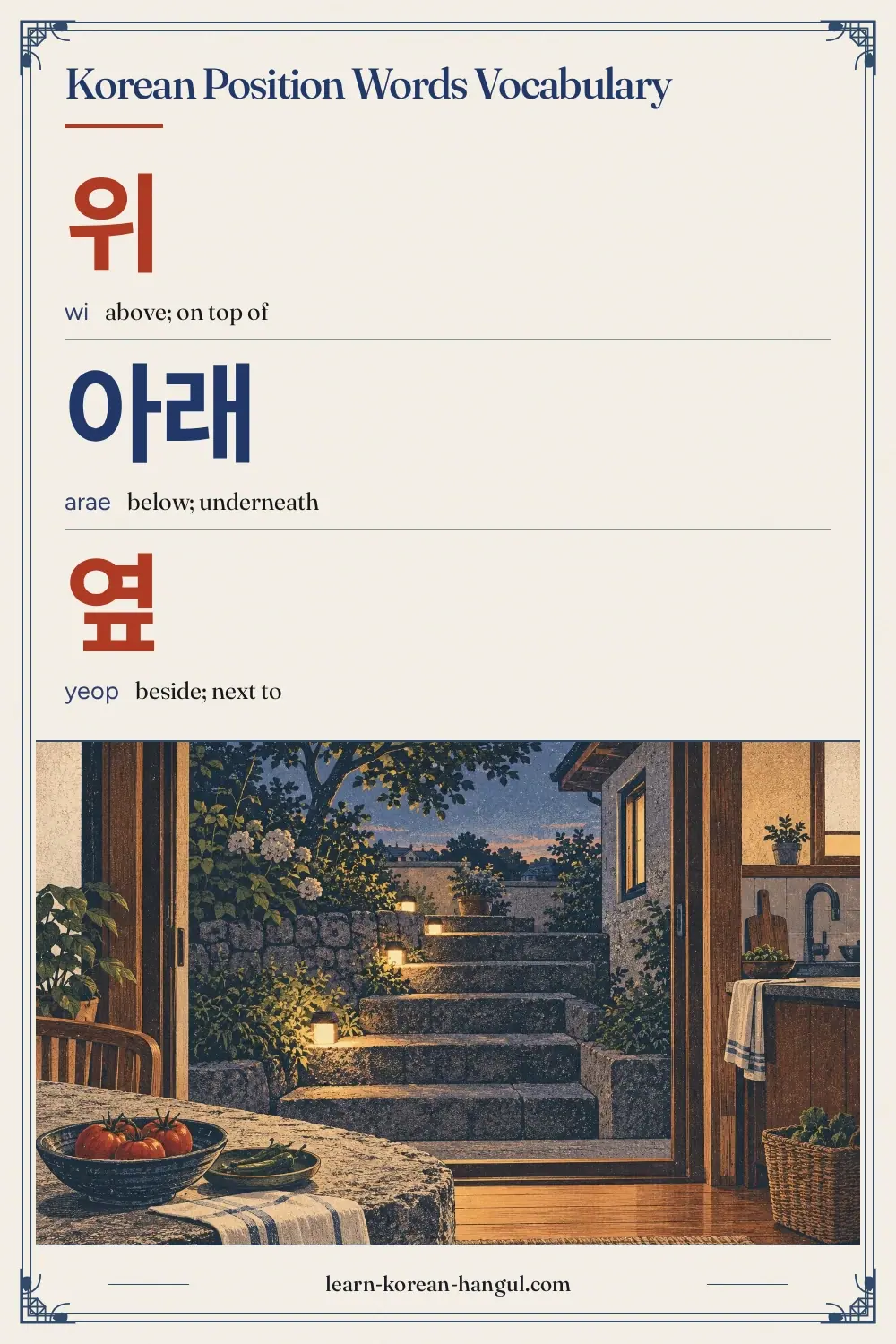
This list has 20 words in five groups of four. It starts with the vertical and side words, adds front and back, then inside and outside, then between and among, and ends with distance words. It belongs to Shapes, Materials and Measurements in Korean and pairs with Korean Measurement Vocabulary. Every word has an example sentence, so the page doubles as a ready deck.
| Group | Words | Use |
|---|---|---|
| Above, below and beside | 4 | Vertical and side positions |
| In front and behind | 4 | Front, back and opposite sides |
| Inside and outside | 4 | Containers and rooms |
| Between and among | 4 | Middles and gaps |
| Far and near | 4 | Distance and direction |
All twenty are nouns or adverbs. The grammar is small, because the same pattern works for every word: place + position noun + 에 + 있어요. The pattern is the main thing to learn, and the next section shows it.
How Does Korean Say "on the Desk" without a Preposition?
Korean puts the place first, then a position noun, then the particle 에. English says "on the desk" with a preposition and a noun. Korean says desk, top, at: 책상 위에. The position noun works like a place of its own, so it can take any particle that a place takes.
| English | Korean pattern | Example |
|---|---|---|
| on the desk | place + 위 + 에 | 책상 위에 |
| under the bed | place + 밑 + 에 | 침대 밑에 |
| in the bag | place + 안 + 에 | 가방 안에 |
| in front of the school | place + 앞 + 에 | 학교 앞에 |
| between A and B | A와/과 B + 사이 + 에 | 은행과 우체국 사이에 |
The particle after the position noun depends on the verb. With 있어요 (there is), use 에: 책상 위에 있어요. With an action verb, use 에서: 학교 앞에서 만나요. With a direction verb, 에 also works: 학교 앞에 가요. The full rules are on the location particles page. For now, remember that "where something is" takes 에 and "where an action happens" takes 에서.
Which Position Words Should You Learn First?
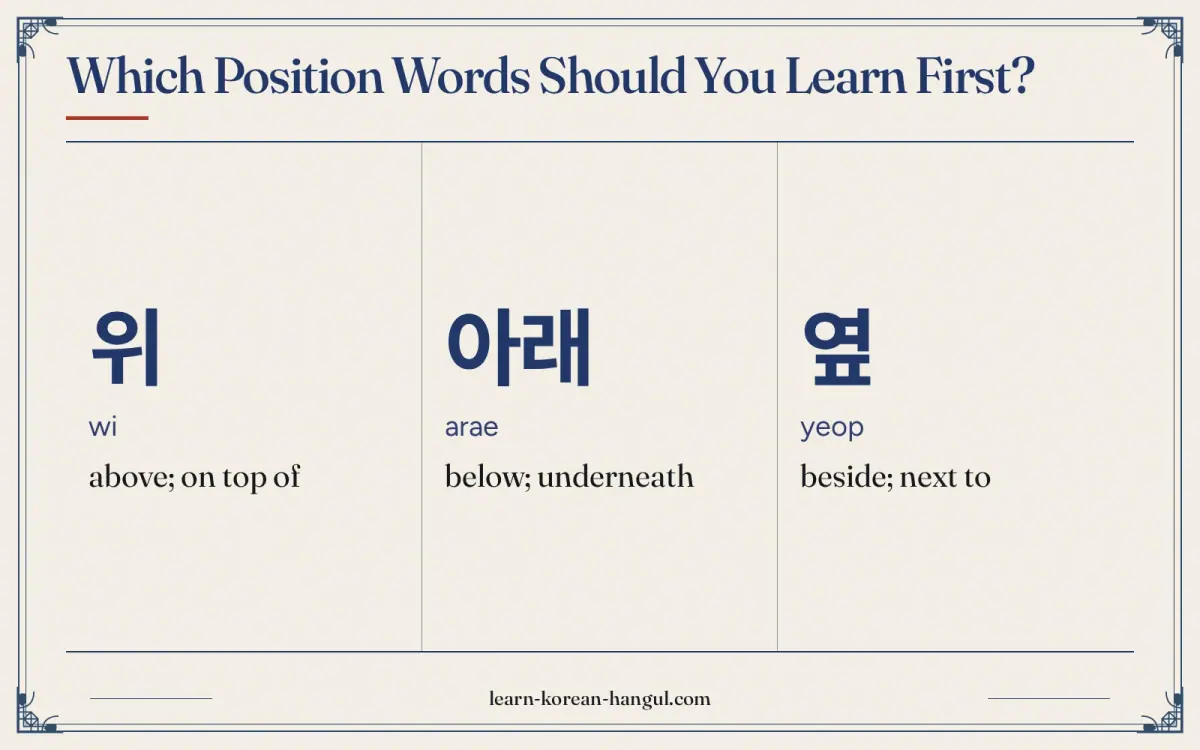
Learn 위 (above), 아래 (below), 앞 (front), 뒤 (behind) and 안 (inside) first. These five cover most everyday descriptions, and the pattern you practise with them works for all the other words. After those five, add 옆 (beside) and 밖 (outside) for giving directions.
- Words to say. 위, 아래, 앞, 뒤, 옆, 안, 밖. You use these in nearly every location sentence.
- Words to recognise. 맞은편, 건너편, 근처. These appear in directions and on maps.
- Words to understand when spoken. 가운데, 중간, 사이. A person giving directions says these, and you only need to follow them.
A box and a ball make a good study aid. Put a ball above, below, beside, in front of, behind, inside and outside a box, and say a sentence for each. The table below gives all seven, plus the "between two boxes" case.
| Position of the ball | Korean sentence | English |
|---|---|---|
| on the box | 공이 상자 위에 있어요. | The ball is on the box. |
| under the box | 공이 상자 아래에 있어요. | The ball is under the box. |
| beside the box | 공이 상자 옆에 있어요. | The ball is beside the box. |
| in front of the box | 공이 상자 앞에 있어요. | The ball is in front of the box. |
| behind the box | 공이 상자 뒤에 있어요. | The ball is behind the box. |
| inside the box | 공이 상자 안에 있어요. | The ball is inside the box. |
| outside the box | 공이 상자 밖에 있어요. | The ball is outside the box. |
| between two boxes | 공이 상자 두 개 사이에 있어요. | The ball is between two boxes. |
Word · 8
- 1
위
wi
above; on top of
- 2
아래
arae
below; underneath
- 3
옆
yeop
beside; next to
- 4
앞
ap
front; in front of
- 5
뒤
dwi
back; behind
- 6
안
an
inside; in
- 7
밖
bak
outside
- 8
사이
sai
between; gap
Above, below and Beside
These four words answer the question "where is it?" when you describe things along the vertical line and the side. Each is a noun, so it follows the place it describes and takes the location particle 에. The first two are opposites, the third is close to the second, and the fourth is the neighbour on either side.
| No. | Hangul | Revised Romanization | Meaning and note | Example sentence | Audio assetId |
|---|---|---|---|---|---|
| 1 | 위 | wi | above; on top of. Covers both "on" and "above". Context shows whether the thing touches. The opposite is 아래. | 책이 책상 위에 있어요. (The book is on the desk.) | au-pg-vocabulary-descriptions-positions-1; example: au-pg-vocabulary-descriptions-positions-21 |
| 2 | 아래 | arae | below; underneath. The lower area in general. The opposite of 위. 아래층 is the floor below. | 고양이가 의자 아래에 있어요. (The cat is under the chair.) | au-pg-vocabulary-descriptions-positions-2; example: au-pg-vocabulary-descriptions-positions-22 |
| 3 | 밑 | mit | directly under; bottom. Said [밑] alone and [미테] before 에. Closer than 아래, and often touching or very near. | 가방이 침대 밑에 있어요. (The bag is under the bed.) | au-pg-vocabulary-descriptions-positions-3; example: au-pg-vocabulary-descriptions-positions-23 |
| 4 | 옆 | yeop | beside; next to. Said [엽]; before 에 it sounds like [여페]. Works for left or right. | 은행은 우체국 옆에 있어요. (The bank is next to the post office.) | au-pg-vocabulary-descriptions-positions-4; example: au-pg-vocabulary-descriptions-positions-24 |
Example Sentences
All four sentences follow one frame: thing + 이/가 + place + position noun + 에 + 있어요. The thing being located takes the subject particle 이 or 가, the place stands alone with no particle, and 에 marks where something is. Korean needs no word for "the" or "of", so 책상 위에 means "on the desk" without any extra word. Say each sentence aloud after the audio clip, and swap in other nouns, such as 의자 (chair) or 침대 (bed), to make new ones.
How Do You Say in Front and behind in Korean?
Front and back words describe where you stand in a line, where a shop sits on a street and where two buildings face each other. Four words cover it. The first two are plain opposites. The last two describe the other side of a road or a space, and they are the ones English speakers mix up.
| No. | Hangul | Revised Romanization | Meaning and note | Example sentence | Audio assetId |
|---|---|---|---|---|---|
| 5 | 앞 | ap | front; in front of. Said [압] alone and [아페] before 에. Also means "ahead", including ahead in time, as in 앞으로 (from now on). | 학교 앞에서 만나요. (Let us meet in front of the school.) | au-pg-vocabulary-descriptions-positions-5; example: au-pg-vocabulary-descriptions-positions-25 |
| 6 | 뒤 | dwi | back; behind. The opposite of 앞. Also "after" in time phrases, as in 수업 뒤. | 집 뒤에 공원이 있어요. (There is a park behind the house.) | au-pg-vocabulary-descriptions-positions-6; example: au-pg-vocabulary-descriptions-positions-26 |
| 7 | 맞은편 | majeunpyeon | directly opposite. Said [마즌편]. 맞은 means facing and 편 means side. The thing faces yours. | 카페는 은행 맞은편에 있어요. (The cafe is opposite the bank.) | au-pg-vocabulary-descriptions-positions-7; example: au-pg-vocabulary-descriptions-positions-27 |
| 8 | 건너편 | geonneopyeon | the other side; across. 건너다 means to cross. The other side of a road, river or tracks. | 길 건너편에 편의점이 있어요. (There is a convenience store across the street.) | au-pg-vocabulary-descriptions-positions-8; example: au-pg-vocabulary-descriptions-positions-28 |
Note the particle in the first example: 학교 앞에서 만나요 uses 에서, not 에. The particle 에서 marks the place where an action happens (meeting), while 에 marks where something exists (is located). The difference is explained on the location particles page, and it is the most common slip in sentences with these words.
Inside and Outside
Inside and outside words are the position words you hear in everyday instructions, such as "put it in the bag" and "wait outside". Korean has two words for inside and two for outside. For inside, the choice depends on depth; for outside, on whether the space is physical.
| No. | Hangul | Revised Romanization | Meaning and note | Example sentence | Audio assetId |
|---|---|---|---|---|---|
| 9 | 안 | an | inside; in. The everyday word for being inside a space. It is also the negative adverb 안, as in 안 가요. | 가방 안에 지갑이 있어요. (There is a wallet in the bag.) | au-pg-vocabulary-descriptions-positions-9; example: au-pg-vocabulary-descriptions-positions-29 |
| 10 | 속 | sok | inside; deep within. Suggests depth or the middle of something, as in 마음속 (in the heart). | 상자 속에 선물이 있어요. (There is a gift inside the box.) | au-pg-vocabulary-descriptions-positions-10; example: au-pg-vocabulary-descriptions-positions-30 |
| 11 | 밖 | bak | outside. Said [박]; before 에 it sounds like [바께]. The opposite of 안. | 밖에 비가 와요. (It is raining outside.) | au-pg-vocabulary-descriptions-positions-11; example: au-pg-vocabulary-descriptions-positions-31 |
| 12 | 바깥 | bakkat | outside; the outdoors. Used only for physical space, while 밖 also has abstract uses, as in 그 밖에 (besides that). Its pair is 안 or 안쪽. | 바깥에서 기다려요. (I wait outside.) | au-pg-vocabulary-descriptions-positions-12; example: au-pg-vocabulary-descriptions-positions-32 |
The word 안 has two jobs. As a noun it means "inside" and follows the place: 가방 안에 (in the bag). As an adverb it means "not" and comes before a verb: 안 가요 (I do not go). The two look the same but sit in different places in the sentence. The same is true of 밖에, which means "outside" in 밖에 비가 와요, but means "only" when the sentence ends in a negative. The mistakes section below gives an example.
How Do You Say between and Among in Korean?
Between and middle words describe the space in the middle of two or more things. They are useful for giving directions, because shops and stations often sit between landmarks. One of them, 중, is a different kind of word and shows up in many fixed expressions.
| No. | Hangul | Revised Romanization | Meaning and note | Example sentence | Audio assetId |
|---|---|---|---|---|---|
| 13 | 사이 | sai | between; gap. Needs two things: A와 B 사이. Also means a relationship, as in 사이가 좋다. | 은행과 우체국 사이에 있어요. (It is between the bank and the post office.) | au-pg-vocabulary-descriptions-positions-13; example: au-pg-vocabulary-descriptions-positions-33 |
| 14 | 가운데 | gaunde | middle; centre. The centre of a space or the middle one of three. 한가운데 means the very centre. | 방 가운데에 테이블이 있어요. (There is a table in the middle of the room.) | au-pg-vocabulary-descriptions-positions-14; example: au-pg-vocabulary-descriptions-positions-34 |
| 15 | 중간 | junggan | middle; halfway point. More abstract than 가운데: the middle of a road, a process or a list. | 길 중간에 서 있어요. (I am standing in the middle of the road.) | au-pg-vocabulary-descriptions-positions-15; example: au-pg-vocabulary-descriptions-positions-35 |
| 16 | 중 | jung | among; during; in the middle of. A bound noun. 친구 중에 means "among friends", and 공부 중 means "studying". | 친구 중에 한 명이 의사예요. (One of my friends is a doctor.) | au-pg-vocabulary-descriptions-positions-16; example: au-pg-vocabulary-descriptions-positions-36 |
The pattern A와/과 B 사이에 uses 와 after a vowel and 과 after a consonant. 은행과 우체국 사이에 is correct because 은행 ends in a consonant. Notice that 사이 needs two named things, while 가운데 needs only one place. Ask yourself whether there is one thing or two before you choose between them.
Far and Near
Distance words finish the set. They tell you how close something is, and the last one, 저쪽, points in a direction. Used with the question 어디에 있어요?, they let you ask where something is and understand the answer.
| No. | Hangul | Revised Romanization | Meaning and note | Example sentence | Audio assetId |
|---|---|---|---|---|---|
| 17 | 근처 | geuncheo | nearby; neighbourhood. 근 means near and 처 means place. 이 근처 means near here. | 학교 근처에 살아요. (I live near the school.) | au-pg-vocabulary-descriptions-positions-17; example: au-pg-vocabulary-descriptions-positions-37 |
| 18 | 가까이 | gakkai | close; nearby (adverb). An adverb of nearness. The adjective is 가깝다. Used with verbs of motion. | 가까이 오세요. (Please come closer.) | au-pg-vocabulary-descriptions-positions-18; example: au-pg-vocabulary-descriptions-positions-38 |
| 19 | 멀리 | meolli | far away. An adverb. Said with a doubled l. The adjective is 멀다. | 멀리 가지 마세요. (Please do not go far.) | au-pg-vocabulary-descriptions-positions-19; example: au-pg-vocabulary-descriptions-positions-39 |
| 20 | 저쪽 | jeojjok | over there; that way. Said [저쪽] with a tense ㅉ. 이쪽 is this way and 그쪽 is that way near you. | 화장실은 저쪽이에요. (The restroom is over there.) | au-pg-vocabulary-descriptions-positions-20; example: au-pg-vocabulary-descriptions-positions-40 |
How Do You Ask Where Something Is?
The question is 어디에 있어요? (where is it?). The answer uses the pattern you have just learned, and it can be as short as one word. Distance words and direction words let you answer without naming the place twice.
| Question | Answer | Meaning |
|---|---|---|
| 화장실이 어디에 있어요? | 저쪽에 있어요. | Where is the restroom? It is over there. |
| 은행이 어디에 있어요? | 우체국 옆에 있어요. | Where is the bank? It is next to the post office. |
| 편의점이 어디에 있어요? | 길 건너편에 있어요. | Where is the convenience store? It is across the street. |
| 지갑이 어디에 있어요? | 가방 안에 있어요. | Where is the wallet? It is in the bag. |
The words 이쪽, 그쪽 and 저쪽 point in a direction: 이쪽 is this side, near me, 그쪽 is that side, near you, and 저쪽 is that side, far from both. These three use the same ㅈ and ㅉ sounds you saw in the group above. Answers that sound short are normal in Korean, because the context already holds the rest of the sentence.
How Do You Pronounce These Words?
Position words end in many consonants, and they change sound when 에 follows. Standard pronunciation follows the National Institute of Korean Language (국립국어원) rules, and the romanization follows the Revised Romanization of Korean, which records some sound changes and ignores others.
| Spelling | Sounds like | What changes |
|---|---|---|
| 옆에 | [여페] | The final ㅍ moves to the next syllable as a ㅍ sound. |
| 앞에 | [아페] | The same linking: the final ㅍ becomes the start of 에. |
| 밑에 | [미테] | The final ㅌ sound moves across and keeps its aspirated sound. |
| 밖에 | [바께] | The final ㄲ is released as tense [ㄲ] before the vowel. |
| 맞은편 | [마즌편] | The final ㅈ links across to the vowel of 은. |
| 바깥 | [바깓] | A final ㅌ is said as [ㄷ] at the end of a word. |
Without the particle, a final consonant is not released. 옆 alone is [엽], 앞 alone is [압], and 밖 alone is [박]. This is why the same word looks different in the audio when it stands alone. The doubled ㄹ in 멀리 is one long l sound, held a little longer than a single l.
Audio and Slow Playback
Every headword and every example sentence has its own audio. The five clips below replay the trickiest words slowly. Play one, repeat it aloud, then play it again and compare.
What Mistakes Do Learners Make with Position Words?
These five mistakes come up often with position words.
- Dropping 에. 책상 위 있어요 is incomplete. Add the particle: 책상 위에 있어요.
- Using 에 for an action. 학교 앞에 만나요 is wrong. Use 에서 for where an action happens: 학교 앞에서 만나요.
- Adding 의 between the place and the position noun. 책상의 위에 is possible but stiff. In speech, say 책상 위에.
- Confusing 밖에 (outside) with 밖에 (only). 밖에 비가 와요 means "it is raining outside". But 하나밖에 없어요 means "there is only one": here 밖에 is a particle that must be followed by a negative. The spelling is the same, so the end of the sentence decides.
- Mixing up the noun 안 and the negative 안. In 가방 안에, 안 is a noun that follows the place. In 안 가요, 안 is a negative adverb that comes right before the verb. Position in the sentence tells you which one you have.
A habit that avoids most of these: say the place, the position noun and 에, then the verb. Do not add anything between them.
Practice: Flashcards and Worksheet
Study in three steps. First, run the flashcard deck in recognition mode until you know each of the 20 words. Second, switch to listening mode and answer from the audio alone. Third, take the quiz. The deck covers all 20 words with audio, and your progress stays in your browser. The vocabulary flashcard decks page lists the other decks.
Practice · 45
- 01위
Show answer
headword 1: above; on top of
- 02책이 책상 위에 있어요.
Show answer
example sentence for 위: The book is on the desk.
- 03아래
Show answer
headword 2: below; underneath
- 04고양이가 의자 아래에 있어요.
Show answer
example sentence for 아래: The cat is under the chair.
- 05밑
Show answer
headword 3: directly under; bottom
- 06가방이 침대 밑에 있어요.
Show answer
example sentence for 밑: The bag is under the bed.
- 07옆
Show answer
headword 4: beside; next to
- 08은행은 우체국 옆에 있어요.
Show answer
example sentence for 옆: The bank is next to the post office.
- 09앞
Show answer
headword 5: front; in front of
- 10학교 앞에서 만나요.
Show answer
example sentence for 앞: Let us meet in front of the school.
- 11뒤
Show answer
headword 6: back; behind
- 12집 뒤에 공원이 있어요.
Show answer
example sentence for 뒤: There is a park behind the house.
- 13맞은편
Show answer
headword 7: directly opposite
- 14카페는 은행 맞은편에 있어요.
Show answer
example sentence for 맞은편: The cafe is opposite the bank.
- 15건너편
Show answer
headword 8: the other side; across
- 16길 건너편에 편의점이 있어요.
Show answer
example sentence for 건너편: There is a convenience store across the street.
- 17안
Show answer
headword 9: inside; in
- 18가방 안에 지갑이 있어요.
Show answer
example sentence for 안: There is a wallet in the bag.
- 19속
Show answer
headword 10: inside; deep within
- 20상자 속에 선물이 있어요.
Show answer
example sentence for 속: There is a gift inside the box.
- 21밖
Show answer
headword 11: outside
- 22밖에 비가 와요.
Show answer
example sentence for 밖: It is raining outside.
- 23바깥
Show answer
headword 12: outside; the outdoors
- 24바깥에서 기다려요.
Show answer
example sentence for 바깥: I wait outside.
- 25사이
Show answer
headword 13: between; gap
- 26은행과 우체국 사이에 있어요.
Show answer
example sentence for 사이: It is between the bank and the post office.
- 27가운데
Show answer
headword 14: middle; centre
- 28방 가운데에 테이블이 있어요.
Show answer
example sentence for 가운데: There is a table in the middle of the room.
- 29중간
Show answer
headword 15: middle; halfway point
- 30길 중간에 서 있어요.
Show answer
example sentence for 중간: I am standing in the middle of the road.
- 31중
Show answer
headword 16: among; during; in the middle of
- 32친구 중에 한 명이 의사예요.
Show answer
example sentence for 중: One of my friends is a doctor.
- 33근처
Show answer
headword 17: nearby; neighbourhood
- 34학교 근처에 살아요.
Show answer
example sentence for 근처: I live near the school.
- 35가까이
Show answer
headword 18: close; nearby (adverb)
- 36가까이 오세요.
Show answer
example sentence for 가까이: Please come closer.
- 37멀리
Show answer
headword 19: far away
- 38멀리 가지 마세요.
Show answer
example sentence for 멀리: Please do not go far.
- 39저쪽
Show answer
headword 20: over there; that way
- 40화장실은 저쪽이에요.
Show answer
example sentence for 저쪽: The restroom is over there.
- 41아래
Show answer
slow playback of headword 2: below; underneath
- 42옆
Show answer
slow playback of headword 4: beside; next to
- 43맞은편
Show answer
slow playback of headword 7: directly opposite
- 44밖
Show answer
slow playback of headword 11: outside
- 45바깥
Show answer
slow playback of headword 12: outside; the outdoors
Practice · 5
What does 위 (wi) mean?
Show answer
above; on top of
위 means above; on top of. Example: 책이 책상 위에 있어요. (The book is on the desk.)
What does 아래 (arae) mean?
Show answer
below; underneath
아래 means below; underneath. Example: 고양이가 의자 아래에 있어요. (The cat is under the chair.)
What does 뒤 (dwi) mean?
Show answer
back; behind
뒤 means back; behind. Example: 집 뒤에 공원이 있어요. (There is a park behind the house.)
What does 밖 (bak) mean?
Show answer
outside
밖 means outside. Example: 밖에 비가 와요. (It is raining outside.)
What does 사이 (sai) mean?
Show answer
between; gap
사이 means between; gap. Example: 은행과 우체국 사이에 있어요. (It is between the bank and the post office.)
Korean Position Words Vocabulary Worksheet (PDF)
A printable worksheet for these words (word list, matching, writing practice, fill-in-the-blank exercises and answer key) is available in A4 and US Letter from the download card on this page. For practice, put real objects around your room and say one sentence for each: 컵이 책상 위에 있어요, 신발이 문 옆에 있어요. Saying the sentence while you look at the object fixes both the word and the pattern.
Where to Go Next
After this page, continue with Korean Quantity Words Vocabulary, which teaches words for how much and how many, or Korean Measurement Vocabulary. For the grammar behind the sentences, see location particles. To move up a level, return to Shapes, Materials and Measurements in Korean.
Frequently Asked Questions
How Do You Say above in Korean?
Above is 위 (wi). It also means "on top of", so it covers both "on the desk" and "above the desk". Say 책상 위에 (on the desk) with the particle 에. The opposite is 아래 (arae), meaning below. If something touches the surface, 위 is still the right word.
How Do You Pronounce 아래 (arae)?
Say a-rae, with two short syllables. The ㄹ between vowels is a light tap, like the "tt" in the American "butter". The final ㅐ is open, like the vowel in "bed". Press the audio button on this page for the normal and slow versions.
How Many Position Words Should I Learn First?
Five first: 위, 아래, 앞, 뒤 and 안. At five new words a day, the whole list of 20 takes four days plus review. Add 옆 and 밖 on day two, since you need them to give directions.
Where Can I Practise Position Words with Flashcards?
Use the vocabulary flashcard decks. The deck for this page holds all 20 words with Hangul, romanization and audio, and it offers recognition and listening modes. Your progress stays in your browser, so return daily and review the cards you missed.
Is the Romanization on This Page Official?
It follows the Revised Romanization of Korean, which South Korea adopted on 7 July 2000 and whose rules the National Institute of Korean Language (국립국어원) publishes. It is a learning aid and does not mark every sound change, so rely on the Hangul and the audio.
Is There a Printable Worksheet for Position Words?
A printable worksheet for these words (word list, matching, writing practice, fill-in-the-blank exercises and answer key) is available in A4 and US Letter from the download card on this page. For practice, copy the tables on this page by hand or use the flashcard deck, which carries the same 20 words.