Korean Measurement Vocabulary at a Glance
This list has 30 words in five groups of six. It begins with the nouns that name a measurement, such as length and height, then the units of length, then weight, then volume and area, and ends with temperature, speed and size. It belongs to Shapes, Materials and Measurements in Korean and follows Korean Materials Vocabulary.
| Group | Words | Use |
|---|---|---|
| Length and height | 6 | Nouns that name a measurement of size |
| Units of length | 6 | Units used on rulers, roads and screens |
| Weight | 6 | Weighing and buying |
| Volume and area | 6 | Liquids, rooms and floor space |
| Temperature, speed and size | 6 | Weather, travel and shopping |
All 30 are nouns. Metric units such as 미터 and 킬로그램 are loanwords from English, written the way Korean hears them. A number goes before the unit, and the number is Sino-Korean, as in 이십 센티미터 (20 centimetres). The counting words that work differently are on the counters for things page, and the next section picks the words to learn first.
Which Measurement Words Should You Learn First?
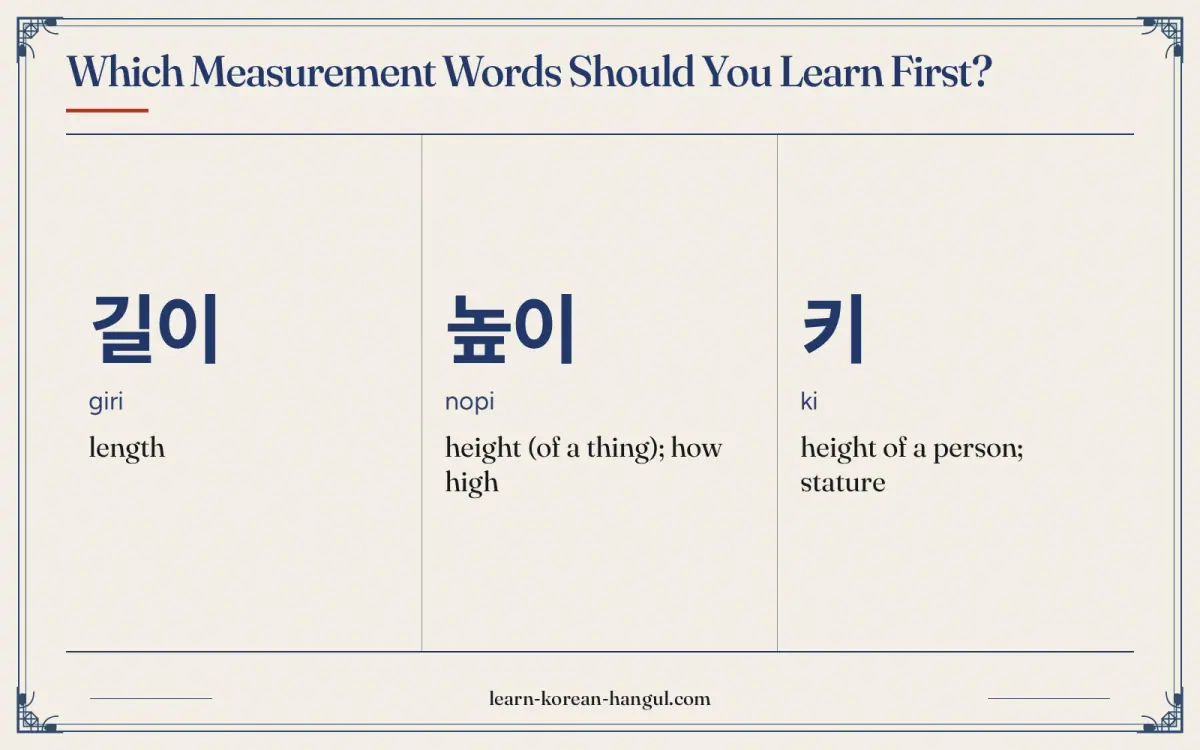
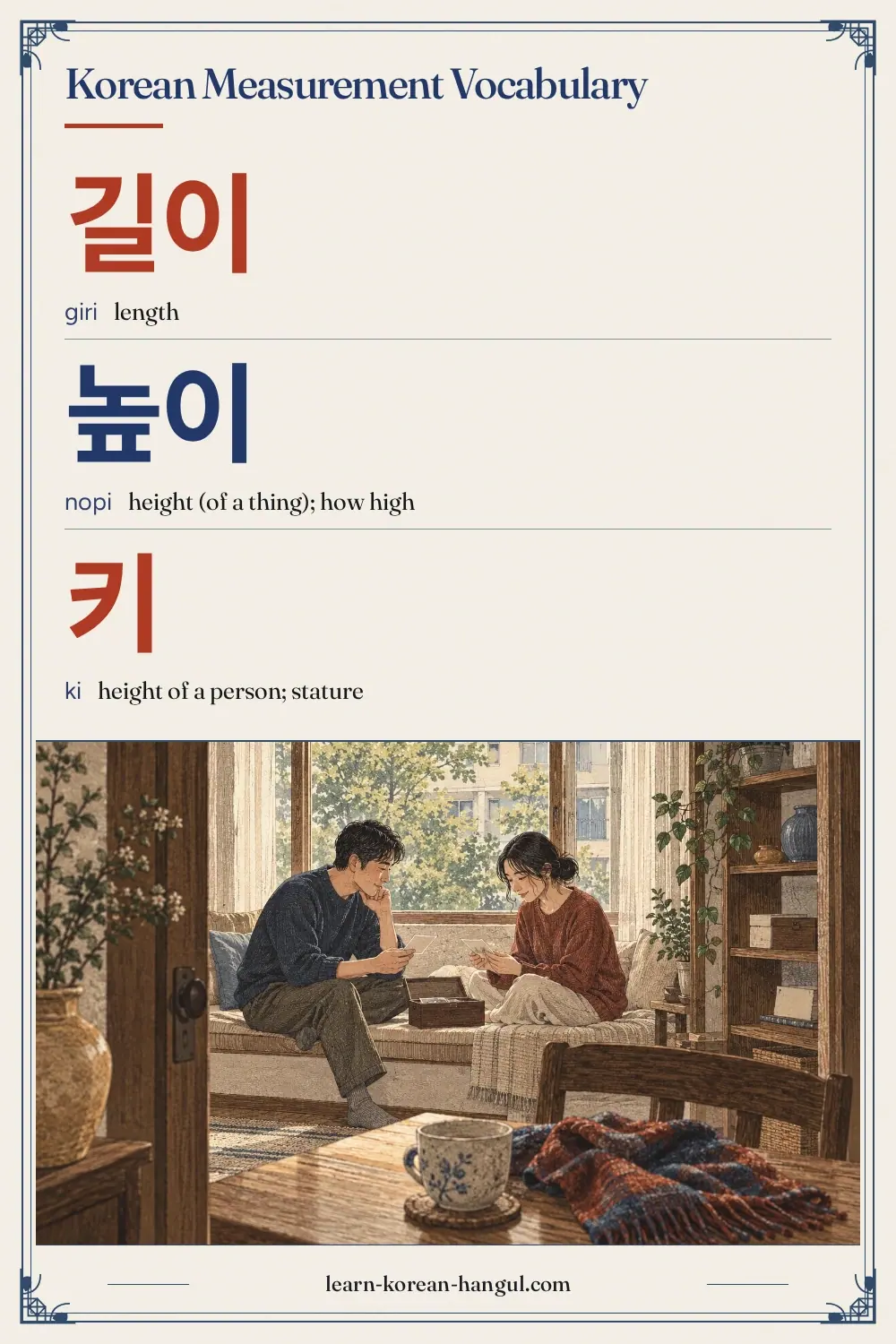
Learn 길이 (length), 키 (height of a person), 무게 (weight), 킬로그램 (kilogram) and 온도 (temperature) first. These five answer the questions you hear most often: how long, how tall, how heavy, how many kilograms and how hot. After them, add 센티미터, 미터 and 리터, the three units you meet in shops and on packages.
- Words to say. 키, 무게, 킬로그램, 센티미터, 리터. You use them to give your own height, weight and amounts.
- Words to recognise. 길이, 높이, 두께, 온도, 속도. They appear on forms, signs and package labels.
- Words to understand when spoken. 평, 근, 제곱미터, 시속. A seller, a real-estate agent or a car dealer uses these.
Two words both mean height. 키 is the height of a person or an animal, and 높이 is the height of a thing such as a building or a mountain. You say 키가 커요 (I am tall), but 건물이 높아요 (the building is tall). For the single-word pages, see height in korean, weight in korean and measurement in korean.
Word · 10
- 1
길이
giri
length
- 2
높이
nopi
height (of a thing); how high
- 3
키
ki
height of a person; stature
- 4
센티미터
sentimiteo
centimetre
- 5
킬로그램
killogeuraem
kilogram
- 6
저울
jeoul
scale; weighing machine
- 7
리터
riteo
litre
- 8
평
pyeong
pyeong; traditional unit of floor area
- 9
온도
ondo
temperature (of a thing); degree reading
- 10
속도
sokdo
speed; velocity
Length and Height
These six nouns name the size of an object or a distance. Each one is the answer to a how-question: how long, how high, how tall, how wide, how thick and how far. They share a pattern, noun + 이/가 + number + unit, which the sentences below show.
| No. | Hangul | Revised Romanization | Meaning and note | Example sentence | Audio assetId |
|---|---|---|---|---|---|
| 1 | 길이 | giri | length. Said [기리]. The distance from one end to the other. The same word means the long way of a thing, as in 길이를 재요 (measure the length). | 이 책상의 길이는 120센티미터예요. (The length of this desk is 120 centimetres.) | au-pg-vocabulary-descriptions-measurement-1; example: au-pg-vocabulary-descriptions-measurement-31 |
| 2 | 높이 | nopi | height (of a thing); how high. Said [노피]. From the ground up. Used for buildings, mountains and shelves. For the height of a person, use 키. | 이 건물의 높이는 얼마예요? (How tall is this building?) | au-pg-vocabulary-descriptions-measurement-2; example: au-pg-vocabulary-descriptions-measurement-32 |
| 3 | 키 | ki | height of a person; stature. The word for how tall a person is. The loanword 키 (key), as in 자동차 키, has the same spelling, so context decides. | 저는 키가 170센티미터예요. (I am 170 centimetres tall.) | au-pg-vocabulary-descriptions-measurement-3; example: au-pg-vocabulary-descriptions-measurement-33 |
| 4 | 너비 | neobi | width; breadth. The sideways measurement. 폭 is a common one-syllable word with the same meaning. | 문의 너비를 재요. (I measure the width of the door.) | au-pg-vocabulary-descriptions-measurement-4; example: au-pg-vocabulary-descriptions-measurement-34 |
| 5 | 두께 | dukke | thickness. How thick a thing is, such as a book or a board. It has a tense ㄲ. | 이 책은 두께가 3센티미터예요. (This book is 3 centimetres thick.) | au-pg-vocabulary-descriptions-measurement-5; example: au-pg-vocabulary-descriptions-measurement-35 |
| 6 | 거리 | geori | distance. The space between two places. A different word with the same spelling means a street, as in 거리 공연 (street performance). | 집에서 학교까지 거리가 멀어요. (The distance from home to school is far.) | au-pg-vocabulary-descriptions-measurement-6; example: au-pg-vocabulary-descriptions-measurement-36 |
Example Sentences
The sentences use two frames. The first is thing + 의 + measurement + 는 + number + unit + 이에요/예요, as in 이 책상의 길이는 120센티미터예요 (the length of this desk is 120 centimetres). After a unit that ends in a vowel, such as 센티미터, the copula is 예요. The second is the question 얼마예요? (how much is it?), which asks for the number. The same pattern works for 높이, 너비 and 두께. A related question for people is 키가 몇이에요? Say each sentence aloud after the clip, and read the numbers as Sino-Korean: 백이십, 백칠십.
How Do You Say Centimetre, Metre and Kilometre in Korean?
Units are written the way Korean hears the English word. For example, the English ending -er becomes the vowel ㅓ, which is why metre is 미터. The first word of this group is the general word for unit, and the other five are the units you meet on rulers, roads and screens.
| No. | Hangul | Revised Romanization | Meaning and note | Example sentence | Audio assetId |
|---|---|---|---|---|---|
| 7 | 단위 | danwi | unit (of measurement). Said [다뉘]. The general word for a unit. The question 단위가 뭐예요? asks what the unit is. | 단위가 뭐예요? (What is the unit?) | au-pg-vocabulary-descriptions-measurement-7; example: au-pg-vocabulary-descriptions-measurement-37 |
| 8 | 밀리미터 | millimiteo | millimetre. Often written mm. Rain is measured in 밀리미터, so a weather report says 비가 10밀리미터 왔어요. | 비가 10밀리미터 왔어요. (It rained 10 millimetres.) | au-pg-vocabulary-descriptions-measurement-8; example: au-pg-vocabulary-descriptions-measurement-38 |
| 9 | 센티미터 | sentimiteo | centimetre. Often written cm. In conversation people shorten it to 센티, as in 170센티. | 자에 센티미터 눈금이 있어요. (The ruler has centimetre marks.) | au-pg-vocabulary-descriptions-measurement-9; example: au-pg-vocabulary-descriptions-measurement-39 |
| 10 | 미터 | miteo | metre; also a meter (gauge). Often written m. A taxi meter is 미터기, which starts with the same word. | 수영장은 25미터예요. (The pool is 25 metres.) | au-pg-vocabulary-descriptions-measurement-10; example: au-pg-vocabulary-descriptions-measurement-40 |
| 11 | 킬로미터 | killomiteo | kilometre. Often written km. In daily speech people also say 킬로. | 학교까지 2킬로미터예요. (It is 2 kilometres to school.) | au-pg-vocabulary-descriptions-measurement-11; example: au-pg-vocabulary-descriptions-measurement-41 |
| 12 | 인치 | inchi | inch. Used for screens, such as a monitor or a TV. The inch is not used for people's height in Korea. | 이 모니터는 27인치예요. (This monitor is 27 inches.) | au-pg-vocabulary-descriptions-measurement-12; example: au-pg-vocabulary-descriptions-measurement-42 |
The written short forms follow the international symbols: mm, cm, m and km. In writing, you will see 170cm, but you read it as 백칠십 센티미터. The number and the unit are usually written together without a space in running text, as in 120센티미터. In careful printing, you may also see a space. Both are found, so do not worry about it.
Numbers before these units are Sino-Korean, not native. You say 이십오 미터 for 25 metres, and never 스물다섯 미터. The Sino-Korean numbers are explained on the Sino-Korean numbers page.
How Do You Say Weight in Korean?
Weight words are the ones you use at a market, a post office and a doctor's office. They begin with the noun for weight and then give three units and a tool. One unit, 근, is a traditional word that is still used when you buy meat.
| No. | Hangul | Revised Romanization | Meaning and note | Example sentence | Audio assetId |
|---|---|---|---|---|---|
| 13 | 무게 | muge | weight. How heavy something is. 무게를 재요 means to weigh it. For body weight the word is 몸무게. | 짐의 무게를 재요. (I weigh the luggage.) | au-pg-vocabulary-descriptions-measurement-13; example: au-pg-vocabulary-descriptions-measurement-43 |
| 14 | 그램 | geuraem | gram. Often written g. Spices and meat are sold by the gram: 200그램. | 설탕 200그램 주세요. (Please give me 200 grams of sugar.) | au-pg-vocabulary-descriptions-measurement-14; example: au-pg-vocabulary-descriptions-measurement-44 |
| 15 | 킬로그램 | killogeuraem | kilogram. Often written kg. In speech it is shortened to 킬로: 오 킬로 is five kilos. | 이 가방은 5킬로그램이에요. (This bag is 5 kilograms.) | au-pg-vocabulary-descriptions-measurement-15; example: au-pg-vocabulary-descriptions-measurement-45 |
| 16 | 톤 | ton | ton; tonne. Used for trucks, ships and cargo. A pickup truck might be a 1톤 트럭. | 이 트럭은 5톤이에요. (This truck is 5 tons.) | au-pg-vocabulary-descriptions-measurement-16; example: au-pg-vocabulary-descriptions-measurement-46 |
| 17 | 근 | geun | geun; a traditional unit of weight. Still used for meat and some produce. The amount of one 근 depends on what is sold, so check the label. | 삼겹살 두 근 주세요. (Please give me two geun of pork belly.) | au-pg-vocabulary-descriptions-measurement-17; example: au-pg-vocabulary-descriptions-measurement-47 |
| 18 | 저울 | jeoul | scale; weighing machine. The tool that measures weight. A kitchen scale is 주방 저울. | 저울에 올려 보세요. (Try putting it on the scale.) | au-pg-vocabulary-descriptions-measurement-18; example: au-pg-vocabulary-descriptions-measurement-48 |
Notice that the number is native Korean before 근, as in 한 근 (one geun), but Sino-Korean before gram and kilogram, as in 이백 그램 (200 grams). This is because 근 is a counter-like traditional unit, and the metric units are loanwords. The rule is simple: for metric units, use Sino-Korean numbers.
For body weight, ask 몸무게가 몇 킬로예요? (How many kilos is your body weight?). This question can feel personal, so do not ask it of a new acquaintance. You will hear it at a clinic, on a form or from a friend.
Volume and Area
Volume words measure liquids and space inside a container. Area words measure floors and land. The group has three volume words, two area words, and one traditional unit, 평, which Koreans still use to describe the size of a flat.
| No. | Hangul | Revised Romanization | Meaning and note | Example sentence | Audio assetId |
|---|---|---|---|---|---|
| 19 | 부피 | bupi | volume (of a space or a solid). How much space a thing fills. Not used for cooking amounts, where you use the unit directly. | 상자의 부피가 커요. (The box has a large volume.) | au-pg-vocabulary-descriptions-measurement-19; example: au-pg-vocabulary-descriptions-measurement-49 |
| 20 | 리터 | riteo | litre. Often written L. Water, milk and petrol are measured in 리터. | 물 2리터를 샀어요. (I bought 2 litres of water.) | au-pg-vocabulary-descriptions-measurement-20; example: au-pg-vocabulary-descriptions-measurement-50 |
| 21 | 밀리리터 | milliriteo | millilitre. Often written ml. Medicine and drinks use 밀리리터. In speech it is shortened to 미리, as in 오백 미리. | 컵에 물 200밀리리터가 들어가요. (The cup holds 200 millilitres of water.) | au-pg-vocabulary-descriptions-measurement-21; example: au-pg-vocabulary-descriptions-measurement-51 |
| 22 | 넓이 | neolbi | area; width of a surface. Said [널비]. The size of a surface, such as a room or a field. Do not confuse it with 너비, which is a width. | 방의 넓이를 재요. (I measure the area of the room.) | au-pg-vocabulary-descriptions-measurement-22; example: au-pg-vocabulary-descriptions-measurement-52 |
| 23 | 평 | pyeong | pyeong; traditional unit of floor area. One 평 is about 3.3 square metres. Official documents use 제곱미터, but 평 is still common when people talk about homes and shops. | 이 집은 30평이에요. (This home is 30 pyeong.) | au-pg-vocabulary-descriptions-measurement-23; example: au-pg-vocabulary-descriptions-measurement-53 |
| 24 | 제곱미터 | jegommiteo | square metre. Said [제곰미터]. Often written m². 제곱 means square, as in a squared number. | 이 방은 20제곱미터예요. (This room is 20 square metres.) | au-pg-vocabulary-descriptions-measurement-24; example: au-pg-vocabulary-descriptions-measurement-54 |
A good way to remember the two area words is by who uses them. A real-estate agent says 30평 in conversation. A contract or an official page prints the area in 제곱미터. If you want to convert in your head, multiply the number of 평 by about 3.3 to get square metres, so 30평 is about 100 square metres.
Say 넓이 [널비] and 너비 [너비] carefully, because they are one letter apart in writing and almost the same in sound. 넓이 is the area of a surface, and 너비 is the width of an object.
How Do You Say Temperature in Korean?
The last group collects the measurements of weather, travel and size. Temperature and speed are the two you hear in forecasts and on the road. Size and the verb for measuring are useful in shops and at the doctor's.
| No. | Hangul | Revised Romanization | Meaning and note | Example sentence | Audio assetId |
|---|---|---|---|---|---|
| 25 | 온도 | ondo | temperature (of a thing); degree reading. Used for rooms, water and machines. For the weather, 기온 (air temperature) is the word in forecasts. | 오늘 온도는 20도예요. (Today's temperature is 20 degrees.) | au-pg-vocabulary-descriptions-measurement-25; example: au-pg-vocabulary-descriptions-measurement-55 |
| 26 | 도 | do | degree (of temperature or angle). Said after the number: 20도. It is a counter-like unit. The same sound is also the particle 도 (also), as in 저도, so look for a number before it. | 물이 100도에서 끓어요. (Water boils at 100 degrees.) | au-pg-vocabulary-descriptions-measurement-26; example: au-pg-vocabulary-descriptions-measurement-56 |
| 27 | 속도 | sokdo | speed; velocity. Said [속또]. The ㄷ is tense after the final ㄱ, and the Romanization does not show it. | 속도를 줄여 주세요. (Please slow down.) | au-pg-vocabulary-descriptions-measurement-27; example: au-pg-vocabulary-descriptions-measurement-57 |
| 28 | 시속 | sisok | speed per hour; kilometres per hour. 시 (hour) + 속 (speed). Always used with a number and a unit: 시속 100킬로미터. | 이 차는 시속 100킬로미터로 달려요. (This car runs at 100 kilometres per hour.) | au-pg-vocabulary-descriptions-measurement-28; example: au-pg-vocabulary-descriptions-measurement-58 |
| 29 | 크기 | keugi | size. How big something is. For a clothing or shoe size, shops usually say the loanword 사이즈. | 이 신발은 크기가 맞아요. (The size of these shoes fits.) | au-pg-vocabulary-descriptions-measurement-29; example: au-pg-vocabulary-descriptions-measurement-59 |
| 30 | 측정 | cheukjeong | measurement; measuring. Said [측쩡]. The ㅈ is tense after the final ㄱ. A formal noun that becomes a verb with 하다: 측정하다. | 키를 측정해요. (I measure my height.) | au-pg-vocabulary-descriptions-measurement-30; example: au-pg-vocabulary-descriptions-measurement-60 |
Two words in this group need extra care. 도 is a unit after the number, and it also means "also" as a particle (저도 = me too). The sentence shows which one: 20도 means 20 degrees because a number comes before it.
For the weather, the usual question is 오늘 몇 도예요? (What is the temperature today?), and the answer is 오늘은 20도예요. The word 기온 appears in forecasts instead of 온도, but for conversation 도 is enough.
How Do You Ask about a Measurement?
Most measurement questions use the question word 얼마 (how much) or 몇 (how many), together with the unit. The pattern is subject + 이/가 + 얼마예요? or + 몇 + unit + 이에요/예요?. The answer repeats the unit with a number.
| Question | Answer | Meaning |
|---|---|---|
| 키가 몇 센티미터예요? | 170센티미터예요. | How tall are you? I am 170 centimetres. |
| 무게가 몇 킬로예요? | 5킬로예요. | How heavy is it? It is 5 kilos. |
| 거리가 얼마나 돼요? | 2킬로미터쯤 돼요. | How far is it? About 2 kilometres. |
| 넓이가 몇 평이에요? | 30평이에요. | What is the area? It is 30 pyeong. |
| 오늘 몇 도예요? | 20도예요. | What is the temperature today? 20 degrees. |
Pay attention to the form of the copula. After a vowel, such as the ㅓ in 센티미터 or the ㅗ in 킬로, it is 예요. After a consonant, such as the ㅇ in 평 or the ㄴ in 톤, use 이에요. The question words themselves are covered on the 얼마 and 몇 pages.
What Traditional Units Are Still Used in Korea?
Korea has used the metric system for official measurements for a long time, but a few traditional units remain in daily talk. The two most important are 평 (pyeong, for floor area) and 근 (geun, for weight). Others you may hear in a market, such as 되 and 말 for volume, are rare outside rural shops and older speakers.
| Unit | Measures | Everyday use | Metric equivalent |
|---|---|---|---|
| 평 | Floor area | Homes, shops and land | About 3.3 square metres |
| 근 | Weight | Meat and some produce | Depends on the item, so check the label |
The rule is simple. Use metric units in writing, on forms and in dealings with offices. Use 평 and 근 when you hear them from a seller or a neighbour, and convert them in your head. Because official documents use metric units, you will see 제곱미터 on contracts even when people say 평 in speech. If you need an exact figure, ask for the metric number: 제곱미터로는 얼마예요? (How much is it in square metres?)
How Do You Pronounce These Words?
Measurement words are made of long loanwords and of short Sino-Korean words with tense sounds. The long loanwords add a vowel after each consonant cluster. The short words tense a consonant after a final stop. Standard pronunciation follows the National Institute of Korean Language (국립국어원) rules, and the romanization follows the Revised Romanization of Korean, which records some sound changes and ignores others.
| Spelling | Sounds like | What changes |
|---|---|---|
| 넓이 | [널비] | The two final letters ㄼ split: the ㄹ stays in 넓 and the ㅂ moves across to 이. |
| 속도 | [속또] | The ㄷ becomes tense after the final ㄱ. The Romanization does not show the tensing: sokdo. |
| 측정 | [측쩡] | The ㅈ becomes tense after the final ㄱ. The Romanization writes cheukjeong. |
| 높이 | [노피] | The final ㅍ of 높 moves across to the next syllable, so the word sounds like 노피. |
| 킬로미터 | [킬로미터] | No change in sound. The double ㄹ is written ll in the Romanization: killomiteo. |
| 밀리리터 | [밀리리터] | No change. The Romanization writes milliriteo. |
| 두께 | [두께] | No change. The ㄲ is tense from the start, so the Romanization shows kk: dukke. |
Two of the hardest sounds are in 높이 (nopi) and 길이 (giri). The ㄹ between vowels in 길이 is a light tap of the tongue, like the "tt" in the American "butter". The ㄹ in 킬로 and 밀리 comes after a final ㄹ, so it is held a little longer, like a long "l". The vowel ㅓ in 미터 (miteo) is unrounded: keep your lips relaxed and open, not round. The Romanization writes it eo, but the sound is closer to the "u" in "cup" than to "o".
Audio and Slow Playback
Every headword and every example sentence has its own audio. The five clips below replay the trickiest words slowly. Play one, repeat it aloud, then play it again and compare.
What Mistakes Do Learners Make with Measurement Words?
These five mistakes come up often with measurement words.
- Using native numbers before metric units. 스물다섯 미터 is wrong. Use Sino-Korean numbers before 미터, 킬로그램 and 리터: 이십오 미터.
- Mixing 키 and 높이. 키 is for people and animals. 높이 is for things. 건물의 키 is wrong, and 저의 높이 sounds like you are measuring a statue.
- Confusing 넓이 and 너비. 넓이 is area (a surface). 너비 is width (one side). The spellings are one letter apart.
- Using 이에요 after a vowel. After 센티미터, 킬로 and 리터, use 예요: 170센티미터예요, not 170센티미터이에요.
- Reading 도 as only the particle. After a number, 도 is the degree unit: 20도. After a noun with no number, 도 is the particle "also", as in 저도.
A habit that avoids most of these: say the number, then the unit, then 예요 or 이에요, as one unit. Practise with your own height, your weight in kilos, and the temperature outside.
Practice: Flashcards and Worksheet
Study in three steps. First, run the flashcard deck in recognition mode until you know each of the 30 words. Second, switch to listening mode and answer from the audio alone. Third, take the quiz. The deck covers all 30 words with audio, and your progress stays in your browser. The vocabulary flashcard decks page lists the other decks.
Practice · 65
- 01길이
Show answer
headword 1: length
- 02높이
Show answer
headword 2: height (of a thing); how high
- 03키
Show answer
headword 3: height of a person; stature
- 04너비
Show answer
headword 4: width; breadth
- 05두께
Show answer
headword 5: thickness
- 06거리
Show answer
headword 6: distance
- 07단위
Show answer
headword 7: unit (of measurement)
- 08밀리미터
Show answer
headword 8: millimetre
- 09센티미터
Show answer
headword 9: centimetre
- 10미터
Show answer
headword 10: metre; also a meter (gauge)
- 11킬로미터
Show answer
headword 11: kilometre
- 12인치
Show answer
headword 12: inch
- 13무게
Show answer
headword 13: weight
- 14그램
Show answer
headword 14: gram
- 15킬로그램
Show answer
headword 15: kilogram
- 16톤
Show answer
headword 16: ton; tonne
- 17근
Show answer
headword 17: geun; a traditional unit of weight
- 18저울
Show answer
headword 18: scale; weighing machine
- 19부피
Show answer
headword 19: volume (of a space or a solid)
- 20리터
Show answer
headword 20: litre
- 21밀리리터
Show answer
headword 21: millilitre
- 22넓이
Show answer
headword 22: area; width of a surface
- 23평
Show answer
headword 23: pyeong; traditional unit of floor area
- 24제곱미터
Show answer
headword 24: square metre
- 25온도
Show answer
headword 25: temperature (of a thing); degree reading
- 26도
Show answer
headword 26: degree (of temperature or angle)
- 27속도
Show answer
headword 27: speed; velocity
- 28시속
Show answer
headword 28: speed per hour; kilometres per hour
- 29크기
Show answer
headword 29: size
- 30측정
Show answer
headword 30: measurement; measuring
- 31이 책상의 길이는 120센티미터예요.
Show answer
example sentence for 길이: The length of this desk is 120 centimetres.
- 32이 건물의 높이는 얼마예요?
Show answer
example sentence for 높이: How tall is this building?
- 33저는 키가 170센티미터예요.
Show answer
example sentence for 키: I am 170 centimetres tall.
- 34문의 너비를 재요.
Show answer
example sentence for 너비: I measure the width of the door.
- 35이 책은 두께가 3센티미터예요.
Show answer
example sentence for 두께: This book is 3 centimetres thick.
- 36집에서 학교까지 거리가 멀어요.
Show answer
example sentence for 거리: The distance from home to school is far.
- 37단위가 뭐예요?
Show answer
example sentence for 단위: What is the unit?
- 38비가 10밀리미터 왔어요.
Show answer
example sentence for 밀리미터: It rained 10 millimetres.
- 39자에 센티미터 눈금이 있어요.
Show answer
example sentence for 센티미터: The ruler has centimetre marks.
- 40수영장은 25미터예요.
Show answer
example sentence for 미터: The pool is 25 metres.
- 41학교까지 2킬로미터예요.
Show answer
example sentence for 킬로미터: It is 2 kilometres to school.
- 42이 모니터는 27인치예요.
Show answer
example sentence for 인치: This monitor is 27 inches.
- 43짐의 무게를 재요.
Show answer
example sentence for 무게: I weigh the luggage.
- 44설탕 200그램 주세요.
Show answer
example sentence for 그램: Please give me 200 grams of sugar.
- 45이 가방은 5킬로그램이에요.
Show answer
example sentence for 킬로그램: This bag is 5 kilograms.
- 46이 트럭은 5톤이에요.
Show answer
example sentence for 톤: This truck is 5 tons.
- 47삼겹살 두 근 주세요.
Show answer
example sentence for 근: Please give me two geun of pork belly.
- 48저울에 올려 보세요.
Show answer
example sentence for 저울: Try putting it on the scale.
- 49상자의 부피가 커요.
Show answer
example sentence for 부피: The box has a large volume.
- 50물 2리터를 샀어요.
Show answer
example sentence for 리터: I bought 2 litres of water.
- 51컵에 물 200밀리리터가 들어가요.
Show answer
example sentence for 밀리리터: The cup holds 200 millilitres of water.
- 52방의 넓이를 재요.
Show answer
example sentence for 넓이: I measure the area of the room.
- 53이 집은 30평이에요.
Show answer
example sentence for 평: This home is 30 pyeong.
- 54이 방은 20제곱미터예요.
Show answer
example sentence for 제곱미터: This room is 20 square metres.
- 55오늘 온도는 20도예요.
Show answer
example sentence for 온도: Today's temperature is 20 degrees.
- 56물이 100도에서 끓어요.
Show answer
example sentence for 도: Water boils at 100 degrees.
- 57속도를 줄여 주세요.
Show answer
example sentence for 속도: Please slow down.
- 58이 차는 시속 100킬로미터로 달려요.
Show answer
example sentence for 시속: This car runs at 100 kilometres per hour.
- 59이 신발은 크기가 맞아요.
Show answer
example sentence for 크기: The size of these shoes fits.
- 60키를 측정해요.
Show answer
example sentence for 측정: I measure my height.
- 61넓이
Show answer
slow playback of the headword 넓이
- 62높이
Show answer
slow playback of the headword 높이
- 63밀리리터
Show answer
slow playback of the headword 밀리리터
- 64제곱미터
Show answer
slow playback of the headword 제곱미터
- 65측정
Show answer
slow playback of the headword 측정
Practice · 8
What does 길이 (giri) mean?
Show answer
length
길이 means length. Example: 이 책상의 길이는 120센티미터예요. (The length of this desk is 120 centimetres.)
What does 키 (ki) mean?
Show answer
height of a person; stature
키 means height of a person; stature. Example: 저는 키가 170센티미터예요. (I am 170 centimetres tall.)
What does 너비 (neobi) mean?
Show answer
width; breadth
너비 means width; breadth. Example: 문의 너비를 재요. (I measure the width of the door.)
What does 근 (geun) mean?
Show answer
geun; a traditional unit of weight
근 means geun; a traditional unit of weight. Example: 삼겹살 두 근 주세요. (Please give me two geun of pork belly.)
What does 저울 (jeoul) mean?
Show answer
scale; weighing machine
저울 means scale; weighing machine. Example: 저울에 올려 보세요. (Try putting it on the scale.)
What does 넓이 (neolbi) mean?
Show answer
area; width of a surface
넓이 means area; width of a surface. Example: 방의 넓이를 재요. (I measure the area of the room.)
What does 평 (pyeong) mean?
Show answer
pyeong; traditional unit of floor area
평 means pyeong; traditional unit of floor area. Example: 이 집은 30평이에요. (This home is 30 pyeong.)
What does 시속 (sisok) mean?
Show answer
speed per hour; kilometres per hour
시속 means speed per hour; kilometres per hour. Example: 이 차는 시속 100킬로미터로 달려요. (This car runs at 100 kilometres per hour.)
Korean Measurement Vocabulary Worksheet (PDF)
A printable worksheet for these words (word list, matching, writing practice, fill-in-the-blank exercises and answer key) is available in A4 and US Letter from the download card on this page. For practice, measure something at home, such as a book, a cup of water or your own height, and say the result aloud: 이 책은 길이가 20센티미터예요. Saying the real number while you hold the real object fixes both the word and the pattern.
Where to Go Next
After this page, continue with Korean Position Words Vocabulary, which teaches words for where something is, or go back to Korean Materials Vocabulary. For counting people and things rather than measuring them, see counters for things. To return to the full set, go to Shapes, Materials and Measurements in Korean.
Frequently Asked Questions
How Do You Say Length in Korean?
Length is 길이 (giri). It is a noun, so it takes a particle: 길이가 (length is) or 길이를 (the length). To ask for it, say 길이가 얼마예요? (How long is it?). The unit follows the number, as in 120센티미터. The pages for height in korean and weight in korean cover two related words.
How Do You Pronounce 높이 (nopi)?
Say no-pi, with two short syllables. The spelling has a final ㅍ in 높, but that ㅍ moves to the next syllable, so the sound is [노피]. The first vowel is a rounded "o" as in "go", and the last is a clear "ee". Press the audio button for the normal and slow versions.
How Many Measurement Words Should I Learn First?
Five first: 길이, 키, 무게, 킬로그램 and 온도. At five new words a day, the whole list of 30 takes six days plus review. Add 센티미터, 미터 and 리터 on day two, since you will meet them on packages.
Where Can I Practise Measurement Words with Flashcards?
Use the vocabulary flashcard decks. The deck for this page holds all 30 words with Hangul, romanization and audio, and it offers recognition and listening modes. Your progress stays in your browser, so return daily and review the cards you missed.
Is the Romanization on This Page Official?
It follows the Revised Romanization of Korean, which South Korea adopted on 7 July 2000 and whose rules the National Institute of Korean Language (국립국어원) publishes. It is a learning aid and does not show every sound change, so rely on the Hangul and the audio.
Is There a Printable Worksheet for Measurement Words?
A printable worksheet for these words (word list, matching, writing practice, fill-in-the-blank exercises and answer key) is available in A4 and US Letter from the download card on this page. For practice, copy the tables on this page by hand or use the flashcard deck, which carries the same 30 words.