Korean Drinking Culture Vocabulary at a Glance
This page is a vocabulary list, not advice to drink. Many Korean social events, from company dinners to birthday gatherings, include alcohol, and the language around them is rich. You will hear these words in dramas, in variety shows and from colleagues, so they help even if you rarely drink yourself. The list belongs to Drinks, and it has 35 words in five groups of seven.
| Group | Words | Use |
|---|---|---|
| Drinks | 7 | Names of alcoholic drinks |
| Drinking rounds | 7 | Rounds, places and food |
| Etiquette | 7 | Customs and polite behaviour |
| Drinking games and toasts | 7 | Toasts and shared moments |
| Morning after | 7 | Recovery, health and rules |
The groups follow a night out. You start with the drinks (술, 소주, 맥주), move through the rounds of the evening (일차, 이차), follow the customs that make a gathering polite, share a toast or a game, and end with the morning after. Where a custom is described, the page treats it as a common practice that changes from group to group and not as a fixed rule. For the wider set of manners, see language etiquette.
Which Drinking Culture Words Should You Learn First?
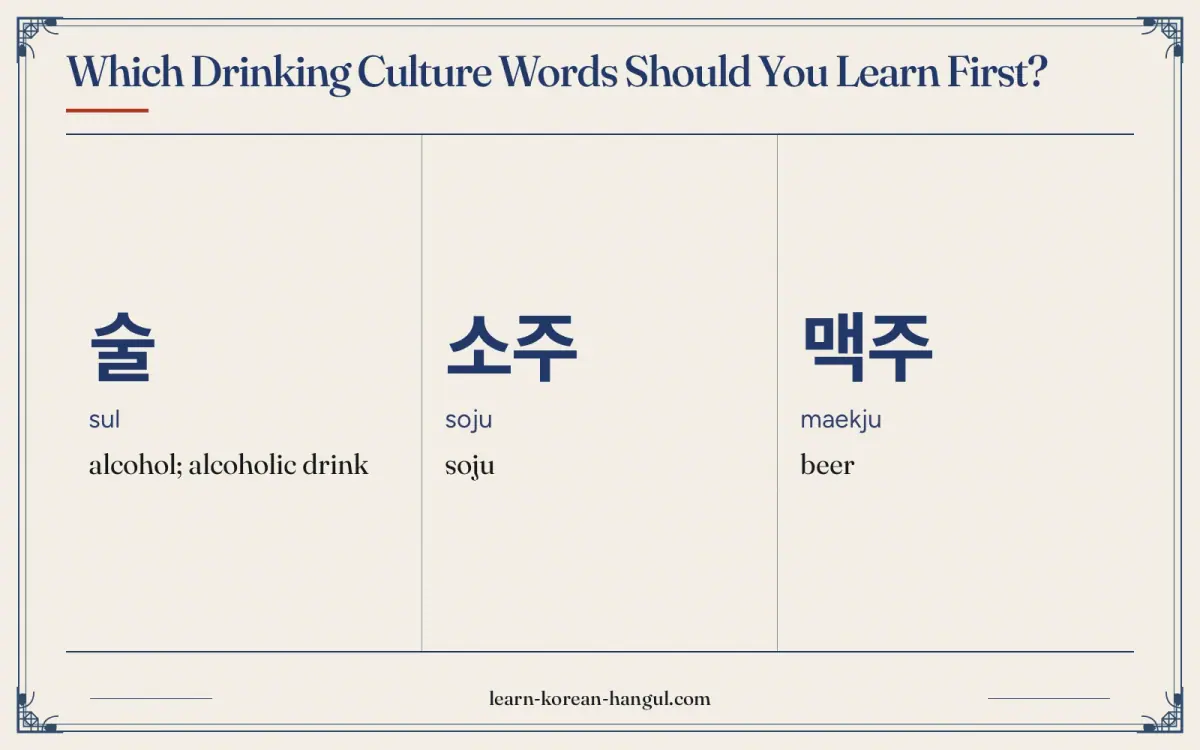
Learn 술, 소주, 맥주, 건배 and 회식 first. With those five you can follow most conversations about a night out: 오늘 저녁에 회식이 있어요 (There is a company dinner this evening). Add 사양하다 early, too, because it is the polite way to turn down another drink. Declining is normal, and 저는 술을 잘 안 마셔요 (I don't drink much) is a complete and polite answer.
- Words to say. 술, 소주, 맥주, 건배, 사양하다. They cover ordering, toasting and declining.
- Words to recognise. 소맥, 안주, 일차, 회식, 포장마차. They describe the setting and the rounds.
- Words to understand when spoken. 짠, 원샷, 러브샷, 폭탄주, 해장. They are casual and appear in dramas and shows.
Drinks are counted by the container, using native numbers: 소주 한 병 (one bottle of soju), 맥주 두 잔 (two glasses of beer). The scene below shows a table with food and drinks, with twelve numbered labels that match words in the tables.
Word · 12
- 1
술
sul
alcohol; alcoholic drink
- 2
소주
soju
soju
- 3
맥주
maekju
beer
- 4
막걸리
makgeolli
makgeolli (rice wine)
- 5
소맥
somaek
soju-beer mix
- 6
일차
ilcha
first round (1차)
- 7
이차
icha
second round (2차)
- 8
술집
suljip
bar; pub
- 9
안주
anju
side dish for drinks
- 10
잔
jan
glass; cup
- 11
건배
geonbae
toast; cheers
- 12
숙취
sukchwi
hangover
Drinks (소주, 맥주, 막걸리)
Drink words come first. The general word is 술, and the three drinks you will hear most are 소주 (a clear spirit), 맥주 (beer) and 막걸리 (a milky rice drink). A mix of the first two has its own name, 소맥. Use the verb 마시다 (to drink) with all of them.
| No. | Hangul | Revised Romanization | Meaning and note | Example sentence | Audio assetId |
|---|---|---|---|---|---|
| 1 | 술 | sul | alcohol; alcoholic drink. The general word. Drink it with 마시다. | 저는 술을 잘 안 마셔요. (I don't drink alcohol much.) | au-pg-vocabulary-food-drinks-alcohol-drinking-1; example: au-pg-vocabulary-food-drinks-alcohol-drinking-36 |
| 2 | 소주 | soju | soju. A clear spirit, often sold in small bottles and served in small glasses. | 소주는 보통 작은 잔에 마셔요. (Soju is usually drunk from small glasses.) | au-pg-vocabulary-food-drinks-alcohol-drinking-2; example: au-pg-vocabulary-food-drinks-alcohol-drinking-37 |
| 3 | 맥주 | maekju | beer. Said [맥쭈]. 생맥주 is draft beer. | 맥주 한 병 주세요. (One bottle of beer, please.) | au-pg-vocabulary-food-drinks-alcohol-drinking-3; example: au-pg-vocabulary-food-drinks-alcohol-drinking-38 |
| 4 | 막걸리 | makgeolli | makgeolli (rice wine). Said [막껄리]. A milky, lightly sweet rice drink. | 비 오는 날에는 막걸리가 생각나요. (On rainy days I think of makgeolli.) | au-pg-vocabulary-food-drinks-alcohol-drinking-4; example: au-pg-vocabulary-food-drinks-alcohol-drinking-39 |
| 5 | 소맥 | somaek | soju-beer mix. Short for 소주 + 맥주. It mixes the two. | 소맥은 소주와 맥주를 섞어요. (Somaek mixes soju and beer.) | au-pg-vocabulary-food-drinks-alcohol-drinking-5; example: au-pg-vocabulary-food-drinks-alcohol-drinking-40 |
| 6 | 와인 | wain | wine. A loanword. | 저녁에 와인을 한 잔 마셔요. (I have a glass of wine in the evening.) | au-pg-vocabulary-food-drinks-alcohol-drinking-6; example: au-pg-vocabulary-food-drinks-alcohol-drinking-41 |
| 7 | 양주 | yangju | Western-style liquor. Spirits such as whisky and brandy. | 양주는 도수가 높아요. (Western liquor has a high alcohol content.) | au-pg-vocabulary-food-drinks-alcohol-drinking-7; example: au-pg-vocabulary-food-drinks-alcohol-drinking-42 |
Drinks are counted by container: 병 (bottle), 잔 (glass) and 캔 (can), with native numbers, as in 소주 한 병 and 맥주 두 잔. The Drinks page lists the soft drinks, coffee and tea words, and the Korean Cafe Menu Vocabulary page covers what to order at a cafe. For single words, see alcohol in Korean and soju in Korean.
Example Sentences
The examples use three frames. The first is noun + 을/를 + 마셔요, as in 와인을 마셔요. The second is noun + 이/가 + descriptive verb, as in 도수가 높아요. The third is noun + 에서 + verb for the place, as in 술자리에서 이야기했어요. The particle follows the last sound of the noun: 술을 (consonant, so 을), 와인을 (consonant, so 을), 안주가 (vowel, so 가) and 회식이 (consonant, so 이). Say each sentence aloud after the audio and replace the noun with another from the table.
How Do You Say Drinking Rounds (1차, 2차) in Korean?
Koreans often describe a night out in rounds. The first place is 1차, the second is 2차 and the third is 3차. Each round is a different venue: dinner first, then a bar, then perhaps a karaoke room. Read the numbers with Sino-Korean numbers, 일차 and 이차, and add 차 (round). The other words name the occasion, the place and the food.
| No. | Hangul | Revised Romanization | Meaning and note | Example sentence | Audio assetId |
|---|---|---|---|---|---|
| 8 | 일차 | ilcha | first round (1차). Usually written 1차. The first place a group goes to eat and drink. | 일차는 고깃집에서 먹었어요. (We had the first round at a barbecue restaurant.) | au-pg-vocabulary-food-drinks-alcohol-drinking-8; example: au-pg-vocabulary-food-drinks-alcohol-drinking-43 |
| 9 | 이차 | icha | second round (2차). Usually written 2차. The next place, often a bar or a karaoke room. | 이차는 노래방에 갔어요. (We went to a karaoke room for the second round.) | au-pg-vocabulary-food-drinks-alcohol-drinking-9; example: au-pg-vocabulary-food-drinks-alcohol-drinking-44 |
| 10 | 회식 | hoesik | company dinner. A work dinner with colleagues, often with drinks. | 오늘 저녁에 회식이 있어요. (There is a company dinner this evening.) | au-pg-vocabulary-food-drinks-alcohol-drinking-10; example: au-pg-vocabulary-food-drinks-alcohol-drinking-45 |
| 11 | 술자리 | suljari | drinking gathering. Said [술짜리]. From 술 and 자리 (seat). A gathering where people drink. | 술자리에서 이야기를 많이 했어요. (We talked a lot at the drinking gathering.) | au-pg-vocabulary-food-drinks-alcohol-drinking-11; example: au-pg-vocabulary-food-drinks-alcohol-drinking-46 |
| 12 | 술집 | suljip | bar; pub. Said [술찝]. A place that serves drinks. | 근처에 술집이 많아요. (There are many bars nearby.) | au-pg-vocabulary-food-drinks-alcohol-drinking-12; example: au-pg-vocabulary-food-drinks-alcohol-drinking-47 |
| 13 | 포장마차 | pojangmacha | street tent bar. A tented street stall that serves food and drinks. | 포장마차에서 어묵을 먹어요. (I eat fish cake at a street stall.) | au-pg-vocabulary-food-drinks-alcohol-drinking-13; example: au-pg-vocabulary-food-drinks-alcohol-drinking-48 |
| 14 | 안주 | anju | side dish for drinks. Food eaten with alcohol. | 안주는 뭐가 좋아요? (What is good to eat with drinks?) | au-pg-vocabulary-food-drinks-alcohol-drinking-14; example: au-pg-vocabulary-food-drinks-alcohol-drinking-49 |
A night out is therefore described in stages: 일차는 저녁, 이차는 술집 (first round dinner, second round a bar). A person who leaves after the first round says 저는 일차만 할게요 (I'll only do the first round). The pair is also used outside drinking, for any event that moves on to another place. The word 회식 is a work event, so you will see it in the School and Work vocabulary too.
Etiquette
Etiquette words describe how people behave around a drink. Two words matter most for a learner: 어른 (an older or respected person) and 윗사람 (someone senior to you). Common customs include pouring for others and receiving a glass with both hands, especially from someone older. These are usual habits in many groups, not laws, and practice differs between families, offices and friends.
| No. | Hangul | Revised Romanization | Meaning and note | Example sentence | Audio assetId |
|---|---|---|---|---|---|
| 15 | 예절 | yejeol | etiquette; manners. The word for good manners in general. | 한국의 술자리 예절을 배워요. (I learn Korean drinking etiquette.) | au-pg-vocabulary-food-drinks-alcohol-drinking-15; example: au-pg-vocabulary-food-drinks-alcohol-drinking-50 |
| 16 | 어른 | eoreun | adult; elder. An older or respected person. In many groups the elder lifts their glass first. | 어른이 먼저 잔을 들어요. (The elder lifts their glass first.) | au-pg-vocabulary-food-drinks-alcohol-drinking-16; example: au-pg-vocabulary-food-drinks-alcohol-drinking-51 |
| 17 | 윗사람 | witsaram | superior; senior. Said [위싸람], also [윋싸람]. Someone older or higher in rank than you. | 윗사람에게 술을 따라 드려요. (I pour a drink for a senior person.) | au-pg-vocabulary-food-drinks-alcohol-drinking-17; example: au-pg-vocabulary-food-drinks-alcohol-drinking-52 |
| 18 | 잔 | jan | glass; cup. Also the counter for glasses: 한 잔. | 잔을 두 손으로 받아요. (I receive the glass with both hands.) | au-pg-vocabulary-food-drinks-alcohol-drinking-18; example: au-pg-vocabulary-food-drinks-alcohol-drinking-53 |
| 19 | 따르다 | ttareuda | to pour. Pour for others. For an elder, many people use both hands. | 먼저 제가 술을 따를게요. (Let me pour the drink first.) | au-pg-vocabulary-food-drinks-alcohol-drinking-19; example: au-pg-vocabulary-food-drinks-alcohol-drinking-54 |
| 20 | 받다 | batda | to receive. Receive a glass or a gift with both hands to show respect. | 선배가 주는 술을 받았어요. (I received the drink my senior gave me.) | au-pg-vocabulary-food-drinks-alcohol-drinking-20; example: au-pg-vocabulary-food-drinks-alcohol-drinking-55 |
| 21 | 사양하다 | sayanghada | to decline politely. A polite way to turn down another drink. | 저는 사양할게요. (I will pass.) | au-pg-vocabulary-food-drinks-alcohol-drinking-21; example: au-pg-vocabulary-food-drinks-alcohol-drinking-56 |
Declining is part of etiquette too. The respectful way to say no is not 싫어요 (I don't like it), which is blunt, but 괜찮아요 (I'm fine) or 사양할게요 (I'll pass). If someone insists, you can add a reason in a gentle sentence: 내일 일찍 일어나야 해요 (I have to get up early tomorrow). The sentence uses the polite present of 일어나다 inside an obligation pattern.
How Do You Say Drinking Games and Toasts in Korean?
Toast words are the most cheerful vocabulary on the page. The classic is 건배, and the short, playful version is 짠, which imitates the sound of glasses touching. Some groups add drinking games, and the words 원샷, 러브샷, 폭탄주 and 벌주 belong to those games. They are casual and tied to friendly moments; nobody has to join, and water is a normal drink at any table.
| No. | Hangul | Revised Romanization | Meaning and note | Example sentence | Audio assetId |
|---|---|---|---|---|---|
| 22 | 건배 | geonbae | toast; cheers. A word said when glasses are raised. 건배하다 means to make a toast. | 건배를 하고 한 모금 마셔요. (We make a toast and take a sip.) | au-pg-vocabulary-food-drinks-alcohol-drinking-22; example: au-pg-vocabulary-food-drinks-alcohol-drinking-57 |
| 23 | 짠 | jjan | cheers (clink sound). Informal. It imitates the sound of glasses touching. | 짠 하고 잔을 부딪쳐요. (We say jjan and clink glasses.) | au-pg-vocabulary-food-drinks-alcohol-drinking-23; example: au-pg-vocabulary-food-drinks-alcohol-drinking-58 |
| 24 | 원샷 | wonsyat | drinking a glass in one go. From the English one shot. Casual, and never required. | 저는 원샷은 못 해요. (I can't down it in one go.) | au-pg-vocabulary-food-drinks-alcohol-drinking-24; example: au-pg-vocabulary-food-drinks-alcohol-drinking-59 |
| 25 | 폭탄주 | poktanju | bomb shot (mixed drink). A mixed drink made by dropping a shot glass into a beer glass. | 회식에서 폭탄주를 만들었어요. (We made a bomb shot at the company dinner.) | au-pg-vocabulary-food-drinks-alcohol-drinking-25; example: au-pg-vocabulary-food-drinks-alcohol-drinking-60 |
| 26 | 러브샷 | reobeusyat | love shot (arm-linked drink). Two people link arms and drink. A playful custom often seen on TV. | 러브샷은 팔을 걸고 마셔요. (In a love shot you link arms and drink.) | au-pg-vocabulary-food-drinks-alcohol-drinking-26; example: au-pg-vocabulary-food-drinks-alcohol-drinking-61 |
| 27 | 벌주 | beolju | penalty drink. Said [벌쭈]. A drink given as a penalty in a game. | 벌주 대신 물을 마셔도 돼요. (You may drink water instead of the penalty drink.) | au-pg-vocabulary-food-drinks-alcohol-drinking-27; example: au-pg-vocabulary-food-drinks-alcohol-drinking-62 |
| 28 | 위하여 | wihayeo | to (the words of a toast). The toast phrase "to ...". It follows what you are drinking to. | 우리의 건강을 위하여 건배해요. (Let's make a toast to our health.) | au-pg-vocabulary-food-drinks-alcohol-drinking-28; example: au-pg-vocabulary-food-drinks-alcohol-drinking-63 |
The toast 위하여 follows the thing you drink to: 우리의 건강을 위하여 (to our health). The particle 을 appears before 위하여 because the phrase is object + 을 + 위하여. Because drinking games are optional, a gentle way to opt out is 저는 물로 할게요 (I'll have water).
Morning After
The last group covers the day after and some health and safety words. The Korean hangover (숙취) has its own cure (해장), and a whole soup category takes its name from it. The group also includes 과음 (drinking too much), 금주 (giving up drinking) and 음주 (drinking), the last of which appears in the safety phrase 음주 운전 (drunk driving).
| No. | Hangul | Revised Romanization | Meaning and note | Example sentence | Audio assetId |
|---|---|---|---|---|---|
| 29 | 숙취 | sukchwi | hangover. Said [숙취]. 숙취 해소 means hangover relief. | 숙취 때문에 머리가 아파요. (I have a headache because of a hangover.) | au-pg-vocabulary-food-drinks-alcohol-drinking-29; example: au-pg-vocabulary-food-drinks-alcohol-drinking-64 |
| 30 | 해장 | haejang | hangover cure. Food or drink that eases a hangover. 해장하다 is the verb. | 해장에는 국물이 좋아요. (Broth is good for easing a hangover.) | au-pg-vocabulary-food-drinks-alcohol-drinking-30; example: au-pg-vocabulary-food-drinks-alcohol-drinking-65 |
| 31 | 해장국 | haejangguk | hangover soup. Said [해장꾹]. A hot soup eaten the next day. | 아침에 해장국을 먹었어요. (I ate hangover soup in the morning.) | au-pg-vocabulary-food-drinks-alcohol-drinking-31; example: au-pg-vocabulary-food-drinks-alcohol-drinking-66 |
| 32 | 과음 | gwaeum | drinking too much. 과음하다 means to drink too much. It is best avoided. | 과음은 건강에 안 좋아요. (Drinking too much is not good for your health.) | au-pg-vocabulary-food-drinks-alcohol-drinking-32; example: au-pg-vocabulary-food-drinks-alcohol-drinking-67 |
| 33 | 취하다 | chwihada | to get drunk. Also means "to be intoxicated". | 술에 취해서 일찍 잤어요. (I got drunk and went to bed early.) | au-pg-vocabulary-food-drinks-alcohol-drinking-33; example: au-pg-vocabulary-food-drinks-alcohol-drinking-68 |
| 34 | 금주 | geumju | abstaining from alcohol. 금주하다 means to stop drinking. | 오늘부터 금주해요. (From today I'm not drinking.) | au-pg-vocabulary-food-drinks-alcohol-drinking-34; example: au-pg-vocabulary-food-drinks-alcohol-drinking-69 |
| 35 | 음주 | eumju | drinking (alcohol). Formal. 음주 운전 means drunk driving. | 음주 운전은 절대 안 돼요. (Drunk driving is never acceptable.) | au-pg-vocabulary-food-drinks-alcohol-drinking-35; example: au-pg-vocabulary-food-drinks-alcohol-drinking-70 |
Safety words matter. 음주 운전 is a serious matter in Korea, and you will see it on signs, in news reports and in public notices. The phrase 절대 안 돼요 (never acceptable) is how people say it plainly. If you are with people who plan to drive, 대리운전 (a driver you can book) is the usual alternative, and taking a taxi is also common.
How Do You Pronounce These Words?
Drinking words contain some of the most common tense consonants in Korean, because many are compounds. The Hangul shows the written form, while the spoken form shifts where one sound meets another. Standard pronunciation follows the National Institute of Korean Language (국립국어원) rules, and the romanization follows the Revised Romanization of Korean, which writes double-letter tense consonants but does not show tensing caused by a neighbouring sound.
| Spelling | Sounds like | What changes |
|---|---|---|
| 맥주 | [맥쭈] | After a final ㄱ, ㅈ becomes tense [ㅉ]. |
| 막걸리 | [막껄리] | After a final ㄱ, the next ㄱ becomes tense [ㄲ]. |
| 술자리 | [술짜리] | In this compound, ㅈ after ㄹ is said tense [ㅉ]. |
| 술집 | [술찝] | In this compound, ㅈ after ㄹ is said tense [ㅉ], and the final ㅂ is closed. |
| 윗사람 | [위싸람] or [윋싸람] | The ㅅ in the middle (사이시옷) makes the next ㅅ tense [ㅆ]; the standard form drops it, and saying it as [ㄷ] is also allowed. |
| 벌주 | [벌쭈] | After the final ㄹ, ㅈ is said tense [ㅉ]. |
| 해장국 | [해장꾹] | After the final ㅇ in this compound, ㄱ is said tense [ㄲ]. |
Tense sounds are the hardest part of drinking vocabulary for learners. A tense consonant is said with a tight throat and no puff of air, so in 맥주 the ㄱ closes briefly and the "ju" comes out tight. The romanization writes 맥주 as maekju, not maekjju, because the Revised Romanization follows the spelling and not the tense sound. Press the audio before you copy these words.
Audio and Slow Playback
Every headword and every example sentence has its own audio. The five clips below replay the hardest words slowly. Play one, repeat it aloud, then play it again and compare.
What Mistakes Do Learners Make with Drinking Culture Words?
Five mistakes appear often.
- Using only 먹다 for alcohol. The usual verb for drinking is 마시다: 술을 마셔요. 술을 먹다 is also common in casual speech and is not wrong, but 마시다 is the safe choice in polite or written Korean.
- Treating 1차 and 2차 as courses of a meal. They are rounds at different venues. Dinner is 1차 and the next stop is 2차, even if both serve food.
- Using 짠 or 원샷 with elders or in formal settings. Both are casual. At a formal event, say 건배 and let the senior person lead.
- Calling 소맥 a brand. It is a mix of 소주 and 맥주, made at the table. The same idea has other names, such as 폭탄주 for a dropped shot glass.
- Declining with 싫어요. That means "I don't like it" and sounds blunt. Use 괜찮아요 or 사양할게요, and say 저는 물로 할게요 if you prefer water.
If you only fix one, fix the way you decline. A polite 괜찮아요 is accepted almost everywhere.
Practice: Flashcards and Worksheet
Study in three steps. First, run the flashcard deck in recognition mode until you recognise all 35 words. Second, switch to listening mode and answer from the audio alone. Third, take the quiz. The deck covers all 35 words with audio, and your progress stays in your browser. The vocabulary flashcard decks page lists the other decks.
Practice · 75
- 01술
Show answer
headword 1: alcohol; alcoholic drink
- 02소주
Show answer
headword 2: soju
- 03맥주
Show answer
headword 3: beer
- 04막걸리
Show answer
headword 4: makgeolli (rice wine)
- 05소맥
Show answer
headword 5: soju-beer mix
- 06와인
Show answer
headword 6: wine
- 07양주
Show answer
headword 7: Western-style liquor
- 08일차
Show answer
headword 8: first round (1차)
- 09이차
Show answer
headword 9: second round (2차)
- 10회식
Show answer
headword 10: company dinner
- 11술자리
Show answer
headword 11: drinking gathering
- 12술집
Show answer
headword 12: bar; pub
- 13포장마차
Show answer
headword 13: street tent bar
- 14안주
Show answer
headword 14: side dish for drinks
- 15예절
Show answer
headword 15: etiquette; manners
- 16어른
Show answer
headword 16: adult; elder
- 17윗사람
Show answer
headword 17: superior; senior
- 18잔
Show answer
headword 18: glass; cup
- 19따르다
Show answer
headword 19: to pour
- 20받다
Show answer
headword 20: to receive
- 21사양하다
Show answer
headword 21: to decline politely
- 22건배
Show answer
headword 22: toast; cheers
- 23짠
Show answer
headword 23: cheers (clink sound)
- 24원샷
Show answer
headword 24: drinking a glass in one go
- 25폭탄주
Show answer
headword 25: bomb shot (mixed drink)
- 26러브샷
Show answer
headword 26: love shot (arm-linked drink)
- 27벌주
Show answer
headword 27: penalty drink
- 28위하여
Show answer
headword 28: to (the words of a toast)
- 29숙취
Show answer
headword 29: hangover
- 30해장
Show answer
headword 30: hangover cure
- 31해장국
Show answer
headword 31: hangover soup
- 32과음
Show answer
headword 32: drinking too much
- 33취하다
Show answer
headword 33: to get drunk
- 34금주
Show answer
headword 34: abstaining from alcohol
- 35음주
Show answer
headword 35: drinking (alcohol)
- 36저는 술을 잘 안 마셔요.
Show answer
example for 술
- 37소주는 보통 작은 잔에 마셔요.
Show answer
example for 소주
- 38맥주 한 병 주세요.
Show answer
example for 맥주
- 39비 오는 날에는 막걸리가 생각나요.
Show answer
example for 막걸리
- 40소맥은 소주와 맥주를 섞어요.
Show answer
example for 소맥
- 41저녁에 와인을 한 잔 마셔요.
Show answer
example for 와인
- 42양주는 도수가 높아요.
Show answer
example for 양주
- 43일차는 고깃집에서 먹었어요.
Show answer
example for 일차
- 44이차는 노래방에 갔어요.
Show answer
example for 이차
- 45오늘 저녁에 회식이 있어요.
Show answer
example for 회식
- 46술자리에서 이야기를 많이 했어요.
Show answer
example for 술자리
- 47근처에 술집이 많아요.
Show answer
example for 술집
- 48포장마차에서 어묵을 먹어요.
Show answer
example for 포장마차
- 49안주는 뭐가 좋아요?
Show answer
example for 안주
- 50한국의 술자리 예절을 배워요.
Show answer
example for 예절
- 51어른이 먼저 잔을 들어요.
Show answer
example for 어른
- 52윗사람에게 술을 따라 드려요.
Show answer
example for 윗사람
- 53잔을 두 손으로 받아요.
Show answer
example for 잔
- 54먼저 제가 술을 따를게요.
Show answer
example for 따르다
- 55선배가 주는 술을 받았어요.
Show answer
example for 받다
- 56저는 사양할게요.
Show answer
example for 사양하다
- 57건배를 하고 한 모금 마셔요.
Show answer
example for 건배
- 58짠 하고 잔을 부딪쳐요.
Show answer
example for 짠
- 59저는 원샷은 못 해요.
Show answer
example for 원샷
- 60회식에서 폭탄주를 만들었어요.
Show answer
example for 폭탄주
- 61러브샷은 팔을 걸고 마셔요.
Show answer
example for 러브샷
- 62벌주 대신 물을 마셔도 돼요.
Show answer
example for 벌주
- 63우리의 건강을 위하여 건배해요.
Show answer
example for 위하여
- 64숙취 때문에 머리가 아파요.
Show answer
example for 숙취
- 65해장에는 국물이 좋아요.
Show answer
example for 해장
- 66아침에 해장국을 먹었어요.
Show answer
example for 해장국
- 67과음은 건강에 안 좋아요.
Show answer
example for 과음
- 68술에 취해서 일찍 잤어요.
Show answer
example for 취하다
- 69오늘부터 금주해요.
Show answer
example for 금주
- 70음주 운전은 절대 안 돼요.
Show answer
example for 음주
- 71맥주
Show answer
slow playback: 맥주
- 72막걸리
Show answer
slow playback: 막걸리
- 73술자리
Show answer
slow playback: 술자리
- 74윗사람
Show answer
slow playback: 윗사람
- 75해장국
Show answer
slow playback: 해장국
Practice · 6
What does 술 (sul) mean?
Show answer
alcohol; alcoholic drink
술 means alcohol; alcoholic drink. Example: 저는 술을 잘 안 마셔요. (I don't drink alcohol much.)
What does 소맥 (somaek) mean?
Show answer
soju-beer mix
소맥 means soju-beer mix. Example: 소맥은 소주와 맥주를 섞어요. (Somaek mixes soju and beer.)
What does 일차 (ilcha) mean?
Show answer
first round (1차)
일차 means first round (1차). Example: 일차는 고깃집에서 먹었어요. (We had the first round at a barbecue restaurant.)
What does 회식 (hoesik) mean?
Show answer
company dinner
회식 means company dinner. Example: 오늘 저녁에 회식이 있어요. (There is a company dinner this evening.)
What does 건배 (geonbae) mean?
Show answer
toast; cheers
건배 means toast; cheers. Example: 건배를 하고 한 모금 마셔요. (We make a toast and take a sip.)
What does 숙취 (sukchwi) mean?
Show answer
hangover
숙취 means hangover. Example: 숙취 때문에 머리가 아파요. (I have a headache because of a hangover.)
Korean Drinking Culture Vocabulary Worksheet (PDF)
A printable worksheet for these words (word list, matching, writing practice, fill-in-the-blank exercises and answer key) is available in A4 and US Letter from the download card on this page. For practice, write three sentences about a night out: where the first round was, what you ordered and how you declined a second drink.
Where to Go Next
After this page, return to Drinks for water, coffee, tea and traditional drinks, or open Korean Cafe Menu Vocabulary for ordering a coffee. For the manners around a table, see language etiquette. For single words, open alcohol in Korean and soju in Korean.
Frequently Asked Questions
How Do You Say Soju in Korean?
Soju is 소주 (soju), written the same way in English. Say so-ju in two even beats with a plain ㅈ. To order, use the counter 병 (bottle): 소주 한 병 주세요 (soju han byeong juseyo) means "one bottle of soju, please". Press the audio button to hear it.
How Do You Pronounce 맥주 (maekju)?
Say maek-ju, written [맥쭈]. The final ㄱ of 맥 is closed and not released, and the ㅈ after it becomes tense, said with a tight throat and no puff of air. The Revised Romanization writes maekju, because it follows the spelling and not the tense sound.
How Many Drinking Culture Words Should I Learn First?
Five first: 술, 소주, 맥주, 건배 and 회식. At five new words a day, the 35-word list takes seven days plus review. Learn 사양하다 in the same week, because knowing how to decline politely is as useful as knowing how to order.
Where Can I Practise Drinking Culture Words with Flashcards?
Use the vocabulary flashcard decks. The deck for this page holds all 35 words with Hangul, romanization and audio, and it offers recognition and listening modes. Your progress stays in your browser, so return daily and review the cards you missed.
Is the Romanization on This Page Official?
It follows the Revised Romanization of Korean, which South Korea adopted on 7 July 2000 and whose rules the National Institute of Korean Language (국립국어원) publishes. It is a learning aid and does not show every sound change, so rely on the Hangul and the audio.
Is There a Printable Worksheet for Drinking Culture Words?
A printable worksheet for these words (word list, matching, writing practice, fill-in-the-blank exercises and answer key) is available in A4 and US Letter from the download card on this page. For practice, copy the tables on this page by hand or use the flashcard deck, which carries the same 35 words.