
Key facts
Korean Food Vocabulary at a Glance
Korean food vocabulary is large, so this site splits it into six lists, one for each situation in which you meet food words. Each list is a page of its own with audio, example sentences and a flashcard deck,; consult the vocabulary worksheets page for printable practice. This page helps you choose between them. It sits inside Korean Vocabulary.
| List | Words you learn | Use it when you want to |
|---|---|---|
| Korean Dishes | 40 dish names: rice, stews, grilled meat, noodles, street food, kimchi and desserts | Read a menu or recognise a dish |
| Ingredients | 45 words: meat, seafood, sauces, staples and basics | Shop or follow a recipe |
| Fruits and Vegetables | Two lists of 40 words each, fruits and vegetables | Buy produce or order a side dish |
| Drinks | 45 words: water, coffee, tea, traditional drinks, alcohol and cafe words | Order a drink |
| At the Restaurant | 45 words: restaurant types, tableware, ordering, paying and delivery | Eat out |
| Cooking and Taste | 40 words: steps, tools, taste, method nouns and measures | Cook or describe flavour |
Which List Should You Open First?
Open the list that matches the next thing you will do with food in Korean. A traveller who will eat out should start with the restaurant list. A learner who cooks at home should start with ingredients. A learner who only wants to drink coffee should start with drinks. The table below gives a start for each goal.
| Your goal | Start with | Then add |
|---|---|---|
| Eating out on a trip | At the Restaurant | Korean Dishes |
| Reading menus | Korean Dishes | Ingredients |
| Shopping for groceries | Ingredients | Fruits and Vegetables |
| Ordering at a cafe | Drinks | At the Restaurant |
| Cooking from Korean recipes | Cooking and Taste | Ingredients |
If you are unsure, start with the six meal words below. They appear in every list, and they explain how a Korean meal is put together. For ordering phrases, see the restaurant phrases page.
The Meal Words behind Every List
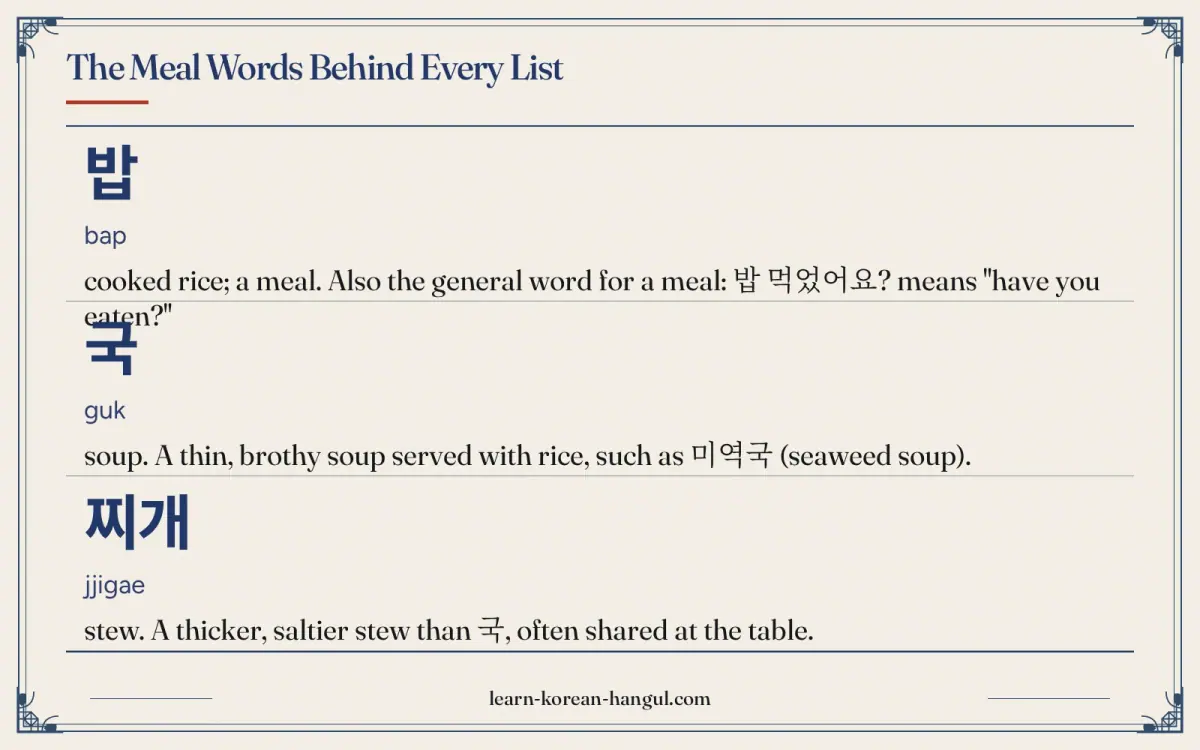
Six words show how a Korean meal is built, and they come back in every list on this site. 밥 is the rice at the centre, 국 and 찌개 are the soups and stews, 반찬 are the side dishes and 김치 and 떡 are two foods you will meet early. Learn these before you open a list, because they are the frame that the other words fit into.
| No. | Hangul | Revised Romanization | Meaning and note | Example sentence | Audio assetId |
|---|---|---|---|---|---|
| 1 | 밥 | bap | cooked rice; a meal. Also the general word for a meal: 밥 먹었어요? means "have you eaten?" | 밥을 먹어요. (I eat rice (a meal).) | au-pg-vocabulary-food-1; example: au-pg-vocabulary-food-7 |
| 2 | 국 | guk | soup. A thin, brothy soup served with rice, such as 미역국 (seaweed soup). | 국이 뜨거워요. (The soup is hot.) | au-pg-vocabulary-food-2; example: au-pg-vocabulary-food-8 |
| 3 | 찌개 | jjigae | stew. A thicker, saltier stew than 국, often shared at the table. | 김치찌개를 먹어요. (I eat kimchi stew.) | au-pg-vocabulary-food-3; example: au-pg-vocabulary-food-9 |
| 4 | 반찬 | banchan | side dishes. The small dishes shared at a meal, often refilled for free in restaurants. | 반찬이 많아요. (There are many side dishes.) | au-pg-vocabulary-food-4; example: au-pg-vocabulary-food-10 |
| 5 | 김치 | gimchi | kimchi (fermented vegetables). The best-known side dish. It comes in many kinds, such as 배추김치. | 김치를 좋아해요. (I like kimchi.) | au-pg-vocabulary-food-5; example: au-pg-vocabulary-food-11 |
| 6 | 떡 | tteok | rice cake. A chewy cake made from rice flour, eaten as a snack or at holidays. | 떡을 먹어요. (I eat rice cake.) | au-pg-vocabulary-food-6; example: au-pg-vocabulary-food-12 |
How Is a Korean Meal Structured?
The six words above show the shape of a meal. 밥 sits in front of you, 국 or 찌개 sits beside it, and 반찬 sit in the middle for everyone to share. This is why Korean menus often list a main dish and then say that rice and side dishes come with it. The structure is also why 밥 can mean both "rice" and "a meal": the rice is the centre of the table.
Two verbs go with all of these nouns. 먹다 (meokda) means to eat, and 마시다 (masida) means to drink. Say 밥을 먹어요 (I eat a meal) and 물을 마셔요 (I drink water). The word lists teach nouns only, because these two verbs, and the others that go with food, belong to the verb pages. See the common verbs page for them.
What Is in the Korean Dishes List?
The Korean Dishes list teaches 40 dish names in six groups: rice dishes, stews and soups, grilled meat, noodles, street food, and kimchi, side dishes and desserts. Dish names are often built from an ingredient and a method, so learning the pattern lets you read new names. The list is the best next step after the six meal words, because dishes are what you order.
What Is in the Ingredients List?
The Ingredients list covers 45 foods you buy and cook with: meat and eggs, seafood, sauces and seasonings, basic staples, and vegetables and bread. It is the list to open before a grocery trip, and it pairs with the Fruits and Vegetables section, which holds two 40-word lists of produce. Together they cover a supermarket shop.
What Is in the Drinks List?
The Drinks list has 45 words: water and soft drinks, coffee and tea, traditional drinks such as 식혜, alcohol and cafe menu words. It also explains small traps, such as 차 meaning both tea and car. It has two deeper pages: the cafe menu and drinking culture.
What Is in the Restaurant and Cooking Lists?
The At the Restaurant list has 45 words for types of restaurant, table and tableware, the menu and ordering, paying, and delivery and takeaway. The Cooking and Taste list has 40 words for recipes, tools, heat, taste and cooking methods, such as 볶음 (stir-fried dish) and 찜 (steamed or braised dish). Use the first when you eat out and the second when you cook or want to describe flavour.
What Do All the Lists Have in Common?
All six lists follow the same layout. Each word has its Hangul, a Revised Romanization guide, an English meaning, an audio clip and an example sentence. The romanization follows the Revised Romanization of Korean, published by the National Institute of Korean Language (국립국어원), and it is a learning aid, not a replacement for Hangul.
The lists also share a pattern in where their words come from. Many food words are native Korean, such as 밥, 국 and 떡. Restaurant and kitchen terms are more often Sino-Korean, such as 식당 (restaurant), or English loanwords, such as 메뉴 (menu) and 레시피 (recipe). Knowing which type a word is helps you guess its pronunciation and spot related words. The food in korean page answers the single-word lookup.
Practice: Flashcards and Worksheet
Each list has its own flashcard deck,; consult the vocabulary worksheets page for printable practice. Study with the deck first, then use a worksheet from the vocabulary worksheets page to check what you remember. The vocabulary flashcard decks page lists every deck, and the vocabulary worksheets page lists the printable sheets as they are published. Review a few cards each day, and your progress stays in your browser. Counters for food, such as 잔 and 병, are on the food counters page.
Where to Go Next
If you want a first list, open Korean Dishes or Drinks. To keep building daily vocabulary, go to Daily Life or Nature and the World. To move up a level, return to Korean Vocabulary.
Frequently Asked Questions
Which List in Korean Food Vocabulary Should I Start With?
Start with the list that matches your next use of food Korean. For eating out, open At the Restaurant. For menus, open Korean Dishes. For groceries, open Ingredients. If you are unsure, learn the six meal words on this page first: 밥, 국, 찌개, 반찬, 김치 and 떡.
How Are the Lists in Korean Food Vocabulary Organised?
There are six lists: Korean Dishes, Ingredients, Fruits and Vegetables, Drinks, At the Restaurant, and Cooking and Taste. Each list holds its words in groups, with Hangul, Revised Romanization, an English meaning, audio and an example sentence for each word.
Do These Lists Include Verbs and Adjectives?
No. The lists hold nouns, so you learn the words for things. The two verbs that go with food are 먹다 (to eat) and 마시다 (to drink), and the verb pages teach the rest. The Cooking and Taste list stays with nouns such as 맛 (taste) and 볶음 (stir-fried dish).
Where Can I Find Flashcards and Worksheets for These Topics?
Each list has its own flashcard deck, listed on the vocabulary flashcard decks page. Printable worksheets can be found on the vocabulary worksheets page. Your flashcard progress stays in your browser.