Korean Question Words Vocabulary at a Glance
A question word is a word such as who, what, where or why that asks for missing information. English moves the question word to the front of the sentence. Korean does not: the question word sits in the same slot where the answer would go. So 학교에 가요 (I go to school) becomes 어디에 가요? (Where do you go?) by swapping 학교 for 어디, and nothing else moves.
The list has 25 words in five groups, ordered like the question words of English: who and what, where and when, why and how, how much and how many, and which and what kind. Many of them are one syllable or two, and almost all are native Korean words. This page is the word list for memorising them. For how to build whole questions, see the grammar page on questions. The list sits inside Korean Pronouns, Question Words and Connectors.
| Group | Words | Examples |
|---|---|---|
| Who and what | 5 | 누구, 누가, 뭐, 무엇 |
| Where and when | 5 | 어디, 어디에서, 어디로, 언제 |
| Why and how | 5 | 왜, 어째서, 어떻게, 어때요 |
| How much and how many | 5 | 얼마, 얼마나, 몇, 몇 시 |
| Which and what kind | 5 | 어느, 무슨, 어떤, 어느 쪽 |
By word origin, the list has 23 native and 2 mixed entries. The only Chinese-derived parts are the counters in 몇 시 (시, hour) and 몇 개 (개, piece), so most words have to be learned on their own, with no shared Sino-Korean syllables to help.
Which Question Words Should You Learn First?
Start with the five that carry most conversations: 누구, 뭐, 어디, 언제 and 왜. Press play, then the slow button, and say each word aloud.
누구 (nugu) means who. It means who. The subject form is 누가, not 누구가. The same word asks about a person in the object slot: 누구를 만나요? (Who are you meeting?). Example: 이 사람은 누구예요? (Who is this person?)
뭐 (mwo) means what (spoken). It is the spoken short form of 무엇, and it is what people actually say. The spelling 뭐 is pronounced with a w glide: mwo. Add 를 and you get 뭘, as in 뭘 먹어요? Example: 뭐 먹어요? (What are you eating?)
어디 (eodi) means where. It means where, and it appears in the most useful question for a traveller: ...어디예요? (Where is...?). With a verb of motion it needs a particle: 어디에 가요? or the short 어디 가요? Example: 화장실이 어디예요? (Where is the restroom?)
언제 (eonje) means when. It means when, and it is used for a point in time, such as a day or a month. It does not take a particle in most sentences: 언제 와요? (When do you come?). Example: 언제 와요? (When are you coming?)
왜 (wae) means why. It means why, and it usually comes early in the clause. Its sound is a single vowel that glides: weh. The answer often starts with the connector 왜냐하면 (because), which you will meet on the conjunctions page. Example: 왜 늦었어요? (Why were you late?)
Who and What
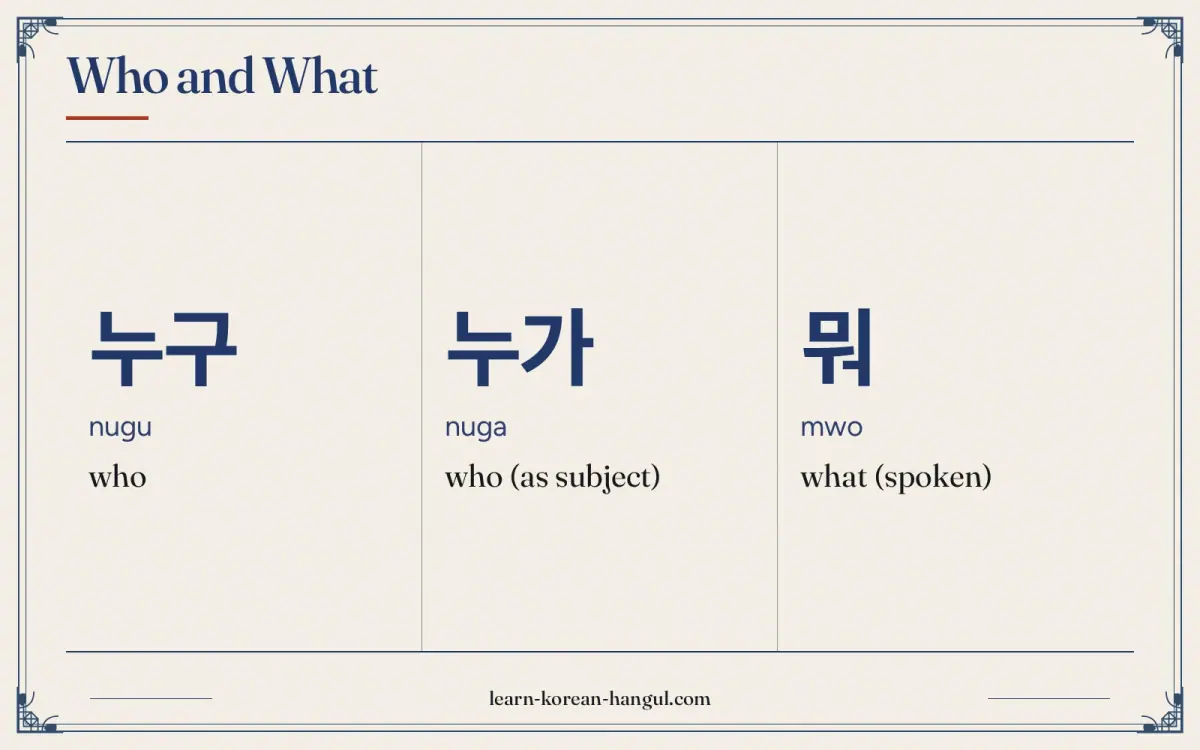
Who and what are the two question words you will use in the first week. Each of them has a long form, a short spoken form and a subject form.
| No. | Hangul | Revised Romanization | Meaning | Origin | Example sentence | Audio assetId |
|---|---|---|---|---|---|---|
| 1 | 누구 | nugu | who | native | 이 사람은 누구예요? (i sarameun nuguyeyo; Who is this person?) | au-pg-vocabulary-function-words-question-words-1; example: au-pg-vocabulary-function-words-question-words-101 |
| 2 | 누가 | nuga | who (as subject) | native | 누가 왔어요? (nuga wasseoyo; Who came?) | au-pg-vocabulary-function-words-question-words-2; example: au-pg-vocabulary-function-words-question-words-102 |
| 3 | 뭐 | mwo | what (spoken) | native | 뭐 먹어요? (mwo meogeoyo; What are you eating?) | au-pg-vocabulary-function-words-question-words-3; example: au-pg-vocabulary-function-words-question-words-103 |
| 4 | 무엇 | mueot | what (formal) | native | 무엇을 도와 드릴까요? (mueoseul dowa deurilkkayo; How can I help you?) | au-pg-vocabulary-function-words-question-words-4; example: au-pg-vocabulary-function-words-question-words-104 |
| 5 | 뭘 | mwol | what (object, spoken) | native | 뭘 마실래요? (mwol masillaeyo; What will you drink?) | au-pg-vocabulary-function-words-question-words-5; example: au-pg-vocabulary-function-words-question-words-105 |
- 누구: Koreans also use it to mean someone, which is why the intonation matters. 누가 왔어요? with the stress on 누가 and a falling or rise-fall end asks who came; with a sharp final rise it asks whether someone came.
- 누가: It is 누구 joined with 가 (the subject particle) into a single form. Learn it as one word and do not say 누구가.
- 뭐: With a polite ending it makes a friendly everyday question. It is the form you will hear most often.
- 무엇: This is the written and formal form. Shop staff and announcements use it. The sentence literally asks what shall I help with.
- 뭘: It is 뭐 plus 를 shortened. Use it when what is the object of the verb.
Example Sentences
Question words keep their place in the sentence. In 저는 학교에 가요 (I go to school), swap 학교 for 어디 to get 어디에 가요? (Where do you go?). Swap 책 (book) for 뭐 to get 뭐 읽어요? (What are you reading?). The word order stays the same, and the stress falls on the question word. A second pattern is the answer: when someone asks 몇 시예요?, the reply uses the same slot, as in 세 시예요 (It is three o'clock). For a longer discussion of building questions, see the questions page.
How Do You Say Where and When in Korean?
Where and when are close partners in a plan. Where has three forms, and each form marks a different relation: place, location of an action and direction.
| No. | Hangul | Revised Romanization | Meaning | Origin | Example sentence | Audio assetId |
|---|---|---|---|---|---|---|
| 6 | 어디 | eodi | where | native | 화장실이 어디예요? (hwajangsiri eodiyeyo; Where is the restroom?) | au-pg-vocabulary-function-words-question-words-6; example: au-pg-vocabulary-function-words-question-words-106 |
| 7 | 어디에서 | eodieseo | where (at which an action happens) | native | 어디에서 만나요? (eodieseo mannayo; Where shall we meet?) | au-pg-vocabulary-function-words-question-words-7; example: au-pg-vocabulary-function-words-question-words-107 |
| 8 | 어디로 | eodiro | to where; which way | native | 어디로 가요? (eodiro gayo; Where are you going?) | au-pg-vocabulary-function-words-question-words-8; example: au-pg-vocabulary-function-words-question-words-108 |
| 9 | 언제 | eonje | when | native | 언제 와요? (eonje wayo; When are you coming?) | au-pg-vocabulary-function-words-question-words-9; example: au-pg-vocabulary-function-words-question-words-109 |
| 10 | 며칠 | myeochil | what day of the month; how many days | native | 오늘이 며칠이에요? (oneuri myeochirieyo; What is the date today?) | au-pg-vocabulary-function-words-question-words-10; example: au-pg-vocabulary-function-words-question-words-110 |
- 어디: This is the pattern to learn first: place name plus 이/가 어디예요? It is the question every traveller needs.
- 어디에서: The particle 에서 marks the place of an action. It is often shortened to 어디서 in speech.
- 어디로: The particle 로 marks direction. 어디에 가요? is also correct, and the difference is small.
- 언제: It asks about a time. The answers are time words such as 내일 (tomorrow) or 다섯 시에 (at five o'clock).
- 며칠: The word has two uses. It asks for a day of the month and, with a duration, how many days. Write it 며칠, never 몇 일, even though 몇 is the word for how many.
Why and How
Why and how bring together the reasons and the methods. This is where 어떻게 and 어떡해, two words that look almost the same, have to be separated.
| No. | Hangul | Revised Romanization | Meaning | Origin | Example sentence | Audio assetId |
|---|---|---|---|---|---|---|
| 11 | 왜 | wae | why | native | 왜 늦었어요? (wae neujeosseoyo; Why were you late?) | au-pg-vocabulary-function-words-question-words-11; example: au-pg-vocabulary-function-words-question-words-111 |
| 12 | 어째서 | eojjaeseo | why (more formal) | native | 어째서 그렇게 생각해요? (eojjaeseo geureoke saenggakaeyo; Why do you think so?) | au-pg-vocabulary-function-words-question-words-12; example: au-pg-vocabulary-function-words-question-words-112 |
| 13 | 어떻게 | eotteoke | how | native | 이 단어는 어떻게 읽어요? (i daneoneun eotteoke ilgeoyo; How do you read this word?) | au-pg-vocabulary-function-words-question-words-13; example: au-pg-vocabulary-function-words-question-words-113 |
| 14 | 어때요 | eottaeyo | how is it? | native | 한국 생활은 어때요? (hanguk saenghwareun eottaeyo; How is life in Korea?) | au-pg-vocabulary-function-words-question-words-14; example: au-pg-vocabulary-function-words-question-words-114 |
| 15 | 어떡해 | eotteokae | what should I do? | native | 지갑을 잃어버렸어요. 어떡해요? (jigabeul ireobeoryeosseoyo eotteokaeyo; I lost my wallet. What should I do?) | au-pg-vocabulary-function-words-question-words-15; example: au-pg-vocabulary-function-words-question-words-115 |
- 왜: It is the everyday way to ask for a reason, and can be used alone: 왜요? (Why?).
- 어째서: It is a more formal or more insistent word than 왜. It is common in writing and speeches.
- 어떻게: It asks about the way or the method. It is said [어떠케], because the ㅎ joins the next ㄱ into a ㅋ sound.
- 어때요: It asks for an opinion or a condition and comes from the verb 어떻다. Use it for how something is, not for how to do it.
- 어떡해: It is a short form of 어떻게 해 and sounds like [어떠캐]. It is an exclamation of worry. Do not use it for how.
How Do You Say How Much and How Many in Korean?
Two words handle quantity. 몇 asks about a count and is always followed by a counter, and 얼마 asks about an amount, a price or a total.
| No. | Hangul | Revised Romanization | Meaning | Origin | Example sentence | Audio assetId |
|---|---|---|---|---|---|---|
| 16 | 얼마 | eolma | how much | native | 커피는 얼마예요? (keopineun eolmayeyo; How much is the coffee?) | au-pg-vocabulary-function-words-question-words-16; example: au-pg-vocabulary-function-words-question-words-116 |
| 17 | 얼마나 | eolmana | how much; how long; how (adverb) | native | 학교까지 얼마나 걸려요? (hakgyokkaji eolmana geollyeoyo; How long does it take to get to school?) | au-pg-vocabulary-function-words-question-words-17; example: au-pg-vocabulary-function-words-question-words-117 |
| 18 | 몇 | myeot | how many; what (number) | native | 몇 살이에요? (myeot sarieyo; How old are you?) | au-pg-vocabulary-function-words-question-words-18; example: au-pg-vocabulary-function-words-question-words-118 |
| 19 | 몇 시 | myeot si | what time | mixed | 지금 몇 시예요? (jigeum myeot siyeyo; What time is it now?) | au-pg-vocabulary-function-words-question-words-19; example: au-pg-vocabulary-function-words-question-words-119 |
| 20 | 몇 개 | myeot gae | how many pieces | mixed | 사과가 몇 개 있어요? (sagwaga myeot gae isseoyo; How many apples are there?) | au-pg-vocabulary-function-words-question-words-20; example: au-pg-vocabulary-function-words-question-words-120 |
- 얼마: It asks about price and about amount. Staff answer with a number and 원, the unit of money.
- 얼마나: The 나 makes it an adverb of degree. It can be used for time, distance and quantity.
- 몇: It must be followed by a counter or a unit, so it is never used alone. See the counters section for the full set.
- 몇 시: The pair is two words, written with a space. The answer uses the native number for the hour.
- 몇 개: 개 is the general counter for things. Use 명 for people and 마리 for animals in the same slot.
Which and What Kind
Korean has three words that modify a noun: 어느 asks which one, 무슨 asks what sort or what, and 어떤 asks what kind or what is it like. The set is the hardest part of the topic, so it has examples with minimal pairs.
| No. | Hangul | Revised Romanization | Meaning | Origin | Example sentence | Audio assetId |
|---|---|---|---|---|---|---|
| 21 | 어느 | eoneu | which | native | 어느 나라 사람이에요? (eoneu nara saramieyo; Which country are you from?) | au-pg-vocabulary-function-words-question-words-21; example: au-pg-vocabulary-function-words-question-words-121 |
| 22 | 무슨 | museun | what (kind of); what | native | 오늘은 무슨 요일이에요? (oneureun museun yoirieyo; What day of the week is it today?) | au-pg-vocabulary-function-words-question-words-22; example: au-pg-vocabulary-function-words-question-words-122 |
| 23 | 어떤 | eotteon | what kind of; some | native | 어떤 음식을 좋아해요? (eotteon eumsigeul joahaeyo; What kind of food do you like?) | au-pg-vocabulary-function-words-question-words-23; example: au-pg-vocabulary-function-words-question-words-123 |
| 24 | 어느 쪽 | eoneu jjok | which way; which side | native | 화장실은 어느 쪽이에요? (hwajangsireun eoneu jjogieyo; Which way is the restroom?) | au-pg-vocabulary-function-words-question-words-24; example: au-pg-vocabulary-function-words-question-words-124 |
| 25 | 어느 것 | eoneu geot | which one | native | 어느 것이 더 좋아요? (eoneu geosi deo joayo; Which one is better?) | au-pg-vocabulary-function-words-question-words-25; example: au-pg-vocabulary-function-words-question-words-125 |
- 어느: It asks you to pick from a known set, such as the countries of the world. 어느 나라 is the standard way to ask which country.
- 무슨: It asks about the category or identity of a noun. Use it before nouns such as 요일, 일 and 음악.
- 어떤: It asks about quality or type, and also means some in a statement. Its answer is a description, not a name.
- 어느 쪽: The word 쪽 means a side or a direction, and the phrase is common when asking for directions.
- 어느 것: It chooses one thing among known options. In speech it often becomes 어느 거.
How Do You Pronounce These Words?
Several question words contain a final consonant that changes the next sound. The table follows the Standard Pronunciation rules (표준 발음법) of the 국립국어원.
| Word | Romanization | Said | Rule |
|---|---|---|---|
| 어떻게 | eotteoke | [어떠케] | the ㅎ and the following ㄱ combine into one ㅋ sound |
| 어떡해 | eotteokae | [어떠캐] | the final ㄱ and the following ㅎ combine into one ㅋ sound |
| 몇 시 | myeot si | [멷씨] | the final ㅊ is said as ㄷ, and ㅅ after it becomes tense |
| 몇 명 | myeot myeong | [면명] | the final ㅊ is said as ㄷ, which then turns into ㄴ before ㅁ |
| 무엇이 | mueosi | [무어시] | the final ㅅ of 엇 moves onto the empty ㅇ of 이 |
Revised Romanization is the official romanization system of South Korea, announced on 7 July 2000. It follows most sound changes inside a word, so 어떻게 is written eotteoke to match [어떠케], but it does not show tensing caused by a neighbouring sound and it romanizes each word separately, so 몇 시 is myeot si even though it is said [멷씨]. It is only a learning aid. Always read the Hangul as well.
Audio and Slow Playback
Each headword and each example sentence has its own audio clip, and the 5 words in the first-words section also have a slow clip at 0.8 times the speed. Nothing plays until you press a button. Listen to 어떻게 and 어떡해 one after the other and notice how close they are.
What Mistakes Do Learners Make with Question Words?
- Moving the question word to the front of the sentence. Korean keeps it in the slot of the answer: 뭐 먹어요?, not 뭐 you eat.
- Saying 누구가 for who as the subject. The form is 누가.
- Mixing 어떻게 and 어떡해. 어떻게 asks how, and 어떡해 asks what should I do.
- Using 몇 for prices. Prices take 얼마, and counts take 몇 with a counter.
- Treating 무슨, 어떤 and 어느 as the same word. 어느 chooses from a set, 무슨 asks which kind of thing it is, and 어떤 asks what it is like.
- Reading 왜 as two sounds. It is one vowel that glides, said weh.
Practice: Flashcards and Worksheet
Drill all 25 words with the vocabulary flashcard decks: each card shows the Hangul on one side and the meaning on the other, so you can test yourself in both directions. Consult the vocabulary worksheets page for printable sheets; for practice, write the Korean word for each numbered speech mark in the scene above by hand. A simple plan is to learn the who, where and when words on day one, why and how on day two, and the quantity and choice words on day three. Then ask yourself one real question with each word, and answer it in Korean.
Self-Test: 10 Sentences
Fill each blank with a word from this page. Say the whole sentence aloud when you have it. The answers follow the test.
- 이 사람은 ___예요? (Who is this person?)
- ___ 먹어요? (What are you eating?)
- 화장실이 ___예요? (Where is the restroom?)
- ___ 가요? (Where are you going?)
- ___ 늦었어요? (Why were you late?)
- 이 단어는 ___ 읽어요? (How do you read this word?)
- 커피는 ___예요? (How much is the coffee?)
- ___ 살이에요? (How old are you?)
- ___ 나라 사람이에요? (Which country are you from?)
- ___ 음식을 좋아해요? (What kind of food do you like?)
Answers: 1. 누구; 2. 뭐; 3. 어디; 4. 어디로; 5. 왜; 6. 어떻게; 7. 얼마; 8. 몇; 9. 어느; 10. 어떤.
A score of 8 or more suggests the words are settling in. If you scored lower, reread the groups where you missed words.
Where to Go Next
This Korean question words vocabulary list sits inside Korean Pronouns, Question Words and Connectors. Continue with Korean Pronouns Vocabulary and Korean Conjunctions Vocabulary. For the single-word answer about the word question itself, see question in korean.
FAQ
How Do You Say Who in Korean?
Say 누구 (nugu). When who is the subject, the form is 누가, as in 누가 왔어요? (Who came?). To ask who someone is, say 누구예요? or, more politely, 누구세요? Keep 누구 in the slot of the answer, as in 이 사람은 누구예요? (Who is this person?)
How Do You Pronounce 뭐 (mwo)?
Say mwo. Start with your lips rounded, as for English "w", then open to a vowel like the o in "more" without the r. The two sounds happen in one beat. In writing, 뭐 is the short form of 무엇, which is said [무얻].
How Many Question Words Should I Learn First?
Learn the five words in the first-words section: 누구, 뭐, 어디, 언제 and 왜. Then add 어떻게, 얼마 and 몇, and the three words for which and what kind. The rest of the 25 words can be added a group at a time.
Where Can I Practise Question Words with Flashcards?
Use the vocabulary flashcard decks. Start with the who, where and when words, then add the others. Review the older cards before you add new ones, so the earlier words do not fade, and answer each card with a short real question of your own.
Is the Romanization on This Page Official?
Yes, as a learning aid. It follows the Revised Romanization of Korean, the official system of South Korea since 7 July 2000, and the page gives the Hangul too. It follows most sound changes, as in 어떻게 eotteoke for [어떠케], but not tense sounds: 몇 시 is myeot si but said [멷씨]. Treat the Hangul as the real spelling.
Is There a Printable Worksheet for Question Words?
The vocabulary worksheets page lists the printable sheets. For paper practice, use the illustrated scene on this page as a labelling task and write the Korean word next to each numbered speech mark. You can also copy the scene words by hand.