Korean Board Games Vocabulary at a Glance
This list has 30 words in five groups of six. It belongs to Games and goes deeper than the board and traditional game groups on that page. The first two groups cover games played at a table: those with a board and pieces, and those with cards. The next two are games linked to New Year or to childhood playgrounds. The last group has the words every game needs: rules, turns, fouls and teams.
| Group | Words | Use |
|---|---|---|
| Board games | 6 | Games with a board and pieces |
| Card games | 6 | Playing cards and hwatu |
| Holiday games (윷놀이) | 6 | Games linked to New Year |
| Playground games | 6 | Childhood games |
| Rules and players | 6 | Words every game needs |
Names of traditional games follow patterns, and the patterns help you guess. Many end in 기, the noun ending that turns a verb into an activity: 제기차기, 연날리기, 줄넘기. Others end in 놀이 (play): 윷놀이, 고무줄놀이. A few are plain nouns, like 바둑 and 장기. The page describes the games only in outline, because the aim is the words, not a rule book. If you play any of them with Korean friends, they will gladly explain the rest.
Which Board and Traditional Games Should You Learn First?
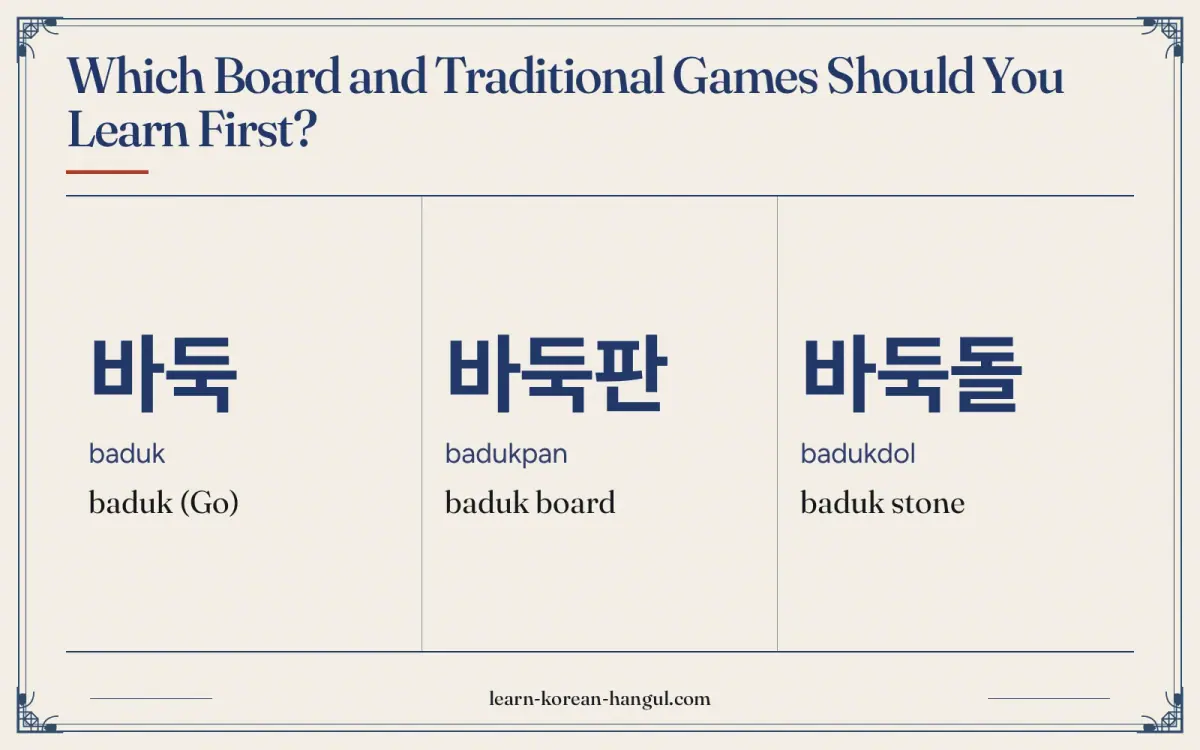
Learn 바둑, 장기, 윷놀이, 규칙 and 차례 first. With those five you can name the best-known games and ask who goes next: 누구 차례예요? (Whose turn is it?). Then add 술래잡기, 줄넘기 and 연날리기, which every Korean child knows. The verbs matter as much as the nouns. Games with pieces on a board take 두다 (바둑을 둬요), most other games take 하다 (윷놀이를 해요) and cards take 치다 for hwatu or 하다 for card games in general.
- Words to say. 바둑, 장기, 윷놀이, 규칙, 차례. They cover the best-known games and the question about turns.
- Words to recognise. 화투, 고스톱, 제기차기, 술래잡기, 반칙. You hear these in family stories and see them in dramas.
- Words to add later. 말뚝박기, 딱지치기, 숨바꼭질, 승부. They are childhood words that make your Korean sound lived-in.
The scene below shows a family table with games laid out, with twelve numbered objects that match words in the tables.
Word · 12
- 1
바둑
baduk
baduk (Go)
- 2
바둑판
badukpan
baduk board
- 3
바둑돌
badukdol
baduk stone
- 4
장기
janggi
janggi (Korean chess)
- 5
오목
omok
omok (five in a row)
- 6
카드
kadeu
card; playing card
- 7
포커
pokeo
poker
- 8
윷놀이
yunnori
yutnori (stick-throwing board game)
- 9
윷가락
yutgarak
yut sticks
- 10
술래잡기
sullaejapgi
tag (chase game)
- 11
숨바꼭질
sumbakkokjil
hide-and-seek
- 12
차례
charye
turn; order
Board Games
The board games group begins with 바둑, an old strategy game for two with black and white stones placed on a grid. 장기 is a Korean game of pieces on a board, often compared with chess, and 오목 asks players to line up five stones. The pieces in these games are called 말, a word with other meanings too.
| No. | Hangul | Revised Romanization | Meaning and note | Example sentence | Audio assetId |
|---|---|---|---|---|---|
| 1 | 바둑 | baduk | baduk (Go). Two players place black and white stones on a grid to surround space. Play it with 두다. | 저는 바둑 두는 법을 배우고 있어요. (I am learning how to play baduk.) | au-pg-vocabulary-hobbies-games-board-games-1; example: au-pg-vocabulary-hobbies-games-board-games-31 |
| 2 | 바둑판 | badukpan | baduk board. From 바둑 and 판 (board). The grid of crossing lines. | 바둑판에 돌을 놓아요. (I place a stone on the baduk board.) | au-pg-vocabulary-hobbies-games-board-games-2; example: au-pg-vocabulary-hobbies-games-board-games-32 |
| 3 | 바둑돌 | badukdol | baduk stone. Said [바둑똘]. From 바둑 and 돌 (stone). Black and white. | 흰 바둑돌과 검은 바둑돌이 있어요. (There are white baduk stones and black baduk stones.) | au-pg-vocabulary-hobbies-games-board-games-3; example: au-pg-vocabulary-hobbies-games-board-games-33 |
| 4 | 장기 | janggi | janggi (Korean chess). A board game with pieces for two players. Play it with 두다. | 장기는 두 사람이 둬요. (Two people play janggi.) | au-pg-vocabulary-hobbies-games-board-games-4; example: au-pg-vocabulary-hobbies-games-board-games-34 |
| 5 | 오목 | omok | omok (five in a row). Players try to line up five stones in a row. It is often played on a baduk board. | 오목은 규칙이 쉬워서 아이들도 해요. (The rules of omok are easy, so even children play it.) | au-pg-vocabulary-hobbies-games-board-games-5; example: au-pg-vocabulary-hobbies-games-board-games-35 |
| 6 | 말 | mal | game piece. Other meanings are "speech" and "horse". In a board game it is a piece. | 말을 한 칸 옮겨요. (I move the piece one square.) | au-pg-vocabulary-hobbies-games-board-games-6; example: au-pg-vocabulary-hobbies-games-board-games-36 |
The verb 두다 (to place) is the one to remember for baduk and janggi, because it matches the act of putting a piece on a board. For omok and board games sold in shops, 하다 also works. English speakers who say "play" for all of them can start with 하다 and add 두다 for baduk and janggi.
Example Sentences
The examples use three frames. The first is noun + 을/를 + verb, as in 말을 옮겨요. The second is noun + 이/가 + descriptive verb, as in 규칙이 쉬워요. The third is noun + 에서 + verb for where or in what, as in 딱지치기에서 땄어요. The particle follows the last sound of the noun: 바둑을 (consonant, so 을), 오목은 (consonant, so 은), 고스톱은 (consonant, so 은) and 포커는 (vowel, so 는). Say each sentence aloud after the audio and replace the noun with another from the table.
How Do You Say Card Games in Korean?
Card words split into two sets. 카드 and 트럼프 name the Western deck, and 포커 is a game played with it. 화투 is a different deck of small cards printed with flower pictures, and 고스톱 is a game played with it. The word 패 names the cards in your hand in both. Hwatu is mentioned here only as vocabulary you will see in dramas and hear in family talk.
| No. | Hangul | Revised Romanization | Meaning and note | Example sentence | Audio assetId |
|---|---|---|---|---|---|
| 7 | 카드 | kadeu | card; playing card. Also means a credit or bank card. A card game is 카드 게임. | 카드를 한 장씩 나눠 줘요. (I hand out the cards one at a time.) | au-pg-vocabulary-hobbies-games-board-games-7; example: au-pg-vocabulary-hobbies-games-board-games-37 |
| 8 | 트럼프 | teureompeu | deck of playing cards. The ordinary Western deck, from the English word trump. | 트럼프로 카드 게임을 해요. (I play a card game with a deck of cards.) | au-pg-vocabulary-hobbies-games-board-games-8; example: au-pg-vocabulary-hobbies-games-board-games-38 |
| 9 | 화투 | hwatu | hwatu (flower cards). A deck of small cards with flower pictures, used for several traditional games. | 설날에 화투를 치는 가족도 있어요. (Some families play hwatu at New Year.) | au-pg-vocabulary-hobbies-games-board-games-9; example: au-pg-vocabulary-hobbies-games-board-games-39 |
| 10 | 고스톱 | goseutop | go-stop (card game). A game played with hwatu cards. The name comes from the English words go and stop. | 고스톱은 규칙이 복잡해요. (The rules of go-stop are complicated.) | au-pg-vocabulary-hobbies-games-board-games-10; example: au-pg-vocabulary-hobbies-games-board-games-40 |
| 11 | 포커 | pokeo | poker. A loanword for the Western card game. | 포커는 카드 게임이에요. (Poker is a card game.) | au-pg-vocabulary-hobbies-games-board-games-11; example: au-pg-vocabulary-hobbies-games-board-games-41 |
| 12 | 패 | pae | hand of cards; tile. The cards you hold in your hand. | 좋은 패가 나왔어요. (I got good cards.) | au-pg-vocabulary-hobbies-games-board-games-12; example: au-pg-vocabulary-hobbies-games-board-games-42 |
Notice the verb 치다 (to hit) with 화투, as in 화투를 치다. It is the normal verb for hwatu and for some other games with small tiles or cards, even though nobody hits anything. Many people also say 카드를 치다 or 포커를 치다 for Western cards, and 카드 게임을 하다 is the neutral choice. If you are unsure, use 하다.
Holiday Games (윷놀이)
Holiday games are the ones families play when they gather. The best known is 윷놀이 (yutnori), a team game in which players throw four sticks and move pieces round a board. It is closely tied to the New Year holiday, 설날. Jegi kicking and kite flying are also linked to New Year, and the top game belongs to the cold months. For the holidays themselves, see holidays.
| No. | Hangul | Revised Romanization | Meaning and note | Example sentence | Audio assetId |
|---|---|---|---|---|---|
| 13 | 윷놀이 | yunnori | yutnori (stick-throwing board game). Said [윤노리]. Played in teams with four sticks and a board. | 설날에는 온 가족이 윷놀이를 해요. (At New Year the whole family plays yutnori.) | au-pg-vocabulary-hobbies-games-board-games-13; example: au-pg-vocabulary-hobbies-games-board-games-43 |
| 14 | 윷가락 | yutgarak | yut sticks. Said [윧까락]. From 윷 and 가락 (stick). Four sticks decide how far a piece moves. | 윷가락 네 개를 던져요. (I throw four yut sticks.) | au-pg-vocabulary-hobbies-games-board-games-14; example: au-pg-vocabulary-hobbies-games-board-games-44 |
| 15 | 윷판 | yutpan | yut board. The board with the path that the pieces follow. | 윷판 위에 말을 놓아요. (I place a piece on the yut board.) | au-pg-vocabulary-hobbies-games-board-games-15; example: au-pg-vocabulary-hobbies-games-board-games-45 |
| 16 | 제기차기 | jegichagi | jegi kicking. Kicking a small weighted shuttlecock (제기) to keep it in the air. | 제기를 떨어뜨리지 않고 차요. (I kick the jegi without dropping it.) | au-pg-vocabulary-hobbies-games-board-games-16; example: au-pg-vocabulary-hobbies-games-board-games-46 |
| 17 | 연날리기 | yeonnalligi | kite flying. 연 (kite) + 날리기 (flying). | 설날에는 연날리기도 해요. (At New Year people also fly kites.) | au-pg-vocabulary-hobbies-games-board-games-17; example: au-pg-vocabulary-hobbies-games-board-games-47 |
| 18 | 팽이치기 | paengichigi | spinning top game. Spinning a top by whipping it with a string. | 팽이가 오래 돌아요. (The top spins for a long time.) | au-pg-vocabulary-hobbies-games-board-games-18; example: au-pg-vocabulary-hobbies-games-board-games-48 |
The five throws in yutnori have names: 도 (do, one step), 개 (gae, two), 걸 (geol, three), 윷 (yut, four) and 모 (mo, five). A common explanation links them to a pig, a dog, a sheep, a cow and a horse. The table gives the Revised Romanization of each.
| Throw | Revised Romanization | Steps |
|---|---|---|
| 도 | do | 1 |
| 개 | gae | 2 |
| 걸 | geol | 3 |
| 윷 | yut | 4 |
| 모 | mo | 5 |
The throw 개 also means "dog" and is a general counter, so the context tells you which it is.
How Do You Say Playground Games in Korean?
Playground games are the ones children play at school or in the street. Their names follow the same two patterns, 기 and 놀이, and two of them, tag and hide-and-seek, have a 술래, the person who is "it". These words are close to what you hear in dramas about school days, and Koreans of all ages recognise them.
| No. | Hangul | Revised Romanization | Meaning and note | Example sentence | Audio assetId |
|---|---|---|---|---|---|
| 19 | 술래잡기 | sullaejapgi | tag (chase game). Said [술래잡끼]. The 술래 is the person who is "it". | 술래잡기를 하면 많이 뛰어요. (When we play tag, we run a lot.) | au-pg-vocabulary-hobbies-games-board-games-19; example: au-pg-vocabulary-hobbies-games-board-games-49 |
| 20 | 숨바꼭질 | sumbakkokjil | hide-and-seek. Said [숨바꼭찔]. 숨다 means to hide. | 숨바꼭질에서 술래가 눈을 감아요. (In hide-and-seek, the seeker closes their eyes.) | au-pg-vocabulary-hobbies-games-board-games-20; example: au-pg-vocabulary-hobbies-games-board-games-50 |
| 21 | 말뚝박기 | malttukbakgi | stake-driving game (leapfrog-like). Said [말뚝빡끼]. Players leap onto a line of bent-over teammates. | 말뚝박기는 힘이 필요해요. (Malttukbakgi needs strength.) | au-pg-vocabulary-hobbies-games-board-games-21; example: au-pg-vocabulary-hobbies-games-board-games-51 |
| 22 | 줄넘기 | julleomgi | jump rope. Said [줄럼끼]. 줄 (rope) + 넘기 (jumping over). | 줄넘기를 백 번 했어요. (I did a hundred jump-rope skips.) | au-pg-vocabulary-hobbies-games-board-games-22; example: au-pg-vocabulary-hobbies-games-board-games-52 |
| 23 | 고무줄놀이 | gomujullori | rubber band game. Said [고무줄로리]. Children jump over a stretched rubber band. | 아이들이 고무줄놀이를 해요. (Children play the rubber band game.) | au-pg-vocabulary-hobbies-games-board-games-23; example: au-pg-vocabulary-hobbies-games-board-games-53 |
| 24 | 딱지치기 | ttakjichigi | ddakji (paper tile flipping). Said [딱찌치기]. Players flip folded paper tiles to turn the other tile over. | 딱지치기에서 딱지를 많이 땄어요. (I won a lot of tiles at ddakji.) | au-pg-vocabulary-hobbies-games-board-games-24; example: au-pg-vocabulary-hobbies-games-board-games-54 |
Several of these names have a sound change inside them, which the next section covers. They also share a family trait: they need no equipment beyond a rope, a rubber band or folded paper, which is why they are remembered as street games.
Rules and Players
The last group is the one you can use with any game, traditional or not. These six words let you ask whose turn it is, explain a rule, call a foul and name your side. Most are Sino-Korean, and 판 and 편 are short everyday words used in many other contexts too.
| No. | Hangul | Revised Romanization | Meaning and note | Example sentence | Audio assetId |
|---|---|---|---|---|---|
| 25 | 규칙 | gyuchik | rule. 규칙을 지키다 means to follow the rules. | 규칙을 먼저 설명해 주세요. (Please explain the rules first.) | au-pg-vocabulary-hobbies-games-board-games-25; example: au-pg-vocabulary-hobbies-games-board-games-55 |
| 26 | 차례 | charye | turn; order. Ask 누구 차례예요? to find out whose turn it is. | 이제 내 차례예요. (Now it is my turn.) | au-pg-vocabulary-hobbies-games-board-games-26; example: au-pg-vocabulary-hobbies-games-board-games-56 |
| 27 | 승부 | seungbu | contest; win or lose. From 승 (win) and 부 (lose). It names the outcome. | 승부는 마지막에 정해져요. (The outcome is decided at the end.) | au-pg-vocabulary-hobbies-games-board-games-27; example: au-pg-vocabulary-hobbies-games-board-games-57 |
| 28 | 판 | pan | round; board; game. Counts rounds: 한 판, 두 판. | 한 판만 더 해요. (Let's play just one more round.) | au-pg-vocabulary-hobbies-games-board-games-28; example: au-pg-vocabulary-hobbies-games-board-games-58 |
| 29 | 반칙 | banchik | foul; breaking the rules. 반칙하다 means to break the rules. | 그건 반칙이에요. (That is a foul.) | au-pg-vocabulary-hobbies-games-board-games-29; example: au-pg-vocabulary-hobbies-games-board-games-59 |
| 30 | 편 | pyeon | side; team. 우리 편 means our side, and 상대편 means the other side. | 저는 우리 편을 응원해요. (I cheer for our side.) | au-pg-vocabulary-hobbies-games-board-games-30; example: au-pg-vocabulary-hobbies-games-board-games-60 |
The question 누구 차례예요? asks "who", so the question word 누구 carries the stress and the voice does not climb sharply at the end. Answer with a name and 차례예요: 민지 차례예요 (It is Minji's turn). With these six words, you can join any game with a group of Korean friends.
How Do You Pronounce These Words?
Many game names are compounds, and compounds are where sound changes happen. The Hangul shows the written form, while the spoken form shifts where a final consonant meets the next sound. Standard pronunciation follows the National Institute of Korean Language (국립국어원) rules, and the romanization follows the Revised Romanization of Korean, which writes double-letter tense consonants but does not show tensing caused by a neighbouring sound.
| Spelling | Sounds like | What changes |
|---|---|---|
| 윷놀이 | [윤노리] | The final ㅊ is said as [ㄷ], then [ㄴ] before ㄴ; the ㄹ of 놀 links to 이. |
| 술래잡기 | [술래잡끼] | After a final ㅂ, the next ㄱ becomes tense [ㄲ]. |
| 숨바꼭질 | [숨바꼭찔] | After a final ㄱ, ㅈ becomes tense [ㅉ]. |
| 말뚝박기 | [말뚝빡끼] | The tense ㄸ is written; after the final ㄱ of 뚝, ㅂ becomes [ㅃ], and after the final ㄱ of 박 the next ㄱ becomes [ㄲ]. |
| 줄넘기 | [줄럼끼] | The ㄴ after ㄹ is said as [ㄹ], and the ㄱ after the final ㅁ becomes tense [ㄲ]. |
| 딱지치기 | [딱찌치기] | After a final ㄲ (said [ㄱ]), ㅈ becomes tense [ㅉ]. |
The RR of these words follows the spelling, not the tense sound, so 숨바꼭질 is written sumbakkokjil and 딱지치기 is written ttakjichigi. In 줄넘기 and 고무줄놀이 the ㄹ sound is doubled, which is why they are written julleomgi and gomujullori. Press the audio button to hear the length of that doubled l.
Audio and Slow Playback
Every headword and every example sentence has its own audio. The five clips below replay the hardest words slowly. Play one, repeat it aloud, then play it again and compare.
What Mistakes Do Learners Make with Board and Traditional Games?
Five mistakes appear often.
- Using 하다 for baduk and janggi. The natural verb is 두다: 바둑을 둬요, 장기를 둬요. 하다 is understood but sounds less natural.
- Reading 말 as only "horse" or "speech". In a board game, 말 is a game piece. The topic tells you which meaning is used, as in 말을 옮겨요.
- Not knowing the counter 판. 한 번 더 해요 (let's do it once more) is fine, but players usually count rounds of a game with 판: 한 판 더 해요 (one more round).
- Calling every card a 카드. 카드 is the general word, and 트럼프 and 화투 are two different decks. Use the specific word when it matters.
- Looking for an English-like word for a traditional game. Names such as 제기차기 and 딱지치기 have no single English word. Learn them as Korean words and explain them in a short sentence.
If you only fix one, fix the verb for pieces on a board: 바둑을 둬요 is what a Korean would say.
Practice: Flashcards and Worksheet
Study in three steps. First, run the flashcard deck in recognition mode until you recognise all 30 words. Second, switch to listening mode and answer from the audio alone. Third, take the quiz. The deck covers all 30 words with audio, and your progress stays in your browser. The vocabulary flashcard decks page lists the other decks.
Practice · 65
- 01바둑
Show answer
headword 1: baduk (Go)
- 02바둑판
Show answer
headword 2: baduk board
- 03바둑돌
Show answer
headword 3: baduk stone
- 04장기
Show answer
headword 4: janggi (Korean chess)
- 05오목
Show answer
headword 5: omok (five in a row)
- 06말
Show answer
headword 6: game piece
- 07카드
Show answer
headword 7: card; playing card
- 08트럼프
Show answer
headword 8: deck of playing cards
- 09화투
Show answer
headword 9: hwatu (flower cards)
- 10고스톱
Show answer
headword 10: go-stop (card game)
- 11포커
Show answer
headword 11: poker
- 12패
Show answer
headword 12: hand of cards; tile
- 13윷놀이
Show answer
headword 13: yutnori (stick-throwing board game)
- 14윷가락
Show answer
headword 14: yut sticks
- 15윷판
Show answer
headword 15: yut board
- 16제기차기
Show answer
headword 16: jegi kicking
- 17연날리기
Show answer
headword 17: kite flying
- 18팽이치기
Show answer
headword 18: spinning top game
- 19술래잡기
Show answer
headword 19: tag (chase game)
- 20숨바꼭질
Show answer
headword 20: hide-and-seek
- 21말뚝박기
Show answer
headword 21: stake-driving game (leapfrog-like)
- 22줄넘기
Show answer
headword 22: jump rope
- 23고무줄놀이
Show answer
headword 23: rubber band game
- 24딱지치기
Show answer
headword 24: ddakji (paper tile flipping)
- 25규칙
Show answer
headword 25: rule
- 26차례
Show answer
headword 26: turn; order
- 27승부
Show answer
headword 27: contest; win or lose
- 28판
Show answer
headword 28: round; board; game
- 29반칙
Show answer
headword 29: foul; breaking the rules
- 30편
Show answer
headword 30: side; team
- 31저는 바둑 두는 법을 배우고 있어요.
Show answer
example for 바둑
- 32바둑판에 돌을 놓아요.
Show answer
example for 바둑판
- 33흰 바둑돌과 검은 바둑돌이 있어요.
Show answer
example for 바둑돌
- 34장기는 두 사람이 둬요.
Show answer
example for 장기
- 35오목은 규칙이 쉬워서 아이들도 해요.
Show answer
example for 오목
- 36말을 한 칸 옮겨요.
Show answer
example for 말
- 37카드를 한 장씩 나눠 줘요.
Show answer
example for 카드
- 38트럼프로 카드 게임을 해요.
Show answer
example for 트럼프
- 39설날에 화투를 치는 가족도 있어요.
Show answer
example for 화투
- 40고스톱은 규칙이 복잡해요.
Show answer
example for 고스톱
- 41포커는 카드 게임이에요.
Show answer
example for 포커
- 42좋은 패가 나왔어요.
Show answer
example for 패
- 43설날에는 온 가족이 윷놀이를 해요.
Show answer
example for 윷놀이
- 44윷가락 네 개를 던져요.
Show answer
example for 윷가락
- 45윷판 위에 말을 놓아요.
Show answer
example for 윷판
- 46제기를 떨어뜨리지 않고 차요.
Show answer
example for 제기차기
- 47설날에는 연날리기도 해요.
Show answer
example for 연날리기
- 48팽이가 오래 돌아요.
Show answer
example for 팽이치기
- 49술래잡기를 하면 많이 뛰어요.
Show answer
example for 술래잡기
- 50숨바꼭질에서 술래가 눈을 감아요.
Show answer
example for 숨바꼭질
- 51말뚝박기는 힘이 필요해요.
Show answer
example for 말뚝박기
- 52줄넘기를 백 번 했어요.
Show answer
example for 줄넘기
- 53아이들이 고무줄놀이를 해요.
Show answer
example for 고무줄놀이
- 54딱지치기에서 딱지를 많이 땄어요.
Show answer
example for 딱지치기
- 55규칙을 먼저 설명해 주세요.
Show answer
example for 규칙
- 56이제 내 차례예요.
Show answer
example for 차례
- 57승부는 마지막에 정해져요.
Show answer
example for 승부
- 58한 판만 더 해요.
Show answer
example for 판
- 59그건 반칙이에요.
Show answer
example for 반칙
- 60저는 우리 편을 응원해요.
Show answer
example for 편
- 61숨바꼭질
Show answer
slow playback: 숨바꼭질
- 62말뚝박기
Show answer
slow playback: 말뚝박기
- 63줄넘기
Show answer
slow playback: 줄넘기
- 64고무줄놀이
Show answer
slow playback: 고무줄놀이
- 65윷놀이
Show answer
slow playback: 윷놀이
Practice · 6
What does 바둑 (baduk) mean?
Show answer
baduk (Go)
바둑 means baduk (Go). Example: 저는 바둑 두는 법을 배우고 있어요. (I am learning how to play baduk.)
What does 장기 (janggi) mean?
Show answer
janggi (Korean chess)
장기 means janggi (Korean chess). Example: 장기는 두 사람이 둬요. (Two people play janggi.)
What does 패 (pae) mean?
Show answer
hand of cards; tile
패 means hand of cards; tile. Example: 좋은 패가 나왔어요. (I got good cards.)
What does 윷판 (yutpan) mean?
Show answer
yut board
윷판 means yut board. Example: 윷판 위에 말을 놓아요. (I place a piece on the yut board.)
What does 숨바꼭질 (sumbakkokjil) mean?
Show answer
hide-and-seek
숨바꼭질 means hide-and-seek. Example: 숨바꼭질에서 술래가 눈을 감아요. (In hide-and-seek, the seeker closes their eyes.)
What does 차례 (charye) mean?
Show answer
turn; order
차례 means turn; order. Example: 이제 내 차례예요. (Now it is my turn.)
Korean Board Games Vocabulary Worksheet (PDF)
A printable worksheet for these words (word list, matching, writing practice, fill-in-the-blank exercises and answer key) is available in A4 and US Letter from the download card on this page. For practice, write three sentences about a game you know in Korean: its name, how many people play it and whose turn comes first.
Where to Go Next
After this page, continue with Korean Video Games Vocabulary for the newer side of Korean play. For the holidays when many of these games are played, see holidays. To move up a level, return to Games.
Frequently Asked Questions
How Do You Say Baduk in Korean?
Baduk is 바둑 (baduk). English calls the same game Go. Say ba-duk, with a plain ㅂ and a final ㄱ that you do not release. Play it with the verb 두다: 바둑을 둬요 (badugeul dwoyo) means "I play baduk". Press the audio button to hear it.
How Do You Pronounce 장기 (janggi)?
Say jang-gi in two beats. The final ㅇ of 장 is the ng sound, as at the end of "song", and 기 follows with a plain g. Do not say "jan-gi" with an n. The word 장기 also means "long term" in other contexts, so the topic decides which one is meant.
How Many Board and Traditional Games Should I Learn First?
Five first: 바둑, 장기, 윷놀이, 규칙 and 차례. At five new words a day, the 30-word list takes six days plus review. Add the three childhood games 술래잡기, 줄넘기 and 연날리기 in the second week, because Korean friends will recognise them at once.
Where Can I Practise Board and Traditional Games with Flashcards?
Use the vocabulary flashcard decks. The deck for this page holds all 30 words with Hangul, romanization and audio, and it offers recognition and listening modes. Your progress stays in your browser, so return daily and review the cards you missed.
Is the Romanization on This Page Official?
It follows the Revised Romanization of Korean, which South Korea adopted on 7 July 2000 and whose rules the National Institute of Korean Language (국립국어원) publishes. It is a learning aid and does not show every sound change, so rely on the Hangul and the audio.
Is There a Printable Worksheet for Board and Traditional Games?
A printable worksheet for these words (word list, matching, writing practice, fill-in-the-blank exercises and answer key) is available in A4 and US Letter from the download card on this page. For practice, copy the tables on this page by hand or use the flashcard deck, which carries the same 30 words.