Korean Gaming Vocabulary at a Glance
Games in Korea range from phone apps to board games that are hundreds of years old, and the vocabulary follows the same range. This page holds 40 words in five groups of eight and works as the hub of the Games section inside Hobbies and Leisure. The first group covers video games, the second board games, the third traditional games, the fourth online play and the last esports.
| Group | Words | Use |
|---|---|---|
| Video games | 8 | Screens, consoles and in-game words |
| Board games | 8 | Games with pieces, cards and dice |
| Traditional games | 8 | Holiday and folk games |
| Online play | 8 | Connecting, chatting and playing together |
| Esports | 8 | Tournaments and spectators |
Most video game words are loanwords, written in Hangul with the English sound, so an English speaker can guess many of them: 레벨, 아이템, 팀. Board and traditional games use older Sino-Korean or native words, such as 바둑 and 윷놀이, that you have to learn. Two pages go deeper than this one: video games and Korean Board and Traditional Games Vocabulary. Use this page to see the whole picture first.
Which Gaming Words Should You Learn First?
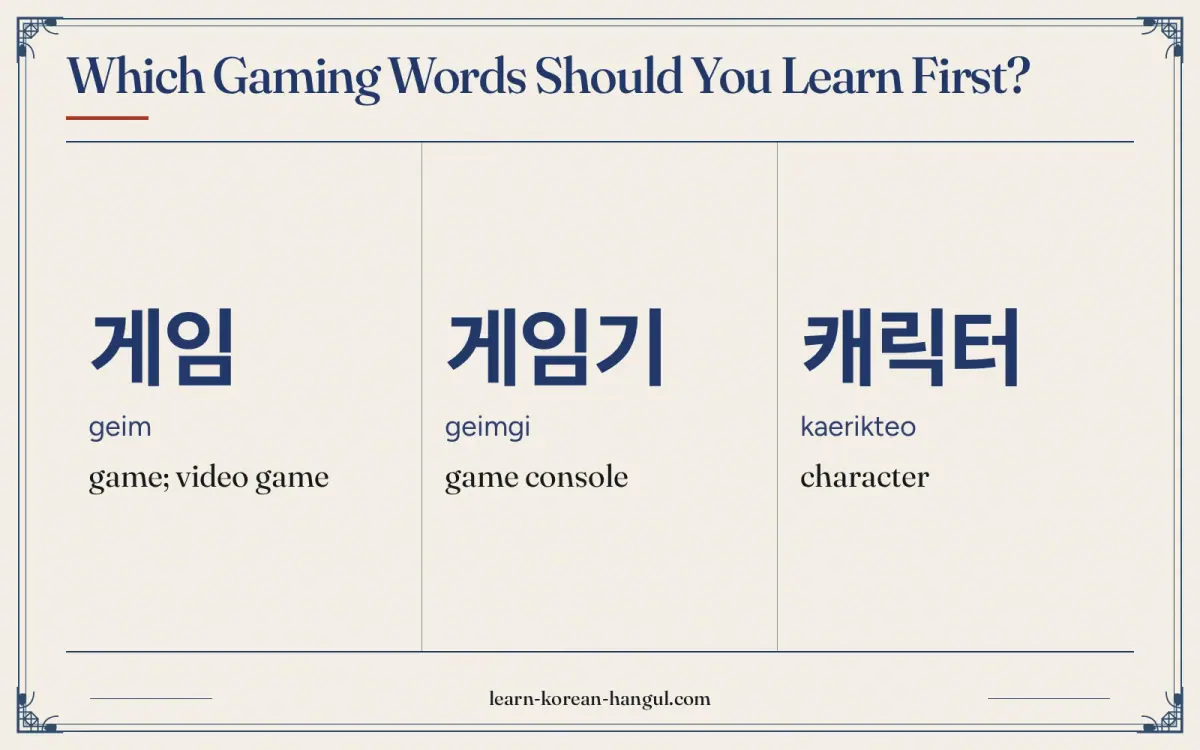
Learn 게임, 팀, 친구, 점수 and 온라인 first, together with three verbs: 하다 (to play a game), 이기다 (to win) and 지다 (to lose). With them you can say you play, say who won and name your team: 어제 우리 팀이 이겼어요 (Our team won yesterday). After that, add 캐릭터, 레벨 and 아이템, which you meet every time you start a video game. The single verb to master early is 하다, because Korean plays games with 하다 (to do), not with 놀다 (to play like a child).
- Words to say. 게임, 팀, 친구, 점수, with the verbs 이기다 and 지다. They carry almost every casual chat about a game.
- Words to recognise. 레벨, 아이템, 접속, 로그인, 랭킹. You see these on screens and in app menus.
- Words to add later. 윷놀이, 씨름, 결승, 중계. They connect games to Korean holidays and sports television.
Gaming also has places. The PC방 (PC cafe) is a room of gaming computers rented by the hour, and many students and friends meet there. The 보드게임 카페 (board game cafe) lets you borrow and play games for a fee. The older 오락실 (oraksil, arcade) still exists too. The scene below shows twelve of the 40 words with numbers that match the tables.
Word · 12
- 1
게임
geim
game; video game
- 2
게임기
geimgi
game console
- 3
캐릭터
kaerikteo
character
- 4
보드게임
bodeugeim
board game
- 5
바둑
baduk
baduk (Go)
- 6
퍼즐
peojeul
puzzle
- 7
주사위
jusawi
dice
- 8
윷놀이
yunnori
yutnori (stick-throwing board game)
- 9
제기차기
jegichagi
jegi kicking
- 10
온라인
ollain
online
- 11
e스포츠
iseupocheu
esports
- 12
대회
daehoe
tournament; competition
Video Games
Video game words are mostly loanwords, so the first group is the easiest. Two patterns repeat: English words are respelled with Hangul letters and every syllable gets a clear vowel, so item becomes 아이템, and English l sounds become ㄹ, so level becomes 레벨. The word 게임 (geim) itself is a loanword, written in Hangul.
| No. | Hangul | Revised Romanization | Meaning and note | Example sentence | Audio assetId |
|---|---|---|---|---|---|
| 1 | 게임 | geim | game; video game. Play it with 하다, not 놀다: 게임을 해요. | 저는 저녁에 게임을 해요. (I play games in the evening.) | au-pg-vocabulary-hobbies-games-1; example: au-pg-vocabulary-hobbies-games-41 |
| 2 | 게임기 | geimgi | game console. From 게임 (game) and 기 (machine). | 게임기를 새로 샀어요. (I bought a new game console.) | au-pg-vocabulary-hobbies-games-2; example: au-pg-vocabulary-hobbies-games-42 |
| 3 | 모바일 | mobail | mobile; on a phone. A loanword. A game on a phone is a 모바일 게임. | 모바일 게임을 지하철에서 해요. (I play mobile games on the subway.) | au-pg-vocabulary-hobbies-games-3; example: au-pg-vocabulary-hobbies-games-43 |
| 4 | 캐릭터 | kaerikteo | character. Three beats, kae-rik-teo; the ㄱ of 릭 is closed, not released, before 터. | 내 캐릭터는 마법사예요. (My character is a wizard.) | au-pg-vocabulary-hobbies-games-4; example: au-pg-vocabulary-hobbies-games-44 |
| 5 | 레벨 | rebel | level. The word used for game levels. Level up is 레벨이 오르다. | 제 레벨이 벌써 오십이에요. (My level is already fifty.) | au-pg-vocabulary-hobbies-games-5; example: au-pg-vocabulary-hobbies-games-45 |
| 6 | 점수 | jeomsu | score; points. The points you earn in a round. | 점수가 올랐어요. (My score went up.) | au-pg-vocabulary-hobbies-games-6; example: au-pg-vocabulary-hobbies-games-46 |
| 7 | 미션 | misyeon | mission. A task the game gives you. 미션 완료 means mission complete. | 오늘 미션을 끝냈어요. (I finished today's mission.) | au-pg-vocabulary-hobbies-games-7; example: au-pg-vocabulary-hobbies-games-47 |
| 8 | 아이템 | aitem | item. A loanword for an in-game item. | 이 아이템은 아주 비싸요. (This item is very expensive.) | au-pg-vocabulary-hobbies-games-8; example: au-pg-vocabulary-hobbies-games-48 |
Levels use Sino-Korean numbers (일, 이, 삼 ...): 레벨 오십 is level fifty. Rounds and matches use the counter 판, which you meet again in the board games group. The deeper page on video games adds controls, items and online play.
Example Sentences
The examples use three frames. The first is noun + 을/를 + 해요 for playing, as in 게임을 해요. The second is noun + 에서 + verb for where or in what, as in 게임에서 새 친구를 만났어요. The third is noun + 이/가 + verb for something that happens, as in 점수가 올랐어요. Note 을 after a noun that ends in a consonant (게임을, 퍼즐을) and 를 after a noun that ends in a vowel (카드를, 체스를). Say each sentence aloud after the audio and replace the noun with another from the table.
How Do You Say Board Games in Korean?
Board game words mix old and new. 바둑 and 장기 are long-established Korean games, while 체스 and 보드게임 are borrowed. Games played with pieces on a board take the verb 두다 (to place a piece): 바둑을 둬요. Other games take 하다.
| No. | Hangul | Revised Romanization | Meaning and note | Example sentence | Audio assetId |
|---|---|---|---|---|---|
| 9 | 보드게임 | bodeugeim | board game. Written as one word. Board game cafes let you play by the hour. | 주말에 보드게임 카페에 가요. (I go to a board game cafe on weekends.) | au-pg-vocabulary-hobbies-games-9; example: au-pg-vocabulary-hobbies-games-49 |
| 10 | 바둑 | baduk | baduk (Go). An old strategy game with black and white stones on a grid. Play it with 두다. | 바둑은 규칙이 간단해요. (The rules of baduk are simple.) | au-pg-vocabulary-hobbies-games-10; example: au-pg-vocabulary-hobbies-games-50 |
| 11 | 장기 | janggi | janggi (Korean chess). A two-player board game with pieces on a grid. Play it with 두다. Another 장기 means "long term". | 공원에서 장기를 두는 사람들이 많아요. (Many people play janggi in the park.) | au-pg-vocabulary-hobbies-games-11; example: au-pg-vocabulary-hobbies-games-51 |
| 12 | 체스 | cheseu | chess. A loanword. Western chess, as distinct from 장기. | 저는 체스를 배우고 있어요. (I am learning chess.) | au-pg-vocabulary-hobbies-games-12; example: au-pg-vocabulary-hobbies-games-52 |
| 13 | 카드 | kadeu | card; playing card. Also means a credit or bank card. | 카드를 섞어 주세요. (Please shuffle the cards.) | au-pg-vocabulary-hobbies-games-13; example: au-pg-vocabulary-hobbies-games-53 |
| 14 | 퍼즐 | peojeul | puzzle. Both a jigsaw and a puzzle game. | 이 퍼즐은 조각이 많아요. (This puzzle has many pieces.) | au-pg-vocabulary-hobbies-games-14; example: au-pg-vocabulary-hobbies-games-54 |
| 15 | 주사위 | jusawi | dice. One die or many. Roll it with 던지다. | 주사위를 던져 주세요. (Please roll the dice.) | au-pg-vocabulary-hobbies-games-15; example: au-pg-vocabulary-hobbies-games-55 |
| 16 | 판 | pan | round; board; game. Counts rounds: 한 판. It also means the board itself. | 한 판 더 해요. (Let's play one more round.) | au-pg-vocabulary-hobbies-games-16; example: au-pg-vocabulary-hobbies-games-56 |
The word 판 is worth learning early, because it counts rounds of any game: 한 판 (one round), 두 판 (two rounds). It takes native numbers. A common request among friends is 한 판 더 해요 (one more round).
Traditional Games
Traditional games are tied to the calendar. Many are played at New Year (설날) or at the autumn harvest holiday (추석), and some are now shown as cultural performances. Their names often end in 기, a noun ending that turns a verb into the name of an activity: 제기차기 (kicking the jegi), 연날리기 (flying a kite).
| No. | Hangul | Revised Romanization | Meaning and note | Example sentence | Audio assetId |
|---|---|---|---|---|---|
| 17 | 윷놀이 | yunnori | yutnori (stick-throwing board game). Said [윤노리]. Played at New Year with four sticks and a board. | 설날에 가족과 윷놀이를 해요. (At New Year I play yutnori with my family.) | au-pg-vocabulary-hobbies-games-17; example: au-pg-vocabulary-hobbies-games-57 |
| 18 | 제기차기 | jegichagi | jegi kicking. Kicking a weighted shuttlecock (제기) to keep it in the air. | 제기차기는 발로 해요. (You play jegi kicking with your feet.) | au-pg-vocabulary-hobbies-games-18; example: au-pg-vocabulary-hobbies-games-58 |
| 19 | 연날리기 | yeonnalligi | kite flying. 연 (kite) + 날리기 (flying). | 겨울에 공원에서 연날리기를 해요. (In winter we fly kites in the park.) | au-pg-vocabulary-hobbies-games-19; example: au-pg-vocabulary-hobbies-games-59 |
| 20 | 팽이치기 | paengichigi | spinning top game. Spinning a top by whipping it with a string. | 아이들이 팽이치기를 해요. (Children play the spinning top game.) | au-pg-vocabulary-hobbies-games-20; example: au-pg-vocabulary-hobbies-games-60 |
| 21 | 줄다리기 | juldarigi | tug of war. Two teams pull a rope (줄) from each end. | 운동회에서 줄다리기를 해요. (We play tug of war at sports day.) | au-pg-vocabulary-hobbies-games-21; example: au-pg-vocabulary-hobbies-games-61 |
| 22 | 널뛰기 | neolttwigi | seesaw jumping. Two people jump on the ends of a board in turn. | 널뛰기는 높이 뛰는 놀이예요. (Neolttwigi is a game of jumping high.) | au-pg-vocabulary-hobbies-games-22; example: au-pg-vocabulary-hobbies-games-62 |
| 23 | 씨름 | ssireum | ssireum (Korean wrestling). A traditional wrestling sport. | 추석에 씨름을 봐요. (I watch ssireum on Chuseok.) | au-pg-vocabulary-hobbies-games-23; example: au-pg-vocabulary-hobbies-games-63 |
| 24 | 투호 | tuho | tuho (arrow-throwing game). Players throw arrows into a jar. | 투호는 화살을 항아리에 던져요. (In tuho you throw arrows into a jar.) | au-pg-vocabulary-hobbies-games-24; example: au-pg-vocabulary-hobbies-games-64 |
Look at the ending 기 on five of the names. It turns the verb stem into an activity noun: 날리다 (to fly) becomes 날리기 (flying), and 차다 (to kick) becomes 차기 (kicking). Once you see the pattern, new names such as 말뚝박기 are easier to guess. The deeper page on board and traditional games lists more of them, with the holidays when they are played. For the holidays themselves, see holidays.
How Do You Say Online Play in Korean?
Online play words are the ones you use to connect and play with other people. They are nearly all loanwords or Sino-Korean nouns that take 하다 to become verbs: 접속하다 (to connect), 로그인하다 (to log in), 채팅하다 (to chat). Remember that 접속하다 is used for servers and sites, and you do not say you "go" to a server.
| No. | Hangul | Revised Romanization | Meaning and note | Example sentence | Audio assetId |
|---|---|---|---|---|---|
| 25 | 온라인 | ollain | online. A loanword that comes before nouns: 온라인 게임. The ㄴ+ㄹ is said [올라인]. | 친구와 온라인으로 게임을 해요. (I play games online with a friend.) | au-pg-vocabulary-hobbies-games-25; example: au-pg-vocabulary-hobbies-games-65 |
| 26 | 접속 | jeopsok | connection; logging in. Said [접쏙]. 접속하다 means to connect. | 서버에 접속했어요. (I connected to the server.) | au-pg-vocabulary-hobbies-games-26; example: au-pg-vocabulary-hobbies-games-66 |
| 27 | 로그인 | rogeuin | login. 로그인하다 means to log in. | 먼저 로그인해 주세요. (Please log in first.) | au-pg-vocabulary-hobbies-games-27; example: au-pg-vocabulary-hobbies-games-67 |
| 28 | 채팅 | chaeting | chat. Typed chat. 채팅하다 means to chat. | 게임하면서 채팅해요. (I chat while playing a game.) | au-pg-vocabulary-hobbies-games-28; example: au-pg-vocabulary-hobbies-games-68 |
| 29 | 팀 | tim | team. One syllable with a short vowel. | 우리는 같은 팀이에요. (We are on the same team.) | au-pg-vocabulary-hobbies-games-29; example: au-pg-vocabulary-hobbies-games-69 |
| 30 | 친구 | chingu | friend. In games, 친구 추가 means "add a friend". | 게임에서 새 친구를 만났어요. (I met a new friend in the game.) | au-pg-vocabulary-hobbies-games-30; example: au-pg-vocabulary-hobbies-games-70 |
| 31 | 초대 | chodae | invitation. 초대하다 means to invite. | 방에 친구를 초대해요. (I invite a friend to the room.) | au-pg-vocabulary-hobbies-games-31; example: au-pg-vocabulary-hobbies-games-71 |
| 32 | 랭킹 | raengking | ranking. A ranking list or leaderboard. | 랭킹이 올랐어요. (My ranking went up.) | au-pg-vocabulary-hobbies-games-32; example: au-pg-vocabulary-hobbies-games-72 |
Online chat has its own slang. Players shorten 게임 to 겜 and type bare consonants, such as ㄱㄱ (let's go) and ㅋㅋ (laughter). These shortened forms are casual and belong to chat with friends, not to polite speech. They are covered with other casual words in the Korean slang section.
Esports
Esports is the last group, and it shows how games became spectator events. Professional players, tournaments and live broadcasts all have their own words. The written form uses a Latin e followed by Hangul: e스포츠, read 이스포츠 (iseupocheu).
| No. | Hangul | Revised Romanization | Meaning and note | Example sentence | Audio assetId |
|---|---|---|---|---|---|
| 33 | e스포츠 | iseupocheu | esports. The e is read as 이, so it is said [이스포츠]. | e스포츠는 인기가 많아요. (Esports are very popular.) | au-pg-vocabulary-hobbies-games-33; example: au-pg-vocabulary-hobbies-games-73 |
| 34 | 프로게이머 | peurogeimeo | pro gamer. 프로 (pro) + 게이머 (gamer). | 그는 프로게이머예요. (He is a pro gamer.) | au-pg-vocabulary-hobbies-games-34; example: au-pg-vocabulary-hobbies-games-74 |
| 35 | 대회 | daehoe | tournament; competition. A competition with many entrants. | 다음 달에 대회가 열려요. (A tournament is held next month.) | au-pg-vocabulary-hobbies-games-35; example: au-pg-vocabulary-hobbies-games-75 |
| 36 | 결승 | gyeolseung | final. Said [결씅]. The final match is 결승전. | 오늘 결승이 있어요. (There is a final today.) | au-pg-vocabulary-hobbies-games-36; example: au-pg-vocabulary-hobbies-games-76 |
| 37 | 우승 | useung | victory; championship. 우승하다 means to win the championship. | 우리 팀이 우승했어요. (Our team won the championship.) | au-pg-vocabulary-hobbies-games-37; example: au-pg-vocabulary-hobbies-games-77 |
| 38 | 선수 | seonsu | player; athlete. The word for a player in any sport. | 이 선수는 정말 빨라요. (This player is really fast.) | au-pg-vocabulary-hobbies-games-38; example: au-pg-vocabulary-hobbies-games-78 |
| 39 | 중계 | junggye | live broadcast; relay. 중계하다 means to broadcast live. | 경기를 중계로 봐요. (I watch the match on the live broadcast.) | au-pg-vocabulary-hobbies-games-39; example: au-pg-vocabulary-hobbies-games-79 |
| 40 | 응원 | eungwon | cheering; support. 응원하다 means to cheer. | 우리 팀을 응원해요. (I cheer for our team.) | au-pg-vocabulary-hobbies-games-40; example: au-pg-vocabulary-hobbies-games-80 |
Notice that 우승 (winning the championship) is different from 이기다 (to win a single game). A team can 이기다 (win) one match, but only the team that takes the whole tournament 우승하다. The same words work for sports, which is why 선수 and 응원 also appear on every sports page. Check the outdoor activities page for more words about being active outside.
How Do You Pronounce These Words?
Gaming words have fewer sound changes than most topics, because many are loanwords, but the traditional and esports words contain several. The Hangul shows the written form, while the spoken form shifts where one sound meets another. Standard pronunciation follows the National Institute of Korean Language (국립국어원) rules, and the romanization follows the Revised Romanization of Korean, which writes double-letter tense consonants but does not show tensing caused by a neighbouring sound.
| Spelling | Sounds like | What changes |
|---|---|---|
| 윷놀이 | [윤노리] | The final ㅊ is said as [ㄷ], then becomes [ㄴ] before ㄴ; the ㄹ of 놀 links to 이. |
| 온라인 | [올라인] | The ㄴ before ㄹ is said as [ㄹ], so ollain. |
| 접속 | [접쏙] | After a final ㅂ, ㅅ becomes tense [ㅆ]. |
| 결승 | [결씅] | In this Sino-Korean word, ㅅ after a final ㄹ is said tense [ㅆ]. |
| e스포츠 | [이스포츠] | The letter e is read with its Korean name 이. |
| 널뛰기 | [널뛰기] | The tense ㄸ is part of the spelling, so RR writes tt: neolttwigi. |
The [ㄹㄹ] in 온라인 [올라인] is one long l, held a little longer than a single l. The loanword 보드게임 has four even beats, bo-deu-ge-im, with a flat 으 in 드. Press the audio before you copy it.
Audio and Slow Playback
Every headword and every example sentence has its own audio. The five clips below replay the hardest words slowly. Play one, repeat it aloud, then play it again and compare.
What Mistakes Do Learners Make with Gaming Words?
Five mistakes appear often.
- Using 놀다 for games. 게임을 놀아요 is not Korean. Say 게임을 해요. 놀다 means to hang out or play like a child: 친구와 놀아요.
- Reading 장기 as only a board game. 장기 also means "long term" and "internal organ" in other contexts. The surrounding words, such as 두다 or 공원, tell you it is the game.
- Saying "go to the server". Use 서버에 접속하다 (to connect to the server). 서버에 가다 sounds like walking to a building.
- Mixing 대회 and 경기. A 대회 is a whole tournament, and a 경기 is one match or game within it. You can watch a 경기 at a 대회.
- Counting rounds with 개. Rounds are counted with 판: 한 판, 두 판. Saying 한 개 gives the wrong counter.
If you only fix one, fix the verb: 게임을 해요 sounds natural, and 게임을 놀아요 sounds like a child's mistake.
Practice: Flashcards and Worksheet
Study in three steps. First, run the flashcard deck in recognition mode until you recognise all 40 words. Second, switch to listening mode and answer from the audio alone. Third, take the quiz. The deck covers all 40 words with audio, and your progress stays in your browser. The vocabulary flashcard decks page lists the other decks.
Practice · 85
- 01게임
Show answer
headword 1: game; video game
- 02게임기
Show answer
headword 2: game console
- 03모바일
Show answer
headword 3: mobile; on a phone
- 04캐릭터
Show answer
headword 4: character
- 05레벨
Show answer
headword 5: level
- 06점수
Show answer
headword 6: score; points
- 07미션
Show answer
headword 7: mission
- 08아이템
Show answer
headword 8: item
- 09보드게임
Show answer
headword 9: board game
- 10바둑
Show answer
headword 10: baduk (Go)
- 11장기
Show answer
headword 11: janggi (Korean chess)
- 12체스
Show answer
headword 12: chess
- 13카드
Show answer
headword 13: card; playing card
- 14퍼즐
Show answer
headword 14: puzzle
- 15주사위
Show answer
headword 15: dice
- 16판
Show answer
headword 16: round; board; game
- 17윷놀이
Show answer
headword 17: yutnori (stick-throwing board game)
- 18제기차기
Show answer
headword 18: jegi kicking
- 19연날리기
Show answer
headword 19: kite flying
- 20팽이치기
Show answer
headword 20: spinning top game
- 21줄다리기
Show answer
headword 21: tug of war
- 22널뛰기
Show answer
headword 22: seesaw jumping
- 23씨름
Show answer
headword 23: ssireum (Korean wrestling)
- 24투호
Show answer
headword 24: tuho (arrow-throwing game)
- 25온라인
Show answer
headword 25: online
- 26접속
Show answer
headword 26: connection; logging in
- 27로그인
Show answer
headword 27: login
- 28채팅
Show answer
headword 28: chat
- 29팀
Show answer
headword 29: team
- 30친구
Show answer
headword 30: friend
- 31초대
Show answer
headword 31: invitation
- 32랭킹
Show answer
headword 32: ranking
- 33e스포츠
Show answer
headword 33: esports
- 34프로게이머
Show answer
headword 34: pro gamer
- 35대회
Show answer
headword 35: tournament; competition
- 36결승
Show answer
headword 36: final
- 37우승
Show answer
headword 37: victory; championship
- 38선수
Show answer
headword 38: player; athlete
- 39중계
Show answer
headword 39: live broadcast; relay
- 40응원
Show answer
headword 40: cheering; support
- 41저는 저녁에 게임을 해요.
Show answer
example for 게임
- 42게임기를 새로 샀어요.
Show answer
example for 게임기
- 43모바일 게임을 지하철에서 해요.
Show answer
example for 모바일
- 44내 캐릭터는 마법사예요.
Show answer
example for 캐릭터
- 45제 레벨이 벌써 오십이에요.
Show answer
example for 레벨
- 46점수가 올랐어요.
Show answer
example for 점수
- 47오늘 미션을 끝냈어요.
Show answer
example for 미션
- 48이 아이템은 아주 비싸요.
Show answer
example for 아이템
- 49주말에 보드게임 카페에 가요.
Show answer
example for 보드게임
- 50바둑은 규칙이 간단해요.
Show answer
example for 바둑
- 51공원에서 장기를 두는 사람들이 많아요.
Show answer
example for 장기
- 52저는 체스를 배우고 있어요.
Show answer
example for 체스
- 53카드를 섞어 주세요.
Show answer
example for 카드
- 54이 퍼즐은 조각이 많아요.
Show answer
example for 퍼즐
- 55주사위를 던져 주세요.
Show answer
example for 주사위
- 56한 판 더 해요.
Show answer
example for 판
- 57설날에 가족과 윷놀이를 해요.
Show answer
example for 윷놀이
- 58제기차기는 발로 해요.
Show answer
example for 제기차기
- 59겨울에 공원에서 연날리기를 해요.
Show answer
example for 연날리기
- 60아이들이 팽이치기를 해요.
Show answer
example for 팽이치기
- 61운동회에서 줄다리기를 해요.
Show answer
example for 줄다리기
- 62널뛰기는 높이 뛰는 놀이예요.
Show answer
example for 널뛰기
- 63추석에 씨름을 봐요.
Show answer
example for 씨름
- 64투호는 화살을 항아리에 던져요.
Show answer
example for 투호
- 65친구와 온라인으로 게임을 해요.
Show answer
example for 온라인
- 66서버에 접속했어요.
Show answer
example for 접속
- 67먼저 로그인해 주세요.
Show answer
example for 로그인
- 68게임하면서 채팅해요.
Show answer
example for 채팅
- 69우리는 같은 팀이에요.
Show answer
example for 팀
- 70게임에서 새 친구를 만났어요.
Show answer
example for 친구
- 71방에 친구를 초대해요.
Show answer
example for 초대
- 72랭킹이 올랐어요.
Show answer
example for 랭킹
- 73e스포츠는 인기가 많아요.
Show answer
example for e스포츠
- 74그는 프로게이머예요.
Show answer
example for 프로게이머
- 75다음 달에 대회가 열려요.
Show answer
example for 대회
- 76오늘 결승이 있어요.
Show answer
example for 결승
- 77우리 팀이 우승했어요.
Show answer
example for 우승
- 78이 선수는 정말 빨라요.
Show answer
example for 선수
- 79경기를 중계로 봐요.
Show answer
example for 중계
- 80우리 팀을 응원해요.
Show answer
example for 응원
- 81윷놀이
Show answer
slow playback: 윷놀이
- 82온라인
Show answer
slow playback: 온라인
- 83결승
Show answer
slow playback: 결승
- 84널뛰기
Show answer
slow playback: 널뛰기
- 85보드게임
Show answer
slow playback: 보드게임
Practice · 6
What does 게임 (geim) mean?
Show answer
game; video game
게임 means game; video game. Example: 저는 저녁에 게임을 해요. (I play games in the evening.)
What does 체스 (cheseu) mean?
Show answer
chess
체스 means chess. Example: 저는 체스를 배우고 있어요. (I am learning chess.)
What does 윷놀이 (yunnori) mean?
Show answer
yutnori (stick-throwing board game)
윷놀이 means yutnori (stick-throwing board game). Example: 설날에 가족과 윷놀이를 해요. (At New Year I play yutnori with my family.)
What does 온라인 (ollain) mean?
Show answer
online
온라인 means online. Example: 친구와 온라인으로 게임을 해요. (I play games online with a friend.)
What does 로그인 (rogeuin) mean?
Show answer
login
로그인 means login. Example: 먼저 로그인해 주세요. (Please log in first.)
What does 프로게이머 (peurogeimeo) mean?
Show answer
pro gamer
프로게이머 means pro gamer. Example: 그는 프로게이머예요. (He is a pro gamer.)
Korean Gaming Vocabulary Worksheet (PDF)
A printable worksheet for these words (word list, matching, writing practice, fill-in-the-blank exercises and answer key) is available in A4 and US Letter from the download card on this page. For practice, write three sentences about a game you play: its kind, who you play it with and whether you won (이겼어요) or lost (졌어요).
Where to Go Next
After this page, go deeper with video games or Korean Board and Traditional Games Vocabulary. For related pastimes, open Movies and TV or Korean Outdoor Activities Vocabulary. To move up a level, return to Hobbies and Leisure.
Pages in This Section
Two deeper pages sit under this one.
- Korean Video Games Vocabulary: 35 words for game types, characters and levels, controls and items, online play and esports.
- Korean Board and Traditional Games Vocabulary: 30 words for board games, card games, holiday games, playground games, and rules and players.
Frequently Asked Questions
How Do You Say Game in Korean?
Game is 게임 (geim), a loanword. Play one with the verb 하다: 게임을 해요 (geimeul haeyo) means "I play games". Do not use 놀다 for games. For a board game, say 보드게임 (bodeugeim). Press the audio button to hear both words.
How Do You Pronounce 보드게임 (bodeugeim)?
Say bo-deu-ge-im in four beats. The ㅡ in 드 is flat, with lips spread, so it is not "doo". The ㅔ in 게 is like the vowel in "get", and the final ㅁ closes the lips. Use the slow clip to practise the rhythm.
How Many Gaming Words Should I Learn First?
Five first: 게임, 팀, 친구, 점수 and 온라인, together with the verbs 이기다 (to win) and 지다 (to lose). At five new words a day, the 40-word list takes eight days plus review. Learn the verb 하다 with 게임 before anything else, because it fixes the most common mistake.
Where Can I Practise Gaming Words with Flashcards?
Use the vocabulary flashcard decks. The deck for this page holds all 40 words with Hangul, romanization and audio, and it offers recognition and listening modes. Your progress stays in your browser, so return daily and review the cards you missed.
Is the Romanization on This Page Official?
It follows the Revised Romanization of Korean, which South Korea adopted on 7 July 2000 and whose rules the National Institute of Korean Language (국립국어원) publishes. It is a learning aid and does not show every sound change, so rely on the Hangul and the audio.
Is There a Printable Worksheet for Gaming Words?
A printable worksheet for these words (word list, matching, writing practice, fill-in-the-blank exercises and answer key) is available in A4 and US Letter from the download card on this page. For practice, copy the tables on this page by hand or use the flashcard deck, which carries the same 40 words.