
Korean Hobbies Vocabulary at a Glance
Hobbies are classic small talk in Korean. When you meet someone new, 취미가 뭐예요? is one of the first questions, right after your name and where you are from. This list has 45 words in five groups of nine, and it works as the hub of the Hobbies and Leisure section. It sits inside Korean Vocabulary. Each group has a deeper page for readers who want more words on one topic.
| Group | Words | Use |
|---|---|---|
| Sports and exercise | 9 | Exercise and team sports |
| Music and instruments | 9 | Listening, singing and playing |
| Movies, TV and reading | 9 | Watching and reading for fun |
| Games | 9 | Video, board and card games |
| Outdoor activities and travel | 9 | Camping, hiking, trips and photos |
Almost every word here is a noun. Nouns alone do not make a sentence, so each example pairs the noun with the verb that normally goes with it. That pairing is the real skill: in Korean you do not "do" every hobby. You hit the piano, ride a bicycle, watch a movie and read a book. The section on hobby verbs below puts those pairings in one table. When you can say your own hobby, you can also use the page on introducing yourself to build a short self-introduction around it.
Which Hobby Words Should You Learn First?
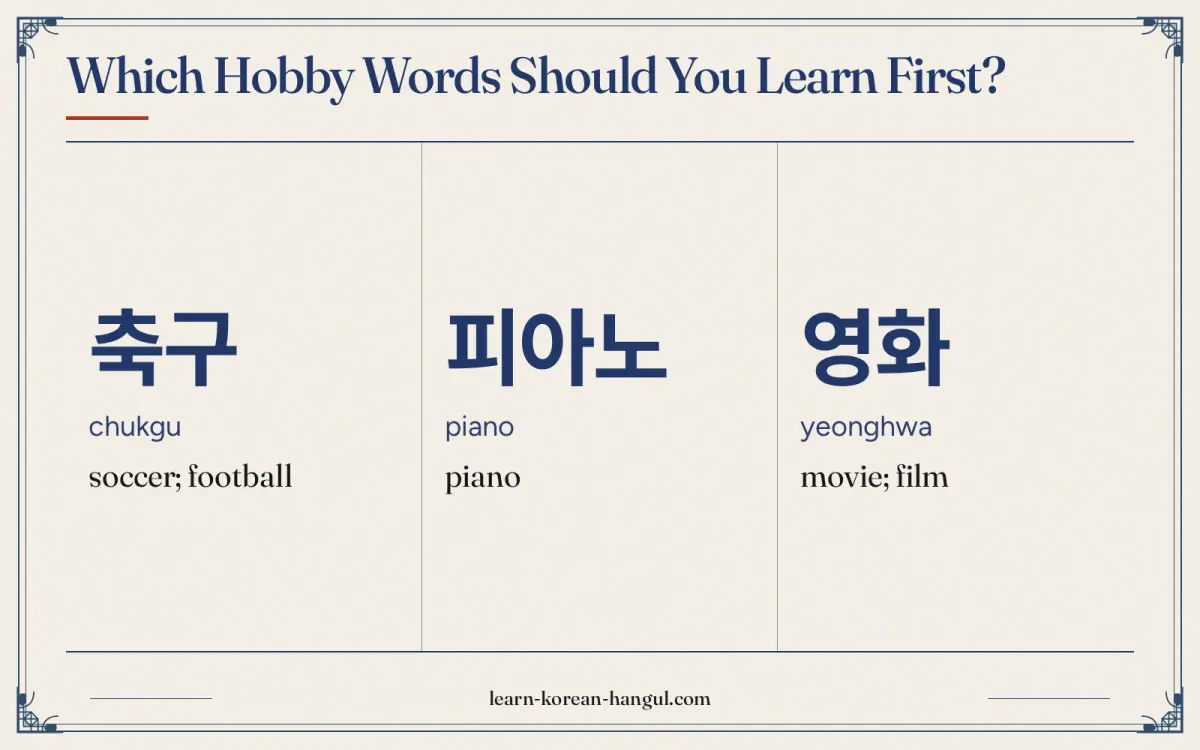
Learn 취미, 운동, 음악, 영화 and 여행 first. With those five you can ask the question, answer it, and name the five most common kinds of free-time activity. A complete small-talk exchange is only two lines: 취미가 뭐예요? and 제 취미는 영화예요 (My hobby is movies). The question word 뭐 (what) is stressed, and the voice does not climb sharply at the end, because a question that uses a question word is not a yes/no question.
- Words to say. 취미, 운동, 음악, 영화, 여행, 게임. These answer the question in one word.
- Words to recognise. 노래방, PC방, 찜질방, 등산. These are places and pastimes you see on signs and hear about from Korean friends.
- Words to add later. 바이올린, 독서, 소설, 낚시. They are more specific and make your answer sound personal.
Four pastimes are especially Korean: the karaoke room (노래방), the PC cafe (PC방), the Korean bathhouse (찜질방) and hiking (등산). You will meet all four in the lists below. The scene shows twelve of the 45 words with numbers that match the tables.
Word · 12
- 1
축구
chukgu
soccer; football
- 2
피아노
piano
piano
- 3
영화
yeonghwa
movie; film
- 4
책
chaek
book
- 5
게임
geim
game
- 6
캠핑
kaemping
camping
- 7
낚시
naksi
fishing
- 8
자전거
jajeongeo
bicycle
- 9
여행
yeohaeng
travel; trip
- 10
노래
norae
song; singing
- 11
수영
suyeong
swimming
- 12
찜질방
jjimjilbang
Korean bathhouse and sauna
Sports and Exercise
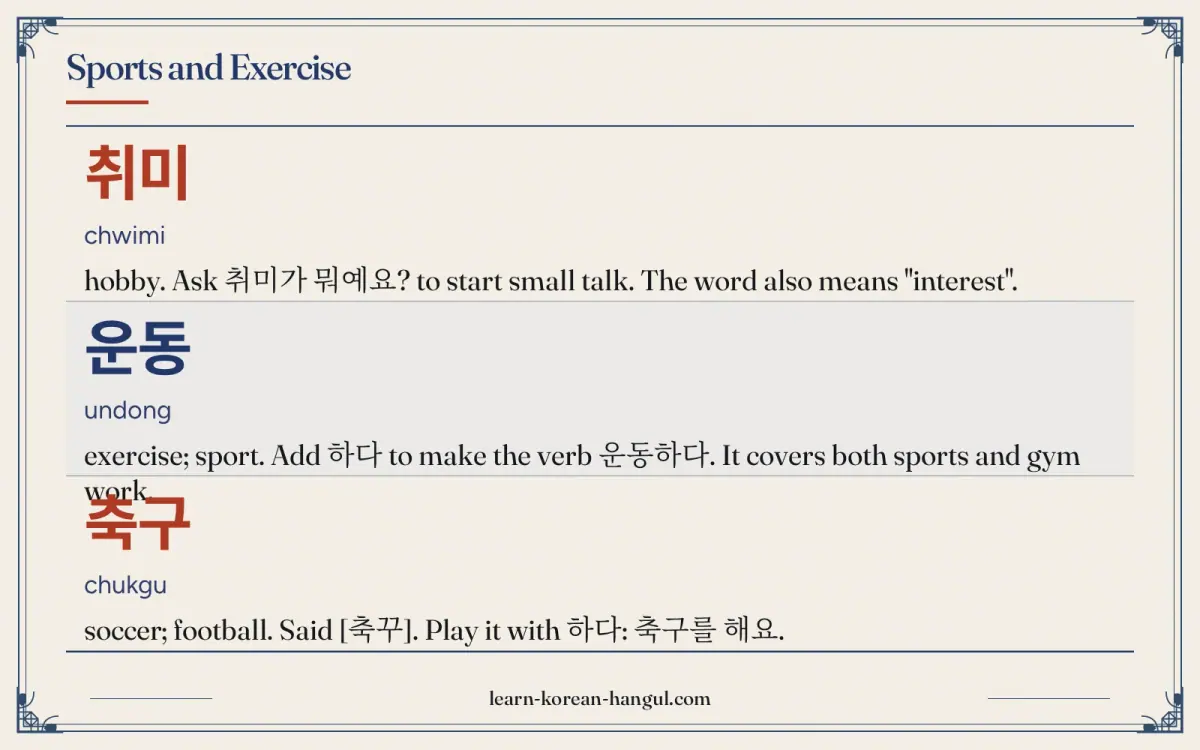
Exercise is the most common answer to the hobby question. The word 운동 covers both playing a sport and working out, and most sport names are loanwords or short Sino-Korean words. The first word, 취미, is the question word for the whole page.
| No. | Hangul | Revised Romanization | Meaning and note | Example sentence | Audio assetId |
|---|---|---|---|---|---|
| 1 | 취미 | chwimi | hobby. Ask 취미가 뭐예요? to start small talk. The word also means "interest". | 제 취미는 운동이에요. (My hobby is exercise.) | au-pg-vocabulary-hobbies-1; example: au-pg-vocabulary-hobbies-46 |
| 2 | 운동 | undong | exercise; sport. Add 하다 to make the verb 운동하다. It covers both sports and gym work. | 저는 매일 운동해요. (I exercise every day.) | au-pg-vocabulary-hobbies-2; example: au-pg-vocabulary-hobbies-47 |
| 3 | 축구 | chukgu | soccer; football. Said [축꾸]. Play it with 하다: 축구를 해요. | 주말에 친구와 축구를 해요. (On weekends I play soccer with a friend.) | au-pg-vocabulary-hobbies-3; example: au-pg-vocabulary-hobbies-48 |
| 4 | 야구 | yagu | baseball. Watching is also a hobby: 야구를 봐요. | 야구 경기를 보러 가요. (I go to watch a baseball game.) | au-pg-vocabulary-hobbies-4; example: au-pg-vocabulary-hobbies-49 |
| 5 | 농구 | nonggu | basketball. Play it with 하다: 농구를 해요. | 우리는 농구를 좋아해요. (We like basketball.) | au-pg-vocabulary-hobbies-5; example: au-pg-vocabulary-hobbies-50 |
| 6 | 수영 | suyeong | swimming. Use 하다 or 배우다: 수영을 해요, 수영을 배워요. | 수영을 배우고 싶어요. (I want to learn swimming.) | au-pg-vocabulary-hobbies-6; example: au-pg-vocabulary-hobbies-51 |
| 7 | 요가 | yoga | yoga. A loanword. Use 하다: 요가를 해요. | 아침에 요가를 해요. (I do yoga in the morning.) | au-pg-vocabulary-hobbies-7; example: au-pg-vocabulary-hobbies-52 |
| 8 | 헬스 | helseu | gym workout. The building is 헬스장. Use 하다: 헬스를 해요. | 저는 일주일에 세 번 헬스를 해요. (I work out at the gym three times a week.) | au-pg-vocabulary-hobbies-8; example: au-pg-vocabulary-hobbies-53 |
| 9 | 달리기 | dalligi | running; jogging. From 달리다 (to run). The ㄹㄹ is one long l sound. | 공원에서 달리기를 해요. (I go running in the park.) | au-pg-vocabulary-hobbies-9; example: au-pg-vocabulary-hobbies-54 |
Notice the pattern 친구와 (with a friend) in the third example. The particle 와 follows a noun that ends in a vowel, and 과 follows a noun that ends in a consonant, so 친구 takes 와. Sports are almost always played with other people, so this frame is useful: 친구와, 동료와 (with a coworker), 가족과 (with family).
Example Sentences
The examples use four frames. The first is noun + 은/는 + noun + 이에요/예요 for naming a hobby, as in 제 취미는 독서예요. The second is noun + 을/를 + 하다, as in 낚시를 해요. The third is noun + 에 + 가요 for going to a place, as in 노래방에 가요. The fourth is noun + 을/를 + the matching verb, as in 책을 읽어요. Note 을 after a consonant (책을) and 를 after a vowel (영화를). Say each sentence aloud after the audio, then replace the noun with another one from the table.
How Do You Say Music and Instruments in Korean?
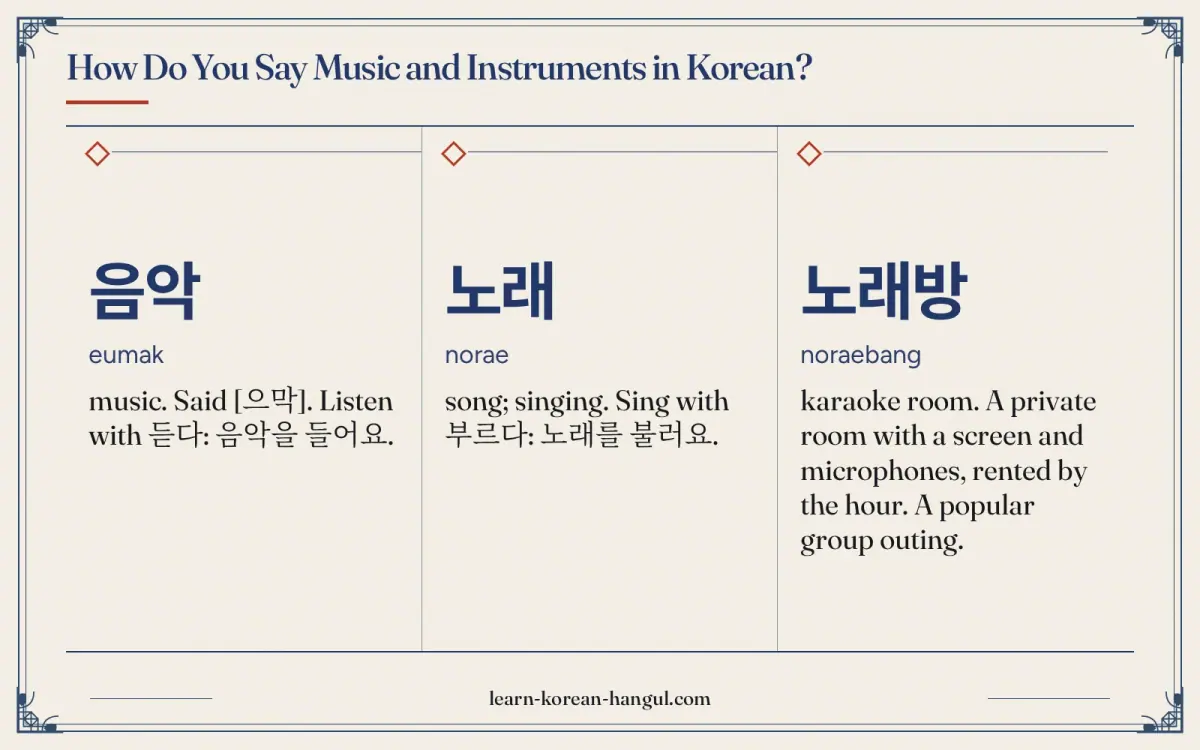
Music words cover listening, singing and playing. The general word is 음악, a song is a 노래, and the instrument is an 악기. Korean uses 치다 (to hit) for instruments you strike or press, such as the piano, guitar and drums, and 연주하다 (to perform) for any instrument.
| No. | Hangul | Revised Romanization | Meaning and note | Example sentence | Audio assetId |
|---|---|---|---|---|---|
| 10 | 음악 | eumak | music. Said [으막]. Listen with 듣다: 음악을 들어요. | 저는 음악을 자주 들어요. (I often listen to music.) | au-pg-vocabulary-hobbies-10; example: au-pg-vocabulary-hobbies-55 |
| 11 | 노래 | norae | song; singing. Sing with 부르다: 노래를 불러요. | 이 노래가 정말 좋아요. (This song is really good.) | au-pg-vocabulary-hobbies-11; example: au-pg-vocabulary-hobbies-56 |
| 12 | 노래방 | noraebang | karaoke room. A private room with a screen and microphones, rented by the hour. A popular group outing. | 친구들과 노래방에 가요. (I go to a karaoke room with my friends.) | au-pg-vocabulary-hobbies-12; example: au-pg-vocabulary-hobbies-57 |
| 13 | 피아노 | piano | piano. Play it with 치다: 피아노를 쳐요. | 피아노를 배우고 있어요. (I am learning the piano.) | au-pg-vocabulary-hobbies-13; example: au-pg-vocabulary-hobbies-58 |
| 14 | 기타 | gita | guitar. Also means "etc." in other contexts. Play it with 치다: 기타를 쳐요. | 그는 기타를 잘 쳐요. (He plays the guitar well.) | au-pg-vocabulary-hobbies-14; example: au-pg-vocabulary-hobbies-59 |
| 15 | 바이올린 | baiollin | violin. Bowed strings take 켜다 (바이올린을 켜요), and 연주하다 (바이올린을 연주해요) works for any instrument. The ㄹㄹ is one long l sound. | 그 바이올린 소리가 예뻐요. (The sound of that violin is pretty.) | au-pg-vocabulary-hobbies-15; example: au-pg-vocabulary-hobbies-60 |
| 16 | 드럼 | deureom | drums. Hit it with 치다: 드럼을 쳐요. The 드 has a flat 으 vowel. | 동생은 드럼을 쳐요. (My younger sibling plays the drums.) | au-pg-vocabulary-hobbies-16; example: au-pg-vocabulary-hobbies-61 |
| 17 | 콘서트 | konseoteu | concert. A loanword, used for pop and classical concerts alike. The wider word for a performance is 공연. | 이번 주말에 콘서트에 가요. (I am going to a concert this weekend.) | au-pg-vocabulary-hobbies-17; example: au-pg-vocabulary-hobbies-62 |
| 18 | 악기 | akgi | musical instrument. Said [악끼]. The general word for any instrument. | 어떤 악기를 연주해요? (Which instrument do you play?) | au-pg-vocabulary-hobbies-18; example: au-pg-vocabulary-hobbies-63 |
The question in the last row, 어떤 악기를 연주해요?, is a good one to ask a new friend. Answer with the instrument and the verb: 피아노를 쳐요 (I play the piano). For a full list of instruments, the deeper page on Korean musical instruments follows this section in the series.
Movies, TV and Reading
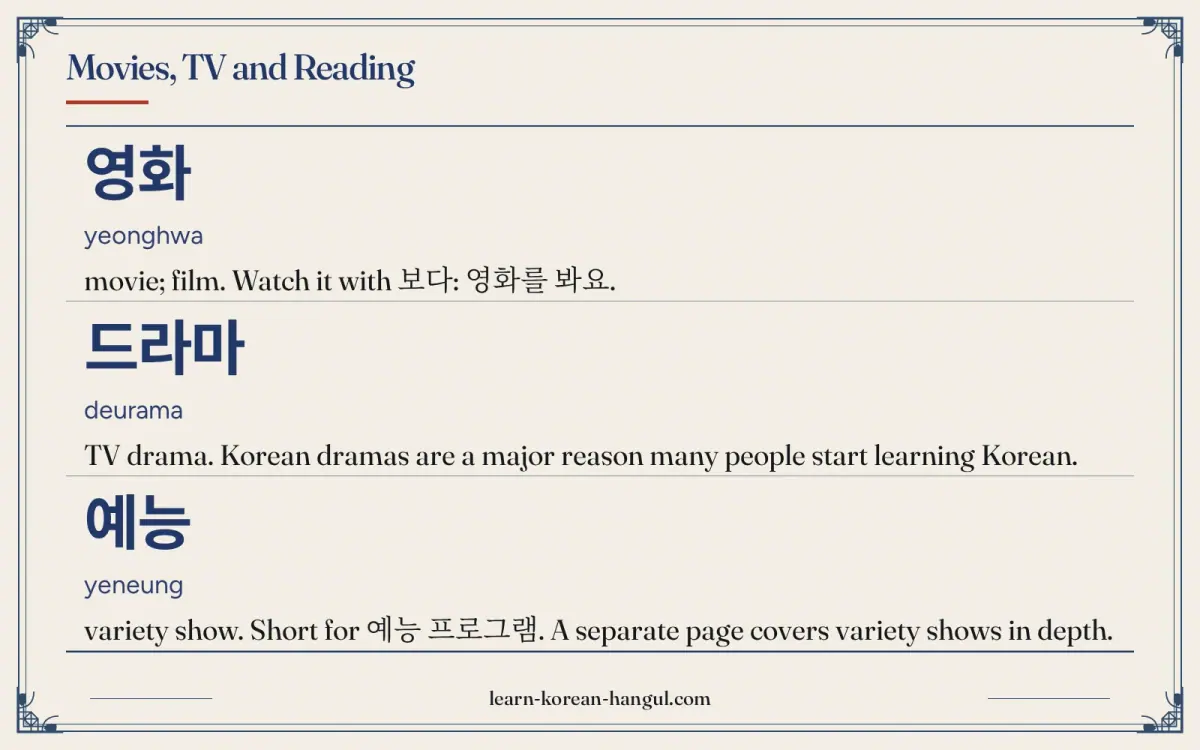
Watching and reading fill many free evenings. Two verbs do most of the work: 보다 (to see, to watch) for movies, dramas and webtoons, and 읽다 (to read) for books and comics. Webtoons, which are comics made for phone screens, are a large part of Korean reading habits today.
| No. | Hangul | Revised Romanization | Meaning and note | Example sentence | Audio assetId |
|---|---|---|---|---|---|
| 19 | 영화 | yeonghwa | movie; film. Watch it with 보다: 영화를 봐요. | 주말에 영화를 봐요. (I watch a movie on weekends.) | au-pg-vocabulary-hobbies-19; example: au-pg-vocabulary-hobbies-64 |
| 20 | 드라마 | deurama | TV drama. Korean dramas are a major reason many people start learning Korean. | 저는 한국 드라마를 좋아해요. (I like Korean dramas.) | au-pg-vocabulary-hobbies-20; example: au-pg-vocabulary-hobbies-65 |
| 21 | 예능 | yeneung | variety show. Short for 예능 프로그램. A separate page covers variety shows in depth. | 예능은 정말 재미있어요. (Variety shows are really fun.) | au-pg-vocabulary-hobbies-21; example: au-pg-vocabulary-hobbies-66 |
| 22 | 만화 | manhwa | comic; cartoon. Comic books and animated cartoons. A comic book is also 만화책, and the online kind is 웹툰. | 동생은 만화를 읽어요. (My younger sibling reads comics.) | au-pg-vocabulary-hobbies-22; example: au-pg-vocabulary-hobbies-67 |
| 23 | 웹툰 | weptun | webtoon. A comic published online and read on a phone. | 저는 매일 웹툰을 봐요. (I read a webtoon every day.) | au-pg-vocabulary-hobbies-23; example: au-pg-vocabulary-hobbies-68 |
| 24 | 책 | chaek | book. Read it with 읽다: 책을 읽어요. With 을 it links to the verb: [채글]. | 주말에 책을 읽어요. (I read a book on weekends.) | au-pg-vocabulary-hobbies-24; example: au-pg-vocabulary-hobbies-69 |
| 25 | 독서 | dokseo | reading (books). Said [독써]. A formal word seen on forms and school notices. | 제 취미는 독서예요. (My hobby is reading.) | au-pg-vocabulary-hobbies-25; example: au-pg-vocabulary-hobbies-70 |
| 26 | 소설 | soseol | novel. A long work of fiction. | 저는 한국 소설을 읽어요. (I read Korean novels.) | au-pg-vocabulary-hobbies-26; example: au-pg-vocabulary-hobbies-71 |
| 27 | 영화관 | yeonghwagwan | movie theater. From 영화 (movie) and 관 (hall). The word 극장 is also common. | 영화관에서 팝콘을 먹어요. (I eat popcorn at the movie theater.) | au-pg-vocabulary-hobbies-27; example: au-pg-vocabulary-hobbies-72 |
Two verbs for one idea can confuse learners. In English you read both comics and webtoons, but Korean usually says 보다 for webtoons (웹툰을 봐요) and either 읽다 or 보다 for comic books (만화를 읽어요, 만화책을 봐요). 만화를 봐요 can also mean watching cartoons, so the context decides.
How Do You Say Games in Korean?
Game words cover video games, board games, card games and the cafes where people play them. The key verb is 하다, not 놀다: Korean says 게임을 해요 (I do a game), never 게임을 놀아요. Korean games are a big enough topic to have their own hub, which this section previews.
| No. | Hangul | Revised Romanization | Meaning and note | Example sentence | Audio assetId |
|---|---|---|---|---|---|
| 28 | 게임 | geim | game. Play it with 하다, not 놀다: 게임을 해요. | 저는 게임을 자주 해요. (I often play games.) | au-pg-vocabulary-hobbies-28; example: au-pg-vocabulary-hobbies-73 |
| 29 | 보드게임 | bodeugeim | board game. Written as one word. Play it with 하다. | 보드게임 카페에서 친구를 만나요. (I meet my friend at a board game cafe.) | au-pg-vocabulary-hobbies-29; example: au-pg-vocabulary-hobbies-74 |
| 30 | 바둑 | baduk | baduk (Go). An old strategy game with black and white stones on a grid. Play it with 두다. | 할아버지는 바둑을 두세요. (My grandfather plays baduk.) | au-pg-vocabulary-hobbies-30; example: au-pg-vocabulary-hobbies-75 |
| 31 | 장기 | janggi | janggi (Korean chess). A two-player board game, often compared to chess. Play it with 두다. | 아버지와 장기를 둬요. (I play janggi with my father.) | au-pg-vocabulary-hobbies-31; example: au-pg-vocabulary-hobbies-76 |
| 32 | 카드 | kadeu | card; playing card. Also means a credit or bank card. A card game is 카드 게임. | 카드 게임을 같이 해요. (We play a card game together.) | au-pg-vocabulary-hobbies-32; example: au-pg-vocabulary-hobbies-77 |
| 33 | 퍼즐 | peojeul | puzzle. Both a jigsaw and a puzzle game. Put a jigsaw together with 맞추다; a puzzle you work out takes 풀다. | 퍼즐을 맞춰요. (I do a jigsaw puzzle.) | au-pg-vocabulary-hobbies-33; example: au-pg-vocabulary-hobbies-78 |
| 34 | PC방 | pisibang | PC cafe. Said [피씨방]. A pay-by-the-hour room full of gaming computers. | 주말에 PC방에 가요. (I go to a PC cafe on weekends.) | au-pg-vocabulary-hobbies-34; example: au-pg-vocabulary-hobbies-79 |
| 35 | 이기다 | igida | to win. The opposite is 지다. The past form is 이겼어요. | 어제 우리 팀이 이겼어요. (Our team won yesterday.) | au-pg-vocabulary-hobbies-35; example: au-pg-vocabulary-hobbies-80 |
| 36 | 지다 | jida | to lose (a game). The opposite is 이기다. The past form is 졌어요. In other uses 지다 means "to fall". | 어제 게임에서 졌어요. (I lost the game yesterday.) | au-pg-vocabulary-hobbies-36; example: au-pg-vocabulary-hobbies-81 |
Board games have two verbs. Games played with pieces on a board, such as baduk and janggi, take 두다 (to place a piece): 바둑을 둬요. Other games take 하다. For more words, see the Games page, with its pages on video games and board and traditional games.
Outdoor Activities and Travel
Outdoor words are the last group. Korea is mountainous, and hiking is one of the most common weekend activities, so 등산 deserves a place on any hobby list. Camping, fishing, cycling and travel round out the group, with photography and the bathhouse as two extras that many people count as hobbies.
| No. | Hangul | Revised Romanization | Meaning and note | Example sentence | Audio assetId |
|---|---|---|---|---|---|
| 37 | 캠핑 | kaemping | camping. A loanword. Go camping with 가다: 캠핑을 가요. | 이번 여름에 캠핑을 가요. (I am going camping this summer.) | au-pg-vocabulary-hobbies-37; example: au-pg-vocabulary-hobbies-82 |
| 38 | 낚시 | naksi | fishing. Said [낙씨]. Fish with 하다: 낚시를 해요. | 아버지는 낚시를 좋아하세요. (My father likes fishing.) | au-pg-vocabulary-hobbies-38; example: au-pg-vocabulary-hobbies-83 |
| 39 | 등산 | deungsan | hiking; mountain climbing. Very popular in Korea. 등산하다 is the verb, 등산복 is hiking clothing. | 일요일에는 등산을 해요. (I go hiking on Sundays.) | au-pg-vocabulary-hobbies-39; example: au-pg-vocabulary-hobbies-84 |
| 40 | 여행 | yeohaeng | travel; trip. 여행하다 is the verb, and 여행을 가다 means to go on a trip. | 여름에 제주도로 여행을 가요. (I am going on a trip to Jeju Island in the summer.) | au-pg-vocabulary-hobbies-40; example: au-pg-vocabulary-hobbies-85 |
| 41 | 산책 | sanchaek | walk; stroll. Take one with 하다: 산책을 해요. | 저녁에 강아지와 산책해요. (I take a walk with my dog in the evening.) | au-pg-vocabulary-hobbies-41; example: au-pg-vocabulary-hobbies-86 |
| 42 | 사진 | sajin | photograph. Take one with 찍다: 사진을 찍어요. | 여행에서 사진을 많이 찍어요. (I take many photographs on trips.) | au-pg-vocabulary-hobbies-42; example: au-pg-vocabulary-hobbies-87 |
| 43 | 자전거 | jajeongeo | bicycle. Ride it with 타다: 자전거를 타요. | 한강에서 자전거를 타요. (I ride a bicycle by the Han River.) | au-pg-vocabulary-hobbies-43; example: au-pg-vocabulary-hobbies-88 |
| 44 | 소풍 | sopung | picnic; outing. A day trip with food, often a school trip. | 소풍 때 김밥을 먹어요. (I eat gimbap on a picnic.) | au-pg-vocabulary-hobbies-44; example: au-pg-vocabulary-hobbies-89 |
| 45 | 찜질방 | jjimjilbang | Korean bathhouse and sauna. Said [찜질빵]. A large public bath with heated rooms where people relax for hours. | 친구와 찜질방에 가요. (I go to a jjimjilbang with a friend.) | au-pg-vocabulary-hobbies-45; example: au-pg-vocabulary-hobbies-90 |
The activities in this group have a deeper page in the series, Korean outdoor activities vocabulary, for readers who want trail, camp and trip words.
Which Verb Goes with Which Hobby?
Hobby nouns choose their verbs. English often says "play" for sports, instruments and games, but Korean uses different verbs for each. The table lists the main patterns, and each verb is shown in its polite present form.
| Hobby type | Verb | Polite form | Example |
|---|---|---|---|
| Sports and activities | 하다 (to do) | 해요 | 수영을 해요 (I swim) |
| Piano, guitar, drums | 치다 (to hit) | 쳐요 | 기타를 쳐요 (I play the guitar) |
| Bicycles and rides | 타다 (to ride) | 타요 | 자전거를 타요 (I ride a bicycle) |
| Movies, dramas, webtoons | 보다 (to watch) | 봐요 | 영화를 봐요 (I watch a movie) |
| Books and paper comics | 읽다 (to read) | 읽어요 | 책을 읽어요 (I read a book) |
| Music | 듣다 (to listen) | 들어요 | 음악을 들어요 (I listen to music) |
| Photos | 찍다 (to take) | 찍어요 | 사진을 찍어요 (I take photos) |
Two of these change shape in a way worth noticing. The verb 듣다 is irregular: it changes its ㄷ to ㄹ before a vowel ending, so 듣다 becomes 들어요. The verb 치다 is regular, but 치 + 어요 merge into one syllable, 쳐요. When you are not sure which verb a hobby takes, 하다 is the safe fallback, and it is correct for most sports and activities.
How Do You Pronounce These Words?
Hobby words contain several sound changes that English speakers rarely expect. The spelling shows the written form, and the spoken form shifts where one sound meets another. Standard pronunciation follows the National Institute of Korean Language (국립국어원) rules, and the romanization follows the Revised Romanization of Korean, which writes tense consonants that are spelled with a double letter but does not show tensing caused by a neighbouring sound.
| Spelling | Sounds like | What changes |
|---|---|---|
| 축구 | [축꾸] | After a final ㄱ, the next ㄱ becomes tense [ㄲ]. |
| 낚시 | [낙씨] | The final ㄲ is said as plain [ㄱ], and the ㅅ after it becomes tense [ㅆ]. |
| 독서 | [독써] | After a final ㄱ, ㅅ becomes tense [ㅆ]. |
| 악기 | [악끼] | After a final ㄱ, the next ㄱ becomes tense [ㄲ]. |
| 음악 | [으막] | The final ㅁ of 음 moves to the next syllable, which has no sound of its own. |
| 책을 | [채글] | The final ㄱ links to the vowel of the particle 을. |
| PC방 | [피씨방] | The letters P and C are read as the Korean letter names 피 and 씨. |
The tense sounds are the ones learners miss most. A tense consonant is said with a tight throat and no puff of air, so 축구 sounds like "chuk-kku" with a short pause before the second consonant. The doubled l in 달리기 and 바이올린 is not two sounds but one long l, held slightly longer than a single one.
Audio and Slow Playback
Every headword and every example sentence has its own audio. The five clips below replay the trickiest words slowly. Play one, repeat it aloud, then play it again and compare.
What Mistakes Do Learners Make with Hobby Words?
Five mistakes appear often.
- Using 하다 for every hobby. 자전거를 해요 is not Korean. Use 자전거를 타요. For instruments, use 기타를 쳐요 or 연주해요.
- Saying 놀다 for games. 놀다 means to hang out or play like a child, as in 친구와 놀아요 (I hang out with friends). For games, say 게임을 해요.
- Reading 기타 as only a guitar. 기타 also means "others" or "etc.", as in lists on forms. The topic tells you which one is meant.
- Treating 헬스 as health. 헬스 means working out at a gym. Health is 건강. A person who says 헬스를 해요 is talking about weights and machines.
- Ignoring the question word. 취미가 뭐예요? asks "what", so an answer like 네 (yes) does not fit. Answer with the hobby itself: 영화예요 or 제 취미는 영화예요.
If you meet only one, make it the verb mistake: choosing 하다, 치다, 타다 or 보다 correctly makes the biggest difference to how natural your sentence sounds.
Practice: Flashcards and Worksheet
Study in three steps. First, run the flashcard deck in recognition mode until you know each of the 45 words. Second, switch to listening mode and answer from the audio alone. Third, take the quiz. The deck covers all 45 words with audio, and your progress stays in your browser. The vocabulary flashcard decks page lists the other decks.
Practice · 95
- 01취미
Show answer
headword 1: hobby
- 02운동
Show answer
headword 2: exercise; sport
- 03축구
Show answer
headword 3: soccer; football
- 04야구
Show answer
headword 4: baseball
- 05농구
Show answer
headword 5: basketball
- 06수영
Show answer
headword 6: swimming
- 07요가
Show answer
headword 7: yoga
- 08헬스
Show answer
headword 8: gym workout
- 09달리기
Show answer
headword 9: running; jogging
- 10음악
Show answer
headword 10: music
- 11노래
Show answer
headword 11: song; singing
- 12노래방
Show answer
headword 12: karaoke room
- 13피아노
Show answer
headword 13: piano
- 14기타
Show answer
headword 14: guitar
- 15바이올린
Show answer
headword 15: violin
- 16드럼
Show answer
headword 16: drums
- 17콘서트
Show answer
headword 17: concert
- 18악기
Show answer
headword 18: musical instrument
- 19영화
Show answer
headword 19: movie; film
- 20드라마
Show answer
headword 20: TV drama
- 21예능
Show answer
headword 21: variety show
- 22만화
Show answer
headword 22: comic; cartoon
- 23웹툰
Show answer
headword 23: webtoon
- 24책
Show answer
headword 24: book
- 25독서
Show answer
headword 25: reading (books)
- 26소설
Show answer
headword 26: novel
- 27영화관
Show answer
headword 27: movie theater
- 28게임
Show answer
headword 28: game
- 29보드게임
Show answer
headword 29: board game
- 30바둑
Show answer
headword 30: baduk (Go)
- 31장기
Show answer
headword 31: janggi (Korean chess)
- 32카드
Show answer
headword 32: card; playing card
- 33퍼즐
Show answer
headword 33: puzzle
- 34PC방
Show answer
headword 34: PC cafe
- 35이기다
Show answer
headword 35: to win
- 36지다
Show answer
headword 36: to lose (a game)
- 37캠핑
Show answer
headword 37: camping
- 38낚시
Show answer
headword 38: fishing
- 39등산
Show answer
headword 39: hiking; mountain climbing
- 40여행
Show answer
headword 40: travel; trip
- 41산책
Show answer
headword 41: walk; stroll
- 42사진
Show answer
headword 42: photograph
- 43자전거
Show answer
headword 43: bicycle
- 44소풍
Show answer
headword 44: picnic; outing
- 45찜질방
Show answer
headword 45: Korean bathhouse and sauna
- 46제 취미는 운동이에요.
Show answer
example for 취미
- 47저는 매일 운동해요.
Show answer
example for 운동
- 48주말에 친구와 축구를 해요.
Show answer
example for 축구
- 49야구 경기를 보러 가요.
Show answer
example for 야구
- 50우리는 농구를 좋아해요.
Show answer
example for 농구
- 51수영을 배우고 싶어요.
Show answer
example for 수영
- 52아침에 요가를 해요.
Show answer
example for 요가
- 53저는 일주일에 세 번 헬스를 해요.
Show answer
example for 헬스
- 54공원에서 달리기를 해요.
Show answer
example for 달리기
- 55저는 음악을 자주 들어요.
Show answer
example for 음악
- 56이 노래가 정말 좋아요.
Show answer
example for 노래
- 57친구들과 노래방에 가요.
Show answer
example for 노래방
- 58피아노를 배우고 있어요.
Show answer
example for 피아노
- 59그는 기타를 잘 쳐요.
Show answer
example for 기타
- 60그 바이올린 소리가 예뻐요.
Show answer
example for 바이올린
- 61동생은 드럼을 쳐요.
Show answer
example for 드럼
- 62이번 주말에 콘서트에 가요.
Show answer
example for 콘서트
- 63어떤 악기를 연주해요?
Show answer
example for 악기
- 64주말에 영화를 봐요.
Show answer
example for 영화
- 65저는 한국 드라마를 좋아해요.
Show answer
example for 드라마
- 66예능은 정말 재미있어요.
Show answer
example for 예능
- 67동생은 만화를 읽어요.
Show answer
example for 만화
- 68저는 매일 웹툰을 봐요.
Show answer
example for 웹툰
- 69주말에 책을 읽어요.
Show answer
example for 책
- 70제 취미는 독서예요.
Show answer
example for 독서
- 71저는 한국 소설을 읽어요.
Show answer
example for 소설
- 72영화관에서 팝콘을 먹어요.
Show answer
example for 영화관
- 73저는 게임을 자주 해요.
Show answer
example for 게임
- 74보드게임 카페에서 친구를 만나요.
Show answer
example for 보드게임
- 75할아버지는 바둑을 두세요.
Show answer
example for 바둑
- 76아버지와 장기를 둬요.
Show answer
example for 장기
- 77카드 게임을 같이 해요.
Show answer
example for 카드
- 78퍼즐을 맞춰요.
Show answer
example for 퍼즐
- 79주말에 PC방에 가요.
Show answer
example for PC방
- 80어제 우리 팀이 이겼어요.
Show answer
example for 이기다
- 81어제 게임에서 졌어요.
Show answer
example for 지다
- 82이번 여름에 캠핑을 가요.
Show answer
example for 캠핑
- 83아버지는 낚시를 좋아하세요.
Show answer
example for 낚시
- 84일요일에는 등산을 해요.
Show answer
example for 등산
- 85여름에 제주도로 여행을 가요.
Show answer
example for 여행
- 86저녁에 강아지와 산책해요.
Show answer
example for 산책
- 87여행에서 사진을 많이 찍어요.
Show answer
example for 사진
- 88한강에서 자전거를 타요.
Show answer
example for 자전거
- 89소풍 때 김밥을 먹어요.
Show answer
example for 소풍
- 90친구와 찜질방에 가요.
Show answer
example for 찜질방
- 91낚시
Show answer
slow playback: 낚시
- 92독서
Show answer
slow playback: 독서
- 93찜질방
Show answer
slow playback: 찜질방
- 94달리기
Show answer
slow playback: 달리기
- 95바이올린
Show answer
slow playback: 바이올린
Practice · 6
What does 취미 (chwimi) mean?
Show answer
hobby
취미 means hobby. Example: 제 취미는 운동이에요. (My hobby is exercise.)
What does 영화 (yeonghwa) mean?
Show answer
movie; film
영화 means movie; film. Example: 주말에 영화를 봐요. (I watch a movie on weekends.)
What does 게임 (geim) mean?
Show answer
game
게임 means game. Example: 저는 게임을 자주 해요. (I often play games.)
What does 캠핑 (kaemping) mean?
Show answer
camping
캠핑 means camping. Example: 이번 여름에 캠핑을 가요. (I am going camping this summer.)
What does 낚시 (naksi) mean?
Show answer
fishing
낚시 means fishing. Example: 아버지는 낚시를 좋아하세요. (My father likes fishing.)
What does 찜질방 (jjimjilbang) mean?
Show answer
Korean bathhouse and sauna
찜질방 means Korean bathhouse and sauna. Example: 친구와 찜질방에 가요. (I go to a jjimjilbang with a friend.)
Korean Hobbies Vocabulary Worksheet (PDF)
A printable worksheet for these words (word list, matching, writing practice, fill-in-the-blank exercises and answer key) is available in A4 and US Letter from the download card on this page. For practice, write three sentences about your own free time in Korean: one sport or activity, one thing you watch or read, and one place you like to go.
Where to Go Next
After this page, continue with the group that interests you most: Movies and TV or Games. To talk about your job and study life instead, open School and Work, and for festivals and customs see Korean Culture Words. If you are preparing for the exam, TOPIK Vocabulary lists words by exam level. To move up a level, return to Korean Vocabulary.
Pages in This Section
Five deeper pages sit under this one, one for each kind of free-time activity.
- Sports: the deeper list for the sports and exercise group.
- Music: the deeper list for the music and instruments group.
- Movies and TV: 40 words for movies, dramas, genres, cinema and streaming.
- Games: 40 words for video games, board games, traditional games, online play and esports.
- Korean Outdoor Activities Vocabulary: the deeper list for the outdoor activities and travel group.
Frequently Asked Questions
How Do You Say Camping in Korean?
Camping is 캠핑 (kaemping), a loanword. To say you are going camping, use 캠핑을 가요 (kaempingeul gayo), which means "I go camping". The ㅁ and ㅍ are said clearly, so it sounds like kaem-ping. Press the audio button on this page to hear it.
How Do You Pronounce 낚시 (naksi)?
Say nak-si, written [낙씨]. The double ㄲ at the end of 낚 is said as a plain k that you do not release, and the ㅅ after it becomes tense, like a tight s. Do not add a vowel after the k. The slow clip on this page lets you repeat it step by step.
How Many Hobby Words Should I Learn First?
Five first: 취미, 운동, 음악, 영화 and 여행. At five new words a day, the whole list of 45 takes nine days plus review. Add the matching verbs from the verb table early, because 기타를 쳐요 and 자전거를 타요 are only correct with the right verb.
Where Can I Practise Hobby Words with Flashcards?
Use the vocabulary flashcard decks. The deck for this page holds all 45 words with Hangul, romanization and audio, and it offers recognition and listening modes. Your progress stays in your browser, so return daily and review the cards you missed.
Is the Romanization on This Page Official?
It follows the Revised Romanization of Korean, which South Korea adopted on 7 July 2000 and whose rules the National Institute of Korean Language (국립국어원) publishes. It is a learning aid and does not show every sound change, so rely on the Hangul and the audio.
Is There a Printable Worksheet for Hobby Words?
A printable worksheet for these words (word list, matching, writing practice, fill-in-the-blank exercises and answer key) is available in A4 and US Letter from the download card on this page. For practice, copy the tables on this page by hand or use the flashcard deck, which carries the same 45 words.