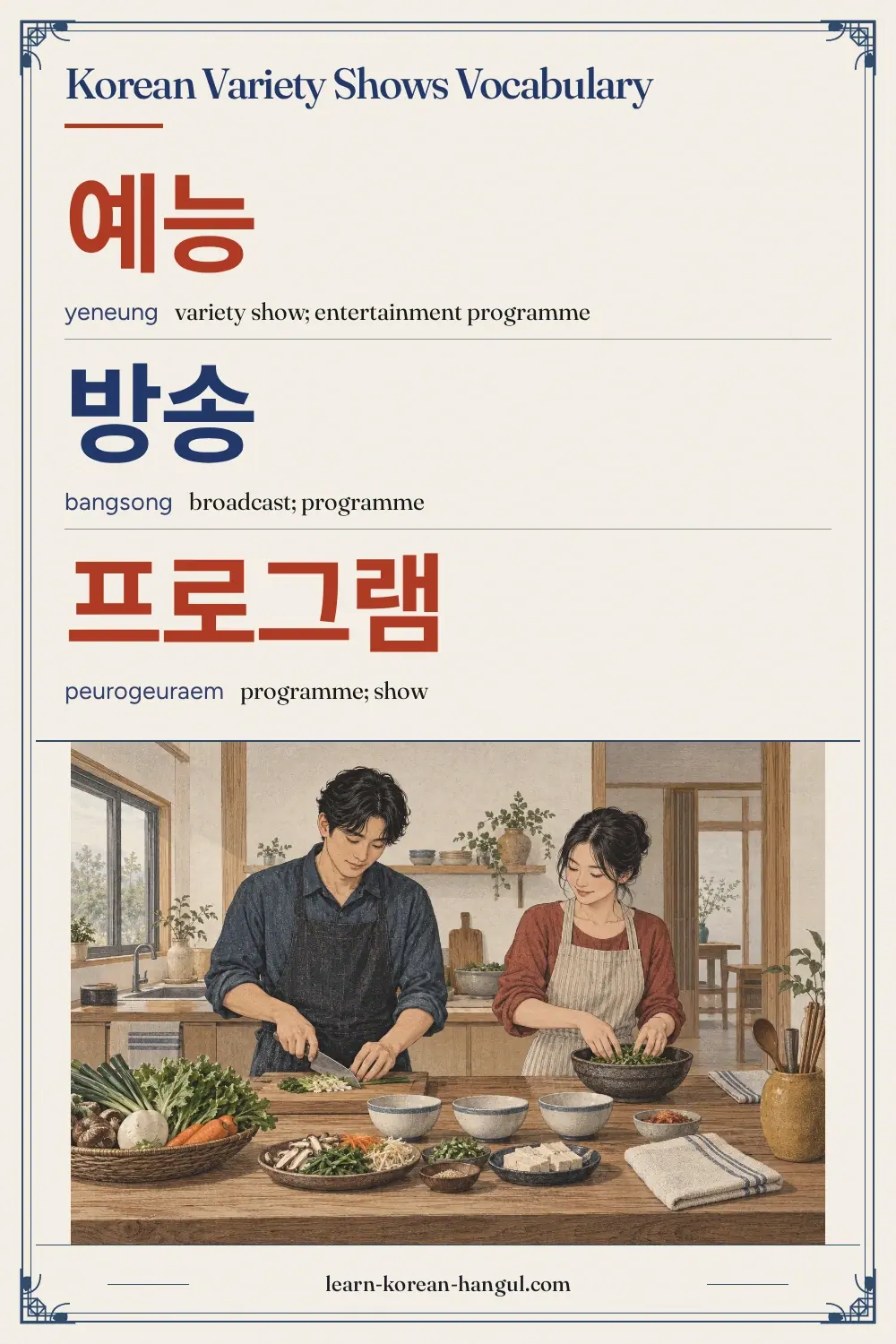
Korean Variety Shows Vocabulary at a Glance
Variety shows are one of the most fun ways to learn spoken Korean, because the language is casual, fast and full of reactions. This list has 30 words in five groups of six. It belongs to Movies and TV. The first group names the kinds of programme. The second covers what appears on the screen, because captions are a signature of the format. The third names the people, the fourth the games they play and the last the reactions you hear and read.
| Group | Words | Use |
|---|---|---|
| Show types | 6 | Kinds of programme |
| On-screen captions | 6 | Words on the screen and behind it |
| Cast and guests | 6 | People on the programme |
| Games and punishments | 6 | What the cast does on the programme |
| Reactions | 6 | What viewers and cast say |
A variety show is a loose format. A single programme might mix a talk segment, a travel trip, a cooking task and a team game. The Korean word 예능 does not mean one genre, so it covers all of those. The shows are also often built on a group of regular members (멤버) plus guests (게스트), which is why the third group matters. For the wider set of screen words, including genres and cinema, return to Movies and TV. For webtoons, see Korean Webtoon Vocabulary.
Which Variety Show Words Should You Learn First?
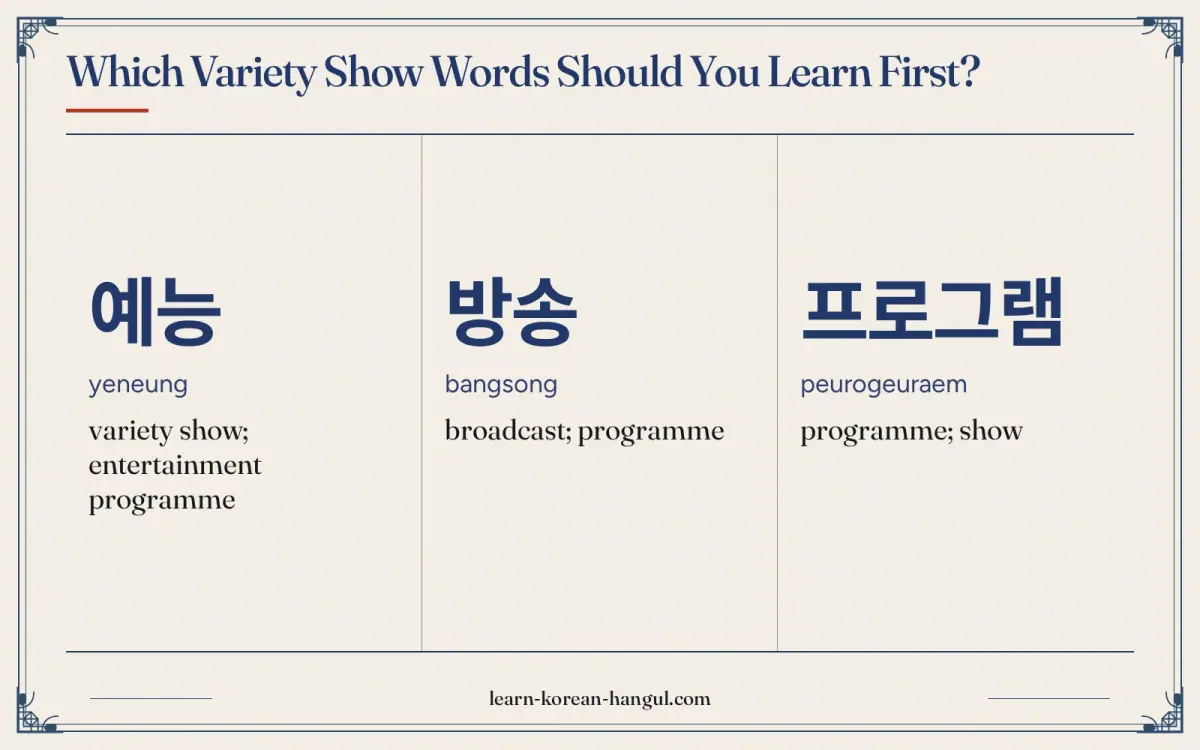
Learn 예능, 자막, 게스트, 벌칙 and 재미있다 first. With those five you can name what you watch, say whether it was fun and talk about the games: 이 예능은 정말 재미있어요 (This variety show is really fun). Then add 헐 and 대박, because they appear in captions and in friends' reactions. Keep in mind that 헐 and 대박 are casual slang, so use them with friends and not with elders.
- Words to say. 예능, 자막, 게스트, 벌칙, 재미있다. They work in everyday talk about a programme.
- Words to recognise. 편집, 효과음, 미션, 복불복, 출연자. You read these in captions and on show pages.
- Words to understand when spoken. 헐, 대박, 꼴찌, 웃기다. Friends say them quickly, and they are casual.
The scene below shows a studio with a screen, a host and guests, with twelve numbered objects that match words in the tables.
Word · 12
- 1
예능
yeneung
variety show; entertainment programme
- 2
방송
bangsong
broadcast; programme
- 3
프로그램
peurogeuraem
programme; show
- 4
자막
jamak
caption; subtitle
- 5
효과음
hyogwaeum
sound effect
- 6
촬영
chwaryeong
filming; shooting
- 7
출연자
churyeonja
cast member; performer
- 8
게스트
geseuteu
guest
- 9
진행자
jinhaengja
host; presenter
- 10
벌칙
beolchik
penalty; forfeit
- 11
미션
misyeon
mission
- 12
꼴찌
kkoljji
last place
Show Types
Show types give the label for what you are watching. The umbrella word is 예능, short for 예능 프로그램. Below it sit more precise labels: a talk show (토크쇼), a reality programme (리얼리티) and a rerun (재방송). The word 방송 means both the act of broadcasting and the programme itself.
| No. | Hangul | Revised Romanization | Meaning and note | Example sentence | Audio assetId |
|---|---|---|---|---|---|
| 1 | 예능 | yeneung | variety show; entertainment programme. Short for 예능 프로그램. It covers games, travel, talk and reality formats. | 저는 주말마다 예능을 봐요. (I watch variety shows every weekend.) | au-pg-vocabulary-hobbies-movies-tv-variety-shows-1; example: au-pg-vocabulary-hobbies-movies-tv-variety-shows-31 |
| 2 | 방송 | bangsong | broadcast; programme. The act of broadcasting, and the programme itself. | 이 방송은 매주 토요일에 방송해요. (This programme airs every Saturday.) | au-pg-vocabulary-hobbies-movies-tv-variety-shows-2; example: au-pg-vocabulary-hobbies-movies-tv-variety-shows-32 |
| 3 | 프로그램 | peurogeuraem | programme; show. Often shortened to 프로 in speech. | 어떤 프로그램을 좋아해요? (Which programme do you like?) | au-pg-vocabulary-hobbies-movies-tv-variety-shows-3; example: au-pg-vocabulary-hobbies-movies-tv-variety-shows-33 |
| 4 | 리얼리티 | rieolliti | reality (show). 리얼리티 쇼 or 리얼리티 프로그램. The doubled l is one long l. | 리얼리티 프로그램은 일상을 보여 줘요. (A reality programme shows ordinary daily life.) | au-pg-vocabulary-hobbies-movies-tv-variety-shows-4; example: au-pg-vocabulary-hobbies-movies-tv-variety-shows-34 |
| 5 | 토크쇼 | tokeusyo | talk show. A programme where a host talks to guests. | 토크쇼에서 게스트가 이야기해요. (On the talk show, the guest tells a story.) | au-pg-vocabulary-hobbies-movies-tv-variety-shows-5; example: au-pg-vocabulary-hobbies-movies-tv-variety-shows-35 |
| 6 | 재방송 | jaebangsong | rerun. 재 (again) + 방송. 재방송하다 means to rebroadcast. | 놓친 예능은 재방송으로 봐요. (I watch variety shows I missed as reruns.) | au-pg-vocabulary-hobbies-movies-tv-variety-shows-6; example: au-pg-vocabulary-hobbies-movies-tv-variety-shows-36 |
The question 어떤 프로그램을 좋아해요? uses the question word 어떤 (what kind of), so the voice does not climb sharply at the end. A friendly answer names the type: 토크쇼를 좋아해요 (I like talk shows). If you want to compare screen types, 드라마 is a scripted TV series, and 예능 is not scripted in the same way.
Example Sentences
The examples use three frames. The first is noun + 을/를 + verb, as in 예능을 봐요. The second is noun + 이/가 + descriptive verb, as in 편집이 빨라요. The third is noun + 은/는 + noun + 이에요/예요, as in 오늘 게스트는 가수예요. Particles follow the last sound of the noun: 예능을 (consonant, so 을), 퀴즈를 (vowel, so 를), 자막이 (consonant, so 이) and 진행자가 (vowel, so 가). Say each sentence aloud after the audio and replace the noun with another from the table.
How Do You Say on-Screen Captions in Korean?
Captions are one of the most recognisable parts of a Korean variety show. Large coloured Hangul often adds jokes, reactions and sound effects over the picture. For a learner this is useful: the written words repeat what the people say, so you see the Hangul while you hear the sound. The group also has words for what happens behind the camera.
| No. | Hangul | Revised Romanization | Meaning and note | Example sentence | Audio assetId |
|---|---|---|---|---|---|
| 7 | 자막 | jamak | caption; subtitle. On variety shows these are often large, coloured and funny. | 자막이 재미있어서 웃어요. (I laugh because the captions are funny.) | au-pg-vocabulary-hobbies-movies-tv-variety-shows-7; example: au-pg-vocabulary-hobbies-movies-tv-variety-shows-37 |
| 8 | 효과음 | hyogwaeum | sound effect. From 효과 (effect) and 음 (sound). | 효과음이 너무 커요. (The sound effects are too loud.) | au-pg-vocabulary-hobbies-movies-tv-variety-shows-8; example: au-pg-vocabulary-hobbies-movies-tv-variety-shows-38 |
| 9 | 편집 | pyeonjip | editing. 편집하다 means to edit. | 편집이 정말 빨라요. (The editing is really fast.) | au-pg-vocabulary-hobbies-movies-tv-variety-shows-9; example: au-pg-vocabulary-hobbies-movies-tv-variety-shows-39 |
| 10 | 촬영 | chwaryeong | filming; shooting. 촬영하다 means to film. | 오늘 촬영이 있어요. (There is filming today.) | au-pg-vocabulary-hobbies-movies-tv-variety-shows-10; example: au-pg-vocabulary-hobbies-movies-tv-variety-shows-40 |
| 11 | 장면 | jangmyeon | scene. One scene of a programme. | 이 장면이 제일 웃겨요. (This scene is the funniest.) | au-pg-vocabulary-hobbies-movies-tv-variety-shows-11; example: au-pg-vocabulary-hobbies-movies-tv-variety-shows-41 |
| 12 | 예고 | yego | preview; teaser. 예고편 is a trailer. | 다음 주 예고를 봤어요. (I watched next week's preview.) | au-pg-vocabulary-hobbies-movies-tv-variety-shows-12; example: au-pg-vocabulary-hobbies-movies-tv-variety-shows-42 |
Learners often turn on Korean captions and try to read them aloud. A good habit is to pause on one caption, say it, then play the audio again. Two words in the table pair well: 자막 (what you read) and 효과음 (what you hear), because many captions describe a sound as well as a word.
Cast and Guests
Cast words name who appears. Most shows have a host (진행자), regular members (멤버) and a guest (게스트) each week. The general word for a performer is 출연자, and a famous person from the entertainment industry is a 연예인. Fans are 팬. Many of these nouns take 하다-type verbs: 출연하다 (to appear on a programme).
| No. | Hangul | Revised Romanization | Meaning and note | Example sentence | Audio assetId |
|---|---|---|---|---|---|
| 13 | 출연자 | churyeonja | cast member; performer. From 출연 (appearing) and 자 (person). 출연하다 means to appear on a programme. | 출연자들이 모두 웃고 있어요. (The performers are all laughing.) | au-pg-vocabulary-hobbies-movies-tv-variety-shows-13; example: au-pg-vocabulary-hobbies-movies-tv-variety-shows-43 |
| 14 | 게스트 | geseuteu | guest. A loanword for a guest on a programme. | 오늘 게스트는 가수예요. (Today's guest is a singer.) | au-pg-vocabulary-hobbies-movies-tv-variety-shows-14; example: au-pg-vocabulary-hobbies-movies-tv-variety-shows-44 |
| 15 | 멤버 | membeo | member. A regular member of a cast or group. | 멤버들이 서로 친해요. (The members are close to each other.) | au-pg-vocabulary-hobbies-movies-tv-variety-shows-15; example: au-pg-vocabulary-hobbies-movies-tv-variety-shows-45 |
| 16 | 진행자 | jinhaengja | host; presenter. The person who runs the programme. | 진행자가 질문을 해요. (The host asks a question.) | au-pg-vocabulary-hobbies-movies-tv-variety-shows-16; example: au-pg-vocabulary-hobbies-movies-tv-variety-shows-46 |
| 17 | 연예인 | yeonyein | entertainer; celebrity. Said [여녜인]. Actors, singers and TV personalities. | 연예인이 예능에 나와요. (A celebrity appears on a variety show.) | au-pg-vocabulary-hobbies-movies-tv-variety-shows-17; example: au-pg-vocabulary-hobbies-movies-tv-variety-shows-47 |
| 18 | 팬 | paen | fan. A loanword. 팬이에요 means "I am a fan". | 저는 이 프로그램의 팬이에요. (I am a fan of this programme.) | au-pg-vocabulary-hobbies-movies-tv-variety-shows-18; example: au-pg-vocabulary-hobbies-movies-tv-variety-shows-48 |
Three of these words end in 자 or 인, which mean "person". The ending 자 appears in many job and role words, such as 진행자 (host), 출연자 (performer) and 시청자 (viewer), and 인 is the same idea in 연예인 (entertainer). When you meet a new noun with 자 or 인, you can often guess it names a person.
How Do You Say Games and Punishments in Korean?
Games are the heart of many shows. The cast competes, scores points, takes a quiz, and the loser might get a light penalty such as a silly task or a smaller meal. The words are Sino-Korean nouns and loanwords, plus one informal native word: 꼴찌 (last place).
| No. | Hangul | Revised Romanization | Meaning and note | Example sentence | Audio assetId |
|---|---|---|---|---|---|
| 19 | 벌칙 | beolchik | penalty; forfeit. The silly task the loser must do. | 지면 벌칙을 받아요. (If you lose, you get a penalty.) | au-pg-vocabulary-hobbies-movies-tv-variety-shows-19; example: au-pg-vocabulary-hobbies-movies-tv-variety-shows-49 |
| 20 | 미션 | misyeon | mission. A task the players must complete. | 오늘 미션은 요리예요. (Today's mission is cooking.) | au-pg-vocabulary-hobbies-movies-tv-variety-shows-20; example: au-pg-vocabulary-hobbies-movies-tv-variety-shows-50 |
| 21 | 복불복 | bokbulbok | luck of the draw. Said [복뿔복]. Fate decided by chance, such as who gets which meal. | 점심은 복불복으로 정해요. (We decide lunch by luck of the draw.) | au-pg-vocabulary-hobbies-movies-tv-variety-shows-21; example: au-pg-vocabulary-hobbies-movies-tv-variety-shows-51 |
| 22 | 퀴즈 | kwijeu | quiz. A loanword for a quiz. | 퀴즈를 맞히면 점수를 받아요. (If you answer the quiz correctly, you get points.) | au-pg-vocabulary-hobbies-movies-tv-variety-shows-22; example: au-pg-vocabulary-hobbies-movies-tv-variety-shows-52 |
| 23 | 점수 | jeomsu | score; points. The points a team earns. | 우리 팀 점수가 더 높아요. (Our team's score is higher.) | au-pg-vocabulary-hobbies-movies-tv-variety-shows-23; example: au-pg-vocabulary-hobbies-movies-tv-variety-shows-53 |
| 24 | 꼴찌 | kkoljji | last place. Informal. The formal word is 최하위. | 꼴찌는 벌칙을 받아요. (The last-place player gets a penalty.) | au-pg-vocabulary-hobbies-movies-tv-variety-shows-24; example: au-pg-vocabulary-hobbies-movies-tv-variety-shows-54 |
Look at the order of the words in the example 지면 벌칙을 받아요. The conditional ending -(으)면 (if) attaches to the verb 지다 to make 지면 (if you lose). The same ending makes 맞히면 (if you answer correctly). Learning a handful of these small endings is the quickest way to follow game rules in Korean.
Reactions
Reaction words are what you hear most. Cast members shout them, captions print them and friends repeat them. The first two, 헐 and 대박, are casual slang. The other four are standard words for being amused or moved: 웃음, 웃기다, 재미있다 and 감동.
| No. | Hangul | Revised Romanization | Meaning and note | Example sentence | Audio assetId |
|---|---|---|---|---|---|
| 25 | 헐 | heol | wow; oh no (slang). Casual slang for surprise or disbelief. Not for elders. | 헐, 진짜예요? (Wow, really?) | au-pg-vocabulary-hobbies-movies-tv-variety-shows-25; example: au-pg-vocabulary-hobbies-movies-tv-variety-shows-55 |
| 26 | 대박 | daebak | awesome; a big hit. Casual slang for something great or surprising. | 이 장면은 정말 대박이에요. (This scene is really amazing.) | au-pg-vocabulary-hobbies-movies-tv-variety-shows-26; example: au-pg-vocabulary-hobbies-movies-tv-variety-shows-56 |
| 27 | 웃음 | useum | laughter. Said [우슴]. 웃다 is the verb "to laugh". | 예능은 웃음이 많아요. (Variety shows have a lot of laughter.) | au-pg-vocabulary-hobbies-movies-tv-variety-shows-27; example: au-pg-vocabulary-hobbies-movies-tv-variety-shows-57 |
| 28 | 웃기다 | utgida | to be funny; to make laugh. Said [욷끼다]. Used for something funny. | 이 예능은 너무 웃겨요. (This variety show is so funny.) | au-pg-vocabulary-hobbies-movies-tv-variety-shows-28; example: au-pg-vocabulary-hobbies-movies-tv-variety-shows-58 |
| 29 | 재미있다 | jaemiitda | to be fun; interesting. Said [재미읻따]. The everyday word for "fun". | 이 프로그램은 정말 재미있어요. (This programme is really fun.) | au-pg-vocabulary-hobbies-movies-tv-variety-shows-29; example: au-pg-vocabulary-hobbies-movies-tv-variety-shows-59 |
| 30 | 감동 | gamdong | being moved; touching. 감동하다 means to be moved. | 마지막 장면에서 감동했어요. (I was moved by the last scene.) | au-pg-vocabulary-hobbies-movies-tv-variety-shows-30; example: au-pg-vocabulary-hobbies-movies-tv-variety-shows-60 |
The pair 웃다 and 웃기다 is a trap, so notice it now. 웃다 is what a person does (저는 웃어요, I laugh) and 웃기다 is what something is (웃겨요, it is funny). Saying 저는 웃겨요 means "I am funny". Written laughter also has its own letters: typed ㅋㅋ (read keukeu) means laughter, and typed ㅠㅠ is a crying face. They appear in captions and chat, and they belong to casual writing.
How Do You Pronounce These Words?
Variety show words have several sound changes, mostly in the reaction and game groups. The Hangul shows the written form, while the spoken form shifts where one sound meets another. Standard pronunciation follows the National Institute of Korean Language (국립국어원) rules, and the romanization follows the Revised Romanization of Korean, which writes double-letter tense consonants but does not show tensing caused by a neighbouring sound.
| Spelling | Sounds like | What changes |
|---|---|---|
| 복불복 | [복뿔복] | After a final ㄱ, the next ㅂ becomes tense [ㅃ]. |
| 웃기다 | [욷끼다] | The final ㅅ is said as [ㄷ], and the ㄱ after it becomes tense [ㄲ]. |
| 재미있다 | [재미읻따] | The ㅆ is said as [ㄷ] before another consonant, and the ㄷ after it becomes tense [ㄸ]. |
| 웃음 | [우슴] | The final ㅅ links to the vowel of 음 and is said [ㅅ]. |
| 연예인 | [여녜인] | The final ㄴ of 연 moves to the start of the next syllable, so 연예 sounds like 여녜. |
Check the vowel in 헐 (heol). The ㅓ is unrounded: the lips stay relaxed and open, not pushed into a circle, and the syllable is short and sharp. Press the audio before you copy it.
Audio and Slow Playback
Every headword and every example sentence has its own audio. The five clips below replay the hardest words slowly. Play one, repeat it aloud, then play it again and compare.
What Mistakes Do Learners Make with Variety Show Words?
Five mistakes appear often.
- Calling every show a 예능. 예능 is for entertainment programmes. A scripted series is a 드라마, and the news is 뉴스.
- Mixing 웃다 and 웃기다. 웃다 is what a person does (저는 웃어요, I laugh). 웃기다 is what something is (웃겨요, it is funny). 저는 웃겨요 means "I am funny".
- Using 헐 and 대박 with elders. Both are casual slang. With a teacher or an older person, say 정말요? (really?) or 멋있어요 (it is great).
- Reading 방송 as only "broadcast". 방송 is also the programme, as in 이 방송 (this programme). A TV station is a 방송국.
- Using 꼴찌 politely. 꼴찌 is informal. In a formal situation, the word for last place is 최하위.
If you only fix one, fix the 웃다 and 웃기다 pair, because the wrong choice changes the meaning of the whole sentence.
Practice: Flashcards and Worksheet
Study in three steps. First, run the flashcard deck in recognition mode until you recognise all 30 words. Second, switch to listening mode and answer from the audio alone. Third, take the quiz. The deck covers all 30 words with audio, and your progress stays in your browser. The vocabulary flashcard decks page lists the other decks.
Practice · 65
- 01예능
Show answer
headword 1: variety show; entertainment programme
- 02방송
Show answer
headword 2: broadcast; programme
- 03프로그램
Show answer
headword 3: programme; show
- 04리얼리티
Show answer
headword 4: reality (show)
- 05토크쇼
Show answer
headword 5: talk show
- 06재방송
Show answer
headword 6: rerun
- 07자막
Show answer
headword 7: caption; subtitle
- 08효과음
Show answer
headword 8: sound effect
- 09편집
Show answer
headword 9: editing
- 10촬영
Show answer
headword 10: filming; shooting
- 11장면
Show answer
headword 11: scene
- 12예고
Show answer
headword 12: preview; teaser
- 13출연자
Show answer
headword 13: cast member; performer
- 14게스트
Show answer
headword 14: guest
- 15멤버
Show answer
headword 15: member
- 16진행자
Show answer
headword 16: host; presenter
- 17연예인
Show answer
headword 17: entertainer; celebrity
- 18팬
Show answer
headword 18: fan
- 19벌칙
Show answer
headword 19: penalty; forfeit
- 20미션
Show answer
headword 20: mission
- 21복불복
Show answer
headword 21: luck of the draw
- 22퀴즈
Show answer
headword 22: quiz
- 23점수
Show answer
headword 23: score; points
- 24꼴찌
Show answer
headword 24: last place
- 25헐
Show answer
headword 25: wow; oh no (slang)
- 26대박
Show answer
headword 26: awesome; a big hit
- 27웃음
Show answer
headword 27: laughter
- 28웃기다
Show answer
headword 28: to be funny; to make laugh
- 29재미있다
Show answer
headword 29: to be fun; interesting
- 30감동
Show answer
headword 30: being moved; touching
- 31저는 주말마다 예능을 봐요.
Show answer
example for 예능
- 32이 방송은 매주 토요일에 방송해요.
Show answer
example for 방송
- 33어떤 프로그램을 좋아해요?
Show answer
example for 프로그램
- 34리얼리티 프로그램은 일상을 보여 줘요.
Show answer
example for 리얼리티
- 35토크쇼에서 게스트가 이야기해요.
Show answer
example for 토크쇼
- 36놓친 예능은 재방송으로 봐요.
Show answer
example for 재방송
- 37자막이 재미있어서 웃어요.
Show answer
example for 자막
- 38효과음이 너무 커요.
Show answer
example for 효과음
- 39편집이 정말 빨라요.
Show answer
example for 편집
- 40오늘 촬영이 있어요.
Show answer
example for 촬영
- 41이 장면이 제일 웃겨요.
Show answer
example for 장면
- 42다음 주 예고를 봤어요.
Show answer
example for 예고
- 43출연자들이 모두 웃고 있어요.
Show answer
example for 출연자
- 44오늘 게스트는 가수예요.
Show answer
example for 게스트
- 45멤버들이 서로 친해요.
Show answer
example for 멤버
- 46진행자가 질문을 해요.
Show answer
example for 진행자
- 47연예인이 예능에 나와요.
Show answer
example for 연예인
- 48저는 이 프로그램의 팬이에요.
Show answer
example for 팬
- 49지면 벌칙을 받아요.
Show answer
example for 벌칙
- 50오늘 미션은 요리예요.
Show answer
example for 미션
- 51점심은 복불복으로 정해요.
Show answer
example for 복불복
- 52퀴즈를 맞히면 점수를 받아요.
Show answer
example for 퀴즈
- 53우리 팀 점수가 더 높아요.
Show answer
example for 점수
- 54꼴찌는 벌칙을 받아요.
Show answer
example for 꼴찌
- 55헐, 진짜예요?
Show answer
example for 헐
- 56이 장면은 정말 대박이에요.
Show answer
example for 대박
- 57예능은 웃음이 많아요.
Show answer
example for 웃음
- 58이 예능은 너무 웃겨요.
Show answer
example for 웃기다
- 59이 프로그램은 정말 재미있어요.
Show answer
example for 재미있다
- 60마지막 장면에서 감동했어요.
Show answer
example for 감동
- 61복불복
Show answer
slow playback: 복불복
- 62연예인
Show answer
slow playback: 연예인
- 63재방송
Show answer
slow playback: 재방송
- 64웃기다
Show answer
slow playback: 웃기다
- 65촬영
Show answer
slow playback: 촬영
Practice · 6
What does 예능 (yeneung) mean?
Show answer
variety show; entertainment programme
예능 means variety show; entertainment programme. Example: 저는 주말마다 예능을 봐요. (I watch variety shows every weekend.)
What does 자막 (jamak) mean?
Show answer
caption; subtitle
자막 means caption; subtitle. Example: 자막이 재미있어서 웃어요. (I laugh because the captions are funny.)
What does 출연자 (churyeonja) mean?
Show answer
cast member; performer
출연자 means cast member; performer. Example: 출연자들이 모두 웃고 있어요. (The performers are all laughing.)
What does 벌칙 (beolchik) mean?
Show answer
penalty; forfeit
벌칙 means penalty; forfeit. Example: 지면 벌칙을 받아요. (If you lose, you get a penalty.)
What does 복불복 (bokbulbok) mean?
Show answer
luck of the draw
복불복 means luck of the draw. Example: 점심은 복불복으로 정해요. (We decide lunch by luck of the draw.)
What does 재미있다 (jaemiitda) mean?
Show answer
to be fun; interesting
재미있다 means to be fun; interesting. Example: 이 프로그램은 정말 재미있어요. (This programme is really fun.)
Korean Variety Shows Vocabulary Worksheet (PDF)
A printable worksheet for these words (word list, matching, writing practice, fill-in-the-blank exercises and answer key) is available in A4 and US Letter from the download card on this page. For practice, write three sentences about a programme you like: its type, one guest or member and one reaction word.
Where to Go Next
After this page, go on to Korean Webtoon Vocabulary. For casual words you hear in captions and chat, open Korean slang. To move up a level, return to Movies and TV.
Frequently Asked Questions
How Do You Say Variety Programme in Korean?
Variety programme is 예능 (yeneung), short for 예능 프로그램. Watch one with 보다: 예능을 봐요 (yeneungeul bwayo) means "I watch a variety show". The RR is yeneung, not yeoneung, because the first syllable is 예 (ye). Press the audio button to hear it.
How Do You Pronounce 방송 (bangsong)?
Say bang-song in two beats. Both syllables end in the ng sound, as at the end of "song", so close the back of your tongue each time and do not add a g sound. The ㅗ in 송 is round and short. Use the audio to hear the rhythm.
How Many Variety Show Words Should I Learn First?
Five first: 예능, 자막, 게스트, 벌칙 and 재미있다. At five new words a day, the 30-word list takes six days plus review. Add the reaction words 헐 and 대박 only after you know the polite alternatives.
Where Can I Practise Variety Show Words with Flashcards?
Use the vocabulary flashcard decks. The deck for this page holds all 30 words with Hangul, romanization and audio, and it offers recognition and listening modes. Your progress stays in your browser, so return daily and review the cards you missed.
Is the Romanization on This Page Official?
It follows the Revised Romanization of Korean, which South Korea adopted on 7 July 2000 and whose rules the National Institute of Korean Language (국립국어원) publishes. It is a learning aid and does not show every sound change, so rely on the Hangul and the audio.
Is There a Printable Worksheet for Variety Show Words?
A printable worksheet for these words (word list, matching, writing practice, fill-in-the-blank exercises and answer key) is available in A4 and US Letter from the download card on this page. For practice, copy the tables on this page by hand or use the flashcard deck, which carries the same 30 words.