
Korean Slang at a Glance
Korean slang is organised by where you meet it. Internet slang lives in comment threads and videos, texting shortcuts live in chat apps, and swear words live in anger and in drama dialogue. Each list below is its own page with its own audio, so this hub only routes you. It belongs to Korean Vocabulary, and it sits beside Korean Culture Words and Korean Word Types. For the plain dictionary word, see slang in Korean.
| List | Best for | Level |
|---|---|---|
| Internet Slang and Abbreviations | Understanding comments, videos and online talk | B1 |
| Texting Shortcuts | Reading and sending chat messages | A2 |
| Korean Swear Words | Recognising rude words and knowing when they offend | B1 |
Three deeper pages sit under internet slang: Gen Z slang, social slang and abbreviations and shortened words. Under texting sits a list of laughing and crying emoticons.
Which Slang List Should You Open First?
Open the list that matches where you meet slang. A learner who watches Korean videos usually starts with internet slang. A learner who chats with Korean friends starts with texting shortcuts. A learner who watches dramas may want the swear words page, to know what a rude word means before reacting to it.
- To follow videos and comments. Start with Internet Slang and Abbreviations, then read Gen Z slang.
- To chat with friends. Start with Texting Shortcuts, and pair it with texting phrases.
- To understand dramas and arguments. Start with Korean Swear Words to learn what is rude and what is mild.



Which Eight Slang Words Do You Need on Day One?
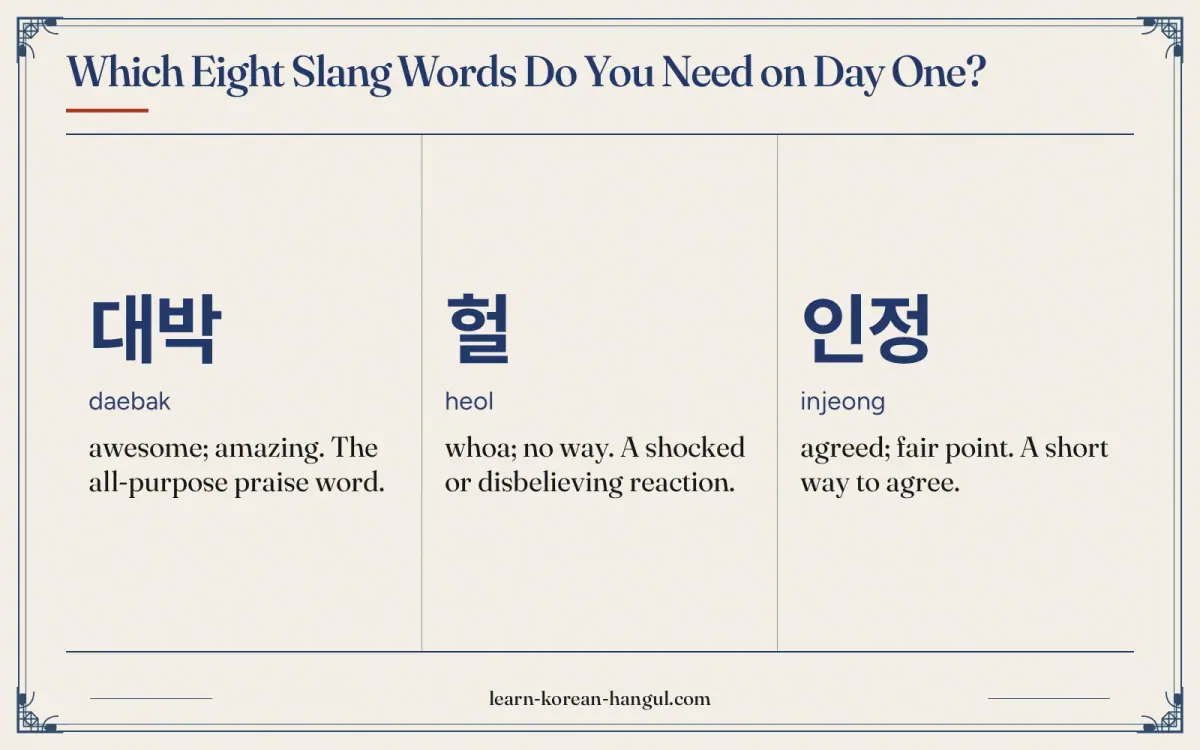
These eight words are the base for every list on this page. Each one is common, mild and safe among friends, and each is explained in more detail on the internet slang page. Use them as a first test of how slang feels, and notice that every example here is still polite, because the -요 ending keeps the tone friendly.
| No. | Hangul | Revised Romanization | Meaning and note | Example sentence | Audio assetId |
|---|---|---|---|---|---|
| 1 | 대박 | daebak | awesome; amazing. The all-purpose praise word. | 합격했어요? 대박이에요. (You passed? That is awesome.) | au-pg-vocabulary-slang-1; example: au-pg-vocabulary-slang-9 |
| 2 | 헐 | heol | whoa; no way. A shocked or disbelieving reaction. | 헐, 시험이 내일이에요? (Whoa, the exam is tomorrow?) | au-pg-vocabulary-slang-2; example: au-pg-vocabulary-slang-10 |
| 3 | 인정 | injeong | agreed; fair point. A short way to agree. | 인정, 이 가게는 맛있어요. (Agreed, this shop is tasty.) | au-pg-vocabulary-slang-3; example: au-pg-vocabulary-slang-11 |
| 4 | 꿀잼 | kkuljaem | great fun. 꿀 is honey; 잼 is fun. | 이 웹툰은 꿀잼이에요. (This webtoon is great fun.) | au-pg-vocabulary-slang-4; example: au-pg-vocabulary-slang-12 |
| 5 | 노잼 | nojaem | boring. The opposite of 꿀잼. | 그 영화는 노잼이었어요. (That film was boring.) | au-pg-vocabulary-slang-5; example: au-pg-vocabulary-slang-13 |
| 6 | 인싸 | inssa | popular, sociable person. From English insider. | 그 친구는 우리 반의 인싸예요. (That friend is the popular one in our class.) | au-pg-vocabulary-slang-6; example: au-pg-vocabulary-slang-14 |
| 7 | 먹방 | meokbang | eating broadcast. Said [먹빵]. | 주말에 먹방을 봤어요. (I watched an eating show on the weekend.) | au-pg-vocabulary-slang-7; example: au-pg-vocabulary-slang-15 |
| 8 | 갓생 | gatsaeng | a disciplined, productive life. Said [갇쌩]. | 올해는 갓생을 살고 싶어요. (This year I want to live a disciplined life.) | au-pg-vocabulary-slang-8; example: au-pg-vocabulary-slang-16 |
Three of these words repay a closer look. 대박 can show delight or shock, and the tone tells you which. 꿀잼 and 노잼 are a pair, with 꿀 (honey) meaning good and 노 (no) meaning none, and the pattern gives you many more words. And 먹방 is said with a tense ㅂ, [먹빵], because a final ㄱ makes the next consonant tense and does not turn it into ㅁ.
What Is Slang Called in Korean?
The general word for slang is 속어 (sogeo). Korean also has 은어 (euneo), for the private words of a closed group, and 비속어 (bisogeo), for crude or vulgar words. Learners mostly meet the first and the third. 속어 is the neutral word that you can use in any setting, and 비속어 is the label for rude words, which are collected on Korean swear words. When someone says a word is 비속어, they are warning that it is rude.
How Does Slang Change the Way You Speak?
Slang goes with informal speech. Between close friends, Koreans often drop the polite -요 and speak in a shorter style, so 대박이에요 becomes 대박이야. Slang also comes with short, sharp sentences, with no honorific forms. That is why slang can sound wrong in front of a boss or an elder. The safe route for a learner is to understand slang widely and to use it only with peers who use it first. When in doubt, say the polite sentence and leave the slang out.
Slang is also a good reason to learn how Korean words are built. Many slang words are shortenings, called 줄임말 (julimmal), such as 현타 and 멘붕, and some are English words in Hangul, such as 레전드 and 플렉스. Others play with sound, or add an intensifying prefix such as 개- (very), as in 개이득 (a huge win). 개- is casual and can sound coarse, and 존- is vulgar, so both belong only with close friends. Once you see the patterns, a new slang word looks less random. The internet slang page lists the patterns with examples.
Where Do Learners Meet Korean Slang?
The most common places are chat apps, comment sections, short videos, music fandoms and TV. Variety shows put slang into captions, which makes them a good source of listening practice, and the page on Korean variety show vocabulary lists the words you will see on screen. Dramas use slang in dialogue between friends and siblings, but the scriptwriters pick words for effect, so what you hear is not always what people say every day. Compare what you hear with a list before you copy it.
How Do You Pronounce the Starter Slang Words?
Press each button, repeat the word and compare. The Revised Romanization of Korean, published by the National Institute of Korean Language (국립국어원), is a learning aid here and does not show tensing caused by a neighbouring sound, so rely on the Hangul and the audio.
Two words in this set need extra care. 먹방 is [먹빵], with a tense second consonant, and 갓생 is [갇쌩], with the final ㅅ said as ㄷ and a tense ㅅ after it. The other six are said as they are spelled.
What Should You Remember before You Use Korean Slang?
Four habits keep slang from going wrong.
- Use slang with peers. Slang is for friends and people your age. To a boss, teacher or elder, use the polite style and standard words.
- Expect slang to change. Slang moves fast, and a word can sound dated within a few years. Check a recent source or ask a Korean friend before you use a new word.
- Expect spelling to vary. Online, the same word may be spelled in several ways. Use the dictionary spelling when you write, and expect variants when you read.
- Keep rude words separate. Vulgar slang is not mixed into the other lists on purpose. Read the swear words page first, so you know which words can offend.
With these four habits, slang becomes a tool and not a risk. The lists below then show you the words.
Practice and Study Plan
Use the lists in order of need, and review the starter words every few days. The vocabulary flashcard decks page lists the decks for slang and other topics, and the vocabulary worksheets page will list printable practice sheets as they are ready. A simple routine is to learn two new words a day and use one of them in a message to a friend.
Where to Go Next
After this hub, open Internet Slang and Abbreviations for the biggest list, or Texting Shortcuts for chat. To move up a level, return to Korean Vocabulary, or go on to Korean Culture Words.
Frequently Asked Questions
What Is Slang Called in Korean?
The general word is 속어 (sogeo). Korean also has 은어 for the private words of a group and 비속어 for crude or vulgar words. 속어 is neutral and safe to say in any setting. 비속어 is the label for rude words, which are on the swear words page.
Is It Okay for Learners to Use Korean Slang?
Yes, with friends and peers who use it first. Slang is informal, so avoid it with a boss, a teacher or an older person. If you are not sure, use the polite style and standard words. Understanding slang is always useful, even when you choose not to say it.
Which Korean Slang List Should I Study First?
Start with the list that matches where you meet slang. For videos and comments, open the internet slang page. For chat, open texting shortcuts. For dramas, the swear words page explains which words are rude. The eight starter words on this page are a good first step in every case.
How Fast Does Korean Slang Change?
Quickly. New words appear every year, and some fade within a few years. The words on these pages are widely understood, but a new word may be missing, and an old word may sound dated. Treat any list as a guide, and check recent sources.
Where Can I Practise Slang with Flashcards?
The vocabulary flashcard decks page lists the slang decks that are available, with Hangul, romanization and audio. Progress is saved only in your browser.
Is the Romanization on This Page Official?
It follows the Revised Romanization of Korean, which South Korea adopted in 2000 and whose rules the National Institute of Korean Language (국립국어원) publishes. It is a learning aid, and it does not show tensing caused by a neighbouring sound, so rely on the Hangul and the audio.