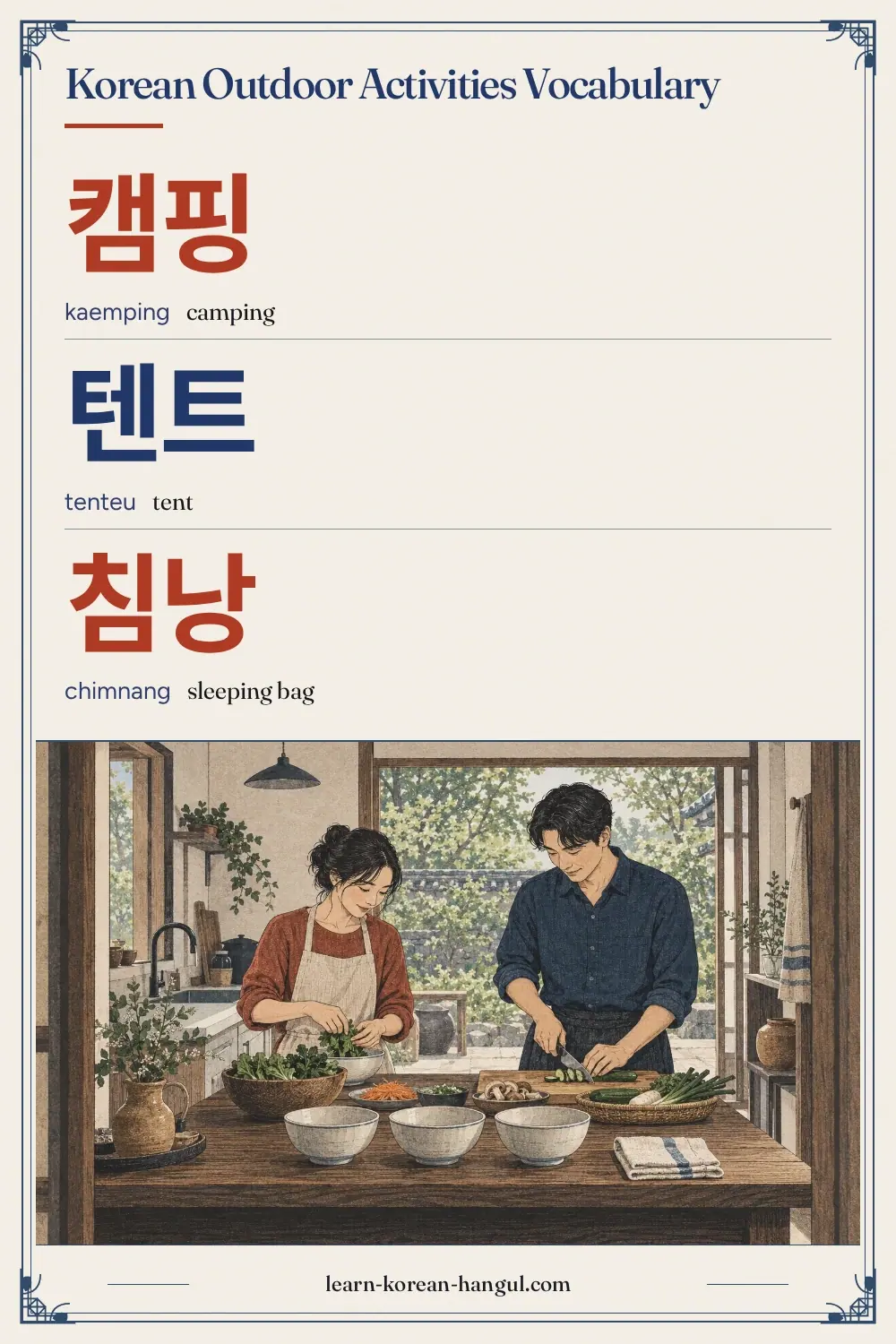
What you'll learn
- Match all 35 outdoor words to their English meanings.
- Choose the right verb: 치다 for a tent, 피우다 for a fire, 오르다 for a mountain.
- Say five of the words aloud with the help of the Revised Romanization and the audio.
- Write two original sentences with words such as 캠핑 and 텐트.
Prerequisites: you can read Hangul and know the polite ending -아요/-어요. Estimated time: about 60 minutes, plus short reviews on the following days.
Korean Outdoor Activities Vocabulary at a Glance
Outdoor life in Korea splits into two kinds of words. The equipment and trends from abroad keep their English names in Hangul: 캠핑, 텐트, 랜턴 and 바비큐. The older, local activities use Sino-Korean or native Korean words: 등산 (hiking), 소풍 (picnic or school outing) and 낚시 (fishing). A hike is often a day trip to a nearby mountain, and a 소풍 is a school outing as much as a family picnic.
Each activity also has its own verb. You pitch (치다) a tent, make (피우다) a fire, climb (오르다) a mountain and spread (펴다) a mat. This page sits inside Hobbies and Leisure. For the single-word lessons, see camping in korean, hiking in korean and fishing in korean, and for mountain vocabulary see mountains and hiking.
| Group | Words | Examples |
|---|---|---|
| Camping | 9 | 캠핑, 텐트, 침낭, 캠핑장 |
| Hiking | 8 | 등산, 정상, 등산로, 등산화 |
| Fishing | 7 | 낚시, 낚싯대, 미끼, 물고기 |
| Picnics | 6 | 소풍, 돗자리, 도시락, 김밥 |
| Travel hobbies | 5 | 여행, 배낭여행, 드라이브, 사진 |
By origin, the list has 18 Sino-Korean words, 10 native Korean words, 6 loanwords, and 1 mixed word (캠핑장: the English loanword 캠핑 plus the Sino-Korean 장).
Which Outdoor Activity Words Should You Learn First?
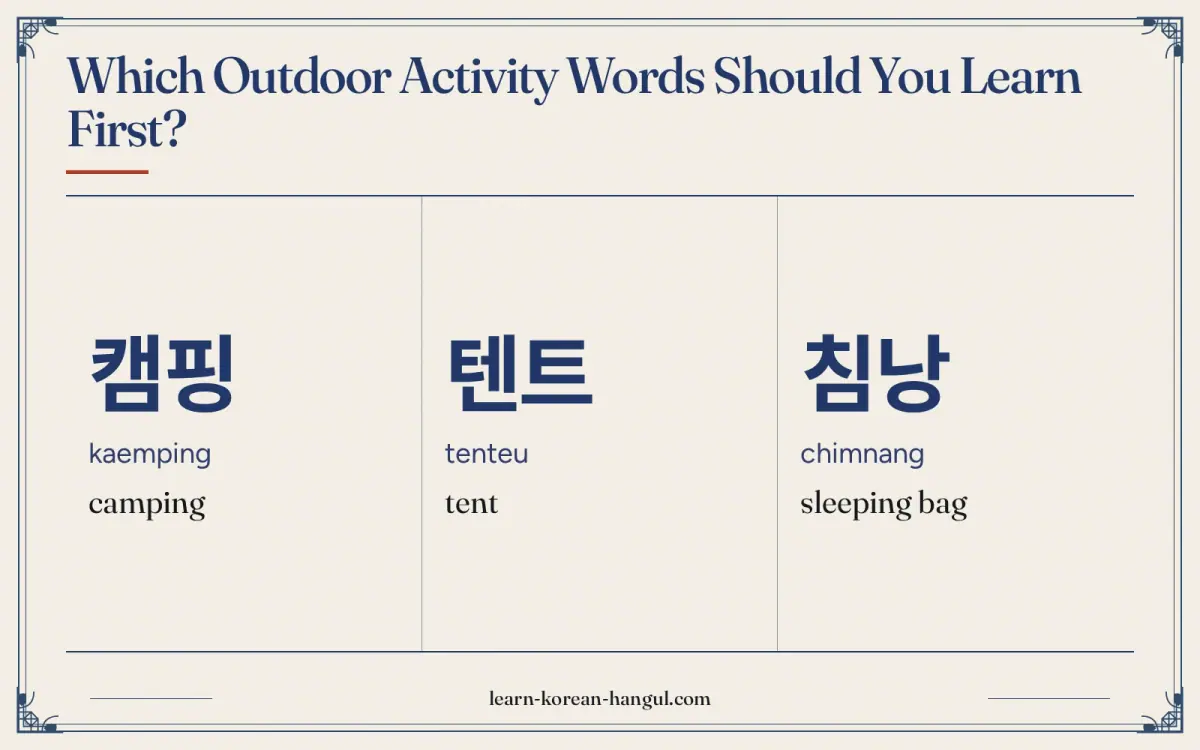
Start with five words: 캠핑, 텐트, 등산, 낚시 and 소풍. They name the four main activities and the most important piece of camping gear. Press the slow button, say each word, then listen to the sentence.
The scene below shows twelve of the 35 words. Each number matches a word in the lists that follow.
Word · 12
- 1
캠핑
kaemping
camping
- 2
텐트
tenteu
tent
- 3
침낭
chimnang
sleeping bag
- 4
모닥불
modakbul
campfire
- 5
등산
deungsan
hiking, mountain climbing
- 6
정상
jeongsang
summit
- 7
배낭
baenang
backpack
- 8
낚시
naksi
fishing
- 9
낚싯대
naksitdae
fishing rod
- 10
물고기
mulgogi
fish
- 11
소풍
sopung
picnic, outing
- 12
돗자리
dotjari
picnic mat
Twelve numbered objects match twelve words from the lists. Use the list under the picture if you cannot see the numbers.
Camping
Nine words for a camping trip. Most are loanwords, so you can read them at once if you know Hangul.
| No. | Hangul | Revised Romanization | Meaning | Example sentence | Audio assetId |
|---|---|---|---|---|---|
| 1 | 캠핑 | kaemping | camping | 이번 주말에 캠핑을 가요. (ibeon jumare kaempingeul gayo. We go camping this weekend.) | au-pg-vocabulary-hobbies-outdoor-1; example: au-pg-vocabulary-hobbies-outdoor-101 |
| 2 | 텐트 | tenteu | tent | 텐트를 쳐요. (tenteureul chyeoyo. We pitch the tent.) | au-pg-vocabulary-hobbies-outdoor-2; example: au-pg-vocabulary-hobbies-outdoor-102 |
| 3 | 침낭 | chimnang | sleeping bag | 침낭이 따뜻해요. (chimnangi ttatteutaeyo. The sleeping bag is warm.) | au-pg-vocabulary-hobbies-outdoor-3; example: au-pg-vocabulary-hobbies-outdoor-103 |
| 4 | 캠핑장 | kaempingjang | campsite | 캠핑장은 산 근처에 있어요. (kaempingjangeun san geuncheoe isseoyo. The campsite is near the mountain.) | au-pg-vocabulary-hobbies-outdoor-4; example: au-pg-vocabulary-hobbies-outdoor-104 |
| 5 | 모닥불 | modakbul | campfire | 모닥불을 피워요. (modakbureul piwoyo. We make a campfire.) | au-pg-vocabulary-hobbies-outdoor-5; example: au-pg-vocabulary-hobbies-outdoor-105 |
| 6 | 장작 | jangjak | firewood | 장작이 많이 필요해요. (jangjagi mani piryohaeyo. We need a lot of firewood.) | au-pg-vocabulary-hobbies-outdoor-6; example: au-pg-vocabulary-hobbies-outdoor-106 |
| 7 | 랜턴 | raenteon | lantern | 밤에는 랜턴이 필요해요. (bameneun raenteoni piryohaeyo. You need a lantern at night.) | au-pg-vocabulary-hobbies-outdoor-7; example: au-pg-vocabulary-hobbies-outdoor-107 |
| 8 | 바비큐 | babikyu | barbecue | 캠핑장에서 바비큐를 해요. (kaempingjangeseo babikyureul haeyo. We have a barbecue at the campsite.) | au-pg-vocabulary-hobbies-outdoor-8; example: au-pg-vocabulary-hobbies-outdoor-108 |
| 9 | 캠핑카 | kaempingka | camper van | 캠핑카를 빌리고 싶어요. (kaempingkareul billigo sipeoyo. I want to rent a camper van.) | au-pg-vocabulary-hobbies-outdoor-9; example: au-pg-vocabulary-hobbies-outdoor-109 |
- 캠핑: The usual pattern is 캠핑을 가다, to go camping. A related loanword is 글램핑 (geullaemping, glamping): camping in a ready-pitched tent with beds and furniture, a style that has spread widely in Korea.
- 텐트: The verb for putting up a tent is 치다, the same verb used for hanging a net or a curtain (커튼을 치다).
- 침낭: 침 (sleeping) plus 낭 (bag). Said chim-nang, with no change.
- 캠핑장: 캠핑 plus 장 (place). The suffix 장 also appears in 수영장 (pool) and 주차장 (car park).
- 모닥불: Said [모닥뿔]: the ㅂ after a final ㄱ becomes tense, and the ㄱ does not turn into ㅇ. The verb for a fire is 피우다.
- 장작: Logs cut for burning. The adjective 필요하다 means to be necessary.
- 랜턴: Written 랜턴 with ㅐ and ㅓ. 밤에는 means "at night", with the particle 는 adding a contrast with the daytime.
- 바비큐: Said ba-bi-kyu. Barbecue is usually a group meal with grilled meat.
- 캠핑카: 캠핑 plus 카 (car). The verb 빌리다 means to borrow or rent.
Example Sentences
Press play and repeat each sentence aloud. Each camping sentence uses a different verb: 가다, 치다, 피우다 and 하다.
이번 주말에 캠핑을 가요.
ibeon jumare kaempingeul gayo.
We go camping this weekend.
텐트를 쳐요.
tenteureul chyeoyo.
We pitch the tent.
모닥불을 피워요.
modakbureul piwoyo.
We make a campfire.
캠핑장에서 바비큐를 해요.
kaempingjangeseo babikyureul haeyo.
We have a barbecue at the campsite.
Notice that 캠핑 takes 가요 (go), 텐트 takes 쳐요 (pitch) and 모닥불 takes 피워요 (make a fire). The verb changes with the object.
Hiking
Eight words for a mountain walk. Hiking is a national hobby in Korea, so these words are common in daily talk.
| No. | Hangul | Revised Romanization | Meaning | Example sentence | Audio assetId |
|---|---|---|---|---|---|
| 10 | 등산 | deungsan | hiking, mountain climbing | 일요일에 가족과 등산을 가요. (iryoire gajokgwa deungsaneul gayo. I go hiking with my family on Sundays.) | au-pg-vocabulary-hobbies-outdoor-10; example: au-pg-vocabulary-hobbies-outdoor-110 |
| 11 | 정상 | jeongsang | summit | 정상에서 사진을 찍어요. (jeongsangeseo sajineul jjigeoyo. We take a photo at the summit.) | au-pg-vocabulary-hobbies-outdoor-11; example: au-pg-vocabulary-hobbies-outdoor-111 |
| 12 | 등산로 | deungsanno | hiking trail | 등산로가 깨끗해요. (deungsannoga kkaekkeutaeyo. The hiking trail is clean.) | au-pg-vocabulary-hobbies-outdoor-12; example: au-pg-vocabulary-hobbies-outdoor-112 |
| 13 | 등산화 | deungsanhwa | hiking boots | 등산화를 신어요. (deungsanhwareul sineoyo. I put on hiking boots.) | au-pg-vocabulary-hobbies-outdoor-13; example: au-pg-vocabulary-hobbies-outdoor-113 |
| 14 | 배낭 | baenang | backpack | 배낭을 메요. (baenangeul meyo. I carry a backpack on my back.) | au-pg-vocabulary-hobbies-outdoor-14; example: au-pg-vocabulary-hobbies-outdoor-114 |
| 15 | 국립공원 | gungnipgongwon | national park | 설악산은 국립공원이에요. (seoraksaneun gungnipgongwonieyo. Seoraksan is a national park.) | au-pg-vocabulary-hobbies-outdoor-15; example: au-pg-vocabulary-hobbies-outdoor-115 |
| 16 | 계곡 | gyegok | valley, mountain stream | 여름에 계곡에서 쉬어요. (yeoreume gyegogeseo swieoyo. In summer I rest by the valley stream.) | au-pg-vocabulary-hobbies-outdoor-16; example: au-pg-vocabulary-hobbies-outdoor-116 |
| 17 | 단풍 | danpung | autumn leaves | 가을에 단풍이 아름다워요. (gaeure danpungi areumdawoyo. In autumn the leaves are beautiful.) | au-pg-vocabulary-hobbies-outdoor-17; example: au-pg-vocabulary-hobbies-outdoor-117 |
- 등산: 등 (climb) plus 산 (mountain). 등산을 가다 means to go hiking.
- 정상: The top of a mountain. It also means normal, in a different context.
- 등산로: Said [등산노]: the ㄹ after the ㄴ is said as ㄴ. The last syllable 로 means road.
- 등산화: The verb for shoes is 신다. Shoes and boots always take 신다.
- 배낭: The verb 메다 means to carry on the back or shoulders.
- 국립공원: Said [궁닙꽁원]. Korea has many national parks, and several are mountains.
- 계곡: Cool mountain streams are popular summer spots. Said [계곡], and [게곡] is also standard.
- 단풍: Many people go hiking to see 단풍. The adjective 아름답다 changes to 아름다워요.
Fishing
Seven words for fishing, from the rod to the water.
| No. | Hangul | Revised Romanization | Meaning | Example sentence | Audio assetId |
|---|---|---|---|---|---|
| 18 | 낚시 | naksi | fishing | 아버지는 주말마다 낚시를 하세요. (abeojineun jumalmada naksireul haseyo. My father goes fishing every weekend.) | au-pg-vocabulary-hobbies-outdoor-18; example: au-pg-vocabulary-hobbies-outdoor-118 |
| 19 | 낚싯대 | naksitdae | fishing rod | 낚싯대를 가져가요. (naksitdaereul gajyeogayo. I take the fishing rod.) | au-pg-vocabulary-hobbies-outdoor-19; example: au-pg-vocabulary-hobbies-outdoor-119 |
| 20 | 미끼 | mikki | bait | 미끼를 끼워요. (mikkireul kkiwoyo. I put the bait on the hook.) | au-pg-vocabulary-hobbies-outdoor-20; example: au-pg-vocabulary-hobbies-outdoor-120 |
| 21 | 물고기 | mulgogi | fish | 물고기가 많아요. (mulgogiga manayo. There are many fish.) | au-pg-vocabulary-hobbies-outdoor-21; example: au-pg-vocabulary-hobbies-outdoor-121 |
| 22 | 낚시터 | naksiteo | fishing spot | 낚시터는 호수 옆에 있어요. (naksiteoneun hosu yeope isseoyo. The fishing spot is next to the lake.) | au-pg-vocabulary-hobbies-outdoor-22; example: au-pg-vocabulary-hobbies-outdoor-122 |
| 23 | 바다 | bada | sea | 바다에서 낚시를 해요. (badaeseo naksireul haeyo. I fish in the sea.) | au-pg-vocabulary-hobbies-outdoor-23; example: au-pg-vocabulary-hobbies-outdoor-123 |
| 24 | 호수 | hosu | lake | 호수가 맑아요. (hosuga malgayo. The lake is clear.) | au-pg-vocabulary-hobbies-outdoor-24; example: au-pg-vocabulary-hobbies-outdoor-124 |
- 낚시: Said [낙씨]. The verb is 낚시를 하다 (to fish). Revised Romanization writes naksi.
- 낚싯대: 낚시 plus 대 (stick), with a ㅅ added between them. 가져가다 means to take along.
- 미끼: The double ㄲ is tense. Be careful not to say 미키.
- 물고기: Water (물) plus meat (고기), said [물꼬기]. 고기 alone can mean meat, so 물고기 is the safe word for the animal.
- 낚시터: 낚시 plus 터 (site). 터 appears in 놀이터 (playground).
- 바다: The native Korean word for sea. Fishing from a boat or the shore at sea is 바다낚시 (badanaksi), and a beach is 해변.
- 호수: 호 (lake) plus 수 (water). The adjective 맑다 means clear or clean.
Picnics
Six words for outings with food. A 소풍 is a school outing as well as a picnic. In Seoul, the riverside parks along the Han River (한강공원, Hanganggongwon) are a favourite picnic spot, where friends and families spread a 돗자리 on the grass and share food.
| No. | Hangul | Revised Romanization | Meaning | Example sentence | Audio assetId |
|---|---|---|---|---|---|
| 25 | 소풍 | sopung | picnic, outing | 내일 학교에서 소풍을 가요. (naeil hakgyoeseo sopungeul gayo. We go on a school outing tomorrow.) | au-pg-vocabulary-hobbies-outdoor-25; example: au-pg-vocabulary-hobbies-outdoor-125 |
| 26 | 돗자리 | dotjari | picnic mat | 돗자리를 펴요. (dotjarireul pyeoyo. I spread out the picnic mat.) | au-pg-vocabulary-hobbies-outdoor-26; example: au-pg-vocabulary-hobbies-outdoor-126 |
| 27 | 도시락 | dosirak | lunch box | 엄마가 도시락을 싸요. (eommaga dosirageul ssayo. My mother packs a lunch box.) | au-pg-vocabulary-hobbies-outdoor-27; example: au-pg-vocabulary-hobbies-outdoor-127 |
| 28 | 김밥 | gimbap | gimbap (rice roll) | 소풍에는 김밥을 먹어요. (sopungeneun gimbabeul meogeoyo. We eat gimbap on a picnic.) | au-pg-vocabulary-hobbies-outdoor-28; example: au-pg-vocabulary-hobbies-outdoor-128 |
| 29 | 공원 | gongwon | park | 공원에서 산책해요. (gongwoneseo sanchaekaeyo. I take a walk in the park.) | au-pg-vocabulary-hobbies-outdoor-29; example: au-pg-vocabulary-hobbies-outdoor-129 |
| 30 | 간식 | gansik | snack | 간식을 가져와요. (gansigeul gajyeowayo. I bring snacks.) | au-pg-vocabulary-hobbies-outdoor-30; example: au-pg-vocabulary-hobbies-outdoor-130 |
- 소풍: In Korean schools, 소풍 is a yearly day trip. It also names a family picnic.
- 돗자리: Said [돋짜리]. The verb 펴다 means to unfold or spread.
- 도시락: The verb 싸다 means to wrap or pack. A lunch box for a school outing is often packed the night before.
- 김밥: 김 (seaweed) plus 밥 (rice). Gimbap is the classic picnic food.
- 공원: The word for a city park. Said gong-won.
- 간식: A snack between meals. Said gan-sik.
Travel Hobbies
Five words for trips and for the hobbies that go with travel.
| No. | Hangul | Revised Romanization | Meaning | Example sentence | Audio assetId |
|---|---|---|---|---|---|
| 31 | 여행 | yeohaeng | travel, trip | 저는 여행을 좋아해요. (jeoneun yeohaengeul joahaeyo. I like travelling.) | au-pg-vocabulary-hobbies-outdoor-31; example: au-pg-vocabulary-hobbies-outdoor-131 |
| 32 | 배낭여행 | baenangnyeohaeng | backpacking trip | 친구와 배낭여행을 가요. (chinguwa baenangnyeohaengeul gayo. I go on a backpacking trip with a friend.) | au-pg-vocabulary-hobbies-outdoor-32; example: au-pg-vocabulary-hobbies-outdoor-132 |
| 33 | 드라이브 | deuraibeu | a drive | 주말에 드라이브를 해요. (jumare deuraibeureul haeyo. I go for a drive on the weekend.) | au-pg-vocabulary-hobbies-outdoor-33; example: au-pg-vocabulary-hobbies-outdoor-133 |
| 34 | 사진 | sajin | photo | 사진을 많이 찍어요. (sajineul mani jjigeoyo. I take a lot of photos.) | au-pg-vocabulary-hobbies-outdoor-34; example: au-pg-vocabulary-hobbies-outdoor-134 |
| 35 | 지도 | jido | map | 지도를 확인해요. (jidoreul hwaginhaeyo. I check the map.) | au-pg-vocabulary-hobbies-outdoor-35; example: au-pg-vocabulary-hobbies-outdoor-135 |
- 여행: The verb is 여행하다 or 여행을 가다. The word names any trip.
- 배낭여행: 배낭 (backpack) plus 여행 (trip). Said [배낭녀행], with an added ㄴ before 여, so the romanization is baenangnyeohaeng. The word is common among students.
- 드라이브: From English drive. 드라이브를 가다 or 드라이브를 하다 both work.
- 사진: The verb is 찍다 (to take a photo), not 만들다.
- 지도: Do not confuse 지도 (map) with 지도 (guidance), which has the same spelling.
How Do You Pronounce These Words?
Most outdoor words are easy to read, but several follow sound rules. The table follows the standard pronunciation rules (표준 발음법) of the 국립국어원 (National Institute of Korean Language).
| Word | Revised Romanization | Said | Rule |
|---|---|---|---|
| 모닥불 | modakbul | [모닥뿔] | ㅂ after a final ㄱ becomes tense, and the ㄱ does not become ㅇ |
| 돗자리 | dotjari | [돋짜리] | the final ㅅ is said as ㄷ, and ㅈ becomes tense |
| 낚시 | naksi | [낙씨] | the final ㄲ is said as ㄱ, and ㅅ becomes tense |
| 등산로 | deungsanno | [등산노] | ㄹ after a final ㄴ is said as ㄴ |
| 국립공원 | gungnipgongwon | [궁닙꽁원] | ㄹ after ㄱ is said as ㄴ, ㄱ before that ㄴ becomes ㅇ, and ㄱ after a final ㅂ becomes tense |
Revised Romanization follows the spoken sound when a consonant changes, as in 등산로 (deungsanno) and 국립공원 (gungnipgongwon), but it does not show tensing caused by a neighbouring sound: 낚시 is written naksi even though it is said [낙씨].
Audio and Slow Playback
Each headword and each example sentence has its own audio clip, and the 5 words in the first-words section also have a slow clip at 0.8 times the speed. Nothing plays until you press a button. Listen to 모닥불 and 돗자리 one after the other and hear how the second consonant becomes tense in both.
What Mistakes Do Learners Make with Outdoor Activity Words?
- Using 하다 for every activity. You go camping (캠핑을 가다), fish (낚시를 하다) and climb a mountain (산을 오르다).
- Saying 텐트를 만들다 for pitching a tent. The natural verb is 치다: 텐트를 쳐요. (텐트를 세우다 is also heard.)
- Reading 낚시 with a plain ㅅ. It is said [낙씨], with a tense second consonant.
- Mixing up 지도 (map) with 지도 (guidance). The spelling is the same, so the sentence decides.
- Using 고기 for the animal in the water. 고기 usually means meat, so say 물고기 for fish.
- Forgetting that 소풍 also means a school outing. It is not only a family picnic.
Practice: Flashcards and Worksheet
Drill all 35 words with the vocabulary flashcard decks: each card shows the Hangul on one side and the meaning on the other. A printable worksheet for these words (word list, matching, writing practice, fill-in-the-blank exercises and answer key) is available in A4 and US Letter from the download card on this page. A simple plan is to pack a trip in Korean: write a list of the items you need for camping, hiking and a picnic, with the verb for each.
Practice · 4
- 01이번 주말에 캠핑을 가요.
Show answer
ibeon jumare kaempingeul gayo.
We go camping this weekend.
- 02텐트를 쳐요.
Show answer
tenteureul chyeoyo.
We pitch the tent.
- 03모닥불을 피워요.
Show answer
modakbureul piwoyo.
We make a campfire.
- 04캠핑장에서 바비큐를 해요.
Show answer
kaempingjangeseo babikyureul haeyo.
We have a barbecue at the campsite.
Korean Outdoor Activities Vocabulary Worksheet (PDF)
Quick Quiz
Choose the best answer. The explanation after each question tells you why.
Practice · 5
Which verb goes with 텐트?
Show answer
치다
You pitch a tent with 치다. 피우다 is for a fire, 오르다 is for climbing and 펴다 is for spreading a mat.
What does 등산 mean?
Show answer
hiking
등산 is mountain climbing or hiking. 낚시 is fishing and 소풍 is a picnic.
How is 낚시 pronounced?
Show answer
[낙씨]
The final ㄲ is said as ㄱ and the ㅅ becomes tense.
Which word means the summit of a mountain?
Show answer
정상
정상 is the summit. 계곡 is a valley and 호수 is a lake.
Which word means picnic mat?
Show answer
돗자리
돗자리 is a mat you sit on. 도시락 is a lunch box and 침낭 is a sleeping bag.
Write two sentences of your own, one about a trip you would like to take and one about the food you bring. For example, 주말에 캠핑을 가요 or 도시락을 싸요.
Where to Go Next
This outdoor list sits inside Hobbies and Leisure. For mountain words, see mountains and hiking. For another hobby list, continue with Games.
FAQ
How Do You Say Camping in Korean?
Say 캠핑 (kaemping). It is the English word written in Hangul. To say you go camping, use 캠핑을 가요. The camping site is a 캠핑장 and the tent is a 텐트.
How Do You Pronounce 텐트 (tenteu)?
Say ten-teu in two syllables. The first syllable has the vowel ㅔ and the last syllable has a short, unrounded ㅡ. Revised Romanization writes it tenteu.
How Many Outdoor Activity Words Should I Learn First?
Learn the five words in the first-words section: 캠핑, 텐트, 등산, 낚시 and 소풍. Then add one group a day and the verbs that go with each noun.
Where Can I Practise Outdoor Activity Words with Flashcards?
Use the vocabulary flashcard decks. Start with camping and hiking, then add fishing and picnics, and say each noun with its verb.
Is the Romanization on This Page Official?
It follows the Revised Romanization of Korean, the system South Korea has officially used since 2000, as a learning aid. It does not show tensing caused by a neighbouring sound, so 낚시 is written naksi but said [낙씨]. Always read the Hangul as well.
Is There a Printable Worksheet for Outdoor Activity Words?
A printable worksheet for these words (word list, matching, writing practice, fill-in-the-blank exercises and answer key) is available in A4 and US Letter from the download card on this page. For additional practice, write the Korean name next to each numbered object in the scene above.