Korean Mountains and Hiking Vocabulary at a Glance
Much of Korea is hills and mountains, and hiking is one of the most common weekend plans. A day on a mountain has a shape that this list follows: you look at the mountain and its features, pack your gear, read the signs on the trail, visit a temple or a lookout and keep an eye on safety. The vocabulary is useful on a hike, and it also helps with weather reports, news about autumn leaves and posts about weekend trips. The list sits in Geography and Countries. For a single-word lookup, see hiking in Korean.
| Group | Words | Use |
|---|---|---|
| Mountain features | 6 | Peaks, ridges, valleys and rocks |
| Gear | 6 | Boots, clothes, backpacks and food |
| Trails and signs | 6 | Trail words and the signs you must understand |
| Temples and views | 6 | Mountain temples, lookouts and autumn leaves |
| Safety | 6 | Safety words, rescue and the map |
Which Mountain and Hiking Words Should You Learn First?
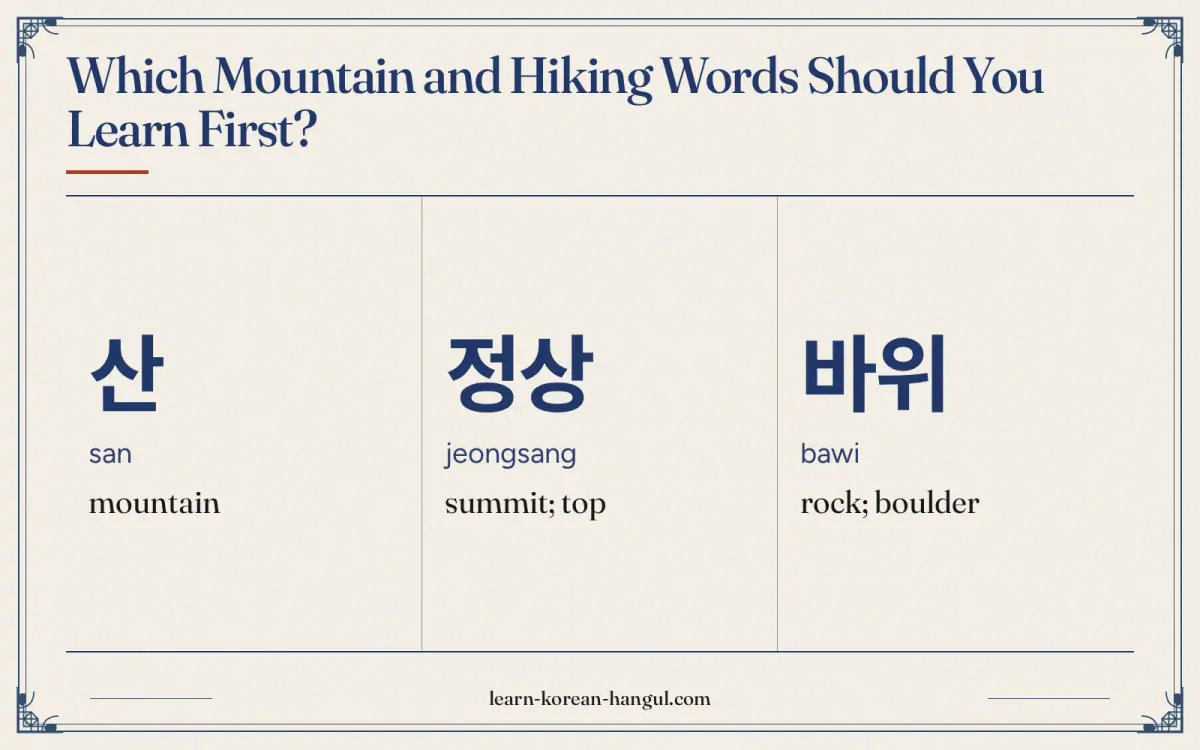
Learn 산, 등산, 정상, 등산화, 배낭 and 경치 first. They are the words you say on the way up, at the top and in the shop where you buy your gear. Add 입산 금지 and 대피소 before your first real hike, since they are words on signs you need to understand.
- Words to say. 산, 등산, 정상, 등산화, 배낭, 경치.
- Words to recognise. 입산 금지, 이정표, 대피소, 조난. They appear on signs and in news reports.
- Words to match. 능선, 계곡, 봉우리, 오르막, 내리막. Match them to a picture of a mountain and the shape of the land is easy to remember.
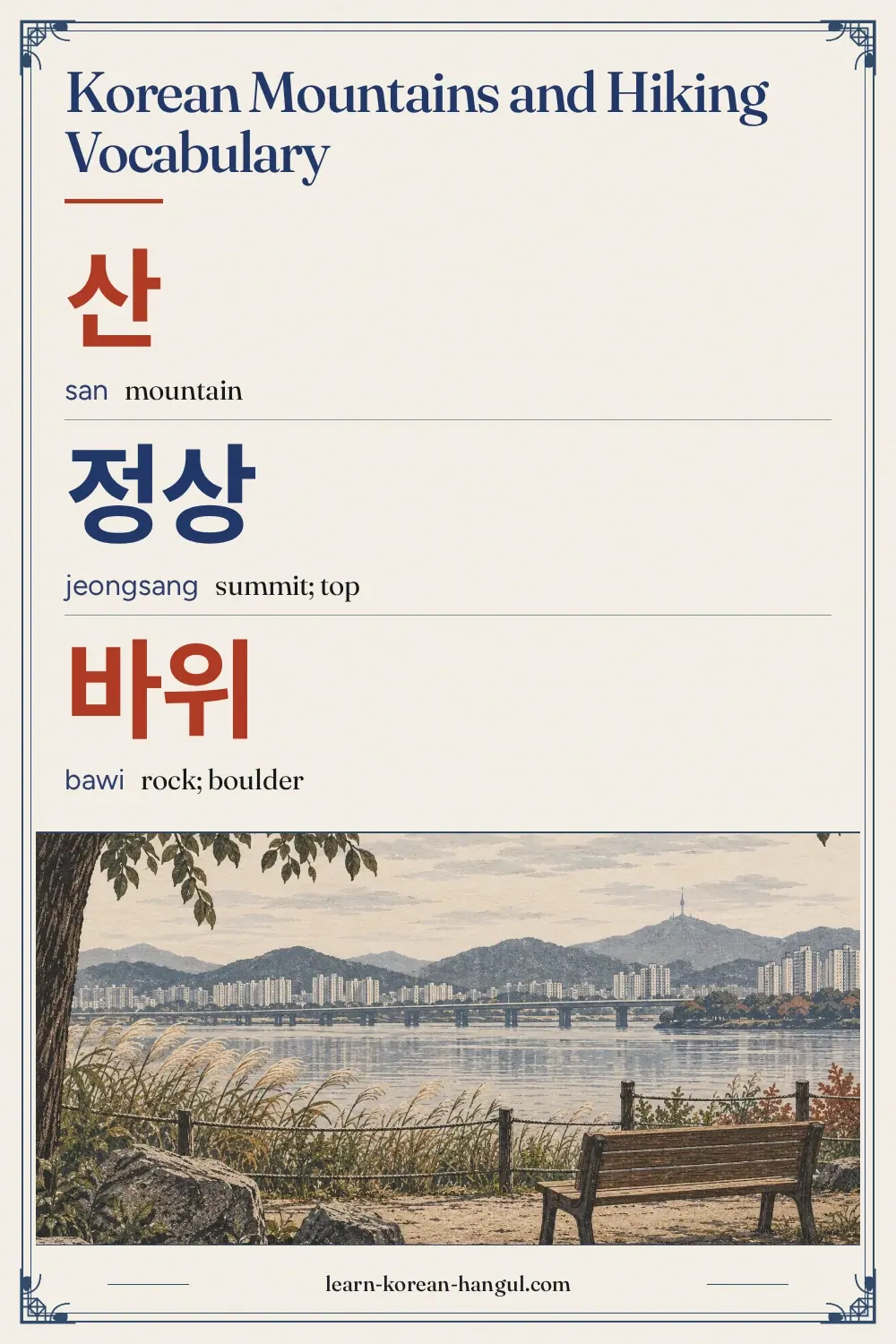
Note the pair 오르막 and 내리막. Both end in 막 and mean the slope: 오르막 is the way up and 내리막 is the way down. The scene below shows a mountain with numbered features and gear that match the list.
Word · 10
- 1
산
san
mountain
- 2
정상
jeongsang
summit; top
- 3
바위
bawi
rock; boulder
- 4
등산화
deungsanhwa
hiking boots
- 5
배낭
baenang
backpack; rucksack
- 6
등산로
deungsanno
hiking trail
- 7
이정표
ijeongpyo
signpost; trail marker
- 8
절
jeol
temple (Buddhist)
- 9
전망대
jeonmangdae
lookout; observation deck
- 10
대피소
daepiso
shelter; refuge
Mountain Features
Six words describe the shape of a mountain. 산 is the general word for mountain, and 봉우리 is a single peak. 정상 is the very top, and a hiker who reaches it has 정상에 올랐어요 (reached the summit). 능선 is the ridge between peaks, 계곡 is a valley with a stream, and 바위 is a rock or boulder. In names, 산 is often attached to the place: 한라산 is the mountain on Jeju and the highest in South Korea, and 북한산 is the mountain at the edge of Seoul.
| No. | Hangul | Revised Romanization | Meaning and note | Example sentence | Audio assetId |
|---|---|---|---|---|---|
| 1 | 산 | san | mountain. Also the suffix in mountain names, such as 한라산 and 북한산. | 한국에는 산이 많아요. (Korea has many mountains.) | au-pg-vocabulary-nature-geography-mountains-hiking-1; example: au-pg-vocabulary-nature-geography-mountains-hiking-31 |
| 2 | 봉우리 | bonguri | peak. A single high point. A range has many 봉우리. | 봉우리가 높아요. (The peak is high.) | au-pg-vocabulary-nature-geography-mountains-hiking-2; example: au-pg-vocabulary-nature-geography-mountains-hiking-32 |
| 3 | 정상 | jeongsang | summit; top. The same word also means normal, as in 정상이에요. The sentence shows which one. | 정상에 올라가요. (I go up to the summit.) | au-pg-vocabulary-nature-geography-mountains-hiking-3; example: au-pg-vocabulary-nature-geography-mountains-hiking-33 |
| 4 | 계곡 | gyegok | valley; gorge. Summer is the season to cool off in a mountain stream. | 계곡에서 놀아요. (We play in the valley stream.) | au-pg-vocabulary-nature-geography-mountains-hiking-4; example: au-pg-vocabulary-nature-geography-mountains-hiking-34 |
| 5 | 바위 | bawi | rock; boulder. Large rocks have names on many trails. | 바위에 앉아요. (I sit on a rock.) | au-pg-vocabulary-nature-geography-mountains-hiking-5; example: au-pg-vocabulary-nature-geography-mountains-hiking-35 |
| 6 | 능선 | neungseon | ridge. With 을 it is [능서늘]. The line along the top of a mountain. | 능선을 따라 걸어요. (I walk along the ridge.) | au-pg-vocabulary-nature-geography-mountains-hiking-6; example: au-pg-vocabulary-nature-geography-mountains-hiking-36 |
Example Sentences
Mountain sentences use three simple frames. The first is place + 에 + movement verb, as in 정상에 올라가요 (I go up to the summit). The second is noun + 이/가 + adjective, as in 봉우리가 높아요 (the peak is high). The third is place + 에서 + verb, as in 계곡에서 놀아요 (I play in the valley). The particle 에 marks where you go, and 에서 marks where you do something. Read each sentence aloud after its audio.
The next group is the gear you bring to the mountain.
How Do You Say Hiking Gear in Korean?
Gear words are easy because most describe the object. 등산화 is hiking boots and 등산복 is hiking clothes, built from 등산 (hiking) and 화 (shoes) or 복 (clothes). 배낭 is the backpack and 스틱 is the trekking pole, borrowed from English. 물통 is the water bottle and 도시락 is the lunch box, a Korean hiking classic: many hikers pack a lunch and eat it at the top. In shops, outdoor stores are called 등산 용품점 and sell all of these.
| No. | Hangul | Revised Romanization | Meaning and note | Example sentence | Audio assetId |
|---|---|---|---|---|---|
| 7 | 등산화 | deungsanhwa | hiking boots. 등산 plus 화, shoes. Strong soles for rock and mud. | 등산화를 신어요. (I put on hiking boots.) | au-pg-vocabulary-nature-geography-mountains-hiking-7; example: au-pg-vocabulary-nature-geography-mountains-hiking-37 |
| 8 | 등산복 | deungsanbok | hiking clothes. Light, quick-drying outdoor wear for the mountain. | 등산복을 입어요. (I wear hiking clothes.) | au-pg-vocabulary-nature-geography-mountains-hiking-8; example: au-pg-vocabulary-nature-geography-mountains-hiking-38 |
| 9 | 배낭 | baenang | backpack; rucksack. The standard word for a bag that sits on the back. | 배낭이 무거워요. (The backpack is heavy.) | au-pg-vocabulary-nature-geography-mountains-hiking-9; example: au-pg-vocabulary-nature-geography-mountains-hiking-39 |
| 10 | 스틱 | seutik | trekking pole. From English stick. Usually used in a pair. | 스틱을 써요. (I use trekking poles.) | au-pg-vocabulary-nature-geography-mountains-hiking-10; example: au-pg-vocabulary-nature-geography-mountains-hiking-40 |
| 11 | 물통 | multong | water bottle. A bottle for carrying water. Pack more than you think you need. | 물통에 물을 넣어요. (I put water in the bottle.) | au-pg-vocabulary-nature-geography-mountains-hiking-11; example: au-pg-vocabulary-nature-geography-mountains-hiking-41 |
| 12 | 도시락 | dosirak | lunch box; packed lunch. Eaten at the summit or beside a stream. | 정상에서 도시락을 먹어요. (I eat a packed lunch at the summit.) | au-pg-vocabulary-nature-geography-mountains-hiking-12; example: au-pg-vocabulary-nature-geography-mountains-hiking-42 |
The verbs differ by item: 신다 for boots, 입다 for clothes and 메다 for carrying a bag on your shoulders. Using the right verb sounds more natural than using one verb for all three.
Trails and Signs
This group is the words you will read on the way up. 등산 is the activity itself, and 등산로 is the trail. 이정표 is a signpost that shows a direction and a distance. 오르막 and 내리막 are the uphill and downhill parts of a path. 입산 금지 is a sign that closes a mountain or path to hikers. Signs of this kind appear for safety reasons, such as the dry season, and you should always obey them.
| No. | Hangul | Revised Romanization | Meaning and note | Example sentence | Audio assetId |
|---|---|---|---|---|---|
| 13 | 등산 | deungsan | hiking; mountain climbing. The usual word for hiking on a Korean mountain. 등산을 가다 means go hiking. | 주말에 등산을 가요. (On the weekend I go hiking.) | au-pg-vocabulary-nature-geography-mountains-hiking-13; example: au-pg-vocabulary-nature-geography-mountains-hiking-43 |
| 14 | 등산로 | deungsanno | hiking trail. Said [등산노]. 로 is road, and ㄹ turns to ㄴ after ㄴ. | 등산로가 좁아요. (The trail is narrow.) | au-pg-vocabulary-nature-geography-mountains-hiking-14; example: au-pg-vocabulary-nature-geography-mountains-hiking-44 |
| 15 | 이정표 | ijeongpyo | signpost; trail marker. Shows a direction and often a distance. | 이정표를 봐요. (I look at the signpost.) | au-pg-vocabulary-nature-geography-mountains-hiking-15; example: au-pg-vocabulary-nature-geography-mountains-hiking-45 |
| 16 | 입산 금지 | ipsan geumji | no entry to the mountain. Said [입싼 금지]. A sign that closes a path to hikers, often for fire or nature protection. | 이곳은 입산 금지예요. (This place is closed to hikers.) | au-pg-vocabulary-nature-geography-mountains-hiking-16; example: au-pg-vocabulary-nature-geography-mountains-hiking-46 |
| 17 | 오르막 | oreumak | uphill; ascent. With 이 it is 오르막이 [오르마기]. From 오르다, to go up. | 오르막이 힘들어요. (The uphill is hard.) | au-pg-vocabulary-nature-geography-mountains-hiking-17; example: au-pg-vocabulary-nature-geography-mountains-hiking-47 |
| 18 | 내리막 | naerimak | downhill; descent. From 내리다, to go down. Take care on wet leaves. | 내리막은 미끄러워요. (The downhill is slippery.) | au-pg-vocabulary-nature-geography-mountains-hiking-18; example: au-pg-vocabulary-nature-geography-mountains-hiking-48 |
Learn 입산 금지 as a block. It is two words that you read as one sign, and the romanization shows a space: ipsan geumji.
How Do You Say Temples and Views in Korean?
Many Korean mountains have a Buddhist temple partway up, and a walk to the temple is a popular day trip. 절 is the everyday word for temple, 사찰 is the more formal word and 산사 is a temple in the mountains. Some temples offer a temple stay, where visitors sleep and eat in the temple. At the top or along the way, a 전망대 is a lookout, and the 경치 is the view. In autumn, hikers go to see the 단풍, the red and yellow leaves.
| No. | Hangul | Revised Romanization | Meaning and note | Example sentence | Audio assetId |
|---|---|---|---|---|---|
| 19 | 절 | jeol | temple (Buddhist). The same spelling is a deep bow. A temple sentence uses 에 or 에서. | 산속에 절이 있어요. (There is a temple in the mountains.) | au-pg-vocabulary-nature-geography-mountains-hiking-19; example: au-pg-vocabulary-nature-geography-mountains-hiking-49 |
| 20 | 사찰 | sachal | Buddhist temple (formal). Used in guides and signs. The everyday word is 절. | 이 사찰은 아주 오래됐어요. (This temple is very old.) | au-pg-vocabulary-nature-geography-mountains-hiking-20; example: au-pg-vocabulary-nature-geography-mountains-hiking-50 |
| 21 | 산사 | sansa | mountain temple. 산 plus 사, temple. Often a quiet place to rest. | 산사에서 템플스테이를 해요. (I do a temple stay at a mountain temple.) | au-pg-vocabulary-nature-geography-mountains-hiking-21; example: au-pg-vocabulary-nature-geography-mountains-hiking-51 |
| 22 | 전망대 | jeonmangdae | lookout; observation deck. A built viewpoint with a rail or platform. | 전망대에서 사진을 찍어요. (I take photos at the lookout.) | au-pg-vocabulary-nature-geography-mountains-hiking-22; example: au-pg-vocabulary-nature-geography-mountains-hiking-52 |
| 23 | 경치 | gyeongchi | scenery; view. Used for beautiful natural views. 경치가 좋다 is a common phrase. | 경치가 아름다워요. (The scenery is beautiful.) | au-pg-vocabulary-nature-geography-mountains-hiking-23; example: au-pg-vocabulary-nature-geography-mountains-hiking-53 |
| 24 | 단풍 | danpung | autumn leaves; fall foliage. A big topic in October and November. 단풍 구경 is leaf watching. | 가을에 단풍을 봐요. (In autumn I see the autumn leaves.) | au-pg-vocabulary-nature-geography-mountains-hiking-24; example: au-pg-vocabulary-nature-geography-mountains-hiking-54 |
Use 절 in conversation and 사찰 when you read or write. 산사 appears in guidebooks and poems.
Safety
The last group is the words you need if something goes wrong. 안전 is safety. 조난 means being lost or in danger in the mountains, and 구조대 is the rescue team. 대피소 is a shelter, often a small hut where hikers can rest or wait out bad weather. 지도 is a map and 안개 is fog, which can turn a clear path into a confusing one. In an emergency in Korea, the number to call for fire, rescue and an ambulance is 119, said 일일구. Keep this number and the word 조난 in mind before a hike.
| No. | Hangul | Revised Romanization | Meaning and note | Example sentence | Audio assetId |
|---|---|---|---|---|---|
| 25 | 안전 | anjeon | safety. Common on signs: 안전 제일 means safety first. | 안전이 가장 중요해요. (Safety is the most important.) | au-pg-vocabulary-nature-geography-mountains-hiking-25; example: au-pg-vocabulary-nature-geography-mountains-hiking-55 |
| 26 | 조난 | jonan | being lost or in distress in the mountains. Used for hikers who are stranded, injured or lost. | 조난 신호를 보내요. (I send a distress signal.) | au-pg-vocabulary-nature-geography-mountains-hiking-26; example: au-pg-vocabulary-nature-geography-mountains-hiking-56 |
| 27 | 구조대 | gujodae | rescue team. 구조 is rescue and 대 is team. | 구조대가 도와줘요. (The rescue team helps.) | au-pg-vocabulary-nature-geography-mountains-hiking-27; example: au-pg-vocabulary-nature-geography-mountains-hiking-57 |
| 28 | 대피소 | daepiso | shelter; refuge. A hut or shelter for rest or protection from weather. | 대피소에서 쉬어요. (I rest at the shelter.) | au-pg-vocabulary-nature-geography-mountains-hiking-28; example: au-pg-vocabulary-nature-geography-mountains-hiking-58 |
| 29 | 지도 | jido | map. A paper map or a phone app. Check it before you start. | 지도를 봐요. (I look at the map.) | au-pg-vocabulary-nature-geography-mountains-hiking-29; example: au-pg-vocabulary-nature-geography-mountains-hiking-59 |
| 30 | 안개 | angae | fog. Mountain fog can come quickly. Check the forecast. | 안개가 많아요. (There is a lot of fog.) | au-pg-vocabulary-nature-geography-mountains-hiking-30; example: au-pg-vocabulary-nature-geography-mountains-hiking-60 |
Safety words are best learned before you need them. Say them aloud, and keep the emergency number saved on your phone.
How Do You Pronounce These Words?
Most mountain words are said as written. The signs and trail words have a few sound changes: tensing after a final ㅂ and inside some compounds, linking, and ㄹ turning into ㄴ. Standard pronunciation follows the National Institute of Korean Language (국립국어원) rules, and the romanization follows the Revised Romanization of Korean, which writes the ㄹ to ㄴ change (deungsanno) but does not show tensing caused by a neighbouring sound.
| Spelling | Sounds like | What changes |
|---|---|---|
| 입산 금지 | [입싼 금지] | After final ㅂ, ㅅ becomes tense [ㅆ]. |
| 등산로 | [등산노] | ㄹ becomes ㄴ after ㄴ. The Revised Romanization shows this as deungsanno. |
| 오르막이 | [오르마기] | The final ㄱ moves to the vowel of 이. |
| 능선을 | [능서늘] | The final ㄴ links to the vowel of 을. |
| 산속 | [산쏙] | ㅅ becomes tense after the final ㄴ in this compound. |
| 도시락을 | [도시라글] | The final ㄱ links to the vowel of 을. |
| 정상 | [정상] | No change. Say each syllable clearly. |
The hardest sound is the tense ㅆ in 입산 금지. Close your throat a little and say it without a puff of air. Compare the plain ㅅ in 산 and 정상.
Audio and Slow Playback
Each word and sentence has its own clip. The five clips below replay the hardest words slowly. Play one, repeat it aloud, then play it again and compare.
What Mistakes Do Learners Make with Mountain and Hiking Words?
Five mistakes come up again and again.
- Thinking 등산 means only hard mountaineering. 등산 covers an ordinary hike, and it is the right word for a weekend walk up a Korean mountain.
- Mixing up the two meanings of 절. The spelling for a temple and for a deep bow is the same. 절에 가요 is I go to the temple, and 절을 해요 is I bow.
- Mixing up 정상 meanings. 정상 is the summit, but 정상이에요 can also mean it is normal. Use the context.
- Reading 입산 금지 as two unrelated words. The sign means the whole mountain or path is closed. Obey it.
- Using one verb for boots, clothes and a bag. 신다 is for shoes, 입다 is for clothes and 메다 is for a bag on the shoulders.
The practice section turns the list into drills.
Practice: Flashcards and Worksheet
Use three steps. Run the flashcard deck in recognition mode until the 30 words come quickly. Switch to listening mode, then take the quiz. The deck holds every word on this page with audio, and your progress stays in your browser. The vocabulary flashcard decks page lists the other decks.
Practice · 65
- 01산
Show answer
headword 1: mountain
- 02봉우리
Show answer
headword 2: peak
- 03정상
Show answer
headword 3: summit; top
- 04계곡
Show answer
headword 4: valley; gorge
- 05바위
Show answer
headword 5: rock; boulder
- 06능선
Show answer
headword 6: ridge
- 07등산화
Show answer
headword 7: hiking boots
- 08등산복
Show answer
headword 8: hiking clothes
- 09배낭
Show answer
headword 9: backpack; rucksack
- 10스틱
Show answer
headword 10: trekking pole
- 11물통
Show answer
headword 11: water bottle
- 12도시락
Show answer
headword 12: lunch box; packed lunch
- 13등산
Show answer
headword 13: hiking; mountain climbing
- 14등산로
Show answer
headword 14: hiking trail
- 15이정표
Show answer
headword 15: signpost; trail marker
- 16입산 금지
Show answer
headword 16: no entry to the mountain
- 17오르막
Show answer
headword 17: uphill; ascent
- 18내리막
Show answer
headword 18: downhill; descent
- 19절
Show answer
headword 19: temple (Buddhist)
- 20사찰
Show answer
headword 20: Buddhist temple (formal)
- 21산사
Show answer
headword 21: mountain temple
- 22전망대
Show answer
headword 22: lookout; observation deck
- 23경치
Show answer
headword 23: scenery; view
- 24단풍
Show answer
headword 24: autumn leaves; fall foliage
- 25안전
Show answer
headword 25: safety
- 26조난
Show answer
headword 26: being lost or in distress in the mountains
- 27구조대
Show answer
headword 27: rescue team
- 28대피소
Show answer
headword 28: shelter; refuge
- 29지도
Show answer
headword 29: map
- 30안개
Show answer
headword 30: fog
- 31한국에는 산이 많아요.
Show answer
example sentence for 산
- 32봉우리가 높아요.
Show answer
example sentence for 봉우리
- 33정상에 올라가요.
Show answer
example sentence for 정상
- 34계곡에서 놀아요.
Show answer
example sentence for 계곡
- 35바위에 앉아요.
Show answer
example sentence for 바위
- 36능선을 따라 걸어요.
Show answer
example sentence for 능선
- 37등산화를 신어요.
Show answer
example sentence for 등산화
- 38등산복을 입어요.
Show answer
example sentence for 등산복
- 39배낭이 무거워요.
Show answer
example sentence for 배낭
- 40스틱을 써요.
Show answer
example sentence for 스틱
- 41물통에 물을 넣어요.
Show answer
example sentence for 물통
- 42정상에서 도시락을 먹어요.
Show answer
example sentence for 도시락
- 43주말에 등산을 가요.
Show answer
example sentence for 등산
- 44등산로가 좁아요.
Show answer
example sentence for 등산로
- 45이정표를 봐요.
Show answer
example sentence for 이정표
- 46이곳은 입산 금지예요.
Show answer
example sentence for 입산 금지
- 47오르막이 힘들어요.
Show answer
example sentence for 오르막
- 48내리막은 미끄러워요.
Show answer
example sentence for 내리막
- 49산속에 절이 있어요.
Show answer
example sentence for 절
- 50이 사찰은 아주 오래됐어요.
Show answer
example sentence for 사찰
- 51산사에서 템플스테이를 해요.
Show answer
example sentence for 산사
- 52전망대에서 사진을 찍어요.
Show answer
example sentence for 전망대
- 53경치가 아름다워요.
Show answer
example sentence for 경치
- 54가을에 단풍을 봐요.
Show answer
example sentence for 단풍
- 55안전이 가장 중요해요.
Show answer
example sentence for 안전
- 56조난 신호를 보내요.
Show answer
example sentence for 조난
- 57구조대가 도와줘요.
Show answer
example sentence for 구조대
- 58대피소에서 쉬어요.
Show answer
example sentence for 대피소
- 59지도를 봐요.
Show answer
example sentence for 지도
- 60안개가 많아요.
Show answer
example sentence for 안개
- 61입산 금지
Show answer
slow playback: 입산 금지
- 62등산로
Show answer
slow playback: 등산로
- 63오르막
Show answer
slow playback: 오르막
- 64도시락
Show answer
slow playback: 도시락
- 65능선
Show answer
slow playback: 능선
Practice · 5
What does 정상 (jeongsang) mean?
Show answer
summit; top
정상 means summit; top. Example: 정상에 올라가요. (I go up to the summit.)
What does 계곡 (gyegok) mean?
Show answer
valley; gorge
계곡 means valley; gorge. Example: 계곡에서 놀아요. (We play in the valley stream.)
What does 입산 금지 (ipsan geumji) mean?
Show answer
no entry to the mountain
입산 금지 means no entry to the mountain. Example: 이곳은 입산 금지예요. (This place is closed to hikers.)
What does 조난 (jonan) mean?
Show answer
being lost or in distress in the mountains
조난 means being lost or in distress in the mountains. Example: 조난 신호를 보내요. (I send a distress signal.)
What does 대피소 (daepiso) mean?
Show answer
shelter; refuge
대피소 means shelter; refuge. Example: 대피소에서 쉬어요. (I rest at the shelter.)
Korean Mountains and Hiking Vocabulary Worksheet (PDF)
A printable worksheet for these words (word list, matching, writing practice, fill-in-the-blank exercises and answer key) is available in A4 and US Letter from the download card on this page. For practice, draw a mountain with a trail and label five things in Korean: 정상, 등산로, 이정표, 배낭, 절.
Where to Go Next
After this page, continue with Korean Landscape Words for rivers, fields and forests, or look at the seaside on Korean Ocean and Beach Vocabulary. For other leisure words, see hobbies. To move up a level, return to Geography and Countries.
Frequently Asked Questions
How Do You Say Hiking in Korean?
Hiking is 등산 (deungsan). Say 주말에 등산을 가요 for on the weekend I go hiking. The word covers a walk up a mountain trail, and you use it for any level of hike.
How Do You Say Summit and Trail in Korean?
Summit is 정상 (jeongsang) and trail is 등산로 (deungsanno). Say 정상에 올라가요 for I go up to the summit. The trail is said [등산노] because ㄹ becomes ㄴ after ㄴ.
What Does 입산 금지 Mean on a Sign?
입산 금지 means entering the mountain is forbidden. The sign closes a path or a whole area to hikers, for example during a dry season or to protect nature. Obey it, and look for a different trail.
What Should I Know about Hiking Safety Words in Korean?
Learn 조난 (distress), 구조대 (rescue team) and 대피소 (shelter). In an emergency in Korea, the number for fire, rescue and an ambulance is 119. Check the current rules for the mountain you plan to visit with the park office.
How Many Hiking Words Should I Learn First?
Start with about six: 산, 등산, 정상, 등산화, 배낭 and 경치. The whole list of 30 takes about six days at five new words a day, with review.
Is the Romanization on This Page Official?
It follows the Revised Romanization of Korean, which South Korea adopted on 7 July 2000 and whose rules the National Institute of Korean Language (국립국어원) publishes. It is a learning aid and does not mark every sound change, so rely on the Hangul and the audio.