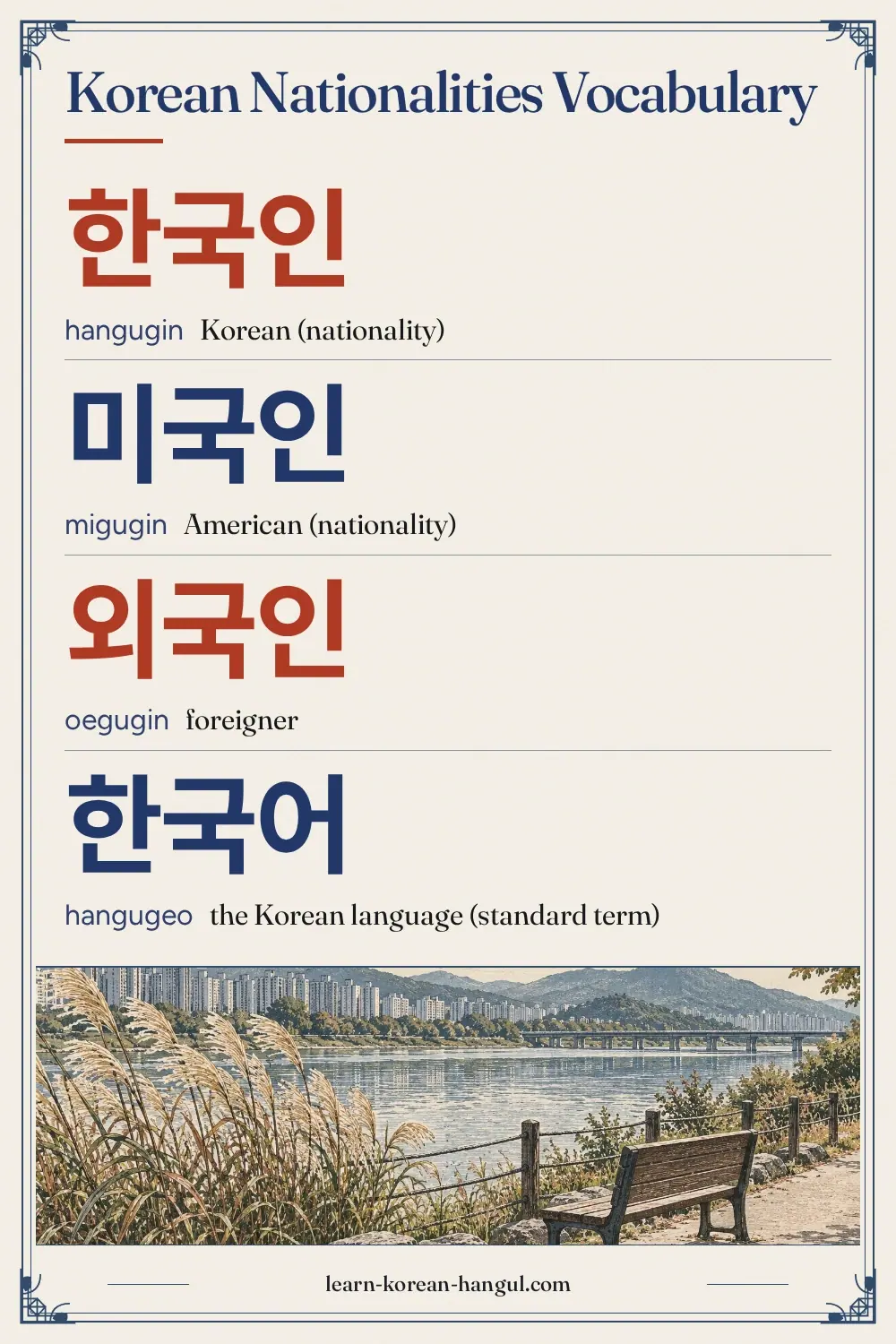
Korean Nationalities Vocabulary at a Glance
This list covers how Korean names a person by country, how it names a language and how it names a continent. It sits inside Geography and Countries. The country names themselves are mostly the same words you already know from the news: 한국, 미국, 일본, 중국. Once you know a country name, you can build the nationality and the language with a short ending.
| Group | Words | Use |
|---|---|---|
| Country + 사람 | 8 | Saying where a person is from in plain speech |
| Country + 인 | 7 | Writing and formal speech: news, forms, signs |
| Languages (-어) | 8 | Naming languages, with 어 meaning language |
| Continents | 6 | Naming the large regions of the world |
| Introducing where you are from | 6 | Questions and answers when you meet someone |
Which Nationality and Language Words Should You Learn First?
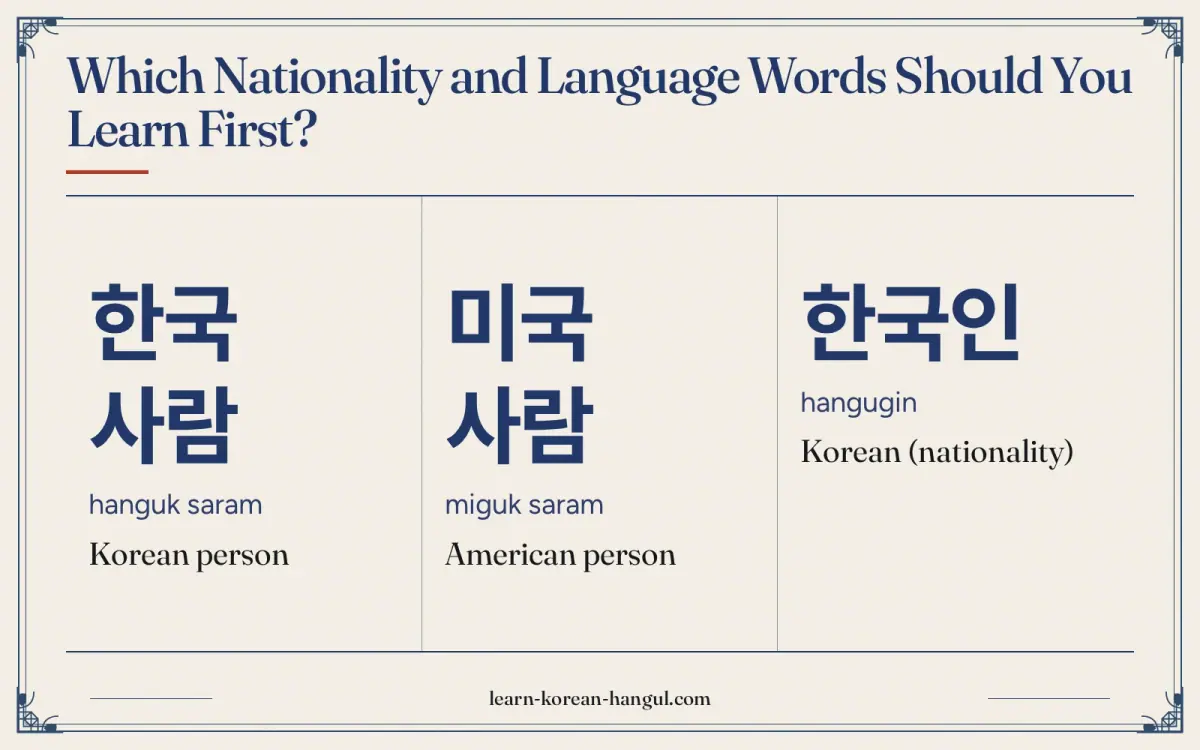
Learn 한국 사람, 외국인, 영어, 한국어 and 어디에서 왔어요? first. They let you say where you are from, name a language and answer the question that opens most first meetings. Then add the country you come from and one or two of its neighbours.
- Words to say. 한국 사람, 미국 사람, 영어, 한국어, 한국말, and your own country name.
- Words to recognise. 한국인, 외국인, 국적 and the -인 forms. They appear on forms, signs and news pages.
- Words to build. Any country name + 사람, 인 or 어. This is a pattern, not a list to memorise.
Two words need a clear split. 한국어 is the dictionary and school word for the Korean language, while 한국말 is what people say in conversation. 외국인 is a general word for a foreigner, and it is common in official writing. In casual talk people more often ask which country someone is from. The scene below shows ten of the words as numbered objects.
Word · 10
- 1
한국 사람
hanguk saram
Korean person
- 2
미국 사람
miguk saram
American person
- 3
한국인
hangugin
Korean (nationality)
- 4
미국인
migugin
American (nationality)
- 5
외국인
oegugin
foreigner
- 6
한국어
hangugeo
the Korean language (standard term)
- 7
한국말
hangungmal
Korean (spoken language)
- 8
영어
yeongeo
English (language)
- 9
아시아
asia
Asia
- 10
국적
gukjeok
nationality
Country + 사람
The spoken pattern is the country name plus 사람, which means person. 한국 사람 is a Korean person, 미국 사람 is an American and 일본 사람 is a Japanese person. It is two words with a space. You attach the copula 이에요 or 예요 to say who someone is: 저는 한국 사람이에요, I am Korean. Use 이에요 after a consonant (사람이에요) and 예요 after a vowel.
| No. | Hangul | Revised Romanization | Meaning and note | Example sentence | Audio assetId |
|---|---|---|---|---|---|
| 1 | 한국 사람 | hanguk saram | Korean person. The everyday spoken pattern: country + 사람 (person). | 저는 한국 사람이에요. (I am Korean.) | au-pg-vocabulary-nature-geography-nationalities-languages-1; example: au-pg-vocabulary-nature-geography-nationalities-languages-36 |
| 2 | 미국 사람 | miguk saram | American person. Spoken and friendly. | 제 친구는 미국 사람이에요. (My friend is American.) | au-pg-vocabulary-nature-geography-nationalities-languages-2; example: au-pg-vocabulary-nature-geography-nationalities-languages-37 |
| 3 | 일본 사람 | ilbon saram | Japanese person. Said [일본 사람]; the two words stay separate. | 일본 사람을 만났어요. (I met a Japanese person.) | au-pg-vocabulary-nature-geography-nationalities-languages-3; example: au-pg-vocabulary-nature-geography-nationalities-languages-38 |
| 4 | 중국 사람 | jungguk saram | Chinese person. Add 이 아니에요 to say someone is not. | 저는 중국 사람이 아니에요. (I am not Chinese.) | au-pg-vocabulary-nature-geography-nationalities-languages-4; example: au-pg-vocabulary-nature-geography-nationalities-languages-39 |
| 5 | 영국 사람 | yeongguk saram | British person. 영국 is the United Kingdom, not the language. | 영국 사람이 왔어요. (A British person came.) | au-pg-vocabulary-nature-geography-nationalities-languages-5; example: au-pg-vocabulary-nature-geography-nationalities-languages-40 |
| 6 | 프랑스 사람 | peurangseu saram | French person. 프랑스 is a loanword for France. | 프랑스 사람하고 이야기했어요. (I talked with a French person.) | au-pg-vocabulary-nature-geography-nationalities-languages-6; example: au-pg-vocabulary-nature-geography-nationalities-languages-41 |
| 7 | 독일 사람 | dogil saram | German person. 독일 is the Korean name for Germany. | 선생님은 독일 사람이에요. (My teacher is German.) | au-pg-vocabulary-nature-geography-nationalities-languages-7; example: au-pg-vocabulary-nature-geography-nationalities-languages-42 |
| 8 | 호주 사람 | hoju saram | Australian person. 호주 is the common name for Australia. | 호주 사람을 알아요. (I know an Australian.) | au-pg-vocabulary-nature-geography-nationalities-languages-8; example: au-pg-vocabulary-nature-geography-nationalities-languages-43 |
Example Sentences
Three sentence frames carry most of these examples. The first is 저는 ○○ 사람이에요, I am a person of ○○. The second is ○○ 사람이 아니에요, I am not from ○○. The third is ○○ 사람을 만났어요, I met a person from ○○. Swap the country and read each aloud after the audio. Note that 저는 marks you as the topic: 는 follows a vowel (저는) and 은 follows a consonant (선생님은).
Country + 사람 is the form you will hear at a party or in a taxi. The next group is the shorter, more formal pattern.
How Do You Say Country + 인 in Korean?
The formal pattern is the country name plus 인, which means person in Sino-Korean. 미국인 is an American, 한국인 is a Korean and 외국인 is a foreigner. Unlike 사람, 인 never stands alone and has no space before it. You see it in news headlines, on forms and in set phrases such as 외국인 등록. Because 인 begins with a vowel, the final consonant of the country moves onto it: 미국인 is said [미구긴].
| No. | Hangul | Revised Romanization | Meaning and note | Example sentence | Audio assetId |
|---|---|---|---|---|---|
| 9 | 한국인 | hangugin | Korean (nationality). Said [한구긴]: the final ㄱ moves to the next syllable. 인 means person. | 한국인 관광객이 많아요. (There are many Korean tourists.) | au-pg-vocabulary-nature-geography-nationalities-languages-9; example: au-pg-vocabulary-nature-geography-nationalities-languages-44 |
| 10 | 미국인 | migugin | American (nationality). Said [미구긴]. Common in news and forms. | 미국인 학생이 두 명 있어요. (There are two American students.) | au-pg-vocabulary-nature-geography-nationalities-languages-10; example: au-pg-vocabulary-nature-geography-nationalities-languages-45 |
| 11 | 일본인 | ilbonin | Japanese (nationality). Said [일보닌]: ㄴ links to the vowel. | 일본인 친구가 있어요. (I have a Japanese friend.) | au-pg-vocabulary-nature-geography-nationalities-languages-11; example: au-pg-vocabulary-nature-geography-nationalities-languages-46 |
| 12 | 중국인 | junggugin | Chinese (nationality). Said [중구긴]. | 중국인 손님이 왔어요. (A Chinese guest arrived.) | au-pg-vocabulary-nature-geography-nationalities-languages-12; example: au-pg-vocabulary-nature-geography-nationalities-languages-47 |
| 13 | 영국인 | yeonggugin | British (nationality). Said [영구긴]. | 영국인 작가의 책을 읽어요. (I read a book by a British author.) | au-pg-vocabulary-nature-geography-nationalities-languages-13; example: au-pg-vocabulary-nature-geography-nationalities-languages-48 |
| 14 | 프랑스인 | peurangseuin | French (nationality). Said [프랑스인]; 인 attaches directly. | 프랑스인 요리사를 만났어요. (I met a French chef.) | au-pg-vocabulary-nature-geography-nationalities-languages-14; example: au-pg-vocabulary-nature-geography-nationalities-languages-49 |
| 15 | 외국인 | oegugin | foreigner. Said [외구긴]. Often an official or news word; 외국 사람 is softer. | 외국인도 신청할 수 있어요. (Foreigners can apply too.) | au-pg-vocabulary-nature-geography-nationalities-languages-15; example: au-pg-vocabulary-nature-geography-nationalities-languages-50 |
The two patterns mean the same thing, so choose by setting. Say 미국 사람 to a new friend and expect to read 미국인 in a newspaper. 프랑스 and 영국 take both patterns too. For a country-by-country order of learning, see the next section.
Languages (-어)
A language name is usually the country name plus 어, which means language: 영어 is English, 중국어 is Chinese and 일본어 is Japanese. The country half is sometimes shortened or changed. English is 영어 even though the country is 영국, the United Kingdom. Korean has two names for its own language. 한국어 is the standard, textbook word. 한국말 is the everyday word, where 말 means speech.
| No. | Hangul | Revised Romanization | Meaning and note | Example sentence | Audio assetId |
|---|---|---|---|---|---|
| 16 | 한국어 | hangugeo | the Korean language (standard term). Said [한구거]. Used in schools and books. | 한국어를 배워요. (I am learning Korean.) | au-pg-vocabulary-nature-geography-nationalities-languages-16; example: au-pg-vocabulary-nature-geography-nationalities-languages-51 |
| 17 | 한국말 | hangungmal | Korean (spoken language). Said [한궁말]: ㄱ before ㅁ becomes ㅇ. The everyday word. | 한국말을 잘해요. (You speak Korean well.) | au-pg-vocabulary-nature-geography-nationalities-languages-17; example: au-pg-vocabulary-nature-geography-nationalities-languages-52 |
| 18 | 영어 | yeongeo | English (language). Not the same as 영국 (the UK). | 영어로 말해요. (I speak in English.) | au-pg-vocabulary-nature-geography-nationalities-languages-18; example: au-pg-vocabulary-nature-geography-nationalities-languages-53 |
| 19 | 중국어 | junggugeo | Chinese (language). Said [중구거]. | 중국어는 어려워요. (Chinese is difficult.) | au-pg-vocabulary-nature-geography-nationalities-languages-19; example: au-pg-vocabulary-nature-geography-nationalities-languages-54 |
| 20 | 일본어 | ilboneo | Japanese (language). Said [일보너]. | 일본어 수업이 있어요. (There is a Japanese class.) | au-pg-vocabulary-nature-geography-nationalities-languages-20; example: au-pg-vocabulary-nature-geography-nationalities-languages-55 |
| 21 | 스페인어 | seupeineo | Spanish (language). From 스페인 (Spain) plus 어. | 스페인어를 공부해요. (I study Spanish.) | au-pg-vocabulary-nature-geography-nationalities-languages-21; example: au-pg-vocabulary-nature-geography-nationalities-languages-56 |
| 22 | 프랑스어 | peurangseueo | French (language). From 프랑스 (France) plus 어. | 프랑스어 책이에요. (It is a French book.) | au-pg-vocabulary-nature-geography-nationalities-languages-22; example: au-pg-vocabulary-nature-geography-nationalities-languages-57 |
| 23 | 외국어 | oegugeo | foreign language. Said [외구거]. 외국 means foreign country. | 외국어를 하나 더 배우고 싶어요. (I want to learn one more foreign language.) | au-pg-vocabulary-nature-geography-nationalities-languages-23; example: au-pg-vocabulary-nature-geography-nationalities-languages-58 |
To say you speak or study a language, put 을 after a consonant and 를 after a vowel, then add a verb: 한국어를 배워요, 영어를 공부해요. The particle 로 shows the language you use, as in 영어로 말해요.
How Do You Say Continents in Korean?
Continent names are loanwords written in Hangul, so they are easy to read: 아시아, 유럽, 아프리카. The Americas are split as 북아메리카 (north) and 남아메리카 (south), and 오세아니아 is the region that includes Australia. The word 대륙 means continent, so you may also see 아시아 대륙 in a geography book. Locations take the particle 에, as in 아시아에 있어요, it is in Asia.
| No. | Hangul | Revised Romanization | Meaning and note | Example sentence | Audio assetId |
|---|---|---|---|---|---|
| 24 | 아시아 | asia | Asia. A loanword; stress is even. | 한국은 아시아에 있어요. (Korea is in Asia.) | au-pg-vocabulary-nature-geography-nationalities-languages-24; example: au-pg-vocabulary-nature-geography-nationalities-languages-59 |
| 25 | 유럽 | yureop | Europe. Loanword; the final ㅂ is not released. | 유럽에 가 봤어요. (I have been to Europe.) | au-pg-vocabulary-nature-geography-nationalities-languages-25; example: au-pg-vocabulary-nature-geography-nationalities-languages-60 |
| 26 | 아프리카 | apeurika | Africa. Loanword. | 아프리카는 커요. (Africa is big.) | au-pg-vocabulary-nature-geography-nationalities-languages-26; example: au-pg-vocabulary-nature-geography-nationalities-languages-61 |
| 27 | 북아메리카 | bugamerika | North America. Said [부가메리카]. 북 means north. | 미국은 북아메리카에 있어요. (The United States is in North America.) | au-pg-vocabulary-nature-geography-nationalities-languages-27; example: au-pg-vocabulary-nature-geography-nationalities-languages-62 |
| 28 | 남아메리카 | namamerika | South America. Said [나마메리카]. 남 means south. | 브라질은 남아메리카에 있어요. (Brazil is in South America.) | au-pg-vocabulary-nature-geography-nationalities-languages-28; example: au-pg-vocabulary-nature-geography-nationalities-languages-63 |
| 29 | 오세아니아 | oseania | Oceania. Loanword for the region around Australia. | 호주는 오세아니아에 있어요. (Australia is in Oceania.) | au-pg-vocabulary-nature-geography-nationalities-languages-29; example: au-pg-vocabulary-nature-geography-nationalities-languages-64 |
Country names do not follow the continents. The United States is 미국 even though the continent is 북아메리카, so learn each country as its own word.
Introducing Where You Are From
These six items are the exchange you will use most. A Korean speaker will often ask 어느 나라 사람이에요? or 어디에서 왔어요?. You reply with the country plus 에서 왔어요, which means I came from. The particle 에서 marks the starting point. You can also answer with the pattern from the first group, 저는 호주 사람이에요.
| No. | Hangul | Revised Romanization | Meaning and note | Example sentence | Audio assetId |
|---|---|---|---|---|---|
| 30 | 나라 | nara | country. The everyday native word; 어느 나라 means which country. | 저는 다른 나라에서 왔어요. (I come from another country.) | au-pg-vocabulary-nature-geography-nationalities-languages-30; example: au-pg-vocabulary-nature-geography-nationalities-languages-65 |
| 31 | 국적 | gukjeok | nationality. Said [국쩍]. Used on forms and at borders. | 국적이 어디예요? (What is your nationality?) | au-pg-vocabulary-nature-geography-nationalities-languages-31; example: au-pg-vocabulary-nature-geography-nationalities-languages-66 |
| 32 | 어느 나라 사람이에요? | eoneu nara saramieyo? | Which country are you from? Literally, which-country person are you? | 실례지만, 어느 나라 사람이에요? (Excuse me, which country are you from?) | au-pg-vocabulary-nature-geography-nationalities-languages-32; example: au-pg-vocabulary-nature-geography-nationalities-languages-67 |
| 33 | 어디에서 왔어요? | eodieseo wasseoyo? | Where did you come from? Said [어디에서 와써요]. | 어디에서 왔어요? 미국에서 왔어요. (Where are you from? I am from the United States.) | au-pg-vocabulary-nature-geography-nationalities-languages-33; example: au-pg-vocabulary-nature-geography-nationalities-languages-68 |
| 34 | 호주에서 왔어요 | hojueseo wasseoyo | I come from Australia. Replace 호주 with any country. | 저는 호주에서 왔어요. (I come from Australia.) | au-pg-vocabulary-nature-geography-nationalities-languages-34; example: au-pg-vocabulary-nature-geography-nationalities-languages-69 |
| 35 | 한국어를 배워요 | hangugeoreul baewoyo | I am learning Korean. A natural follow-up in a first meeting. | 서울에서 한국어를 배워요. (I learn Korean in Seoul.) | au-pg-vocabulary-nature-geography-nationalities-languages-35; example: au-pg-vocabulary-nature-geography-nationalities-languages-70 |
If you want to go further, the page on introducing yourself puts these items into a full first meeting. City and province names are on Korean Cities Vocabulary and Korean Provinces Vocabulary.
How Do You Pronounce These Words?
Nationality words link their final consonants to the next vowel and nasalise before ㅁ. Standard pronunciation follows the National Institute of Korean Language (국립국어원) rules. The romanization follows the Revised Romanization of Korean, which shows linking and nasalization (한국말 is hangungmal) but not tensing (국적 is gukjeok, said [국쩍]).
| Spelling | Sounds like | What changes |
|---|---|---|
| 한국인 | [한구긴] | The final ㄱ of 한국 moves to the empty ㅇ of 인. |
| 미국인 | [미구긴] | The same linking: ㄱ + 인 sounds like 기 + ㄴ. |
| 일본어 | [일보너] | The final ㄴ of 본 moves onto the vowel of 어. |
| 한국말 | [한궁말] | Nasalization: ㄱ before ㅁ is said as ㅇ. |
| 국적 | [국쩍] | After a final ㄱ, ㅈ is said as tense [ㅉ]. |
| 왔어요 | [와써요] | The final ㅆ is carried to the next vowel and said as ㅆ. |
Linking is the main habit to learn. Say 미국 and 인 as separate words, then merge them so the ㄱ lands on the next syllable. The nasalization in 한국말 is the second sound to practise: your lips close for ㅁ, so the ㄱ turns into a nasal [ㅇ].
Audio and Slow Playback
Each word and sentence has its own clip. The five clips below replay the hardest words slowly. Play one, repeat it aloud, then play it again and compare.
What Mistakes Do Learners Make with Nationality and Language Words?
Five mistakes come up again and again.
- Adding 사람 to a language. 영어 사람 is not a nationality. For an English person, say 영국 사람 or 영국인.
- Writing 인 as a separate word. 미국 인 is wrong. The formal pattern is one word, 미국인.
- Mixing up country and language. 한국 is the country and 한국어 is the language. 한국을 배워요 would mean learning the country, so say 한국어를 배워요.
- Confusing 영국 and 영어. 영국 is the United Kingdom, and 영어 is English. They share 영 but name different things.
- Using 외국인 to describe a person to their face. The word is correct, but it points out that someone is an outsider. Asking 어느 나라 사람이에요? is warmer.
Most of these mistakes come from reusing English word shapes, where one word covers country, person and language. Korean keeps three endings apart. The practice section turns the list into drills.
Practice: Flashcards and Worksheet
Work in three steps. Start the flashcard deck in recognition mode until you know all 35 words. Switch to listening mode, then take the quiz. The deck covers every word on this page with audio, and your progress stays in your browser. The vocabulary flashcard decks page lists the other decks.
Practice · 75
- 01한국 사람
Show answer
headword 1: Korean person
- 02미국 사람
Show answer
headword 2: American person
- 03일본 사람
Show answer
headword 3: Japanese person
- 04중국 사람
Show answer
headword 4: Chinese person
- 05영국 사람
Show answer
headword 5: British person
- 06프랑스 사람
Show answer
headword 6: French person
- 07독일 사람
Show answer
headword 7: German person
- 08호주 사람
Show answer
headword 8: Australian person
- 09한국인
Show answer
headword 9: Korean (nationality)
- 10미국인
Show answer
headword 10: American (nationality)
- 11일본인
Show answer
headword 11: Japanese (nationality)
- 12중국인
Show answer
headword 12: Chinese (nationality)
- 13영국인
Show answer
headword 13: British (nationality)
- 14프랑스인
Show answer
headword 14: French (nationality)
- 15외국인
Show answer
headword 15: foreigner
- 16한국어
Show answer
headword 16: the Korean language (standard term)
- 17한국말
Show answer
headword 17: Korean (spoken language)
- 18영어
Show answer
headword 18: English (language)
- 19중국어
Show answer
headword 19: Chinese (language)
- 20일본어
Show answer
headword 20: Japanese (language)
- 21스페인어
Show answer
headword 21: Spanish (language)
- 22프랑스어
Show answer
headword 22: French (language)
- 23외국어
Show answer
headword 23: foreign language
- 24아시아
Show answer
headword 24: Asia
- 25유럽
Show answer
headword 25: Europe
- 26아프리카
Show answer
headword 26: Africa
- 27북아메리카
Show answer
headword 27: North America
- 28남아메리카
Show answer
headword 28: South America
- 29오세아니아
Show answer
headword 29: Oceania
- 30나라
Show answer
headword 30: country
- 31국적
Show answer
headword 31: nationality
- 32어느 나라 사람이에요?
Show answer
headword 32: Which country are you from?
- 33어디에서 왔어요?
Show answer
headword 33: Where did you come from?
- 34호주에서 왔어요
Show answer
headword 34: I come from Australia
- 35한국어를 배워요
Show answer
headword 35: I am learning Korean
- 36저는 한국 사람이에요.
Show answer
example sentence for 한국 사람
- 37제 친구는 미국 사람이에요.
Show answer
example sentence for 미국 사람
- 38일본 사람을 만났어요.
Show answer
example sentence for 일본 사람
- 39저는 중국 사람이 아니에요.
Show answer
example sentence for 중국 사람
- 40영국 사람이 왔어요.
Show answer
example sentence for 영국 사람
- 41프랑스 사람하고 이야기했어요.
Show answer
example sentence for 프랑스 사람
- 42선생님은 독일 사람이에요.
Show answer
example sentence for 독일 사람
- 43호주 사람을 알아요.
Show answer
example sentence for 호주 사람
- 44한국인 관광객이 많아요.
Show answer
example sentence for 한국인
- 45미국인 학생이 두 명 있어요.
Show answer
example sentence for 미국인
- 46일본인 친구가 있어요.
Show answer
example sentence for 일본인
- 47중국인 손님이 왔어요.
Show answer
example sentence for 중국인
- 48영국인 작가의 책을 읽어요.
Show answer
example sentence for 영국인
- 49프랑스인 요리사를 만났어요.
Show answer
example sentence for 프랑스인
- 50외국인도 신청할 수 있어요.
Show answer
example sentence for 외국인
- 51한국어를 배워요.
Show answer
example sentence for 한국어
- 52한국말을 잘해요.
Show answer
example sentence for 한국말
- 53영어로 말해요.
Show answer
example sentence for 영어
- 54중국어는 어려워요.
Show answer
example sentence for 중국어
- 55일본어 수업이 있어요.
Show answer
example sentence for 일본어
- 56스페인어를 공부해요.
Show answer
example sentence for 스페인어
- 57프랑스어 책이에요.
Show answer
example sentence for 프랑스어
- 58외국어를 하나 더 배우고 싶어요.
Show answer
example sentence for 외국어
- 59한국은 아시아에 있어요.
Show answer
example sentence for 아시아
- 60유럽에 가 봤어요.
Show answer
example sentence for 유럽
- 61아프리카는 커요.
Show answer
example sentence for 아프리카
- 62미국은 북아메리카에 있어요.
Show answer
example sentence for 북아메리카
- 63브라질은 남아메리카에 있어요.
Show answer
example sentence for 남아메리카
- 64호주는 오세아니아에 있어요.
Show answer
example sentence for 오세아니아
- 65저는 다른 나라에서 왔어요.
Show answer
example sentence for 나라
- 66국적이 어디예요?
Show answer
example sentence for 국적
- 67실례지만, 어느 나라 사람이에요?
Show answer
example sentence for 어느 나라 사람이에요?
- 68어디에서 왔어요? 미국에서 왔어요.
Show answer
example sentence for 어디에서 왔어요?
- 69저는 호주에서 왔어요.
Show answer
example sentence for 호주에서 왔어요
- 70서울에서 한국어를 배워요.
Show answer
example sentence for 한국어를 배워요
- 71미국인
Show answer
slow playback: 미국인
- 72한국말
Show answer
slow playback: 한국말
- 73일본어
Show answer
slow playback: 일본어
- 74국적
Show answer
slow playback: 국적
- 75외국인
Show answer
slow playback: 외국인
Practice · 5
What does 한국 사람 (hanguk saram) mean?
Show answer
Korean person
한국 사람 means Korean person. Example: 저는 한국 사람이에요. (I am Korean.)
What does 미국인 (migugin) mean?
Show answer
American (nationality)
미국인 means American (nationality). Example: 미국인 학생이 두 명 있어요. (There are two American students.)
What does 외국인 (oegugin) mean?
Show answer
foreigner
외국인 means foreigner. Example: 외국인도 신청할 수 있어요. (Foreigners can apply too.)
What does 한국말 (hangungmal) mean?
Show answer
Korean (spoken language)
한국말 means Korean (spoken language). Example: 한국말을 잘해요. (You speak Korean well.)
What does 아시아 (asia) mean?
Show answer
Asia
아시아 means Asia. Example: 한국은 아시아에 있어요. (Korea is in Asia.)
Korean Nationalities Vocabulary Worksheet (PDF)
A printable worksheet for these words (word list, matching, writing practice, fill-in-the-blank exercises and answer key) is available in A4 and US Letter from the download card on this page. For practice, write a sentence for each of your friends: 제 친구는 ○○ 사람이에요 and name the language they speak.
Where to Go Next
After this page, continue with Korean Cities Vocabulary or Korean Provinces Vocabulary. For a full first meeting, see introducing yourself. To move up a level, return to Geography and Countries.
Frequently Asked Questions
How Do You Say Korean Person in Korean?
Korean person is 한국 사람 (hanguk saram). The formal word is 한국인 (hangugin), said [한구긴]. Use 한국 사람 in conversation, as in 저는 한국 사람이에요, and 한국인 in writing and news.
How Do You Pronounce 미국인 (migugin)?
Say mi-gu-gin. The final ㄱ of 미국 moves to the next syllable, so the word sounds like [미구긴]. Press the audio button on this page to hear it and the slow clip. The romanization migugin already reflects this linking.
How Many Nationality and Language Words Should I Learn First?
Start with five: 한국 사람, 외국인, 영어, 한국어 and 어디에서 왔어요?. Then learn your own country with the three endings 사람, 인 and 어. At five new words a day the full list of 35 takes a week plus review.
Where Can I Practise Nationality and Language Words with Flashcards?
Use the vocabulary flashcard decks. The deck for this page holds all 35 words with Hangul, romanization and audio, in recognition and listening modes. Your progress stays in your browser.
Is the Romanization on This Page Official?
It follows the Revised Romanization of Korean, which South Korea adopted on 7 July 2000 and whose rules the National Institute of Korean Language (국립국어원) publishes. It is a learning aid and does not mark every sound change, so rely on the Hangul and the audio.
Is There a Printable Worksheet for Nationality and Language Words?
A printable worksheet for these words (word list, matching, writing practice, fill-in-the-blank exercises and answer key) is available in A4 and US Letter from the download card on this page. For practice, use the flashcard deck, which carries the same 35 words, or copy the tables by hand.