
Countries in Korean at a Glance
Country names help you introduce yourself, talk about travel and read the news. Most Korean country names are loanwords that sound like the English name, so many are easy to guess. A few use a Sino-Korean name instead, and they are the ones to learn carefully: 독일 (Germany), 호주 (Australia), 영국 (the UK) and 미국 (the USA).
The page is arranged by region, with the countries that learners meet most often in each group. The word for country is 나라 (nara), and the word for foreign country is 외국 (oeguk). Names of languages and people are built from the country names, and the patterns are explained further down.
The list holds 50 words. By origin, the list has 11 Sino-Korean, 38 loanword and 1 mixed word. "Mixed" means a word that combines parts of different origins: 남아프리카공화국 joins Sino-Korean 남 (south) and 공화국 (republic) with the loanword 아프리카. Most names are loanwords. The Sino-Korean names, such as 한국, 일본, 중국, 미국 and 영국, are short and often appear in the news.
| Group | Words | Examples |
|---|---|---|
| Asia and Oceania | 14 | 한국, 북한, 일본, 중국 |
| Europe | 14 | 영국, 프랑스, 독일, 이탈리아 |
| North and South America | 10 | 미국, 캐나다, 멕시코, 브라질 |
| Africa and the Middle East | 12 | 이집트, 남아프리카공화국, 케냐, 에티오피아 |
This list sits inside Nature and the World. It also leads to seven deeper pages: nationalities and languages, Korean cities, provinces, landscape, mountains and hiking, the ocean and beach, and space.
Which Country Names Should You Learn First?
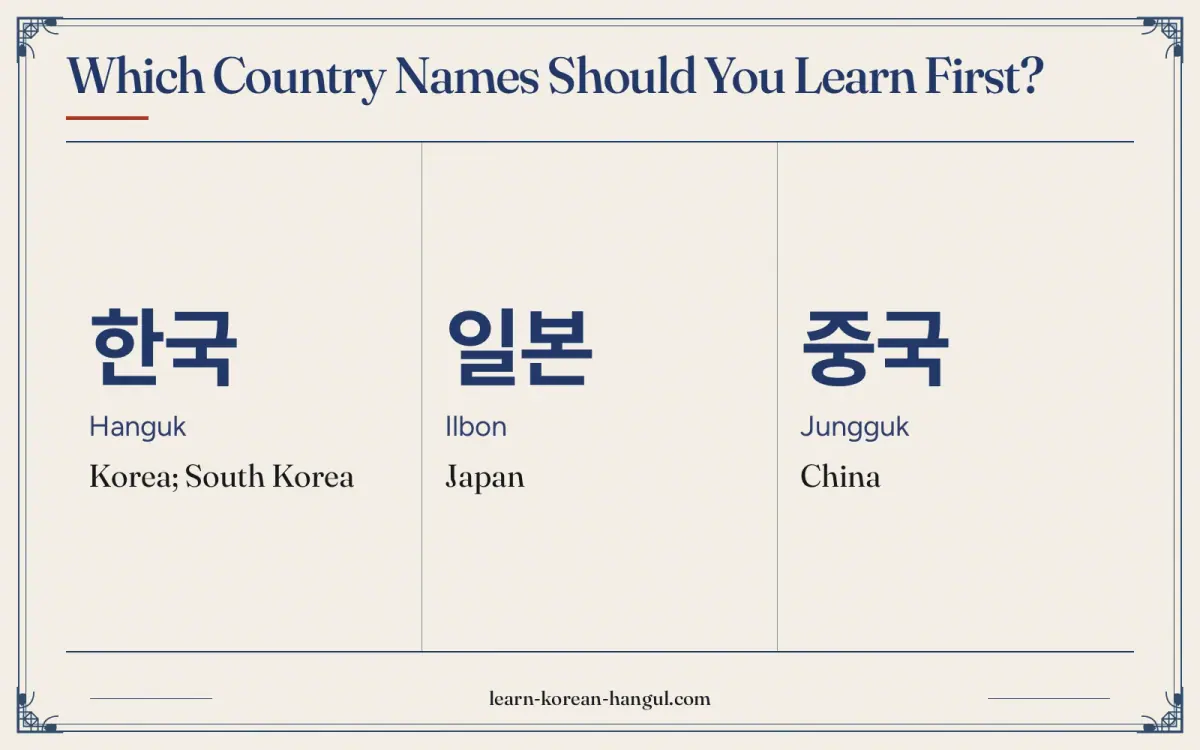
Start with five countries that come up most often in introductions: 한국, 미국, 일본, 중국 and 호주. Use the scene to see eight countries at once, then press play and the slow button on each of the five and say the word aloud.
Word · 8
- 1
한국
Hanguk
Korea; South Korea
- 2
일본
Ilbon
Japan
- 3
중국
Jungguk
China
- 4
미국
Miguk
the United States; USA
- 5
캐나다
Kaenada
Canada
- 6
호주
Hoju
Australia
- 7
영국
Yeongguk
the United Kingdom; Britain
- 8
프랑스
Peurangseu
France
한국 (Hanguk) is the Korean name for Korea; South Korea. This is the everyday name for South Korea. The formal name is 대한민국. Example: 한국에서 한국어를 배워요. (I learn Korean in Korea.)
미국 (Miguk) is the Korean name for the United States; USA. The language is 영어 (English). A person is 미국 사람. Example: 미국에서 영어를 써요. (They use English in the USA.)
일본 (Ilbon) is the Korean name for Japan. The ㄹ closes the first syllable: il-bon. Example: 일본은 한국의 이웃 나라예요. (Japan is a neighboring country of Korea.)
중국 (Jungguk) is the Korean name for China. Example: 중국은 아주 커요. (China is very big.)
호주 (Hoju) is the Korean name for Australia. The name is based on a Chinese-character name. The formal name is 오스트레일리아. Example: 호주에는 캥거루가 있어요. (There are kangaroos in Australia.)
Asia and Oceania
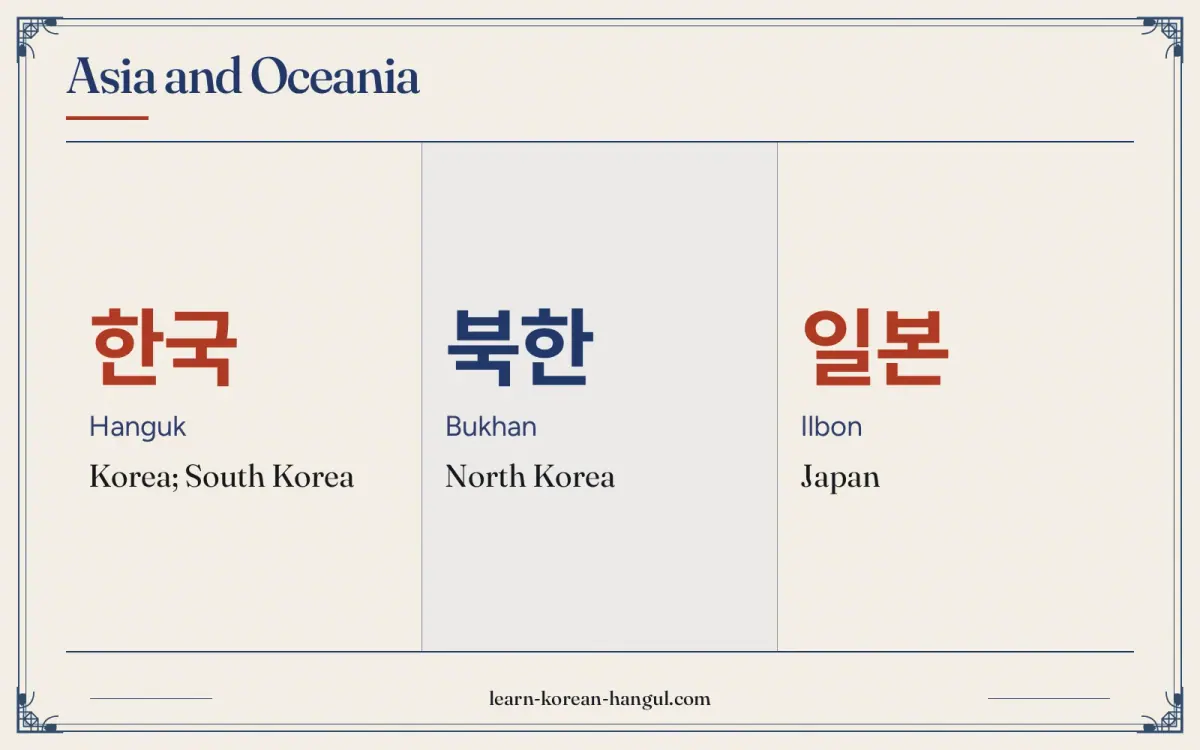
Asia is where most learners start, because Korea sits in the group. The group has fourteen names, and it includes Korea, its neighbors, Southeast Asia, India and Oceania. Eight of the fourteen are Sino-Korean names and six are loanwords.
| No. | Hangul | Revised Romanization | Meaning | Origin | Example sentence | Audio assetId |
|---|---|---|---|---|---|---|
| 1 | 한국 | Hanguk | Korea; South Korea | Sino-Korean | 한국에서 한국어를 배워요. (Hangugeseo hangugeoreul baewoyo; I learn Korean in Korea.) | au-pg-vocabulary-nature-geography-1; example: au-pg-vocabulary-nature-geography-101 |
| 2 | 북한 | Bukhan | North Korea | Sino-Korean | 북한은 한국의 북쪽에 있어요. (Bukhaneun Hangugui bukjjoge isseoyo; North Korea is north of South Korea.) | au-pg-vocabulary-nature-geography-2; example: au-pg-vocabulary-nature-geography-102 |
| 3 | 일본 | Ilbon | Japan | Sino-Korean | 일본은 한국의 이웃 나라예요. (Ilboneun Hangugui iut narayeyo; Japan is a neighboring country of Korea.) | au-pg-vocabulary-nature-geography-3; example: au-pg-vocabulary-nature-geography-103 |
| 4 | 중국 | Jungguk | China | Sino-Korean | 중국은 아주 커요. (Junggugeun aju keoyo; China is very big.) | au-pg-vocabulary-nature-geography-4; example: au-pg-vocabulary-nature-geography-104 |
| 5 | 대만 | Daeman | Taiwan | Sino-Korean | 대만에 여행 가고 싶어요. (Daemane yeohaeng gago sipeoyo; I want to travel to Taiwan.) | au-pg-vocabulary-nature-geography-5; example: au-pg-vocabulary-nature-geography-105 |
| 6 | 몽골 | Monggol | Mongolia | loanword | 몽골에는 넓은 초원이 있어요. (Monggoreneun neolbeun chowoni isseoyo; Mongolia has wide grasslands.) | au-pg-vocabulary-nature-geography-6; example: au-pg-vocabulary-nature-geography-106 |
| 7 | 베트남 | Beteunam | Vietnam | loanword | 베트남 쌀국수를 좋아해요. (Beteunam ssalguksureul joahaeyo; I like Vietnamese rice noodles.) | au-pg-vocabulary-nature-geography-7; example: au-pg-vocabulary-nature-geography-107 |
| 8 | 태국 | Taeguk | Thailand | Sino-Korean | 태국에서 휴가를 보냈어요. (Taegugeseo hyugareul bonaesseoyo; I spent my vacation in Thailand.) | au-pg-vocabulary-nature-geography-8; example: au-pg-vocabulary-nature-geography-108 |
| 9 | 필리핀 | Pillipin | the Philippines | loanword | 필리핀은 섬이 많아요. (Pillipineun seomi manayo; The Philippines has many islands.) | au-pg-vocabulary-nature-geography-9; example: au-pg-vocabulary-nature-geography-109 |
| 10 | 인도 | Indo | India | Sino-Korean | 인도는 인구가 많아요. (Indoneun inguga manayo; India has a large population.) | au-pg-vocabulary-nature-geography-10; example: au-pg-vocabulary-nature-geography-110 |
| 11 | 싱가포르 | Singgaporeu | Singapore | loanword | 싱가포르는 작은 나라예요. (Singgaporeuneun jageun narayeyo; Singapore is a small country.) | au-pg-vocabulary-nature-geography-11; example: au-pg-vocabulary-nature-geography-111 |
| 12 | 인도네시아 | Indonesia | Indonesia | loanword | 인도네시아에서 친구가 왔어요. (Indonesiaeseo chinguga wasseoyo; A friend came from Indonesia.) | au-pg-vocabulary-nature-geography-12; example: au-pg-vocabulary-nature-geography-112 |
| 13 | 호주 | Hoju | Australia | Sino-Korean | 호주에는 캥거루가 있어요. (Hojueneun kaenggeoruga isseoyo; There are kangaroos in Australia.) | au-pg-vocabulary-nature-geography-13; example: au-pg-vocabulary-nature-geography-113 |
| 14 | 뉴질랜드 | Nyujillaendeu | New Zealand | loanword | 뉴질랜드는 호주 옆에 있어요. (Nyujillaendeuneun Hoju yeope isseoyo; New Zealand is next to Australia.) | au-pg-vocabulary-nature-geography-14; example: au-pg-vocabulary-nature-geography-114 |
- 한국 is the everyday name and 대한민국 is the formal name. The section on the names of Korea explains the choice.
- 일본 and 중국 are Sino-Korean names that are used for both the country and its things: 일본 음식 (Japanese food) and 중국 음식 (Chinese food).
- Names such as 베트남, 태국 and 필리핀 are often used before a noun without any particle: 베트남 쌀국수 (Vietnamese rice noodles).
Example Sentences
Country sentences use country + 은/는 + description: 중국은 아주 커요 (China is very big). Use 은 after a consonant and 는 after a vowel: 일본은 and 영국은 (consonant), 호주는 and 프랑스는 (vowel). For where something is, add 에 and 있어요: 이집트에 피라미드가 있어요 (there are pyramids in Egypt). For where you came from, add 에서 and 왔어요: 이스라엘에서 왔어요 (I came from Israel). To use a country as a describing word, put it before the noun: 프랑스 빵 (French bread).
How Do You Say Europe in Korean?
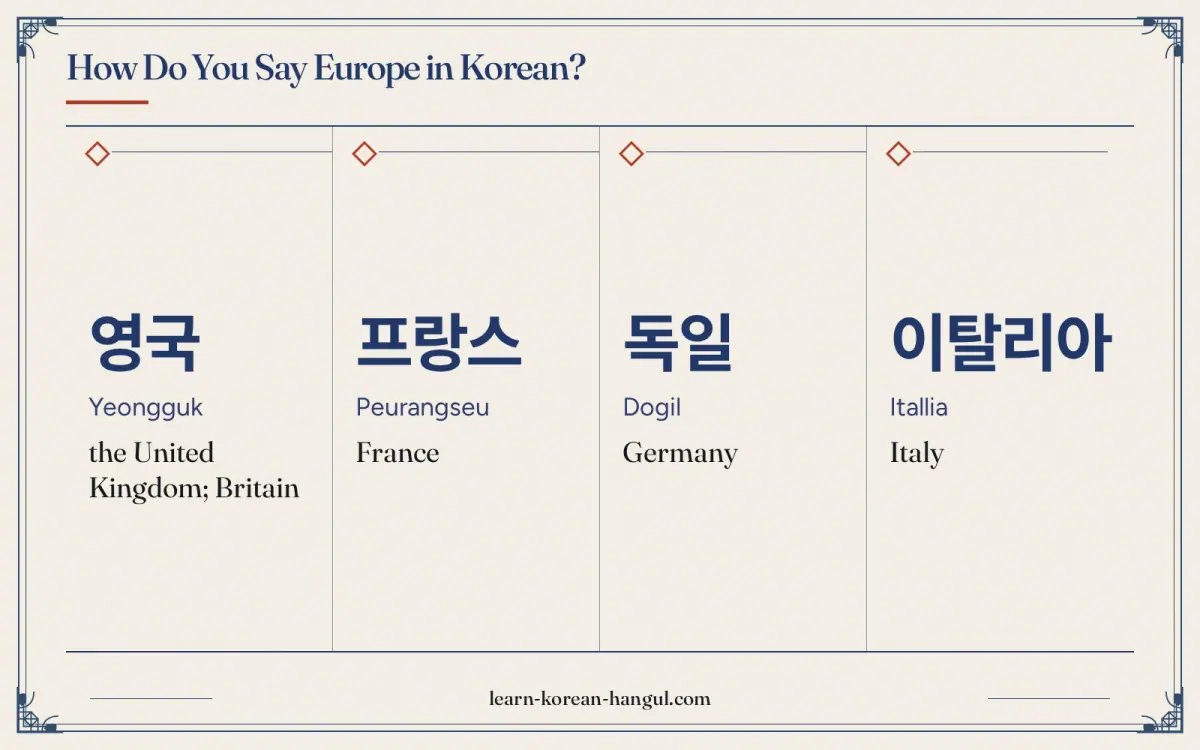
Europe has fourteen names in this list, and only two are Sino-Korean: 영국 and 독일. The others are loanwords that sound like the English name, so you can often guess them. The sentences below mention food, weather and neighbors.
| No. | Hangul | Revised Romanization | Meaning | Origin | Example sentence | Audio assetId |
|---|---|---|---|---|---|---|
| 15 | 영국 | Yeongguk | the United Kingdom; Britain | Sino-Korean | 영국은 비가 자주 와요. (Yeonggugeun biga jaju wayo; It often rains in the UK.) | au-pg-vocabulary-nature-geography-15; example: au-pg-vocabulary-nature-geography-115 |
| 16 | 프랑스 | Peurangseu | France | loanword | 프랑스 빵이 맛있어요. (Peurangseu ppangi masisseoyo; French bread is tasty.) | au-pg-vocabulary-nature-geography-16; example: au-pg-vocabulary-nature-geography-116 |
| 17 | 독일 | Dogil | Germany | Sino-Korean | 독일은 소시지가 유명해요. (Dogireun sosijiga yumyeonghaeyo; Germany is famous for sausages.) | au-pg-vocabulary-nature-geography-17; example: au-pg-vocabulary-nature-geography-117 |
| 18 | 이탈리아 | Itallia | Italy | loanword | 이탈리아에서 피자를 먹었어요. (Italliaeseo pijareul meogeosseoyo; I ate pizza in Italy.) | au-pg-vocabulary-nature-geography-18; example: au-pg-vocabulary-nature-geography-118 |
| 19 | 스페인 | Seupein | Spain | loanword | 스페인은 날씨가 따뜻해요. (Seupeineun nalssiga ttatteutaeyo; The weather in Spain is warm.) | au-pg-vocabulary-nature-geography-19; example: au-pg-vocabulary-nature-geography-119 |
| 20 | 포르투갈 | Poreutugal | Portugal | loanword | 포르투갈은 스페인 옆에 있어요. (Poreutugareun Seupein yeope isseoyo; Portugal is next to Spain.) | au-pg-vocabulary-nature-geography-20; example: au-pg-vocabulary-nature-geography-120 |
| 21 | 네덜란드 | Nedeollandeu | the Netherlands | loanword | 네덜란드는 자전거가 많아요. (Nedeollandeuneun jajeongeoga manayo; The Netherlands has many bicycles.) | au-pg-vocabulary-nature-geography-21; example: au-pg-vocabulary-nature-geography-121 |
| 22 | 스위스 | Seuwiseu | Switzerland | loanword | 스위스에는 산이 많아요. (Seuwiseueneun sani manayo; Switzerland has many mountains.) | au-pg-vocabulary-nature-geography-22; example: au-pg-vocabulary-nature-geography-122 |
| 23 | 러시아 | Reosia | Russia | loanword | 러시아는 아주 넓어요. (Reosianeun aju neolbeoyo; Russia is very large.) | au-pg-vocabulary-nature-geography-23; example: au-pg-vocabulary-nature-geography-123 |
| 24 | 그리스 | Geuriseu | Greece | loanword | 그리스에서 바다를 봤어요. (Geuriseueseo badareul bwasseoyo; I saw the sea in Greece.) | au-pg-vocabulary-nature-geography-24; example: au-pg-vocabulary-nature-geography-124 |
| 25 | 스웨덴 | Seuweden | Sweden | loanword | 스웨덴은 겨울이 길어요. (Seuwedeneun gyeouri gireoyo; Winters are long in Sweden.) | au-pg-vocabulary-nature-geography-25; example: au-pg-vocabulary-nature-geography-125 |
| 26 | 노르웨이 | Noreuwei | Norway | loanword | 노르웨이는 추워요. (Noreuweineun chuwoyo; Norway is cold.) | au-pg-vocabulary-nature-geography-26; example: au-pg-vocabulary-nature-geography-126 |
| 27 | 폴란드 | Pollandeu | Poland | loanword | 폴란드 친구가 있어요. (Pollandeu chinguga isseoyo; I have a Polish friend.) | au-pg-vocabulary-nature-geography-27; example: au-pg-vocabulary-nature-geography-127 |
| 28 | 아일랜드 | Aillaendeu | Ireland | loanword | 아일랜드는 섬나라예요. (Aillaendeuneun seomnarayeyo; Ireland is an island country.) | au-pg-vocabulary-nature-geography-28; example: au-pg-vocabulary-nature-geography-128 |
- 영국 is used for the United Kingdom. 영국 사람 is a British person, and 영어 is the English language.
- 독일 is the one to remember, because it does not sound like the English word "Germany". The short Sino-Korean name is the standard word.
- Loanwords add the vowel ㅡ to break up English consonant clusters, so 프랑스 (France) and 스위스 (Switzerland) have more syllables than the English names.
North and South America
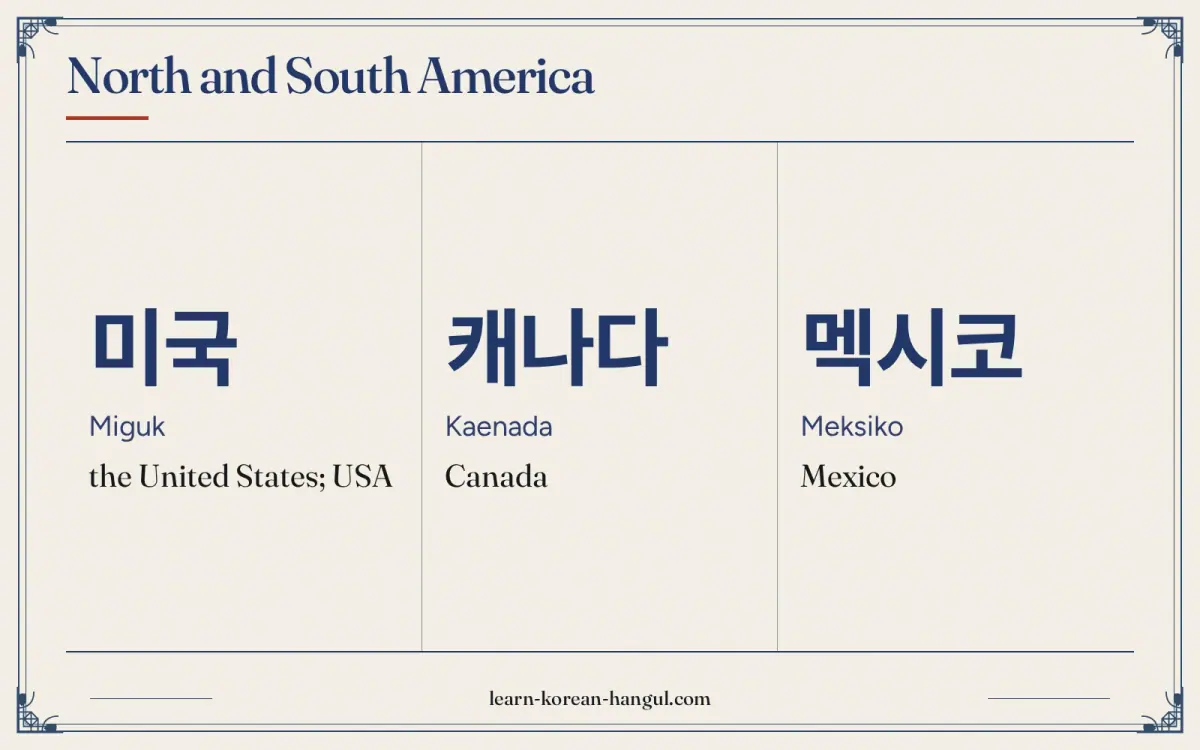
The Americas have ten names. The United States is the only Sino-Korean one, and 미국 is a very common word in the news. The other names are loanwords from Spanish, Portuguese or English. The word 남미 (South America) is short for 남아메리카.
| No. | Hangul | Revised Romanization | Meaning | Origin | Example sentence | Audio assetId |
|---|---|---|---|---|---|---|
| 29 | 미국 | Miguk | the United States; USA | Sino-Korean | 미국에서 영어를 써요. (Migugeseo yeongeoreul sseoyo; They use English in the USA.) | au-pg-vocabulary-nature-geography-29; example: au-pg-vocabulary-nature-geography-129 |
| 30 | 캐나다 | Kaenada | Canada | loanword | 캐나다는 겨울에 눈이 많이 와요. (Kaenadaneun gyeoure nuni mani wayo; It snows a lot in Canada in winter.) | au-pg-vocabulary-nature-geography-30; example: au-pg-vocabulary-nature-geography-130 |
| 31 | 멕시코 | Meksiko | Mexico | loanword | 멕시코 음식을 좋아해요. (Meksiko eumsigeul joahaeyo; I like Mexican food.) | au-pg-vocabulary-nature-geography-31; example: au-pg-vocabulary-nature-geography-131 |
| 32 | 브라질 | Beurajil | Brazil | loanword | 브라질은 축구로 유명해요. (Beurajireun chukguro yumyeonghaeyo; Brazil is famous for football.) | au-pg-vocabulary-nature-geography-32; example: au-pg-vocabulary-nature-geography-132 |
| 33 | 아르헨티나 | Areuhentina | Argentina | loanword | 아르헨티나는 남미에 있어요. (Areuhentinaneun nammie isseoyo; Argentina is in South America.) | au-pg-vocabulary-nature-geography-33; example: au-pg-vocabulary-nature-geography-133 |
| 34 | 칠레 | Chille | Chile | loanword | 칠레는 남북으로 길어요. (Chilleneun nambugeuro gireoyo; Chile is long from north to south.) | au-pg-vocabulary-nature-geography-34; example: au-pg-vocabulary-nature-geography-134 |
| 35 | 페루 | Peru | Peru | loanword | 페루에 마추픽추가 있어요. (Perue machupikchuga isseoyo; Machu Picchu is in Peru.) | au-pg-vocabulary-nature-geography-35; example: au-pg-vocabulary-nature-geography-135 |
| 36 | 콜롬비아 | Kollombia | Colombia | loanword | 콜롬비아 커피가 유명해요. (Kollombia keopiga yumyeonghaeyo; Colombian coffee is famous.) | au-pg-vocabulary-nature-geography-36; example: au-pg-vocabulary-nature-geography-136 |
| 37 | 쿠바 | Kuba | Cuba | loanword | 쿠바는 섬이에요. (Kubaneun seomieyo; Cuba is an island.) | au-pg-vocabulary-nature-geography-37; example: au-pg-vocabulary-nature-geography-137 |
| 38 | 베네수엘라 | Benesuella | Venezuela | loanword | 베네수엘라에서 온 친구를 만났어요. (Benesuellaeseo on chingureul mannasseoyo; I met a friend from Venezuela.) | au-pg-vocabulary-nature-geography-38; example: au-pg-vocabulary-nature-geography-138 |
- 미국 is a short name for the United States, and a very common word in the news and on signs.
- 캐나다 starts with a puff of air, because ㅋ is an aspirated consonant.
- 남미 means South America. Its counterpart 북미 means North America.
How Do You Say Africa and the Middle East in Korean?
The last group has twelve names from Africa and the Middle East. The region name 중동 means Middle East, and 아프리카 means Africa. Almost all names are loanwords, and 남아프리카공화국 is the longest name on the page.
| No. | Hangul | Revised Romanization | Meaning | Origin | Example sentence | Audio assetId |
|---|---|---|---|---|---|---|
| 39 | 이집트 | Ijipteu | Egypt | loanword | 이집트에 피라미드가 있어요. (Ijipteue piramideuga isseoyo; There are pyramids in Egypt.) | au-pg-vocabulary-nature-geography-39; example: au-pg-vocabulary-nature-geography-139 |
| 40 | 남아프리카공화국 | Namapeurikagonghwaguk | South Africa | mixed | 남아프리카공화국은 아프리카 남쪽에 있어요. (Namapeurikagonghwagugeun apeurika namjjoge isseoyo; South Africa is in the south of Africa.) | au-pg-vocabulary-nature-geography-40; example: au-pg-vocabulary-nature-geography-140 |
| 41 | 케냐 | Kenya | Kenya | loanword | 케냐에서 사자를 봤어요. (Kenyaeseo sajareul bwasseoyo; I saw lions in Kenya.) | au-pg-vocabulary-nature-geography-41; example: au-pg-vocabulary-nature-geography-141 |
| 42 | 에티오피아 | Etiopia | Ethiopia | loanword | 에티오피아 커피가 맛있어요. (Etiopia keopiga masisseoyo; Ethiopian coffee is tasty.) | au-pg-vocabulary-nature-geography-42; example: au-pg-vocabulary-nature-geography-142 |
| 43 | 모로코 | Moroko | Morocco | loanword | 모로코는 아프리카 북쪽에 있어요. (Morokoneun apeurika bukjjoge isseoyo; Morocco is in the north of Africa.) | au-pg-vocabulary-nature-geography-43; example: au-pg-vocabulary-nature-geography-143 |
| 44 | 나이지리아 | Naijiria | Nigeria | loanword | 나이지리아는 인구가 많아요. (Naijirianeun inguga manayo; Nigeria has a large population.) | au-pg-vocabulary-nature-geography-44; example: au-pg-vocabulary-nature-geography-144 |
| 45 | 이란 | Iran | Iran | loanword | 이란은 중동에 있어요. (Iraneun jungdonge isseoyo; Iran is in the Middle East.) | au-pg-vocabulary-nature-geography-45; example: au-pg-vocabulary-nature-geography-145 |
| 46 | 이라크 | Irakeu | Iraq | loanword | 이라크는 이란 옆에 있어요. (Irakeuneun Iran yeope isseoyo; Iraq is next to Iran.) | au-pg-vocabulary-nature-geography-46; example: au-pg-vocabulary-nature-geography-146 |
| 47 | 이스라엘 | Iseurael | Israel | loanword | 이스라엘에서 왔어요. (Iseuraereseo wasseoyo; I came from Israel.) | au-pg-vocabulary-nature-geography-47; example: au-pg-vocabulary-nature-geography-147 |
| 48 | 사우디아라비아 | Saudiarabia | Saudi Arabia | loanword | 사우디아라비아는 사막이 많아요. (Saudiarabianeun samagi manayo; Saudi Arabia has a lot of desert.) | au-pg-vocabulary-nature-geography-48; example: au-pg-vocabulary-nature-geography-148 |
| 49 | 튀르키예 | Twireukiye | Türkiye (Turkey) | loanword | 튀르키예는 아시아와 유럽에 걸쳐 있어요. (Twireukiyeneun asiawa yureobe geolchyeo isseoyo; Türkiye spans Asia and Europe.) | au-pg-vocabulary-nature-geography-49; example: au-pg-vocabulary-nature-geography-149 |
| 50 | 아랍에미리트 | Arabemiriteu | the United Arab Emirates | loanword | 아랍에미리트는 아주 더워요. (Arabemiriteuneun aju deowoyo; The United Arab Emirates is very hot.) | au-pg-vocabulary-nature-geography-50; example: au-pg-vocabulary-nature-geography-150 |
- Long names are usually written as one word: 남아프리카공화국. The spaced form 남아프리카 공화국 also appears.
- 튀르키예 is the current Korean name for Türkiye. The older 터키 is still widely understood, and you may see both.
- 중동 (Middle East) is a Sino-Korean word made of 중 (middle) and 동 (east).
Where Are You from? Sentences with Country Names
The most useful sentences about countries answer the question "Where are you from?". The question is 어느 나라에서 왔어요? (eoneu naraeseo wasseoyo; Which country are you from?). The word 나라 (nara) means country. The answer has two common forms:
| Sentence | Revised Romanization | Meaning | Audio assetId |
|---|---|---|---|
| 어느 나라에서 왔어요? | eoneu naraeseo wasseoyo | Which country are you from? | au-pg-vocabulary-nature-geography-601 |
| 저는 호주에서 왔어요. | jeoneun Hojueseo wasseoyo | I am from Australia. | au-pg-vocabulary-nature-geography-602 |
| 저는 미국 사람이에요. | jeoneun Miguk saramieyo | I am an American. | au-pg-vocabulary-nature-geography-603 |
In the first answer, the country takes 에서 (from) before 왔어요 (came). In the second answer, the country comes before 사람 (person) and 이에요 (to be). Replace the country with any name from this list. More self-introduction sentences are on the introducing yourself page.
Country Names That Differ from English
Most country names are loanwords, so they sound like the English name: 캐나다 (Canada), 브라질 (Brazil), 멕시코 (Mexico). A few are different, and they are worth learning one by one.
| English name | Korean name | Revised Romanization | Why it differs |
|---|---|---|---|
| Germany | 독일 | Dogil | based on the Chinese-character name, not on the English sound |
| Australia | 호주 | Hoju | based on a Chinese-character name; 오스트레일리아 is the formal name |
| the United Kingdom | 영국 | Yeongguk | based on a Chinese-character name |
| the United States | 미국 | Miguk | based on a Chinese-character name |
| Türkiye (Turkey) | 튀르키예 | Twireukiye | the name used officially in Korea since 2022; 터키 is the older form |
The Sino-Korean names (독일, 호주, 영국, 미국) are short, two syllables each. The newer names, such as 튀르키예, are loanwords.
The Names of Korea: 한국, 대한민국, 남한 and 북한
Korea has several names, and the choice depends on the speaker and the topic.
- 한국 (Hanguk) is the everyday name for South Korea, and the word Koreans use for their own country.
- 대한민국 (Daehanminguk) is the formal name, used in official documents, the anthem and at sports events.
- 남한 (Namhan) means South Korea and is used when you compare it with the North.
- 북한 (Bukhan) is the usual name for North Korea in South Korea.
Use 한국 in daily talk. When a person says 한국 사람, they usually mean a person from South Korea. For the language, 한국어 is the standard word, and for the food, 한국 음식 is the usual name.
Country-Name Patterns and Sound Changes
Country names are the base for two more families of words. A language takes 어 (language) after the country: 한국 + 어 = 한국어 (the Korean language). A person takes 인 (person) or 사람 (person) after the country: 한국 + 인 = 한국인, and 한국 + 사람 = 한국 사람. The 인 form is formal and written, and the 사람 form is the one you say in daily talk.
| Country | Language | Nationality (formal) | Person (everyday) |
|---|---|---|---|
| 한국 (Hanguk) | 한국어 (hangugeo) | 한국인 (hangugin) | 한국 사람 (Hanguk saram) |
| 일본 (Ilbon) | 일본어 (ilboneo) | 일본인 (ilbonin) | 일본 사람 (Ilbon saram) |
| 중국 (Jungguk) | 중국어 (junggugeo) | 중국인 (junggugin) | 중국 사람 (Jungguk saram) |
| 프랑스 (Peurangseu) | 프랑스어 (peurangseueo) | 프랑스인 (peurangseuin) | 프랑스 사람 (Peurangseu saram) |
| 독일 (Dogil) | 독일어 (dogireo) | 독일인 (dogirin) | 독일 사람 (Dogil saram) |
| 이탈리아 (Itallia) | 이탈리아어 (italliaeo) | 이탈리아인 (italliain) | 이탈리아 사람 (Itallia saram) |
| 영국 (Yeongguk) | 영어 (yeongeo) | 영국인 (yeonggugin) | 영국 사람 (Yeongguk saram) |
| 미국 (Miguk) | 영어 (yeongeo) | 미국인 (migugin) | 미국 사람 (Miguk saram) |
Two rows break the pattern. The language of the UK and the USA is called 영어 (English), not 영국어 or 미국어, because 영 stands for England. In the same way, people in Mexico speak 스페인어 (Spanish) and people in Brazil speak 포르투갈어 (Portuguese), not 멕시코어 or 브라질어. The full list of languages and nationalities is on the Korean Nationalities and Languages page.
Country names that come from other languages have a few sound patterns that Korean speakers use to fit them into the language.
- A final -a is written with the vowel ㅏ: 캐나다, 쿠바, 케냐.
- The ending -ia is written 이아: 인도네시아, 에티오피아, 콜롬비아.
- The English k sound at the start of a word is written with the aspirated ㅋ: 캐나다 and 쿠바 both start with ㅋ.
- A consonant with no vowel after it gets the vowel ㅡ: France becomes 프랑스, and the -re of Singapore becomes 르 in 싱가포르.
- Long names are usually written as one word: 남아프리카공화국 and 아랍에미리트.
You can often guess the Korean name of a country by sounding out the English name with Korean syllables. Then check the spelling, because a few names have their own forms.
How Do You Pronounce These Words?
Country names have long loanword forms and a few sound changes. The table lists five words, following the Standard Pronunciation rules (표준 발음법) of the 국립국어원.
| Word | Romanization | Said | Rule |
|---|---|---|---|
| 한국 | Hanguk | [한국] | the final ㄱ of 국 is held short and not released |
| 독일 | Dogil | [도길] | the final ㄱ of 독 moves to the next syllable |
| 필리핀 | Pillipin | [필리핀] | ㄹ at the end of 필 and ㄹ at the start of 리 are both pronounced as ll |
| 캐나다 | Kaenada | [캐나다] | ㅋ is aspirated: say it with a puff of air |
| 튀르키예 | Twireukiye | [튀르키예] | the vowel ㅟ is said as wi, and the ending is ye |
Revised Romanization is the official romanization system of South Korea, announced on 7 July 2000. It follows most sound changes, such as linking and nasalization, and it spells the written double letters (ㄲ as kk), but it does not show tensing caused by a neighbouring sound: 축구 is said [축꾸] but written chukgu. It is a learning aid, so always read the Hangul as well.
Audio and Slow Playback
Each headword and each example sentence has its own audio clip, and the five words in the learn-first section also have a slow clip at 0.8 times the speed. Nothing plays until you press a button. Listen once, repeat aloud, and only then check the romanization.
What Mistakes Do Learners Make with Country Names?
- Saying 독일 as a copy of the English name. The Korean name is 독일, from a Chinese-character name.
- Using 영국어 or 미국어 for the language. The language is 영어.
- Using 한국 for the whole peninsula without thinking. 한국 usually means South Korea, and 북한 is North Korea.
- Forgetting the aspirated start of 캐나다. The first sound is ㅋ, not ㄱ.
- Reading 한국어 syllable by syllable. The ㄱ links to the next vowel, [한구거], and Revised Romanization shows the same linking: hangugeo.
Practice: Flashcards and Worksheet
Drill these 50 words with the vocabulary flashcard decks: each card shows the Hangul on one side and the meaning on the other, so you can test recall instead of recognition. Print a labelling sheet from the vocabulary worksheets and write the Korean name for each numbered country in the scene above. A simple plan is to learn eight names a day, one region at a time.
Korean Countries Worksheet
Try this five-question check, then say the words aloud once more.
Practice · 5
What does 한국 mean?
Show answer
Korea; South Korea
한국 (Hanguk) means Korea; South Korea.
What does 싱가포르 mean?
Show answer
Singapore
싱가포르 (Singgaporeu) means Singapore.
What does 네덜란드 mean?
Show answer
the Netherlands
네덜란드 (Nedeollandeu) means the Netherlands.
What does 멕시코 mean?
Show answer
Mexico
멕시코 (Meksiko) means Mexico.
What does 케냐 mean?
Show answer
Kenya
케냐 (Kenya) means Kenya.
Self-Test: 10 Sentences
Fill each blank with a word from this page. Say the whole sentence aloud when you have it. The answers follow the test.
- ___은 한국의 북쪽에 있어요. (North Korea is north of South Korea.)
- ___에는 넓은 초원이 있어요. (Mongolia has wide grasslands.)
- ___는 작은 나라예요. (Singapore is a small country.)
- ___ 빵이 맛있어요. (French bread is tasty.)
- ___는 자전거가 많아요. (The Netherlands has many bicycles.)
- ___는 추워요. (Norway is cold.)
- ___ 음식을 좋아해요. (I like Mexican food.)
- ___ 커피가 유명해요. (Colombian coffee is famous.)
- ___에서 사자를 봤어요. (I saw lions in Kenya.)
- ___는 이란 옆에 있어요. (Iraq is next to Iran.)
Answers: 1. 북한; 2. 몽골; 3. 싱가포르; 4. 프랑스; 5. 네덜란드; 6. 노르웨이; 7. 멕시코; 8. 콜롬비아; 9. 케냐; 10. 이라크.
A score of 8 or more suggests the words are settling in. If you scored lower, reread the groups where you missed words.
Where to Go Next
After countries, many learners move on to Korean Nationalities and Languages and Korean Cities Vocabulary. For the living side of nature, the next topic is Plants and Flowers. This list sits inside Nature and the World.
Pages in This Section
Seven pages sit below Geography and Countries. Each one expands a part of the topic with more words and more notes.
- Korean Nationalities and Languages: 35 words for nationalities with 사람 and 인, language names with 어, the continents and the where-are-you-from exchange. Level A1.
- Korean Cities Vocabulary: 25 words for Seoul, the large cities, tourist islands and Seoul districts, with the -시, -구 and -동 address suffixes. Level A1.
- Korean Provinces Vocabulary: nine provinces with short forms and dialect names.
- Korean Landscape Words: 40 words for mountains, rivers, the sea, the sky and fields, with place-name suffixes. Level A1.
- Korean Mountains and Hiking Vocabulary: hiking boots, trails, summits and mountain signs.
- Korean Ocean and Beach Vocabulary: 30 words in five groups, from 바다 and 해변 to tides, beach gear, seafood stalls and Korea's three seas. Level A1.
- Korean Space and Planets Vocabulary: planets, moon, stars and space travel.
Frequently Asked Questions
How Do You Say Australia in Korean?
Say 호주 (Hoju). It is a two-syllable Sino-Korean name, and it is the everyday word. The formal name 오스트레일리아 (Oseuteureillia) is longer and appears mainly in formal writing. For the full list of countries, see the table above.
How Do You Pronounce 캐나다 (kaenada)?
Say kae-na-da. The first sound is an aspirated ㅋ, so push out a small puff of air. The vowel ㅐ is said like the e in "bed". The second and third syllables are plain, and the stress is even. Press the audio button on this page to hear it.
How Many Country Names Should I Learn First?
Learn the five starter words, 한국, 미국, 일본, 중국 and 호주, then add one region at a time. Eight new names a day with a short review of the older ones is a steady pace, and the whole list takes about a week.
Where Can I Practise Country Names with Flashcards?
Use the vocabulary flashcard decks. Start with Asia and Oceania, then add Europe and the Americas. Review the older cards before you add new ones, so the earlier words do not fade.
Is the Romanization on This Page Official?
Yes, as a learning aid. It follows the Revised Romanization of Korean, the system South Korea has officially used since 7 July 2000, and the page also gives the Hangul for every word. It follows most sound changes but does not show tensing: 축구 is written chukgu but is said [축꾸]. Treat the Hangul as the real spelling.
Is There a Printable Worksheet for Country Names?
The vocabulary worksheets page lists the printable sheets. The sheet for this topic is a labelling task built on the same illustrated scene as this page, so you write the Korean name next to each numbered country.