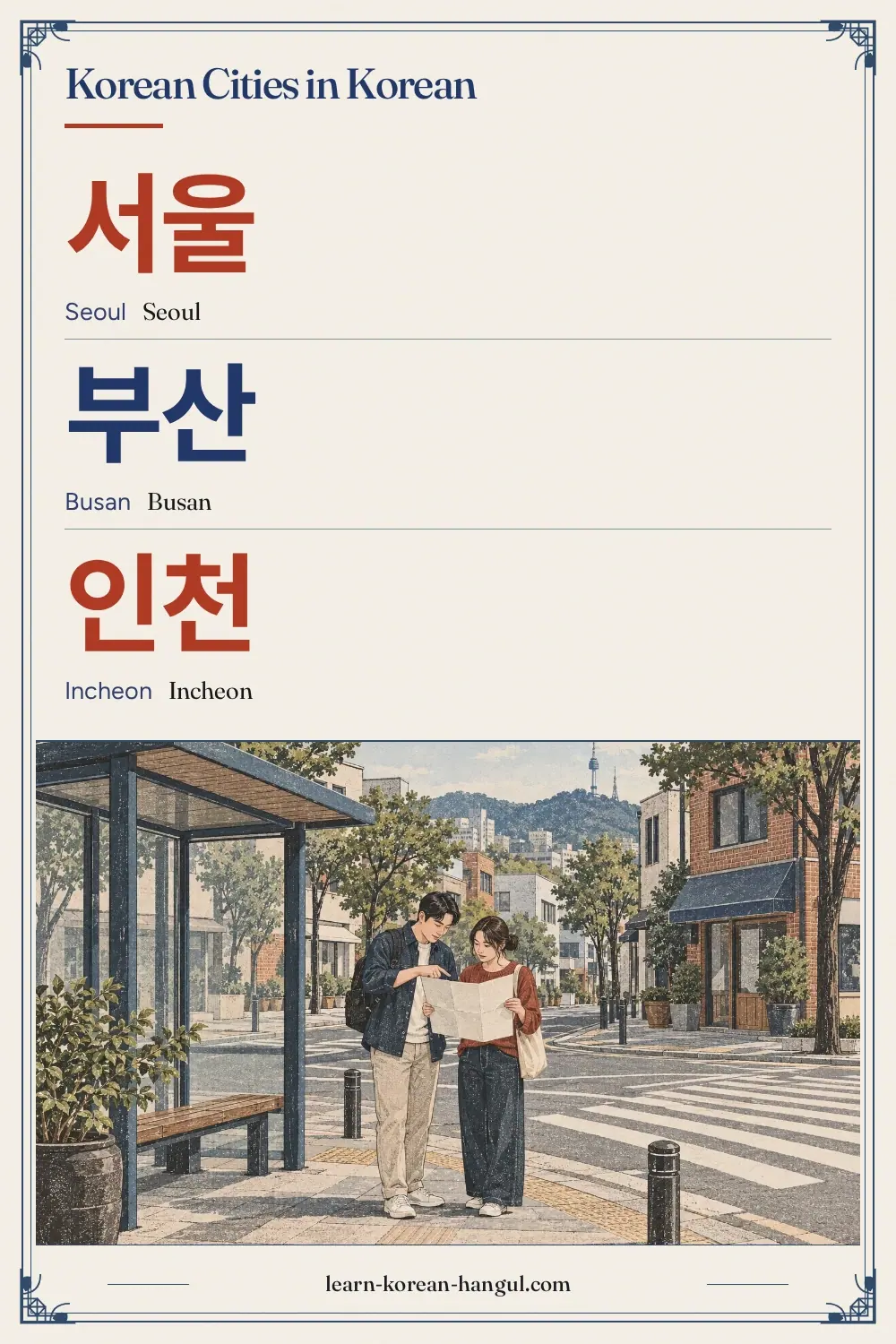
Korean Cities in Korean at a Glance
City names are some of the most useful words for travel, directions and talk about where people live. Most are Sino-Korean names of two syllables, such as 부산, 대구 and 인천. The one exception is 서울, which is a native Korean word that means capital.
The list is arranged by what a visitor meets: the capital and its region first, then the major cities, then the tourist islands, then the districts of Seoul, and last a few regional cities. Every name is shown in Hangul, with the official spelling in Revised Romanization.
The list holds 25 words. By origin, the list has 1 native and 24 Sino-Korean words. Nearly all the names are Sino-Korean, which means each syllable can be written with a Chinese character.
| Group | Words | Examples |
|---|---|---|
| Capital and metropolitan areas | 6 | 서울, 수도권, 인천, 수원 |
| Major cities | 7 | 부산, 대구, 대전, 광주 |
| Tourist islands | 3 | 제주도, 울릉도, 강화도 |
| Districts of Seoul | 6 | 강남, 홍대, 명동, 이태원 |
| Regional city names | 3 | 전주, 경주, 강릉 |
This page expands the cities part of Geography and Countries. The provinces are on Korean Provinces Vocabulary, and the people and languages are on Korean Nationalities and Languages.
Which Korean City Names Should You Learn First?
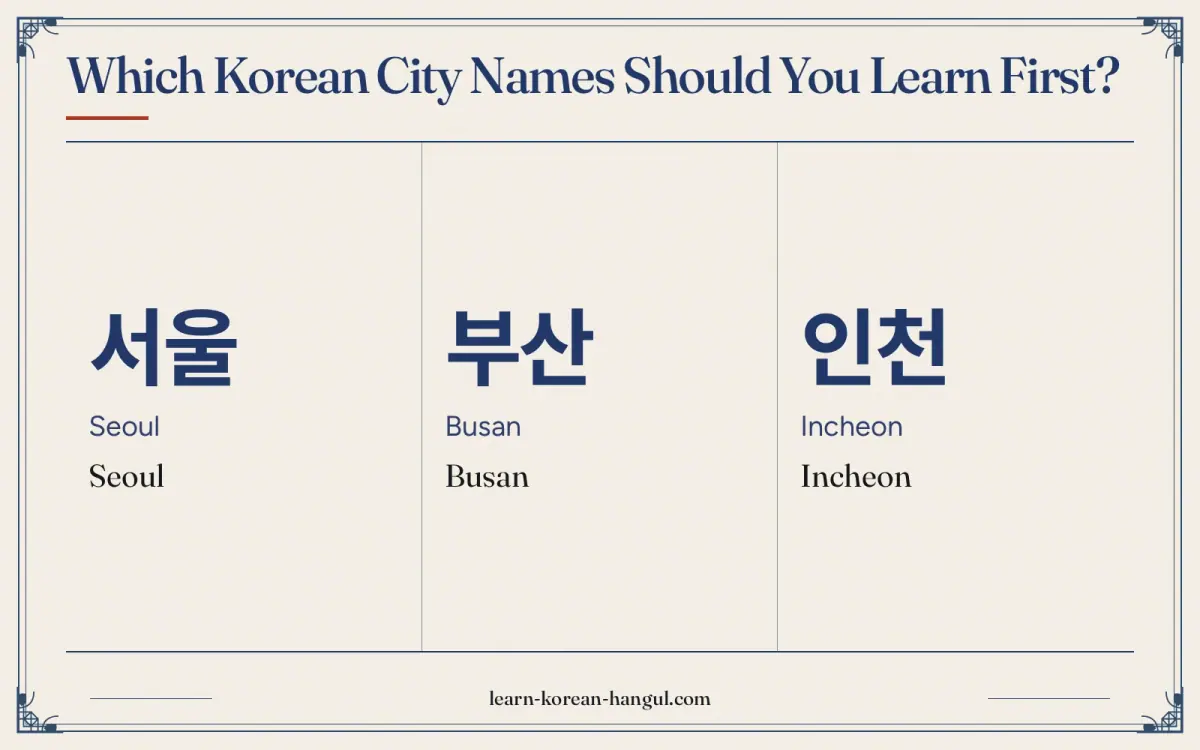
Start with five places that appear in nearly every trip plan: 서울, 부산, 인천, 대구 and 제주도. Use the scene to see eight places at once, then press play and the slow button on each of the five and say the name aloud.
Word · 8
- 1
서울
Seoul
Seoul
- 2
부산
Busan
Busan
- 3
인천
Incheon
Incheon
- 4
대구
Daegu
Daegu
- 5
대전
Daejeon
Daejeon
- 6
광주
Gwangju
Gwangju
- 7
울산
Ulsan
Ulsan
- 8
제주도
Jejudo
Jeju Island
서울 (Seoul) is the Korean name for Seoul. The name is a native Korean word, not a Sino-Korean one, and it means capital. Example: 서울은 한국의 수도예요. (Seoul is the capital of Korea.)
부산 (Busan) is the Korean name for Busan. The first syllable has a plain b and the second ends in ㄴ: bu-san. Example: 부산은 바다로 유명해요. (Busan is famous for its sea.)
인천 (Incheon) is the Korean name for Incheon. The name has two syllables, in-cheon, and the second one begins with the aspirated ㅊ. Example: 인천에 공항이 있어요. (Incheon has an airport.)
대구 (Daegu) is the Korean name for Daegu. Example: 대구는 여름에 더워요. (Daegu is hot in summer.)
제주도 (Jejudo) is the Korean name for Jeju Island. The ㅈ at the start is plain, and the 도 at the end means island or province. Example: 제주도에 여행 가요. (I travel to Jeju Island.)
Capital and Metropolitan Areas
The capital and the cities around it are home to about half of South Korea's population, so the group matters. It has six names. Seoul is one word, and the other five are Sino-Korean names or the word for the region.
| No. | Hangul | Revised Romanization | Meaning | Origin | Example sentence | Audio assetId |
|---|---|---|---|---|---|---|
| 1 | 서울 | Seoul | Seoul | native | 서울은 한국의 수도예요. (Seoureun hangugui sudoyeyo; Seoul is the capital of Korea.) | au-pg-vocabulary-nature-geography-korean-cities-1; example: au-pg-vocabulary-nature-geography-korean-cities-101 |
| 2 | 수도권 | sudogwon | capital region | Sino-Korean | 수도권에 사람이 많아요. (sudogwone sarami manayo; Many people live in the capital region.) | au-pg-vocabulary-nature-geography-korean-cities-2; example: au-pg-vocabulary-nature-geography-korean-cities-102 |
| 3 | 인천 | Incheon | Incheon | Sino-Korean | 인천에 공항이 있어요. (Incheone gonghangi isseoyo; Incheon has an airport.) | au-pg-vocabulary-nature-geography-korean-cities-3; example: au-pg-vocabulary-nature-geography-korean-cities-103 |
| 4 | 수원 | Suwon | Suwon | Sino-Korean | 수원에서 친구를 만나요. (Suwoneseo chingureul mannayo; I meet a friend in Suwon.) | au-pg-vocabulary-nature-geography-korean-cities-4; example: au-pg-vocabulary-nature-geography-korean-cities-104 |
| 5 | 성남 | Seongnam | Seongnam | Sino-Korean | 성남에 살아요. (Seongname sarayo; I live in Seongnam.) | au-pg-vocabulary-nature-geography-korean-cities-5; example: au-pg-vocabulary-nature-geography-korean-cities-105 |
| 6 | 고양 | Goyang | Goyang | Sino-Korean | 고양은 서울 근처에 있어요. (Goyangeun Seoul geuncheoe isseoyo; Goyang is near Seoul.) | au-pg-vocabulary-nature-geography-korean-cities-6; example: au-pg-vocabulary-nature-geography-korean-cities-106 |
- 서울 is the capital. It has no suffix in speech, even though the formal name is 서울특별시.
- 수도권 is a region, not a city. It covers Seoul, Incheon and Gyeonggi Province.
- 인천, 수원, 성남 and 고양 are cities in the capital region, and they are close to Seoul by subway or train.
Example Sentences
City sentences use city + 에 or 에서 + verb. Use 에 for where something is or where you go: 인천에 공항이 있어요 (Incheon has an airport) and 제주도에 여행 가요 (I travel to Jeju Island). Use 에서 for where an action happens: 강남에서 일해요 (I work in Gangnam) and 홍대에서 공연을 봐요 (I watch a performance in Hongdae). To say where you live, use 에 살아요: 성남에 살아요. To say you are from a city, use 출신: 저는 부산 출신이에요 (I am from Busan).
How Do You Say Major Cities in Korean?
The major cities are the places outside Seoul that everyone knows. The group has seven names. Five of them are metropolitan cities (Incheon, the sixth, is in the first group), 세종 is a special city and 창원 is a large city in the south.
| No. | Hangul | Revised Romanization | Meaning | Origin | Example sentence | Audio assetId |
|---|---|---|---|---|---|---|
| 7 | 부산 | Busan | Busan | Sino-Korean | 부산은 바다로 유명해요. (Busaneun badaro yumyeonghaeyo; Busan is famous for its sea.) | au-pg-vocabulary-nature-geography-korean-cities-7; example: au-pg-vocabulary-nature-geography-korean-cities-107 |
| 8 | 대구 | Daegu | Daegu | Sino-Korean | 대구는 여름에 더워요. (Daeguneun yeoreume deowoyo; Daegu is hot in summer.) | au-pg-vocabulary-nature-geography-korean-cities-8; example: au-pg-vocabulary-nature-geography-korean-cities-108 |
| 9 | 대전 | Daejeon | Daejeon | Sino-Korean | 대전에서 기차를 타요. (Daejeoneseo gichareul tayo; I take a train in Daejeon.) | au-pg-vocabulary-nature-geography-korean-cities-9; example: au-pg-vocabulary-nature-geography-korean-cities-109 |
| 10 | 광주 | Gwangju | Gwangju | Sino-Korean | 광주에 친구가 있어요. (Gwangjue chinguga isseoyo; I have a friend in Gwangju.) | au-pg-vocabulary-nature-geography-korean-cities-10; example: au-pg-vocabulary-nature-geography-korean-cities-110 |
| 11 | 울산 | Ulsan | Ulsan | Sino-Korean | 울산은 공업 도시예요. (Ulsaneun gongeop dosiyeyo; Ulsan is an industrial city.) | au-pg-vocabulary-nature-geography-korean-cities-11; example: au-pg-vocabulary-nature-geography-korean-cities-111 |
| 12 | 세종 | Sejong | Sejong | Sino-Korean | 세종은 행정 도시예요. (Sejongeun haengjeong dosiyeyo; Sejong is an administrative city.) | au-pg-vocabulary-nature-geography-korean-cities-12; example: au-pg-vocabulary-nature-geography-korean-cities-112 |
| 13 | 창원 | Changwon | Changwon | Sino-Korean | 창원에 가 봤어요. (Changwone ga bwasseoyo; I have been to Changwon.) | au-pg-vocabulary-nature-geography-korean-cities-13; example: au-pg-vocabulary-nature-geography-korean-cities-113 |
- 부산 is the second-largest city and a port, so the sea is part of its identity.
- 세종 is a planned administrative city, and it is named after King Sejong, who is linked with the creation of Hangul.
- In a metropolitan city, the long name ends in 광역시: 부산광역시, 대구광역시 and so on.
Tourist Islands
Korea has many islands, and three of them are well known to visitors. The group has three names, and each one ends in 도 (island). The same 도 also appears in province names.
| No. | Hangul | Revised Romanization | Meaning | Origin | Example sentence | Audio assetId |
|---|---|---|---|---|---|---|
| 14 | 제주도 | Jejudo | Jeju Island | Sino-Korean | 제주도에 여행 가요. (Jejudoe yeohaeng gayo; I travel to Jeju Island.) | au-pg-vocabulary-nature-geography-korean-cities-14; example: au-pg-vocabulary-nature-geography-korean-cities-114 |
| 15 | 울릉도 | Ulleungdo | Ulleungdo | Sino-Korean | 울릉도는 동해에 있어요. (Ulleungdoneun donghaee isseoyo; Ulleungdo is in the East Sea.) | au-pg-vocabulary-nature-geography-korean-cities-15; example: au-pg-vocabulary-nature-geography-korean-cities-115 |
| 16 | 강화도 | Ganghwado | Ganghwado | Sino-Korean | 강화도는 인천에 있어요. (Ganghwadoneun Incheone isseoyo; Ganghwado is in Incheon.) | au-pg-vocabulary-nature-geography-korean-cities-16; example: au-pg-vocabulary-nature-geography-korean-cities-116 |
- 제주도 is the largest island in Korea and a popular holiday place. In daily speech people also say 제주. 제주도 is also the name of the province, officially 제주특별자치도.
- 울릉도 lies in the East Sea. 동해 is the Korean name of the East Sea.
- 강화도 is an island west of Seoul, and it belongs to Incheon.
How Do You Say Districts of Seoul in Korean?
Visitors to Seoul rarely say the city only. They name a district. The group has six names. Three of them, 강남, 홍대 and 명동, are known for shopping and nightlife, and 종로 is a historic center. Strictly, only 강남 and 종로 are district (구) names: 명동, 이태원 and 잠실 are neighborhoods (동), and 홍대 is the area around Hongik University.
| No. | Hangul | Revised Romanization | Meaning | Origin | Example sentence | Audio assetId |
|---|---|---|---|---|---|---|
| 17 | 강남 | Gangnam | Gangnam | Sino-Korean | 강남에서 일해요. (Gangnameseo ilhaeyo; I work in Gangnam.) | au-pg-vocabulary-nature-geography-korean-cities-17; example: au-pg-vocabulary-nature-geography-korean-cities-117 |
| 18 | 홍대 | Hongdae | Hongdae | Sino-Korean | 홍대에서 공연을 봐요. (Hongdaeeseo gongyeoneul bwayo; I watch a performance in Hongdae.) | au-pg-vocabulary-nature-geography-korean-cities-18; example: au-pg-vocabulary-nature-geography-korean-cities-118 |
| 19 | 명동 | Myeongdong | Myeongdong | Sino-Korean | 명동에서 쇼핑해요. (Myeongdongeseo syopinghaeyo; I go shopping in Myeongdong.) | au-pg-vocabulary-nature-geography-korean-cities-19; example: au-pg-vocabulary-nature-geography-korean-cities-119 |
| 20 | 이태원 | Itaewon | Itaewon | Sino-Korean | 이태원에서 외국 음식을 먹어요. (Itaewoneseo oeguk eumsigeul meogeoyo; I eat foreign food in Itaewon.) | au-pg-vocabulary-nature-geography-korean-cities-20; example: au-pg-vocabulary-nature-geography-korean-cities-120 |
| 21 | 종로 | Jongno | Jongno | Sino-Korean | 종로에 궁이 있어요. (Jongnoe gungi isseoyo; There are palaces in Jongno.) | au-pg-vocabulary-nature-geography-korean-cities-21; example: au-pg-vocabulary-nature-geography-korean-cities-121 |
| 22 | 잠실 | Jamsil | Jamsil | Sino-Korean | 잠실에 롯데월드가 있어요. (Jamsire rotdewoldeuga isseoyo; Lotte World is in Jamsil.) | au-pg-vocabulary-nature-geography-korean-cities-22; example: au-pg-vocabulary-nature-geography-korean-cities-122 |
- 강남 means south of the river, because it lies south of the Han River (한강).
- 명동 and 홍대 are shopping and street areas, and 이태원 is known for foreign food.
- 종로 is read jongno, because the ㄹ is said as ㄴ after the ng sound.
Regional City Names
The last group has three regional cities that visitors often choose for a trip. They are famous for food, history and the sea.
| No. | Hangul | Revised Romanization | Meaning | Origin | Example sentence | Audio assetId |
|---|---|---|---|---|---|---|
| 23 | 전주 | Jeonju | Jeonju | Sino-Korean | 전주 비빔밥이 유명해요. (Jeonju bibimbabi yumyeonghaeyo; Jeonju bibimbap is famous.) | au-pg-vocabulary-nature-geography-korean-cities-23; example: au-pg-vocabulary-nature-geography-korean-cities-123 |
| 24 | 경주 | Gyeongju | Gyeongju | Sino-Korean | 경주는 옛 도시예요. (Gyeongjuneun yet dosiyeyo; Gyeongju is an old city.) | au-pg-vocabulary-nature-geography-korean-cities-24; example: au-pg-vocabulary-nature-geography-korean-cities-124 |
| 25 | 강릉 | Gangneung | Gangneung | Sino-Korean | 강릉에 바다가 있어요. (Gangneunge badaga isseoyo; Gangneung is by the sea.) | au-pg-vocabulary-nature-geography-korean-cities-25; example: au-pg-vocabulary-nature-geography-korean-cities-125 |
- 전주 is known for its food, and the dish 비빔밥 (bibimbap) is linked with the city.
- 경주 was the capital of the Silla kingdom, so it has many old sites.
- 강릉 is on the east coast, and it is known for its beaches.
Place-Name Suffixes: -시, -구, -동 and -도
Korean place names carry a short suffix that tells you the size of the place. The suffix comes after the name and has no space: 서울 + 시 = 서울시 (Seoul City). The suffixes you see most often are listed here.
| Suffix | Meaning | Examples |
|---|---|---|
| 시 (si) | city | 서울시, 부산시, 수원시 |
| 구 (gu) | district of a large city | 강남구, 종로구 |
| 동 (dong) | neighborhood | 역삼동, 명동 |
| 도 (do) | province or island | 제주도, 강화도 |
| 군 (gun) | county | 울릉군 |
An address in Korea goes from the largest unit to the smallest, which is the reverse of an English address. For example, 서울특별시 강남구 역삼동 means Seoul Special City, Gangnam District, Yeoksam Neighborhood. In speech, people usually drop the suffix and say the name only: 강남, 명동, 홍대.
- 서울시 강남구에 살아요. (seoulsi gangnamgue sarayo; I live in Gangnam District, Seoul.) Audio: au-pg-vocabulary-nature-geography-korean-cities-601.
- 부산시는 바다 옆에 있어요. (busansineun bada yeope isseoyo; Busan City is next to the sea.) Audio: au-pg-vocabulary-nature-geography-korean-cities-602.
In Revised Romanization an administrative unit is joined to the name with a hyphen, as in Gangnam-gu and Jeju-do (the province), while the island keeps one word, Jejudo. The same suffixes appear in the Korean Provinces Vocabulary list.
Official City Types
Korean cities have different administrative levels, and the official names show it.
| Place | Official type | Revised Romanization |
|---|---|---|
| 서울특별시 | Special City | Seoul-teukbyeolsi |
| 부산광역시, 대구광역시, 인천광역시 | Metropolitan City | Busan-gwangyeoksi, Daegu-gwangyeoksi, Incheon-gwangyeoksi |
| 광주광역시, 대전광역시, 울산광역시 | Metropolitan City | Gwangju-gwangyeoksi, Daejeon-gwangyeoksi, Ulsan-gwangyeoksi |
| 세종특별자치시 | Special Self-Governing City | Sejong-teukbyeoljachisi |
| 제주특별자치도 | Special Self-Governing Province | Jeju-teukbyeoljachido |
In speech people drop the long ending and say 부산, 대구 or 제주도. The long forms appear on maps, documents and bus signs. The word 광역시 (metropolitan city) is useful because it tells you that a city is one of the six metropolitan cities. The word 수도권 (capital region) is a different idea: it names the area around Seoul, which includes Seoul, Incheon and Gyeonggi Province, and it is not an administrative city.
Older Spellings: Pusan, Taegu and Cheju
You may see older English spellings on old maps, books and some company names. They come from the McCune-Reischauer system, which South Korea used officially until 2000. Since 7 July 2000 the official system is the Revised Romanization of Korean, and road signs, maps and textbooks use it.
| Older spelling | Current spelling | Hangul |
|---|---|---|
| Pusan | Busan | 부산 |
| Taegu | Daegu | 대구 |
| Taejon | Daejeon | 대전 |
| Kwangju | Gwangju | 광주 |
| Cheju | Jeju | 제주 |
The Hangul has stayed the same, so the Hangul is the safest way to check a name. The page on romanization explains the system and its rules. A few older spellings are still used by people and companies, so both forms can appear side by side.
How Do You Pronounce These Words?
City names have a few sound changes. The table lists five words, following the Standard Pronunciation rules (표준 발음법) of the 국립국어원.
| Word | Romanization | Said | Rule |
|---|---|---|---|
| 종로 | Jongno | [종노] | ㄹ after ㅇ is said as ㄴ |
| 강릉 | Gangneung | [강능] | ㄹ after ㅇ is said as ㄴ |
| 인천 | Incheon | [인천] | ㅊ is aspirated: say it with a puff of air |
| 대전 | Daejeon | [대전] | the first syllable has the vowel ㅐ, said like the e in "bed" |
| 부산 | Busan | [부산] | a plain b at the start and a final ㄴ |
Revised Romanization is the official romanization system of South Korea, announced on 7 July 2000. It follows most sound changes, such as linking and nasalization, and it spells the written double letters (ㄲ as kk), but it does not show tensing caused by a neighbouring sound: 광역시 is said [광역씨] but written gwangyeoksi. It is a learning aid, so always read the Hangul as well.
Audio and Slow Playback
Each headword and each example sentence has its own audio clip, and the five words in the learn-first section also have a slow clip at 0.8 times the speed. Nothing plays until you press a button. Listen once, repeat aloud, and only then check the romanization.
What Mistakes Do Learners Make with Korean City Names?
- Reading 종로 as jong-ro. The ㄹ becomes ㄴ after the ng sound, so say jong-no.
- Using an older spelling such as Pusan when you ask for tickets. Signs and tickets use Busan.
- Adding 시 to every city. In speech people say 부산 and 대구, not 부산시 and 대구시, unless they want the formal name.
- Mixing up 광주 (Gwangju) and 경주 (Gyeongju). The names look alike, so check the first syllable.
- Expecting the romanization to show every sound. 광역시 is said [광역씨], but Revised Romanization writes gwangyeoksi.
Practice: Flashcards and Worksheet
Drill these 25 words with the vocabulary flashcard decks: each card shows the Hangul on one side and the meaning on the other, so you can test recall instead of recognition. Print a labelling sheet from the vocabulary worksheets and write the Korean name for each numbered place in the scene above. A simple plan is to learn five names a day, one group at a time.
Korean Cities Worksheet
Try this five-question check, then say the words aloud once more.
Practice · 5
What does 서울 mean?
Show answer
Seoul
서울 (Seoul) means Seoul.
What does 고양 mean?
Show answer
Goyang
고양 (Goyang) means Goyang.
What does 울산 mean?
Show answer
Ulsan
울산 (Ulsan) means Ulsan.
What does 강화도 mean?
Show answer
Ganghwado
강화도 (Ganghwado) means Ganghwado.
What does 종로 mean?
Show answer
Jongno
종로 (Jongno) means Jongno.
Self-Test: 10 Sentences
Fill each blank with a word from this page. Say the whole sentence aloud when you have it. The answers follow the test.
- ___은 한국의 수도예요. (Seoul is the capital of Korea.)
- ___에 공항이 있어요. (Incheon has an airport.)
- ___은 서울 근처에 있어요. (Goyang is near Seoul.)
- ___는 여름에 더워요. (Daegu is hot in summer.)
- ___은 공업 도시예요. (Ulsan is an industrial city.)
- ___에 가 봤어요. (I have been to Changwon.)
- ___는 인천에 있어요. (Ganghwado is in Incheon.)
- ___에서 공연을 봐요. (I watch a performance in Hongdae.)
- ___에 궁이 있어요. (There are palaces in Jongno.)
- ___ 비빔밥이 유명해요. (Jeonju bibimbap is famous.)
Answers: 1. 서울; 2. 인천; 3. 고양; 4. 대구; 5. 울산; 6. 창원; 7. 강화도; 8. 홍대; 9. 종로; 10. 전주.
A score of 8 or more suggests the words are settling in. If you scored lower, reread the groups where you missed words.
Where to Go Next
After cities, many learners move on to Korean Provinces Vocabulary and Korean Landscape Words. This list sits inside Geography and Countries.
Related pages:
- seoul in korean: a single-word entry with pronunciation notes, usage and more example sentences.
- busan in korean: a single-word entry with pronunciation notes, usage and more example sentences.
Frequently Asked Questions
How Do You Say Seoul in Korean?
Say 서울 (seoul). It has two syllables, seo-ul, and the first vowel ㅓ is said with the mouth open and the lips relaxed. The word is a native Korean word that means capital. For a full word entry, see seoul in korean.
How Do You Pronounce 부산 (busan)?
Say bu-san. The first syllable starts with a plain b and has the rounded vowel ㅜ, and the second syllable ends in ㄴ. Both syllables have the same weight. For a full word entry, see busan in korean.
How Many Korean City Names Should I Learn First?
Learn the five starter words, 서울, 부산, 인천, 대구 and 제주도, then add one group at a time. Five new names a day with a short review of the older ones is a steady pace, and the whole list takes about five days.
Where Can I Practise Korean City Names with Flashcards?
Use the vocabulary flashcard decks. Start with the capital and the major cities, then add the islands and the districts. Review the older cards before you add new ones, so the earlier words do not fade.
Is the Romanization on This Page Official?
Yes, as a learning aid. It follows the Revised Romanization of Korean, the system South Korea has officially used since 7 July 2000, and the page also gives the Hangul for every word. Older English spellings such as Pusan come from the McCune-Reischauer system and are no longer official. Treat the Hangul as the real spelling.
Is There a Printable Worksheet for Korean City Names?
The vocabulary worksheets page lists the printable sheets. The sheet for this topic is a labelling task built on the same illustrated scene as this page, so you write the Korean name next to each numbered place.